
EMF Bed Canopy Setup Guide Australia 2026
An EMF bed canopy is a Faraday enclosure made from conductive fabric that shields your sleeping area from external radio-frequency (RF) radiation — but only if installed correctly, grounded properly to Australian earthing standards, and deployed after internal EMF sources have been removed first. According to Building Biology SBM-2015 guidelines, the target for sleeping areas is RF below 0.1 mW/m², and a correctly installed silver-cotton canopy rated at 40-42 dB attenuation can reduce external RF by 99.99% at frequencies from 800 MHz to 8 GHz — turning a bedroom reading of 5-50 mW/m² from a nearby cell tower or smart meter into a reading below 0.005 mW/m².
A silver-cotton EMF bed canopy rated at 40+ dB is the most effective single-product RF shield for your sleeping area — but it is the last step, not the first. The critical mistake most people make is buying a canopy before removing internal RF sources (phones, Wi-Fi routers, DECT cordless phones) from the bedroom. A conductive enclosure around internal sources reflects and amplifies exposure inside the canopy. You must measure, remove sources, then shield residual external RF only. Grounding the canopy to Australian earthing standards (AS/NZS 3000:2018) is mandatory for electric field drainage — an ungrounded canopy can accumulate static charge and redistribute AC electric fields from bedroom wiring.
| Setup Step | What It Does | Verdict |
|---|---|---|
| 1. Remove internal sources | Eliminates reflected/amplified RF inside canopy | Essential — do first |
| 2. Measure with RF meter | Confirms external RF is the actual problem | Essential — validates spend |
| 3. Install + ground canopy | Shields residual external RF + drains AC E-fields | Recommended — silver cotton 42 dB |
Key catches
- A canopy does NOT shield 50 Hz magnetic fields from wiring or appliances — it shields RF and drains AC electric fields only when grounded
- Gaps at the floor or around the mattress create RF leakage paths that can halve effective attenuation
- Australian homes use 50 Hz grid frequency (not 60 Hz like the US) — a demand switch on the bedroom circuit is more effective for ELF electric fields than any canopy
- Grounding to the earth pin of an Australian GPO requires a purpose-built grounding cord and AS/NZS 3000-compliant wiring — do NOT use a random wire to a water pipe
Why the Canopy Is Step Three, Not Step One
Every US-centric EMF canopy guide I have read gets the sequence wrong. They lead with fabric selection and hanging hardware. That is backwards. If you have a Wi-Fi router in the bedroom, a DECT cordless phone on the nightstand, or a phone charging next to your pillow — you do not need a canopy. You need to remove those sources. A canopy deployed over active internal RF sources creates a reflective cavity that bounces radiation between the fabric walls and your body, increasing your exposure rather than reducing it.
As a former Navy Clearance Diver, I approach EMF the same way I approach dive planning: you identify the hazard, you address the hazard at the source, and you use protective equipment only for residual risk you cannot eliminate. The correct sequence for any Australian bedroom is: measure, reduce, then shield.
Here is what that looks like in practice. First, put your phone on airplane mode or move it out of the room entirely. That is free. Second, move your Wi-Fi router to the furthest room in the house or put it on a Jackson 24hr mechanical timer (~$20) so it powers off during sleep hours. Third, remove any DECT cordless phone base station — these transmit at ~1.9 GHz continuously, even when idle. Fourth, measure the bedroom with an RF meter to confirm what residual RF remains. Only then do you decide whether a canopy is justified.
The most common scenario where a canopy is actually needed: your bedroom shares an exterior wall with a Telstra/Ausgrid smart meter (900 MHz mesh), or you live within 100-200 metres of a cell tower or 5G small cell on a street pole. In those cases, external RF penetrates your walls at levels above 1 mW/m² and you cannot eliminate the source. That is when a canopy earns its price tag.
Choosing the Right Canopy Fabric for Australian Conditions
You will see three fabric types marketed for EMF bed canopies: silver-infused cotton, copper mesh, and polyester-silver blends. They are not equal. In Australian conditions — where humidity in Brisbane, Cairns, and coastal NSW regularly exceeds 70% for months at a time — fabric choice determines both shielding performance and lifespan.
Silver-Infused Cotton (Recommended)
Silver-cotton fabric is the standard for high-performance EMF bed canopies. The SaferEMF silver-cotton 42 dB canopy uses a blend of organic cotton woven with pure silver threads. At 42 dB attenuation, this fabric blocks 99.99% of RF radiation across the 800 MHz to 8 GHz range — covering 4G/5G mobile bands, Wi-Fi 2.4 and 5 GHz, smart meters at 900 MHz, and DECT phones at 1.9 GHz. The cotton component makes it breathable. The silver component makes it conductive for grounding and washable (hand wash only, no bleach — chlorine degrades silver threads).
The 42 dB rating is measured per the IEEE 299 / ASTM D4935 shielding effectiveness standard. That means in a controlled test environment, the fabric reduces RF power density by a factor of approximately 15,849. In real-world installation with seams, an entry gap, and floor-level tuck, you will see 30-38 dB effective attenuation — still a reduction of 1,000x to 6,300x. That is more than enough to bring a bedroom from 10 mW/m² (cell tower exposure) down to below the Building Biology SBM-2015 “no anomaly” threshold of 0.1 mW/m².
Copper Mesh
Copper mesh canopies are heavier, stiffer, and harder to drape. They provide good RF shielding (30-40 dB depending on mesh aperture size) but offer poor breathability and are difficult to wash. In humid Queensland or northern NSW environments, copper mesh oxidises faster than silver, potentially degrading shielding performance within 12-18 months. Copper mesh is better suited to wall or window panel installations where rigidity is an advantage, not a limitation.
Polyester-Silver Blends
Cheaper polyester-silver canopies exist at the $200-$350 range. They typically offer 25-35 dB attenuation. The lower attenuation means they reduce RF by 99% to 99.97% rather than 99.99%. For a bedroom with moderate external RF (1-5 mW/m²), this may be sufficient. However, polyester does not breathe as well as cotton, and in Australian summer conditions (especially in Brisbane, Darwin, and Cairns), sleeping inside a polyester enclosure can be uncomfortably warm. If budget is tight, a polyester-silver canopy is functional. If you are spending the money, the silver-cotton 42 dB option is the better long-term investment.
| Fabric Type | Attenuation (dB) | RF Reduction | Breathability | Humidity Durability | AU Suitability |
|---|---|---|---|---|---|
| Silver-cotton (42 dB) | 40–42 dB | 99.99% | Excellent | Good (hand wash) | Recommended |
| Copper mesh | 30–40 dB | 99.9–99.99% | Poor | Poor (oxidises) | Walls/windows only |
| Polyester-silver | 25–35 dB | 99–99.97% | Moderate | Moderate | Budget option |
Step-by-Step Installation: Hanging, Sealing, and Grounding
Most canopy failures I see come down to three installation errors: inadequate ceiling support, gaps at the base, and missing or incorrect grounding. Here is the complete installation sequence for Australian homes.
Step 1: Ceiling Mount Points
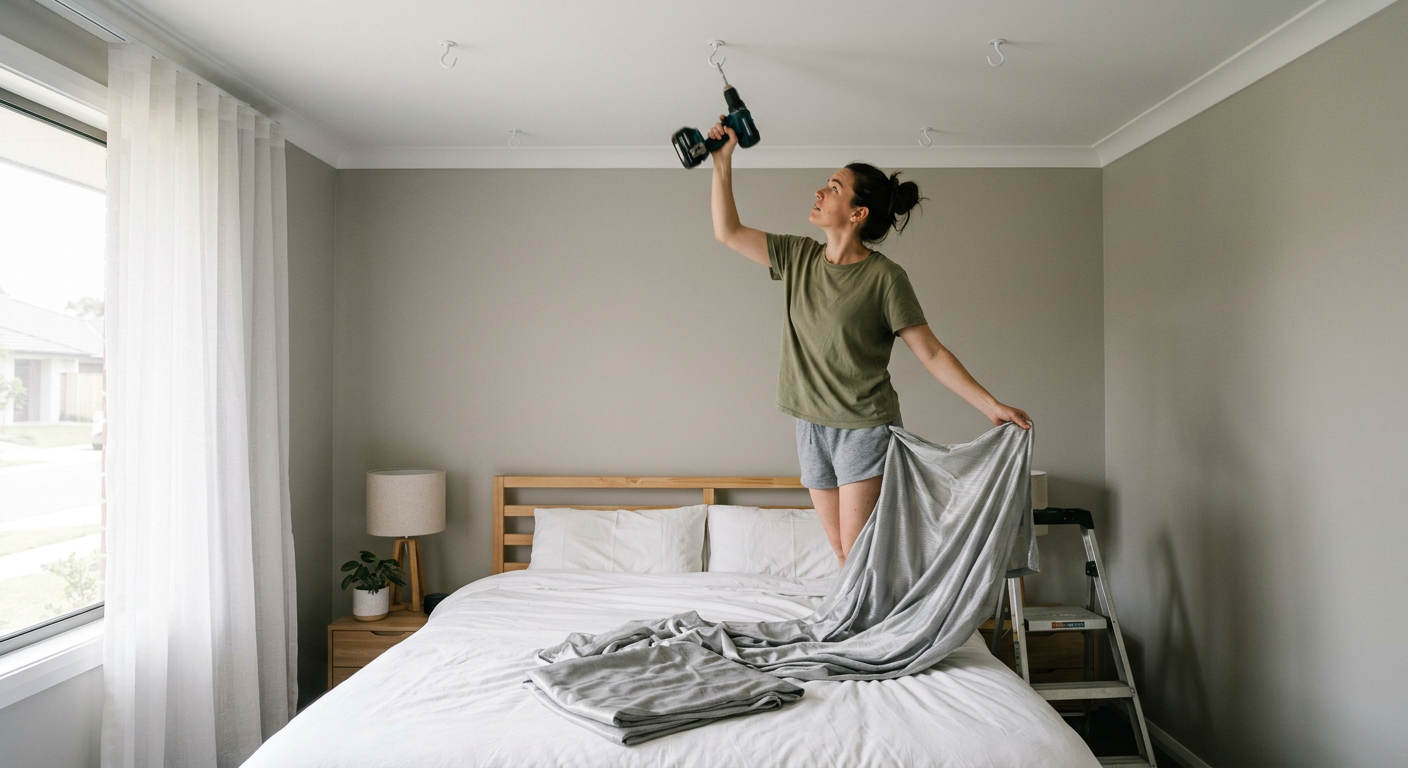
You need four to six ceiling hooks positioned to suspend the canopy so it drapes over and around the entire bed with 15-20 cm clearance above your head when lying down. Use heavy-duty screw-in ceiling hooks rated for at least 10 kg each — a king-size silver-cotton canopy weighs 3-5 kg, but the hooks also bear tension load from draping. If you are in a rental and cannot drill into the ceiling, a freestanding canopy frame (steel tube, available in single through to king sizes) is the alternative. Position hooks so the canopy hangs symmetrically with equal drape on all four sides.
For plasterboard ceilings (standard in most Australian homes built after 1980), use hollow-wall anchors or toggle bolts rather than screw hooks directly into plasterboard. Plasterboard alone will not hold the sustained weight. If you can locate a ceiling joist (use a stud finder or knock test), screw directly into the joist — that is the strongest mount.
Step 2: Draping and Sealing Gaps
The canopy must form a complete enclosure around and above the sleeping area. RF leaks through any gap like water leaks through a hole in a boat. A 10 cm gap at the base of the canopy can reduce effective attenuation from 40 dB to 20 dB — cutting your shielding from 99.99% to 99%. That sounds like a small percentage difference, but it means 100x more RF reaching your body.
The most critical gap is at the base. The canopy fabric must drape all the way to the floor on all four sides and tuck under the mattress by at least 30 cm, or be weighted down with non-conductive weights (cloth-covered sand tubes work well). On the entry side, overlap the fabric panels by at least 40 cm so you can enter and exit without creating a permanent opening. Some canopies include a zipper entry — these are effective but check that the zipper teeth are conductive (metal, not plastic) and maintain electrical continuity with the fabric panels.
Where the canopy meets the ceiling hooks, ensure the fabric is gathered tightly around the hook points with no exposed gaps above. The goal is a continuous conductive surface on all six sides (four walls, ceiling, floor-tuck).
Step 3: Grounding the Canopy — Australian-Specific
This is where every US guide falls apart for Australian readers. Grounding is not optional — an ungrounded conductive canopy can accumulate static charge and act as an antenna for AC electric fields from bedroom wiring, potentially increasing your body voltage rather than reducing it. But the grounding method must comply with Australian electrical standards.
Option A: Earth pin of an Australian GPO (general purpose outlet). Australian power outlets (AS/NZS 3112) have three pins: active, neutral, and earth. The earth pin is the top pin (the one that looks different). You can purchase a purpose-built grounding cord from SaferEMF or similar specialist retailers. This cord has an alligator clip on one end (connecting to the canopy’s grounding tab) and a plug on the other end that connects ONLY to the earth pin — the active and neutral pins are not wired. This drains static charge and AC electric fields from the canopy fabric to the house earthing system.
Critical safety rule: never wire your own grounding plug unless you are a licensed electrician or confident working with AS/NZS 3000:2018 Wiring Rules. The earth circuit in Australian homes is bonded to a main earthing electrode (copper rod or water pipe bond at the switchboard) per AS/NZS 3000 clause 5.6. If your home’s earthing is faulty (common in pre-1980 homes), grounding the canopy to it can introduce fault currents to the canopy fabric. Before using GPO earth grounding, verify your outlet’s earth is functional using a socket tester ($15-$25 from any hardware store) — or better, have an electrician test earth loop impedance.
Option B: Dedicated external grounding rod. This is the preferred method in Building Biology practice. Drive a 1.2-metre copper or galvanised steel grounding rod into moist soil outside your bedroom window. Run a green/yellow insulated earth wire (minimum 4 mm² copper, per AS/NZS 3000 requirements for protective earth conductors) from the rod, through the window frame (use a flat window feed-through cable), to the canopy’s grounding tab. This creates an independent earth path that is not connected to the house’s electrical earthing system, avoiding any risk of fault current coupling.
In Australian soil conditions, grounding rod effectiveness depends heavily on soil moisture and resistivity. Sandy soils in Perth’s northern suburbs or dry inland soils during summer may have earth resistance above 25 ohms, reducing grounding effectiveness. Clay soils in Brisbane, Sydney’s western suburbs, and Melbourne’s inner east typically have lower resistivity and better grounding performance. If you install a dedicated rod, test its resistance with a multimeter between the rod and a known earth reference — aim for below 25 ohms. Watering the soil around the rod periodically improves conductivity.
Step 4: Verify with an RF Meter — Before and After
You would not install a water filter without testing the output water. Do not install a canopy without testing RF levels before and after. This step validates your entire investment.
Use a calibrated RF meter. The TriField TF2 (~$260 AUD on Amazon AU) measures RF, AC magnetic, and AC electric fields in one device. For RF-only with higher sensitivity, the Safe and Sound Pro II from SaferEMF AU provides audio readout proportional to signal strength, making it intuitive for before/after comparisons.
Measurement protocol:
- Measure RF at pillow height with no canopy deployed. Record the peak reading (use peak hold mode — Australian smart meters at 900 MHz transmit in bursts, and peak readings can be 100-1,000x higher than time-averaged readings).
- Install and ground the canopy, seal all gaps, and close the entry.
- Measure RF at the same position inside the canopy. Peak hold again.
- The difference between readings is your effective attenuation in real-world conditions.
Example: if your pre-canopy reading at pillow height is 8 mW/m² (common if your bedroom is within 50m of a smart meter cluster or has line-of-sight to a cell tower), and your post-canopy reading is 0.005 mW/m², you have achieved approximately 32 dB of real-world attenuation — below the Building Biology “no anomaly” threshold. That reading confirms the canopy is working and the gaps are sealed.
If your post-canopy reading is still above 0.1 mW/m², check for gaps. Walk the meter around the base of the canopy — the reading will spike at the leak point. Seal it, re-measure, and repeat until you hit your target.
The Five Most Common Installation Mistakes
After reviewing dozens of forum posts, customer support threads, and Building Biology case studies, these are the five mistakes that cause canopy installations to fail. Every one of them is avoidable.
Mistake 1: Deploying the Canopy Before Removing Internal Sources
This is the number-one failure. If your phone is on your nightstand with Wi-Fi and mobile data active, a canopy around the bed creates a reflective enclosure that concentrates that phone’s RF output back at your body. The physics is simple: conductive fabric reflects RF in both directions. A phone transmitting at 0.5 W inside a 42 dB enclosure has nowhere for that energy to go except back through you. Remove the phone, the Bluetooth speaker, the smart watch charger, and the DECT base station before the canopy goes up. Airplane mode is free. A Jackson mechanical timer on the router is $20.
Mistake 2: Leaving Gaps at the Base
RF does not respect your intention to shield. A 5 cm gap between the canopy fabric and the floor on the side facing a smart meter or cell tower creates a direct path for RF to enter the enclosure. Tuck the fabric under the mattress on all four sides. On the entry side, use an overlapping panel design (minimum 40 cm overlap) rather than a simple slit opening. If your bed is on a raised frame with clearance underneath, the canopy fabric must extend past the frame edge and contact the floor.
Mistake 3: No Grounding
An ungrounded conductive canopy sits in the AC electric field generated by the 50 Hz wiring in your bedroom walls. The silver threads in the fabric pick up this field and can elevate body voltage measured on a person sleeping inside the canopy. Building Biology practitioners in Australia report body voltage readings of 2,000-5,000 mV on ungrounded canopies — well above the 100 mV target for sleeping areas. Grounding drops this to 10-50 mV. Never skip this step.
Mistake 4: Grounding to a Water Pipe or Gas Pipe
Some US guides recommend connecting the grounding wire to a cold water pipe. In Australian homes, this is problematic. Modern Australian plumbing increasingly uses PVC or PEX pipe, which is non-conductive and provides no earth path. Even in homes with copper plumbing, the plumbing earth bond may not be maintained to AS/NZS 3000 standard. And grounding to a gas pipe is a serious safety hazard under any standard. Use the GPO earth pin or a dedicated grounding rod — nothing else.
Mistake 5: Expecting the Canopy to Shield Low-Frequency Magnetic Fields
A silver-cotton canopy shields RF (radio frequency, 800 MHz and above) and, when grounded, drains AC electric fields (50 Hz E-field from wiring). It does NOT shield AC magnetic fields. Magnetic field shielding requires mu-metal or specialised steel alloys at thicknesses that are impractical for a bed canopy. If your bedroom has elevated AC magnetic fields — from nearby power lines, a meter box on the other side of the wall, or underfloor wiring — the canopy will not help. You need to identify and address the magnetic field source directly (move the bed, re-route wiring, or in extreme cases, use mu-metal panels on the wall).
The Building Biology SBM-2015 threshold for sleeping area AC magnetic fields is below 0.2 µT. The TriField TF2’s magnetic field mode can verify whether your bedroom exceeds this. If it does, the solution is source reduction or distance — not a canopy.
Australian Grid Differences: 50 Hz vs 60 Hz and Why It Matters
Every US-authored EMF guide assumes a 60 Hz grid frequency. Australia uses 50 Hz. This matters for two reasons relevant to canopy setup.
First, the AC electric fields from bedroom wiring oscillate at 50 Hz, not 60 Hz. The grounding mechanism for draining these fields is frequency-independent — grounding works the same regardless — but the Building Biology SBM-2015 thresholds for AC electric fields (<5 V/m for sleeping areas) apply equally at 50 Hz. When you ground your canopy and measure AC electric fields inside, you are measuring the 50 Hz component. If you are comparing your readings to a US forum post, be aware they are measuring 60 Hz -- the numbers are directly comparable in terms of threshold, but the waveform is different.
Second, a demand switch installed on your bedroom circuit by a licensed Australian electrician (~$100-$150) is the most effective solution for AC electric fields from wiring. A demand switch (also called a circuit cut-off relay) detects when no loads are drawing current on the bedroom circuit and disconnects the active conductor, eliminating the 50 Hz electric field from the wiring entirely. This is more effective for ELF electric field reduction than any canopy grounding arrangement. When combined with a grounded canopy for RF, you address both field types at their source.
Australian smart meters operated by Ausgrid (NSW), Energex (QLD), and Western Power (WA) transmit at 900 MHz using mesh networking protocols. They transmit data in short bursts — typically a few milliseconds every 15-60 seconds — but the peak RF output during those bursts can be 100-1,000x higher than the time-averaged reading. When measuring smart meter RF at your bedroom wall, always use peak hold mode on your meter. A time-averaged reading of 0.3 mW/m² can correspond to peak bursts of 30-300 mW/m² — well above the Building Biology “extreme anomaly” threshold of 10 mW/m².
What to Buy: Complete Setup Checklist and Costs
Here is the full bill of materials for a correctly installed, verified EMF bed canopy in an Australian home. I have priced everything in AUD at current 2026 prices.
| Item | Purpose | Approx. Cost (AUD) | Source |
|---|---|---|---|
| Silver-cotton 42 dB canopy | RF shielding enclosure | $400–$700 | SaferEMF AU |
| Grounding cord (earth-pin type) | Drains AC E-field to house earth | $30–$50 | SaferEMF AU / included |
| Grounding rod (1.2m copper) | Independent external earth | $25–$40 | Electrical wholesaler |
| Ceiling hooks (x6, heavy-duty) | Suspension | $10–$20 | Hardware store |
| TriField TF2 meter | Before/after verification | ~$260 | Amazon AU |
| Socket tester | Verify GPO earth integrity | $15–$25 | Hardware store |
| Jackson mechanical timer | Router auto-off at night | ~$20 | Amazon AU |
| Demand switch (installed) | Eliminates 50 Hz E-field from wiring | $100–$150 | Licensed electrician |
| Total (canopy + grounding + verification) | $860–$1,265 | ||
That total looks significant. Reframe it: $860 buys you a verified, grounded RF shield for 2,920 nights of sleep per year for 5+ years of fabric life. That is $0.06 per night. A single sleep study consultation in Australia costs $300-$500. If external RF is disrupting your sleep quality — and you have measured it and confirmed it is there — the canopy is the most cost-effective intervention available.
Start with the two highest-impact, lowest-cost actions first: phone airplane mode (free) and a mechanical timer on the router ($20). Then measure with a meter to confirm whether residual external RF justifies a canopy. If it does, invest in the silver-cotton 42 dB option and ground it properly.
Maintenance and Lifespan in Australian Conditions
Silver-cotton canopy fabric degrades under three conditions: chlorine exposure, mechanical abrasion, and prolonged UV. In practical Australian terms, this means:
Washing: Hand wash only in cold water with a pH-neutral detergent (no bleach, no fabric softener). Do not machine wash — the tumbling action abrades silver threads and accelerates conductivity loss. Air dry in shade. In chloramine-treated water cities (Brisbane, Sydney, Adelaide, Gold Coast, Darwin), the chloramine in tap water is less aggressive to silver than free chlorine, but still avoid prolonged soaking. Wash every 6-12 months unless visibly soiled.
UV exposure: Keep the canopy out of direct sunlight. If your bedroom has north-facing windows (south-facing in the northern hemisphere equivalent) that let in strong afternoon light, draw curtains or blinds during the day. UV degrades both the cotton fibres and the silver coating over time.
Expected lifespan: A well-maintained silver-cotton 42 dB canopy retains above 35 dB attenuation for 5-8 years under typical indoor conditions. Verify annually by measuring RF inside the canopy with your meter. If attenuation drops below 25-30 dB, the fabric is approaching end of life.
Storage: If you travel or move house, fold the canopy loosely (do not compress) and store in a breathable cotton bag. Do not store in plastic bags where condensation can form — especially in humid Queensland and northern NSW climates.
Decision Tree: Do You Actually Need a Canopy?
Not everyone does. Before spending $400-$700 on fabric, run through this three-question sequence.
1. Have you removed all internal RF sources from the bedroom?
Phone on airplane mode or out of the room. Router off or on a timer. DECT base station removed. Smart TV Wi-Fi disabled. Bluetooth devices off. If no: do this first. It is free and may solve your problem entirely.
2. Have you measured external RF at pillow height with a calibrated meter?
If the reading is below 0.1 mW/m² (peak hold), you already meet the Building Biology “no anomaly” threshold. A canopy provides no additional benefit. If the reading is 0.1-1 mW/m², consider lower-cost interventions first (moving the bed to an interior wall, aluminium window screening). If the reading is above 1 mW/m², a canopy is justified.
3. Is the RF source external and not something you can relocate?
Cell towers, smart meter clusters, 5G small cells on street poles — these are permanent external sources you cannot move. If the source is your neighbour’s Wi-Fi router, talk to them about placement or use targeted wall shielding rather than a full canopy. A canopy is warranted only for external, persistent RF sources above 1 mW/m² at sleeping position.
If you answered yes to all three, a canopy is a justified investment. If you answered no to any of them, start with the cheaper interventions first. More detail on the full EMF bedroom strategy is in our complete guide to EMF in the Australian home.
Final Verdict
An EMF bed canopy is the most effective single product for shielding your sleeping area from external RF radiation — when installed correctly. The key phrase is “when installed correctly.” That means internal sources removed first, silver-cotton fabric at 40+ dB, all gaps sealed at the base, proper grounding to either the Australian GPO earth pin or a dedicated external rod, and verification with an RF meter before and after.
Skip any of those steps and you risk spending $400-$700 on a fabric tent that either does nothing or actively worsens your exposure. Follow all of them and you create a verified sleeping environment below Building Biology thresholds — a measurable, quantifiable improvement you can confirm with a $260 meter.
Start with the free actions: phone airplane mode and router on a timer. Measure. If external RF remains above 1 mW/m² at pillow height, the canopy is your answer. If it does not, you have already solved the problem for $20.
Last reviewed: August 2026 – Clean and Native
Start with measurement. The TriField TF2 is the only meter you need.
Measures AC magnetic, AC electric, and RF in one device. Without real readings, every EMF decision is a guess.
Frequently Asked Questions
Does an EMF bed canopy block 5G signals in Australia?
Yes. A silver-cotton canopy rated at 42 dB attenuates RF across 800 MHz to 8 GHz, which covers Australian 5G sub-6 GHz bands (3.5 GHz from Telstra, Optus, and TPG). The 28 GHz mmWave band is also blocked — higher frequencies are easier to shield with conductive fabric. Standard building walls already attenuate mmWave 5G by 10-30 dB before it reaches your bedroom.
Can I ground an EMF canopy to an Australian power point?
Yes, via the earth pin only. Use a purpose-built grounding cord that connects the canopy’s grounding tab to the top (earth) pin of an AS/NZS 3112 power outlet. The active and neutral pins must not be wired. Before use, test the outlet’s earth with a socket tester to confirm continuity — faulty earthing in pre-1980 homes is common.
Does an EMF canopy block magnetic fields from power lines?
No. Silver-cotton and copper-mesh canopies shield RF and, when grounded, drain AC electric fields. They do not attenuate AC magnetic fields at 50 Hz. Magnetic field shielding requires mu-metal or specialised steel alloys. If your concern is magnetic fields from power lines or wiring, measure with the TriField TF2’s magnetic mode and address the source directly.
What happens if I leave my phone inside the canopy?
The canopy reflects the phone’s RF emissions back inside the enclosure, increasing your exposure rather than reducing it. A conductive enclosure amplifies internal RF sources through reflection. Always switch your phone to airplane mode or move it outside the canopy before sleeping.
How do I wash a silver-cotton EMF canopy?
Hand wash in cold water with pH-neutral detergent. Do not use bleach, fabric softener, or a washing machine. Chlorine degrades silver threads and reduces conductivity. Air dry in shade — UV exposure accelerates fabric degradation. Wash every 6-12 months unless visibly soiled.
Does the Australian 50 Hz grid frequency affect canopy performance?
Not for RF shielding — the canopy’s RF attenuation operates at megahertz and gigahertz frequencies, unrelated to grid frequency. However, Australia’s 50 Hz wiring creates AC electric fields that a grounded canopy drains. A demand switch on the bedroom circuit (installed by a licensed electrician for $100-$150) eliminates the 50 Hz E-field at the source, which is more effective than relying on canopy grounding alone.
How do I know if my bedroom needs an EMF canopy?
Measure RF at pillow height using an RF meter such as the TriField TF2 or Safe and Sound Pro II, with all internal sources removed. If the peak reading exceeds 1 mW/m² and the source is external (cell tower, smart meter, 5G small cell), a canopy is justified. If the reading is below 0.1 mW/m², you already meet the Building Biology SBM-2015 “no anomaly” threshold and a canopy provides no measurable benefit.
Can I install an EMF bed canopy in a rental property?
Yes. Use a freestanding canopy frame (steel tube, single through to king sizes) instead of ceiling hooks. No drilling required. The grounding cord still connects to the GPO earth pin — no modifications to the property’s wiring. When you move out, the entire setup is portable.
What is the difference between an EMF canopy and EMF shielding paint?
EMF shielding paint (carbon-based conductive paint) is applied to walls and ceilings to block RF from a specific direction — typically one external wall facing a cell tower. A canopy is a portable enclosure that shields all directions around the bed. Paint is permanent and requires grounding to the house earth system. A canopy is removable and portable. For single-direction RF sources, paint on one wall may be sufficient. For omnidirectional exposure (multiple towers, smart meter plus neighbour’s Wi-Fi), a canopy provides 360-degree coverage.
{“@context”:”https://schema.org”,”@type”:”Article”,”headline”:”EMF Bed Canopy Setup Guide Australia 2026: Grounding Wire, Hanging + Common Mistakes”,”author”:{“@type”:”Person”,”name”:”Jayce Love”,”url”:”https://cleanandnative.com.au/about/”},”publisher”:{“@type”:”Organization”,”name”:”Clean and Native”,”logo”:{“@type”:”ImageObject”,”url”:”https://cleanandnative.com.au/wp-content/uploads/2024/01/clean-and-native-logo.png”}},”datePublished”:”2026-08-04″,”dateModified”:”2026-08-04″,”url”:”https://cleanandnative.com.au/emf/emf-bed-canopy-setup-guide-australia/”,”image”:{“@type”:”ImageObject”,”url”:”https://cleanandnative.com.au/wp-content/uploads/2024/01/clean-and-native-logo.png”,”width”:1200,”height”:630}}
Get the Australian Home Environment Checklist
30 checks across water, air and EMF. Most of them free. Ranked by impact.
No spam. Unsubscribe any time.

Former Royal Australian Navy Clearance Diver and TAG-E counter-terrorism operator. Founded Clean and Native to apply the same rigorous thinking to the home environment.
Full biography →Similar Posts
Smart Meter Shield vs Smart Meter Opt-Out: Which Should You Choose? (Australia 2026)
Your smart meter transmits RF microwave pulses through your wall — sometimes thousands of times per day — and you want it to stop. You have…
Blushield Australia Review 2026: Does Active EMF Protection Actually Work?
Disclosure: Clean and Native earns a commission on qualifying purchases at no extra cost to you. Our picks are based…
Earthing Side Effects: What to Expect When You Start Grounding (Australia 2026)
Most earthing side effects are mild, temporary, and resolve within one to two weeks of consistent use. The most commonly reported experiences are tingling…
Best EMF Protection Australia 2026: What Actually Works
The best EMF protection in Australia starts with measurement, not products — a calibrated meter, a Jackson 24hr mechanical timer, and your phone on…
Miranda Kerr’s EMF Fears: What You Can Do
Miranda Kerr’s instinct to keep the phone away from her head is physically correct. Here’s the evidence — and the free, measurable steps that actually reduce RF-EMF in an Australian home.
EMF Protection During Pregnancy in Australia: What the Research Shows and What to Do
A practical guide to EMF exposure during pregnancy — what Australian and international research shows, which exposures are worth addressing, and specific low-cost actions ranked by actual impact.