Electromagnetic Hypersensitivity (EHS) Australia 2026
Electromagnetic hypersensitivity (EHS) is not a recognised medical diagnosis in Australia, but the symptoms people report — headaches, insomnia, fatigue, cognitive fog, skin tingling — are real and measurable. The World Health Organisation acknowledges these symptoms exist but states that current scientific evidence does not confirm a causal link to EMF exposure, which means the most effective approach is systematic environmental modification: measuring your actual exposure, reducing confirmed sources, and addressing the sleep and stress factors that overlap with every reported symptom.
EHS is not a diagnosed condition in Australia, but the symptoms are not imaginary — they are functional, distressing, and treatable through environmental and behavioural modification. Provocation studies consistently show people who report EHS cannot detect EMF presence above chance. However, their symptoms persist regardless of whether a source is on or off, which points to other environmental and neurological triggers. The practical outcome is the same either way: reducing EMF exposure, improving sleep hygiene, and eliminating dirty electricity measurably improves reported symptoms in the published literature. Start with measurement, not shielding.
| Approach | What It Does | Verdict |
|---|---|---|
| Measure first (TriField TF2) | Identifies actual RF, ELF magnetic, and AC electric sources in your bedroom | Start here — every other step is guesswork without data |
| Source reduction (timer, airplane mode, demand switch) | Eliminates the highest-exposure sources for $0-$150 | Recommended — highest impact-per-dollar |
| Shielding (canopy, paint) | Blocks confirmed external RF only — INCREASES exposure if internal sources remain | Only after internal sources eliminated |
Key catches
- No double-blind provocation study has confirmed that EHS individuals can detect EMF above chance — the WHO, ARPANSA, and NHMRC all cite this evidence
- Nocebo effect (expecting symptoms triggers them) is well-documented in the literature and must be acknowledged honestly
- Despite the above, environmental modification (reducing RF, dirty electricity, and AC magnetic fields) consistently correlates with symptom improvement in observational studies — the mechanism may differ from what people assume, but the practical result is the same
- Shielding without measurement is the most common and most expensive mistake — a Faraday canopy around a bed with a DECT phone inside INCREASES exposure by reflection
What Is Electromagnetic Hypersensitivity? The WHO Position and ICD-10 Coding
If you experience headaches, insomnia, difficulty concentrating, or skin sensations that you believe are triggered by proximity to Wi-Fi routers, mobile phone towers, smart meters, or electrical wiring, you are not alone. The WHO estimates that prevalence of self-reported EHS ranges from a few individuals per million to up to 5% of the population depending on the country and survey methodology. In Sweden, where formal accommodation exists, the self-reported rate is among the highest globally.
Here is what the WHO actually says, directly from their Environmental Health fact sheet on electromagnetic hypersensitivity: “EHS is characterised by a variety of non-specific symptoms that differ from individual to individual. The symptoms are certainly real and can vary widely in their severity. Whatever its cause, EHS can be a disabling problem for the affected individual.” That language matters. The WHO does not dismiss the symptoms. It challenges the proposed mechanism — that EMF exposure is the cause.
In Australia, ARPANSA (the Australian Radiation Protection and Nuclear Safety Agency) aligns with the WHO position. ARPANSA has not issued standalone clinical guidance on EHS because it is not classified as a diagnosable condition under the ICD-10 framework used by Australian clinicians. The ICD-10 does include code R68.89 (“Other general symptoms and signs”) and W90 (“Exposure to other nonionizing radiation”) as external cause codes, but there is no specific EHS diagnostic code. Your GP cannot diagnose you with electromagnetic hypersensitivity because there is no diagnostic framework for it. That does not mean your symptoms are not real. It means the medical system does not have an agreed-upon label or treatment pathway.
This is the tension you are living with if you suspect EHS: your experience is genuine, but the current scientific evidence does not support the specific causal mechanism you may believe is responsible. Understanding that tension honestly is the foundation of every practical step that follows.
What Provocation Studies Actually Show — and Why That Matters for Your Next Steps
This is the section most EHS content online either omits or distorts. You deserve the honest data, because it shapes how you spend your time and money.
Provocation studies are the gold standard for testing whether a person can detect the presence or absence of an EMF source. The design is simple: participants sit in a controlled environment. A device (Wi-Fi router, mobile phone, base station simulator) is turned on or off in random order. The participant reports whether they believe the source is active and whether they are experiencing symptoms. Neither the participant nor the researcher administering the test knows the exposure state during the trial — double-blind protocol.
The results, across decades of research, are remarkably consistent. A 2005 systematic review published in Bioelectromagnetics by Rubin et al. examined 31 double-blind provocation experiments involving 725 participants who reported EHS. The conclusion: “No robust evidence could be found to support the hypothesis that individuals reporting EHS can detect the presence of EMFs.” A follow-up by the same group in 2010, published in the same journal, reviewed 46 studies and reached the same conclusion. The WHO references these reviews directly in their EHS factsheet.
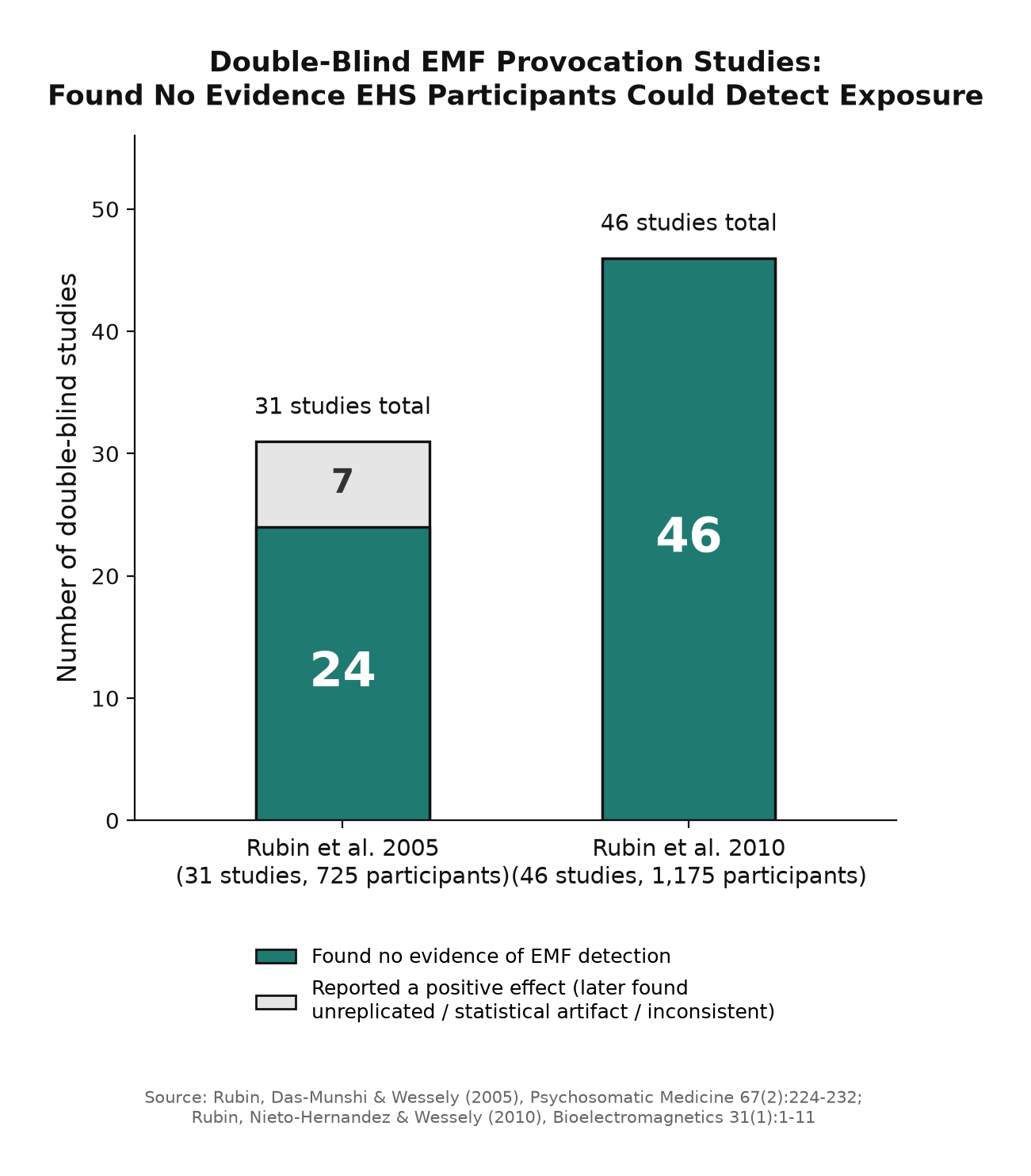
A critical finding across these studies: participants reported symptoms at the same rate whether the EMF source was on or off. This is not a finding of “no symptoms.” It is a finding that symptoms occur regardless of actual exposure. That distinction is everything. Your headaches are real. Your insomnia is real. The trigger may not be what you think it is.
The Nocebo Effect — Honest, Not Dismissive
The nocebo effect is the inverse of placebo: expecting a negative outcome produces negative symptoms. A 2012 study by Witthöft and Rubin published in the Journal of Psychosomatic Research demonstrated that watching a documentary about the health dangers of Wi-Fi significantly increased symptom reporting in participants subsequently exposed to a sham Wi-Fi signal — a device that looked active but produced no EMF. The symptoms were physiologically measurable (elevated skin conductance, heart rate variability). The effect was real. The EMF was not.
Acknowledging this does not mean you are “making it up.” The nocebo effect is a documented neurological phenomenon. It happens to everyone — including trained researchers. It happens with medications, with foods, with environmental exposures. If you have been reading alarming content about 5G towers or smart meter radiation for months, your nervous system may actually be primed to produce symptoms in response to perceived — not actual — exposure. That is how brains work, and it is not a moral failing.
What it means practically: if you buy a $2,000 shielding canopy before you have taken a single EMF measurement in your bedroom, the nocebo dynamic is working against you. You are spending money on a solution to a problem you have not confirmed exists. And if the canopy makes you feel safer, you may attribute any improvement to shielding rather than to the actual variable that changed — your anxiety level.
Australian-Specific EMF Sources You Should Know About
Most EHS content online is written from a US or European perspective. The EMF landscape in Australian homes is different in specific, measurable ways. If you are going to reduce your exposure, you need to know what you are actually exposed to.
Smart Meters (Ausgrid NSW, Energex QLD, Jemena VIC, Western Power WA)
Every state electricity distributor in Australia is rolling out or has completed smart meter installation. These operate at 900 MHz in a mesh network, transmitting data back to the utility in short bursts — typically a few milliseconds every 15-30 minutes. The time-averaged RF exposure from a smart meter at 1 metre is extremely low. However — and this is where most official guidance stops being useful — peak readings during transmission bursts can be 100 to 1,000 times higher than the time-average. If your bedroom wall shares an exterior wall with your smart meter, and you measure only with time-averaging, you will miss these spikes entirely. Use peak-hold mode on your meter.
For Energex customers in south-east Queensland and Ausgrid customers in Sydney, the smart meter is often mounted on the exterior wall of the master bedroom or a child’s bedroom. If your reported symptoms are worst at night, and your bed is against the wall where the meter sits on the other side, this is the first thing to investigate. Moving the bed to an interior wall is free and takes twenty minutes.
Can’t move the bed to an interior wall?
If the bedroom wall adjacent to your smart meter is the only option, an EMF-shielding bed canopy blocks RF exposure from that direction while you sleep — our full setup guide covers ceiling mounting, sealing gaps, and Australian-compliant grounding.
Read the EMF Bed Canopy Setup Guide →NBN Infrastructure and Home Routers
The NBN NTD (Network Termination Device) — the white box your ISP installed — does not transmit RF. It is a wired device. The Wi-Fi router connected to it does. If your router is in your bedroom or on the other side of a bedroom wall, it is the single highest-power RF source in your home during sleep hours, transmitting continuously even when no devices are actively using the network.
For inner-Sydney households within 200 metres of NBN street cabinets (FTTN/FTTC deployments), external RF from the cabinet itself is negligible — these are wired infrastructure, not broadcast transmitters. Your concern is inside your home, not outside it.
Solar Inverters
Australia has one of the highest rooftop solar penetration rates in the world, according to the Clean Energy Regulator. Solar inverters — particularly string inverters mounted on garage walls — produce dirty electricity (high-frequency voltage transients on your household wiring) and AC magnetic fields during daylight hours. If your symptoms are worse during the day and you have rooftop solar, your inverter is worth measuring. A TriField TF2 on AC magnetic mode, held at 30 cm from the inverter, will tell you immediately whether your exposure exceeds the Building Biology SBM-2015 guideline of 0.2 µT for sleeping areas.
DECT Cordless Phones
Still common in Australian homes. DECT phones transmit at approximately 1.9 GHz continuously — not just during calls. The base station transmits a beacon signal 24/7 even when the handset is cradled. If you have a DECT base station in or near your bedroom, it is producing more RF exposure during sleep than your Wi-Fi router in most cases. Replace it with a corded phone or move the base station to a far room.
ARPANSA Limits vs. Building Biology Guidelines
ARPANSA’s RF exposure limit at 2.4 GHz is 1,000 µW/cm² (equivalent to 10 W/m²). This is a thermal safety limit — it protects you from tissue heating. It is not a precautionary limit. The Building Biology SBM-2015 guideline for sleeping areas is less than 0.1 mW/m² — a factor of 100,000 lower than the ARPANSA limit. Neither is “right” or “wrong.” They measure different things. ARPANSA protects against confirmed acute harm. Building Biology attempts to define a precautionary threshold for chronic low-level exposure, which is not yet confirmed in the scientific literature but aligns with the reduction approach that helps EHS-reporting individuals.
Your router at 1 metre typically produces 0.5-5 mW/m². That is well within ARPANSA limits and above Building Biology sleeping-area guidelines. Turning it off at night eliminates that exposure entirely, costs nothing, and is the highest-impact single action you can take.
The Practical Protocol: 7 Steps That Actually Help (Evidence-Based, Australian Context)
Whether your symptoms are caused by EMF, by nocebo, by poor sleep architecture, by stress, or by some combination of all four — the following steps address every one of those variables. That is deliberate. You do not need to resolve the causal debate to start feeling better. You need to systematically improve your sleep environment.
I have structured these in order of cost (lowest first) and impact (highest first). As a former Navy Clearance Diver, I was trained to solve problems in sequence: assess, prioritise, act. The same logic applies here.
Step 1: Measure Your Bedroom (Cost: ~$250 One-Off)
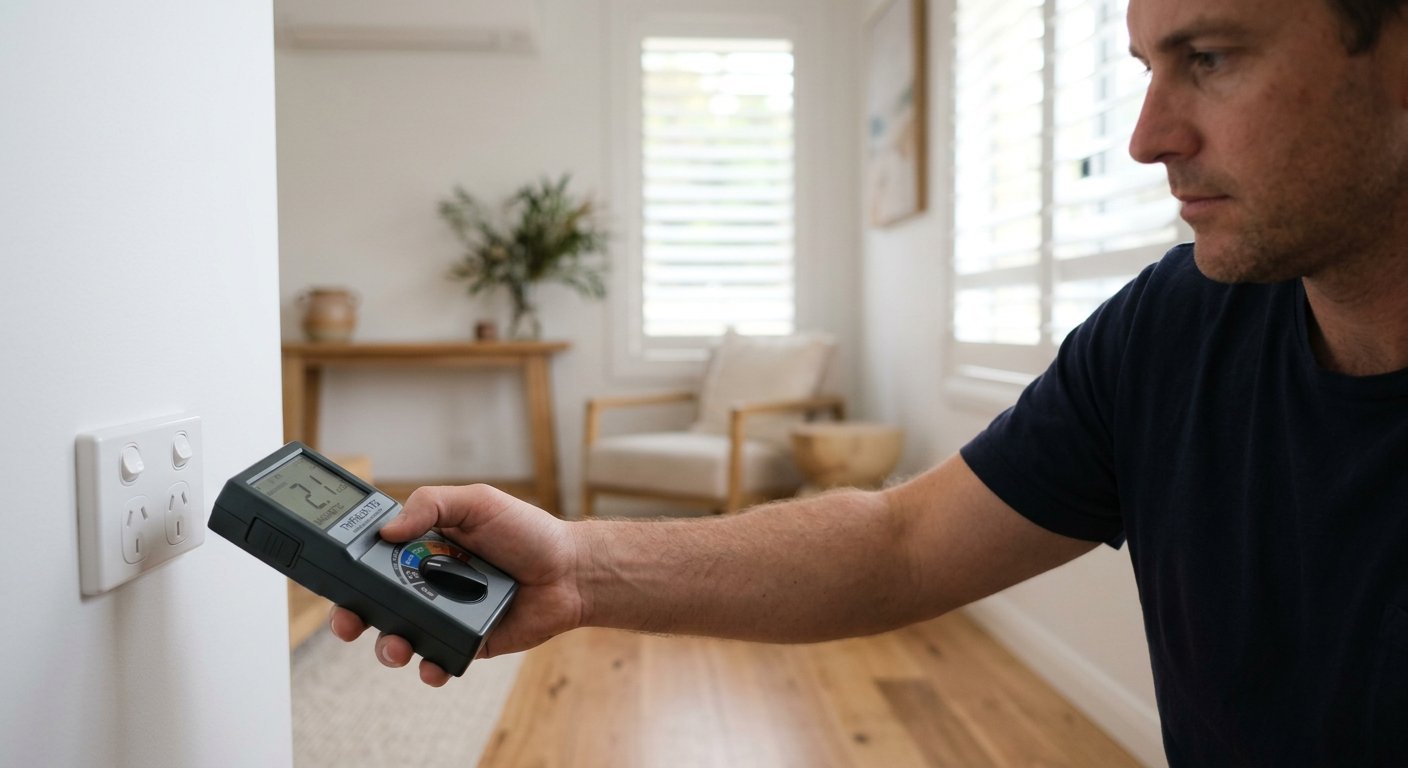
Without measurement, every decision you make about EMF is a guess. The TriField TF2 measures all three field types relevant to your bedroom: RF (radiofrequency from Wi-Fi, smart meters, 5G), AC magnetic (from wiring, appliances, inverters), and AC electric (from unshielded wiring in walls). It costs roughly $250 on Amazon AU and pays for itself by preventing you from spending $500-$2,000 on shielding you may not need.
Walk your bedroom with the meter. Check each wall, especially exterior walls. Check above the bed (reverse-cycle aircon units). Check at bedside table height (where your phone sits). Record the readings. You now have data instead of anxiety.
Critical shielding trap: If your highest readings come from sources inside your bedroom (router, DECT phone, phone on nightstand, smart TV on standby), then any shielding enclosure — canopy, window film, shielding paint — will reflect those internal signals back at you and increase your exposure. This is basic RF physics. A Faraday cage works in both directions. Always eliminate internal sources first.
Step 2: Phone on Airplane Mode at Night (Cost: Free)
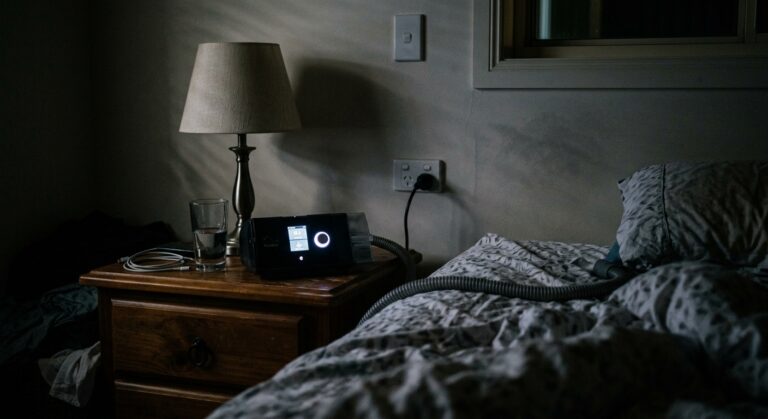
Your phone on the nightstand transmits RF continuously — checking for updates, syncing data, maintaining cell tower registration. At 30 cm from your head during 8 hours of sleep, this is your single highest cumulative RF exposure source. Airplane mode eliminates it instantly. Your alarm still works. If you need to be reachable for emergencies, move the phone to the far side of the room with the ringer volume at maximum. RF power drops with the square of the distance — doubling the distance cuts exposure by 75%.
Step 3: Router Timer (Cost: ~$20)
A Jackson 24hr Mechanical Timer on your router’s power plug eliminates Wi-Fi RF during sleep hours automatically. Set it to cut power from 10 PM to 6 AM (or whatever your sleep window is). This is the highest impact-per-dollar EMF reduction available. No router firmware changes, no complicated settings. Plug the router’s power adapter into the timer. Done.
For households where someone works night shifts or needs late-night connectivity, run a Cat6 ethernet cable from the router to the room that needs it. Wired connections produce zero RF. Your internet speed will actually improve.
Step 4: Remove DECT Phones and Smart Speakers from the Bedroom (Cost: Free)
As covered above, DECT base stations transmit continuously at 1.9 GHz. Alexa, Google Home, and other smart speakers maintain always-on Wi-Fi and listen for wake words via always-active microphones — the Wi-Fi connection transmits beacon frames every 100 ms regardless of whether you are speaking to it. Move them to the kitchen or living room. Replace the bedroom DECT handset with a corded phone if you need a landline at the bedside.
Step 5: Demand Switch on Bedroom Circuit (Cost: ~$100-$150, Licensed Electrician)
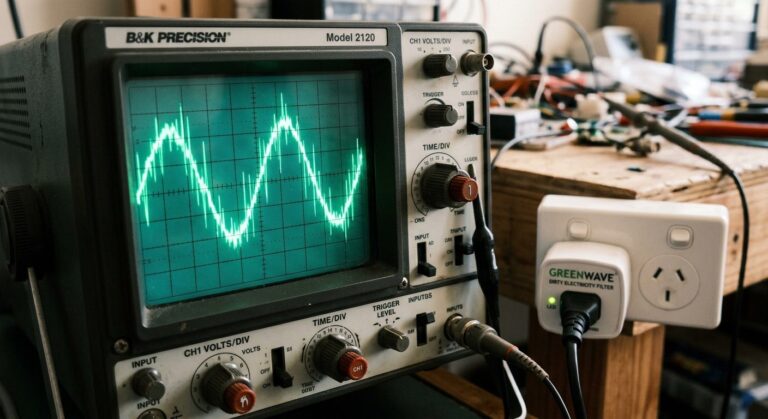
AC electric fields radiate from every energised wire in your walls, even when nothing is plugged in or turned on. A demand switch (also called a circuit cut-off relay) is installed by a licensed electrician on your bedroom circuit. When the last load on the circuit is removed (you turn off the bedside lamp), the switch automatically cuts mains voltage to that circuit. The wiring de-energises. AC electric fields from walls and ceiling wiring drop to near zero.
At $100-$150 installed, this is one of the most cost-effective sleep environment upgrades available. The Building Biology SBM-2015 guideline for AC electric fields in sleeping areas is less than 5 V/m. With a demand switch installed and no loads on the circuit, readings typically drop below 1 V/m.
Step 6: Blue Light and Sleep Hygiene (Cost: Free to Minimal)
This is where the EHS conversation intersects with mainstream sleep science. Many EHS-reported symptoms — insomnia, fatigue, cognitive fog, irritability — are identical to symptoms of circadian disruption from blue light exposure at night. A 2014 study published in Proceedings of the National Academy of Sciences by Chang et al. demonstrated that reading on a light-emitting device before bed suppressed melatonin, delayed circadian phase, and reduced next-morning alertness compared to reading a printed book.
If you are using your phone, tablet, or laptop in bed before sleep and attributing your resulting insomnia to EMF, the blue light mechanism is a far more evidence-supported explanation. Night Shift mode and blue-light glasses help but do not fully eliminate the effect. The strongest intervention: no screens for 60 minutes before sleep. Read a physical book. Boring, effective, free.
Step 7: Shield External Sources Only (Cost: $200-$2,000+ Depending on Method)
Only after Steps 1 through 6 are complete — after you have measured, eliminated internal RF sources, installed a demand switch, and addressed sleep hygiene — should you consider shielding. If your TriField TF2 or Safe and Sound Pro II still shows elevated RF readings from confirmed external sources (a cell tower within 200 metres, a neighbour’s router through a shared wall, a smart meter on your exterior bedroom wall that cannot be relocated), then targeted shielding makes sense.
Options for Australian homes include:
- RF shielding window film — Applied to the specific window facing the external source. Typically provides 20-30 dB attenuation. Targeted and cost-effective.
- EMF shielding paint — Applied to the interior of the wall facing the external source, then painted over with standard wall paint. Provides 30-40 dB attenuation. Must be grounded by a licensed electrician.
- EMF bed canopy (silver cotton, 42 dB) — A full enclosure around the bed. Only appropriate when ALL internal RF sources have been eliminated (Steps 2-4). If your phone is inside the canopy transmitting, the canopy reflects that signal and concentrates it around your body.
The sequence matters more than the product. Measure, reduce, then shield. Not the other way around.
Why Australian EHS Discussions Miss the Point — and What to Do Instead
The online conversation about EHS in Australia falls into two unhelpful camps. Camp one: “EHS is not real, the science is clear, stop worrying.” Camp two: “The government and telecoms are covering up the truth, 5G is dangerous, buy this $3,000 harmoniser.” Both camps fail you.
Camp one is technically correct about provocation studies but dismissive of genuine suffering. If your insomnia, headaches, and cognitive fog are real — and they are — being told “the science says you are fine” does not fix your Tuesday night at 3 AM staring at the ceiling. Camp two exploits your distress to sell unverified products. “Harmonisers,” “neutralisers,” and “scalar energy devices” have no published peer-reviewed evidence of efficacy, no measurable mechanism of action, and no ARPANSA or TGA approval. They are expensive placebos.
The productive middle ground is environmental medicine: systematically identify and modify your environment regardless of the theoretical mechanism. If turning off your Wi-Fi router at night improves your sleep, it does not matter whether the improvement came from reduced RF, reduced nocebo anxiety, or a placebo effect of “doing something.” The result is the same. Your sleep improved. That is the outcome you wanted.
This is the approach used by Building Biology practitioners in Australia. It is pragmatic, measurable, and does not require you to resolve the scientific debate before taking action. Our complete guide to EMF in Australian homes covers the full measurement and reduction protocol in detail.
When to See a Doctor — and What to Ask For
If your symptoms are persistent and interfering with work or daily life, see your GP. Not because EHS is “all in your head” — because the symptoms you are describing (chronic headache, insomnia, fatigue, cognitive difficulty, skin sensations) overlap with a dozen other conditions that are diagnosable and treatable. Thyroid disorders, sleep apnoea, anxiety, depression, vitamin D deficiency (common in Australian office workers who avoid sun exposure), and chronic fatigue syndrome all present with similar symptom profiles.
Ask your GP for:
- Thyroid function panel (TSH, T3, T4)
- Vitamin D level (25-hydroxyvitamin D)
- Full blood count and iron studies
- Sleep study referral if snoring, daytime sleepiness, or witnessed apnoeas are present
- Mental health screening — not because your symptoms are “psychological” but because anxiety and depression amplify every physical symptom, and they are treatable
Rule out the diagnosable conditions first. If everything comes back normal and your symptoms persist, the environmental modification protocol in Steps 1-7 above becomes your primary intervention. You will have lost nothing by getting the blood work done, and you may discover the actual cause.
The Cost of Not Measuring: How People Spend $2,000+ Solving the Wrong Problem
Here is a scenario I see repeatedly. A person in Brisbane’s inner suburbs — let’s say Paddington or Red Hill — reports severe insomnia and headaches. They read online that 5G towers and smart meters cause these symptoms. They buy a $1,800 silver-cotton bed canopy. They feel better for a week (placebo/reduced anxiety). Then the symptoms return. They buy $600 of shielding paint. Symptoms persist. They buy a $400 “harmoniser” pendant. Nothing changes.
Total spent: $2,800. Total measurements taken: zero.
If that person had started with a $250 TriField TF2, they might have discovered that their DECT phone base station was 40 cm from their pillow, transmitting 1.9 GHz continuously. Moving it to the hallway — a free action that takes 30 seconds — would have eliminated the highest RF source in their bedroom. They might have discovered their bedside lamp was producing 15 V/m of AC electric field because it was plugged into an ungrounded extension lead. Replacing it with a grounded lead costs $12.
Measurement before intervention is not just good science. It is good economics. At $250 for a TriField TF2 or approximately $500 for a Safe and Sound Pro II (the more sensitive RF-specific option from SaferEMF AU), you are buying the ability to make every subsequent dollar count.
Australian Workplace EMF: Open-Plan Offices, Data Centres, and Your Rights
The WHO notes that some individuals with EHS report symptoms severe enough to cease work entirely. In Australia, workplace health and safety falls under the Work Health and Safety Act 2011 (harmonised across all states except Victoria, which has its own Occupational Health and Safety Act 2004). Employers have a duty to eliminate or minimise risks to health so far as is reasonably practicable.
However — and this is important — because EHS is not a recognised medical diagnosis, requesting workplace accommodation specifically for EHS is legally complex. You cannot get a medical certificate for a condition that has no ICD-10 code. What you can do is frame your request in terms of the symptoms: “I am experiencing persistent headaches and insomnia that my GP is investigating. I have found that reducing my proximity to Wi-Fi access points improves my symptoms. I am requesting to sit at a workstation further from the ceiling-mounted access point and to use a wired ethernet connection.”
This is a reasonable adjustment request under Australian workplace law. You are not claiming EMF causes your symptoms — you are noting that a specific environmental change reduces them. Most employers will accommodate this without requiring further justification, particularly if you frame it as a no-cost or low-cost change.
For open-plan offices in CBD locations — Sydney, Melbourne, Brisbane, Perth — the RF environment is dense: multiple Wi-Fi access points, dozens of Bluetooth devices, nearby cell antennas on adjacent rooftops. If you are symptomatic and cannot negotiate a workstation change, a USB-C to ethernet adapter allows you to disable your laptop’s Wi-Fi and connect via cable, reducing your personal RF contribution to zero. A DefenderShield air-tube headset reduces RF exposure from phone calls compared to standard Bluetooth earbuds.
Products That Do Not Work — and Why They Persist
I need to be direct here because these products target vulnerable people and take their money without delivering measurable results.
“EMF harmonisers” and “neutralisers”: Devices claiming to “harmonise” or “neutralise” EMFs with scalar waves, orgone energy, or proprietary frequencies have no published peer-reviewed evidence of efficacy. They do not reduce measurable RF, magnetic, or electric field levels. You can verify this yourself: place one next to your router, measure RF with a TriField TF2 before and after. The reading will not change. These products are not registered with the TGA and make no claims that can be independently verified. They range from $80 to $500+.
“Earthing” or “grounding” sheets: The concept of grounding has some preliminary research interest, but conductive bed sheets connected to the mains earth can actually increase your AC electric field exposure if your home’s earthing system carries stray currents — which is common in Australian homes, particularly older pre-2000 builds without modern earthing upgrades. Measure before and after with a body voltage meter. If your body voltage goes up with the sheet connected, you are increasing exposure, not reducing it.
Shungite, tourmaline, and crystal-based products: These minerals have no measurable effect on electromagnetic fields. Shungite has documented electrical conductivity, which is irrelevant to RF shielding at the thicknesses used in pendants and phone stickers. Save your money.
The pattern is consistent: products that cannot be measured cannot be verified. If a product claims to reduce your EMF exposure, the claim is testable with a $250 meter. If the vendor discourages you from measuring, that tells you everything.
Decision Tree: Where to Start Based on Your Situation
Question 1: Have you had blood work done in the last 12 months?
No → See your GP first. Request thyroid panel, vitamin D, full blood count, iron studies. Rule out diagnosable conditions before environmental intervention.
Question 2: Have you measured your bedroom EMF levels?
No → Buy a TriField TF2 (~$250). Measure all three field types in your bedroom. Record readings. This determines every subsequent step.
Question 3: Are your highest readings from internal or external sources?
Internal (router, DECT phone, smart TV, phone) → Implement Steps 2-4 (free to $20). Eliminate internal sources. Re-measure. If readings are now acceptable, stop.
External (smart meter, cell tower, neighbour’s router) → Implement Steps 2-5 first, then consider targeted shielding (Step 7) on the specific wall or window facing the source. Never whole-room shielding before internal source elimination.
Living With Uncertainty: An Honest Conclusion
The honest position on EHS is this: the science does not currently support EMF as the cause of your symptoms. But the science also does not claim to have identified what is causing them in every case. You are living with uncertainty, and that is uncomfortable. The worst response to uncertainty is paralysis or panic-buying. The best response is systematic action: measure, modify, monitor.
Every step in the protocol above is independently justified on its own merits. Turning off your Wi-Fi at night improves sleep latency even in people who report zero EMF sensitivity — fewer notification pings, less temptation to check your phone. A demand switch reduces AC electric fields in your bedroom wiring regardless of whether those fields cause symptoms. Getting blood work done is good preventive medicine. Blue light reduction before bed is supported by decades of circadian research.
You do not need to believe EMF is harming you to benefit from reducing it. You do not need a diagnosis to take practical steps. You need a meter, a $20 timer, and the willingness to change your bedroom environment one variable at a time. Start with the cheapest intervention. Measure before and after. Let the data guide you.
If you want the full measurement and reduction protocol for every room in your home, our complete guide to EMF in Australian homes covers it step by step.
Last reviewed: August 2026 – Clean and Native
Start with measurement. The TriField TF2 is the only meter you need.
Measures AC magnetic, AC electric, and RF in one device. Without real readings, every EMF decision is a guess.
Frequently Asked Questions
Is electromagnetic hypersensitivity a recognised medical condition in Australia?
No. EHS is not a recognised medical diagnosis in Australia. There is no specific ICD-10 code for it. ARPANSA and the NHMRC align with the WHO position that EHS symptoms are real but not causally linked to EMF exposure in current scientific evidence.
Can people with EHS actually detect EMF in scientific studies?
No. Across 46+ double-blind provocation studies reviewed by Rubin et al. (2005, 2010) in Bioelectromagnetics, individuals reporting EHS could not detect EMF presence above chance. Symptoms occurred at equal rates whether the source was on or off.
What is the nocebo effect and how does it relate to EHS?
The nocebo effect is a documented neurological phenomenon where expecting a negative health effect produces measurable symptoms. A 2012 study by Witthöft and Rubin showed that watching a documentary about Wi-Fi dangers increased symptom reporting during subsequent sham (fake) Wi-Fi exposure. The symptoms were physiologically real but not caused by EMF.
Does Australia have different EMF safety limits than other countries?
ARPANSA sets Australia’s RF limit at 1,000 µW/cm² at 2.4 GHz, which is a thermal safety limit aligned with ICNIRP guidelines. This is the same order of magnitude as the US (FCC) and EU limits. It is approximately 100,000 times higher than the Building Biology SBM-2015 precautionary guideline for sleeping areas (less than 0.1 mW/m²).
Do Australian smart meters cause health problems?
Australian smart meters (900 MHz mesh network) transmit in short bursts, typically a few milliseconds every 15-30 minutes. Time-averaged exposure is extremely low. However, peak readings during bursts can be 100-1,000 times higher than the average. If your bedroom wall is directly opposite a smart meter, measuring with peak-hold mode and moving your bed to an interior wall is a practical free action.
What is the cheapest way to reduce EMF in my bedroom?
Phone on airplane mode (free) and a Jackson 24hr Mechanical Timer on your router (~$20). These two actions eliminate the two highest-power RF sources in most Australian bedrooms for under $20 total.
Can I get workers’ compensation for EHS in Australia?
Obtaining workers’ compensation specifically for EHS is extremely difficult because it is not a recognised medical diagnosis in Australia. However, you can request reasonable workplace adjustments under the Work Health and Safety Act 2011 by framing the request around your symptoms (headaches, insomnia) and specific environmental changes (wired connection, workstation relocation) rather than the EHS label.
Do EMF harmonisers and neutralisers actually work?
No. Products claiming to harmonise or neutralise EMFs with scalar waves, orgone energy, or proprietary frequencies have no published peer-reviewed evidence of efficacy. They do not reduce measurable RF, magnetic, or electric field levels. You can verify this with any calibrated EMF meter — readings will not change with the device present.
Should I buy an EMF shielding bed canopy?
Only after eliminating all internal RF sources (phone, router, DECT phone, smart speakers) and confirming with a meter that remaining elevated RF comes from external sources. A canopy creates a Faraday-like enclosure that reflects internal RF signals back at the occupant, increasing exposure if sources are inside. The correct sequence is: measure, reduce internal sources, then shield external residual only.
What medical tests should I ask my GP for if I suspect EHS?
Request a thyroid function panel (TSH, T3, T4), vitamin D level (25-hydroxyvitamin D), full blood count, iron studies, and a sleep study referral if warranted. EHS symptoms overlap significantly with thyroid disorders, vitamin D deficiency, iron deficiency, sleep apnoea, anxiety, and depression — all of which are diagnosable and treatable. Rule these out first.
Get the Australian Home Environment Checklist
30 checks across water, air and EMF. Most of them free. Ranked by impact.
No spam. Unsubscribe any time.

Former Royal Australian Navy Clearance Diver and TAG-E counter-terrorism operator. Founded Clean and Native to apply the same rigorous thinking to the home environment.
Full biography →