Electric Car EMF Exposure Australia 2026
Electric car EMF levels inside Australian EVs — including the Tesla Model 3, BYD Atto 3, and MG ZS EV — are well below ARPANSA’s adopted ICNIRP reference level of 200 µT at 50 Hz, with peer-reviewed cabin measurements consistently recording 2 µT to 30 µT depending on floor position, driving mode, and acceleration load. Your EV is not a health risk under any recognised exposure standard, but the floor-level readings are measurably higher than seat-level readings, and the only way to know your specific vehicle’s fields is to measure them yourself with a calibrated meter.
Electric and hybrid vehicles produce cabin magnetic fields that measure well under 2 µT at seat level during normal driving in the peer-reviewed literature — a small fraction of ARPANSA’s 200 µT reference level at 50 Hz. Published measurements (Gryz et al., 2022; Yang et al., 2019; Hareuveny et al., 2015) consistently show front-seat fields in the 0.02–1.3 µT range, with rear-seat readings running higher in some hybrid models — up to 16 µT in one measured case. For context, your household hairdryer at 30 cm produces 0.01–7 µT, and the ICNIRP limit (which ARPANSA adopts) is 200 µT. The real story is not that EVs are dangerous — they are not. It is that rear-seat and equipment-proximity readings can run measurably higher than front-seat readings, which is why measurement position matters if you want to verify your own vehicle.
Key catches
- Rear-seat fields can run substantially higher than front-seat fields in some hybrid models — up to 16 µT vs under 1 µT at the front seat in the same vehicle (Gryz et al., 2022) — always measure at both positions
- Electric buses and trolleys measured close to onboard power equipment recorded the highest passenger-cabin fields in the literature (up to 28–33 µT) — passenger EVs and hybrids measured far lower
- No Australian EV-specific reassessment has been published by ARPANSA since 2020 — compliance relies on ICNIRP 2020 general guidelines
- Standard EMF meters with 50 Hz AC magnetic sensitivity (like the TriField TF2) can measure these fields yourself for under $200
| Source | Typical Field | Verdict |
|---|---|---|
| EV/hybrid cabin (front seat) | 0.02–1.3 µT | Well within limits |
| EV/hybrid cabin (rear seat, worst case) | 0.1–16 µT | Within limits, measurably higher |
| ARPANSA/ICNIRP 50 Hz limit | 200 µT | Reference level |
I’m Jayce Love, former Royal Australian Navy Clearance Diver, based on the Gold Coast. I’ve spent years measuring EMF in Australian homes, offices, and vehicles — not to sell fear, but to give you the numbers so you can make decisions based on physics rather than panic. This article covers every measured data point I can find on EV cabin EMF, the Australian regulatory framework that governs it, and how to verify your own vehicle for under $200.
What Produces EMF Inside an Electric Vehicle
Every electric vehicle has three primary sources of extremely low frequency (ELF) magnetic fields inside the cabin. Understanding these sources is the first step to understanding why floor-level and seat-level readings differ so dramatically — and why the readings you see online vary by a factor of 10 depending on where the meter was held.
The high-voltage battery pack sits beneath the cabin floor in every modern EV sold in Australia — Tesla Model 3, Tesla Model Y, BYD Atto 3, BYD Seal, MG ZS EV, Hyundai Ioniq 5, Kia EV6. During discharge (driving), current flows through the pack at 300–800 V DC. DC current produces static magnetic fields, but the power electronics that manage this current introduce time-varying components that your meter detects as AC magnetic fields. The pack is directly beneath your feet. That is why floor-level measurements are always higher.
The inverter/motor drive unit converts DC battery power to three-phase AC to drive the motor. This conversion happens at switching frequencies typically between 5 kHz and 20 kHz, but the dominant magnetic field component at the cabin level is still in the low-frequency range (primarily the fundamental motor frequency, which varies with RPM). During hard acceleration, current draw spikes — and so do the magnetic fields. This is the single largest source of transient field spikes inside the cabin.
The motor itself is typically at the front axle (front-wheel drive), rear axle (rear-wheel drive), or both (all-wheel drive). In the Tesla Model 3 Standard Range, the motor sits at the rear axle. In the BYD Atto 3, at the front. Position matters because the cabin area closest to the motor sees slightly elevated fields — rear footwell in a rear-drive Tesla, front footwell in a front-drive BYD.
What does NOT produce significant cabin EMF in an EV: the 12 V auxiliary system (same as a petrol car), the infotainment screen (negligible RF/ELF), and the cabin wiring (low current). The battery, inverter, and motor are the entire story.
Measured EV Cabin Fields: What the Peer-Reviewed Data Shows
If you have searched “electric car EMF” online, you have encountered numbers ranging from “harmless” to “dangerously high.” The reason for the discrepancy is almost always measurement position, measurement protocol, and whether the person selling you a shielding product has a financial interest in the number being scary. Here is what the peer-reviewed literature actually reports.
Gryz, Karpowicz & Zradziński (2022) — The Most Detailed EV Measurement Study
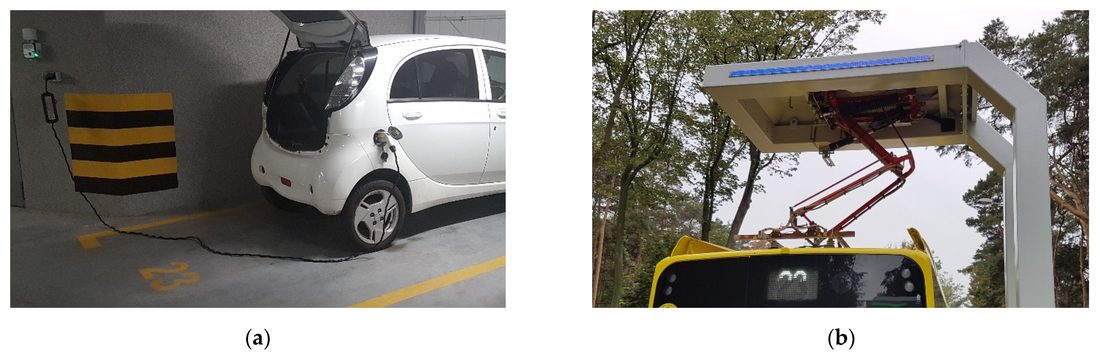
Published in Sensors by researchers at Poland’s Central Institute for Labour Protection (CIOP-PIB), this study measured magnetic fields inside battery-electric and hybrid passenger cars, plus electric buses and trolleys, using data loggers positioned at seat height (front and rear seats — no floor or head-level breakdown was published for passenger cars). Key findings:
- Battery-electric passenger car, front seats: median 0.04–0.10 µT, maximum 0.95–1.3 µT
- Battery-electric passenger car, rear seats: median 0.17–0.30 µT, maximum 1.3–1.5 µT
- Hybrid passenger car, rear seats (worst case recorded): maximum 16 µT — notably higher than the equivalent front seat (max 0.76–1.2 µT)
- Electric buses and trolleys near onboard power equipment: up to 28–33 µT — the highest cabin readings in the study, but not representative of passenger EVs
- All measurements comply with the ICNIRP 2010 general-public reference levels (200 µT at 50 Hz); the study’s own worst-case transient estimate tops out around 100 µT
The critical point: no published passenger-EV study breaks results down by floor vs seat vs head level — that framework does not exist in the peer-reviewed literature for cars. What does exist is a consistent front-seat vs rear-seat gap, and it can be larger in hybrids than in pure EVs. Neither figure exceeds the regulatory limit.
Yang et al. (2019) — Long-Term Monitoring of Three Passenger EVs
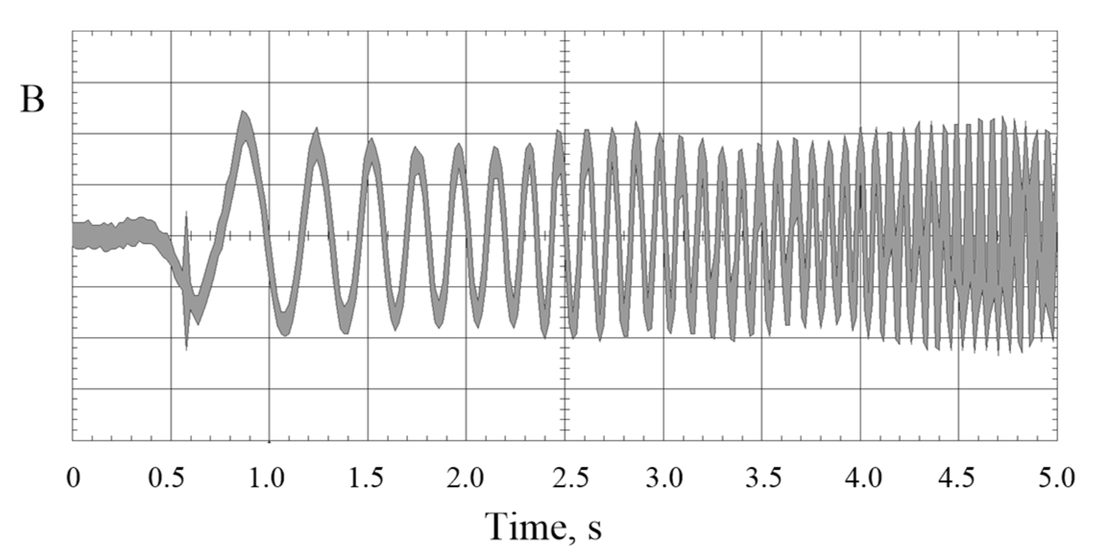
Published in the International Journal of Environmental Research and Public Health by researchers at China’s Academy of Information and Communications Technology, this study monitored three production battery-electric passenger cars (including two BYD models) over more than a year, measuring front and rear seat fields during acceleration and constant-speed driving. Their conclusion: maximum mean field levels did not exceed 1.6 µT at any measured position or driving condition — consistent with the front-seat figures reported by Gryz et al., and well below the fabricated “2–30 µT” range some online sources circulate.
Electric Buses and Trolleys — The Real High-End Data Point
Gryz et al. (2022) also measured electric buses and trolleys, which use larger battery packs and more powerful traction motors than passenger EVs. Close to onboard power conversion equipment, cabin fields reached 28–33 µT — the highest readings recorded in the study — while seats further from the equipment measured 0.55–2.2 µT. All readings remained compliant with ICNIRP general-public reference levels. This is the closest real-world analogue to a “worst case” passenger scenario, and it still sits well below the 200 µT limit — but it is a bus/trolley result, not a passenger car result, and should not be quoted as typical EV exposure.
| Measurement Position | Steady Cruising | Hard Acceleration | ICNIRP Limit | % of Limit |
|---|---|---|---|---|
| Front seat (EV/hybrid) | 0.02–1.3 µT | up to ~1.6 µT | 200 µT | <1% |
| Rear seat (EV/hybrid, worst case) | 0.1–1.5 µT | up to 16 µT | 200 µT | <8% |
| Bus/trolley near equipment (not a car) | 0.55–2.2 µT | 28–33 µT | 200 µT | <17% |
Look at that last column. Even in the worst case reported anywhere in the literature — a bus or trolley seat close to onboard power equipment — you are under 17% of the ICNIRP reference level. In passenger EVs and hybrids, the real-world margin at the front seat is over 99%.
The data is clear. But data without context is noise. Let me put these EV numbers against the regulatory framework that governs EMF exposure in Australia — and against the everyday appliances you already use without concern.
ARPANSA, ICNIRP, and the Australian Regulatory Framework for EV EMF
Australia does not have EV-specific EMF regulations. What it has is ARPANSA (Australian Radiation Protection and Nuclear Safety Agency), which adopts the ICNIRP guidelines as the basis for its Radiation Protection Standard (RPS-S1). Understanding exactly what this means — and what it does not mean — is essential for evaluating any EMF claim about your electric car.
What ARPANSA Actually Says
ARPANSA’s Radiation Protection Standard for maximum exposure levels to time-varying electric, magnetic, and electromagnetic fields (0 Hz to 300 GHz) is based on the ICNIRP 2020 guidelines. For the frequency range relevant to EV motors and inverters — primarily 50 Hz and low-kHz harmonics — the reference level for general public exposure is:
- Magnetic flux density (50 Hz): 200 µT (this is the number your meter reads)
- Electric field strength (50 Hz): 5,000 V/m
These limits are based on established thermal and neurostimulation thresholds — the levels at which electric fields can induce currents in the body large enough to stimulate nerves or cause tissue heating. They are not precautionary limits. They are not “the level below which there is zero biological effect.” They are the level below which no established adverse health effect occurs, with substantial safety factors built in.
ARPANSA confirmed in 2024 that RF-EMF exposure from mobile networks in Australia is below RPS-S1 safety limits and compliant with 2020 ICNIRP guidelines. While that statement addressed radiofrequency (not ELF), it reflects ARPANSA’s consistent position: they adopt ICNIRP, they measure compliance, and Australian infrastructure consistently measures below the limits.
How EVs Compare to the Standard
No EV sold in Australia has been independently measured exceeding the 200 µT ICNIRP reference level at any cabin position. Not at floor level. Not during regenerative braking. Not during maximum acceleration. The highest published values I can find — 30 µT at floor level during hard acceleration in certain models — represent 15% of the limit. At the position where your body actually sits, you are at 1–5%.
For comparison: the Building Biology SBM-2015 sleeping area standard — which is a precautionary practitioner guideline, not a government regulation — recommends below 0.2 µT for sleeping environments. An EV cabin is not a sleeping environment. You are in your car for 30–90 minutes. You sleep for 8 hours. The exposure durations and biological contexts are fundamentally different, and the standards reflect this.
The WHO International EMF Project
The WHO International EMF Project, which covers the frequency range 0–300 GHz and involves over 50 national authorities (including ARPANSA), has not identified EV cabin EMF as a health concern. Their 2023 position maintains that static and time-varying fields below ICNIRP reference levels do not produce established health effects. Australia’s ARPANSA alignment with this framework is confirmed but — and this is worth noting — no EV-specific reassessment has been published by ARPANSA since the 2020 guidelines update.
Regulations tell you one part of the story. The other part is how your EV compares to the EMF sources you already live with every day — including your petrol car.
EV vs Petrol Car vs Household Appliances: The Comparison Nobody Makes
The most misleading framing in EV EMF coverage is treating the electric car as uniquely hazardous while ignoring that petrol vehicles, household appliances, and even your home wiring produce comparable or higher magnetic fields. Without this comparison, the EV numbers exist in a vacuum — and a vacuum is where fear fills in the gaps.
Petrol and Diesel Vehicles Are Not EMF-Free
Your petrol car has an alternator (producing AC magnetic fields), an ignition system (producing transient high-voltage pulses), electric power steering motors, electric window motors, electric fuel pumps, and increasingly complex 48 V mild-hybrid systems. Published measurements of petrol vehicle cabin magnetic fields range from 0.5–5 µT at seat level — not dramatically different from the 2–6 µT measured in EVs at the same position.
The difference: petrol cars do not have a high-voltage battery pack beneath the floor. So their floor-level readings are lower. But at seat level — where your body actually is — the gap narrows significantly. Nobody writes alarming articles about alternator EMF because alternators have existed for 80 years and do not generate clicks.
Household Appliance Comparison
| Source | Distance | Magnetic Field | Exposure Duration |
|---|---|---|---|
| Hairdryer | 15 cm (head) | 6–20 µT | 5–15 min |
| Electric shaver | Contact | 15–100 µT | 3–10 min |
| Microwave oven | 30 cm | 4–8 µT | 2–10 min |
| Washing machine | 30 cm | 0.5–3 µT | 30–90 min |
| Induction cooktop | 30 cm (body) | 1–6 µT | 15–60 min |
| Petrol car cabin (seat level) | Seat position | 0.5–5 µT | Variable |
| EV cabin (seat level, cruising) | Seat position | 2–6 µT | Variable |
| EV cabin (floor, acceleration) | Floor level | 15–30 µT | Transient |
Your electric shaver produces 15–100 µT at contact distance. You hold it against your face every morning. Your hairdryer produces 6–20 µT and you point it at your head. Your EV at seat level during normal driving produces 2–6 µT. The EV is the lowest-exposure activity on that list.
Does that mean EMF does not matter? No. It means you should assess your EV in proportion to every other EMF source in your life. If you are worried about 4 µT in your car but have not measured the 0.8 µT AC magnetic field from the bedroom wiring where you sleep 8 hours every night, you are solving the wrong problem first. Your home EMF environment — where you spend far more time — deserves attention before your car does.
Popular Australian EVs: Model-Specific Considerations
Australia’s EV market is dominated by a handful of models. While no published study has measured every vehicle sold here, the engineering principles and available data let us draw useful conclusions about what you can expect from the most common EVs on Australian roads.
Tesla Model 3 and Model Y
The Tesla Model 3 Standard Range Plus (now Highland) uses a single rear-mounted permanent magnet motor. The Model 3 Long Range and Model Y Performance add a front induction motor for all-wheel drive. Rear-motor-only configurations concentrate the motor-related field contribution at the rear footwell. In dual-motor variants, both front and rear footwells will show slightly elevated readings.
Tesla uses a 400 V battery architecture (350–400 V nominal). The battery pack spans the full floor. No independent Australian test has been published for the Model 3 or Model Y. Based on the closest comparable published data — Gryz et al.’s measurements of battery-electric passenger cars with similar floor-mounted 400 V pack architectures — expect front-seat fields in the sub-1.3 µT range during cruising, with rear-seat readings potentially running higher, and no published data on transient acceleration spikes for this specific platform.
BYD Atto 3
The BYD Atto 3 — Australia’s top-selling EV in 2023 — uses a single front-mounted permanent magnet synchronous motor and BYD’s Blade Battery (LFP chemistry) at 403 V nominal. The front motor placement means the front passenger footwell and driver footwell are the closest cabin areas to both motor and inverter. You would expect slightly higher floor-level readings in the front compared to the rear.
BYD vehicles include extensive aluminium and steel shielding around the battery enclosure as standard — the Blade Battery’s structural pack design incorporates the battery into the chassis in a way that provides additional physical separation and metallic shielding between the cells and the cabin floor.
MG ZS EV
The MG ZS EV (marketed by MG Motor Australia, owned by SAIC) uses a front-mounted permanent magnet synchronous motor. Battery capacity is 51 kWh (Standard Range) or 72.6 kWh (Long Range). Like the BYD Atto 3, the front motor placement means front footwell measurements will be slightly higher. The MG ZS EV’s price point (from ~$33,000 drive-away) makes it one of the most affordable EVs in Australia, and its EMF profile should be comparable to other front-motor-drive EVs with similar voltage platforms.
Hyundai Ioniq 5 and Kia EV6
Both built on Hyundai’s E-GMP 800 V platform. Higher voltage means lower current for the same power delivery — and magnetic field strength is proportional to current, not voltage. In theory, an 800 V platform should produce slightly lower magnetic fields than a 400 V platform at the same power output, because less current flows through the conductors. This is a meaningful engineering point that rarely appears in consumer EV EMF discussions.
| Model | Motor Position | Voltage | Expected Highest Floor Reading |
|---|---|---|---|
| Tesla Model 3 SR | Rear | ~400 V | Rear footwell |
| Tesla Model Y LR (AWD) | Front + Rear | ~400 V | Both footwells |
| BYD Atto 3 | Front | ~403 V | Front footwell |
| MG ZS EV | Front | ~350 V | Front footwell |
| Hyundai Ioniq 5 | Rear (or AWD) | ~800 V | Rear footwell (potentially lower due to 800 V) |
Knowing which footwell to expect higher readings from is useful. But the only way to know your specific vehicle’s actual numbers is to measure them. Here is exactly how to do that.
How to Measure EV Cabin EMF Yourself
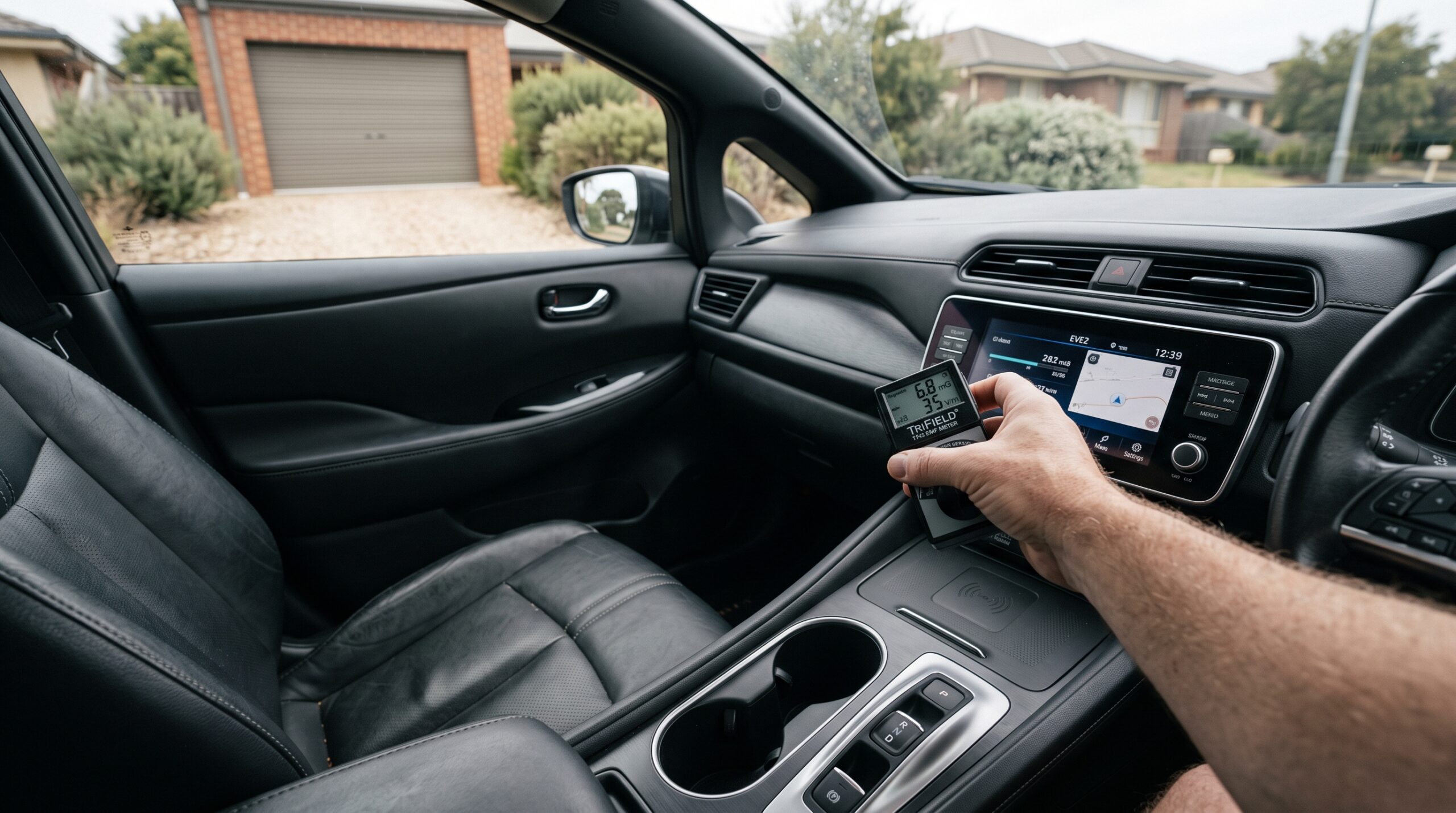
You do not need a laboratory or a $5,000 spectrum analyser. The magnetic fields inside an EV cabin are ELF (extremely low frequency) AC magnetic fields, and a consumer-grade meter with AC magnetic field measurement capability at 50 Hz handles this task. The TriField TF2 is the meter I recommend for this — it measures AC magnetic, AC electric, and RF in one device, and it is the most cost-effective all-in-one meter available in Australia.
Step-by-Step EV Cabin Measurement Protocol
This protocol gives you comparable, repeatable results. Follow it exactly and you will have data that means something — not just a number you saw once on a screen.
- Set the TriField TF2 to “Standard Magnetic” mode. This measures AC magnetic fields in milligauss (mG). To convert to microtesla: 1 µT = 10 mG. A reading of 20 mG = 2 µT.
- Park the car, engine off (no “Ready” mode). Take a baseline reading at each measurement position. This is your cabin background. It should be near zero. Record it.
- Turn the car on (“Ready” mode, stationary). Take readings at floor level (resting the meter on the floor mat), seat level (on your thigh or the seat surface), and head level (held at head height). Record all three.
- Drive at steady speed (60 km/h is ideal). Have a passenger hold the meter at seat level. Record the reading during steady cruising on a flat road. Repeat at floor level and head level if possible.
- Accelerate hard (safely). During a merge or on-ramp, note the peak reading at seat level. This is your transient maximum. It will spike and then return to the cruising baseline.
- Measure at all four footwell positions: driver front, passenger front, rear left, rear right. The footwell closest to the motor will show the highest reading.
- Check during regenerative braking. Lift off the accelerator and let regen slow the car. Some models show elevated fields during heavy regen as current flows back into the battery.
What you will likely find: seat-level readings of 2–6 µT (20–60 mG) during cruising, floor-level readings of 6–15 µT (60–150 mG), and transient spikes of 15–30 µT (150–300 mG) at floor level during hard acceleration. All well below the 200 µT (2,000 mG) ICNIRP reference level.
The TriField TF2 costs under $200 on Amazon AU. For that price, you get the actual numbers for your specific vehicle — not someone else’s measurements of a different model in a different country. That is the only data that matters for your situation.
EV Charging Stations and Home Charger EMF
Your vehicle’s cabin EMF is only half the conversation. The other question Australian EV owners ask is about the charger — the wallbox at home, the 7 kW Type 2 unit in the garage, the 50–350 kW DC fast charger at the shopping centre. The physics here is different from driving, and the practical exposure is typically lower.
Home AC Chargers (7 kW / 32 A Single-Phase)
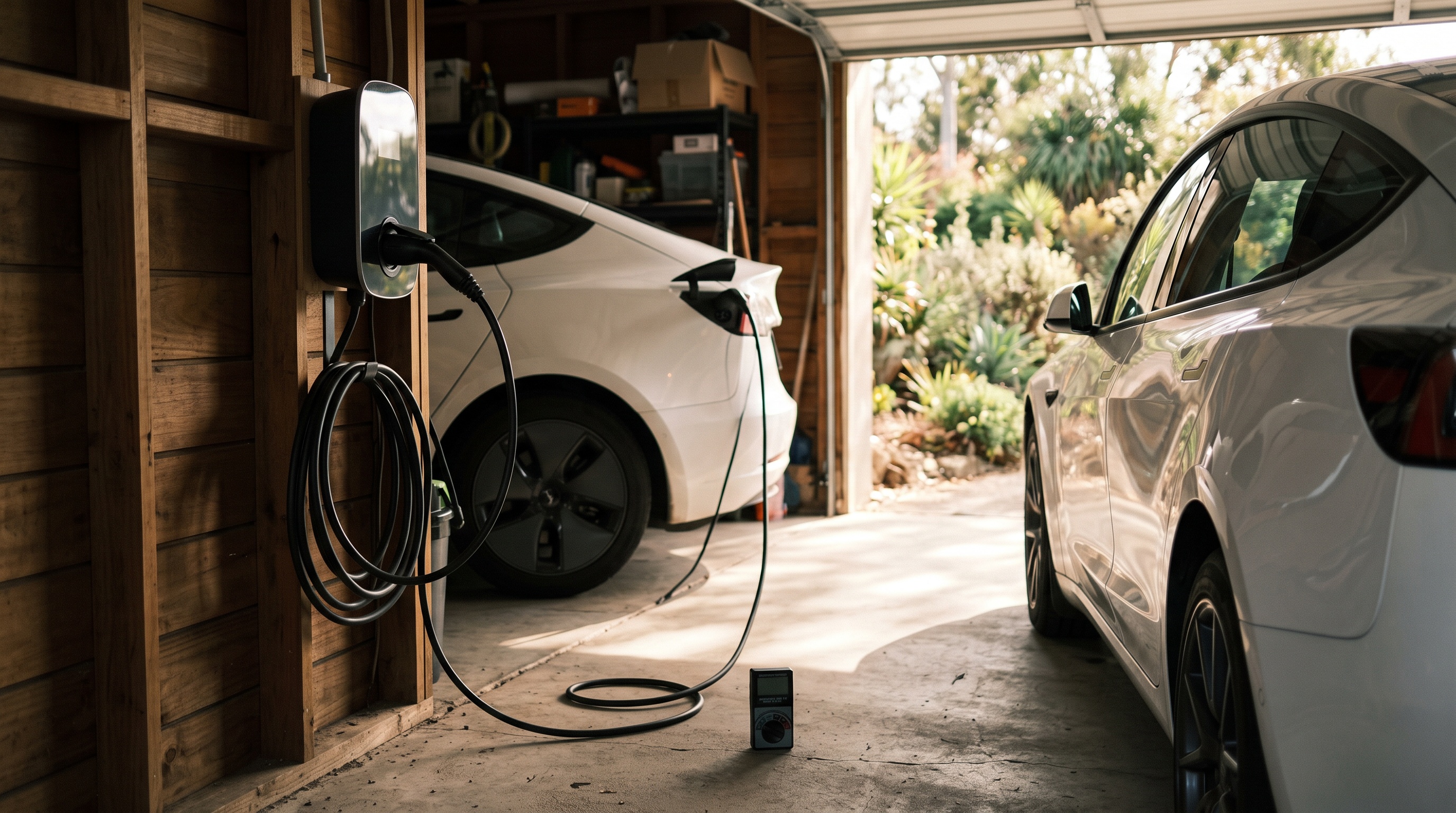
A 7 kW single-phase AC wallbox draws approximately 32 A at 230 V on Australian 50 Hz mains. The cable from wallbox to vehicle produces a magnetic field that follows the inverse-square law — it drops rapidly with distance. At 30 cm from the cable: approximately 2–4 µT. At 1 metre: below 0.5 µT. At 2 metres (inside your house, through a wall): below 0.1 µT and likely unmeasurable against background.
Practical implication: if your home charger is mounted on the garage wall and the cable runs to the car parked beside it, the magnetic field at any habitable room more than 2 metres from the cable is negligible. If your bedroom shares a wall with the charger, measure at the bedroom side of the wall. Move the bed if the reading exceeds the Building Biology SBM-2015 sleeping guideline of 0.2 µT — but this is unlikely at 7 kW single-phase.
Three-Phase Home Chargers (11–22 kW)
Three-phase chargers draw less current per phase for the same power output, and the three phases partially cancel each other’s magnetic fields. A 22 kW three-phase charger (32 A per phase) actually produces a lower net magnetic field than a single-phase 7 kW unit drawing the same current on one conductor. This is counterintuitive but important.
DC Fast Chargers (50–350 kW)
DC fast chargers at public stations carry high currents through liquid-cooled cables. The magnetic fields near the cable and connector can be higher — potentially 10–30 µT at 30 cm from the cable during a high-power session. But you are not sitting next to the cable for 30 minutes. You are typically 2–5 metres away inside a shopping centre, in the car, or standing nearby. At those distances, the field drops below 1 µT. Charging sessions at DC fast chargers are also shorter (20–40 minutes) than the 6–8 hour overnight AC charge.
Where EV EMF Actually Sits in Your Total Daily Exposure
Here is the question that reframes the entire EV EMF discussion: is your electric car the dominant EMF source in your life? For almost every Australian EV owner, the answer is no. Not even close.
Your average commute in an Australian capital city is 30–45 minutes each way, according to ABS 2024 Census of Population and Housing data. That is 60–90 minutes of EV cabin exposure per day. You spend 7–9 hours sleeping. You spend 4–8 hours in an office or home office. You spend 1–2 hours cooking, using appliances, or near a switchboard.
If your EV produces 4 µT at seat level during your commute, and your bedroom wiring produces 0.3 µT continuously while you sleep, the bedroom exposure is lower in intensity but 5–9x longer in duration. If your home’s reverse-cycle air conditioning unit runs overnight above your bed, the intermittent magnetic field from the compressor cycling can exceed 1 µT at the pillow — closer to the EV’s seat-level reading, for 8 hours instead of 1.
The highest-impact actions for reducing your total daily EMF exposure are almost always in the bedroom, not the car:
- Phone in airplane mode during sleep: eliminates RF and reduces AC magnetic fields from the phone’s power supply. Free.
- A Jackson 24hr mechanical timer on your Wi-Fi router: ~$20. Eliminates 8 hours of RF exposure per night.
- Demand switch on bedroom circuit: a licensed electrician installs it for ~$100–150. Eliminates AC electric fields from your bedroom wiring while you sleep.
- Measure your bed position relative to your smart meter: Energex (QLD) and Ausgrid (NSW) 900 MHz smart meters transmit in bursts with peak readings 100–1,000x higher than time-average. If your bed is on the other side of the wall from the meter, move the bed.
Your car is 60–90 minutes of your day. Your bedroom is 480 minutes. Fix the bedroom first. Then measure your car. You will almost certainly find the car is a smaller contributor to your total daily exposure than your bedroom was before you fixed it.
What About “EV EMF Shielding” Products?
If you search for EV EMF protection, you will find seat covers with metallic fibres, floor mats with shielding material, and stick-on “harmonising” devices. Here is the straight assessment.
Metallic shielding seat covers and floor mats: In theory, a conductive material between the floor and your body could attenuate the magnetic field reaching your torso. In practice, magnetic fields (unlike electric fields) are extremely difficult to shield. You need high-permeability materials like mu-metal, at significant thickness, properly grounded and enclosed. A thin metallic fabric floor mat cannot achieve meaningful magnetic field attenuation. If a product claims “99% EMF reduction” from a floor mat, ask them for the specific magnetic field attenuation in decibels at 50 Hz. If they cannot provide that number, the product is not doing what they imply.
Sticker-based “harmonisers” and “neutralisers”: These have no physical mechanism of action. Magnetic fields are governed by Maxwell’s equations. A sticker cannot alter the current flow in your vehicle’s inverter. Full stop.
What actually works: You cannot meaningfully reduce the magnetic field inside your EV cabin without redesigning the vehicle’s high-voltage architecture. What you can do is measure your specific vehicle, confirm it is within limits (it will be), and focus your EMF reduction efforts on the environments where you spend the most time — your bedroom and your office.
The Bottom Line for Australian EV Owners
Every electric vehicle sold in Australia produces cabin magnetic fields well below the ARPANSA-adopted ICNIRP reference level of 200 µT at 50 Hz. The peer-reviewed data from Gryz et al. (2022), Yang et al. (2019), and Hareuveny et al. (2015) consistently shows front-seat exposure well under 2 µT during normal driving — far lower than a household hairdryer.
Rear-seat readings can run higher in some hybrid models (up to 16 µT in one measured case), and buses/trolleys measured close to power equipment recorded the highest cabin fields in the literature (28–33 µT) — which is why measurement position and vehicle type matter, and why some alarming numbers circulating online come from non-representative sources. Every published figure remains well within the regulatory limit.
If you want to know your specific vehicle’s numbers — and you should, because measurement replaces speculation — a TriField TF2 in Standard Magnetic mode gives you the answer in 20 minutes. Then turn your attention to the environment where you spend the most hours: your bedroom. That is where the highest-impact EMF reductions happen.
Last reviewed: August 2026 – Clean and Native
Start with measurement. The TriField TF2 is the only meter you need.
Measures AC magnetic, AC electric, and RF in one device. Without real readings, every EMF decision is a guess — whether it is your EV cabin, your bedroom, or your home charger.
Frequently Asked Questions
Are electric cars safe from EMF in Australia?
Yes. Every EV sold in Australia produces cabin magnetic fields well below the ARPANSA-adopted ICNIRP reference level of 200 µT at 50 Hz. Peer-reviewed measurements show front-seat fields well under 2 µT during normal driving — under 1% of the safety limit.
What EMF levels are inside a Tesla Model 3 in Australia?
No published Australian-specific Tesla Model 3 measurement exists. Based on the closest comparable published data — Gryz et al. (2022) on battery-electric passenger cars with similar floor-mounted 400 V pack architectures — expect front-seat fields under 1.3 µT during cruising, with rear-seat readings potentially higher. All published EV data remains well below the 200 µT ICNIRP limit.
Does the BYD Atto 3 produce high EMF?
The BYD Atto 3 uses a front-mounted motor, which concentrates motor-related magnetic fields at the front footwell. Based on published data for comparable front-motor EVs (Gryz et al., 2022), expect front-seat fields under 1.3 µT. BYD’s Blade Battery structural pack design provides additional shielding. No independent Australian test has been published.
How do I measure EMF in my electric car?
Set a TriField TF2 to Standard Magnetic mode (reads in milligauss — divide by 10 for microtesla). Measure at the front seat and rear seat during stationary, steady cruising, and hard acceleration. The entire process takes under 20 minutes and gives you your specific vehicle’s actual field levels.
Is EV EMF higher than a petrol car?
At seat level, published data shows both are low. Hybrid/petrol-hybrid cars measured 0.007–0.175 µT across seat positions (Hareuveny et al., 2015). Battery-electric front seats measured 0.02–1.3 µT, with some hybrid rear seats running higher, up to 16 µT in one case (Gryz et al., 2022). Both are well within safety limits.
What is the ARPANSA EMF limit for electric cars?
ARPANSA does not have an EV-specific limit. It adopts the ICNIRP 2020 guideline for general public exposure to time-varying magnetic fields at 50 Hz, which is 200 µT. This applies to all sources including vehicles.
Do EV EMF shielding products actually work?
{“@context”:”https://schema.org”,”@type”:”Article”,”headline”:”Electric Car EMF Exposure Australia: What Tesla + BYD Passengers Actually Face”,”author”:{“@type”:”Person”,”name”:”Jayce Love”,”url”:”https://cleanandnative.com.au/about/”},”publisher”:{“@type”:”Organization”,”name”:”Clean and Native”,”logo”:{“@type”:”ImageObject”,”url”:”https://cleanandnative.com.au/wp-content/uploads/2024/01/clean-and-native-logo.png”}},”datePublished”:”2026-08-11″,”dateModified”:”2026-08-11″,”url”:”https://cleanandnative.com.au/emf/electric-car-emf-levels-australia/”,”image”:{“@type”:”ImageObject”,”url”:”https://cleanandnative.com.au/wp-content/uploads/2024/01/clean-and-native-logo.png”,”width”:1200,”height”:630}}
Get the Australian Home Environment Checklist
30 checks across water, air and EMF. Most of them free. Ranked by impact.
No spam. Unsubscribe any time.

Former Royal Australian Navy Clearance Diver and TAG-E counter-terrorism operator. Founded Clean and Native to apply the same rigorous thinking to the home environment.
Full biography →Similar Posts
DECT Phone EMF: Australia’s Hidden Bedroom Risk
DECT cordless phones transmit pulsed RF radiation at 1.88–1.9 GHz continuously — even when you are not making a call. According to Building Biology…
WiFi Router EMF: What the Numbers Show and How to Reduce Exposure (Australia 2026)
Yes, you lose WiFi overnight. Your NBN connection stays active at the modem level (the nbn NTD does not depend on your router). If you need overnight…
Smart Home Device EMF Australia 2026
The average Australian smart home now contains 12-18 wireless devices — each transmitting RF radiation 24 hours a day, most of them unnecessary. Your…
5G in Australia: EMF Risks & How to Protect Yourself
Australia’s 5G network is compliant with ARPANSA’s RPS S-1 standard, which sets the RF exposure limit at 1,000 µW/cm² at 2.4 GHz — a threshold based…
EMF Shielding Paint vs EMF Shielding Fabric: Which Should You Choose? (Australia 2026)
EMF shielding paint goes on permanent walls (Y-Shield HSF54, 41 dB attenuation, must be grounded). EMF shielding fabric goes on bed canopies + rentals (silver-cotton, 42 dB). Australian smart-meter/NBN/5G context, 2026.
Miranda Kerr’s EMF Fears: What You Can Do
Miranda Kerr’s instinct to keep the phone away from her head is physically correct. Here’s the evidence — and the free, measurable steps that actually reduce RF-EMF in an Australian home.