Bushfire Smoke & Air Quality: Protect Your Home in Australia
During Australia’s bushfire season, outdoor PM2.5 concentrations routinely exceed 500 µg/m³ — twenty times the NEPM standard of 25 µg/m³ — and standard weatherstripping does nothing to stop it entering your home. The most effective strategy combines a sealed room with a HEPA air purifier rated for your room size, triggered by live AQI monitoring, and maintained with filter replacements sized to Australian smoke season intensity.
Why Staying Indoors Is Not Enough: The Leaky Home Problem
Every health authority in Australia tells you to stay indoors during bushfire smoke events. That advice is not wrong — it just has a critical expiry time that nobody talks about. A published study in NCBI/PubMed examining residential smoke infiltration in Australian housing stock found that older Australian homes are “quite leaky,” with air exchange rates high enough to equalise indoor and outdoor PM2.5 concentrations over an extended smoke event. The shelter-in-place strategy works for a few hours. After that, without active filtration, you are breathing outdoor air indoors.
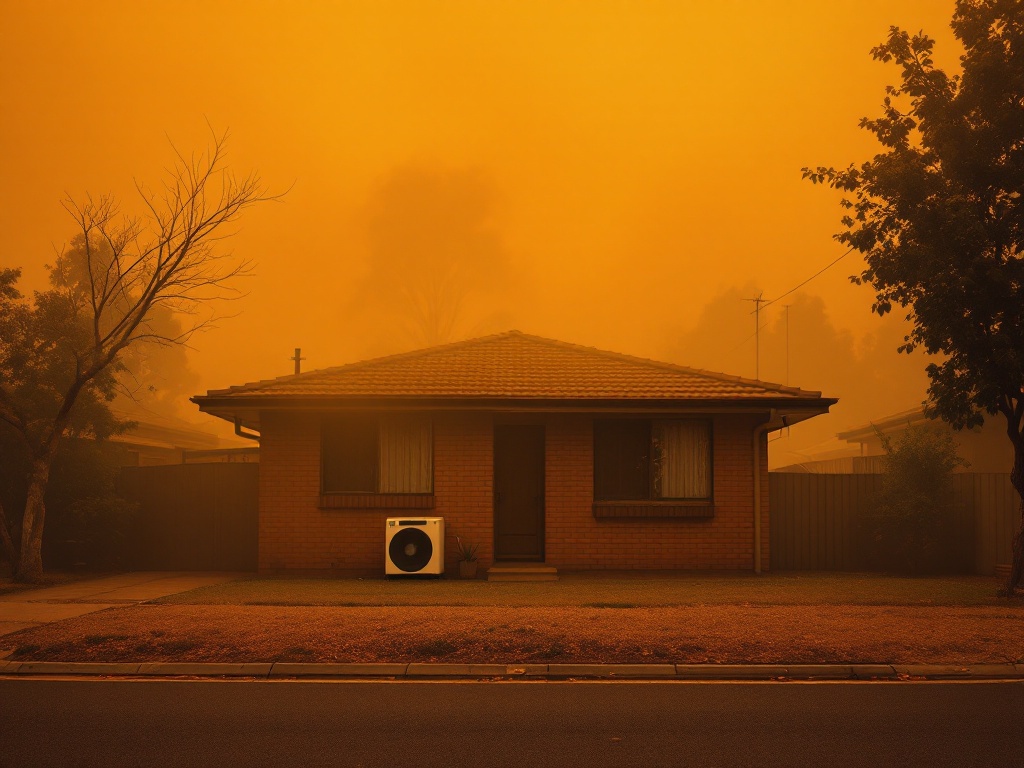
This matters because Australian bushfire smoke events are not short. During the Black Summer of 2019-2020, hazardous AQI readings persisted across Sydney, Canberra, and large parts of coastal NSW and Victoria for days and weeks at a time. Canberra recorded an AQI of over 7,700 in January 2020 — roughly 20 times higher than the level considered hazardous. Homes built before the 1990s, which dominate suburbs in western Sydney, inner Melbourne, and most of regional Australia, were not designed with air-tightness in mind. Gaps in window frames, subfloor vents, roof cavities, and exhaust fans create dozens of pathways for PM2.5 infiltration.
PM2.5 — particles 2.5 micrometres or smaller — is the primary health threat in bushfire smoke. At that size, they travel through the upper respiratory tract and deposit directly in the alveoli. According to Dyson-commissioned environmental research and independent air quality data, outdoor PM2.5 has a higher relative infiltration rate into homes compared to coarser or ultrafine particles. It is small enough to drift through building gaps but large enough to be efficiently captured by H13 HEPA filters, which must remove 99.97% of particles at 0.3 micrometres under EN 1822 testing conditions.
Real-Time AQI Monitoring: When to Activate Your Purifier
The single most common mistake people make is reacting to smoke they can see or smell. By the time you can smell smoke indoors, your PM2.5 concentration is already elevated. PM2.5 is odourless until concentrations reach levels that are well above safe thresholds. You need a data trigger, not a sensory one.
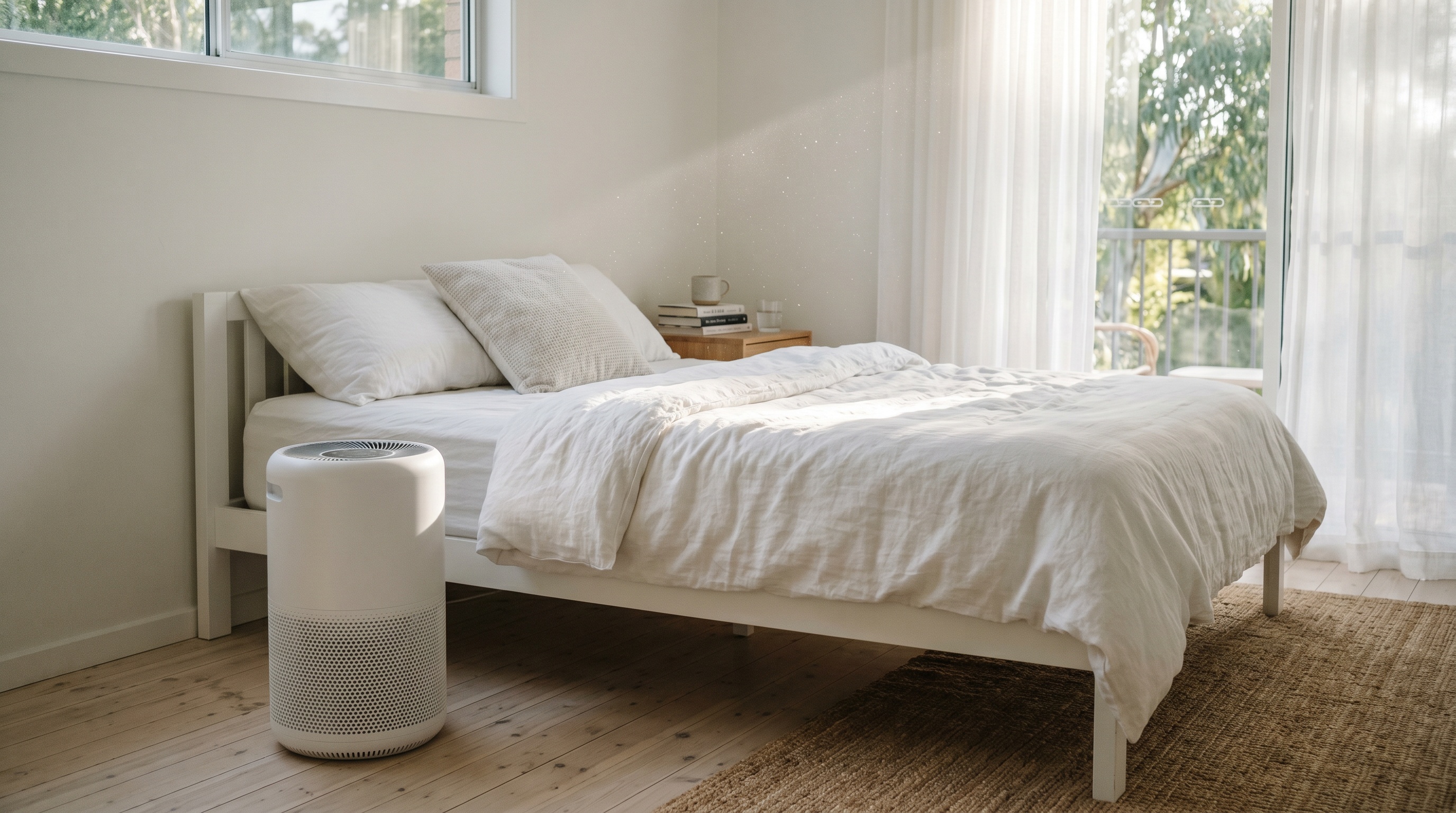
Australia does not have a single unified real-time AQI platform, but the state-based networks are accessible through the AQICN global feed (aqicn.org/city/australia/) and through state EPA portals:
- NSW: NSW Air Quality Monitoring Network via DPIE — provides hourly PM2.5 readings at 30+ stations
- Victoria: EPA Victoria AirWatch (vic.gov.au/airwatch) — real-time AQI with suburb-level mapping
- QLD: Queensland Air Quality Monitoring network, Airly nodes in Brisbane and SEQ
- SA/WA: EPA SA and DWER WA monitoring portals
- ACT: ACT Health Air Quality data — Canberra was among the hardest-hit cities in 2020
The NEPM standard for PM2.5 in Australia is 25 µg/m³ (24-hour average) and 8 µg/m³ (annual average). As a practical operating rule: activate your purifier on high when outdoor PM2.5 exceeds 25 µg/m³. Switch to your highest CADR setting when readings exceed 100 µg/m³. At 150+ µg/m³ — classified as Very Unhealthy — sealed-room protocol applies: close all windows and doors, switch your purifier to maximum, and remain in that room. This is not precautionary; it is what the data demands.
Several smart purifiers including the Levoit Core 400S and Breville Protect Max include built-in PM2.5 laser sensors. These provide in-room real-time readings and can trigger automatic speed adjustments. They are a useful secondary indicator, but they do not tell you what is coming from outside. Use state EPA data or AQICN to predict, and your indoor sensor to confirm.
Sealed-Room Setup: The Method That Works in Older Homes
If your home is older than 25-30 years, sealed-room strategy is your most effective protection during serious smoke events. The principle is simple: reduce a multi-room house to one small, tightly sealed room and run your purifier at maximum CADR in that space. The smaller the volume, the faster the air change rate, the faster PM2.5 concentrations drop.
Step 1: Choose the Right Room
Select the smallest room that can be occupied comfortably. Ideally a bedroom or internal room with the fewest windows and no exhaust vents. Avoid rooms adjacent to garage spaces (carbon monoxide pathway), rooms with large sliding doors, or rooms directly under a metal roof without ceiling insulation (thermal load). An internal bathroom without an exhaust fan is a good fallback for a household with small children.
Step 2: Seal Gaps Methodically
Use self-adhesive foam weather seal tape on door gaps and window frames. For a standard interior door with a gap under the frame, a rolled towel on each side reduces air infiltration significantly. Exterior windows in older Queensland and NSW homes often have aluminium louvre panels or single-slide sashes with no compression seal — apply temporary foam tape along the contact edges. Exhaust fan covers (the type designed for air conditioning ducts) can seal ceiling exhaust vents. None of this needs to be permanent. You are creating a temporary reduced-infiltration zone, not a hermetic seal.
Step 3: Size the Purifier Correctly
CADR — Clean Air Delivery Rate, measured in m³/hour — is the standard performance metric for air purifiers. To achieve the four-to-five air changes per hour recommended during smoke events, multiply your room volume (length x width x height in metres) by five, then select a purifier whose CADR equals or exceeds that number. A standard 4m x 4m x 2.7m bedroom has a volume of 43.2 m³. Five air changes per hour requires 216 m³/hr minimum CADR. The Breville Protect Max at 550 m³/hr CADR handles up to 110 m² comfortably and will clean that bedroom in under 15 minutes on maximum.
The Levoit Core 400S delivers 300 m³/hr CADR — appropriate for rooms up to 40-50 m² at high speed. If you are sealing a master bedroom for a couple with children bunked in, the Breville is the correct choice. If it is one adult in a small room, the Levoit is sufficient and costs less to run.
Our Top Picks for Bushfire Smoke Season
HEPA Filter Maintenance During Australian Smoke Season
Filter replacement in normal operating conditions (year-round, mixed indoor use) typically runs on a 6-12 month schedule. During active bushfire smoke season, that changes. PM2.5 loading during smoke events can saturate a HEPA filter in a fraction of the time — and a saturated filter does not fail gracefully. It continues to push air through, but filtration efficiency drops progressively as the filter media fills. Your purifier’s fan works harder, power draw increases, and your protection degrades without any visible warning.
The practical approach for Australian smoke season:
- Monitor the filter indicator religiously. Most smart purifiers (Levoit, Breville, Winix) have a cumulative runtime counter that triggers a replacement alert. During smoke season at high speed, you may hit that threshold in 3-4 months instead of 12.
- Hold spare filters before season starts. October in NSW, Victoria, and QLD is when you want a spare HEPA filter on hand, not when AQI hits 300. Buying a replacement filter during an emergency order surge means delays.
- Do not vacuum HEPA filters. Vacuuming an H13 HEPA filter damages the fibre matrix and reduces capture efficiency. Replace on schedule.
- Carbon pre-filter maintenance matters for smoke. Bushfire smoke contains VOCs — acrolein, formaldehyde, benzene — which the HEPA layer does not capture. The activated carbon layer does. During smoke events, the carbon stage loads faster. Pre-filters are typically cheaper and more frequently replaceable; check and replace on a shorter cycle during smoke season.
Annual Filter Running Costs: What to Budget
Annual Filter Cost — Australian Bushfire Season (Heavy-Use Estimate)
The Airdog range uses washable electrostatic collection plates instead of HEPA media, which eliminates per-filter replacement costs. That is a genuine advantage on paper. The real-world caveat is that electrostatic precipitators produce trace ozone as a byproduct of ionisation — a concern during smoke events when your airways are already under stress. Washable filter systems also require periodic cleaning discipline to maintain rated efficiency, and CADR figures drop significantly when the collection plates are partially loaded. For direct PM2.5 capture during smoke events, a true H13 HEPA system remains the clinically validated standard.
Sealed Room vs Whole-Home Purifier: Choosing the Right Strategy for Your Property
Not every household needs to default to sealed-room strategy. A newer, well-constructed home with aluminium double-glazed windows, positive pressure ducted air conditioning, and modern weatherstripping has significantly lower air infiltration rates. For that type of property, a whole-home purifier or a ducted system with a HEPA-rated media filter may be both practical and sufficient. For older homes, the sealed-room approach remains the most reliable protection during extreme events.
| Property Type | Air Infiltration Risk | Recommended Strategy | Product Tier |
|---|---|---|---|
| Pre-1990 fibro, brick veneer, or weatherboard (inner-west Sydney, regional NSW/VIC/QLD) | High | Sealed bedroom + high-CADR HEPA purifier | Breville Protect Max (550 CADR) |
| 1990s-2010s brick/rendered construction, standard aluminium windows | Moderate | Sealed room for extreme events, living-area purifier for moderate smoke | Levoit Core 400S per room |
| Post-2015 construction, NCC Section J compliant (lower air leakage by code) | Lower | Whole-home or ducted HEPA, AQI-triggered auto mode | Winix Zero Pro (multi-room) or ducted media filter |
| High-rise apartment (sealed corridor entry, centralised fresh-air system) | Variable | Bedroom HEPA purifier, check building’s fresh-air intake location | Levoit Core 400S or Winix Zero Pro |
For residents in the southern highlands of NSW, the Blue Mountains, and the east Gippsland coast — areas with documented wildfire interface zones — a permanent sealed-room setup with a high-CADR purifier is infrastructure, not optional equipment. Smoke season in those areas runs October through March and does not always give advance warning. The Breville Protect Max runs at 24 dB on its lowest setting, which means it is quiet enough to leave running overnight without disrupting sleep. At maximum speed during an active smoke event, it runs at approximately 52 dB — comparable to a quiet conversation. That is a reasonable trade-off for clean air during a hazardous event.
INOVA offers commercial and residential in-duct HEPA systems designed for larger homes and light commercial installations. Their residential range is quoted individually — contact pricing — which makes direct comparison difficult. For most Australian families in a 3-4 bedroom home, a combination of the Breville Protect Max for the main bedroom and a Levoit Core 400S for the living area covers the two most occupied zones without the complexity or cost of a whole-home ducted retrofit. Total outlay under $700. That is the practical answer for the majority of households.
Bushfire Smoke Beyond PM2.5: VOCs, Carbon Monoxide, and Ozone
HEPA filtration captures particulate matter. It does not capture gases. Bushfire smoke is a complex mixture — PM2.5 is the primary acute health threat, but it arrives with a chemical payload that includes acrolein, benzene, formaldehyde, and other VOCs that are confirmed carcinogens at sustained exposure levels. During a major smoke event, indoor VOC concentrations in unfiltered homes can reach multiples of the typical outdoor urban background.
This is why carbon filtration matters. An activated carbon stage — typically 200-500 grams of granular or powdered activated carbon — adsorbs VOCs through a physical bonding process. The Breville Protect Max contains an activated carbon layer rated for smoke-specific VOC removal. The Levoit Core 400S includes an activated carbon pre-filter, though its mass is lower. For households in direct fire zones or experiencing days-long smoke events at hazardous concentrations, the carbon stage is the difference between filtering smoke and filtering everything that comes with it.
Carbon monoxide (CO) is a separate issue. HEPA and activated carbon filters do not capture CO at the concentrations produced by nearby fire activity. If your home is in a direct bushfire zone or experiencing smoke from an active fire within several kilometres, a battery-powered CO detector is a separate, mandatory item. CO detectors and HEPA purifiers are not alternatives — they address different threats.
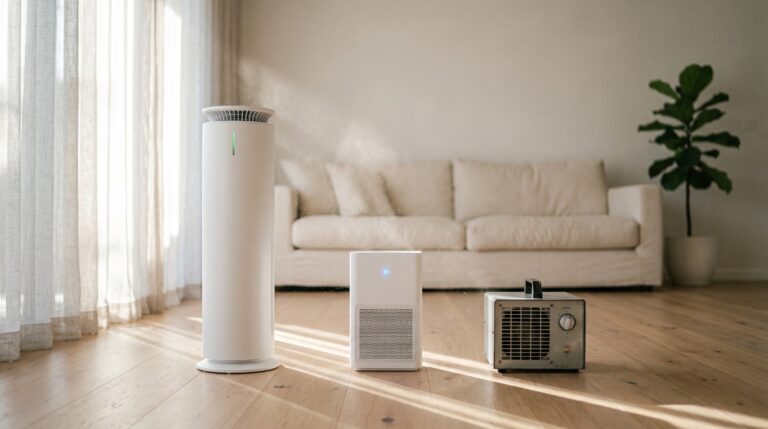
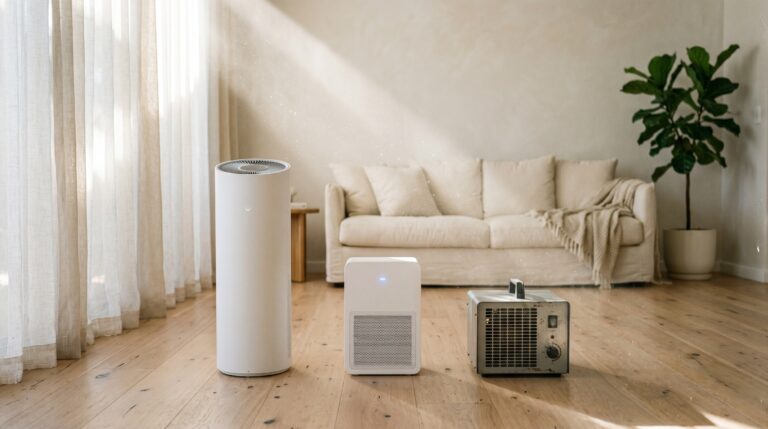
Ozone (O₃) is relevant in a different way. During smoke events, photochemical reactions between bushfire VOCs and sunlight can elevate ground-level ozone. Simultaneously, some air purifiers — particularly those marketed as “air ionisers” or “plasma” systems — produce ozone as a byproduct of ionisation. Running an ozone-generating device during a smoke event when outdoor ozone is already elevated is counterproductive. Stick to HEPA-only or HEPA-plus-carbon units. The Breville Protect Max and Levoit Core 400S both use purely mechanical filtration with no ionisation stage unless you manually enable the optional ioniser (which I recommend leaving off).
Our Verdict
Bushfire smoke is the most serious recurring indoor air quality threat for Australian households in NSW, VIC, QLD, and SA. The data is unambiguous: older homes leak enough PM2.5 to make stay-indoors advice meaningless without active filtration. The correct response is a HEPA purifier with an activated carbon stage, sized to your sealed room, triggered by live AQI data from your state EPA portal before you can smell anything.
For most Australian households, the Breville Protect Max is the benchmark recommendation — 550 CADR, H13 HEPA, activated carbon layer, and quiet enough for overnight bedroom use. The Levoit Core 400S is the right choice for smaller rooms or second zones, delivering 300 CADR with a smart PM2.5 sensor at roughly half the price. Stock spare filters before October. Monitor your state EPA AQI portal. And if your home was built before 1990, treat the sealed-room setup as non-negotiable infrastructure, not a last-resort reaction.
Last reviewed: June 2026 — Clean and Native
Frequently Asked Questions
Only for a few hours. Research published through NCBI confirms that older Australian homes are leaky enough to equalise indoor and outdoor PM2.5 concentrations over the course of an extended smoke event. Staying indoors without a running HEPA air purifier provides meaningful protection for 2-4 hours, then progressively less. Multi-day smoke events — which occurred repeatedly during Black Summer 2019-2020 — require active filtration to maintain safe indoor PM2.5 levels.
Calculate your room volume (length x width x height in metres) and multiply by 5 to get the m³/hr CADR needed for five air changes per hour. A standard 4m x 4m x 2.7m Australian bedroom requires approximately 216 m³/hr minimum. The Breville Protect Max at 550 m³/hr comfortably exceeds this. The Levoit Core 400S at 300 m³/hr is sufficient for rooms up to approximately 40 m² at high speed.
Use your state EPA portal: EPA Victoria AirWatch for VIC, the NSW DPIE Air Quality Monitoring Network for NSW, Queensland’s Air Quality Monitoring network for SEQ and regional QLD, and the DWER portal for WA. The global AQICN platform (aqicn.org) aggregates Australian state data and provides suburb-level real-time PM2.5 readings. Activate your purifier at PM2.5 above 25 µg/m³ — do not wait until you can smell smoke indoors.
No. HEPA filters capture PM2.5 and other particulate matter at 99.97% efficiency at 0.3 micrometres. They do not capture gaseous pollutants like benzene, formaldehyde, or acrolein, which are also present in bushfire smoke. An activated carbon stage is required for VOC removal. Choose a purifier that includes both HEPA and activated carbon layers — the Breville Protect Max and Levoit Core 400S both include carbon stages.
Under normal use (8-12 hours/day, moderate air quality), most HEPA filters last 6-12 months. During active smoke season at high speed, that period can shorten to 3-4 months due to accelerated PM2.5 loading. Monitor the filter indicator on your smart purifier and hold a spare filter before smoke season begins — typically October in NSW, VIC, and QLD. Do not vacuum HEPA filters; damaged fibre media reduces capture efficiency and should be replaced.
No — avoid ioniser or plasma modes during smoke events. These technologies produce ozone as a byproduct of ionisation. During bushfire smoke events, ground-level ozone is often already elevated due to photochemical reactions between VOCs and sunlight. Running an ozone-producing device in that environment adds to your respiratory irritant load. Use HEPA-only or HEPA-plus-carbon units and keep optional ioniser modes switched off.
Standard ducted air conditioning systems use coarse dust filters rated at G4 or similar — these capture large dust particles but allow PM2.5 to pass through freely. Unless your ducted system has been retrofitted with a MERV-13 or HEPA-rated media filter, recirculating air through your ducted system during a smoke event does not reduce PM2.5 meaningfully. Some newer systems support MERV-13 media upgrades — consult your HVAC installer. For most homes, a standalone HEPA purifier in a sealed room remains faster, cheaper, and more effective.
The highest-risk areas are the urban-rural interface zones in eastern Australia: the Blue Mountains and Hawkesbury region west of Sydney, the Southern Highlands and Shoalhaven in NSW, east Gippsland and the Dandenong Ranges in VIC, the Sunshine Coast hinterland and South-East Queensland ranges, and the Adelaide Hills in SA. During major fire seasons, smoke from these zones affects millions of residents in Sydney, Melbourne, Brisbane, and Canberra — cities hundreds of kilometres from the fire front. Residents in these cities are not immune and should maintain air purifier infrastructure accordingly.
No. HEPA and activated carbon filters do not capture carbon monoxide. CO is a gas that passes through air purifier filters entirely. If you are in an area with an active fire nearby, a battery-powered CO detector is a separate mandatory item. The Australian Standard AS 3786 applies to residential smoke alarms; for CO, look for detectors meeting AS/NZS 62990-1. A HEPA purifier and a CO detector address different threats and are not substitutes for each other.
Get the Australian Home Environment Checklist
30 checks across water, air and EMF. Most of them free. Ranked by impact.
No spam. Unsubscribe any time.

Former Royal Australian Navy Clearance Diver and TAG-E counter-terrorism operator. Founded Clean and Native to apply the same rigorous thinking to the home environment.
Full biography →