Is Brisbane Tap Water Safe to Drink in 2026?
14 min read
Brisbane tap water is legally safe to drink and meets all Australian Drinking Water Guidelines (ADWG) parameters. Urban Utilities publishes annual quality reports confirming this compliance. However, ‘safe’ means it won’t cause acute illness – not that it’s optimised for health. Brisbane water contains added fluoride (0.6-0.7 mg/L), chloramine disinfectants (0.5-2.5 mg/L), disinfection byproducts like trihalomethanes, and trace contaminants within permitted levels. While these won’t harm healthy adults acutely, many Brisbane households choose filtration to reduce chronic exposure to these additives and contaminants for optimal health.
Is Brisbane Tap Water Safe to Drink in 2026?
Brisbane tap water is legally safe to drink. It meets every parameter in the Australian Drinking Water Guidelines (ADWG), and Urban Utilities publishes annual quality reports to prove it. But “meets the guidelines” is a specific claim — it means the water will not make you acutely ill. It does not mean the water is optimised for health. Brisbane water contains added fluoride, chloramine disinfectants, disinfection byproducts, and trace contaminants that the guidelines permit at low levels but that a precautionary household might choose to reduce. Here is what is actually in it, why it is there, and what to do if you want to filter it out.
What is Actually in Brisbane Tap Water in 2026
Brisbane’s reticulated supply draws from Wivenhoe, Somerset, and North Pine dams, managed by Seqwater. After treatment, it is distributed by Urban Utilities across the greater Brisbane region. The water meets ADWG across all tested parameters. The question is what those parameters permit.
| Contaminant / Additive | Typical Level | ADWG Limit | Why It Is Present |
|---|---|---|---|
| Fluoride | 0.6–0.7 mg/L | 1.5 mg/L | Added deliberately under Water Fluoridation Act 2008 (Qld) |
| Chloramines | 0.5–2.5 mg/L | 5 mg/L | Primary disinfectant — more stable than free chlorine over long distribution distances |
| Trihalomethanes (THMs) | Under 100 ug/L | 250 ug/L | Disinfection byproduct — chloramine reacting with organic matter in source water |
| Haloacetic Acids (HAAs) | Monitored, within limits | 100 ug/L | Disinfection byproduct — peaks in summer with warmer source water |
| Aluminium | Trace, within limits | 0.2 mg/L | Residual from coagulation treatment process |
| PFAS | Monitored, no known issue | No enforceable limit yet (PFOA/PFOS guidance under review) | Industrial and firefighting foam contamination — monitored by Queensland Health |
None of these are present at levels that cause acute harm to healthy adults. The issue is chronic, cumulative exposure — and that is where the guidelines stop short, because they are designed to prevent harm, not optimise health. There is a gap between those two standards, and the gap is cheap to close with the right filter.
Fluoride: The Numbers and the Debate
Brisbane has added fluoride to its reticulated supply since 2008 under the Water Fluoridation Act 2008 (Qld). The target is 0.7 mg/L — consistent with the NHMRC’s 2017 recommendation and well below the ADWG upper limit of 1.5 mg/L. Seqwater measures fluoride continuously at treatment plants; results are published in annual quality reports and generally sit between 0.6 and 0.8 mg/L (per the Water Fluoridation Regulation 2020) across the distribution network.
The dental benefit case is supported by the NHMRC’s 2017 systematic review, which found no consistent evidence of harm to the general population at Australian fluoridation levels. The legitimate concerns cluster around two populations: infants whose formula is prepared exclusively with fluoridated tap water (cumulative daily intake can exceed recommended thresholds), and individuals with impaired renal clearance who retain fluoride at higher rates. For the general adult population drinking Brisbane tap water at normal volumes, fluoride is not an acute health risk.
My position: I filter fluoride at home. Not because 0.7 mg/L is dangerous to me specifically, but because I can remove it at low cost and I prefer not to consume a mineral I am not deficient in through my drinking water. That is a personal risk-management decision, not a public health statement.
For the full breakdown of Brisbane fluoride data and filtration options: Does Brisbane Tap Water Have Fluoride?
Why Brisbane Water Tastes the Way It Does — Chloramines
If you have noticed a chemical or slightly medicinal taste in Brisbane tap water — especially noticeable when you first fill a glass, or more pronounced in summer — that is chloramines. Brisbane uses chloramine disinfection (monochloramine specifically) rather than free chlorine. The reason is practical: chloramines are more stable and persist further along the distribution network without requiring re-dosing. Brisbane’s network is large; chloramines maintain residual disinfection all the way to your tap.
Chloramines are safe at the concentrations used in Brisbane. They are not, however, easy to remove — and this is critical if you are buying a filter.
Standard activated carbon filters — including most Brita-style pitchers — are designed for free chlorine. They are significantly less effective on chloramines. To reliably remove chloramines from Brisbane water, you need catalytic activated carbon or reverse osmosis. Confirm the specification explicitly states “chloramine reduction” before purchasing any filter for Brisbane use.
Disinfection Byproducts — The Summer Problem
When chloramines react with organic matter in source water, they produce disinfection byproducts — primarily trihalomethanes (THMs) and haloacetic acids (HAAs). Brisbane THM levels are measured quarterly and consistently sit well below the ADWG limit of 250 ug/L. Compliance is not the concern. The concern is that DBP formation peaks in summer when water temperatures are higher and dam catchments carry more organic load following rainfall events. That is the same season when consumption is highest.
THMs in the chloroform and bromodichloromethane families are classified as possible human carcinogens (Group 2B, IARC) at chronic high doses. The evidence for harm at ADWG-compliant levels is limited, but the precautionary case for removal is reasonable. Reverse osmosis removes THMs effectively. Activated carbon provides partial reduction.
Clean Water
The right filter removes what this article describes.
Reverse osmosis is the only residential technology that reliably removes PFAS, fluoride, chloramine, and heavy metals. Our guide covers the top-rated options for Australian homes — tested, certified, and ranked by performance and running cost.
PFAS in Brisbane Water — What We Know in 2026
As of 2026, Brisbane’s reticulated water supply has no known PFAS contamination issue. Queensland Health monitors PFAS in drinking water supplies and Urban Utilities conducts testing. Brisbane’s dam catchments are not adjacent to historical firefighting training facilities or industrial PFAS sources in the way that some regional Queensland supplies have been affected.
If you live in an area near Amberley RAAF Base, legacy industrial precincts, or any area Queensland Health has flagged for PFAS monitoring, check the Queensland Health drinking water PFAS monitoring data for your suburb directly. Do not rely on general Brisbane-wide statements.
For PFAS removal: reverse osmosis is the only residential filtration technology with consistent, well-evidenced PFAS reduction. Standard activated carbon does not remove PFAS reliably. Ion exchange resin can also work but is less common in residential RO units.
What Filter to Use in Brisbane
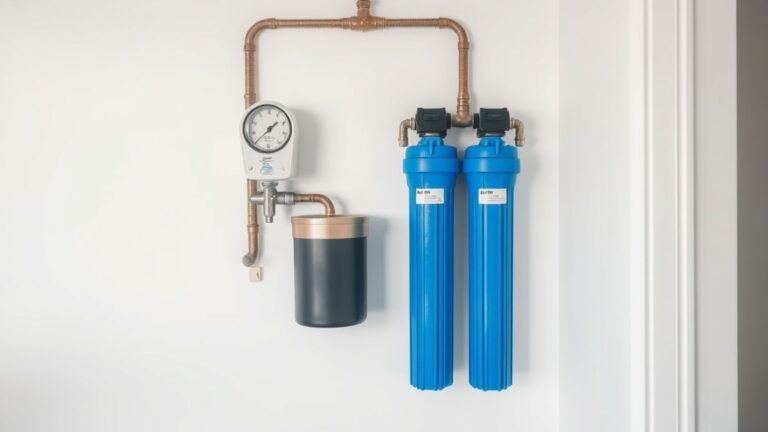
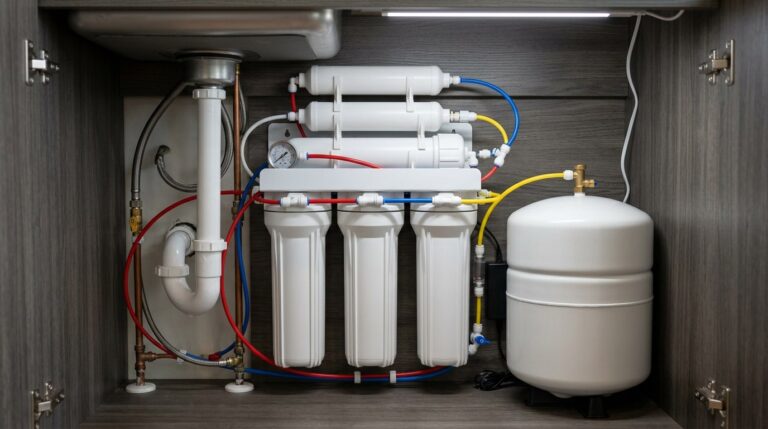
The contaminant profile of Brisbane water — chloramines, fluoride, DBPs, and potential PFAS depending on location — points clearly toward reverse osmosis as the most complete solution. Gravity filters and standard carbon pitchers handle neither chloramines nor fluoride adequately. Here is how the options break down by situation:
| Situation | Best Option | Removes | Does NOT Remove |
|---|---|---|---|
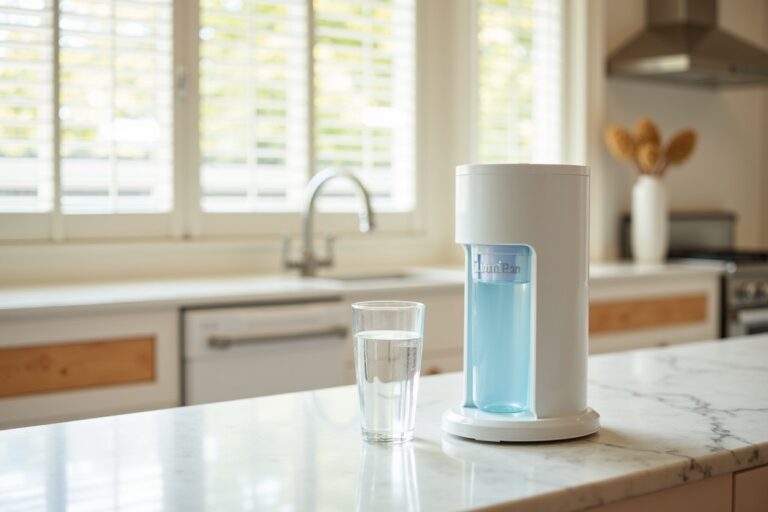
| Renter, no plumbing | Benchtop RO (Waterdrop) | Fluoride, chloramines, DBPs, PFAS, heavy metals | Nothing significant — most complete option |
| Homeowner, permanent install | Under-sink RO system | Full spectrum, higher flow rate | Nothing significant |
| Fluoride priority, gravity filter | Berkey or Clearly Filtered | Fluoride, chlorine, some DBPs | PFAS (not certified), chloramines (partial) |
| Taste and chloramine only | Catalytic carbon filter | Chloramines, taste and odour | Fluoride, PFAS, heavy metals |
| Budget, basic improvement | Catalytic carbon pitcher | Chloramines, taste — partial DBP reduction | Fluoride, PFAS, heavy metals |
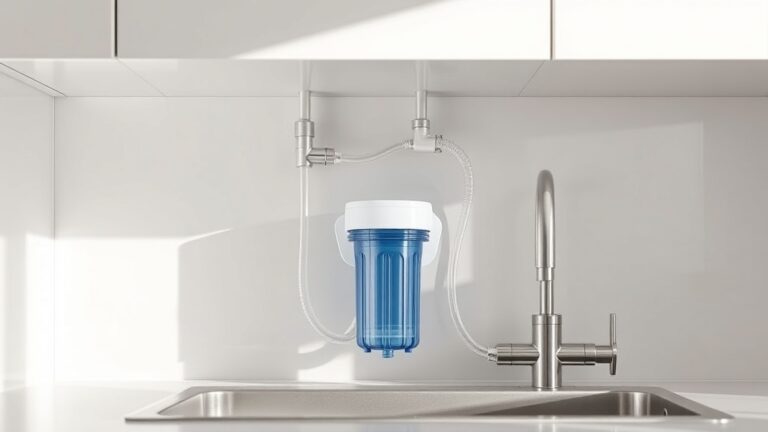
The Waterdrop benchtop reverse osmosis unit is what I use for drinking and cooking water. No plumbing required — it connects to your tap. It removes fluoride, chloramines, THMs, HAAs, PFAS, and heavy metals in a single pass. Running cost is around $80–100 per year in filter replacements. Full review and alternatives: Best Water Filters Australia 2026.
Check Berkey Price on Amazon →
Check Waterdrop Price on Amazon →
My Verdict: What I Actually Do
I spent years working in environments where water quality assessment was a professional responsibility, not a personal interest. The framework I apply at home is the same: identify what is present, assess the exposure route, reduce the controllable variables.
Brisbane tap water will not harm a healthy adult drinking it unfiltered. The levels of every regulated parameter are well within guidelines. But “well within guidelines” and “optimal” are not the same standard, and the gap between them — fluoride removal, chloramine removal, DBP reduction — costs about $80 a year to close with a benchtop RO unit.
I filter my drinking and cooking water. I do not filter shower water — dermally absorbed chloramine at Brisbane concentrations is not my priority concern. I do not boil water as a filtration strategy: boiling concentrates fluoride, does nothing for chloramines, and does not remove PFAS or DBPs. The right tool is the right filter.
Ready to filter your Brisbane water?
We have ranked the best benchtop and under-sink RO systems available in Australia — including options for renters who cannot modify plumbing — by fluoride removal rate, chloramine certification, running cost, and flow rate.
Frequently Asked Questions
Is Brisbane tap water safe for babies and infants?
Brisbane tap water meets ADWG and Queensland Health considers it safe for infant formula preparation. However, formula made exclusively with fluoridated water can push a young infant’s daily fluoride intake above recommended thresholds when combined with fluoride from other sources (toothpaste, supplements). If you are exclusively formula feeding a newborn to 6-month-old, using reverse osmosis-filtered water for preparation is a reasonable precautionary measure. This is not an emergency health warning — it is a straightforward risk reduction step.
Why does Brisbane tap water sometimes taste or smell chemical?
Almost always chloramines. Brisbane uses monochloramine disinfection rather than free chlorine — more stable over long distribution distances but more noticeable in taste, particularly in summer when water temperatures are higher and organic load in source dams increases. Not a health risk. A catalytic carbon filter or reverse osmosis removes it completely. Standard Brita-style carbon filters are not effective on chloramines — you specifically need catalytic carbon or RO.
Does boiling Brisbane tap water remove fluoride?
No — boiling makes fluoride concentration slightly worse. As water evaporates during boiling, the fluoride that remains becomes more concentrated. Boiling handles biological contamination only and has no effect on fluoride, chloramines, DBPs, or PFAS. For fluoride removal you need reverse osmosis, distillation, or activated alumina filtration.
Is Brisbane tap water hard or soft?
Soft to moderately hard. TDS in Brisbane typically reads 50–200 mg/L depending on distribution zone and season. Hard water is conventionally defined at above 200 mg/L (calcium carbonate equivalent). You do not typically need a dedicated water softener in Brisbane — scale buildup is not a significant issue for most households.
What filter actually removes chloramines from Brisbane water?
Catalytic activated carbon — not standard activated carbon. Standard carbon is designed for free chlorine and provides minimal chloramine reduction. Catalytic carbon has a modified surface structure that breaks down the chloramine molecule. Most quality reverse osmosis systems include a catalytic carbon pre-filter stage. If buying a standalone carbon filter, confirm the specification explicitly states “chloramine reduction” — do not assume standard carbon handles it.
Does Brisbane tap water contain PFAS?
No known PFAS contamination in Brisbane reticulated supply as of 2026. Queensland Health monitors PFAS in drinking water and Urban Utilities tests for it. Brisbane’s dam catchments are not adjacent to known PFAS contamination sources. If you live near Amberley RAAF Base or legacy industrial precincts, check Queensland Health’s PFAS monitoring data for your specific suburb. For PFAS removal: reverse osmosis only — standard activated carbon does not remove PFAS reliably.
Related Articles
Jayce Love
Former Royal Australian Navy Clearance Diver · Founder, Clean and Native · Palm Beach, QLD
Jayce spent years working in environments where water quality assessment was a professional responsibility. Clean and Native applies the same systematic risk-assessment framework to the home environment — identify what is present, assess the exposure route, reduce the controllable variables.
Is Fluoride Actually Bad For You?
This is a more contested question than most public health messaging lets on — and the research landscape shifted meaningfully in 2024.
The standard position from bodies like the NHMRC and ADA is that fluoride at recommended levels is safe and effective for dental health. That position hasn’t changed. But a significant body of peer-reviewed research has been accumulating that complicates the picture, particularly around neurological development in children.
What the Recent Research Actually Says
In 2024, the US National Toxicology Program (NTP) published a systematic review of 74 epidemiological studies on fluoride exposure and neurodevelopment. Their conclusion, stated with moderate confidence: higher fluoride exposure is associated with lower IQ scores in children. That finding was consistent across countries, age groups, and study designs — and it held up when the analysis was restricted to high-quality studies only.
The corresponding meta-analysis, published in JAMA Pediatrics in January 2025, found the inverse association between fluoride and children’s IQ persisted even at exposure levels below 1.5 mg/L — the WHO’s guideline maximum, and meaningfully close to the 0.8 mg/L target used here in South East Queensland.
In September 2024, a US federal court ruled that water fluoridation at the EPA’s own recommended level of 0.7 mg/L posed an unreasonable risk of reducing IQ in children and ordered the EPA to formally review the neurotoxicity evidence. That’s not a fringe legal outcome — that’s a federal ruling based on the NTP’s peer-reviewed findings.
Fluoride crosses the blood-brain barrier. The debate is not whether neurological effects are theoretically possible — it’s about dose thresholds and the confidence level of the evidence.
The Honest Position
The science is not as settled as fluoride proponents often suggest. The dental health benefits of fluoridation are real and well-documented. So is a growing body of evidence linking higher exposure to neurodevelopmental effects in children. Both things are simultaneously true.
For most healthy adults drinking Brisbane tap water at 0.8 mg/L, the risk is likely low. For pregnant women, infants, and households with young children who want to apply a precautionary approach — particularly given that topical fluoride from toothpaste already provides the primary dental benefit — reducing fluoride intake through a quality reverse osmosis filter is a reasonable, evidence-informed choice. That’s the framing this site operates from: not fearmongering, not dismissal. Accurate information so you can make your own call.
Get the Australian Home Environment Checklist
30 checks across water, air and EMF. Most of them free. Ranked by impact.
No spam. Unsubscribe any time.

Former Royal Australian Navy Clearance Diver and TAG-E counter-terrorism operator. Founded Clean and Native to apply the same rigorous thinking to the home environment.
Full biography →