VOC Offgassing from New Furniture Australia 2026
New furniture offgasses volatile organic compounds (VOCs) — primarily formaldehyde from composite wood — at concentrations that can reach 5 times outdoor levels inside a sealed Australian home. Peak offgassing occurs in the first 72 hours after delivery, but formaldehyde emissions from MDF and particleboard furniture can continue for 3 to 5 years, with the most significant exposure happening in the first 6 months.
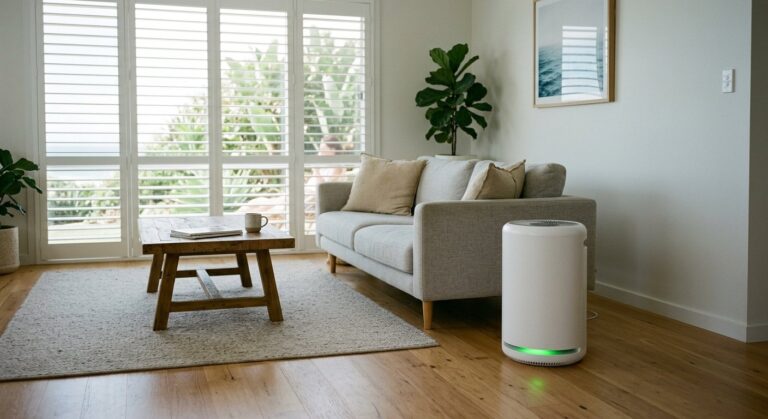
New furniture is the single largest source of formaldehyde in most Australian homes. Composite wood products (MDF, particleboard, plywood) bound with urea-formaldehyde resin offgas continuously, with peak TVOC output in the first 72 hours and measurable formaldehyde emissions lasting 3 to 5 years. Australia’s E1 formaldehyde standard (AS/NZS 2098.21) permits up to 1.0 mg/L — which is the same as the European E1 limit but twice the Japanese F★★★★ standard of 0.3 mg/L. In modern energy-efficient homes with 0.5 ACH or less, even E1-rated furniture can push indoor formaldehyde above the WHO guideline of 0.1 mg/m³. A HEPA + activated carbon air purifier like the Breville Protect Max is the fastest way to reduce airborne VOCs while furniture cures, but ventilation remains the most effective single action you can take.
| Factor | What You Need to Know | Verdict |
|---|---|---|
| Formaldehyde from MDF/PB | Peak 72 hrs, measurable 3-5 years. E1 limit: 1.0 mg/L | Primary offgassing concern |
| Ventilation (open windows) | Free, immediate 60-80% TVOC reduction when cross-ventilating | Recommended — most effective single action |
| Activated carbon air purifier | Adsorbs formaldehyde + VOCs; requires 1+ kg carbon bed | Recommended — Breville Protect Max (1.1 kg carbon) |
Key catches
- HEPA alone does NOT remove VOCs — you need activated carbon filtration for gaseous pollutants like formaldehyde
- Australia has no mandatory labelling requirement for formaldehyde emissions on finished furniture — you must ask the retailer for the emission class
- “Baking out” (heating a room to accelerate offgassing) works but requires sustained ventilation or it concentrates VOCs indoors
What Exactly Is Offgassing and Why Your New Furniture Is the Biggest Source
You know the smell. You unwrap a new bookshelf, unfold a flat-pack desk, or pull the plastic off a new mattress — and the room fills with a chemical tang that was not there ten minutes ago. That smell is volatile organic compounds evaporating from the materials in your furniture. As a former Navy Clearance Diver, I learned to take airborne chemical exposure seriously. The difference between a controlled-environment brief and your bedroom is that nobody is monitoring the air quality in your bedroom for you.
Offgassing is the release of gaseous chemicals from solid or liquid materials at room temperature. Every material offgasses to some degree — even solid timber releases terpenes. But the furniture in most Australian homes is not solid timber. According to CHOICE Australia, the majority of affordable furniture sold through IKEA, Fantastic Furniture, Officeworks, and online flat-pack retailers uses medium-density fibreboard (MDF), particleboard, or plywood as the structural material. These composite wood products are bound together with urea-formaldehyde (UF) resins, and those resins are the problem.
Urea-formaldehyde resins break down at room temperature, releasing formaldehyde gas continuously. The rate of release is highest when the product is new — before any surface curing has occurred — and declines logarithmically over time. But “declines” does not mean “stops.” Peer-reviewed studies published by NICNAS (now AICIS, the Australian Industrial Chemicals Introduction Scheme) confirm that formaldehyde emissions from UF-bonded composite wood are measurable for 3 to 5 years after manufacture, with the most significant exposure in the first 6 to 12 months.
Formaldehyde is not the only VOC. New furniture also releases toluene, xylene, benzene, acetaldehyde, and dozens of other compounds from paints, lacquers, adhesives, foam cushioning, and synthetic fabrics. According to Kaiterra’s published indoor air quality data, total VOC (TVOC) concentrations inside homes can reach 5 times outdoor levels, with new furniture and building materials as the primary source. In an energy-efficient Australian home with good insulation and low natural ventilation — exactly the kind of home built to NCC 2022 energy standards — those VOCs accumulate faster because there is less air exchange to dilute them.
Australian Formaldehyde Standards: E0, E1, E2 and What They Actually Mean for Your Health
If you are buying furniture in Australia and you want to know how much formaldehyde it emits, you need to understand the emission classification system defined in AS/NZS 2098.21. This Australian/New Zealand standard specifies three emission classes — E0, E1, and E2 — based on the desiccator test method, which measures the concentration of formaldehyde released from a sample in a sealed chamber over 24 hours at 20°C.
| Emission Class | Formaldehyde Limit (mg/L) | Equivalent International Standard | What It Means for You |
|---|---|---|---|
| Super E0 | ≤ 0.3 | Japanese F★★★★ | Lowest available. Used in Japanese residential construction. Rare in AU retail furniture. |
| E0 | ≤ 0.5 | Half the E1 limit | Good. Common in better-quality Australian cabinetry. IKEA uses E0.5 or lower globally. |
| E1 | ≤ 1.0 | European E1 (EN 13986) | The Australian default. Most flat-pack furniture meets this. Twice the Japanese F★★★★ limit. |
| E2 | ≤ 3.0 | No longer permitted in EU (banned 2020) | High emission. Banned in the EU since 2020. Still legally sold in Australia. |
Here is the gap that nobody in the Australian furniture industry wants to talk about. The European Union banned E2-rated composite wood from sale in 2020. Australia has not. There is no federal law preventing the import and sale of E2-rated particleboard furniture in Australia. The NCC (National Construction Code) Section J references E1 for building materials in new construction, but finished furniture is not covered by the NCC. You can walk into a retailer today and buy a desk made from E2-rated particleboard emitting formaldehyde at 3.0 mg/L — three times the E1 limit and ten times the Japanese F★★★★ standard — and there is no label on the box telling you so.
This matters because formaldehyde is classified as a Group 1 carcinogen by the International Agency for Research on Cancer (IARC) and is listed as a hazardous substance by AICIS (formerly NICNAS). The WHO guideline for indoor formaldehyde is 0.1 mg/m³ as a 30-minute average. According to AICIS data, a single E1-rated MDF bookshelf in a 12 m² bedroom with 0.5 ACH (air changes per hour — typical of NCC 2022 energy-efficient construction) can push indoor formaldehyde above 0.1 mg/m³ within 24 hours of installation. An E2-rated piece in the same room can push it above 0.3 mg/m³ — three times the WHO guideline.
The health effects at these concentrations are not subtle. AICIS reports that formaldehyde at 0.1 to 0.3 mg/m³ causes eye irritation, nasal passage irritation, headaches, and exacerbation of asthma symptoms. At 0.5 mg/m³ and above, throat irritation, coughing, and breathing difficulty begin. Sensitive individuals — children, the elderly, people with existing respiratory conditions — can experience symptoms at concentrations below 0.1 mg/m³.
How Long Does New Furniture Offgas in Australia — Climate, Humidity, and the Real Timeline
The standard answer you will find on US and European websites — “offgassing lasts a few weeks” — is wrong. It is wrong everywhere, but it is especially misleading for Australian conditions. Here is the real timeline, backed by published data from AICIS, the CSIRO, and peer-reviewed indoor air quality research.
The First 72 Hours: Peak TVOC Output
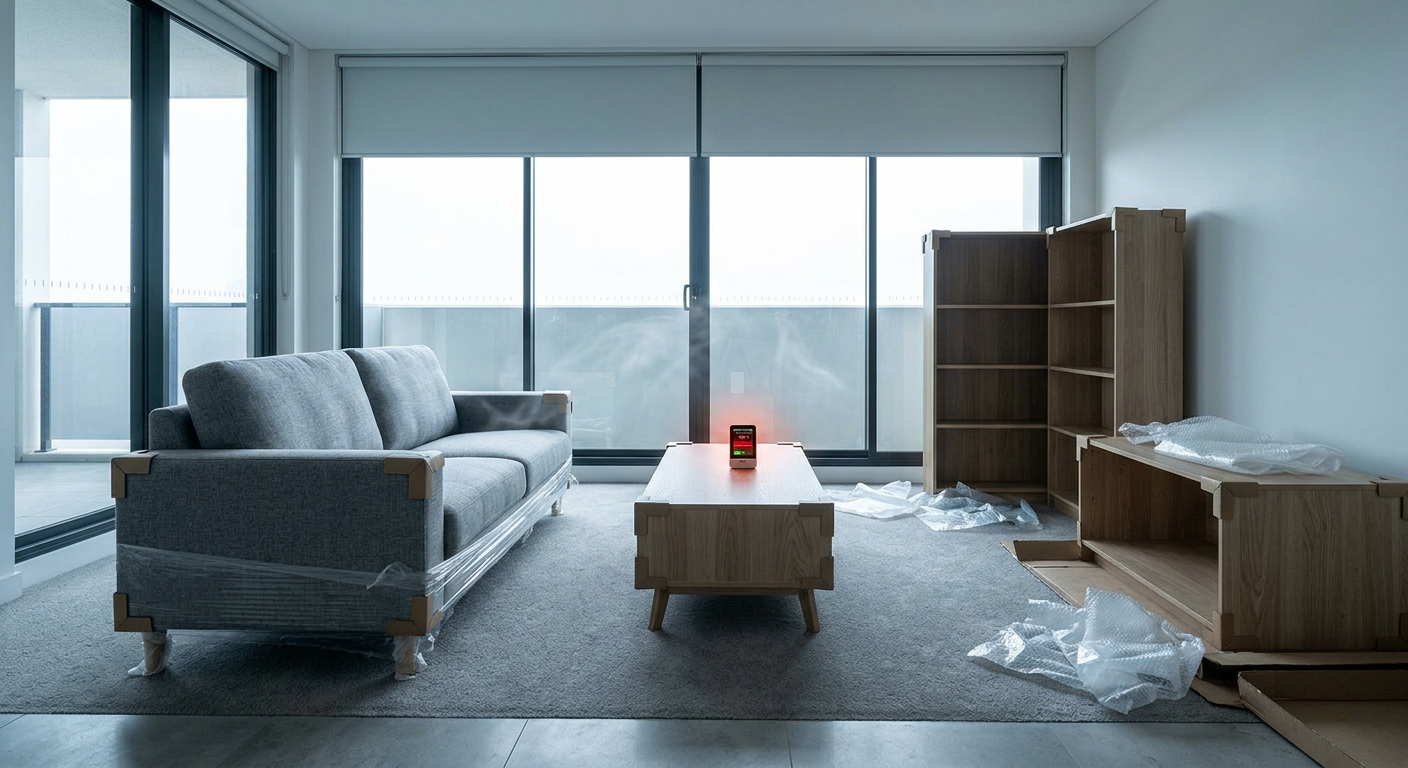
The first 72 hours after furniture delivery is the highest-risk window. During this period, TVOC concentrations in a sealed room can spike to 2,000-5,000 μg/m³ — compared to a typical background of 200-500 μg/m³ in an established Australian home. This spike comes from the initial evaporation of surface-level solvents, adhesives, and resin volatiles that have been trapped under packaging. The IndoorDoctor research confirms that in tightly sealed, energy-efficient homes, these concentrations accumulate faster and persist longer because there is insufficient natural ventilation to dilute them.
If you are furnishing a new apartment in Sydney, a townhouse in Brisbane’s Logan corridor, or a new-build in Melbourne’s western suburbs — all areas with high-density NCC 2022-compliant construction — you are in the highest-risk category. These homes are designed for energy efficiency, which means they seal in conditioned air. They also seal in formaldehyde.
Week 1 to Month 3: Rapid Decline but Still Elevated
After the initial 72-hour peak, TVOC concentrations decline rapidly — typically dropping 50-70% within the first week if you maintain reasonable ventilation (windows open 4+ hours daily). But formaldehyde behaves differently from other VOCs. While toluene, xylene, and most solvent-based compounds evaporate from surfaces relatively quickly, formaldehyde continues to be generated by the ongoing hydrolysis of urea-formaldehyde resin. It is not just evaporating from the surface — it is being chemically produced inside the board itself.
By month 3, you will notice the “new furniture smell” has largely dissipated. This is because the more volatile compounds (toluene, ethylbenzene, various alkanes) have evaporated. But formaldehyde is still being emitted at measurable rates. You just cannot smell it as easily because formaldehyde’s odour threshold (0.5-1.0 ppm) is above the concentration that causes health effects (0.08 ppm / 0.1 mg/m³ per WHO).
Month 3 to Year 5: The Long Tail
AICIS data shows that formaldehyde emission rates from UF-bonded composite wood decline by approximately 50% every 6 months, but never reach zero during the product’s usable life. After 12 months, a single E1-rated bookshelf in a well-ventilated room is unlikely to push indoor levels above the WHO guideline on its own. But most homes do not have a single piece of composite wood furniture. A typical Australian bedroom might contain a bed frame, two bedside tables, a wardrobe, and a chest of drawers — all MDF or particleboard. The cumulative load from five or six pieces can keep indoor formaldehyde above 0.1 mg/m³ for 2 to 3 years.
Australian Climate Accelerators
Two factors make offgassing worse in Australia than in cooler, drier climates:
Heat: Formaldehyde emission rates double for every 7-8°C increase in temperature. A Brisbane or Darwin home where indoor temperatures reach 28-32°C during summer (even with air conditioning cycling) will see emission rates 2 to 4 times higher than a climate-controlled lab at 23°C. Homes in Perth’s eastern suburbs, western Sydney (Penrith, Campbelltown), and North Queensland experience the highest indoor temperatures in Australia — and the highest offgassing rates.
Humidity: Moisture accelerates the hydrolysis of urea-formaldehyde resin, increasing formaldehyde release. Relative humidity above 60% — common in Brisbane (annual average 65%), Darwin (annual average 70%), Cairns, and coastal NSW — drives faster resin breakdown. According to CSIRO building science data, a combination of 30°C and 70% RH can increase formaldehyde emission rates by 3 to 5 times compared to 20°C and 45% RH.
This means if you live in Brisbane, Darwin, Cairns, Townsville, or coastal NSW, your new furniture offgasses faster and harder than identical furniture in Melbourne, Hobart, or Canberra. That is both a disadvantage (higher peak exposure) and an advantage (the curing process completes faster in hot, humid conditions).
The Baking Out Method: How to Accelerate Offgassing Safely
Baking out is a deliberate strategy to accelerate VOC offgassing by raising indoor temperature while maintaining high ventilation. It works. But done incorrectly — heating without ventilating — it concentrates VOCs indoors and makes the exposure worse. Here is the protocol.
Step 1: Isolate the Furniture
If possible, place new furniture in a room that can be sealed off from the rest of the house and ventilated independently. A garage (with the roller door cracked open 15-20 cm) is ideal. A spare bedroom with windows that open to the outside is the next best option. The goal is to maximise airflow around the furniture without distributing VOCs through the rest of the home via your HVAC system.
Step 2: Heat the Room
Raise the room temperature to 30-35°C. In an Australian summer, this may require nothing more than closing the blinds and turning off the air conditioning. In cooler months or in Melbourne, Hobart, and Canberra, use a portable fan heater. Maintain this elevated temperature for 8-12 hours per baking cycle.
Step 3: Ventilate After Each Cycle
After 8-12 hours of heating, open all windows and run a fan (box fan, pedestal fan, anything that moves air) for a minimum of 2 hours. This flushes the concentrated VOCs out of the room. Then seal, heat, and repeat. Three to five baking cycles over 3 to 5 days can reduce initial TVOC emissions by 60-80% — compressing what would normally be weeks of passive offgassing into a few days.
Step 4: Monitor with a VOC Meter (Optional but Recommended)
A handheld TVOC meter (available on Amazon AU for $30-$80) gives you objective data on when the baking process has achieved sufficient reduction. You are looking for TVOC readings below 500 μg/m³ — ideally below 300 μg/m³ — before moving the furniture into a lived-in space. Without a meter, use your nose as a rough guide: if the chemical smell has largely disappeared after three baking cycles, you have captured the majority of the initial VOC load.
General indoor air quality check
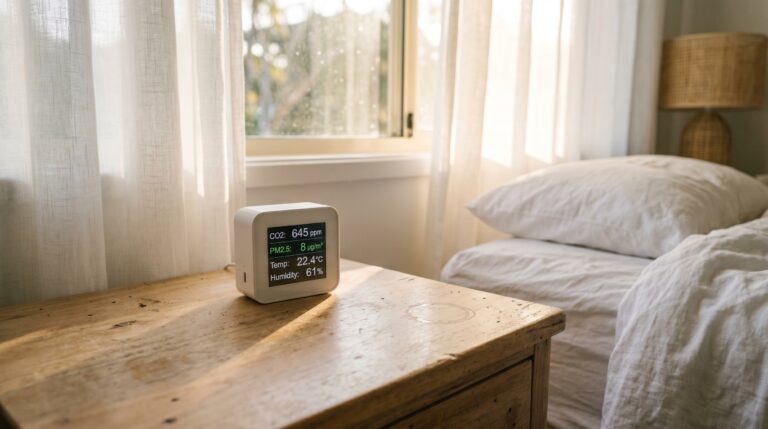
Inkbird Portable CO2 Detector is a genuine Inkbird indoor air quality monitor available on Amazon AU — note it tracks CO2, temperature, and humidity, not TVOC specifically. It will not tell you when off-gassing has cleared, but it is a useful companion check for the poor ventilation that traps VOCs indoors in the first place, since a sealed room during baking-out will also show rising CO2.
See Inkbird CO2 Detector on Amazon AU →Why You Need Activated Carbon — Not Just HEPA — to Remove Furniture VOCs
This is where most air purifier marketing fails you. HEPA filtration captures 99.97% of particles at 0.3 micrometres — dust, pollen, mould spores, bushfire smoke PM2.5. It is exceptional at particulate filtration. But formaldehyde is a gas. Its molecular size is 0.00012 micrometres. A HEPA filter does not touch it. It passes straight through.
To remove gaseous VOCs like formaldehyde, toluene, and benzene, you need activated carbon filtration. Activated carbon works by adsorption — gas molecules bond to the carbon’s massive internal surface area (1 gram of activated carbon has roughly 3,000 m² of surface area). The larger the carbon bed, the more VOC molecules it can capture before the carbon is saturated and needs replacement.
This is why the weight of the carbon filter matters more than any marketing claim about “VOC removal.” A 50-gram carbon filter sachet (the kind found in most budget air purifiers) saturates in days when exposed to new-furniture offgassing. A 1+ kg carbon bed can operate effectively for months.
Breville Protect Max: Why It Is Our Top Pick for VOC Offgassing
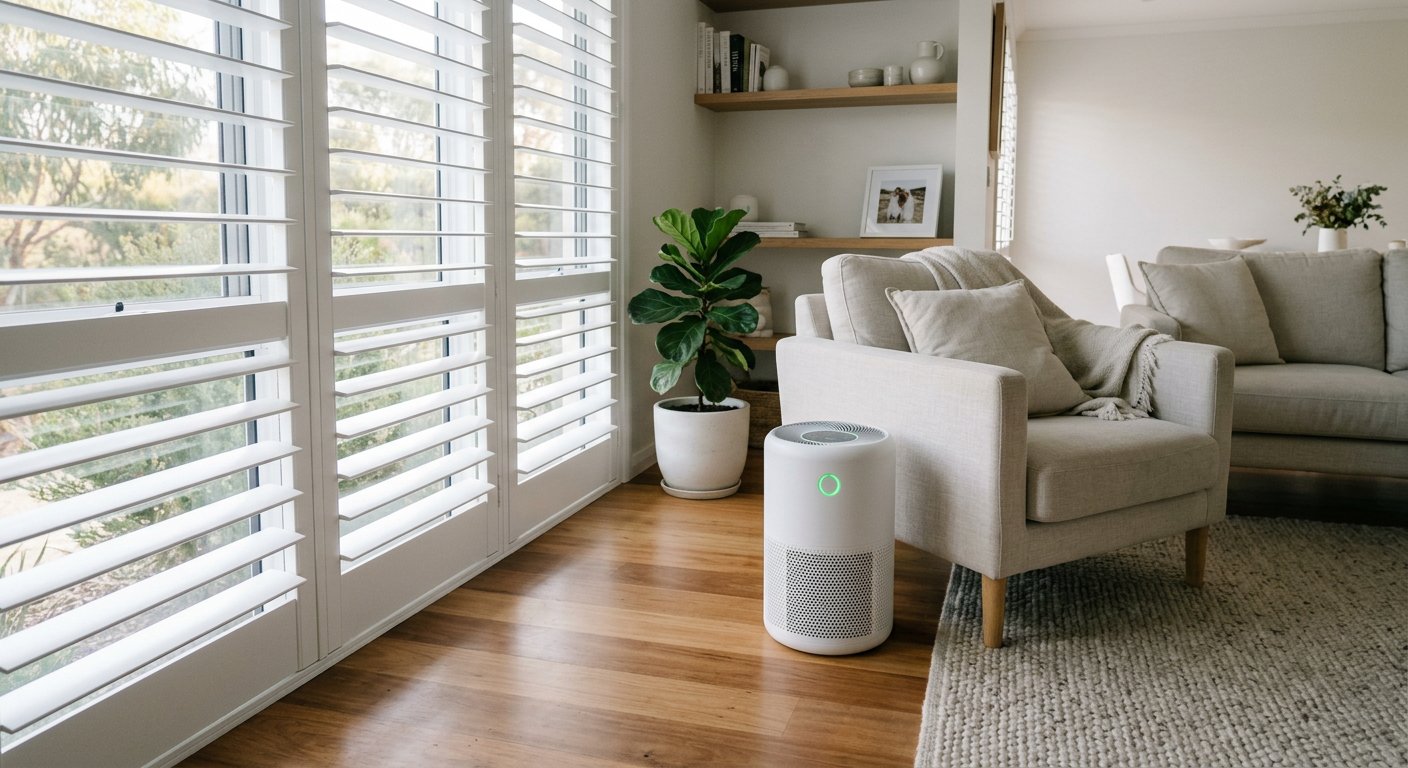
The Breville Protect Max carries a 1.1 kg activated carbon filter alongside its H13 HEPA stage. That is not a token carbon sachet — it is a substantive carbon bed capable of sustained formaldehyde adsorption over weeks to months. The unit covers rooms up to 40 m² (based on 4.8 air changes per hour), which handles a standard Australian bedroom or living room. At 24 dB on Sleep Mode — quieter than a whisper at 30 dB — it runs overnight without disrupting sleep.
For rooms with new furniture offgassing, run the Breville Protect Max on its highest setting for the first 72 hours, then drop to Auto mode. The built-in VOC sensor adjusts fan speed in response to detected TVOC levels, ramping up when concentrations spike (for example, when you close windows at night or when afternoon heat accelerates emission rates).
Ventilation vs Air Purification: What to Use and When
Ventilation and air purification are complementary, not interchangeable. Understanding when each one works best is the difference between effective VOC reduction and wasting your time.
When Ventilation Wins
Cross-ventilation — opening windows on opposite sides of a room to create airflow — is the single most effective action for reducing indoor VOCs. With adequate cross-ventilation, you can achieve 4-6 ACH (air changes per hour), which dilutes indoor VOC concentrations by 60-80% within 30 to 60 minutes. This is faster and more effective than any air purifier for acute VOC reduction.
Use ventilation as your primary strategy during the first 72 hours of new furniture installation, during baking-out cycles, and any time outdoor air quality is good (AQI below 50). In Brisbane, Sydney, Melbourne, Perth, and Adelaide, outdoor air quality is good on most days outside of bushfire season (October to March for NSW, VIC, and QLD) and high-pollen periods.
When an Air Purifier Wins
An activated carbon air purifier becomes essential in three scenarios:
1. You cannot open windows. Bushfire smoke season (October to March across NSW, VIC, and QLD) makes opening windows counterproductive — you are trading indoor formaldehyde for outdoor PM2.5. A HEPA + carbon unit like the Breville Protect Max handles both simultaneously: the HEPA stage captures smoke particulate while the carbon stage adsorbs formaldehyde.
2. Night-time exposure. You cannot sleep with windows open in most Australian homes for security, noise, or climate control reasons. But you spend 7-9 hours in your bedroom every night. If your bedroom contains new MDF furniture, an air purifier running overnight on Sleep Mode provides continuous VOC reduction during your longest single exposure window.
3. Apartments with no cross-ventilation. Single-aspect apartments in Sydney (Parramatta, Zetland, Green Square), Melbourne (Docklands, Southbank), and Brisbane (South Brisbane, Fortitude Valley) have windows on one side only. Without cross-ventilation, opening a window provides minimal air exchange. An air purifier with a CADR (Clean Air Delivery Rate) matched to the room size provides consistent, measurable VOC reduction regardless of building design.
How to Buy Low-VOC Furniture in Australia: A Decision Checklist
The most effective way to deal with furniture offgassing is to avoid it in the first place. If you are furnishing a new home — or replacing existing furniture — here is the hierarchy of options from lowest to highest VOC emissions.
Option 1: Solid Timber (Lowest VOCs)
Solid timber furniture emits only natural terpenes — low concentrations, non-toxic, and typically dissipate within days. Australian hardwoods (spotted gum, blackbutt, Tasmanian oak) are excellent choices. The limitation is cost: a solid timber desk costs 3-5 times more than an equivalent MDF desk. For bedside tables and bed frames — where your face is within 30 cm of the material for 8 hours a night — solid timber is worth the investment.
Option 2: E0 or Super E0 Composite Wood
If solid timber is not in the budget, specify E0-rated or Super E0-rated composite wood. IKEA Australia has committed to E0.5 or lower across its product range globally. Custom cabinetry suppliers in Australia can source E0-rated MDF from Laminex (their Carb2-compliant range) and STRUCTAflor. Always confirm the emission class in writing before ordering.
Option 3: Fully Sealed/Laminated E1
E1-rated MDF or particleboard with all surfaces sealed — including edges, drill holes, and the back panel — offgasses significantly less than unsealed E1. The laminate or veneer acts as a barrier, slowing formaldehyde release from the board surface. Check the back panel and internal shelf edges: if you can see raw, unlaminated MDF, that is an uncontrolled emission surface.
What to Avoid
Unbranded imported flat-pack furniture with no stated emission class. Budget furniture sold online from overseas suppliers without an Australian importer of record. Any composite wood product where the retailer cannot tell you whether it is E0, E1, or E2. Without that information, assume E2 — because there is no Australian law preventing its sale.
Protecting Children and Sensitive Individuals
Children are disproportionately affected by indoor formaldehyde for three physiological reasons. They breathe faster (higher respiratory rate per kilogram of body weight). Their airways are narrower, meaning the same concentration of irritant causes proportionally greater inflammation. And they spend more time at floor level and in bedrooms — the zones where VOC concentrations are often highest (formaldehyde is denser than air at room temperature and can settle in still air).
The NHMRC (National Health and Medical Research Council) does not set a separate indoor formaldehyde guideline for children, but the WHO’s 0.1 mg/m³ guideline is set with sensitive populations in mind. For a child’s bedroom containing a new MDF bed frame and wardrobe, the protocol is simple: bake out the furniture before the child sleeps in the room (3-5 cycles minimum), run an activated carbon air purifier on Auto overnight for the first 6 months, and verify that the furniture is rated E0 or better.
If your child has asthma — and according to AIHW data, 1 in 9 Australian children (11%) has diagnosed asthma — formaldehyde exposure at concentrations above 0.06 mg/m³ can trigger bronchospasm. That is below the WHO guideline. For asthmatic children, E0 or solid timber furniture is not a luxury — it is a clinical necessity. If you have already installed E1-rated furniture in a child’s bedroom and cannot replace it, run the Breville Protect Max on Auto mode continuously and maintain maximum practical ventilation.
The Complete New Furniture VOC Reduction Protocol
Here is the full sequence, from delivery day to month 6. Every step matters. Skipping steps compounds risk.
Day 0 (delivery): Unpack all furniture immediately. Remove all plastic wrapping, foam padding, and cardboard. These packaging materials trap VOCs against surfaces and prevent initial offgassing. Place furniture in a well-ventilated room — ideally a garage or room with openable windows that can be isolated from the rest of the house.
Days 1-3 (baking out): Run 3-5 baking cycles. Heat room to 30-35°C for 8-12 hours, then cross-ventilate for 2+ hours. This captures the peak TVOC output window and compresses weeks of passive offgassing into days.
Days 4-14 (initial ventilation): Move furniture to its permanent location. Keep windows open a minimum of 4 hours daily. If using a Breville Protect Max or similar HEPA + carbon unit, run it on the highest setting during this period — this is not the time for Sleep Mode.
Weeks 3-12 (ongoing reduction): Drop to Auto mode on the air purifier. Continue ventilating when practical. TVOC concentrations should be declining noticeably. If you have a TVOC meter, you are looking for readings consistently below 500 μg/m³.
Months 3-6 (long-tail management): Formaldehyde is still being emitted but at significantly reduced rates. Run the air purifier on Auto or Sleep Mode overnight. Replace the carbon filter at the manufacturer’s recommended interval — a saturated carbon filter provides zero VOC adsorption and becomes dead weight inside the unit.
After 6 months, the most aggressive phase of offgassing is over. You can reduce air purifier use to overnight-only or move it to another room. Formaldehyde emissions continue at low levels for years, but with normal ventilation patterns, indoor concentrations should remain below the WHO guideline of 0.1 mg/m³ for most Australian homes.
Ready to deal with furniture offgassing?
The Breville Protect Max combines H13 HEPA filtration with a 1.1 kg activated carbon bed — the largest in its price class — to capture both particulate and gaseous VOCs from new furniture. 40 m² room coverage. 24 dB Sleep Mode. Built-in VOC sensor with auto-adjust.
Last reviewed: August 2026 – Clean and Native
Frequently Asked Questions
How long does new furniture offgas in Australia?
Peak TVOC offgassing occurs in the first 72 hours after delivery. Formaldehyde emissions from MDF and particleboard furniture decline by approximately 50% every 6 months but remain measurable for 3 to 5 years. Australian heat and humidity accelerate emission rates — homes in Brisbane, Darwin, and Cairns experience 3-5 times higher emission rates than Melbourne or Hobart homes with identical furniture.
Does IKEA furniture offgas formaldehyde?
Yes. IKEA uses MDF and particleboard bound with formaldehyde-based resins. However, IKEA has committed to E0.5 or lower emission standards globally, which is half the Australian E1 limit. IKEA furniture offgasses less formaldehyde than unbranded E1 or E2-rated alternatives, but it still offgasses.
Can a HEPA air purifier remove furniture VOCs?
No. HEPA filtration captures particles, not gases. Formaldehyde and other VOCs are gaseous molecules that pass straight through a HEPA filter. You need an activated carbon filter to adsorb gaseous VOCs. Look for units with a carbon bed weighing 1 kg or more for sustained effectiveness against furniture offgassing.
What is the E1 formaldehyde standard in Australia?
E1 is defined in AS/NZS 2098.21 and permits formaldehyde emissions of up to 1.0 mg/L (desiccator test method). It matches the European E1 standard but allows twice the emission rate of the Japanese F★★★★ standard (0.3 mg/L). E1 is the default for most composite wood furniture sold in Australia.
Is E2 furniture still legal in Australia?
Yes. Unlike the European Union, which banned E2-rated composite wood from sale in 2020, Australia has no federal prohibition on E2-rated furniture. There is also no mandatory labelling requirement for formaldehyde emission class on finished furniture. You must ask the retailer directly for the emission class.
Does baking out furniture actually work?
Yes. Heating a room to 30-35°C for 8-12 hours accelerates VOC evaporation from surfaces. Three to five baking cycles with cross-ventilation after each cycle can reduce initial TVOC emissions by 60-80%. The critical step is ventilating after heating — heating without ventilation concentrates VOCs indoors and worsens exposure.
Is formaldehyde from furniture dangerous for babies?
Babies and young children are more vulnerable to formaldehyde exposure due to their higher respiratory rate per kilogram of body weight and narrower airways. The IARC classifies formaldehyde as a Group 1 carcinogen. For nurseries, use solid timber furniture or E0-rated composite wood, bake out before the child occupies the room, and run an activated carbon air purifier for the first 6 months.
What is the WHO guideline for indoor formaldehyde?
The WHO guideline for indoor formaldehyde is 0.1 mg/m³ as a 30-minute average. A single E1-rated MDF bookshelf in a 12 m² bedroom with 0.5 ACH can push indoor concentrations above this threshold within 24 hours of installation, according to AICIS (formerly NICNAS) data.
Does sealing MDF edges reduce formaldehyde offgassing?
Yes. Unsealed raw MDF surfaces — including back panels, shelf edges, and drill holes — are uncontrolled formaldehyde emission surfaces. Laminate, veneer, or paint acts as a barrier that slows formaldehyde release. When buying composite wood furniture, check that all surfaces are sealed, not just the visible faces.
Does humidity make furniture offgassing worse?
Yes. Moisture accelerates the hydrolysis of urea-formaldehyde resin, increasing formaldehyde emission rates. According to CSIRO building science data, a combination of 30°C and 70% relative humidity can increase formaldehyde emissions by 3 to 5 times compared to 20°C and 45% RH. This makes Brisbane, Darwin, Cairns, and coastal NSW the highest-risk regions in Australia for furniture offgassing.
Get the Australian Home Environment Checklist
30 checks across water, air and EMF. Most of them free. Ranked by impact.
No spam. Unsubscribe any time.

Former Royal Australian Navy Clearance Diver and TAG-E counter-terrorism operator. Founded Clean and Native to apply the same rigorous thinking to the home environment.
Full biography →