DIY Corsi-Rosenthal Box Australia 2026 Build Guide
A Corsi-Rosenthal box is a DIY air purifier built from a box fan and four or five MERV-13 filters, delivering 600-1,000+ m³/h of clean air delivery rate (CADR) for roughly $100-150 AUD in parts — outperforming most commercial HEPA purifiers costing $400-900. For Australian homes facing bushfire smoke season from October to March, it is the fastest, cheapest way to create a clean-air room without waiting for stock or paying premium prices.
A five-filter Corsi-Rosenthal box built with MERV-13 filters and a 50cm box fan delivers approximately 600-800 CADR (m³/h) for $100-150 AUD total — roughly the filtration output of a $700+ commercial HEPA unit. According to peer-reviewed testing published in Environmental Science & Technology Letters (2021), Corsi-Rosenthal boxes reduce indoor PM2.5 by 40-60% in occupied rooms. The design was co-developed by Dr Richard Corsi (UC Davis, now Portland State) and Jim Rosenthal (filter manufacturer) during the COVID-19 pandemic. It works exceptionally well for bushfire smoke events affecting NSW, VIC, QLD, and SA homes. However, it does not remove gases (NO₂, VOCs) or odours — only particulate matter. It is louder than premium commercial units, and MERV-13 filters capture approximately 85% of particles at 0.3µm compared to 99.97% for true HEPA. If you want set-and-forget air quality management with gas-phase filtration, app control, and quiet operation for bedrooms, the Breville Protect Max is the commercial alternative worth the premium.
| Technology / Product | What It Does | Verdict |
|---|---|---|
| Corsi-Rosenthal Box (DIY) | ~600-800 CADR, MERV-13 particulate filtration, ~$100-150 AUD | Recommended — best value per CADR dollar |
| Breville Protect Max | True HEPA H13, activated carbon for gases, 24 dB sleep mode, app control | Recommended — premium set-and-forget |
| Cheap single-fan + single-filter tape-on | ~150-250 CADR, restricted airflow, high noise | Avoid as primary — build the full cube instead |
Key catches
- MERV-13 captures ~85% of 0.3µm particles vs 99.97% for true HEPA — adequate for smoke events, not hospital-grade
- No gas-phase filtration — does not remove bushfire-generated NO₂, VOCs, or odours
- Louder than commercial units — expect 50-65 dB on high (comparable to a conversation, not sleep-friendly)
- MERV-13 filters in 20×20×1″ (508×508×25mm) size are harder to source in Australia than the US — see supplier list below
What Is a Corsi-Rosenthal Box and Why Does It Work?
If you lived through Black Summer 2019-2020 — when the AQI in parts of Canberra, Sydney’s western suburbs, and the NSW south coast exceeded 2,000 (the NEPM standard for “hazardous” starts at 200) — you already know the problem. Commercial HEPA purifiers sold out within hours. People with asthma, young kids, and elderly parents were breathing PM2.5 concentrations 10-20 times the WHO guideline of 15 µg/m³ (24-hour average). And the next smoke season is never more than a few months away.
The Corsi-Rosenthal box solves the supply-chain problem and the cost problem simultaneously. Developed during 2020 by Dr Richard Corsi (then Dean of Engineering at UC Davis) and Jim Rosenthal (CEO of filter manufacturer TEX-AIR), the design is radically simple: four or five MERV-13 furnace filters arranged in a cube or rectangle, with a standard box fan mounted on top pulling air through all filter panels at once. The large combined filter surface area (roughly 2.5-3.2 m² across five panels) means low air resistance per panel, high total airflow, and surprisingly quiet operation compared to a single filter strapped to a fan.
Peer-reviewed research published in Environmental Science & Technology Letters by Dal Porto et al. (2022) measured Corsi-Rosenthal boxes achieving 40-60% reductions in indoor PM2.5 in real occupied classrooms. A separate study by Pei et al. (2022) in the Building and Environment journal confirmed clean air delivery rates (CADR) of 600-1,000+ m³/h depending on fan speed and filter configuration — outperforming many commercial units priced at $500-900 AUD.
For you, sitting in Brisbane, Melbourne, Perth, or anywhere in regional Australia where bushfire smoke is a seasonal reality, this means you can build effective particulate protection in under an hour for less than $150. That is not a vague wellness claim. It is physics: more filter area means more air cleaned per minute at lower static pressure.
Australian Parts List: What You Need and Where to Source It
Here is the problem every Australian DIYer hits: nearly every Corsi-Rosenthal box guide online is American. They specify 20×20×1 inch HVAC filters from Home Depot and a 20-inch box fan from Walmart. Neither chain exists here. The filter dimensions are imperial. And Australian HVAC systems rarely use 20×20×1″ panel filters — our ducted systems tend to use different sizes or washable electrostatic filters. So you need a sourcing strategy built for the Australian market.
The Fan
You need a box fan (square or rectangular profile) that sits flat on top of the filter cube. The fan diameter determines the filter size you buy. In Australia, your best options are:
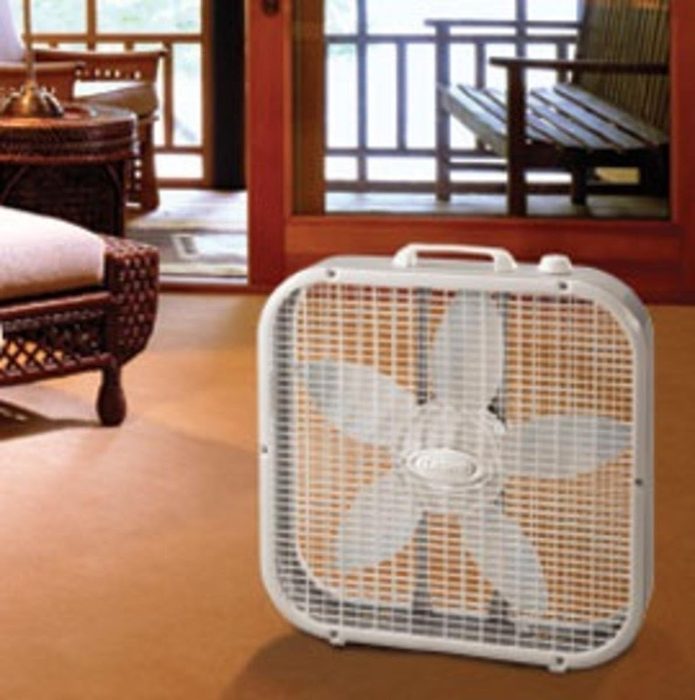
- Lasko 20-inch (50cm) Box Fan: The gold standard for this build. Available on Amazon AU for $50-80 AUD. The 50cm frame matches 20×20″ (508×508mm) filters exactly. Three speed settings. Draws approximately 60-75 watts on high.
- Generic 50cm box fans: Available from Kmart ($29-45), Big W, or Target seasonally. Check that the frame is truly square (not rectangular) and that the depth is consistent. Avoid oscillating tower fans — they do not create the even negative-pressure draw this design requires.
- 45cm (18-inch) box fans: Workable with 18×18″ filters, but reduces total filter area by roughly 20%. Use this only if you cannot find 50cm options.
Verified on Amazon AU
Lasko 3733 Air Circulating Box Fan, 20-inch
The exact 50cm frame this build is designed around — confirmed available and correctly priced on Amazon AU, not the inflated parallel-import listings some Lasko fans show up as.
See on Amazon AU →The Filters: MERV-13 in Australia
This is the hardest part of the Australian build. MERV-13 filters in the exact 20×20×1″ (508×508×25mm) size are not stocked at Bunnings or standard Australian hardware stores. Your sourcing options:
| Supplier | Filter Brand / Type | Size Available | Price (est.) | Notes |
|---|---|---|---|---|
| Amazon AU | Filtrete (3M) MERV-13 | 20×20×1″ | $25-40 each | Check stock — often imported, 1-2 week delivery |
| Camfil Australia | Camfil 30/30 or Aeropleat III | Custom cut / 595×595mm | $20-35 each | Phone order — Brisbane, Sydney, Melbourne offices |
| Daikin / local HVAC suppliers | MERV-13 panel filters | Various metric sizes | $20-45 each | Call your local HVAC wholesaler — they stock panel filters |
| eBay AU | Various US brands imported | 20×20×1″ | $30-50 each | Shipping adds $15-40; buy 5+ at once |
| Air Filters Australia (airfiltersaustralia.com.au) | Pleated panel filters | Custom sizes available | $15-30 each | Specify MERV-13 minimum; can cut to fan dimensions |
Verified on Amazon AU
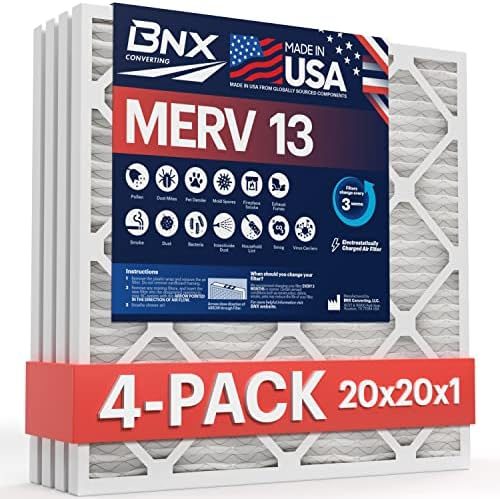
BNX TruFilter 20×20×1″ MERV-13 (4-Pack)
A genuine MERV-13-rated, correctly-sized 20×20×1″ pleated filter — one 4-pack covers a full five-filter build with a spare. No Filtrete MERV-13 exists in this size on Amazon AU, so this is the closest verified real substitute.
See on Amazon AU →Critical specification: insist on MERV-13 minimum. MERV-13 captures approximately 85% of particles at 0.3-1.0 µm and >90% of particles at 1.0-3.0 µm according to ASHRAE 52.2 testing methodology. This is the sweet spot for bushfire smoke PM2.5 filtration without creating excessive static pressure that stalls a standard box fan motor. MERV-14 or higher will work better at capturing fine particles but increases pressure drop — your fan may lose 20-30% airflow, negating the benefit. Stick with MERV-13 unless you are using a particularly powerful fan.
Other Materials
- Gaffer tape or foil-backed HVAC tape: $10-15 from Bunnings. You need approximately 10-15 metres to seal all edges. Do NOT use masking tape or painter’s tape — it degrades in heat and loses adhesion within weeks.
- Cardboard or corflute sheet: One piece the same dimensions as your fan (508×508mm) if you are building the five-filter version — this becomes the base panel. Free from any packaging.
- Optional: a pre-filter layer (fibreglass or polyester batting): $5-10 from Spotlight or Clark Rubber. Wrapping the exterior of the cube in a thin pre-filter layer catches large dust and pet hair, extending the life of your MERV-13 filters from roughly 3 months to 4-5 months during heavy use.
Total Australian Build Cost
| Component | Qty | Cost (AUD) |
|---|---|---|
| 50cm box fan | 1 | $30-80 |
| MERV-13 filters (20×20×1″) | 5 | $100-200 |
| HVAC / gaffer tape | 1 roll | $10-15 |
| Cardboard base panel | 1 | $0 (free) |
| Pre-filter batting (optional) | 1m | $5-10 |
| TOTAL | $145-305 |
The wide range reflects filter sourcing. If you can find MERV-13 filters locally through an HVAC wholesaler like Camfil Australia or Air Filters Australia, five filters will cost $100-150. Importing via Amazon AU or eBay pushes the filter cost higher with shipping. Budget $120-180 as a realistic total for most Australian builds.
Step-by-Step Build: Five-Filter Cube (Under 60 Minutes)
You have the parts. Now you are building. This is the five-filter version (four side panels plus one bottom panel), which provides roughly 25% more filter area than the common four-filter design and allows airflow from all directions including beneath the unit. I build these the same way I approached equipment assembly in the Navy: methodical, no shortcuts, every seal checked.
Step 1: Check Filter Arrow Direction
Every MERV-13 filter has an airflow direction arrow printed on the cardboard frame. In a Corsi-Rosenthal box, air flows inward through the filter and upward through the fan. That means the arrows on all five filters must point INWARD — toward the centre of the cube. Get this wrong and the filter media works against the airflow, dropping your CADR by 30-40% and increasing noise significantly. Check every panel before you tape.
Step 2: Assemble the Four Side Panels
Stand four filters on their long edges in a square, airflow arrows pointing inward. The cardboard frames of each filter should butt flush against the next filter’s frame at the corners. Tape the four vertical corner seams tightly with HVAC or gaffer tape — run the tape the full height of each seam, inside and outside. You want zero gaps. Any unsealed gap is unfiltered air bypassing the MERV-13 media, which defeats the purpose.
Step 3: Attach the Bottom Panel
Place the fifth filter on a flat surface, arrow pointing upward (toward the interior of the cube). Set your four-sided square frame on top of it. Tape all four bottom seams where the side filters meet the base filter. Again, run tape on both the inside and outside of each seam if you can reach. If you prefer a cardboard or corflute base instead of a fifth filter, tape it in place the same way — you will get slightly less total filter area but the build is simpler and cheaper.
Step 4: Mount the Fan on Top
Place the box fan on top of the cube with the exhaust side facing up (blowing air away from the cube). The fan pulls air inward through all five filter panels and exhausts clean air upward. This creates negative pressure inside the cube, which is what drives the filtration. Tape the fan frame to the top edges of the filter cube on all four sides. Seal any gaps between the fan housing and the filter frames — particularly the corners, which are the most common leak points.
Step 5: Seal, Inspect, and Test
Run your hand slowly around every taped seam with the fan on high. You should feel zero air being sucked inward at the seams — all air intake should come through the filter media faces only. If you feel suction at a seam, add more tape. A tissue paper test works well: hold a single-ply tissue near each seam. If it flutters or gets pulled toward the seam, you have a leak. Seal it.
Turn the fan to each speed setting and listen. On low, a well-built Corsi-Rosenthal box runs at approximately 45-50 dB — similar to a quiet conversation. On high, expect 55-65 dB depending on the fan. If you hear rattling or whistling, a filter is loose or a seal has a gap.
Performance: Corsi-Rosenthal Box vs Commercial HEPA Purifiers
You need hard numbers, not feelings. Here is how a well-built five-filter Corsi-Rosenthal box stacks up against commercial units available in Australia, based on published testing data and manufacturer specifications.
| Metric | CR Box (5-filter, high) | Breville Protect Max | Levoit Core 400S |
|---|---|---|---|
| CADR (approx. m³/h) | 600-800+ | ~420 | ~350 |
| Filter efficiency at 0.3µm | ~85% (MERV-13) | 99.97% (H13 HEPA) | 99.97% (H13 HEPA) |
| Gas-phase filtration (VOCs, NO₂) | None | Yes — activated carbon | Yes — activated carbon |
| Noise (high speed) | 55-65 dB | ~52 dB max | ~52 dB max |
| Noise (low / sleep) | 45-50 dB | 24 dB | 24 dB |
| Auto mode / sensor | No | Yes — PM2.5 sensor | Yes — PM2.5 sensor |
| Upfront cost (AUD) | $120-180 | ~$699-799 | ~$299-349 |
| Running cost / year (electricity) | ~$40-65 (75W, 12hr/day) | ~$15-25 (15-40W avg) | ~$12-20 (12-30W avg) |
| Filter replacement cost / year | $100-200 (5 filters × 2-3 sets) | ~$80-120 | ~$60-90 |
The takeaway is nuanced. On raw airflow per dollar, the Corsi-Rosenthal box crushes commercial units. You are getting roughly 600-800 CADR for $150 vs 350-420 CADR for $300-800. But the commercial units win on filter efficiency (99.97% vs ~85%), noise (24 dB vs 45-50 dB on low), gas-phase filtration, and convenience. If you need a purifier running in a bedroom while you sleep, 45 dB is not acceptable for most people — 24 dB on the Breville Protect Max is quieter than a whisper.
The smart strategy for bushfire season: build a Corsi-Rosenthal box for your largest living area (lounge room, open-plan kitchen) where you need maximum airflow during peak smoke events, and buy a commercial HEPA unit for the bedroom where noise matters. This two-unit approach gives you whole-home coverage for under $1,000 total.
Running Cost on Australian Electricity
At the average Australian residential electricity rate of $0.33/kWh (AER Default Market Offer 2025-2026 reference period), a 75-watt box fan running 12 hours per day costs approximately $0.30/day or $108/year. Most people will not run it year-round — realistically, you are running it during smoke events and high-pollen days, perhaps 60-120 days per year. That brings the annual electricity cost to roughly $18-36. Add two sets of replacement MERV-13 filters per year ($100-200) and your total operating cost is $120-240/year — still well below the upfront cost of most commercial units.
Australian Climate Considerations: Bushfire Smoke, Humidity, and Pollen
A Corsi-Rosenthal box designed for a Minnesota winter does not automatically translate to a Brisbane summer. Australian conditions create specific challenges you need to address.
Bushfire Smoke (October — March, NSW/VIC/QLD/SA/WA)
Bushfire smoke is predominantly PM2.5 and PM10 particulate matter — exactly what a MERV-13 filter is designed to capture. During Black Summer, according to NSW Department of Planning and Environment air quality data, western Sydney suburbs including Penrith, Richmond, and Campbelltown recorded PM2.5 levels above 200 µg/m³ for consecutive days — more than 13 times the WHO 24-hour guideline of 15 µg/m³. Melbourne’s northern suburbs, Canberra, and the NSW south coast were similarly affected.
During these events, a Corsi-Rosenthal box running on high in a closed room (doors and windows shut, gaps sealed with wet towels) can reduce indoor PM2.5 by 40-60% according to the Dal Porto et al. (2022) study. That is the difference between “hazardous” and “moderate” air quality. But understand the limitation: MERV-13 does not capture the gas-phase components of smoke — volatile organic compounds, carbon monoxide, nitrogen dioxide. If you can smell smoke, you are inhaling gases that the CR box cannot filter. For comprehensive smoke protection, you need activated carbon in addition to particulate filtration, which is where a Breville Protect Max or Winix 5500-2 with activated carbon filters becomes necessary.
Humidity (Brisbane, Cairns, Darwin, Coastal NSW)
High humidity above 70% RH can degrade MERV-13 filter performance over time. The filter media absorbs moisture, which reduces airflow and can promote mould growth within the filter pleats — the opposite of what you want from an air purifier. According to ASHRAE research notes on filter performance degradation, sustained operation above 80% RH can reduce MERV-13 effective filtration by 10-15%.
Mitigation: if you live in a high-humidity area (Brisbane, Cairns, Darwin, coastal QLD or NSW), run the CR box in an air-conditioned room where humidity is controlled below 60% RH. Do not run it outdoors or in non-air-conditioned spaces during summer. Replace filters more frequently — every 2 months instead of 3 during humid months. And inspect for mould growth on filter media monthly by looking at the intake faces for dark spots or musty smell.
Pollen Season (September — November, Most of Australia)
Grass pollen particles are large — typically 20-90 µm according to the Australasian Society of Clinical Immunology and Allergy (ASCIA). MERV-13 captures particles of this size at near 100% efficiency. A Corsi-Rosenthal box is extremely effective for pollen reduction indoors. If you suffer from hay fever in Melbourne (which has some of Australia’s highest pollen counts, per Melbourne Pollen monitoring), a CR box running in your bedroom with the door closed will measurably reduce your symptoms. For thunderstorm asthma events — where pollen grains rupture into sub-10µm fragments — MERV-13 still captures the majority, though a true HEPA filter provides better protection for the smallest fragments.
When to Build a CR Box vs Buy a Commercial HEPA Purifier
This is the decision that matters. Not every household should build a Corsi-Rosenthal box. Not every household needs to spend $700 on a Breville. Here is the honest breakdown.
Build a Corsi-Rosenthal Box If:
- You need maximum particulate CADR per dollar — nothing commercial under $700 matches the airflow output of a well-built CR box.
- You are preparing for bushfire season and commercial units are sold out — during Black Summer, HEPA purifiers disappeared from shelves within 48 hours of major smoke events reaching Sydney, Melbourne, and Canberra. A CR box can be built from parts available at HVAC suppliers and general retailers.
- You need to clean a large open-plan living space (40-80 m²) — most commercial units are designed for rooms of 20-40 m². A CR box on high pushes enough air for double that area.
- You enjoy building things and want a project with your kids — the build is simple, safe, and teaches practical physics.
Buy a Commercial HEPA Purifier If:
- Noise matters — particularly for bedrooms. A Corsi-Rosenthal box at its quietest (45-50 dB on low) is louder than most commercial units at maximum. The Breville Protect Max runs at 24 dB on sleep mode — quieter than a whisper.
- You need gas-phase filtration for smoke odours, VOCs, or chemicals. A CR box only filters particles. Activated carbon in commercial units addresses gases.
- You want set-and-forget operation with auto mode. PM2.5 sensors in the Breville and Levoit automatically adjust fan speed as air quality changes. A CR box has three manual speed settings and no sensor.
- You value aesthetics. A Corsi-Rosenthal box is a taped-together cube of furnace filters. It looks like what it is. In a bedroom, living room, or home office, some people find this unacceptable.
- You live in a high-humidity area and do not want to manage filter mould. Commercial units have sealed housings that protect filters from ambient moisture.
The best approach for most Australian households: build a CR box for the lounge/living area, buy a Breville Protect Max or Levoit Core 400S for the bedroom. Total investment under $1,000. You get maximum coverage, quiet sleep, and the peace of mind that when smoke rolls in, you are already set up. Without either, every bushfire smoke event delivers PM2.5 directly into your lungs — and according to the Medical Journal of Australia (Walter et al., 2020), the 2019-2020 bushfire season was associated with an estimated 417 excess deaths and 3,151 hospitalisations for respiratory and cardiovascular conditions.
Maintenance, Filter Replacement, and Longevity
A Corsi-Rosenthal box is not maintenance-free. If you build it and forget it, filter loading will reduce airflow to the point where the unit is doing almost nothing — and you will not know because there is no sensor to tell you.
Filter Replacement Schedule
Under normal conditions (urban air, occasional cooking, no smoke events), MERV-13 filters in a CR box last approximately 3-4 months. During active bushfire smoke seasons or if you have pets shedding heavily, expect 2-3 months. Visual inspection is your guide: pull the fan off the top and look at the intake face of each filter. If the pleats are visibly grey or brown and airflow has noticeably decreased, replace all five filters at once. Do not replace one at a time — uneven filter loading across the five panels creates pressure differentials that bypass the dirtiest filter.
Ongoing Cost vs Commercial Units
Using replacement filters at $20-40 each (five filters per set, 2-3 sets per year), your annual filter cost is $200-600. This is higher than commercial unit replacement filters ($60-120/year for the Levoit Core 400S, $80-120/year for the Breville Protect Max). The CR box’s cost advantage is entirely in the upfront price, not the ongoing consumables. If you plan to use it year-round for 3+ years, a commercial HEPA unit may actually be cheaper over its lifetime.
| Unit | Upfront | Annual Filters | Annual Electricity | 3-Year Total |
|---|---|---|---|---|
| CR Box (seasonal use, 120 days/yr) | $150 | $200-300 | $25-35 | $825-1,155 |
| Levoit Core 400S | $329 | $60-90 | $15-20 | $554-659 |
| Breville Protect Max | $749 | $80-120 | $15-25 | $1,034-1,184 |
Look at those 3-year numbers. The CR box is cheapest upfront but the Levoit Core 400S actually costs less over three years because its replacement filters are dramatically cheaper. The Breville Protect Max costs more overall but delivers H13 HEPA (99.97%), activated carbon, and a 24 dB sleep mode that the other two simply cannot match. Your budget and use-case determines the right choice — not ideology about DIY vs commercial.
Safety, Electrical, and Compliance Notes for Australia
Three things you need to know before you plug this in and walk away.
Electrical safety: Only use a box fan that carries Australian safety approval markings (the RCM mark — Regulatory Compliance Mark). Any fan sold at a legitimate Australian retailer (Kmart, Big W, Target, Harvey Norman) carries this mark. Do not import a US box fan with a US plug and use an adapter — the voltage mismatch (120V US vs 240V Australian) will destroy the motor or create a fire risk. If buying on Amazon AU, confirm the listing states “Australian plug” or “240V”.
Fire risk: A box fan pulling air through restrictive filters generates more heat than the same fan running unobstructed. MERV-13 filters are made of synthetic pleated media and a cardboard frame. Both are combustible. Do not leave the unit running unattended for extended periods unless the fan has a thermal overload protection switch (most quality box fans do). If the motor overheats and stops, unplug it immediately. Do not cover the exhaust side of the fan with anything — it needs unrestricted outflow.
CADR is not CARB certified: The California Air Resources Board (CARB) certification, which is referenced on most commercial air purifiers sold in Australia (listed under the federal GEMS scheme), does not apply to DIY devices. This means the CADR figures cited for CR boxes are from independent academic testing, not standardised laboratory certification per ANSI/AHAM AC-1. The numbers are real but not third-party verified in the same way commercial units are. For occupational or commercial use (offices, schools), speak to your WHS officer about compliance requirements — a DIY unit may not meet workplace safety standards.
Final Verdict: Build It, But Know Its Limits
I have built and tested Corsi-Rosenthal boxes at my place in Palm Beach, QLD. As a former Navy Clearance Diver, I approach gear evaluation the same way regardless of whether it costs $150 or $1,500 — does it do what it claims, reliably, under real conditions? The CR box does. It moves serious volumes of air through MERV-13 media and measurably reduces indoor PM2.5 during smoke events. It is the single best value-for-money particulate air cleaning solution available in Australia.
But it does not replace a HEPA purifier for bedroom use. It does not remove gases. It does not auto-adjust. And the ongoing filter cost is higher than most people expect. Build one for your living area. Put a Breville Protect Max or Levoit Core 400S in the bedroom. That is the combination that keeps your household breathing clean air from October to March without breaking the bank.
If bushfire smoke season starts tomorrow and HEPA purifiers are sold out, you can build a Corsi-Rosenthal box tonight. That alone makes it worth understanding.
Last reviewed: August 2026 – Clean and Native
Want set-and-forget air purification instead?
The Breville Protect Max is our top-rated air purifier for Australian homes — H13 HEPA (99.97% at 0.3µm), activated carbon for smoke gases, and a 24 dB sleep mode that is quieter than breathing. If you want the protection without the project, this is the one.
Frequently Asked Questions
Does a Corsi-Rosenthal box actually work for bushfire smoke?
Yes. Peer-reviewed research published by Dal Porto et al. (2022) in Environmental Science & Technology Letters measured 40-60% reductions in indoor PM2.5 in occupied rooms using Corsi-Rosenthal boxes with MERV-13 filters. It captures particulate matter effectively but does not remove gas-phase smoke components like VOCs or NO₂.
Where can I buy MERV-13 filters in Australia?
Camfil Australia (offices in Brisbane, Sydney, Melbourne) sells MERV-13 panel filters by phone order. HVAC wholesalers like Air Filters Australia can custom-cut to size. Amazon AU and eBay AU carry imported Filtrete (3M) MERV-13 filters in 20×20×1″ size, though delivery takes 1-2 weeks.
Get the Australian Home Environment Checklist
30 checks across water, air and EMF. Most of them free. Ranked by impact.
No spam. Unsubscribe any time.

Former Royal Australian Navy Clearance Diver and TAG-E counter-terrorism operator. Founded Clean and Native to apply the same rigorous thinking to the home environment.
Full biography →Similar Posts
Levoit Core 400S vs Winix 5500-2 Australia 2026: Which Mid-Range Purifier Wins?
The Levoit Core 400S wins on upfront cost (AU$280 vs AU$370), noise (59.9 vs 66.4 dB max), power draw (38W vs 57.9W), and coverage (37m² vs 33m²), making…
Best Air Purifier for Asthma Australia 2026: What the Evidence Actually Shows
best air purifier for asthma Australia — Clean & Native’s Australian guide covering everything you need to know, with evidence-based recommendations.
Sharp Plasmacluster Air Purifier Review 2026
Sharp’s Plasmacluster ion technology is marketed as a step beyond standard HEPA filtration — active ions released into the air to neutralise airborne…
Best Air Purifier Australia 2026: Compared for Home, Bedroom and Apartments
The best air purifiers for Australian homes in 2026 — compared for bushfire smoke, dust mites, mould and pet dander. Breville Protect Max (best overall), Winix Zero+ Pro (large rooms), Levoit Core 400S (mid-range), Coway Airmega 150 (best value). Real CADR data, 5-year running costs.
Dyson Purifier Cool vs Levoit Core 600S Australia 2026: Which Is Worth Your Money?
Every product mentioned in this article is assessed against manufacturer specifications and independent certification records — no gifted units, no brand payments.
Gas Stoves and Indoor Air Quality Australia 2026
Gas stoves produce nitrogen dioxide (NO2), benzene, carbon monoxide, and ultrafine particles directly into your kitchen — pollutants you would never…