DIY Corsi-Rosenthal Box Australia 2026 Build Guide
Drafted with AI assistance and checked against published specifications and certifications. First-hand measurements appear only where stated. How we make content
A Corsi-Rosenthal box is a DIY air purifier built from a box fan and four or five MERV-13 filters that moves a lot of particle-filtered air for very little money. In lab testing a five-filter box delivered about 1,000 to 1,450 m³/h of clean air delivery rate (CADR); typical home builds tested by researchers measured about 310 to 400 m³/h, in the range of a mid-size commercial purifier, for roughly $145 to $305 in parts. For Australian homes facing bushfire smoke season from October to March, it is the fastest, cheapest way to create a clean-air room without waiting for stock or paying premium prices.
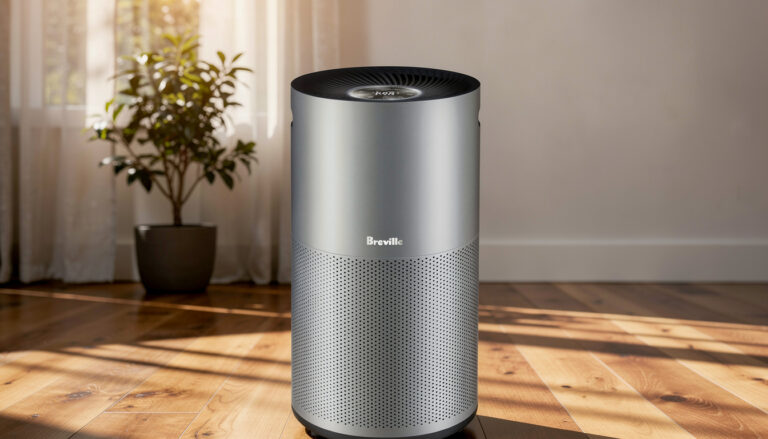
A five-filter Corsi-Rosenthal box built with MERV-13 filters and a 50cm box fan can match or beat the airflow of a mid-size commercial HEPA purifier for $145 to $305 in parts, depending on the fan and how well it is sealed. In peer-reviewed lab testing (Dal Porto et al., Aerosol Science and Technology, 2022), a five-panel MERV-13 box delivered an effective CADR of about 1,000 to 1,450 m³/h depending on fan speed; seven boxes built by first-time builders in a 2024 study measured 313 to 396 m³/h. The design was co-developed by Dr Richard Corsi (then incoming Dean of Engineering at UC Davis) and Jim Rosenthal (CEO of filter manufacturer Tex-Air Filters) during the COVID-19 pandemic. It works exceptionally well for bushfire smoke events affecting NSW, VIC, QLD, and SA homes. However, it does not remove gases (NO₂, VOCs) or odours, only particulate matter. It is louder than premium commercial units, and MERV-13 filters are rated to capture at least 50% of particles at 0.3 to 1 µm (and at least 85% at 1 to 3 µm), compared with 99.97% at 0.3 µm for true HEPA. If you want set-and-forget air quality management with gas-phase filtration, app control, and quiet operation for bedrooms, the Breville Protect Max is the commercial alternative worth the premium.
| Technology / Product | What It Does | Verdict |
|---|---|---|
| Corsi-Rosenthal Box (DIY) | About 310-400 m³/h CADR for a typical home build (up to ~1,450 in lab tests), MERV-13 particulate filtration, ~$145-305 AUD in parts | Recommended, best value per CADR dollar |
| Breville Protect Max | True HEPA H13, activated carbon for gases, PM2.5 auto mode, app control | Recommended, premium set-and-forget |
| Cheap single-fan + single-filter tape-on | Far less airflow through a single filter, high noise | Avoid as primary, build the full cube instead |
Key catches
- MERV-13 is rated at 50% or more for 0.3 to 1 µm particles (85% or more at 1 to 3 µm) vs 99.97% at 0.3 µm for true HEPA. Repeated passes in a closed room make up much of the gap, but it is not hospital-grade
- No gas-phase filtration, does not remove bushfire-generated NO₂, VOCs, or odours
- Louder than commercial units, expect roughly 50-65 dB on high (our estimate; it depends on the fan), not sleep-friendly
- MERV-13 filters in 20×20×1″ (508×508×25mm) size are harder to source in Australia than the US, see supplier list below
What Is a Corsi-Rosenthal Box and Why Does It Work?
If you lived through Black Summer 2019-2020, when the AQI in parts of Canberra, Sydney’s western suburbs, and the NSW south coast exceeded 2,000 (the NEPM standard for “hazardous” starts at 200), you already know the problem. Commercial HEPA purifiers sold out within hours. People with asthma, young kids, and elderly parents were breathing PM2.5 concentrations 10-20 times the WHO guideline of 15 µg/m³ (24-hour average). And the next smoke season is never more than a few months away.
The Corsi-Rosenthal box solves the supply-chain problem and the cost problem simultaneously. Developed during 2020 by Dr Richard Corsi (then incoming Dean of Engineering at UC Davis) and Jim Rosenthal (CEO of filter manufacturer Tex-Air Filters), the design is radically simple: four or five MERV-13 furnace filters arranged in a cube or rectangle, with a standard box fan mounted on top pulling air through all filter panels at once. The large combined filter area of four or five panels means low air resistance per panel, high total airflow, and surprisingly quiet operation compared to a single filter strapped to a fan.
Peer-reviewed lab testing by Dal Porto et al. (2022, Aerosol Science and Technology), a UC Davis team that included Corsi, measured a five-panel MERV-13 box at an effective clean air delivery rate (CADR) of about 600 to 850 cubic feet per minute (roughly 1,000 to 1,450 m³/h), rising with fan speed. Real-world builds come in lower: when Stinson et al. (2024, Indoor Environments) had seven people with no prior experience build boxes, they measured 313 to 396 m³/h. That is still comparable to a mid-size commercial purifier such as the Levoit Core 400S (433 m³/h claimed for the Australian model).
For you, sitting in Brisbane, Melbourne, Perth, or anywhere in regional Australia where bushfire smoke is a seasonal reality, this means you can build effective particulate protection in under an hour for $145 to $305 in parts. That is not a vague wellness claim. It is physics: more filter area means more air cleaned per minute at lower static pressure.
Australian Parts List: What You Need and Where to Source It
Here is the problem every Australian DIYer hits: nearly every Corsi-Rosenthal box guide online is American. They specify 20×20×1 inch HVAC filters from Home Depot and a 20-inch box fan from Walmart. Neither chain exists here. The filter dimensions are imperial. And Australian HVAC systems rarely use 20×20×1″ panel filters, our ducted systems tend to use different sizes or washable electrostatic filters. So you need a sourcing strategy built for the Australian market.
The Fan
You need a box fan (square or rectangular profile) that sits flat on top of the filter cube. The fan diameter determines the filter size you buy. In Australia, your best options are:
- A 50cm (20-inch) box fan: The design is built around a 20-inch box fan because its frame matches 20×20″ (508×508mm) filters. Box fans are far less common in Australia than in the US, and popular US models such as the Lasko 3733 are 120V products. Only buy a fan sold for Australia, rated 240V and carrying the RCM mark (see the safety section below).
- Generic 50cm box fans: Check major Australian retailers each season, as stock comes and goes. Check that the frame is truly square (not rectangular) and that the depth is consistent. Avoid oscillating tower fans, they do not create the even negative-pressure draw this design requires.
- 45cm (18-inch) box fans: Workable with 18×18″ filters, but reduces total filter area by roughly 20%. Use this only if you cannot find 50cm options.
The Filters: MERV-13 in Australia
This is the hardest part of the Australian build. MERV-13 filters in the exact 20×20×1″ (508×508×25mm) size are not stocked at standard Australian hardware stores. Your sourcing options:
| Supplier | Filter Brand / Type | Size Available | Price (est.) | Notes |
|---|---|---|---|---|
| Amazon AU | BNX TruFilter and other imported MERV-13 packs | 20×20×1″ | $25-40 each | Check stock and seller; often imported, 1-2 week delivery |
| Camfil Australia | Ask for a MERV-13 pleated panel (sometimes specified as F7 or ISO ePM1 class) | Metric sizes, e.g. 595×595mm | Quote | Confirm the rating in writing. Camfil’s common 30/30 panel is only MERV 8 |
| Local HVAC filter wholesalers | MERV-13 / F7 pleated panels | Various metric sizes | Quote | Bring your fan dimensions; some can cut to size |
| eBay AU | Various US brands imported | 20×20×1″ | $30-50 each | Shipping adds $15-40; buy 5+ at once |
Verified on Amazon AU
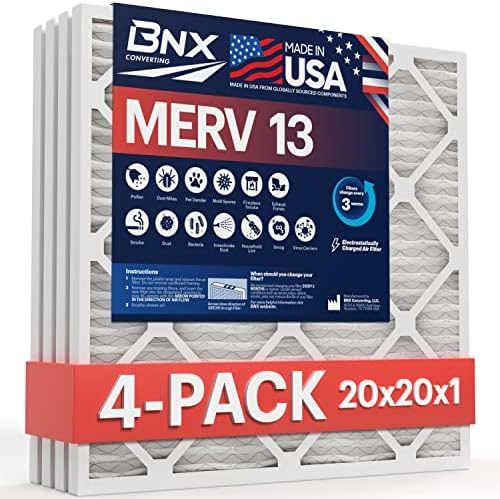
BNX TruFilter 20×20×1″ MERV-13 (4-Pack)
A genuine MERV-13-rated, correctly-sized 20×20×1″ pleated filter, one 4-pack covers a full five-filter build with a spare. No Filtrete MERV-13 exists in this size on Amazon AU, so this is the closest verified real substitute.
See on Amazon AU →Amazon AU price: $64.38 · as of 19 Nov 2026, 11:29 pm AEST DetailsCritical specification: insist on MERV-13 minimum. Under ASHRAE 52.2, MERV-13 means at least 50% capture of 0.3-1.0 µm particles, at least 85% at 1.0-3.0 µm and at least 90% at 3.0-10 µm. This is the sweet spot for bushfire smoke PM2.5 filtration without creating excessive static pressure that stalls a standard box fan motor. MERV-14 or higher will work better at capturing fine particles but increases pressure drop, your fan can lose enough airflow to cancel out the benefit. Stick with MERV-13 unless you are using a particularly powerful fan.
Other Materials
- Gaffer tape or foil-backed HVAC tape: $10-15 from any hardware store. You need approximately 10-15 metres to seal all edges. Do NOT use masking tape or painter’s tape, it degrades in heat and loses adhesion within weeks.
- Cardboard or corflute sheet: One piece the same dimensions as your fan (508×508mm) if you are building the five-filter version, this becomes the base panel. Free from any packaging.
- Optional: a pre-filter layer (fibreglass or polyester batting): $5-10 from Spotlight or Clark Rubber. Wrapping the exterior of the cube in a thin pre-filter layer catches large dust and pet hair, which can extend the life of your MERV-13 filters during heavy use.
Total Australian Build Cost
| Component | Qty | Cost (AUD) |
|---|---|---|
| 50cm box fan | 1 | $30-80 |
| MERV-13 filters (20×20×1″) | 5 | $100-200 |
| HVAC / gaffer tape | 1 roll | $10-15 |
| Cardboard base panel | 1 | $0 (free) |
| Pre-filter batting (optional) | 1m | $5-10 |
| TOTAL | $145-305 |
The wide range reflects filter sourcing. At $20-40 per filter, five filters cost $100-200; imported packs with shipping sit at the top of that range. Importing via Amazon AU or eBay pushes the filter cost higher with shipping. Budget about $150-250 for a typical Australian build.
Step-by-Step Build: Five-Filter Cube (Under 60 Minutes)
You have the parts. Now you are building. This is the five-filter version (four side panels plus one bottom panel), which provides roughly 25% more filter area than the common four-filter design and allows airflow from all directions including beneath the unit. Treat it the way I treated equipment assembly in the Navy: methodical, no shortcuts, every seal checked.
Step 1: Check Filter Arrow Direction
Every MERV-13 filter has an airflow direction arrow printed on the cardboard frame. In a Corsi-Rosenthal box, air flows inward through the filter and upward through the fan. That means the arrows on all five filters must point INWARD, toward the centre of the cube. Get this wrong and the filter media works against the airflow, reducing airflow and filtration and increasing noise. Check every panel before you tape.
Step 2: Assemble the Four Side Panels
Stand four filters on their long edges in a square, airflow arrows pointing inward. The cardboard frames of each filter should butt flush against the next filter’s frame at the corners. Tape the four vertical corner seams tightly with HVAC or gaffer tape, run the tape the full height of each seam, inside and outside. You want zero gaps. Any unsealed gap is unfiltered air bypassing the MERV-13 media, which defeats the purpose.
Step 3: Attach the Bottom Panel
Place the fifth filter on a flat surface, arrow pointing upward (toward the interior of the cube). Set your four-sided square frame on top of it. Tape all four bottom seams where the side filters meet the base filter. Again, run tape on both the inside and outside of each seam if you can reach. If you prefer a cardboard or corflute base instead of a fifth filter, tape it in place the same way, you will get slightly less total filter area but the build is simpler and cheaper.
Step 4: Mount the Fan on Top
Place the box fan on top of the cube with the exhaust side facing up (blowing air away from the cube). The fan pulls air inward through all five filter panels and exhausts clean air upward. This creates negative pressure inside the cube, which is what drives the filtration. Tape the fan frame to the top edges of the filter cube on all four sides. Seal any gaps between the fan housing and the filter frames, particularly the corners, which are the most common leak points.
Step 5: Seal, Inspect, and Test
Run your hand slowly around every taped seam with the fan on high. You should feel zero air being sucked inward at the seams, all air intake should come through the filter media faces only. If you feel suction at a seam, add more tape. A tissue paper test works well: hold a single-ply tissue near each seam. If it flutters or gets pulled toward the seam, you have a leak. Seal it.
Turn the fan to each speed setting and listen. On low, a well-built Corsi-Rosenthal box runs at roughly 45-50 dB (our estimate; it depends on the fan), similar to a quiet conversation. On high, expect 55-65 dB depending on the fan. If you hear rattling or whistling, a filter is loose or a seal has a gap.
Performance: Corsi-Rosenthal Box vs Commercial HEPA Purifiers
You need hard numbers, not feelings. Here is how a well-built five-filter Corsi-Rosenthal box stacks up against commercial units available in Australia, based on published testing data and manufacturer specifications.
| Metric | CR Box (5-filter) | Breville Protect Max | Levoit Core 400S |
|---|---|---|---|
| CADR (m³/h) | ~310-400 typical home build; ~1,000-1,450 in lab tests | 530 (claimed) | 433 (claimed, AU model) |
| Filter rating | MERV-13 (50%+ at 0.3-1 µm, 85%+ at 1-3 µm) | H13 HEPA | H13 True HEPA |
| Gas-phase filtration (VOCs, NO₂) | None | Yes, activated carbon | Yes, activated carbon |
| Noise (high speed) | ~55-65 dB (est.) | Not published | 54 dBA (claimed) |
| Noise (low / sleep) | ~45-50 dB (est.) | Not published | 28 dBA (claimed) |
| Auto mode / sensor | No | Yes, PM2.5 sensor | Yes, PM2.5 sensor |
| Price (AUD) | ~$145-305 in parts | $649 RRP (often discounted) | $399 RRP |
| Power draw | ~50-100 W, fan dependent (est.) | Not published | Up to 38 W |
| Replacement filters | Five MERV-13 panels per set, ~$100-200 a set at $20-40 each | $100 filter about every 6 months (CHOICE) | One H13 filter every 6-8 months (Levoit) |
The takeaway is nuanced. On raw airflow per dollar, a well-built Corsi-Rosenthal box is hard to beat: a typical home build gets you roughly 310-400 m³/h for a few hundred dollars or less, and a carefully sealed box with a strong fan can go well past that. But the commercial units win on single-pass filter efficiency (H13 HEPA vs MERV-13), noise (the Levoit is rated at 28 dBA on its lowest setting vs an estimated 45-50 dB for a box fan on low), gas-phase filtration, and convenience. If you need a purifier running in a bedroom while you sleep, 45 dB is not acceptable for most people, a commercial purifier on its lowest setting is far quieter.
The smart strategy for bushfire season: build a Corsi-Rosenthal box for your largest living area (lounge room, open-plan kitchen) where you need maximum airflow during peak smoke events, and buy a commercial HEPA unit for the bedroom where noise matters. This two-unit approach gives you whole-home coverage for under $1,000 total.
Running Cost on Australian Electricity
At an assumed residential electricity rate of 33c/kWh (check your own bill), a 75-watt box fan running 12 hours per day costs approximately $0.30/day or $108/year. Most people will not run it year-round, realistically, you are running it during smoke events and high-pollen days, perhaps 60-120 days per year. That brings the annual electricity cost to roughly $18-36. Add two sets of replacement MERV-13 filters per year ($200-400) and your total operating cost is roughly $220-440 a year.
Australian Climate Considerations: Bushfire Smoke, Humidity, and Pollen
A Corsi-Rosenthal box designed for a Minnesota winter does not automatically translate to a Brisbane summer. Australian conditions create specific challenges you need to address.
Bushfire Smoke (October: March, NSW/VIC/QLD/SA/WA)
Bushfire smoke is predominantly PM2.5 and PM10 particulate matter, exactly what a MERV-13 filter is designed to capture. During Black Summer, smoke pushed PM2.5 in parts of Sydney, Canberra, Melbourne and the NSW south coast to many times the WHO 24-hour guideline of 15 µg/m³, often for days at a time.
During these events, a Corsi-Rosenthal box running on high in a closed room (doors and windows shut, gaps sealed with wet towels) can cut indoor PM2.5 substantially. How much depends on the box’s CADR relative to the room volume and how leaky the room is; our CADR room calculator does the maths. But understand the limitation: MERV-13 does not capture the gas-phase components of smoke, volatile organic compounds, carbon monoxide, nitrogen dioxide. If you can smell smoke, you are inhaling gases that the CR box cannot filter. For comprehensive smoke protection, you need activated carbon in addition to particulate filtration, which is where a Breville Protect Max or Winix 5500-2 with activated carbon filters becomes necessary. Our bushfire smoke air purifier guide compares those options.
Humidity (Brisbane, Cairns, Darwin, Coastal NSW)
High humidity above 70% RH can degrade MERV-13 filter performance over time. The filter media absorbs moisture, which reduces airflow and can promote mould growth within the filter pleats, the opposite of what you want from an air purifier.
Mitigation: if you live in a high-humidity area (Brisbane, Cairns, Darwin, coastal QLD or NSW), run the CR box in an air-conditioned room where humidity is controlled below 60% RH. Do not run it outdoors or in non-air-conditioned spaces during summer. Replace filters more frequently, every 2 months instead of 3 during humid months. And inspect for mould growth on filter media monthly by looking at the intake faces for dark spots or musty smell.
Pollen Season (September: November, Most of Australia)
Whole grass pollen grains are large, tens of microns across, well above the 3-10 µm band where MERV-13 is already rated at 90% or more. A Corsi-Rosenthal box is extremely effective for pollen reduction indoors. If you suffer from hay fever, a CR box running in your bedroom with the door closed can cut the pollen you breathe indoors. For thunderstorm asthma events, where pollen grains rupture into fragments small enough to reach deep into the lungs, MERV-13 still catches most of them, though true HEPA catches more of the smallest fragments.
Check all seven rooms, not just this one
38 checks, 29 free, ranked by impact. Sent as a 32-page PDF.
We'll email you the audit and a short series of practical guides. Unsubscribe in one click, any time. Privacy.
Sent. Taking you to your download...
When to Build a CR Box vs Buy a Commercial HEPA Purifier
This is the decision that matters. Not every household should build a Corsi-Rosenthal box. Not every household needs to spend $700 on a Breville. Here is the honest breakdown.
Build a Corsi-Rosenthal Box If:
- You need maximum particulate CADR per dollar, nothing commercial under $700 matches the airflow output of a well-built CR box.
- You are preparing for bushfire season and commercial units are sold out, during Black Summer, HEPA purifiers sold out at many retailers as smoke reached Sydney, Melbourne and Canberra. A CR box can be built from parts available at HVAC suppliers and general retailers.
- You need to clean a large open-plan living space, a well-sealed box with a strong fan can move more air than most commercial units in its price range.
- You enjoy building things and want a project with your kids, the build is simple, safe, and teaches practical physics.
Buy a Commercial HEPA Purifier If:
- Noise matters, particularly for bedrooms. A Corsi-Rosenthal box at its quietest (45-50 dB on low) is louder than most commercial units on their sleep setting. Commercial HEPA purifiers on their lowest setting are typically far quieter.
- You need gas-phase filtration for smoke odours, VOCs, or chemicals. A CR box only filters particles. Activated carbon in commercial units addresses gases.
- You want set-and-forget operation with auto mode. PM2.5 sensors in the Breville and Levoit automatically adjust fan speed as air quality changes. A CR box has three manual speed settings and no sensor.
- You value aesthetics. A Corsi-Rosenthal box is a taped-together cube of furnace filters. It looks like what it is. In a bedroom, living room, or home office, some people find this unacceptable.
- You live in a high-humidity area and do not want to manage filter mould. Commercial units have sealed housings that protect filters from ambient moisture.
The best approach for most Australian households: build a CR box for the lounge/living area, buy a Breville Protect Max or Levoit Core 400S for the bedroom. Total investment under $1,000. You get maximum coverage, quiet sleep, and the peace of mind that when smoke rolls in, you are already set up. Without either, every bushfire smoke event delivers PM2.5 directly into your lungs, and according to a study in the Medical Journal of Australia (Borchers Arriagada et al., 2020), smoke from the 2019-20 bushfires in eastern Australia was associated with an estimated 417 excess deaths and 3,151 hospitalisations for respiratory and cardiovascular conditions.
Maintenance, Filter Replacement, and Longevity
A Corsi-Rosenthal box is not maintenance-free. If you build it and forget it, filter loading will reduce airflow to the point where the unit is doing almost nothing, and you will not know because there is no sensor to tell you.
Filter Replacement Schedule
Under normal conditions (urban air, occasional cooking, no smoke events), MERV-13 filters in a CR box last approximately 3-4 months. During active bushfire smoke seasons or if you have pets shedding heavily, expect 2-3 months. Visual inspection is your guide: pull the fan off the top and look at the intake face of each filter. If the pleats are visibly grey or brown and airflow has noticeably decreased, replace all five filters at once. Do not replace one at a time, uneven filter loading across the five panels creates pressure differentials that bypass the dirtiest filter.
Ongoing Cost vs Commercial Units
Using replacement filters at $20-40 each (five per set), two sets a year for seasonal use costs $200-400, and running it year-round, with a new set every 3-4 months, costs $300-600. That is in the same range as, or higher than, a commercial unit: CHOICE lists $200 a year in filters for the Breville Protect Max, and Levoit rates the Core 400S filter at 6-8 months. The CR box’s cost advantage is entirely in the upfront price, not the ongoing consumables. If you plan to use it year-round for 3+ years, a commercial HEPA unit may actually be cheaper over its lifetime.
| Unit | Upfront (AUD) | Annual Filters | Power draw | Notes |
|---|---|---|---|---|
| CR Box (seasonal use) | ~$145-305 in parts | ~$200-400 (two sets of five) | ~50-100 W (fan dependent) | Cheapest to start; filters are the running cost |
| Levoit Core 400S | $399 RRP | One filter every 6-8 months (Levoit) | Up to 38 W | Lowest power draw of the three |
| Breville Protect Max | $649 RRP | ~$200 (CHOICE: $100 filter every 6 months) | Not published | Highest claimed CADR here (530 m³/h) |
Over a few years the gap closes fast. The CR box is cheapest upfront, but buying ten MERV-13 panels a year means its running cost can overtake a commercial unit within two to three years of regular use. The Levoit Core 400S is the budget commercial pick with low power use; the Breville Protect Max costs the most but has the highest claimed CADR (530 m³/h). Your budget and how often you run it decide the right choice, not ideology about DIY vs commercial.
Safety, Electrical, and Compliance Notes for Australia
Three things you need to know before you plug this in and walk away.
Electrical safety: Only use a box fan that carries Australian safety approval markings (the RCM mark, Regulatory Compliance Mark). Electrical products sold through legitimate Australian retailers should carry this mark, so check the label before you buy. Do not import a US box fan with a US plug and use an adapter, the voltage mismatch (120V US vs 240V Australian) will destroy the motor or create a fire risk. If buying on Amazon AU, confirm the listing states “Australian plug” or “240V”.
Fire risk: A box fan pulling air through restrictive filters generates more heat than the same fan running unobstructed. MERV-13 filters are made of synthetic pleated media and a cardboard frame. Both are combustible. Do not leave the unit running unattended for extended periods unless the fan has a thermal overload protection switch (most quality box fans do). If the motor overheats and stops, unplug it immediately. Do not cover the exhaust side of the fan with anything, it needs unrestricted outflow.
A DIY box has no certified CADR: Commercial purifiers quote CADR figures from standardised testing (ANSI/AHAM AC-1). A DIY box has no such rating, so the figures on this page come from academic testing of specific builds, and your result depends on your fan, filters and sealing. For workplaces or schools, speak to your WHS officer before relying on a DIY unit.
Final Verdict: Build It, But Know Its Limits
I have not built a CR box at my place in Palm Beach, QLD; this verdict rests on the published testing. As a former Navy Clearance Diver, I approach gear evaluation the same way regardless of whether it costs $150 or $1,500, does it do what it claims, reliably, under real conditions? The CR box does. It moves serious volumes of air through MERV-13 media and measurably reduces indoor PM2.5 during smoke events. It is the single best value-for-money particulate air cleaning solution available in Australia.
But it does not replace a HEPA purifier for bedroom use. It does not remove gases. It does not auto-adjust. And the ongoing filter cost is higher than most people expect. Build one for your living area. Put a Breville Protect Max or Levoit Core 400S in the bedroom. That is the combination that keeps your household breathing clean air from October to March without breaking the bank.
If bushfire smoke season starts tomorrow and HEPA purifiers are sold out, you can build a Corsi-Rosenthal box tonight. That alone makes it worth understanding.
Last reviewed: November 2026 – Clean and Native
Want set-and-forget air purification instead?
The Breville Protect Max is our top-rated air purifier for Australian homes, H13 HEPA, activated carbon for smoke gases, a PM2.5 auto mode and a claimed CADR of 530 m³/h. If you want the protection without the project, this is the one.
Frequently Asked Questions
Does a Corsi-Rosenthal box actually work for bushfire smoke?
Yes, for particles. In peer-reviewed lab testing (Dal Porto et al., Aerosol Science and Technology, 2022), a five-panel MERV-13 box delivered an effective CADR of about 1,000 to 1,450 m³/h, and home builds tested in 2024 measured 313 to 396 m³/h, comparable to a mid-size commercial purifier. It captures particulate matter effectively but does not remove gas-phase smoke components like VOCs or NO₂.
Where can I buy MERV-13 filters in Australia?
Try HVAC filter wholesalers such as Camfil Australia and ask for MERV-13 (sometimes sold as F7 or ISO ePM1 grade), confirming the rating before you buy. On Amazon AU, imported MERV-13 packs such as BNX TruFilter come in 20×20×1″ size, though delivery takes 1-2 weeks.

Former Royal Australian Navy Clearance Diver and TAG-E counter-terrorism operator. Founded Clean and Native to apply the same rigorous thinking to the home environment.
Full biography →The 7-Room Home Audit
Air is where most homes have their biggest free fix. The audit walks every room: 38 checks across air, water and EMF, ranked by impact against Australian guidelines.
- The rangehood habit that cuts gas cooking fumes
- Two-minute tests for exhaust fans, mould and stale bedrooms
- When a purifier helps, and the bedroom one I own
We'll email you the audit and a short series of practical guides. Unsubscribe in one click, any time. Privacy.
Sent. Taking you to your download...
Similar Posts
Best Air Purifier Under $200 Australia 2026: 4 Sized Picks
Four air purifiers under $200 in Australia, each sized from its published CADR at 4.8 air changes an hour, with running costs at a sourced tariff, filter costs where published, a room and budget fit checker, and the Coway Airmega 150 as the honest step-up.
Best Air Purifier Australia 2026: 5 HEPA Picks Sized by Room
The best air purifier for most Australian homes is the Coway Airmega 150 (about $254), which I run in my 12.5 m² bedroom. Five HEPA picks sized on smoke CADR, with the Philips 3200 for living areas and the Coway Airmega 400 for large rooms and bushfire smoke.
Air Purifier vs Air Conditioner: What Each One Actually Does to Your Air
Air purifier vs air conditioner: what each does to your air, which AC types are safe in bushfire smoke, and when you need both. Real Coway data.
Gas Stoves and Indoor Air Quality Australia 2026
Gas cooktops release nitrogen dioxide and fine particles into your kitchen. What the research shows and how rangehoods, ventilation and purifiers help.
Breville Smart Air Viral Protect Max Review Australia 2026: Specs Checked
Breville Smart Air Viral Protect Max (LAP608) checked against its manual: 530 m³/h CADR, about 44 m² of real coverage, filter costs, UV-C and how it compares.
Coway Airmega 200M vs Austin Air Australia 2026: Which Air Purifier Is Better?
IQAir vs Austin Air Australia 2026, Clean & Native’s Australian guide covering everything you need to know, with evidence-based recommendations.