Gas Stoves and Indoor Air Quality Australia 2026
Gas stoves produce nitrogen dioxide (NO2), benzene, carbon monoxide, and ultrafine particles directly into your kitchen — pollutants you would never tolerate if they came from outdoor sources. According to research from Stanford University (2025), indoor NO2 concentrations in homes with gas stoves are 50-400% higher than in homes with electric stoves, routinely exceeding the outdoor air quality standards Australia already monitors through the NEPM ambient air quality framework.
Gas stoves are the single largest source of nitrogen dioxide in Australian homes, producing indoor NO2 levels that routinely exceed the NEPM outdoor standard of 246 µg/m³ (1-hour average) during and after cooking. Ducted rangehood extraction is the most effective immediate mitigation — recirculating rangehoods do not remove combustion gases. HEPA air purifiers capture the particulate byproducts but do not meaningfully reduce gas-phase NO2. Ventilation first, purification second. Long-term, switching to induction eliminates the source entirely.
| Mitigation | Removes NO2? | Verdict |
|---|---|---|
| Ducted rangehood | Yes — exhausts combustion gases outdoors | Recommended — first action |
| Recirculating rangehood | No — filters grease/odour only | Avoid as primary mitigation |
| HEPA air purifier | Particulates yes, gas-phase NO2 no | Supplementary — not a substitute for extraction |
| Switch to induction | Yes — eliminates the source | Recommended — permanent fix |
Key catches
- HEPA filters capture PM2.5 and ultrafine particles from gas combustion but cannot chemically remove NO2 — only ventilation or source elimination works for that
- Recirculating rangehoods are effectively useless against combustion gases — if your kitchen has one, open a window during and for 15 minutes after cooking
- Induction eliminates combustion pollutants entirely but introduces low-level ELF magnetic fields — see our induction cooktop EMF guide for the trade-off analysis
What Gas Stoves Actually Put Into Your Kitchen Air
You check the AQI app before your morning run. You close windows during bushfire season. But the most concentrated source of nitrogen dioxide you breathe might be the burner you light every evening at 6pm. That is the uncomfortable reality of gas cooking in Australian homes — and the reason this matters more than most people realise.
When natural gas (methane) combusts on your cooktop, the flame does not just produce heat. It generates a cocktail of pollutants that would trigger health warnings if measured at an outdoor monitoring station. According to a 2025 Stanford University study led by Professor Rob Jackson, gas and propane stoves produce NO2 concentrations that frequently exceed outdoor health-based standards within minutes of turning on a burner. The same research confirmed that gas stoves also emit benzene — a Group 1 carcinogen classified by the International Agency for Research on Cancer (IARC) as linked to leukaemia — even during normal cooking, not just during malfunction.
The specific combustion byproducts from your gas cooktop include:
- Nitrogen dioxide (NO2) — a respiratory irritant that inflames airways. The NEPM ambient air quality standard for outdoor NO2 is 246 µg/m³ as a 1-hour average. According to Collaborative on Health and the Environment (CHE) research data, indoor NO2 in gas stove homes runs 50-400% higher than in electric stove homes, routinely breaching this outdoor standard inside your kitchen.
- Carbon monoxide (CO) — produced during incomplete combustion. At low levels it causes headaches and fatigue; at high levels it is lethal. Most Australian gas stoves are well-tuned enough that CO stays below acute danger thresholds, but chronic low-level exposure during daily cooking accumulates.
- Ultrafine particles (UFPs) and PM2.5 — combustion produces particles small enough to cross from lungs into the bloodstream. These are the same particles the NEPM PM2.5 standard (25 µg/m³ annual average, 8 µg/m³ by 2025 guideline) targets outdoors.
- Formaldehyde (HCHO) — a known carcinogen produced as a combustion byproduct and from cooking at high heat, particularly with gas.
- Benzene — as the Stanford 2025 research confirmed, gas stoves emit benzene during normal operation. There is no safe threshold for benzene exposure according to the WHO.
Here is what makes this particularly insidious: your kitchen has no air quality monitor. You do not get an AQI reading for the room where you spend 30-60 minutes cooking dinner with the burners running. If the Adelaide CBD ambient NO2 AQI is 6 (excellent) according to the World Air Quality Index Project (aqicn.org), the air inside a gas kitchen during cooking is dramatically worse — often 5 to 10 times the concentration measured at that outdoor station. You would not go for a jog at AQI 200. But you are breathing the equivalent while stirring pasta.
Gas Cooking in Australia: How Widespread the Problem Is
If you think this is a niche issue, consider the numbers. According to ABS Census and energy data, approximately 38% of Australian households use gas for cooking. That figure varies sharply by state. Victoria has historically had the highest gas cooking penetration — above 60% in some metropolitan areas — driven by the extensive Gascor/APA reticulated gas network and decades of gas industry marketing positioning gas as the “chef’s choice.” New South Wales sits around 40%. Queensland, Western Australia, and South Australia vary between 25-40% depending on metropolitan versus regional distribution.
That means millions of Australian kitchens — including apartments where ducted ventilation is difficult or impossible to retrofit — produce combustion pollutants indoors every single day. And here is the compounding factor: Australian homes are getting tighter. The 2022 update to the National Construction Code (NCC) increased minimum energy efficiency requirements, which means newer homes have better thermal envelopes but reduced natural ventilation. A well-sealed 7-star NatHERS home with a gas cooktop and no ducted rangehood is, from an indoor air quality perspective, a sealed box filling with combustion gases.
The Australian policy landscape is shifting. The ACT banned new gas connections for residential dwellings from 2023. Victoria announced a gas substitution roadmap. Several local councils in NSW and Victoria have passed motions supporting all-electric new builds. The Climate Council of Australia has published multiple reports identifying indoor gas combustion as a health risk, citing the same NO2 research referenced above. The RACGP (Royal Australian College of General Practitioners) has flagged gas stove emissions as a contributor to childhood asthma exacerbation — a position consistent with the 2022 meta-analysis published in the International Journal of Environmental Research and Public Health, which found children in homes with gas stoves had a 42% increased risk of current asthma symptoms compared to children in homes without gas stoves (Lin, Brunekreef & Gehring, 2013, Int J Epidemiol).
For families with young children, the elderly, or anyone with existing respiratory conditions like asthma or COPD, gas stove emissions are not an abstract environmental concern. They are a direct, measurable, daily health exposure happening in the room where you prepare food.
Rangehood Extraction: Ducted vs Recirculating — One Works, One Doesn’t
The first question every gas stove owner should ask is not “which air purifier should I buy?” It is: “Does my rangehood actually exhaust air outside the building?” Because if it does not, you are doing almost nothing about the combustion gases — and most apartment rangehoods in Australia do not.
There are two fundamentally different rangehood types, and the distinction is critical:
Ducted (externally vented) rangehoods
A ducted rangehood connects to ductwork that physically exhausts air from above the cooktop to the building exterior — typically through a wall or roof vent. This is the only rangehood type that removes combustion gases (NO2, CO, formaldehyde, benzene) from your kitchen. When sized and installed correctly, a ducted rangehood captures 60-90% of cooking pollutants at source before they disperse into the rest of the home. The key variables are:
- Extraction rate (m³/hr) — Australian Standard AS/NZS 1668.2 recommends a minimum of 25 L/s (90 m³/hr) extraction for residential kitchens, but 600+ m³/hr units are widely available and far more effective for gas cooking
- Capture efficiency — determined by hood width (should be at least as wide as the cooktop), depth, and height above the burners (600-750mm for gas is the standard range per AS/NZS 60335.2.31)
- Duct diameter and run length — undersized ducting (100mm instead of 150mm) or long runs with multiple bends drastically reduce actual airflow versus rated airflow
- Make-up air — in a well-sealed home, a powerful rangehood creates negative pressure. If there is no make-up air path (cracked window, trickle vent, dedicated supply), the rangehood stalls against the building envelope and extraction drops to a fraction of rated capacity
Recirculating (filterless) rangehoods
Recirculating rangehoods do not remove combustion gases. Full stop. A recirculating unit pulls air through a grease filter and optionally a charcoal odour filter, then pushes the air back into the kitchen. The charcoal filter captures some cooking odours and grease vapour. It does not capture NO2, CO, formaldehyde, benzene, or ultrafine particles in any meaningful quantity. You are running a fan that recycles the same polluted air.
This is not a marginal distinction. If you cook with gas and your rangehood recirculates, you have effectively no combustion gas mitigation from your rangehood. The practical difference between having a recirculating rangehood and having no rangehood at all, when it comes to NO2 exposure, is negligible.
Most apartments built in Australia in the last 20 years use recirculating rangehoods because external ducting adds cost and complexity to multi-storey construction. If you live in an apartment with gas cooking, this is your problem in one sentence: you have a combustion source with no exhaust pathway.
The immediate mitigation if you cannot install ducted extraction: open a window in or near the kitchen during and for at least 15 minutes after gas cooking. Cross-ventilation (two openings on different walls or floors) is significantly more effective than a single window. This is not elegant. It is not energy-efficient. But it is the only way to dilute and displace combustion gases in a kitchen without ducted extraction.
When an Air Purifier Helps — and When It Doesn’t
This is where most content on this topic gets it wrong, and where you need a straight answer before spending $300-600 on a machine. Here is the truth: HEPA air purifiers are effective against the particulate fraction of gas stove emissions but do not meaningfully remove gas-phase nitrogen dioxide.
Let’s break that down by pollutant type:
What HEPA purifiers DO capture from gas cooking
- Ultrafine particles (UFPs) — H13 HEPA filters (the standard in quality purifiers) capture 99.95% of particles at 0.3 µm (the most-penetrating particle size). Gas combustion produces UFPs in the 10-100 nm range, which are actually captured at higher efficiency than 0.3 µm particles due to diffusion-based capture mechanisms
- PM2.5 — fine particulate matter from combustion is captured effectively by H13 HEPA
- Some volatile organic compounds (VOCs) — purifiers with activated carbon stages (like the Breville Protect Max or Winix 5500-2) adsorb a proportion of formaldehyde and benzene, though the carbon bed must be sufficiently large and regularly replaced to maintain effectiveness
What HEPA purifiers do NOT effectively remove
- Nitrogen dioxide (NO2) — this is a reactive gas, not a particle. Standard HEPA media does not capture it. Activated carbon has limited capacity for NO2 adsorption compared to its effectiveness against larger VOC molecules. Some specialised chemisorbent filters (potassium permanganate, for example) target NO2, but these are not standard in consumer air purifiers sold in Australia
- Carbon monoxide (CO) — a small, stable molecule that passes through both HEPA and carbon filters without meaningful capture
This means an air purifier in a gas kitchen addresses roughly half the problem. It reduces the particulate load and some of the VOC fraction. It does not reduce the NO2 concentration — the pollutant most directly linked to respiratory inflammation and asthma exacerbation in the literature. For NO2, the only effective approaches are ventilation (dilution and displacement) and source elimination (switching away from gas).
That said, if you cook with gas and cannot immediately switch to induction, running a HEPA purifier in the kitchen during and after cooking is still measurably better than doing nothing about the particulate fraction. The best approach is ventilation AND purification — not one or the other. A ducted rangehood handles the combustion gases; a HEPA purifier in the adjacent living area captures the particulates and VOCs that escape the rangehood’s capture zone.
Practical Steps: The Correct Sequence for Gas Kitchen Air Quality
Most people jump straight to buying something. A purifier. A new rangehood. An induction cooktop. But the correct sequence matters — and the first actions cost nothing.
Step 1: Ventilate during and after cooking (free)
Every time you use a gas burner, open at least one window in the kitchen. If possible, create cross-ventilation by opening a second window or door on a different wall. Leave windows open for a minimum of 15 minutes after the last burner is turned off — NO2 concentrations peak not during cooking but in the 5-10 minutes immediately after, as residual hot gases rise and disperse. This single action, according to the US EPA Indoor Air Quality guidance (which remains the most comprehensive residential combustion guidance available globally), reduces peak NO2 exposure by 50-70% compared to cooking with windows closed.
Step 2: Confirm your rangehood type and use it correctly
Check whether your rangehood is ducted (connects to an external wall or roof vent) or recirculating (no external exhaust). If ducted: turn it on 2 minutes before lighting any burner and leave it running for 10 minutes after the last burner is off. Use the highest setting during active cooking. If recirculating: acknowledge it is not removing combustion gases and rely on window ventilation instead.
For apartment dwellers in Sydney, Melbourne, or Brisbane with recirculating rangehoods and gas cooktops — this combination is the worst-case indoor air quality scenario for cooking. If this describes your home, prioritise Step 5 (switching to induction) above all other actions.
Step 3: Run a HEPA purifier in the adjacent living space
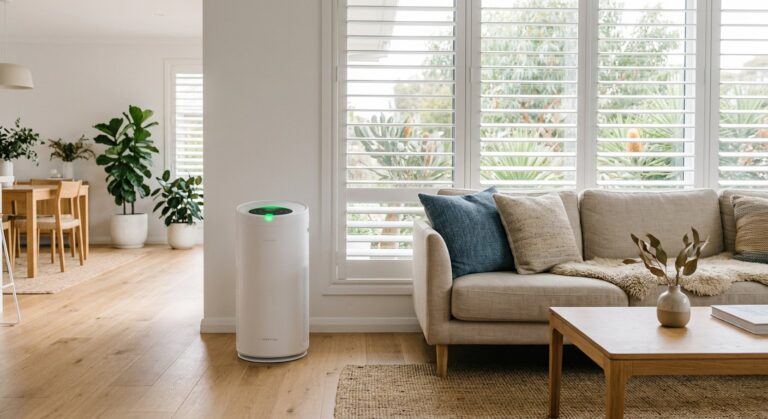
Place a HEPA purifier with an activated carbon stage in the room adjacent to or open to the kitchen. Not in the kitchen directly above the cooktop (the heat and grease will damage the filter prematurely), but in the living or dining area that shares airspace with the kitchen. Run it on high during cooking and for 30 minutes after. This captures the PM2.5, ultrafine particles, and some VOCs that migrate from the kitchen into living areas. The Breville Protect Max (550 CADR, H13 HEPA, activated carbon) handles open-plan kitchen-living rooms up to approximately 55 m². The Levoit Core 400S (350 CADR) suits smaller spaces up to approximately 35 m².
Step 4: Consider a CO alarm (under $50)
Australian building codes do not mandate carbon monoxide alarms for gas cooking (unlike smoke alarms under AS 3786). A standalone CO alarm near the kitchen provides early warning of incomplete combustion from a poorly adjusted burner or a failing gas appliance. This is a cheap insurance policy — under $50 on FireAngel FA6813 CO alarm on Amazon AU.
Step 5: Switch to induction (the permanent fix)
Induction cooktops produce zero combustion byproducts. No NO2. No CO. No benzene. No formaldehyde. No ultrafine particles from the cooktop itself (cooking food still produces some particulates, but these are food-origin, not combustion-origin). Switching to induction eliminates the problem at the source, permanently.
The cost consideration: a quality portable induction hob starts from approximately $100. A full 4-zone built-in induction cooktop ranges from $600-2,500 depending on brand and features. If your home currently has gas only and no dedicated cooktop circuit, an electrician will need to install a 32A circuit (typically $300-600 depending on switchboard distance). Several Australian states offer electrification incentives — check your state energy department for current rebates.
The trade-off: induction cooktops produce ELF (extremely low frequency) magnetic fields during operation. These are non-ionising and well below ARPANSA exposure limits, but they are measurable at close range. If you want the full picture before switching, read our induction cooktop EMF guide for Australia, which covers the measurements, the standards, and the practical distances at which fields drop below building biology thresholds.
Induction as the Long-Term Solution: Eliminating the Source
From a pure indoor air quality perspective, the argument for induction is simple: remove the combustion source and you remove the combustion pollutants. No mitigation strategy — not rangehoods, not purifiers, not ventilation — is as effective as eliminating the problem entirely.
The performance concern that once held back induction adoption in Australian kitchens — “gas is better for wok cooking” — has been addressed by modern high-powered induction zones producing 3,700W or more, matching or exceeding the BTU output of residential gas burners. Professional chefs across Australian restaurants have transitioned to induction over the past decade, driven by commercial kitchen ventilation requirements as much as by cooking performance.
State-level policy is accelerating the transition. The ACT’s 2023 ban on new residential gas connections effectively mandates induction (or ceramic electric) for all new homes. Victoria’s Gas Substitution Roadmap signals a similar direction. For homeowners planning a kitchen renovation in the next 5 years, investing in gas infrastructure (a new gas cooktop, gas line extension) makes increasingly little financial sense when the regulatory trajectory points toward all-electric.
If you rent and cannot modify the cooktop, a portable induction hob (single or double zone) is a practical interim solution. Use the induction hob for the majority of cooking and the gas burners only when necessary. Every meal cooked on induction instead of gas is one fewer dose of NO2 in your kitchen.
For the EMF considerations around induction — specifically the ELF magnetic fields produced during operation and at what distances they fall below the Building Biology SBM-2015 threshold of 0.2 µT — see our detailed guide: Induction Cooktop EMF Australia: What the Measurements Actually Show. The short version: at 30 cm from the cooktop edge (where you stand while cooking), ELF fields from quality induction units are typically below building biology concern thresholds. At 60 cm and beyond, they are negligible. The health risk calculus overwhelmingly favours induction over gas when both NO2 exposure and ELF fields are considered together.
Who Is Most at Risk in Australian Homes
Not every household faces equal risk from gas stove emissions. The concentration of combustion pollutants you actually breathe depends on kitchen volume, ventilation, cooking duration, and your proximity to the burners. But some groups face disproportionate exposure and disproportionate health consequences.
Children under 5. According to the meta-analysis by Lin, Brunekreef and Gehring (2013, International Journal of Epidemiology), children in homes with gas stoves have a 42% increased risk of current asthma symptoms. Children breathe faster relative to body weight than adults, meaning they inhale a higher dose of NO2 per kilogram. They are also lower to the ground — closer to burner height in many kitchen layouts — and spend more time in the home than working adults.
People with asthma or COPD. NO2 is a direct bronchial irritant. For someone with existing airway inflammation, gas stove NO2 exposure during cooking can trigger symptom exacerbation within hours. The RACGP has identified gas cooking emissions as a contributor to asthma management challenges in primary care settings.
Apartment residents without ducted extraction. Apartments in inner Sydney (Surry Hills, Pyrmont, Zetland), inner Melbourne (Southbank, Docklands, Carlton), and inner Brisbane (South Brisbane, Fortitude Valley, Newstead) built between 2000 and 2020 overwhelmingly use recirculating rangehoods with gas cooktops. These smaller enclosed kitchens concentrate pollutants faster and retain them longer than detached homes with multiple ventilation pathways.
Households that cook for extended periods. Cuisines requiring long simmering times (stocks, braises, curries) produce sustained NO2 exposure across hours rather than the 20-30 minute burst of a quick stir-fry. The total dose — concentration multiplied by time — is significantly higher.
If you fall into any of these categories and currently cook with gas, the mitigation sequence above is not optional. It is the minimum response to a measurable health exposure happening in your home daily.
Final Verdict: Stop Ignoring the Burner
The data is not ambiguous. Gas stoves produce indoor NO2 concentrations that exceed the outdoor standards Australia already monitors and acts on. They emit benzene, a confirmed carcinogen. They generate PM2.5 and ultrafine particles in concentrations comparable to bushfire smoke events in a confined space. And the majority of Australian kitchens with gas cooking have either inadequate ventilation (recirculating rangehood) or no mechanical ventilation at all.
The solution hierarchy is clear: ventilate first (free), run HEPA purification in adjacent spaces second (reduces particulates), and switch to induction when possible (eliminates the source permanently). A HEPA purifier is not a substitute for ventilation when it comes to NO2 — but it is a meaningful addition for the particulate and VOC fraction, particularly during and after cooking in open-plan homes.
If you are in a Victorian or NSW apartment with a gas cooktop and a recirculating rangehood, you are breathing the indoor equivalent of a moderate-to-poor AQI day every time you cook dinner. That is not acceptable once you know it. Now you know it.
Reduce particulate exposure from gas cooking with a HEPA purifier in the adjacent living area.
The Breville Protect Max delivers 550 CADR with H13 HEPA and activated carbon — enough for open-plan kitchen-living rooms up to 55 m². Ventilate first. Purify second. Switch to induction when you can.
Last reviewed: August 2026 – Clean and Native
Frequently Asked Questions
Does a gas stove affect indoor air quality?
Yes. Gas stoves produce nitrogen dioxide, carbon monoxide, benzene, formaldehyde, and ultrafine particles during normal operation. According to Stanford University (2025) research, indoor NO2 in gas stove homes is 50-400% higher than in electric stove homes, frequently exceeding the NEPM outdoor air quality standard of 246 µg/m³ (1-hour average).
Can an air purifier remove nitrogen dioxide from gas cooking?
No. Standard HEPA air purifiers do not meaningfully remove gas-phase NO2. They capture particulates (PM2.5, ultrafine particles) and some VOCs through activated carbon stages, but NO2 is a reactive gas that passes through both HEPA and standard carbon media. Only ventilation (ducted rangehood or open windows) or source elimination (switching to induction) effectively reduces indoor NO2.
Does a recirculating rangehood remove gas stove pollution?
No. Recirculating rangehoods filter grease and some cooking odours but do not remove combustion gases (NO2, CO, benzene, formaldehyde). Only ducted rangehoods that exhaust air to the building exterior remove these pollutants. If your rangehood recirculates, open windows during and for 15 minutes after gas cooking.
Are gas stoves linked to childhood asthma?
Yes. A meta-analysis published in the International Journal of Epidemiology (Lin, Brunekreef and Gehring, 2013) found children in homes with gas stoves had a 42% increased risk of current asthma symptoms. The RACGP has identified gas stove emissions as a contributor to childhood asthma exacerbation in Australian primary care settings.
Do gas stoves emit benzene?
Yes. Research published by Stanford University in 2025 confirmed that gas and propane stoves emit benzene — a Group 1 carcinogen classified by the IARC as linked to leukaemia — during normal cooking operation, not only during malfunction or visible flame irregularity.
How long should I ventilate after using a gas stove?
A minimum of 15 minutes after the last burner is turned off. NO2 concentrations peak 5-10 minutes after cooking ends as residual hot gases disperse through the kitchen. Leave the ducted rangehood running or keep windows open for at least this period.
Is induction cooking safer than gas for indoor air quality?
Yes. Induction cooktops produce zero combustion byproducts — no NO2, no CO, no benzene, no formaldehyde, and no combustion-origin particulates. Induction does produce low-level ELF magnetic fields during operation, but at typical standing distances (30 cm from the cooktop edge), these fall below Building Biology SBM-2015 thresholds. The health risk calculus strongly favours induction when both pollutant exposure and ELF fields are considered.
What percentage of Australian homes cook with gas?
Approximately 38% of Australian households use gas for cooking, based on ABS energy use data. Victoria has the highest penetration at above 60% in some metropolitan areas. The ACT banned new residential gas connections from 2023, and other states are signalling similar transitions toward all-electric homes.
Which air purifier is best for a kitchen with a gas stove?
Place the purifier in the adjacent living area, not directly in the kitchen (heat and grease damage filters). The Breville Protect Max (550 CADR, H13 HEPA, activated carbon) handles open-plan kitchen-living rooms up to approximately 55 m². The Levoit Core 400S (350 CADR) suits smaller spaces up to 35 m². Remember: these capture particulates and some VOCs but do not remove gas-phase NO2 — ventilation handles that.
Does the Australian Building Code require ventilation for gas cooktops?
AS/NZS 1668.2 specifies minimum ventilation rates for residential kitchens (25 L/s or 90 m³/hr extraction), but enforcement and compliance vary. The NCC does not mandate ducted extraction specifically for gas — recirculating rangehoods can satisfy the requirement in some jurisdictions. There is no mandatory CO alarm requirement for gas cooking in residential premises under the current code, unlike the mandatory smoke alarm requirements under AS 3786.
Get the Australian Home Environment Checklist
30 checks across water, air and EMF. Most of them free. Ranked by impact.
No spam. Unsubscribe any time.

Former Royal Australian Navy Clearance Diver and TAG-E counter-terrorism operator. Founded Clean and Native to apply the same rigorous thinking to the home environment.
Full biography →