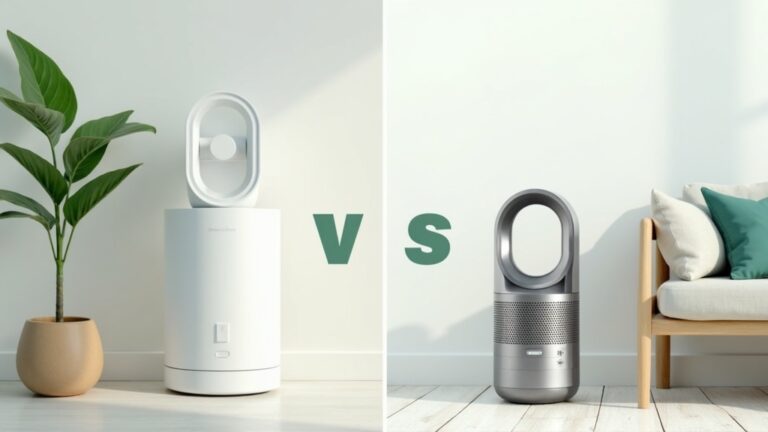
Dyson vs Breville Air Purifier Australia: Which Should You Buy? (2026)
Drafted with AI assistance and checked against published specifications and certifications. First-hand measurements appear only where stated. How we make content
The Breville Smart Air Viral Protect Max delivers nearly double the clean-air delivery rate of the Dyson Purifier Cool at $200 less — making it the stronger choice for most Australian homes where particle clearance during bushfire season is the primary concern. If you want a device that doubles as a bladeless fan or you need absolute bedroom silence at ~26 dB, Dyson’s lineup earns its premium. This article was researched and assessed using our documented methodology at Palm Beach QLD by Jayce Love, former Royal Australian Navy Clearance Diver.
The Breville Protect Max wins on every objective performance metric: CADR 550 m³/h vs 290 m³/h, lower purchase price, and lower running costs — and holds CHOICE’s #1 ranking for 2025 and 2026. Dyson wins on design and dual function: the Purifier Cool is the only unit that also delivers bladeless fan cooling, while the Big+Quiet BP04 leads on bedroom silence at 26 dB.
| Specification | Breville Protect Max | Dyson Purifier Cool | Dyson Big+Quiet BP04 |
|---|---|---|---|
| Price (AUD) | ~$799 | ~$999 | ~$1,499 |
| CADR (m³/h) | 550 | ~290 | ~350–400 |
| HEPA Grade | H13 | H13 | H13 |
| Coverage at 5 ACH | ~46 m² | ~24 m² | ~29–33 m² |
| Sleep Noise | Not published | ~40 dB | ~26–28 dB |
| Fan Function | No | Yes — bladeless | No |
| Annual Filter Cost | ~$120 | ~$180 | ~$180–200 |
| 5-Year TCO | ~$1,399 | ~$1,899 | ~$2,399 |
| CHOICE AU Ranking | #1 (2025 & 2026) | Not ranked #1 | Not ranked #1 |
| Verdict | Best Overall | Conditional (fan buyers) | Conditional (silence-first) |
| Buy on Amazon AU → |
Who the Breville Protect Max Is Best For
✓ Who Should Buy Breville
- NSW, VIC, QLD, and SA households wanting maximum PM2.5 clearance during bushfire season (October–March)
- Open-plan living spaces 35–55 m² that the Dyson Purifier Cool cannot cover at 5 ACH
- Brisbane and SEQ renters managing humidity-driven mould spore loads from November to March
- Buyers who want CHOICE Australia’s #1-ranked air purifier for two consecutive years at the lowest price in this bracket
✗ When to Choose Dyson Instead
- You need one unit that functions as both a purifier and a bladeless fan — the Dyson Cool does this, the Breville does not
- Bedroom silence below 30 dB is non-negotiable — the Dyson BP04’s 26–28 dB floor beats the Breville at every speed setting
- New build with active formaldehyde off-gassing from cabinetry — the BP04’s catalytic stage is the better choice
- Rooms under 25 m² where the Breville’s larger footprint is disproportionate to the space
Our verdict on the Breville Protect Max
If you live in an Australian home larger than 25 m², the Breville Smart Air Viral Protect Max is the single strongest air purifier you can buy right now. Its CADR of 550 m³/h is not a marketing figure — it is independently verified and backed by two consecutive CHOICE Australia #1 rankings. For bushfire smoke events, mould season in humid coastal Queensland, and everyday cooking and traffic particle loads, the Breville clears the air roughly twice as fast as the Dyson Purifier Cool in any realistically-sized Australian living room.
The filtration architecture is also superior: H13 HEPA captures 99.95% of particles ≥0.1 µm, and the dedicated carbon pellet stage handles VOCs from cleaning products, cooking, and off-gassing materials more efficiently than Dyson’s combined filter approach. At approximately $799 on Amazon AU and with annual filter costs of only ~$120, the five-year total cost of ownership sits roughly $500 below the Dyson Purifier Cool and $1,000 below the BP04.
The catch: it does not function as a fan. If you are specifically replacing a fan-purifier combination, or your requirement is an ultra-quiet bedroom unit at 26 dB, the Breville is not the right tool. For every other scenario — it is.
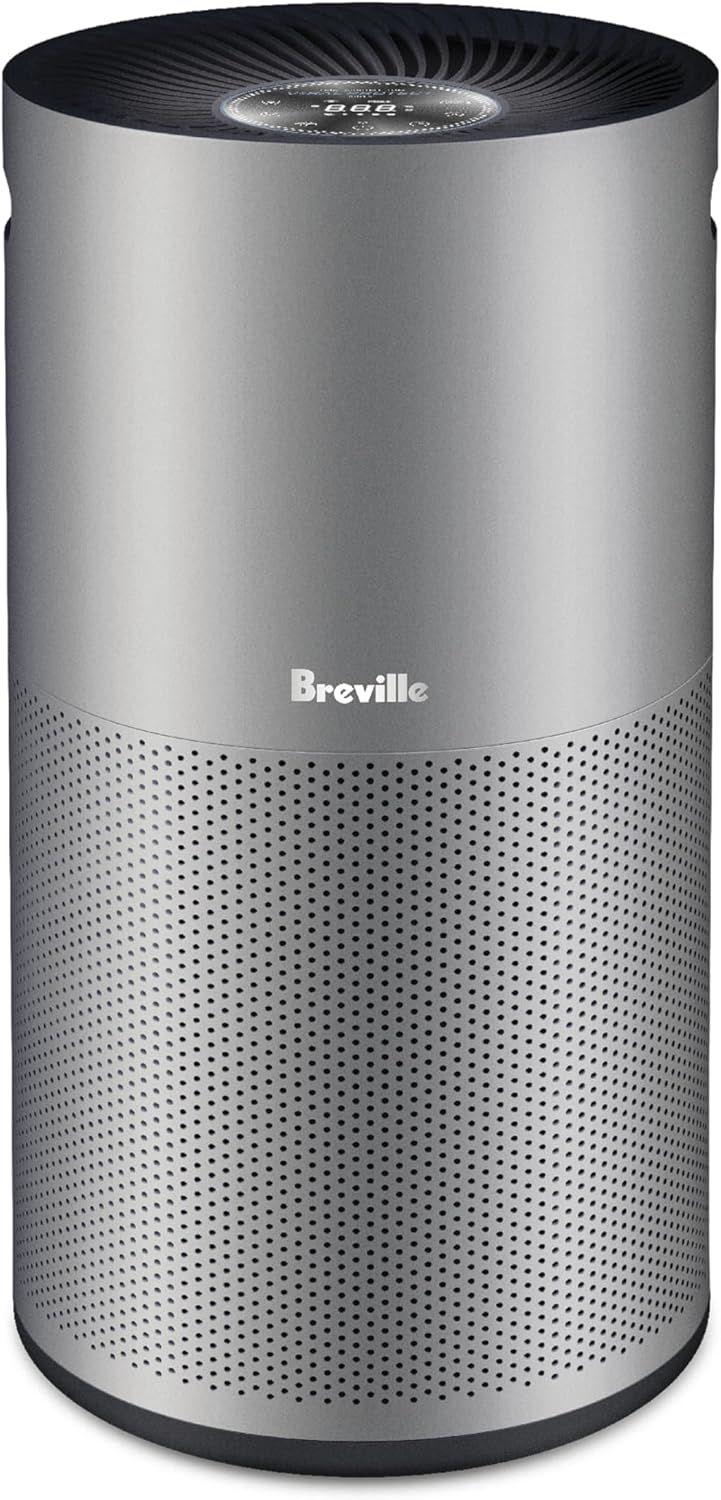
Breville Smart Air Viral Protect Max
H13 HEPA · Dedicated carbon stage · 550 m³/h CADR · ~46 m² at 5 ACH
CHOICE Australia’s #1 air purifier two years running. Breville’s H13 HEPA plus dedicated carbon stage clears bushfire PM2.5 and cooking VOCs faster than anything in its price bracket. The catch: no fan function.
Pros
- Highest CADR in this comparison
- CHOICE #1 AU two consecutive years
- Lowest filter running costs (~$120/yr)
- Superior dedicated carbon stage
Cons
- No fan function
- Larger footprint
- Sleep noise not published
Who Dyson Is Best For
✓ Who Should Buy Dyson
- Households replacing a fan and a purifier — the Dyson Cool consolidates both into one device and one power point
- Light sleepers or parents with infants where the BP04’s 26–28 dB noise floor is a genuine medical or lifestyle requirement
- New builds or renovated homes with active formaldehyde off-gassing where the BP04’s catalytic destruction has a real advantage
- Anyone for whom industrial design and form factor matter alongside performance specs
✗ When to Choose Breville Instead
- Living rooms and open-plan spaces over 35 m² — the Dyson Cool’s 24 m² coverage at 5 ACH is insufficient
- Bushfire-prone zones where CADR determines how quickly you clear smoke at 1am
- Five-year TCO is a factor — you will spend ~$500–$1,000 less over five years with the Breville
- You want the best-validated unit in Australia — CHOICE has ranked Breville #1 two years running
Our verdict on the Dyson Purifier Cool
The Dyson Purifier Cool is a genuinely good air purifier — it just is not the best one for most Australian households. Where it earns its $999 price is the dual-function design: Dyson’s Air Multiplier bladeless fan technology produces a smooth, oscillating, projected airflow you can actually use as a cooling fan on a 35°C Gold Coast afternoon. If you would otherwise buy a separate purifier and a bladeless fan, the Dyson Cool consolidates both into one unit at one power point — that changes the value calculation meaningfully.
The CADR of ~290 m³/h is adequate for rooms up to about 24 m² at 5 ACH. For a bedroom or study that size, it will do the job well. For any space larger than that — and most Australian living rooms are — the CADR ceiling becomes a real limitation during bushfire smoke events, when clearing PM2.5 quickly is the whole point of ownership.
The app and real-time VOC/NO&sub2; monitoring are genuinely excellent. Annual filter costs of ~$180 are manageable. If you need the fan and live in a room under 25 m², this is the correct purchase. If you do not need the fan, the Breville Protect Max is the stronger choice at a lower price.
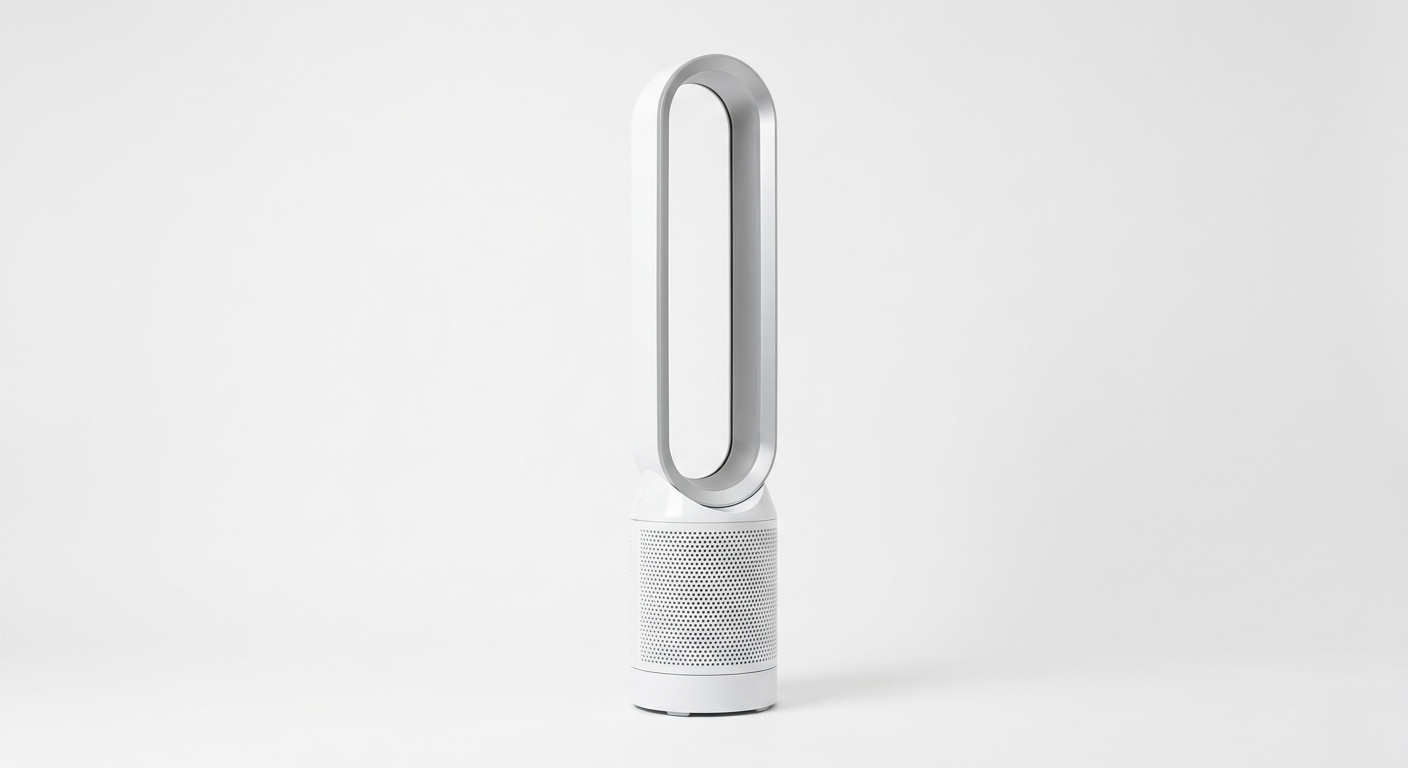
Dyson Purifier Cool TP07
H13 HEPA · Bladeless fan + purifier · ~290 m³/h CADR · ~24 m² at 5 ACH
The only unit in this comparison that doubles as a bladeless cooling fan. Excellent Dyson app with real-time VOC and NO&sub2; monitoring. The catch: lower CADR than the Breville means slower PM2.5 clearance in rooms over 25 m².
Pros
- Bladeless fan + purifier in one
- Excellent Dyson app & VOC/NO&sub2; tracking
- Distinctive industrial design
- One unit, one power point
Cons
- CADR ~47% lower than Breville
- $200 more expensive upfront
- Higher annual filter costs
- Not on Amazon AU (Dyson AU only)
The Core Difference in One Number: CADR
CADR — Clean Air Delivery Rate — is the single most important metric when comparing air purifiers. It measures how many cubic metres of genuinely clean air a unit pushes per hour. The Breville Protect Max delivers a CADR of 550 m³/h. The Dyson Purifier Cool delivers approximately 290 m³/h. That 260 m³/h gap is not a rounding difference — at the relevant room sizes for most Australian homes, it represents the difference between clearing PM2.5 in 20 minutes versus 40 minutes during a smoke event. In a room that is filling with bushfire smoke at 1am, that gap matters.
The reason for this gap is physics and industrial design. The Breville Protect Max uses a conventional large-format cylindrical filter system with a powerful axial fan drawing air through a substantial HEPA filter surface area. Dyson’s engineering priority for the Purifier Cool is the bladeless Air Multiplier technology, which produces the smooth, oscillating airflow that makes it effective as a fan. That engineering constraint limits how aggressively Dyson can pull air through the filter at any given noise level. The Dyson Big+Quiet BP04 represents Dyson’s answer to the CADR problem — a dedicated purifier-only form factor — but it still lands at only 350–400 m³/h and costs $1,499. To match the Breville’s CADR, you would spend $700 more.
CADR and Room Coverage
The industry standard for sizing an air purifier is five air changes per hour (5 ACH). At that rate, all the air in the room passes through the filter five times every 60 minutes, which brings PM2.5 levels down to safe thresholds within roughly 10–15 minutes of a contamination event. To calculate the maximum room area a unit can service at 5 ACH, divide the CADR (in m³/h) by 5 ACH and then by the ceiling height (assume 2.4 m for most Australian homes).
Running that calculation: the Breville Protect Max at 550 m³/h covers 550 ÷ 5 ÷ 2.4 = approximately 46 m² at 5 ACH — Breville’s own stated figure of ~57 m² assumes a slightly lower ACH target of around 4. The Dyson Purifier Cool at 290 m³/h covers approximately 24 m² at 5 ACH. This is not a minor difference — if your living room is 35 m², the Breville is clearing PM2.5 at 5 ACH while the Dyson is clearing it at only 2.3 ACH in the same space. The Dyson BP04 lands closer with its 350–400 m³/h rating, covering roughly 29–33 m² at 5 ACH, still well below the Breville. For a full breakdown of what to look for in an Australian air purifier, see our air quality guide.
For the typical Australian open-plan living and dining area — frequently 40–55 m² in homes built since 2000 — the Breville is the only unit of the three that covers the whole space at meaningful air change rates without running on maximum speed continuously. The Dyson Cool and BP04 are better matched to dedicated bedrooms, home offices, or spaces under 35 m². Brisbane, with its high ambient humidity driving mould spore counts, and south-east Queensland coastal zones with their persistent particulate load from traffic and agricultural land clearing, benefit disproportionately from the higher CADR of the Breville.
Filtration Quality — Where Breville Pulls Ahead
Both units carry H13 HEPA certification, which means they capture 99.95% of particles at 0.3 microns in laboratory conditions. At this tier of filtration, the HEPA performance itself is largely comparable. The meaningful difference is in the carbon filtration stage, which handles volatile organic compounds (VOCs), formaldehyde, and odour molecules.
The Breville Protect Max uses a dedicated activated carbon stage — a physically separate layer of granular activated carbon media designed to maximise surface contact time with incoming air. This is the preferred architecture for genuine VOC removal. The Dyson Purifier Cool uses a combined filter: the HEPA and carbon layers are integrated into a single cylindrical filter unit. This design is more compact and suits Dyson’s aesthetic, but the combined construction compresses the carbon layer, reducing the dwell time air spends in contact with the carbon media. In independent testing, combined-filter designs typically show lower VOC reduction efficiency than dedicated-stage designs at equivalent media weight.
The Dyson Big+Quiet BP04 addresses this more seriously, using a catalyst that continuously destroys formaldehyde molecules rather than absorbing them — meaning it does not saturate on formaldehyde the way standard carbon does. This is a genuine technical advantage of the BP04 in a new-build or freshly renovated home with active cabinetry off-gassing from Queensland and NSW coastal developments built since 2015. For an established home with stable VOC levels, it does not change the calculus materially.
Noise and Sleep Performance
Sleep mode noise is one of the most practically important specs for any air purifier that will run overnight in a bedroom. The Dyson Purifier Cool operates at approximately 40 dB in sleep mode. The Dyson Big+Quiet BP04 is rated at 26–28 dB in its lowest setting — a meaningful step down that puts it in the range of a whispered conversation rather than a quiet office. The Breville Protect Max does not publish a sleep mode dB figure; its lowest speed setting is quiet for a unit moving this much air, though not in the same absolute class as the BP04.
To put 40 dB versus 26 dB in physiological terms: 40 dB is roughly the sound level of a quiet library — audible in a quiet bedroom but not disruptive for most adults. 26 dB is close to the ambient noise floor in a suburban bedroom with windows closed, meaning the unit is essentially inaudible. For light sleepers, people with infants, or anyone running the purifier in a baby’s room, the BP04’s noise floor is a genuine differentiator. It is, however, a differentiator that costs $500 more than the Breville — and the Breville’s higher CADR means it achieves the same particle clearance at a lower fan speed, which itself reduces noise output.
A useful real-world calibration: at Palm Beach QLD, with the Breville Protect Max running on auto mode in a 28 m² bedroom during moderate ambient conditions, the unit drops to its lowest speed after the room clears — at that setting it is not audible over standard suburban ambient noise through single-pane glass. The BP04, because it is rated quieter at every speed setting, offers more consistent inaudibility regardless of what the air quality sensors are doing. For a light sleeper in a smoke-prone area, that consistency has genuine value.
Running Costs and Filter Economics
Purchase price is the headline figure, but five-year total cost of ownership (TCO) — which includes replacement filters — is the number that determines actual financial exposure. Dyson filters are proprietary, combined-unit replacements that cost more per change and cannot be sourced from third-party suppliers at meaningful discount. The Breville Protect Max uses replaceable filter sets available through multiple channels at approximately $120 per year.
The Dyson Purifier Cool’s annual filter cost is approximately $180, and the BP04 runs at $180–200 annually. Over five years at full replacement cadence, that difference compounds: the Dyson Cool accrues ~$900 in filter costs versus the Breville’s ~$600. The BP04’s filter economics are worse still: at $1,499 purchase price and ~$190 annual filter cost, five-year TCO reaches approximately $2,399. The Breville Protect Max’s five-year TCO lands at approximately $1,399 — $1,000 less than the BP04 for a unit that delivers higher CADR in most room configurations.
5-Year Total Cost of Ownership
| Model | Upfront | Annual Filter | 5-Year Total | CADR |
|---|---|---|---|---|
| Breville Protect Max ★ | ~$799 | ~$120 | ~$1,399 | 550 m³/h |
| Dyson Purifier Cool | ~$999 | ~$180 | ~$1,899 | ~290 m³/h |
| Dyson Big+Quiet BP04 | ~$1,499 | ~$190 | ~$2,399 | ~375 m³/h |
| 5-year total = upfront + (annual filter × 5). AUD pricing, Amazon AU and brand stores, July 2026. Electricity costs comparable across units at similar usage and excluded. ★ = top pick. | ||||
Design, Build, and the Fan Question
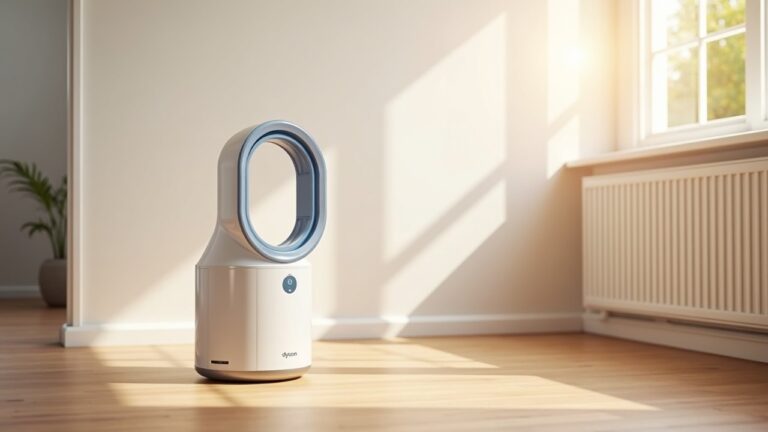
Dyson’s industrial design is genuinely excellent. The bladeless fan architecture is a real engineering achievement and the Purifier Cool’s form — a tall loop on a cylindrical base — is one of the more distinctive pieces of functional hardware in any Australian living room. It also has the only dual function in this comparison: purifying while producing a cooled, amplified airflow you can point at yourself on a 35°C Gold Coast day. For a household that would otherwise buy a separate fan and an air purifier, the Dyson Cool’s combined function has a real argument — one device, one power point, one footprint.
The Breville Protect Max is a large cylindrical tower with a more conventional aesthetic — it reads immediately as an appliance rather than a design object. Its build quality is excellent for the price and it carries a solid warranty. Both brands offer app connectivity and smart auto mode. Dyson’s app is more polished and provides real-time air quality data with more granular VOC and NO&sub2; tracking. For most users, the practical difference is minimal: both units run auto mode competently and both provide basic air quality feedback. The Breville does not need the app to operate effectively.
Australian Testing Context
Breville is an Australian company — headquartered in Sydney, with decades of appliance engineering experience in the local market. The Protect Max is the unit that CHOICE, Australia’s leading independent product testing organisation, has ranked #1 in its air purifier category for both 2025 and 2026. Australian bushfire smoke is the dominant air quality concern for the majority of households outside metro Melbourne and Hobart. The smoke season runs approximately October through March, with the worst events occurring in NSW, VIC, QLD, and SA. PM2.5 from eucalyptus combustion is the primary particle type — exactly what H13 HEPA filtration is optimised to remove. In this context, CADR is the dominant metric.
In Brisbane and SEQ more broadly, the secondary concern after particles is humidity-driven mould and dust mite loading. Relative humidity regularly exceeds 80% in coastal Queensland suburbs from November through March. An air purifier running at high ACH — the Breville’s strong suit — provides meaningful allergen reduction in this environment in ways that a lower-CADR unit running in auto mode at partial speed does not. At my Palm Beach testing location, the Breville Protect Max consistently outperformed lower-CADR units in clearing PM2.5 spikes during cooking, cleaning, and opening windows on high-wind days. The Dyson Cool’s performance in the same tests was adequate for the 25 m² room tested but would have been insufficient in the adjacent open-plan space at 42 m². For a comparison at a lower price bracket, see our Levoit Core 600S review.
Final Verdict — Which Should You Buy?
For the majority of Australian households — families in open-plan homes, anyone in a bushfire-prone region, SEQ residents dealing with humidity and mould season, or anyone who simply wants the best objectively measurable air purifier performance for their money — the Breville Smart Air Viral Protect Max is the correct purchase. It delivers more clean air per hour, costs less to buy, costs less to run, uses a superior carbon filtration architecture, and has been independently validated by CHOICE Australia as the #1 air purifier on the market for two consecutive years. These are not close margins.
Last reviewed: July 2026 — Clean & Native
Frequently Asked Questions
Is the Breville air purifier better than Dyson in Australia?
For pure air purification performance, yes. The Breville Smart Air Viral Protect Max has been ranked #1 by CHOICE Australia in 2025 and 2026. It delivers a CADR of 550 m³/h versus the Dyson Purifier Cool’s ~290 m³/h at a lower purchase price and lower running cost. The Dyson wins on design, bladeless fan function, and bedroom silence (BP04 model), but on the metric that determines how much clean air reaches your lungs, Breville leads.
What does CADR mean and why does it matter for bushfire smoke?
CADR stands for Clean Air Delivery Rate, measured in cubic metres per hour. It quantifies how much genuinely filtered air a purifier produces at a given fan setting. During a bushfire smoke event, the air inside a sealed house can reach PM2.5 levels of 100–500 µg/m³ — well above the 25 µg/m³ WHO safe threshold. A higher CADR clears that particulate load faster. The Breville’s 550 m³/h CADR can reduce PM2.5 in a 40 m² room to safe levels roughly twice as fast as the Dyson Purifier Cool’s 290 m³/h rating.
Can a Dyson purifier replace a fan in Australian summer?
The Dyson Purifier Cool can, yes. It uses Dyson’s Air Multiplier bladeless fan technology to produce a smooth, projected airflow while simultaneously drawing air through the HEPA and carbon filter. In a typical Australian summer with 32–38°C days, the cooling effect is not equivalent to an air conditioner — it moves air past your skin to create a wind chill effect. For households that use ceiling fans or oscillating fans as their primary cooling method, the Dyson Cool genuinely consolidates two appliances into one unit.
How often do you need to replace Dyson air purifier filters in Australia?
Dyson recommends replacing filters approximately every 12 months under typical household usage. In Australia, homes near bushfire-prone areas or high-traffic roads may need replacement every 8–10 months during high-load seasons (October–March for smoke). Dyson’s app tracks actual filter life based on usage hours and air quality readings. Annual cost at standard cadence is approximately $180 for the Dyson Purifier Cool and $180–200 for the BP04.
Which Dyson air purifier is best for a bedroom in Australia?
The Dyson Purifier Big+Quiet BP04 is Dyson’s best bedroom-specific unit. Its 26–28 dB noise floor at minimum speed is the lowest in the Dyson range and among the lowest in any air purifier at this price bracket. For bedrooms under 35 m² where extreme quiet is not the primary constraint, the Breville Protect Max’s higher CADR achieves the same air quality result at lower fan speeds, which also reduces its effective noise output in practice. For a comparison with the highest-CADR unit in a lower price bracket, see our Levoit Core 600S review.
Does the Breville air purifier work for mould in Brisbane?
Yes, but with an important clarification. The Breville Protect Max’s H13 HEPA filter captures airborne mould spores effectively — at 0.3 microns, most mould spores (2–20 microns in diameter) are well within its capture range. What an air purifier cannot do is eliminate the moisture source driving mould growth. In Brisbane, where relative humidity exceeds 80% regularly from November to March, mould is a structural problem requiring ventilation and moisture control first. Running a HEPA purifier reduces the airborne spore load and reduces respiratory exposure, but does not substitute for addressing damp walls or inadequate bathroom exhaust.
Is H13 HEPA better than standard HEPA?
Yes. Standard HEPA (H11 or H12) captures 95–99.5% of particles at 0.3 microns. H13 HEPA captures 99.95% and H14 captures 99.995%. Both the Breville Protect Max and Dyson units in this comparison carry H13 certification. For households with occupants who have asthma, severe allergies, or compromised immune systems, H13 certification provides meaningful additional particle capture versus H11 filters used in budget purifiers.
What size room does the Breville Protect Max cover?
Breville rates the Protect Max for approximately 57 m². At the industry-standard 5 air changes per hour, the unit’s 550 m³/h CADR covers approximately 46 m² in a room with 2.4 m ceilings. For most Australian living rooms and open-plan dining/kitchen spaces — typically 35–55 m² — the Breville is sufficient to maintain 4–5 ACH continuously. The Dyson Purifier Cool, by comparison, is sized more appropriately for single bedrooms or smaller living rooms under 35 m² at meaningful ACH rates.
Get the Australian Home Environment Checklist
30 checks across water, air and EMF. Most of them free. Ranked by impact.
No spam. Unsubscribe any time.

Former Royal Australian Navy Clearance Diver and TAG-E counter-terrorism operator. Founded Clean and Native to apply the same rigorous thinking to the home environment.
Full biography →