Best Water Filters for Fluoride Removal in Australia (2026, Compared)
Drafted with AI assistance and checked against published specifications and certifications. First-hand measurements appear only where stated. How we make content
The only water filters that reliably remove fluoride in Australia are reverse osmosis systems (90–97% removal) and activated alumina filters (80–95% removal) — carbon filters including Brita, standard GAC, and catalytic carbon cannot remove fluoride at all, regardless of price or brand. If you live in Sydney, Brisbane, Adelaide, Gold Coast, or Darwin and want to remove both fluoride and chloramine from your tap water, a reverse osmosis system is the only technology that handles both contaminants simultaneously, as assessed using our documented methodology.
Only reverse osmosis (RO) reliably removes fluoride from Australian tap water. The Waterdrop X8 is our top pick: a tankless under-sink RO certified to NSF/ANSI 58, with fluoride listed among the contaminants it reduces. If you rent and cannot plumb, the AquaTru Classic (a US import, about A$962) is the only countertop RO on sale here that is certified for fluoride; the Philips RO Water Station is the locally stocked option, though Philips publishes no fluoride figure. The EcoHero 5-Stage RO is the best budget under-sink unit — Jayce tested his Palm Beach mains water (69 ppm TDS) and measured 3 ppm post-filter, a 95.7% reduction.
| Filter | Type | Fluoride removal | Verdict |
|---|---|---|---|
| Waterdrop X8 | Under-sink RO (tankless) | Listed (no % published) | Best overall |
| Philips RO Water Station | Countertop RO | Not listed by Philips | Best no-plumbing, local stock |
| AquaTru Classic Alkaline | Countertop RO (US import) | 93.5% avg (NSF/ANSI 58) | Certified no-plumbing |
| EcoHero 5-Stage RO | Under-sink RO | 90–97% | Best budget |
| Brita / carbon filters | GAC / carbon block | 0% | Cannot remove fluoride |
Does Your Australian Tap Water Contain Fluoride?
Yes — every major Australian city fluoridates its water supply. This is not accidental or hidden: fluoridation is a deliberate public health measure, implemented under state and territory legislation, and governed by the Australian Drinking Water Guidelines (ADWG 2022), which sets the maximum acceptable level at 1.5 mg/L. The target range for most Australian cities sits between 0.6 and 1.0 mg/L — enough to deliver the intended dental health benefit, well below the ADWG maximum.
The debate about whether fluoride at these levels is beneficial or harmful to health is outside the scope of this article. What this article addresses is the practical question you are here to answer: if you want to remove fluoride from your drinking water, which filter actually does it? The answer is more specific than most filter manufacturers admit, and the most expensive mistake Australian buyers make is spending hundreds of dollars on a premium carbon filter expecting fluoride removal — and getting none.
| City | Fluoride (mg/L) | Disinfection type | What you need |
|---|---|---|---|
| Sydney | ~1.0 | Chloramine | RO only |
| Melbourne | ~1.0 | Free chlorine | RO (for fluoride) |
| Brisbane / SEQ | ~0.6–0.8 | Chloramine | RO only |
| Adelaide | ~0.9 | Chloramine | RO only |
| Perth | ~0.7 | Chloramine | RO only |
| Darwin | ~0.7 | Chloramine | RO only |
| Hobart / Canberra | ~0.7 | Free chlorine | RO (for fluoride) |
Notice the “What you need” column: five of the seven major cities use chloramine as their disinfectant (Brisbane, Sydney, Adelaide, Gold Coast, Darwin), which means a carbon filter that removes the taste of chloramine still leaves all the fluoride behind. In those cities, the fluoride and chloramine problem must be solved together — and only reverse osmosis solves both. If you are in Melbourne, Hobart, or Canberra, a carbon filter handles taste and chlorine reasonably well, but it does nothing for fluoride; you still need RO for that.
Why Carbon Filters Cannot Remove Fluoride (The Misconception Costing Australians Thousands)
Carbon filters — including standard granular activated carbon (GAC), compressed carbon block, catalytic carbon, and the premium versions used in Brita pitchers and most benchtop systems — work by adsorption. Contaminant molecules stick to the porous carbon surface as water flows through. This mechanism is highly effective for organic compounds, chlorine, chloramines (at reduced efficiency), pesticides, and taste-causing compounds.
Fluoride does not stick to carbon. The fluoride ion (F⁻) has a high charge density and low polarisability — it binds weakly to carbon surfaces and passes straight through at essentially the same concentration as it entered. This is not a quality issue with cheap carbon filters; it is a fundamental chemistry limitation of the adsorption mechanism. A $20 Brita pitcher and a $500 premium carbon block system both remove approximately 0% of fluoride from your water.
⚠ The carbon filter fluoride myth
If a carbon filter’s marketing mentions “reduces impurities” or “improves taste and odour” without specifically stating NSF/ANSI Standard 58 or activated alumina media, it does not remove fluoride. “Reduces contaminants” never includes fluoride unless the certification explicitly names it.
Why does this misconception persist? Partly because filter brands market “improved taste” and “purer water” without specifying what is actually removed. Partly because fluoride is invisible and tasteless — you cannot tell from drinking the water whether it has been removed. The result: Australian families spend hundreds of dollars on a Brita, Clearly Filtered, or premium benchtop system believing they have solved the fluoride problem, when the fluoride concentration in their glass is identical to unfiltered tap water.
| Technology | Fluoride | Chloramine | PFAS | Lead | Hardness |
|---|---|---|---|---|---|
| Standard GAC (Brita) | ✗ 0% | ✗ Poor | ✗ No | ~ Partial | ✗ No |
| Catalytic carbon block | ✗ 0% | ✓ Yes | ✗ No | ✓ NSF53 | ✗ No |
| Reverse osmosis (RO) | ✓ 90–97% | ✓ Yes | ✓ >98% | ✓ >95% | ✓ Yes |
| Activated alumina | ✓ 80–95% | ✗ No | ✗ No | ✗ No | ✗ No |
Which Filter Technologies Actually Remove Fluoride?
Two technologies have a proven track record for fluoride removal: reverse osmosis (RO) and activated alumina. They work through entirely different mechanisms, and for most Australian households, RO is the clear choice — it handles fluoride alongside every other contaminant in one system.
Reverse Osmosis (RO) — 90–97% fluoride removal
Reverse osmosis works by forcing water through a semi-permeable membrane with pores so small (0.0001 microns) that fluoride ions cannot pass through. The membrane physically excludes fluoride along with chloramine, PFAS, nitrates, lead, arsenic, and the dissolved solids responsible for hardness. A quality RO system certified to NSF/ANSI Standard 58 removes 90–97% of fluoride in controlled testing at standard pressures. In real-world conditions at typical Australian mains pressure (around 350–500 kPa), well-maintained RO systems consistently achieve 90–95% reduction.
RO systems come in two main form factors for residential use. Countertop RO units sit on the bench and connect to your tap — no plumbing required, which makes them suitable for renters or anyone unwilling to modify cabinetry. Under-sink RO systems mount inside the cabinet beneath your kitchen sink, connect to the cold water supply line, and feed a dedicated filter tap on the bench surface. Both deliver the same fluoride removal — the choice comes down to your living situation, kitchen layout, and whether you own or rent.
Activated Alumina — 80–95% fluoride removal
Activated alumina (Al₂O₃) is a porous form of aluminium oxide with a specific affinity for fluoride ions. As water passes through the media, fluoride adsorbs onto the surface. It is the mechanism used in some gravity filters and standalone fluoride-specific add-on cartridges. The catch: activated alumina is highly pH-dependent. It performs best at pH 5.5–6.0, while Australian mains water typically sits at pH 7.0–8.0. At neutral to alkaline pH, activated alumina efficiency drops to the lower end of the 80–95% range, and some studies show real-world removal closer to 70% in Australian water conditions. It also requires periodic regeneration with an alum solution to maintain capacity.
For most Australian households, RO is the more practical solution. Activated alumina can be a useful add-on inside a gravity filter system (like the Berkey with fluoride elements), but it comes with caveats that RO does not. The Berkey situation is covered in detail in the section below.
Decision tree: which filter do you need?
Step 1: Can you modify your plumbing (i.e., do you own your home)? No → countertop RO (the imported AquaTru Classic if you need certified fluoride removal, or the Philips RO Water Station for local stock). Yes → under-sink RO (Waterdrop X8 or EcoHero).
Step 2: Which city? Brisbane / Sydney / Adelaide / Gold Coast / Darwin = chloramine present → RO is the only option that handles both. Melbourne / Hobart / Canberra = free chlorine → RO still needed for fluoride.
Step 3: Budget? Under $400 upfront → EcoHero 5-Stage (best value). Around $720 plus about $275/yr in filters → Waterdrop X8 (certified). No plumbing → Philips RO Water Station.
The Best Fluoride-Removing Water Filters in Australia — Reviewed
Every filter below uses reverse osmosis and removes fluoride at 90–97%. None of these are carbon-only systems. Prices are in Australian dollars and current as of July 2026. For the full roundup of best water filters in Australia, including non-fluoride options, see our main guide.
1. Waterdrop X8 Under-Sink RO — Best Overall (Certified, Tankless)
 Tankless RO800 GPDNSF/ANSI 58 system
Tankless under-sink RO | Certified by IAPMO R&T to NSF/ANSI 42, 58 and 372 | 2:1 pure-to-drain | Real-time TDS faucet | Needs a power point | ~$719 (Amazon AU, 18 Oct 2026)
Check the Waterdrop X8 Price →✓ Pros
- Certified to NSF/ANSI 42, 58 and 372 by IAPMO R&T, with fluoride listed among the contaminants it reduces
- 2:1 pure-to-drain ratio: one cup to drain for every two cups of drinking water
- Tankless design and a TDS-reading faucet, so you can see when the membrane needs changing
× Cons
- No fluoride reduction percentage published for this unit
- Needs a power point under the sink, plus a drain and supply connection
- Filters cost roughly $275 a year at Amazon AU prices
Buy this if…
you own your home, want a certified system, and are happy to plumb it in once and change cartridges on schedule.
The X8 is certified by IAPMO R&T against NSF/ANSI 42, 58 and 372, and Waterdrop lists fluoride among the contaminants it reduces. Waterdrop does not publish a fluoride reduction percentage for this unit, so treat the 90 to 97% range in the RO section above as the benchmark for the technology, not a tested figure for the X8. What sets it apart in practice is the 2:1 pure-to-drain ratio, a tankless body that frees up the cupboard, and a faucet that reads TDS in real time. That last feature matters: it is the simplest way to confirm the membrane is still doing its job between cartridge changes. It needs a power point under the sink. Running cost is the trade-off: the three cartridges (F1G every 12 months, F2 every 6 months and the X8-F3 RO cartridge every 24 months) work out to roughly $275 a year at Amazon AU prices checked in October 2026.
For Brisbane and SEQ households, one system covers both complaints: the carbon stages are certified to NSF/ANSI 42 for chlorine taste and odour, and the RO membrane handles the fluoride. Read our full reverse osmosis filter guide for Australia for a deeper technical comparison.
2. Philips RO Water Station (ADD6901) — Best No-Plumbing Option for Renters
 Countertop RO2,000 Lfilter capacity
Countertop RO | Aquaporin Inside membrane | 4 L raw-water tank | Ambient to 95°C dispensing | No plumbing | ~$698 to $779 (Bing Lee, Amazon AU, 18 Oct 2026)
Check the Philips Price →✓ Pros
- No plumbing or drilling: fill the 4 L tank and plug it in
- Hot water at 45, 85 or 95°C as well as ambient, which replaces a kettle for tea and coffee
- Retailer-listed waste ratio of 1 L to drain for every 3 L purified
× Cons
- Philips does not list fluoride among the substances it reduces and names no independent certification
- Very few Amazon AU reviews so far (two ratings when checked)
- Replacement cartridge pricing for this model was not listed in Australia when checked
Buy this if…
you rent or cannot modify your plumbing, and you will confirm fluoride reduction yourself with a test before relying on it.
The Philips station sits on the bench and fills from its own 4 L tank, so there is nothing to plumb. That makes it the realistic option if you rent. It uses an Aquaporin Inside RO membrane, dispenses at ambient, 45, 85 or 95°C, and the filter is rated for 2,000 L. Philips lists chlorine, hardness, lead, pesticides, PFOA and PFOS among the substances it reduces. It does not list fluoride, and it does not name an independent certification.
RO membranes as a technology remove most fluoride, but without published data for this unit you are taking that on trust. If fluoride is the reason you are buying, test the output yourself with fluoride strips or a lab test (see the testing section below) before relying on it, or choose the certified X8 or the imported AquaTru. Reviews are thin so far: two ratings on Amazon AU when checked.
3. AquaTru Classic Alkaline (US Import) — Certified No-Plumbing Option
 Countertop RO93.5%avg fluoride reduction
Countertop RO, 4 stages | Certified by IAPMO to NSF/ANSI 42, 53, 58, 401 and P473 | No plumbing | Sold and shipped by Amazon US | ~A$962 (18 Oct 2026)
Check the AquaTru Import Price →✓ Pros
- The only countertop RO we found on sale in Australia with independent certification for fluoride (NSF/ANSI 58)
- IAPMO performance data: 93.5% average fluoride reduction, 99.1% average lead reduction, at least 97.5% PFOA/PFOS reduction
- No plumbing: fill the tank and switch it on
× Cons
- About A$962 as an import, before replacement filters
- US-market unit with a US plug and US warranty terms, sold and shipped from the US
- Filters also come from Amazon US, so every cartridge change is an import
Buy this if…
you rent, you want certified fluoride removal without plumbing, and you accept import pricing and US-based support.
The AquaTru is the only countertop RO we found on sale in Australia with independent certification for fluoride. Its IAPMO performance data sheet reports 93.5% average fluoride reduction under NSF/ANSI 58, tested from an 8 mg/L challenge, plus 99.1% average lead reduction. The catch is supply: on 18 October 2026 it was available only through Amazon AU as an Amazon US import at about A$962, with a US plug, US warranty terms and imported filters (about A$150 a year for the pre-filters and VOC filter). Read our AquaTru review for Australia for the power and import details before you buy.
4. EcoHero 5-Stage RO — Best Budget Under-Sink (Jayce’s Personal Pick)
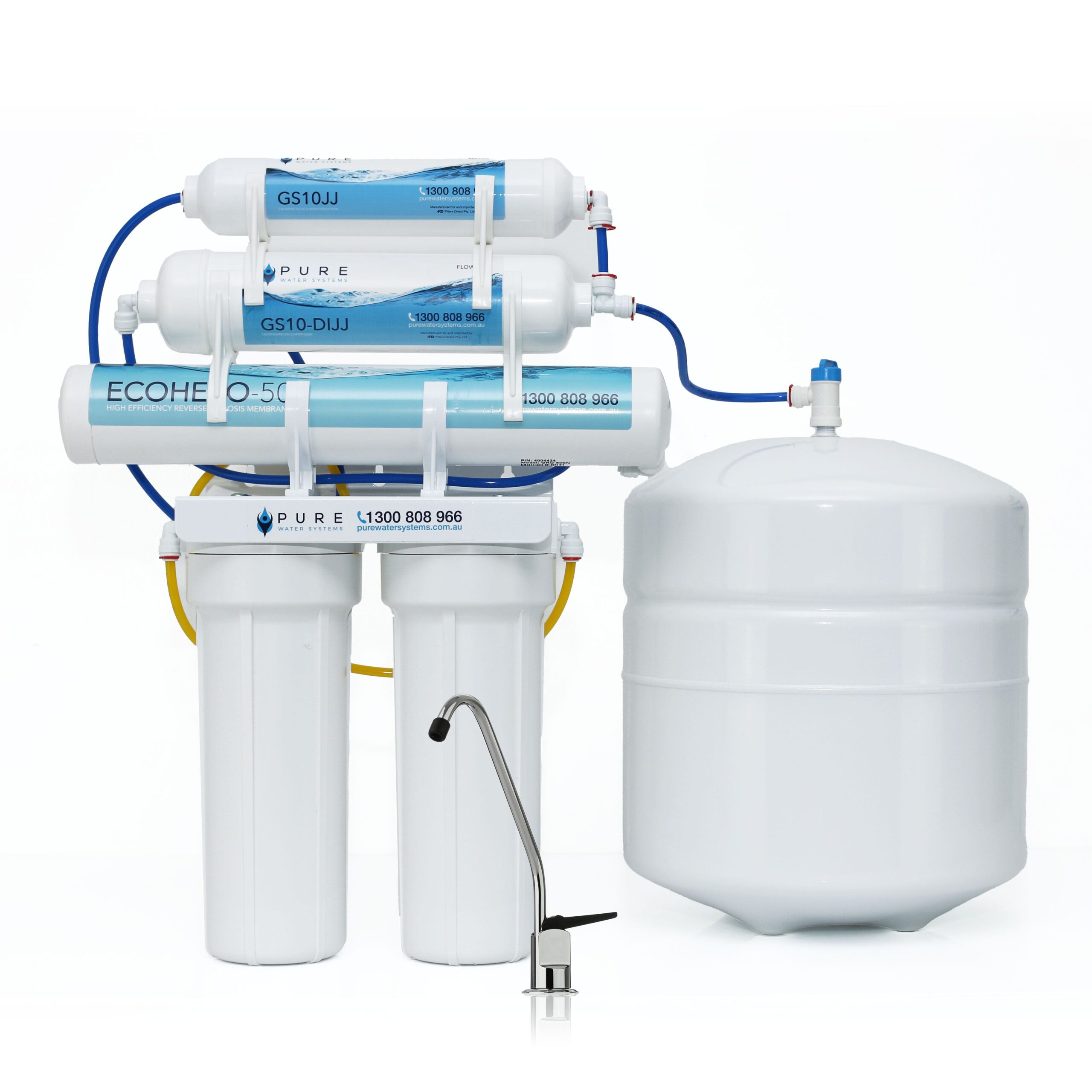
The EcoHero’s 5 stages are: 5-micron sediment, carbon block pre-filter (for chloramine), 100 GPD RO membrane, granular activated carbon post-filter, and a 3.2L pressure tank. It is designed for Australian mains pressure and fits standard Australian under-sink dimensions. Pure Water Systems (the Australian distributor) offers local technical support, which matters when troubleshooting a plumbed system. For my full test results and installation notes, see the EcoHero 5-Stage RO review.
What to Do If You Have a Berkey or Carbon Filter
If you already own a Berkey gravity filter or a carbon-based system, the situation is more nuanced than most Berkey forums acknowledge. Standard Black Berkey elements remove a wide range of contaminants — but they do not remove fluoride. Berkey is explicit about this in their own documentation: fluoride removal requires the addition of their PF-2 Fluoride and Arsenic Reduction elements, which are separate cartridges that slot into the lower chamber beneath the Black Berkey elements.
The PF-2 elements use activated alumina media and are rated at 80–95% fluoride removal — in theory. The real-world complication: activated alumina’s efficiency drops at the pH levels typical of Australian mains water (7.0–8.0). Multiple independent tests of Berkey + PF-2 combinations have shown fluoride reduction in the 60–80% range at neutral pH, not the 95% that optimally acidic water would produce. That still reduces fluoride from Sydney’s 1.0 mg/L to somewhere between 0.2 and 0.4 mg/L — which is a meaningful reduction, but not the near-complete removal that an RO system achieves. The PF-2 elements also require replacement every 1,000 litres, adding to the ongoing cost.
Berkey + Fluoride: the honest summary
- Black Berkey elements alone: 0% fluoride removal
- Black Berkey + PF-2 Fluoride elements: 60–80% fluoride removal at typical Australian water pH
- RO system: 90–97% fluoride removal regardless of pH
- Berkey also does not remove chloramine — critical for Brisbane, Sydney, Adelaide, Gold Coast, and Darwin households
For the Tappwater EcoPro and similar carbon block benchtop systems: these are excellent for chloramine and chlorine removal, and the EcoPro (ASIN: B0BP5BS7B9) is one of our top picks for taste improvement. But a carbon block filter — including the EcoPro — removes 0% of fluoride. If your primary concern is fluoride, the EcoPro is not the right tool. If your concern is chloramine taste in Melbourne or Canberra water and you are not concerned about fluoride, a carbon block is appropriate. Never use a carbon filter as your fluoride solution; use it for what it excels at.
How to Test Fluoride in Your Water at Home
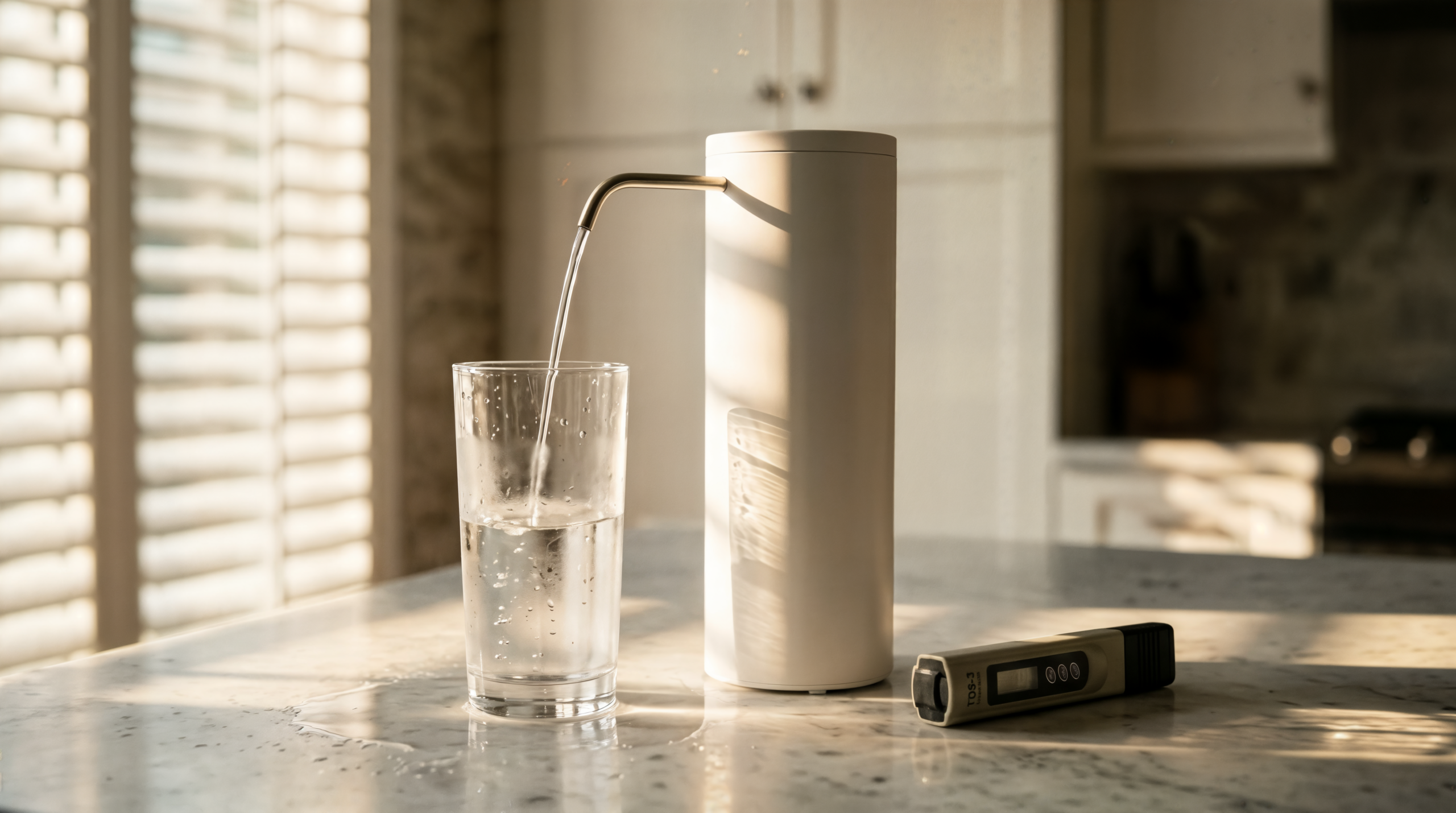
A TDS meter is the most accessible home water quality tool, but it does not specifically measure fluoride — it measures Total Dissolved Solids, which includes fluoride along with calcium, magnesium, chlorides, sulphates, and every other dissolved mineral and salt. Fluoride contributes a small fraction to the total TDS reading. At 1.0 mg/L fluoride in water with a TDS of 80 mg/L (typical Sydney), fluoride represents about 1.25% of the TDS reading. A drop from 80 to 4 ppm on a TDS meter after an RO filter indicates the membrane is performing well and fluoride is likely being removed proportionally — but TDS is a proxy, not a direct fluoride measurement.
For a direct fluoride measurement, you need a fluoride-specific test. Three practical options in Australia:
| Method | Cost | Accuracy | Best for |
|---|---|---|---|
| Fluoride test strips (pool/water) | $15–$40 | ±0.5 mg/L | Quick confirmation that RO is working |
| Laboratory water test (accredited) | $80–$150 | ±0.01 mg/L | Baseline test before + after installing RO |
| State water utility annual report | Free | City average | Understanding your starting level |
Each state water utility publishes annual water quality reports with fluoride levels by zone. Sydney Water, Melbourne Water, Seqwater (Brisbane), SA Water, Water Corporation (Perth), and NT Power and Water all publish these reports online. If you want to know your exact suburb’s fluoride level before buying a filter, start there — the data is free and current. For Penrith and western Sydney suburbs, where fluoride has historically sat at the upper end of the 0.6–1.0 mg/L target range, the utility report is the most accurate starting point.
Last reviewed: July 2026 — Clean and Native
Frequently Asked Questions
Does a Brita filter remove fluoride?
No. Brita filters use granular activated carbon (GAC), which cannot remove fluoride at any meaningful level. The fluoride ion does not adsorb onto carbon surfaces — it passes straight through the filter at essentially the same concentration as your tap water. This applies to all Brita models, including the Brita Maxtra and Brita Stream. If you want to remove fluoride, you need a reverse osmosis system or an activated alumina filter.
What percentage of fluoride do RO filters remove?
Reverse osmosis filters remove 90–97% of fluoride, as tested under NSF/ANSI Standard 58 laboratory conditions. In real-world Australian mains water at typical pressures (350–500 kPa), well-maintained RO systems consistently achieve 90–95% reduction. Jayce’s personal EcoHero 5-Stage RO tested at 95.7% TDS reduction on Palm Beach SEQ mains water (69 ppm in, 3 ppm out), consistent with the high end of the rated specification.
Is fluoride in Australian water safe?
Australian water fluoridation levels (0.6–1.0 mg/L) are well within the Australian Drinking Water Guidelines (ADWG 2022) maximum of 1.5 mg/L. The NHMRC and WHO both consider fluoridation at these levels safe and beneficial for dental health. Concerns about fluoride at higher concentrations (dental fluorosis above 1.5 mg/L, skeletal fluorosis above 4.0 mg/L) are not relevant at Australian tap water levels. Whether you choose to filter it out is a personal decision, not a public health recommendation.
How do I know if my water has fluoride?
All major Australian cities fluoridate their water. Your state water utility publishes annual water quality reports showing fluoride levels by zone — Sydney Water, Melbourne Water, Seqwater, SA Water, Water Corporation (Perth), and NT Power and Water all publish these free. For a specific measurement before and after your filter, use fluoride test strips ($15–$40) or an accredited laboratory water test ($80–$150) for precise results.
Can I add fluoride back to RO water?
Yes. Some RO systems include a remineralisation or alkaline post-filter that adds calcium and magnesium back to the filtered water, but does not re-add fluoride. If you want to add fluoride back — for example, for children whose developing teeth may benefit — you would need to use a fluoride supplement on veterinary or medical advice. Most households that install RO for fluoride removal simply accept the fluoride-free output and rely on fluoride toothpaste for dental health.
Does boiling water remove fluoride?
No. Boiling water does not remove fluoride. Boiling kills biological contaminants (bacteria, viruses, parasites) and causes some chlorine to off-gas, but fluoride is a dissolved mineral ion — it does not evaporate or deactivate when heated. In fact, because boiling reduces water volume through evaporation, the fluoride concentration in the remaining water increases slightly after prolonged boiling. Only RO or activated alumina physically removes fluoride.
What is the cheapest way to remove fluoride from tap water in Australia?
The cheapest fluoride-removing filter in Australia is a budget 5-stage under-sink RO system such as the EcoHero from Pure Water Systems (around $349 installed). A countertop RO such as the Philips RO Water Station costs more upfront (about $698 to $779) but needs no plumbing. Philips does not publish a fluoride figure for it, so test the output if fluoride is your reason for buying. There is no cheaper effective option — activated alumina pitcher inserts are available internationally but not widely sold in Australia in reliable form. Avoid any product claiming to remove fluoride through carbon filtration alone; the claim is false regardless of price.
Does chlorine removal also remove fluoride?
No. Chlorine and fluoride are removed by entirely different mechanisms. Carbon filters that remove chlorine (or chloramine, with catalytic carbon) use adsorption — fluoride does not adsorb onto carbon. Reverse osmosis removes both chlorine and fluoride through physical membrane exclusion. Vitamin C shower filters neutralise chloramine but do nothing for fluoride. If you want fluoride removal, you need RO specifically — not a carbon filter, not a vitamin C filter, not a KDF filter.
Get the Australian Home Environment Checklist
30 checks across water, air and EMF. Most of them free. Ranked by impact.
No spam. Unsubscribe any time.

Former Royal Australian Navy Clearance Diver and TAG-E counter-terrorism operator. Founded Clean and Native to apply the same rigorous thinking to the home environment.
Full biography →