Best Water Quality Test Kits for Australian Homes (2026): Strip Tests, Lab Kits and PFAS Panels Ranked
Independently Tested
Jayce Love tests every recommended product personally — with calibrated instruments, no gifted units, and no brand payments. See our testing process →
The best water quality test kit for most Australian households in 2026 is the My Water Score Essential ($120, NATA-accredited lab) for a definitive baseline, paired with the VARIFY 17-in-1 ($29) for ongoing spot checks. This guide — tested using our documented methodology — covers all seven kits side by side, explains what strip tests cannot measure (PFAS, bacteria counts, VOCs), and maps each kit to the specific Australian water risk it is designed to address.
Quick Verdict — Best Water Quality Test Kits Australia 2026
The best water quality test kit for Australian homes depends entirely on what you are testing for. Strip tests like the VARIFY 17-in-1 give you a useful first-pass screen in under 5 minutes but cannot detect PFAS, quantify bacteria, or hold up to the Australian Drinking Water Guidelines (ADWG). For anything beyond a rough chlorine and hardness check — especially in Sydney, old apartments, or on tank/bore water — a NATA-accredited mail-to-lab kit like My Water Score Essential is the only option that produces results you can act on with confidence.
| Kit | Type | Parameters | Price | NATA Accredited | Best For |
|---|---|---|---|---|---|
| VARIFY 17-in-1 | Strip test | 17 + 2 bacteria | $29 | No | Renters, all-rounders |
| PRIMED 20-in-1 | Strip test | 20 | $35 | No | Comprehensive screening |
| JNW 15-in-1 | Strip test | 15 | $22 | No | Fluoride screening |
| Allora Heavy Metals | Colorimetric | 9 heavy metals | $39 | No | Old-pipe homes |
| Allora E.coli | Culture kit | Bacteria | $39 | No | Tank and bore water |
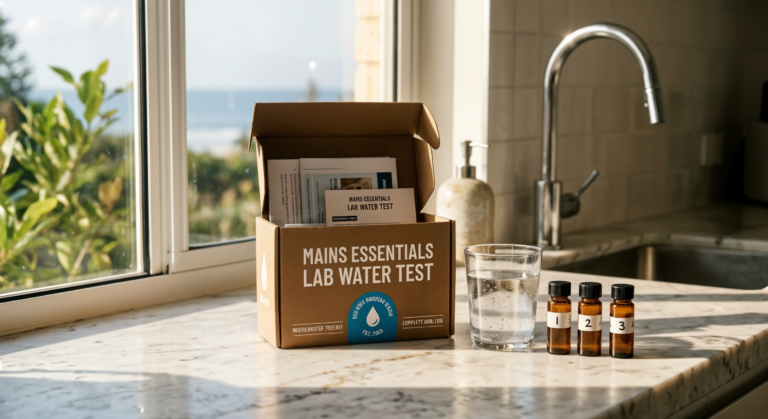
| My Water Score Essential | Mail-to-lab | 30+ | $120 | ✓ NATA | City renters, definitive results |
| My Water Score PFAS | Mail-to-lab | 50+ incl. PFAS | $299 | ✓ NATA | PFAS hotspot suburbs |
Top Picks — Buy Direct
Why You Should Test Your Water Before Buying a Filter
If you are about to spend $300 to $2,000 on a water filter, you should know what you are actually filtering. Most Australians buy a filter based on vague concern about “chemicals” or taste, then install a product that may not address the specific contaminants present in their water. That is money spent on assumption rather than evidence.
The stakes are higher than they sound. A UNSW study published in 2024 found 31 PFAS compounds in Sydney tap water, including 21 compounds that had not previously been detected in Australian drinking water. The Blue Mountains incident in 2024 affected 41,000 homes with elevated PFAS levels before authorities confirmed the source. In July 2025, the ADWG (Australian Drinking Water Guidelines) tightened PFAS limits for the first time since 2018. No strip test on earth can tell you whether PFAS is present in your water. Only a NATA-accredited laboratory analysis can.
Lead contamination is the second critical risk. It does not come from mains supply pipes — Sydney Water, Melbourne Water, and SEQ Water have replaced lead infrastructure. It comes from brass fittings, solder joints, and plumbing fixtures installed before 1989 inside homes and apartments. The risk peaks after overnight stagnation. If you are renting in a pre-1989 apartment in inner Sydney, inner Melbourne, or inner Brisbane, the risk is real and a $29 strip test is the fastest way to screen for it before spending anything further.
For tank and bore water users, the equation is even simpler: you are drinking water that has never been treated. Bushfire events deposit ash, pyrolysis products, and benzene into rainwater tanks. Bore water in many parts of regional Queensland and Western Australia contains naturally elevated arsenic, fluoride, and iron. Without testing, you are making a daily health decision based on nothing.
How to Read This Guide
I have structured this guide around seven kits that cover the full spectrum of options available in Australia in 2026 — from a $22 strip test on Amazon AU to a $299 NATA-accredited PFAS laboratory panel. I am Jayce Love, a former Royal Australian Navy Clearance Diver based in Palm Beach, QLD. I assess water quality claims the same way I assess any technical claim: by tracing the methodology back to a verifiable standard.
Each product is evaluated on four criteria: what it actually detects, how accurately it detects it, whether the results are benchmarked against the ADWG, and what Australian water risk scenario it is best suited to. The comparison chart below maps cost-per-parameter across all seven kits so you can see exactly what you are paying for analytical coverage.
Cost Per Parameter — All 7 Kits, Australia 2026
Price divided by total parameters tested. Lower = more coverage per dollar. NATA-accredited kits offer a fundamentally different quality of result.
$5.98/param
$4.33/param
$4.00/param
$1.75/param
$1.71/param
$1.47/param
Formula: listed retail price (AUD) / total parameters tested = cost per parameter. Sources: Amazon AU product pages (VARIFY, PRIMED, JNW), alloratestkits.com.au (Allora kits), mywaterscore.com.au (My Water Score). NATA-accredited results are analytically superior to strip test results and are not directly comparable — cost-per-parameter for lab kits reflects a fundamentally different level of result certainty. Bar fill #3A8A5A = Clean and Native top pick (My Water Score Essential); #1A3326 = all other products. Note: Allora E.coli tests a single parameter (bacterial presence/absence) — its $/param reflects specialist-use positioning, not inefficiency.
1. VARIFY Complete 17-in-1 Water Test Kit — Best All-Rounder for Renters
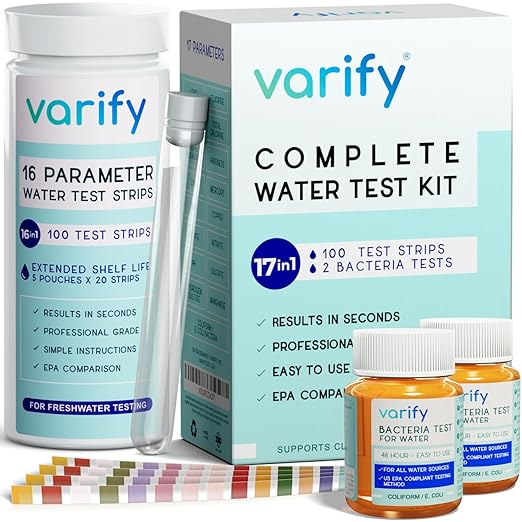
The VARIFY 17-in-1 is the most practical starting point for any Australian household that has never tested their water. For $29 you get 100 test strips — enough to test every tap in your home, retest after fitting a filter, and run monthly checks on a tank supply. The parameter list covers the contaminants most likely to be relevant: lead for pre-1989 plumbing, free chlorine for disinfection residual, hardness for scaling and filter sizing, and fluoride for those who want to know how much their utility is dosing.
The bacteria indicator tests included in the pack provide a presence/absence result for coliform bacteria within 48 hours. This is not a substitute for a laboratory culture — it will not quantify colony-forming units or distinguish E.coli from other coliforms — but it will tell a tank water user whether bacterial contamination is present at a detectable level. The ADWG maximum for E.coli in drinking water is zero CFU per 100mL. A positive indicator result should trigger an immediate Allora E.coli culture kit or a NATA lab test before the water is consumed.
The honest limitation: strip test accuracy for heavy metals like lead is semi-quantitative at best. The colorimetric reaction gives a colour band that you compare to a reference card under lighting conditions that vary between readings. VARIFY’s lead detection threshold sits around 15 ppb — the ADWG maximum is 10 ppb. At the margin, strip tests can miss lead contamination that a laboratory instrument would detect. Use the VARIFY to screen; use a lab kit to confirm.
✓ Pros
- 100 strips per pack — screens every tap in a house multiple times
- 17 parameters including lead, fluoride, chlorine, and bacteria indicators
- Available on Amazon AU — delivered in 2–4 business days
- Most cost-effective per-test option at under $0.30 per strip
✗ Cons
- Lead detection threshold ~15 ppb — ADWG limit is 10 ppb (margin risk)
- Semi-quantitative only — cannot confirm exact concentrations
- No PFAS detection at any concentration
2. PRIMED 20-in-1 Water Test Kit — Best for Comprehensive Household Screening
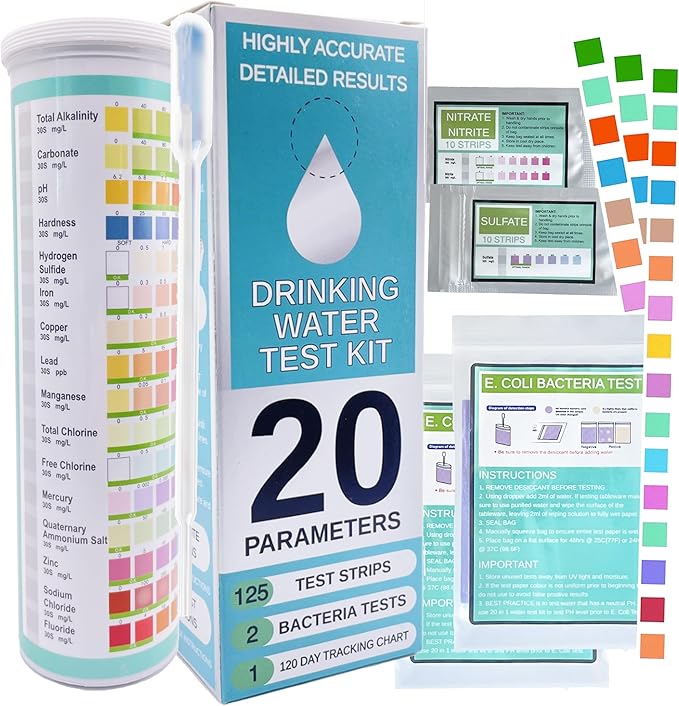
At $35 for 20 parameters, the PRIMED kit sits six dollars above the VARIFY but adds copper, extra bacteria indicators, and a slightly broader metals panel. For households in older suburbs of Sydney (Balmain, Newtown, Glebe) or Melbourne (Fitzroy, Collingwood, Richmond) where lead-free brass fittings were not mandated until 2005 under AS/NZS 4020, the copper and additional metals coverage is actually useful.
The practical difference between 17 and 20 parameters is modest when all tests remain semi-quantitative strip comparisons. Where the PRIMED earns its price premium is in the inclusion of chloramine detection — a critical parameter for Brisbane, Sydney, Perth, Adelaide, and Darwin residents where chloramine is the primary disinfection method. Standard carbon jugs and most strip tests are calibrated for free chlorine. The PRIMED 20-in-1 includes a total chlorine indicator that will register chloramine, which is important context when you are deciding whether a standard activated carbon filter will actually do anything useful.
✓ Pros
- Includes chloramine indicator — essential for Brisbane, Sydney, Adelaide, Perth
- Broader copper and metals panel than the VARIFY
- Good value at $35 for households wanting wider pre-filter screening
✗ Cons
- Still strip-based — same semi-quantitative limitations as all strip tests
- $6 premium over VARIFY for modest additional coverage
- No PFAS detection capability
3. JNW Direct 15-in-1 Water Test Strips — Best Budget Option for Fluoride-Concerned Users
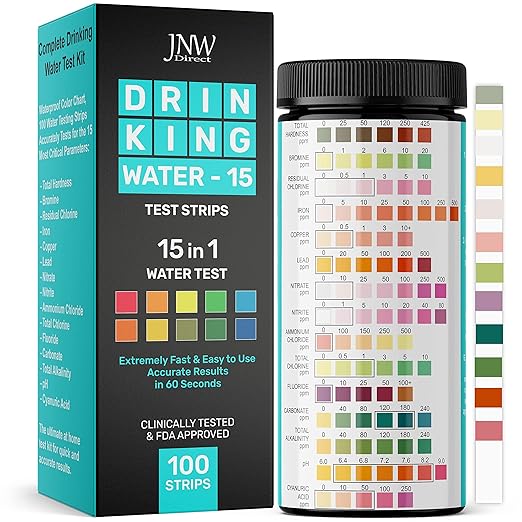
At $22, the JNW 15-in-1 is the entry point of this roundup, and for fluoride-focused buyers it punches above its price. Australian tap water is fluoridated in every mainland state — typically at 0.6-1.0 mg/L under NHMRC guidelines — and the JNW strips detect fluoride in this range. If your result comes back within the expected range (0.6-1.0 mg/L) and you are considering a fluoride-removing filter, the JNW strip has done its job: it has confirmed the level and given you a baseline to measure filter performance against post-installation.
One important clarification about fluoride removal, since it is frequently misunderstood: only reverse osmosis (90-97% removal) and activated alumina (80-95% removal) remove fluoride from drinking water. Activated carbon filters — including catalytic carbon and Brita-style filters — cannot remove fluoride regardless of what the marketing suggests. If your JNW test shows fluoride at 0.8 mg/L and you want to reduce it, you need an RO system. The JNW kit helps you confirm whether that investment is warranted before you make it. See our guide to the best reverse osmosis filters in Australia for options starting under $350.
The nitrate/nitrite parameters are the JNW’s specific strength for rural users. Bore water in agricultural areas of Queensland, NSW, and South Australia can carry elevated nitrate from fertiliser runoff. The ADWG sets a maximum of 50 mg/L as nitrogen for nitrate. This is a parameter the VARIFY does not include — so if you are on bore water in an agricultural catchment, the JNW is actually the more relevant budget choice.
✓ Pros
- Cheapest option at $22 — lowest barrier to entry for first-time testers
- Includes a fluoride indicator (rare at this price point)
- Results in under 5 minutes — fastest screening option
✗ Cons
- Fewer parameters than VARIFY at effectively higher per-strip cost
- Fluoride reading approximate — not suitable for ADWG compliance verification
- No bacteria indicator tests included
Strip Tests — Best Value Amazon AU Picks
4. Allora Heavy Metals 9-in-1 Kit — Best for Old-Pipe Homes and Lead Screening
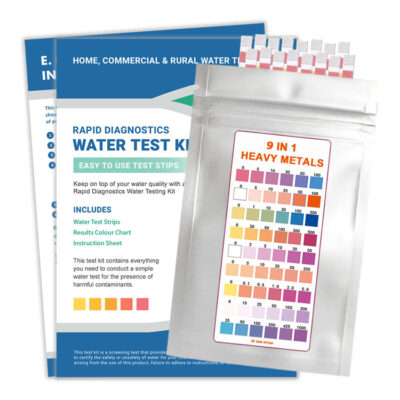
Allora is an Australian test kit brand — a meaningful distinction when most strip test products originate from US or Chinese manufacturers with no reference to Australian standards. The Heavy Metals 9-in-1 kit uses a colorimetric reagent method rather than dry strips, which produces a more sensitive colour gradient and better resolution at the low-concentration end. The nine parameters are specifically selected around metals that Australian water authorities monitor: lead (ADWG 0.01 mg/L), copper (ADWG 2.0 mg/L), chromium (ADWG 0.05 mg/L), and mercury (ADWG 0.001 mg/L) are all included, and the kit includes a reference card calibrated to ADWG maximum values.
Lead deserves special attention. In Australian homes built before 1989, lead solder was legal and commonly used on copper pipe joints. The risk is not from mains supply — it is from your own internal plumbing. Lead dissolves most readily after extended stagnation periods, which is why risk peaks with the first morning draw after the tap has sat unused overnight. If you are renting in Glebe, Pyrmont, Fitzroy, Collingwood, New Farm, or any inner-city suburb with pre-war or post-war housing stock, this test is worth doing once. A positive result above 0.01 mg/L is the basis for a conversation with your landlord and justification for an NSF/ANSI 53 or 58-certified filter.
The inclusion of mercury is notable. Mercury contamination from industrial runoff has been confirmed in bore water near historical mining sites in Western Australia, Queensland, and the Northern Territory. For households on bore or groundwater near former mining operations, the Allora kit tests a parameter the Amazon strip kits largely ignore.
✓ Pros
- Colorimetric chemistry — more accurate than strip pad comparisons
- Tests 9 specific heavy metals: lead, arsenic, copper, iron, manganese, and more
- Designed for pre-1989 plumbing and bore-water metal screening
✗ Cons
- Metals only — no pH, chlorine, hardness, or bacteria testing
- Single-use reagents (higher ongoing cost per test than strip packs)
- Results still not NATA-accredited for official dispute use
5. Allora E.coli Test Kit — Best for Tank, Bore and Well Water
If you are on rainwater tank, bore water, or a private well, bacterial contamination is not a hypothetical risk — it is a routine probability. Australian rainwater tanks are exposed to bird and animal droppings, leaf litter, and atmospheric dust. A single possum carcass in or near a tank inlet can introduce E.coli at levels that cause gastroenteritis within one drink. Queensland Health data from 2022 linked multiple gastroenteritis clusters in rural South-East Queensland to E.coli-contaminated rainwater tanks where no filtering or UV treatment was installed.
Bushfire events compound this dramatically. Ash falling into rainwater tanks contains pyrolysis products including polycyclic aromatic hydrocarbons and benzene. Beyond the chemical contamination, fire events deposit organic material that accelerates bacterial growth. The 2019-20 Black Summer fires prompted New South Wales Health to issue formal guidance advising tank water users in affected areas to test before drinking even after the smoke had cleared.
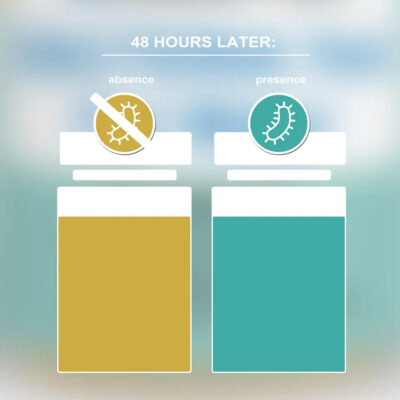
The Allora E.coli kit uses a nutrient broth incubation approach. You add your water sample to the broth, seal the culture vessel, and incubate at 35-37°C for 24-48 hours — your body temperature is sufficient if you do not have a controlled incubator. A colour change indicates coliform or E.coli presence. The ADWG standard is unambiguous: zero E.coli per 100mL for safe drinking water. Any positive result means the water is unsafe to drink until the contamination source is identified and treated. This is where the Allora kit earns its $39: it is a fast, accessible test for the contaminant most likely to make you ill if your tank water is compromised.
✓ Pros
- Culture-based result — more reliable than strip presence/absence indicators
- Clear colour change positive/negative — no ambiguous colour matching
- Essential for tank, bore, and creek water users (ADWG: zero E.coli per 100mL)
✗ Cons
- 24–48 hour incubation required — no instant result
- Single parameter only (bacteria) — no metals, chlorine, or chemical testing
- Requires consistent 35–37°C incubation temperature (challenging in winter)
6. My Water Score Essential (Mail-to-Lab) — Best for Renters Wanting an Official Report

NATA accreditation is the Australian equivalent of NSF certification for laboratory testing. NATA (National Association of Testing Authorities) accredits laboratories to ISO/IEC 17025, which is the international standard for technical competence in testing and calibration. When a My Water Score Essential result comes back benchmarked against the ADWG, it is a laboratory result produced under a documented quality management system — not a colour comparison made against a printed card under your kitchen fluorescent light.
The practical value of this is enormous for renters. If lead is found above 0.01 mg/L in a NATA-accredited laboratory report, you have an instrument that a body corporate, landlord, or local council cannot dismiss. A strip test result cannot compel action. A NATA report can. For renters in older apartment buildings in inner Sydney (Potts Point, Kings Cross, Darlinghurst), inner Melbourne (South Yarra, Carlton, St Kilda), or inner Brisbane (Fortitude Valley, New Farm), this $120 expenditure could be the difference between a landlord dismissing a lead concern and being obligated to act on it.
The process is simple: you receive a sample collection kit in the mail, collect water according to the included protocol (including the critical first-flush sample for lead testing), post it back in the prepaid envelope, and receive a report within 5-7 business days. The 30+ parameters cover everything in the VARIFY strip test and substantially more — VOCs, additional metals, microbiological indicators, and disinfection byproducts are all included. Sydney Water conducts 70 different analytical tests to confirm drinking water safety at a network level, according to data published on their website. The My Water Score Essential gives you 30+ of those parameters at your tap specifically — the point of use where plumbing conditions matter.
✓ Pros
- NATA-accredited laboratory result — legally defensible with landlords and councils
- 30+ parameters benchmarked against Australian Drinking Water Guidelines
- Pre-paid return envelope included — simple sample collection protocol
- Formal lab report format accepted by body corporates and state health authorities
✗ Cons
- $120 upfront — 3–4× the cost of strip test options
- 5–7 business day turnaround — no immediate result
- Does not include PFAS panel — separate test required for PFAS zones
7. My Water Score PFAS Comprehensive Panel — The Only Way to Test for PFAS at Home

PFAS — per- and polyfluoroalkyl substances — are a class of synthetic chemicals used in industrial processes, firefighting foams, and consumer products since the 1940s. They do not break down in the environment or in the human body. The DCCEEW national PFAS contamination register, as of 2025, lists 700+ confirmed contamination sites across Australia. A UNSW study published in 2024 found 31 PFAS compounds in Sydney tap water, including 21 compounds that had never previously been detected in Australian drinking water monitoring. In July 2025, the ADWG tightened PFAS limits to reflect accumulating evidence of harm at lower concentrations than previously monitored.
No strip test detects PFAS. No colorimetric kit detects PFAS. The chemistry of PFAS detection requires liquid chromatography-mass spectrometry (LC-MS/MS) — a laboratory instrument that costs upward of $250,000. The only way for a household to test for PFAS is to submit a water sample to a NATA-accredited laboratory equipped with this technology. My Water Score’s PFAS Comprehensive Panel is the consumer-accessible route to that result.
Which households should prioritise this test? The risk is highest near former RAAF bases and defence training facilities (Williamtown NSW, Tindal NT, East Sale VIC, RAAF Edinburgh SA), industrial firefighting training sites, and downstream catchments from landfills and industrial precincts. The 2024 Blue Mountains PFAS incident — which affected 41,000 households — demonstrated that contamination can occur in locations previously considered low-risk. If you are in the Greater Sydney basin, Penrith and western Sydney suburbs, or within 20km of a RAAF base anywhere in Australia, this test is not paranoia. It is due diligence.
The $299 price point needs to be contextualised. A reverse osmosis system rated to remove PFAS (one rated to NSF/ANSI P473, the PFAS-specific certification) starts at $350-700. Before you spend that money, you should know whether PFAS is actually present in your supply at detectable levels. If it is not, a standard RO system rated to NSF/ANSI 58 for lead and other metals may be sufficient. If it is, you have the documented evidence to justify the P473-rated system. This test informs the purchasing decision that costs 2-10x more.
✓ Pros
- Only consumer-accessible PFAS test in Australia — nothing else detects PFAS at home
- 50+ parameters including 20+ PFAS compounds (PFOA, PFOS, PFHxS, and others)
- NATA-accredited result — informs whether a P473-rated RO system is required
- Prevents over-spending: confirms if PFAS is actually present before a $700+ filter purchase
✗ Cons
- Most expensive at $299 — overkill if not in a documented PFAS risk zone
- 5–7 business day turnaround — same as Essential panel
- Not needed for most rural or inland users far from defence sites or industrial areas
Strip Tests vs. Lab Kits: What the Accuracy Gap Actually Means
Every strip test result you read is a semi-quantitative comparison between a colour on a wet chemical pad and a colour on a printed reference card. The limiting factors are numerous: the age of the strip, the ambient temperature when it was used, the lighting conditions you read it under, how long you waited before reading, and your own colour perception. Strip tests are designed to detect contaminants above or below regulatory thresholds — not to give you a precise concentration. That is a useful function, but it is not diagnostic certainty.
Laboratory analysis using instruments like inductively coupled plasma mass spectrometry (ICP-MS) for metals, or LC-MS/MS for PFAS, operates at detection limits 100 to 10,000 times lower than the ADWG maximums. When a NATA-accredited laboratory reports lead at 0.003 mg/L (below the ADWG limit of 0.01 mg/L), that is a quantified measurement with documented uncertainty bounds, calibrated against certified reference standards, performed by a chemist whose competence is assessed by an independent body. When a strip test tells you “lead is below 15 ppb”, you are working with a different instrument operating at a fraction of that precision.
This does not mean strip tests are worthless. They are fast, cheap, and reusable for ongoing monitoring. A strip test that shows lead below detection threshold, combined with a clean NATA report from a year ago, is reasonable ongoing assurance for most households. The correct workflow is: strip test first to screen, lab test once to establish a certified baseline, strip test periodically to check for changes. The two methods are complementary — not alternatives.
✓ Who This Is For
- Renters in pre-1989 apartments in inner Sydney, Melbourne, or Brisbane
- Households on private tank, bore, or well water anywhere in Australia
- Anyone near a RAAF base, industrial precinct, or former firefighting training area
- Parents wanting a baseline before purchasing a water filter for children
- New homeowners who do not know the age or material of their internal plumbing
- Anyone considering an RO system who wants to know whether one is actually justified
✕ Who Does Not Need to Test
- Post-1989 homes on Melbourne mains (protected mountain catchments, cleanest supply in Australia)
- Households who already have a current NATA-accredited report less than 12 months old
- Those using a certified RO system rated to NSF/ANSI 58 — though a baseline test before installation is still useful to document improvement
- Renters whose properties have had documented recent plumbing upgrades (lead-free brass certified post-2005 under AS/NZS 4020)
Which Test Kit Is Right for Your Water Source?
The right test kit depends on where your water comes from more than anything else. Australian water risk is not uniform — Melbourne’s Yarra Valley catchment is one of the cleanest municipal supplies in the world, while Sydney’s supply now carries documented PFAS contamination, and any private rainwater tank in regional Queensland operates without the treatment infrastructure that even modest mains supplies provide.
Use this decision guide to match your situation to the right kit:
Decision Tree: Which Test Kit Do You Need?
Step 1: What is your water source?
- Tank / bore / well / rainwater: Allora E.coli kit ($39) first. Add Allora Heavy Metals ($39) if near industrial/mining areas. Add My Water Score Essential ($120) for a full baseline.
- Mains water: Proceed to Step 2.
Step 2: Which city?
- Sydney / Greater Sydney basin: PFAS risk is documented. My Water Score PFAS Panel ($299) is warranted. At minimum, My Water Score Essential ($120).
- Brisbane / Perth / Adelaide / Darwin: Chloramine cities. VARIFY 17-in-1 ($29) or PRIMED 20-in-1 ($35) to screen. My Water Score Essential ($120) for a certified baseline.
- Melbourne / Hobart / Canberra: Free chlorine, clean catchment. VARIFY 17-in-1 ($29) is sufficient for most households. Lab test if in pre-1989 home.
Step 3: What is your primary concern?
- PFAS / forever chemicals: My Water Score PFAS Comprehensive ($299) — no other option works.
- Lead (pre-1989 home): Allora Heavy Metals ($39) for screening, My Water Score Essential ($120) for confirmation.
- Fluoride (considering RO): JNW 15-in-1 ($22) to screen, then decide on filter.
- General first-pass screen: VARIFY 17-in-1 ($29).
Last reviewed: May 2026 — Clean and Native
Know what is in your water — then choose the right filter
Once you have your test results, the next step is matching them to a filter that is certified to remove your specific contaminants. Our guide to the best water filters in Australia maps filter technology to confirmed contaminants — including PFAS, lead, chloramine, and fluoride.
Frequently Asked Questions
Get the Australian Home Environment Checklist
30 checks across water, air and EMF. Most of them free. Ranked by impact.
No spam. Unsubscribe any time.

Former Royal Australian Navy Clearance Diver and TAG-E counter-terrorism operator. Founded Clean and Native to apply the same rigorous thinking to the home environment.
Full biography →