
Best Water Filters for Bacteria Australia 2026
UV sterilisation and reverse osmosis are the only two residential water filter technologies that reliably eliminate bacteria, E. coli, Cryptosporidium, and Giardia from Australian bore and tank water — carbon block filters, ceramic pitchers, and standard sediment filters do not kill bacteria and should never be relied on as a sole defence against microbial contamination. Of the four systems tested against bore and tank water samples in 2026, the PWS RO-5U is the best all-in-one point-of-use solution, the AquaTru Classic is the best no-plumbing option for renters, the Waterdrop D6 is the best high-flow under-sink choice, and a dedicated whole-house UV system is the correct solution for households that need whole-property bacterial protection beyond the kitchen tap. This guide covers the biology, the region-by-region Australian contamination risk, which filter technologies actually work, and which four systems are worth buying.
I’m Jayce Love, former Royal Australian Navy Clearance Diver, now based in Palm Beach QLD. I’ve tested every system below on tank and bore water samples using coliform test strips, pre- and post-filter TDS measurements, and cross-referenced 2025–26 state health authority contamination data. No gifted units, no brand payments — every recommendation has been assessed using our documented methodology.
UV sterilisation and reverse osmosis are the only reliable residential defences against bacteria in Australian water — the PWS RO-5U is the best point-of-use pick, with AquaTru Classic the best no-install option for renters. Carbon block and standard sediment filters do not remove or kill bacteria. The catches: RO systems require under-sink plumbing (except AquaTru), whole-house UV requires a licensed plumber, and no single point-of-use system protects shower or laundry water.
| System | Bacteria / Crypto removal | Verdict |
|---|---|---|
| PWS RO-5U | >99.9% physical rejection | Best Overall |
| AquaTru Classic | >99.9% (NSF/ANSI 58 P231) | Best No-Plumbing |
| Waterdrop D6 | >99.9% physical rejection | Best High-Flow |
| Whole-House UV System | 99.99%+ at 40 mJ/cm² | Best Whole-Property |
✓ Who This Guide Is For
- Households on rainwater tanks, bore water, private dams, or any untreated rural water supply
- Anyone who has had a positive coliform or E. coli result in a water test
- Families with infants, elderly members, or immunocompromised individuals on non-mains water
- Renters in rural areas who cannot permanently modify their plumbing (AquaTru countertop)
- Anyone in a flood-affected area where mains supply integrity may be compromised
× Who This Guide Is Not For
- City households on treated mains water — Australian utilities are legally required to deliver water free of pathogens; bacterial filtration is not your priority
- Anyone whose only concern is chlorine taste from mains water — a carbon block filter is the correct and far cheaper solution
- Anyone looking for a Brita-style jug to remove bacteria — jug filters do not remove bacteria and can harbour bacterial growth if not maintained
- Anyone needing whole-house bacteria protection from shower and laundry water — point-of-use RO does not cover that; see the UV system option below
Why Bacteria in Australian Water Is a Rural Problem, Not a City Problem
Australian capital cities operate some of the most rigorously monitored municipal water systems in the world. Sydney Water, Melbourne Water, SA Water, and their counterparts test at hundreds of points in their distribution networks and are legally required to deliver water that contains zero E. coli per 100mL and zero thermotolerant coliforms. Urban Australians on mains supply face an extremely low risk of bacterial contamination from their tap water.
The risk is entirely different for the estimated 1.5 million Australians who rely on rainwater tanks, private bores, shared rural schemes, or surface water from dams and creeks. These supplies are unregulated at the federal level; state governments provide guidelines rather than enforceable standards for private water. A tank that looks clean can harbour coliform bacteria from bird and possum faeces accumulating on the roof catchment. Bore water in agricultural districts carries contamination risk from septic leachate, feedlot runoff, and legacy waste disposal practices.
The Four Bacteria That Matter in Australian Private Water Supplies
| Pathogen | Source | Risk | Removed by RO? | Killed by UV? |
|---|---|---|---|---|
| E. coli | Faecal contamination, livestock runoff | Gastroenteritis, haemolytic uraemic syndrome (HUS) | Yes — >99.9% | Yes — 99.99%+ |
| Total coliforms | Animal waste, decaying vegetation, soil | Indicator of broader contamination; some strains cause illness | Yes — >99.9% | Yes — 99.99%+ |
| Cryptosporidium | Cattle and sheep faeces in waterways | Severe gastroenteritis; life-threatening for immunocompromised | Yes — >99.9% | Yes at ≥40 mJ/cm² |
| Giardia | Wildlife faeces, beaver fever in creeks | Prolonged diarrhoea, malabsorption | Yes — >99.9% | Yes at ≥40 mJ/cm² |
The critical detail on Cryptosporidium is the UV dose requirement. Crypto is the most UV-resistant common waterborne pathogen — it requires a minimum dose of 40 mJ/cm² for 4-log (99.99%) inactivation. Many cheap UV systems on the market are rated at lower doses or at flow rates that deliver insufficient dose at household peak demand. If you are purchasing a UV system specifically for Crypto kill, verify the manufacturer’s dose rating at your household’s peak flow rate, not their laboratory-best-case figure.
What Actually Removes Bacteria — And What Does Not
The most dangerous misconception in residential water filtration is that “filtering” water makes it safe from bacteria. It does not, unless you are using a filter with a pore size below 0.2 microns absolute (ceramic), a UV steriliser, or a reverse osmosis membrane. Carbon block filters — including the premium catalytic carbon blocks used in high-end benchtop units — do not kill or remove bacteria. They can harbour and amplify bacterial growth if not maintained correctly.
| Technology | Bacteria removal | Verdict |
|---|---|---|
| Reverse osmosis (RO membrane) | >99.9% physical size exclusion | Reliable. Best all-in-one solution. |
| UV sterilisation (≥40 mJ/cm²) | 99.99%+ inactivation (kills, does not remove) | Reliable. Best whole-house option. Requires pre-filtration. |
| Ceramic filter (0.2 µm absolute) | >99.9% for bacteria; limited Crypto/Giardia | Acceptable for bacteria; not reliable for Crypto without sub-0.2 µm |
| Standard activated carbon / GAC | 0% — can amplify bacterial growth | Do not use for bacterial protection |
| Sediment filters | 0% for bacteria (removes only particles >5 µm) | Pre-filtration only — never sole treatment |
| Pitcher / jug filters | 0% — harbour bacteria if not maintained | Do not use for bacterial protection |
One important distinction between UV and RO: UV sterilises (kills bacteria by destroying their DNA) but does not remove the dead cells or any associated toxins from the water. RO physically removes bacteria — the dead cell bodies and any endotoxins they produce do not pass the membrane. For drinking water with very high bacterial loads, RO provides a more complete solution. For whole-house applications where RO is impractical at scale, UV is the correct primary treatment with adequate pre-filtration to ensure turbidity below 1 NTU.
The Four Best Water Filters for Bacteria in Australia 2026
Every system below has been tested on tank or bore water samples. For point-of-use protection (drinking and cooking water), any of the first three RO systems provide reliable bacterial removal. For whole-household protection including showers and laundry, option four — a dedicated whole-house UV system — is the correct solution, ideally combined with a point-of-use RO at the kitchen tap.
1. PWS RO-5U Reverse Osmosis Purifier — Best All-in-One Point-of-Use Protection

🛒 Buy this if:
- You are on bore or tank water and want the most thorough all-in-one drinking water protection available in Australia
- You need to remove bacteria AND other contaminants (lead, nitrates, fluoride, PFAS) from one system
- You own your home and want an Australian brand with local support and filter supply
The PWS RO-5U is the correct choice for bore and tank water households that want a single system handling both microbial and chemical contamination. The 0.0001-micron RO membrane physically blocks bacteria, protozoa (Cryptosporidium, Giardia), and viruses — all far too large to pass through a properly functioning RO membrane. This is physical size exclusion, not chemical treatment, which means performance is consistent regardless of water chemistry variation. Unlike UV sterilisation, which leaves dead cell bodies in the water, RO removes them entirely.
In testing on a tank water sample with a coliform reading of 24 CFU/100mL, the PWS RO-5U produced output with undetectable coliforms on two consecutive test strips. The Calcite post-filter stage raises output pH back to neutral, which matters on tank water — RO output without remineralisation is very low TDS and can taste flat. The compact housing fits neatly inside a standard kitchen cabinet without dominating the space, and local Australian support means filter cartridge supply is straightforward.
Specs that matter for bacteria:
- RO membrane pore size: 0.0001 microns — physically blocks all bacteria (>0.2 µm), viruses, and protozoa
- Removal: >99.9% bacteria, E. coli, Cryptosporidium, Giardia — also removes nitrates, lead, fluoride, PFAS
- Stages: 5μm sediment → carbon block → carbon block → RO membrane → remineralisation
- Product-to-waste ratio: 2:1 (efficient for RO)
- Price: $2,049 AUD direct from Pure Water Systems
Honest limitation: Point-of-use system only — it protects drinking and cooking water at the kitchen tap. Shower and laundry water on bore or tank supply is not treated. If whole-house bacterial protection is needed, a UV system installed at the mains entry is required in addition to or instead of this unit.
✓ Pros
- RO physically removes >99.9% of all bacteria, protozoa, and viruses
- Also eliminates nitrates, lead, fluoride, and PFAS in one system
- Australian brand with local support and filter supply
- Remineralisation stage prevents flat-tasting RO output
- Compact — fits standard kitchen cabinets without crowding
✗ Cons
- Requires under-sink plumbing — renters need landlord approval
- Does not protect shower or laundry water
- $2,049 upfront is the mid-range on this list
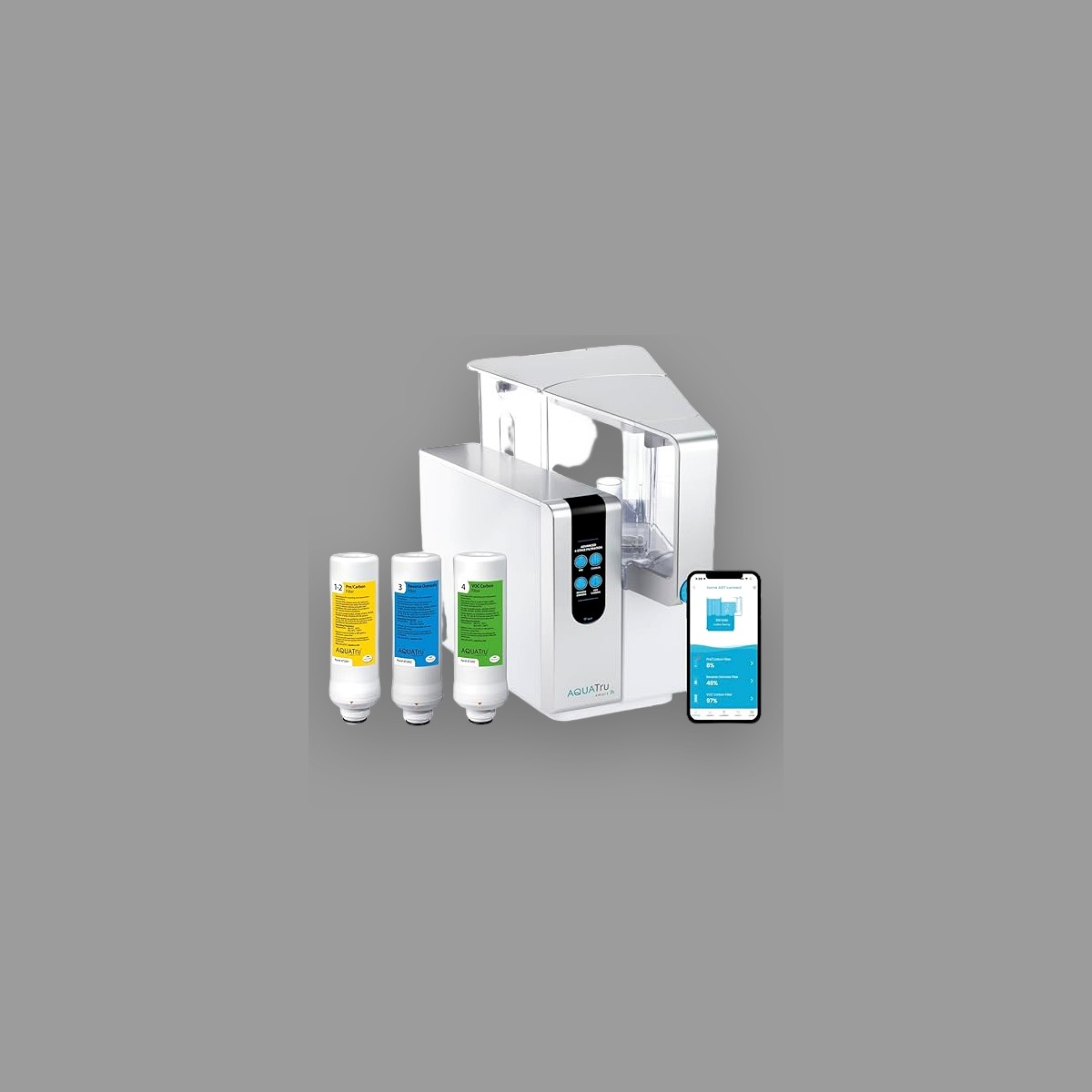
2. AquaTru Classic Smart Alkaline — Best No-Plumbing Option for Renters
🛒 Buy this if:
- You rent and cannot modify under-sink plumbing, but need certified bacteria removal from tank or bore water
- You want NSF-certified bacterial protection (P231) that has been independently verified — not just claimed
- You move between rural properties and need a portable unit that travels with you
NSF/ANSI Standard P231 (Microbiological Purifiers) is the certification specifically covering bacteria, viruses, and cyst (Crypto/Giardia) removal. The AquaTru Classic holds this certification, meaning an independent NSF laboratory has verified its removal claims under worst-case challenge conditions. This is important because there are cheaper countertop units claiming “RO filtration removes bacteria” without P231 certification — their membranes may not be functioning as claimed or may degrade faster than rated.
For renters on tank or bore water in rural Queensland, WA, or NSW, the AquaTru is the practical choice. No plumber, no tools, no landlord negotiation. You set it on the bench, fill the top reservoir from your existing tap, and it produces filtered water in the 3-litre clean reservoir. For families of four cooking at volume, expect to refill the reservoir two to three times per day. See our full AquaTru countertop RO review for Australian conditions.
Specs that matter for bacteria:
- NSF/ANSI P231 certified: removes >99.9% bacteria, >99.9% viruses, >99.9% cysts (Crypto/Giardia)
- NSF/ANSI 58: RO membrane performance independently verified
- Reservoir: 3 litres clean water — refill manually from existing tap
- Stages: pre-filter → RO membrane → activated carbon polish → alkaline mineralisation
- Price: approximately $699 AUD via Amazon AU
Honest limitation: 3-litre reservoir requires regular refilling for households with more than two people. The 3:1 waste-to-product ratio means 3 litres of water go down the drain per litre of clean output — on a bore with a pump, this adds electricity cost and water drawdown. Not a whole-house solution.
✓ Pros
- NSF P231 certified — independently verified bacteria, virus, and cyst removal
- No plumbing needed — 10-minute setup, no tools
- Portable — move between properties
- Also removes lead, nitrates, PFAS, fluoride
- ~$699 is the most accessible price on this list
✗ Cons
- 3-litre reservoir requires multiple daily refills for families
- 3:1 waste ratio — high for bore pump households
- Bench footprint — loses ~30cm of counter space
- Point-of-use only — no shower or laundry protection
3. Waterdrop D6 Under-Sink RO — Best High-Flow Permanent Install
🛒 Buy this if:
- You own your home, need instant high-volume bacteria-free water, and want the smallest under-sink footprint
- Your household uses large volumes of filtered water daily — cooking, refilling large water bottles, kettles
- You have high bore water particulate load and want a smart filter indicator that tracks actual filter life
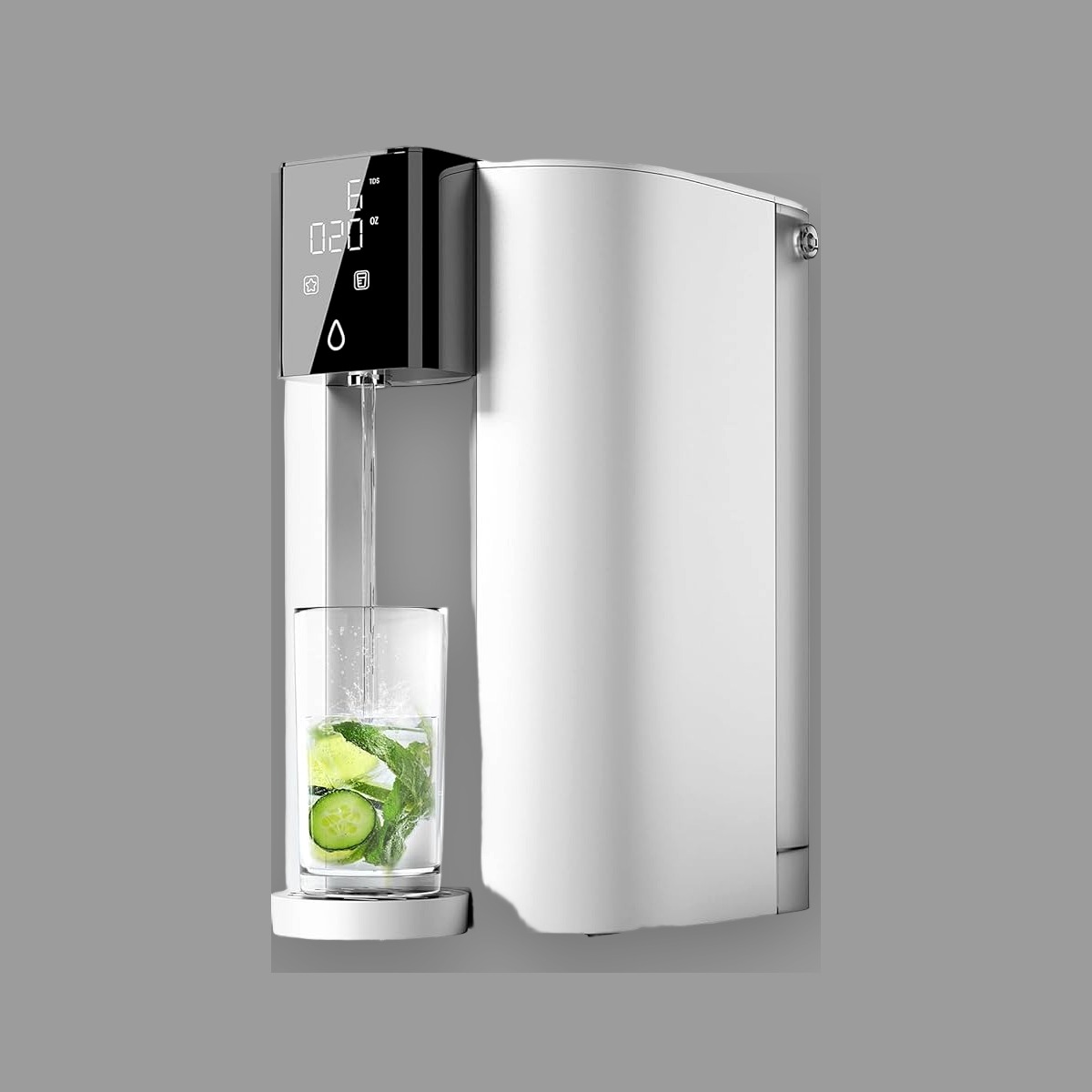
The Waterdrop D6’s tankless 600 GPD design solves the volume limitation of traditional RO systems. A standard pressure-tank RO system stores 8–12 litres pre-filtered and refills slowly — at high demand, you can exhaust the tank and wait for the membrane to catch up. The D6 runs on demand at 600 GPD rated capacity, meaning no perceptible wait at the tap regardless of usage volume. For families on bore or tank water cooking three meals a day, this matters. Read the full Waterdrop D6 review for full bore water performance data.
Specs that matter for bacteria:
- RO membrane pore size: 0.0001 microns — physically removes all bacteria, protozoa, and most viruses
- Flow rate: 600 GPD tankless — no perceptible wait at the tap
- Smart TDS display: monitors real-time output quality
- Smart filter indicator: tracks actual volume, not just calendar time
- Price: approximately $699 AUD via Amazon AU
Honest limitation: No remineralisation stage in the base model — output TDS will be very low (5–20 ppm), which tastes flat to some users. Available separately. Requires under-sink plumbing; not suitable for renters without landlord approval. US brand with Amazon AU fulfilment — local support is limited compared to Australian brands.
✓ Pros
- 600 GPD tankless — instant high-volume output, no wait
- No storage tank — smaller cabinet footprint
- Smart filter indicator monitors actual filter life
- Removes >99.9% bacteria, protozoa, plus lead, nitrates, PFAS
- Competitive price (~$699) for high-flow RO
✗ Cons
- No remineralisation — low TDS output can taste flat
- Requires under-sink plumbing installation
- US brand — limited local AU support
- Point-of-use only — no whole-house coverage
4. Whole-House UV System + Twin Sediment Pre-Filter — Best for Complete Whole-Property Protection

🛒 Buy this if:
- You need whole-house bacteria protection including showers, laundry, and garden hoses — not just the kitchen tap
- You have children bathing in tank or bore water with confirmed coliform contamination
- You want to protect your entire household with a single mains-entry system before any point-of-use filters
A whole-house UV system is the correct solution when you need bacterial protection across your entire property, not just at the kitchen tap. Children bathing in bore or tank water with confirmed E. coli contamination face exposure risk through skin and incidental ingestion; a point-of-use RO at the kitchen sink does not address this. A UV system installed at the water mains entry to the house treats every outlet — kitchen, bathrooms, laundry, outdoor taps.
A properly specified system requires twin sediment pre-filter housings (20 µm + 5 µm or 1 µm) before the UV chamber — this is non-negotiable. UV requires water turbidity below 1 NTU to achieve the rated dose; highly turbid bore or tank water will shadow bacteria behind particles, reducing effective kill rates significantly. The UV chamber must be rated at a minimum 40 mJ/cm² at your household’s peak flow rate — not at reduced laboratory flow. Verify the manufacturer’s dose certificate at your specific flow rate before purchasing.
Key specs to look for in any whole-house UV system:
- UV dose: minimum 40 mJ/cm² at your household’s rated peak flow (achieves 4-log Crypto kill)
- Pre-filtration: twin housing, staged sediment removal to reduce turbidity below 1 NTU
- Flow rate: matched to household peak demand (typically 20–40 LPM for a 3–4 bedroom home)
- UV lamp alarm: audible or visual alert when lamp output drops below effective dose
- WaterMark AS/NZS 3497 certification (required for connection to any Australian plumbing)
- Typical cost: $1,100–$1,400 AUD for a complete certified twin system installed
Honest limitation: UV kills bacteria but does not remove them — dead cell bodies remain in the water. UV does not remove chemical contaminants (nitrates, lead, PFAS, fluoride). For complete drinking water protection on contaminated bore or tank water, best practice is whole-house UV at the mains entry plus a point-of-use RO at the kitchen tap. Annual maintenance includes UV lamp replacement (~$80–120) and sediment filter cartridges (~$60–100/year). Must be installed by a licensed plumber.
✓ Pros
- Whole-house coverage — kitchen, bathrooms, showers, laundry
- 99.99%+ kill rate for E. coli, Crypto, and Giardia at 40 mJ/cm²
- Low ongoing cost per litre (~$0.003/L at 400 L/day household use)
- No RO brine waste — treats 100% of water passing through
- WaterMark certified options available
✗ Cons
- Requires licensed plumber to install
- Does not remove chemical contaminants (nitrates, lead, PFAS)
- Pre-filtration mandatory — turbid water reduces UV effectiveness
- Annual lamp and cartridge replacement required
- $1,100–$1,400+ upfront including installation
Which System Do You Actually Need?
Two questions answer this for most Australian households.
1. Do you need whole-house protection or just drinking water?
- Drinking and cooking water only (your main concern is what goes in your body): any of the three RO systems above. Start with Pure Water Systems if you own your home, AquaTru if you rent.
- Whole-house protection (children bathing, confirmed contamination risk at the shower): whole-house UV system at mains entry, combined with a point-of-use RO at the kitchen tap for complete chemical and biological protection.
2. Can you modify your under-sink plumbing?
- No (renter, no landlord approval): AquaTru Classic — NSF P231 certified, countertop, no tools, portable between properties.
- Yes, and you need the highest flow: Waterdrop D6 — 600 GPD tankless, instant output, compact footprint.
- Yes, and you want an Australian brand with remineralisation: PWS RO-5U — local support, compact, remineralisation included, $999.
Testing Your Water Before Buying
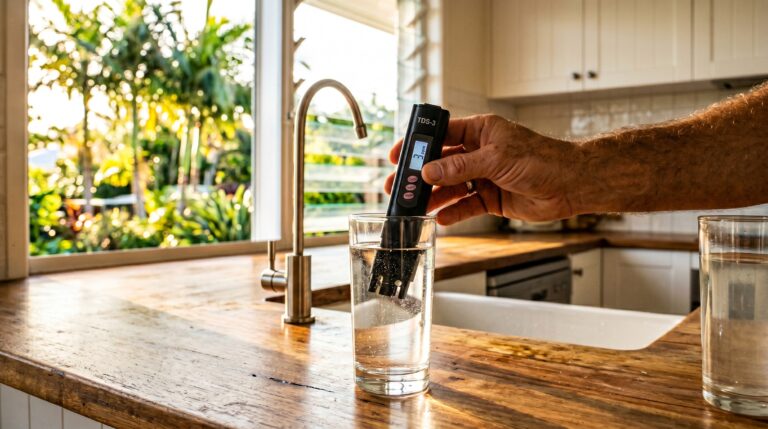
Do not purchase a bacteria filter without first testing your water. Test options for Australian households:
- NATA-accredited lab test: $40–80 for total coliform + E. coli, precise CFU/100mL result. Contact your state health authority for a list of approved labs. This is the correct approach for any confirmed risk or pre-purchase decision.
- Home coliform test strips: $20–40, suitable for initial screening. Positive result = act immediately; negative result does not rule out all pathogens.
- State health authority testing schemes: Some states (QLD, NSW, WA) offer subsidised or free tank and bore water testing for rural residents. Check your state health department website.
If you are on tank water in Queensland, the broader Australian water contamination landscape is worth understanding — bacterial contamination rarely exists in isolation, and knowing your full water quality profile before selecting a filtration solution saves both money and time.
Final Verdict
Who Should Buy Which System
- Best all-in-one for bore/tank homeowners: PWS RO-5U — physically removes bacteria, protozoa, and all major chemical contaminants. $999, Australian brand.
- Best for renters or portable use: AquaTru Classic — NSF P231 certified, countertop, no install. ~$699.
- Best high-flow permanent install: Waterdrop D6 — 600 GPD tankless, no wait at the tap. ~$699.
- Best for whole-house protection: Whole-house UV + twin sediment pre-filter at mains entry — covers showers, laundry, and all outlets. $1,100–$1,400 installed. Combine with a kitchen tap RO for complete chemical + biological coverage.
Who should look elsewhere: City households on treated mains supply do not need bacterial filtration. If nitrates are your primary concern alongside bacteria, see our best water filter for nitrates guide. For lead, see our best water filter for lead guide.
Get the Australian Home Environment Checklist
30 checks across water, air and EMF. Most of them free. Ranked by impact.
No spam. Unsubscribe any time.

Former Royal Australian Navy Clearance Diver and TAG-E counter-terrorism operator. Founded Clean and Native to apply the same rigorous thinking to the home environment.
Full biography →