5G Health Risks in Australia: What ARPANSA Found
Australia‘s 5G network operates within the ARPANSA radiofrequency exposure standard, which aligns with ICNIRP guidelines, and measured background RF-EMF levels remain far below the safety limit of 1,000 µW/cm² at 2.4 GHz. That is the regulatory position — but if you want to understand what the science actually shows, what the limits do and do not protect against, and what practical steps reduce your exposure regardless, this is the article.
What ARPANSA’s RF Standard Actually Measures — and What It Does Not
ARPANSA’s Radiation Protection Standard for Maximum Exposure Levels to Radiofrequency Fields (RPS S-1) sets the Australian legal exposure limit at 10 W/m² (1,000 µW/cm²) for the general public at 2.4 GHz, consistent with ICNIRP 2020 guidelines. That limit is based almost entirely on thermal effects — the point at which RF energy heats tissue enough to cause measurable biological damage. At 5G’s primary Australian deployment frequency of 3.5 GHz, the ICNIRP general public limit is 10 W/m².
Post-rollout measurement surveys cited by ARPANSA, including a large Swiss study, confirmed that average background RF-EMF levels in urban areas showed negligible increase after 5G deployment — and remained far below the ICNIRP limit. That is a real finding. It is also a narrow one. The ICNIRP thermal limit tells you that you will not experience acute tissue heating from ambient 5G exposure. It was not designed to address chronic low-level exposure or potential non-thermal biological interaction.
The WHO’s International EMF Project has been running for decades specifically because the thermal-effects-only framework has known gaps. In 2011, the IARC classified radiofrequency electromagnetic fields as Group 2B — possibly carcinogenic to humans — based primarily on mobile phone use studies. That classification has not been upgraded or withdrawn. It sits in the same category as coffee and pickled vegetables, which tells you something about the strength of evidence — but it also tells you the science is not closed.
Australian 5G Frequencies: 3.5 GHz vs Millimetre Wave — Two Different Conversations
Most commentary about 5G treats it as a single technology. It is not. In Australia, the bulk of commercial 5G operates on the 3.5 GHz band (n78), which Telstra, Optus, and TPG/Vodafone have deployed across capital cities and major regional centres. This frequency is microwave range — the same broad category as Wi-Fi and existing 4G LTE. It has longer range than millimetre wave and penetrates buildings.
Millimetre wave 5G (mmWave, 26-28 GHz) is a different matter. It is currently being deployed in Australia for fixed wireless access and specific high-density venues. At these frequencies, the physics changes dramatically: penetration depth into skin is approximately 1-2 mm. The energy does not reach internal organs. The primary biological concern at mmWave is superficial skin and eye tissue, not systemic thermal exposure. The ARPANSA standard accounts for this with a localised SAR (Specific Absorption Rate) limit of 2 W/kg averaged over 10 g of tissue for the public.
Why does this distinction matter to you? Because the risk profile, the research gaps, and the exposure scenarios are completely different. A 3.5 GHz small cell 200 metres from your house contributes a measurable but tiny fraction of your total RF exposure. A 26 GHz mmWave antenna at a train station operates at closer range but with physically limited penetration. Your phone on your ear operates at 0.1-1.6 W/kg SAR — orders of magnitude more relevant to your personal biology than any tower.
Australian 5G Frequency Bands vs ARPANSA Exposure Limits
Typical public exposure as % of ARPANSA general public limit. Swiss post-rollout survey data cited by ARPANSA; ICNIRP 2020 limits applied.
Formula: measured field strength as % of ARPANSA/ICNIRP general public limit at relevant frequency. Sources: ARPANSA RPS S-1 (2021), Swiss RF survey cited by ARPANSA (2023), ICNIRP 2020 guidelines. Bar fill: #3A8A5A = 5G tower (the reviewed technology); #1A3326 = other RF sources; #999999 = ambient benchmark. Note: SAR (phone against head) and ambient exposure are different metrics — shown here for proportional context only, not direct comparison.
Why Legitimate Concern Exists — and Why Dismissal Is the Wrong Response
Every Australian 5G skeptic I have encountered online gets told the same thing: “ARPANSA says it’s safe, so you’re wrong.” That response is scientifically lazy. The legitimate basis for concern is not the thermal heating effect — it is the gap between what the regulatory standard tests for and what the most cautious researchers are investigating.
Here is the actual case for keeping an open mind. The ICNIRP thermal limit was primarily derived from studies of acute, high-intensity exposure. The epidemiological evidence on long-term, chronic low-level exposure is harder to study and harder to interpret. The BioInitiative Working Group — which includes a number of credentialed researchers — has been cataloguing studies suggesting biological effects at exposures well below ICNIRP limits since 2007. ARPANSA’s position is that this body of evidence is insufficient to justify revising limits. That is a reasonable regulatory position. It is not the same as “definitely no effect.”
The Swiss study ARPANSA cites is actually reassuring for ambient background levels. It measured RF-EMF across multiple Swiss cities before and after 5G rollout and found the increase in background levels was negligible — largely because 5G base stations are more efficient per bit of data transmitted than 4G. You are not bathed in more RF because of 5G towers. That is a real and important finding.
Where the concern has more basis is in emerging mmWave research and in the cumulative effect of device proliferation — more phones, more Wi-Fi access points, more smart home devices, all operating closer to your body. A building biology sleeping-area standard (SBM-2015, the European framework most used by practitioners in Australia) recommends RF below 0.1 mW/m² for sleeping areas. Many Australian bedrooms with phones charging on the bedside table and a Wi-Fi router in the hallway sit well above this level — not because of 5G towers, but because of device placement.
Smart Meters, 5G Routers, and the Sources Most Australians Actually Miss
In most conversations about 5G health risks, the 5G towers are front of mind and the things inside your home barely get a mention. That is the wrong priority order. Australian smart meters transmit at 900 MHz in short bursts, with peak readings 100-1,000 times higher than their time-averaged output. If your smart meter is on a bedroom wall, the peak pulses occur within 2-3 metres of where you sleep — all night. Measured at 1 metre, peak emissions from some Australian smart meter models reach 5-10 µW/cm² during transmission events.
The JRS Eco 100 router reduces Wi-Fi RF output by up to 90% when idle by transmitting only when data is actively requested — a significant exposure reduction for households where a router sits in or near sleeping areas. Standard routers transmit beacon frames every 100 milliseconds continuously, regardless of whether any device is actively connected.
Powerline adapters, baby monitors, cordless phone base stations, and smart TV streaming sticks all contribute to your household’s cumulative RF environment. None of these came with 5G. The point is not that 5G is irrelevant — it is that tower anxiety is misallocated attention when the primary RF sources are already inside your home.
Australian smart meters in New South Wales (Ausgrid, Endeavour Energy), Victoria (AusNet, Jemena, Citipower), Queensland (Energex, Ergon), and Western Australia (Western Power) use the 900 MHz band via the EDMI cellular mesh network. ARPANSA classifies all of these within the same general RF exposure framework — the relevant number is measured exposure at your sleeping position, not the type of transmitter.
Practical EMF Reduction Steps That Cost Nothing or Almost Nothing
The evidence base for precautionary RF reduction is strongest for the sources you control directly. The hierarchy below is ordered by impact — highest first. No wellness language, no speculation. These are physics-based interventions with a measurable effect on your personal exposure.
1. Distance from your phone
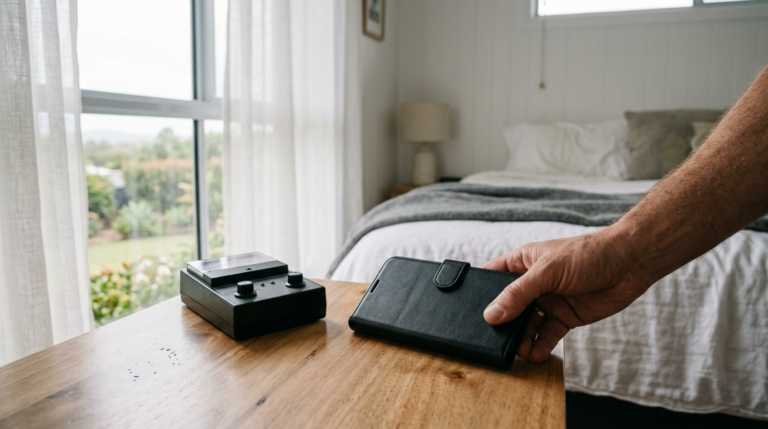
RF exposure follows the inverse square law. Double the distance, reduce exposure by 75%. Phone in your pocket: SAR is constant. Phone on a desk 50 cm away: exposure drops by roughly 94% compared to holding it. Phone on airplane mode overnight on the bedside table: essentially zero RF. The Jackson 24-hour Mechanical Timer (Amazon AU, ASIN B0DCGPPK5H, approximately $20) on your router automatically cuts Wi-Fi during sleeping hours without requiring you to remember to switch it off.
2. Speaker mode or wired headphones
SAR limits apply to devices held against the head. Using speaker phone or wired earphones drops your head exposure from the 0.5-1.6 W/kg range to effectively zero. The DefenderShield air-tube headset at SaferEMF AU eliminates the conductor near your head entirely — the audio travels through an air tube for the last 15 cm rather than a metal wire that can conduct RF.
3. Router placement
A Wi-Fi router in a bedroom or home office where you spend 8+ hours daily is a chronic low-level RF source. Moving a router to a hallway, living area, or utility space — with a timed power cut during sleep — reduces bedroom RF significantly. The JRS Eco 100 router is the only home router I am aware of with a published low-emission mode that reduces idle beacon transmission by 90%.
4. Bedroom audit before shielding
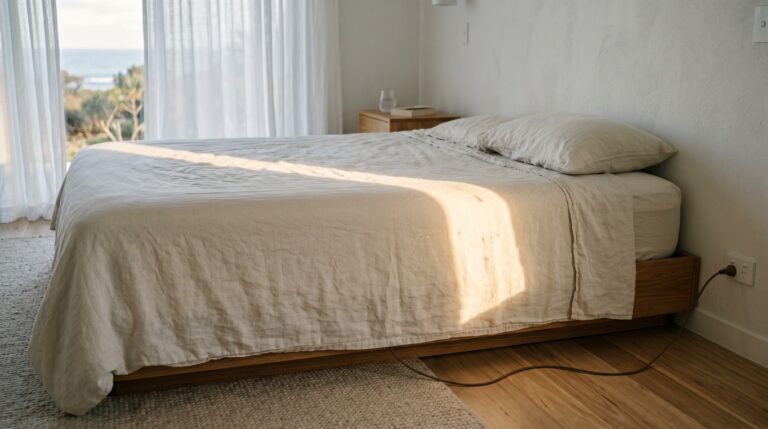
This is the shielding trap that catches most people: if you buy an EMF bed canopy (Faraday enclosure) and you have a phone or router inside or adjacent to the shielded space, you have reflected RF back at yourself and increased exposure. The correct sequence is non-negotiable: measure first with a calibrated meter, remove all internal RF sources, then — and only then — consider shielding for residual external sources like a nearby smart meter wall or street-level 5G small cell.
The SaferEMF EMF shielding bed canopy (silver cotton, 42 dB shielding rated) is the right product for genuine external source situations — a 5G small cell bolted to a pole outside your bedroom window, or a smart meter on the external bedroom wall with no practical relocation option. It is not a blanket solution for general exposure anxiety.
How to Measure Your Own 5G and RF Exposure in an Australian Home
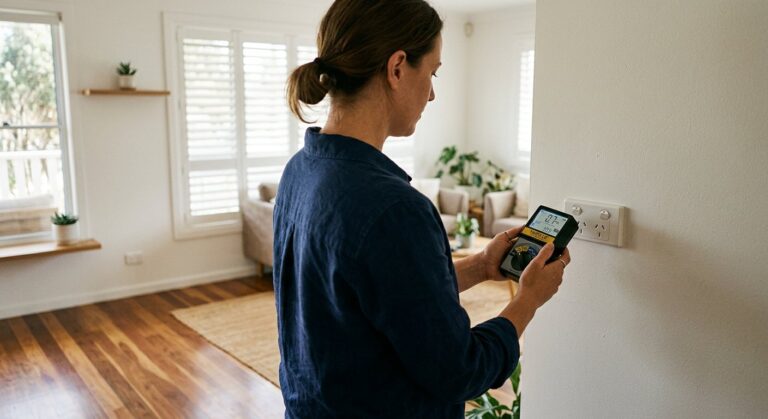
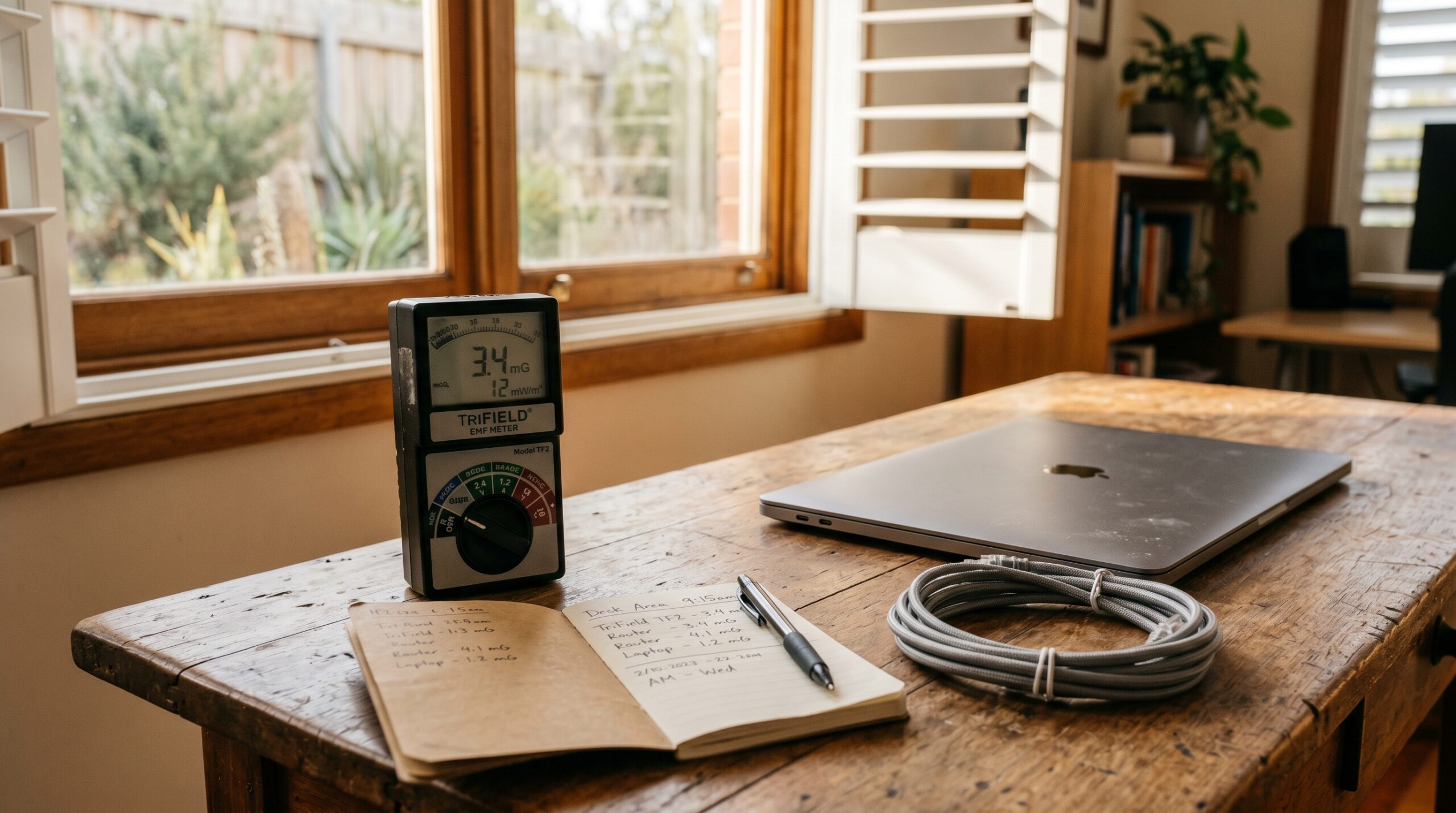
You do not have to take ARPANSA’s population-level averages as your personal answer. You can measure your actual exposure in your bedroom, living area, and near your smart meter in under 30 minutes with a calibrated RF meter. This is what I do at the Palm Beach house — and the readings consistently confirm that internal sources (router, phone, baby monitor) dominate over external sources (towers, neighbours’ Wi-Fi).
The TriField TF2 (ASIN B078T2R64C) measures RF from 20 MHz to 6 GHz, covering all current Australian 5G frequencies (sub-6 GHz band, primarily 3.5 GHz). It also measures AC magnetic fields (0-100 µT) and AC electric fields (0-1,000 V/m), making it the single device that covers all three field types relevant to a full bedroom audit. Accuracy is ±20% at RF — sufficient for identifying problem sources and verifying distance-reduction effectiveness.
The Safe and Sound Pro II (SaferEMF AU) is the better tool if RF is your primary concern. It measures from 200 MHz to 8 GHz with audio feedback that makes sweeping a room intuitive — you hear the pulse pattern of smart meter bursts, the continuous hiss of Wi-Fi, and the intermittent hits of a nearby phone. It reads in µW/m², which maps directly to the building biology reference values (sleeping area target: <0.1 mW/m² = 100 µW/m²).
For interpretation: a reading below 10 µW/m² in your sleeping area is the building biology “no concern” threshold. Between 10-100 µW/m² is a “slight concern” level where source reduction is worth attempting. Above 100 µW/m² (0.1 mW/m²) warrants investigation and active source reduction before considering shielding. The ARPANSA legal limit of 1,000 µW/cm² = 10,000,000 µW/m² — the gap between building biology precautionary levels and the regulatory thermal limit is approximately five orders of magnitude.
What ARPANSA’s Position Does and Does Not Tell You
ARPANSA’s position is that current evidence does not support a causal link between RF exposure at or below ICNIRP limits and adverse health effects. This is a carefully worded statement. “Does not support a causal link” is not “we have proven no effect.” It means the evidence reviewed by ARPANSA’s expert panel does not meet the evidentiary threshold required to revise the standard.
The ICNIRP guidelines themselves contain a section acknowledging uncertainty about long-term low-level exposure — particularly for children, whose developing nervous systems may respond differently to RF than adults. Australia’s ARPANSA standard aligns with ICNIRP and does not apply a specific additional precautionary margin for children, though ARPANSA does recommend precautionary practices such as limiting children’s mobile phone use duration.
The Swiss post-5G rollout study cited by ARPANSA is actually important evidence. It was conducted by the Swiss Federal Office for the Environment (BAFU) using fixed monitoring stations across urban Switzerland. The conclusion — negligible increase in background RF-EMF after 5G deployment — reflects a real-world measurement, not a theoretical model. This should be reassuring. It does not, however, settle questions about individual device exposure or cumulative lifetime exposure from the full ecosystem of RF-emitting devices that have proliferated since 2010.
The honest summary: ARPANSA is not telling you everything is fine because they are captured by industry. They are telling you that, at the population level, ambient 5G exposure does not constitute a demonstrated health hazard at current levels. That is a defensible position. What remains true is that you have meaningful control over your personal RF exposure — primarily through device habits, not through what towers operators deploy.
Last reviewed: June 2026 — Clean and Native
Measurement is the only honest starting point.
If you want to know what your actual bedroom RF exposure is — not the population average, not the ARPANSA limit, not the theoretical tower output — you need a calibrated meter. The TriField TF2 covers RF, AC magnetic, and AC electric in one device. The Safe and Sound Pro II is the better choice for RF-specific investigation with audio feedback. Both are available through Clean and Native’s verified suppliers.
Final Verdict
Final Verdict: This article is most relevant for Australian residents concerned about 5G safety, confirming that current network levels comply with ARPANSA safety standards while acknowledging gaps between regulatory limits and broader scientific evidence. The most important action is to review the complete scientific findings and practical mitigation strategies detailed at Browse at Earthing Oz to make an informed decision about your personal RF-EMF exposure. Compare brands in our Premium Grounding vs Earthing Oz review.
Frequently Asked Questions
ARPANSA’s position is that 5G networks operating within the ARPANSA/ICNIRP exposure standard do not constitute a demonstrated health hazard. Post-rollout measurement surveys confirm background RF levels in Australian cities remain far below the thermal safety limit. ARPANSA does not state that all long-term effects at sub-limit exposures have been ruled out — the WHO EMF project is still active.
At 3.5 GHz (the primary Australian 5G frequency), the ARPANSA general public limit is 10 W/m², consistent with ICNIRP 2020 guidelines. This limit is based on thermal effects — the point at which RF heats tissue — with a 50-fold safety factor applied below the level where measurable thermal damage occurs.
According to a Swiss post-5G rollout survey cited by ARPANSA, average urban background RF exposure increased negligibly after 5G deployment and remains well below 0.04% of the ICNIRP general public limit. Your own mobile phone held against your head produces SAR in the range of 25-80% of the permitted SAR limit — making personal device use a far more relevant exposure source than tower proximity.
Yes — significantly. Sub-6 GHz 5G (3.5 GHz in Australia) behaves similarly to existing 4G and Wi-Fi in terms of penetration and range. Millimetre wave 5G (26-28 GHz, being deployed in Australia for fixed wireless and high-density venues) has a skin penetration depth of approximately 1-2 mm and does not reach internal organs. The biological concerns and research gaps differ between these two frequency ranges.
At close range, potentially yes. Australian smart meters transmit at 900 MHz in short bursts, with peak readings 100-1,000 times higher than their time-averaged output. A smart meter on a bedroom wall, measured at 1 metre during transmission, can reach 5-10 µW/cm² — higher than ambient 5G background levels. If your smart meter is on a bedroom wall, distance and demand switch installation are the most effective interventions.
The TriField TF2 (Amazon AU, ASIN B078T2R64C) measures RF from 20 MHz to 6 GHz, covering all current Australian sub-6 GHz 5G frequencies. For RF-specific investigation with audio feedback, the Safe and Sound Pro II (available at SaferEMF AU) measures 200 MHz to 8 GHz and reads in µW/m², which maps directly to building biology reference values.
Only under specific conditions. An EMF bed canopy (Faraday enclosure) reduces external RF entering the sleeping space. However, if any RF source — phone, router, smart device — is inside or adjacent to the enclosed space, the canopy reflects that signal back at you and increases exposure. The mandatory sequence is: measure first, remove all internal sources, then shield for verified external sources only. Used correctly on a genuine external source, a 42 dB rated canopy reduces RF by approximately 99.9%.
Yes. The IARC classified radiofrequency electromagnetic fields as Group 2B (possibly carcinogenic to humans) in 2011, primarily based on mobile phone use data. This classification has not been upgraded or withdrawn as of 2026. Group 2B indicates limited evidence of carcinogenicity — the same classification as aloe vera extract and coffee. It does not mean proven carcinogen, but it does indicate the science is not closed.
In order of impact: put your phone on airplane mode overnight (or leave it in another room); move your Wi-Fi router out of your bedroom; use a $20 mechanical timer to auto-cut the router during sleep hours; use wired headphones or speaker mode for calls rather than holding the phone to your head. These four actions address your highest personal RF sources with no cost beyond the timer.
Get the Australian Home Environment Checklist
30 checks across water, air and EMF. Most of them free. Ranked by impact.
No spam. Unsubscribe any time.

Former Royal Australian Navy Clearance Diver and TAG-E counter-terrorism operator. Founded Clean and Native to apply the same rigorous thinking to the home environment.
Full biography →