PFAS Forever Chemicals in Tap Water: What Australians Must Know
PFAS (per- and polyfluoroalkyl substances) are synthetic chemicals detected in tap water supplies across Australia, with the NHMRC releasing updated drinking water guidelines in June 2025 that tightened acceptable limits for key compounds including PFOA, PFOS, and PFHxS. Only reverse osmosis filtration (90–97% removal) reliably removes PFAS from drinking water — activated carbon, standard jugs, and KDF filters do not.
What Are PFAS and Why Do They End Up in Drinking Water?
PFAS is a family of more than 12,000 synthetic chemicals built around carbon-fluorine bonds — the strongest bond in organic chemistry. That stability is exactly what makes PFAS useful in manufacturing: non-stick cookware, food packaging, stain-resistant textiles, and aqueous film-forming foam (AFFF) firefighting agents all rely on it. It is also exactly why PFAS do not break down in the environment or in the human body. They accumulate.
In Australia, the primary contamination pathway into drinking water is industrial discharge and — most significantly — AFFF use at military bases, airports, and fire training facilities. The Department of Climate Change, Energy, the Environment and Water (DCCEEW) national PFAS site register, as of 2025, identifies over 700 confirmed or suspected contamination sites across Australia. Groundwater and surface water near these sites carry PFAS into catchments that feed town water supplies. Rainfall events accelerate the migration. Standard water treatment — coagulation, flocculation, sedimentation, chlorination — does not remove PFAS.
The most studied compounds are PFOS (perfluorooctane sulfonic acid), PFOA (perfluorooctanoic acid), and PFHxS (perfluorohexane sulfonic acid). All three have been classified by the International Agency for Research on Cancer (IARC): PFOA is a Group 1 human carcinogen as of 2023. PFOS is Group 2B (possibly carcinogenic). The health evidence — kidney cancer, thyroid disruption, suppressed immune response, reduced vaccine efficacy in children — has driven regulators worldwide to progressively tighten limits since 2016.
The June 2025 NHMRC Guidelines — What Changed and What It Means for Your Tap
In late June 2025, the National Health and Medical Research Council released updated drinking water guidelines for PFAS — the first substantive revision since the interim position statements of 2017–2018. The new limits are tighter. The previous ADWG guidance used a total PFAS sum approach; the 2025 update sets individual compound guideline values and adopts a more precautionary stance aligned with recent IARC reclassifications and updated epidemiological data from European and US cohort studies.
The practical consequence is this: some water supplies that were technically compliant under the 2018 framework now sit closer to — or above — the new 2025 guideline values for specific compounds. This does not automatically mean those supplies are unsafe. Guideline values carry a built-in margin of safety. But the gap between “meets guidelines” and “zero PFAS” is real, and it has narrowed as the science has improved.
What the major city utilities currently report is compliance with applicable guidelines. Sydney Water publishes quarterly PFAS monitoring data on its website and reports concentrations below the guideline thresholds for PFOS, PFOA, and PFHxS at all monitored points in the distribution system as of 2025. Seqwater, which supplies south-east Queensland including Brisbane, reports the same. Melbourne Water similarly reports within-guideline results across the metropolitan catchment. These are consistent monitoring programs with published data — they are not hiding numbers.
The problem is not the major metropolitan supplies. The problem is regional communities adjacent to PFAS contamination sources, many of which draw from groundwater or smaller surface water systems that receive less treatment scrutiny. Williamtown (NSW), Oakey (QLD), Tindal (NT), and Katherine (NT) have all had documented exceedances linked to RAAF base AFFF use. Katherine residents were advised not to drink tap water from 2016 until filtration infrastructure was installed. That is not a hypothetical risk — it happened, and affected households bore the burden of alternative water sources for years.
Which Australian Regions Face the Highest PFAS Risk in 2026
Risk is not uniform across Australia. The communities with the highest exposure to elevated PFAS in drinking water share two characteristics: proximity to a historical AFFF source and reliance on groundwater or small surface water catchments rather than a large, heavily monitored metropolitan supply. Here is a practical breakdown by state.
New South Wales
Williamtown, near RAAF Base Williamtown north of Newcastle, is the most publicly documented case. Contamination was confirmed in 2015 and triggered a long-term community health study. Residents within the “Investigation Area” were provided alternative drinking water. By 2026, remediation infrastructure has been installed, but property owners and long-term residents have legitimate grounds for ongoing monitoring. Jervis Bay and surrounding communities also have documented contamination from HMAS Albatross.
Queensland
Oakey, near RAAF Base Oakey west of Toowoomba, had confirmed PFAS contamination in groundwater and town water supply. The Queensland Government funded alternative water supply and installed granular activated carbon (GAC) filtration on the town water system. GAC provides partial PFAS removal — it is not as effective as RO, but it meaningfully reduces concentrations when correctly maintained and when filter media is replaced on schedule. Amberley, near RAAF Base Amberley west of Ipswich, is another monitored site.
Northern Territory
Katherine is the most serious case in Australian history. PFAS from RAAF Base Tindal contaminated the Katherine town water supply drawn from the Tindal Limestone Aquifer. Residents were told not to drink tap water in 2016. A government-funded RO treatment plant was subsequently installed. By 2025, the Katherine town supply operates with RO treatment at the source — but residents with private bores in the affected area remain at risk and should test independently.
Victoria and South Australia
RAAF Base East Sale (Victoria) and RAAF Base Edinburgh (SA) are both listed on the DCCEEW contamination register. Monitoring data from these sites is available through the Department of Defence PFAS Management Framework. Affected communities in these regions should request current monitoring data from their water utility and from the Defence PFAS Information Line.
Western Australia
RAAF Pearce (Bullsbrook, north of Perth) and RAAF Base Gingin have documented PFAS in groundwater. Perth’s metropolitan supply drawn from the Integrated Water Supply Scheme (surface water plus desalinated water) has reported within-guideline PFAS levels. Residents in Bullsbrook and surrounds with private bores should treat independently or test before relying on groundwater.
The Only Filters That Remove PFAS
How to Actually Remove PFAS from Your Drinking Water
This is where most articles fail Australian consumers. They document the problem, raise alarm, and then leave you with nothing actionable. Here is the unambiguous answer: reverse osmosis is the only filtration technology that reliably removes PFAS from drinking water to consistently low concentrations. Everything else is either ineffective or inconsistent.
Reverse Osmosis — The Standard
RO membranes remove PFAS by size exclusion and charge repulsion. The semi-permeable membrane rejects molecules larger than approximately 0.0001 microns — PFOS and PFOA molecules (roughly 0.5–1 nm) are too large to pass through. Independent testing published in the journal Environmental Science and Technology Letters (2021, Dickenson and Summers) demonstrated RO removal of PFOS at 96–99% and PFOA at 90–97% under real-world operating conditions. NSF/ANSI P473 is the specific certification standard for PFAS reduction in drinking water systems — look for this certification when selecting any RO filter.
For Australian households that cannot modify plumbing — renters, units, older homes — the AquaTru Classic Smart Alkaline is the cleanest solution. It is a countertop 4-stage RO system that requires no installation beyond placing it on your bench and running a single tube to the tap. It holds NSF/ANSI P473 certification for PFAS removal. At roughly 4 litres of filtered water per day for a typical household, it costs approximately $0.04 per litre to operate — versus $2–$4 per litre for bottled water.
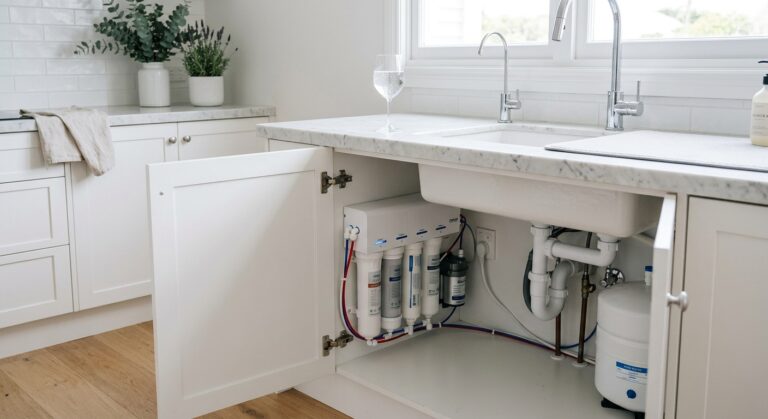
For households with under-sink access, the PWS EcoHero 5-Stage RO is the preferred option in the Australian market. It carries WaterMark certification to AS/NZS 4020 (the Australian standard for products in contact with drinking water) and NSF/ANSI 58, which covers drinking water system components including the membrane. The 5-stage configuration includes sediment pre-filtration, two carbon stages, the RO membrane, and a post-carbon polishing stage. Five-stage filtration matters in the context of PFAS because pre-filtration protects the membrane from particulates that would otherwise reduce membrane life and rejection rates.
Activated Carbon — Partial and Inconsistent
Standard granular activated carbon (GAC) and carbon block filters show variable PFAS removal — typically 40–70% for long-chain PFAS compounds under ideal conditions, dropping significantly as the carbon bed exhausts. A 2020 study from the American Water Works Association Research Foundation found GAC effectiveness for PFAS depends heavily on contact time, carbon type, competing organic matter, and replacement frequency. The problem: under real household conditions, filter cartridges are frequently used beyond their rated capacity, and PFAS removal drops sharply as the carbon saturates. You cannot see or taste the difference. Catalytic carbon performs better than standard GAC for some PFAS compounds, but still does not match RO.
Compressed carbon block filters (as used in Tappwater and similar systems) perform better than GAC for PFAS because the compressed block format provides longer contact time and more consistent flow paths. But published NSF P473 certification data is sparse for carbon-only systems, and the evidence base is thinner than for RO. If PFAS removal is your primary concern, RO is the defensible choice.
What Does Not Work
Standard water jugs (Brita, Aqua Optio, most supermarket brands) use GAC cartridges rated for taste and chlorine improvement — not PFAS removal. KDF-55 media has no mechanism for PFAS removal. Boiling water concentrates PFAS rather than removing it. Distillation removes most PFAS but is impractical for household use due to energy cost and production speed. Activated alumina is effective for fluoride but has no meaningful PFAS removal mechanism.
Bottled Water — The False Safety Option
Bottled water costs $2–$4 per litre at retail. An Australian household of four consuming 2L per person per day spends $5,840–$11,680 per year on bottled water. A countertop RO system costs $600–$800 upfront plus roughly $150–$200 per year in filter replacement, delivering water at $0.04–$0.08 per litre. The economic case for RO is simple. Beyond cost, a 2021 study published in Environment International found PFAS contamination in several bottled water brands — the plastic packaging is not the only source of contamination, as source water quality varies by bottler. Bottled water is not a guaranteed PFAS-free alternative.
How to Test Your Own Tap Water for PFAS
Testing is the only way to know your actual exposure level. This matters most if you live near a known contamination site, rely on a private bore or tank, or are in a regional area with a small, less frequently monitored water supply.
PFAS analysis requires laboratory testing — no consumer test kit available in Australia as of 2026 can detect PFAS at drinking water guideline concentrations. The VARIFY 17-in-1 water test kit available on Amazon AU tests for heavy metals, chlorine, pH, hardness, and nitrates, but does not test for PFAS. Do not buy a consumer kit expecting PFAS results — you need a NATA-accredited laboratory.
In Australia, PFAS water testing is conducted by NATA-accredited laboratories using LC-MS/MS (liquid chromatography with tandem mass spectrometry) analysis, which can detect PFAS compounds at concentrations in the parts-per-trillion range. ALS Environmental, SESL Australia, and Eurofins Scientific all offer PFAS water testing for residential customers. A comprehensive drinking water PFAS panel — covering 20+ compounds including PFOS, PFOA, PFHxS, and PFBS — typically costs $180–$350 depending on the laboratory and the compound list. You collect a sample using a laboratory-supplied sampling bottle (to prevent cross-contamination from PFAS in standard plastic bottles) and courier it to the laboratory.
If you live in an affected community, Defence has operated community testing programs in Williamtown, Oakey, Tindal, and other sites. Contact the Defence PFAS Information Line (1800 333 102) to determine whether a government-funded testing program applies to your property. Some state governments have also run subsidised testing for affected households.
Brisbane and South-East Queensland — What Chloramine Cities Need to Know About PFAS Filtration
Brisbane and south-east QLD are chloramine cities. Seqwater uses chloramine (chlorine plus ammonia) as the primary disinfectant in the SEQ Water Grid. This matters for filter selection because standard granular activated carbon (GAC) removes chloramine at roughly 1/40th the rate it removes free chlorine. A filter that handles chloramine poorly will also have compromised contact time available for PFAS removal.
If you are a Brisbane, Ipswich, or Logan household concerned about PFAS, a standard GAC filter is doubly inadequate — it misses chloramine and provides inconsistent PFAS removal. The correct solution is reverse osmosis, which removes both chloramine (through the carbon pre-filter stage) and PFAS (through the membrane). The PWS EcoHero 5-Stage RO’s dual pre-carbon configuration is specifically suited to chloramine water — the first carbon stage handles chloramine, protecting the membrane, and the membrane handles PFAS, heavy metals, and fluoride.
Sydney is also a chloramine city (Sydney Water uses monochloramine as the primary disinfectant for the metropolitan distribution system). The same logic applies to Sydney households selecting filtration for PFAS: RO is the correct technology, not a standard carbon block or GAC jug.
Melbourne, Hobart, and Canberra use free chlorine — standard carbon pre-filtration works adequately for disinfectant removal in these cities, but the membrane remains the essential component for PFAS.
The “Safe” Label — What It Does and Does Not Mean
I want to be direct about something that most PFAS articles avoid. When Sydney Water, Seqwater, or Melbourne Water says their water is “within Australian Drinking Water Guidelines” for PFAS, that statement is accurate. It is also incomplete.
Guideline values are not zero-risk thresholds. They are risk-based estimates derived from epidemiological data and toxicological modelling, incorporating a safety margin. The NHMRC’s June 2025 guideline values represent a concentration below which no appreciable health risk is estimated for lifetime consumption. “No appreciable risk” is different from “no risk.” And the science on PFAS health effects is not static — IARC’s 2023 reclassification of PFOA to Group 1 carcinogen came after years of accumulating evidence that progressively shifted the consensus.
The precautionary position — which I take at Palm Beach after testing my own supply — is that if you can affordably reduce PFAS exposure to near-zero with an RO filter at $0.04–$0.09 per litre, the cost-benefit calculation strongly favours filtration. This is not alarmism. It is the same logic I applied in the Navy when the cost of a precaution was low relative to the potential consequence of not taking it.
The families in Katherine who were told their water was “managed” and then told not to drink it are the reason I do not rely on utility self-reporting as the sole data point. Check your supplier’s published monitoring data. Know whether you are on a metropolitan supply or a smaller system. If you are near a known contamination site, test independently.
Last reviewed: June 2026 — Clean and Native
Final Verdict
This article is most relevant for Australian households concerned about PFAS contamination in their water supply, with the key takeaway being that only reverse osmosis filtration reliably removes these persistent chemicals according to updated 2025 guidelines. The single most important action is to install a reverse osmosis water filter system in your home, which you can explore at See Pure Water Systems.
Frequently Asked Questions
PFAS (per- and polyfluoroalkyl substances) are a family of over 12,000 synthetic chemicals used in manufacturing since the 1950s. They enter drinking water primarily through industrial discharge and the use of AFFF firefighting foam at military bases and airports. Standard water treatment does not remove them. The DCCEEW national register lists over 700 confirmed or suspected PFAS contamination sites in Australia as of 2025.
Major metropolitan supplies from Sydney Water, Seqwater (Brisbane), and Melbourne Water currently report PFAS levels within the June 2025 NHMRC drinking water guidelines. Regional communities near RAAF bases and airports — including Williamtown NSW, Oakey QLD, and Katherine NT — have had documented exceedances. “Within guidelines” does not mean zero PFAS; it means below the estimated safe threshold for lifetime consumption based on current evidence.
The NHMRC’s June 2025 update tightened drinking water guideline values for individual PFAS compounds including PFOA, PFOS, and PFHxS, moving away from a sum-of-PFAS approach. The new limits are more precautionary and aligned with the IARC’s 2023 reclassification of PFOA as a Group 1 human carcinogen. Some supplies that met the 2018 interim values now sit closer to the updated limits.
No. Standard GAC (granular activated carbon) jugs like Brita do not reliably remove PFAS. Testing shows highly variable removal — 40–70% under ideal conditions, dropping sharply as the carbon exhausts — and no consumer jug carries NSF P473 certification for PFAS removal. For PFAS removal you need reverse osmosis.
Reverse osmosis is the only technology with consistent, certified PFAS removal. NSF/ANSI P473 is the specific certification to look for. The AquaTru Classic (countertop, no plumbing required) and the PWS EcoHero 5-Stage RO (under-sink, WaterMark AS3497 + NSF 58) are the two recommended options for Australian households. Both remove PFAS at 90–97% depending on the compound.
Not with a consumer kit — no retail test kit available in Australia detects PFAS at drinking water concentrations. You need a NATA-accredited laboratory using LC-MS/MS analysis, which costs $180–$350 for a comprehensive panel. ALS Environmental, SESL Australia, and Eurofins Scientific offer residential PFAS testing. If you are near a RAAF base or known contamination site, contact the Defence PFAS Information Line on 1800 333 102 about government-funded testing.
No. Boiling does not remove PFAS — it concentrates them by evaporating the water while leaving PFAS behind. Reverse osmosis is the correct removal method.
Not necessarily. A 2021 study published in Environment International detected PFAS in multiple bottled water brands. Source water quality varies by bottler and is not subject to the same monitoring transparency as municipal supplies. Bottled water also costs $2–$4 per litre versus $0.04–$0.09 per litre for RO-filtered tap water — a 25–40x cost premium with no guaranteed PFAS-free outcome.
Communities adjacent to RAAF bases face the highest documented risk: Katherine NT (RAAF Tindal), Williamtown NSW (RAAF Williamtown), Oakey QLD (RAAF Oakey), Amberley QLD (RAAF Amberley), Bullsbrook WA (RAAF Pearce), and Sale VIC (RAAF East Sale). Residents in these areas, especially those on private bores, should test independently and consider RO filtration regardless of utility reports.
Yes. Reverse osmosis removes fluoride at 90–97% in addition to PFAS. It is the only technology that removes both — activated carbon filters, including catalytic carbon, do not remove fluoride. If you are in a fluoridated supply (all major Australian cities) and also want PFAS removal, RO handles both simultaneously.
Get the Australian Home Environment Checklist
30 checks across water, air and EMF. Most of them free. Ranked by impact.
No spam. Unsubscribe any time.

Former Royal Australian Navy Clearance Diver and TAG-E counter-terrorism operator. Founded Clean and Native to apply the same rigorous thinking to the home environment.
Full biography →