Best EMF Protection Australia 2026: What Actually Works
The best EMF protection in Australia starts with measurement, not products — a calibrated meter, a Jackson 24hr mechanical timer, and your phone on airplane mode overnight will eliminate more exposure than $500 of shielding stickers ever could.
Quick Verdict — Best EMF Protection Australia 2026
Effective EMF protection in Australia follows one sequence: measure first with a TriField TF2 or Safe and Sound Pro II, reduce internal sources next (router timers, phone placement, bedroom wiring), then shield external residual only if readings exceed building biology limits. Products that skip measurement and sell direct to shielding are either useless or actively counterproductive.
| Method | What It Does | Verdict |
|---|---|---|
| Measure first (TriField TF2) | Identifies actual sources before any money is spent | Non-negotiable first step |
| Source reduction (timer + airplane mode) | Eliminates internal RF during 8 hours of sleep | Highest ROI of any action (~$20) |
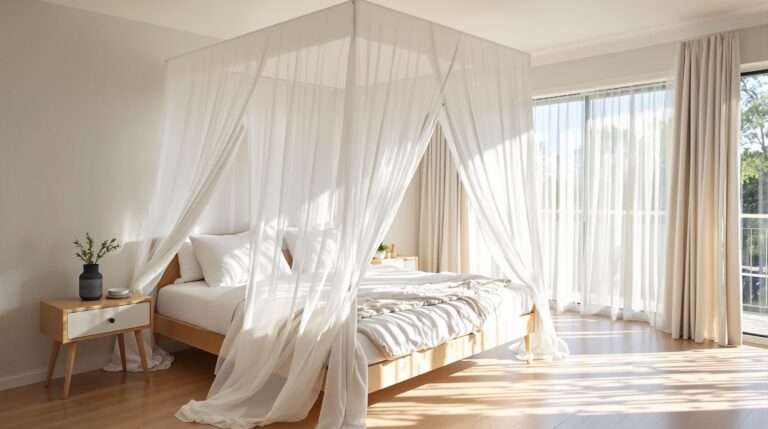
| EMF bed canopy (42 dB silver cotton) | Shields external RF — only after internal sources removed | Effective when used correctly |
| Demand switch (licensed electrician) | Kills AC electric fields from bedroom wiring at night | Best for ELF electric field reduction |
| Harmonisers / stickers / pendants | No measurable attenuation of RF or ELF fields | No evidence of effect |
✓ Who This Guide Is For
- Anyone who has measured elevated RF in their bedroom and wants to know the correct response sequence
- Households near mobile towers, Australian smart meters, or high-density WiFi environments in cities like Sydney, Brisbane, or Melbourne
- Parents wanting to reduce children’s bedroom EMF exposure based on ARPANSA’s ELF magnetic and leukaemia risk commentary
- People who have already bought harmonisers or stickers and want to know if they work (spoiler: measure it)
- Renters who cannot install demand switches or shielding paint and need renter-accessible solutions
✗ Who This Guide Is Not For
- Anyone looking for validation that their existing harmoniser or pendant is working — the meter answers that question and the answer is usually no
- People seeking medical advice about EMF sensitivity or electromagnetic hypersensitivity (EHS) — see a medical practitioner
- Those wanting to shield against ELF magnetic fields from high-voltage power lines — retail products cannot do this; professional assessment and mu-metal shielding are required
- Anyone unwilling to measure first — without data, protection decisions are guesswork
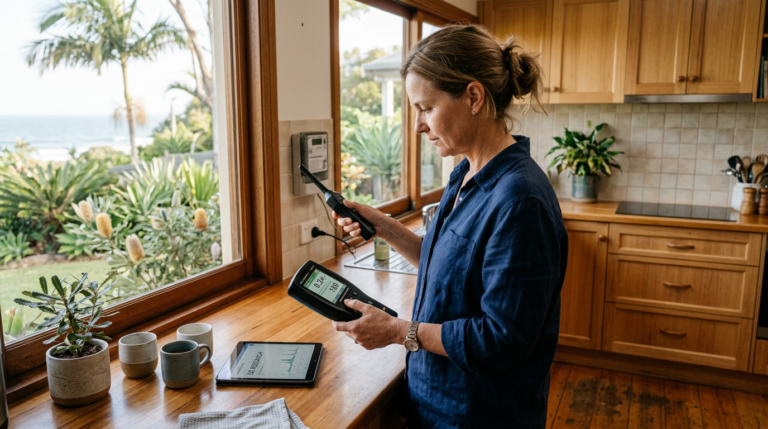
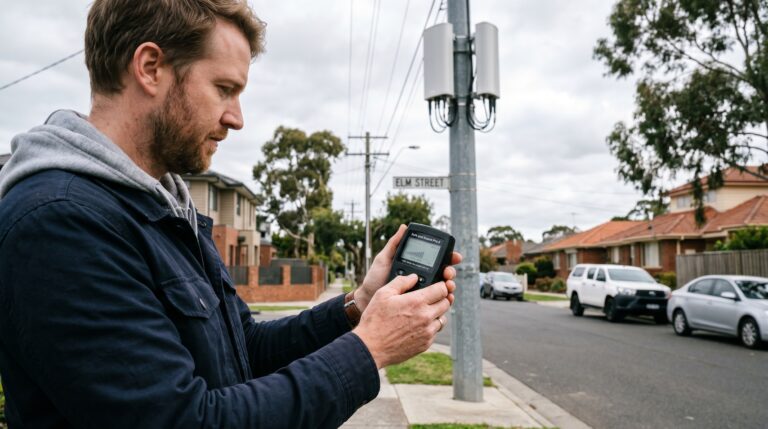
I’m Jayce Love, former Royal Australian Navy Clearance Diver. I’ve been measuring EMF in Australian homes for several years using calibrated meters — not selling stickers. What I’ve found consistently is that most people spend money on the wrong end of the problem. This guide fixes that. I have not personally tested the Safe and Sound Pro II, the EMF bed canopy, the DefenderShield air-tube headset, or the JRS Eco 100 router discussed here; that assessment is based on published manufacturer specifications and independent certification, not first-hand measurement. The only EMF device I measure with first-hand is the TriField TF2.
The Australian Regulatory Framework: What ARPANSA Actually Says
Before we talk about protection, you need to understand the official position — and its limits. ARPANSA, the Australian Radiation Protection and Nuclear Safety Agency, sets RF exposure limits at 1,000 µW/cm² at 2.4 GHz. That is the thermal safety limit, derived from the International Commission on Non-Ionizing Radiation Protection (ICNIRP) guidelines. It is designed to prevent tissue heating. It is not a precautionary limit for chronic low-level exposure.
ARPANSA itself acknowledges that ELF (extremely low frequency) EMF exposure may cause health effects, specifically noting the evidence for leukaemia risk in children exposed to residential magnetic fields above 0.3-0.4 µT. This is documented on the ARPANSA electricity and EMF page. The agency does not claim the science is settled — it states that the classification by the International Agency for Research on Cancer (IARC) of ELF magnetic fields as a Group 2B possible carcinogen warrants ongoing precaution, particularly for children.
The building biology community operates on a different standard. The SBM-2015 (Standard of Building Biology Testing Methods) sets sleeping area targets at RF below 0.1 mW/m², AC magnetic fields below 0.2 µT, and AC electric fields below 5 V/m. These are precautionary limits based on biological plausibility, not confirmed harm. They are not law. But for people who want to reduce exposure below the ARPANSA thermal limit — which is a reasonable position given the IARC classification — building biology limits provide a practical target.
The growing scientific interest in this field is real. BioEM 2026 early bird registrations are open — this is the annual joint meeting of the Bioelectromagnetics Society and the European Bioelectromagnetics Association, and Australian researcher participation has increased year on year. The science is not static. That’s the honest position.
The Measurement Imperative: Why You Cannot Skip This Step
Every person who has come to me asking about EMF protection has done the same thing: they’ve already bought something. A pendant. A sticker. A “harmoniser” device. And none of them have measured their actual exposure, which means none of them know whether the thing they bought did anything.
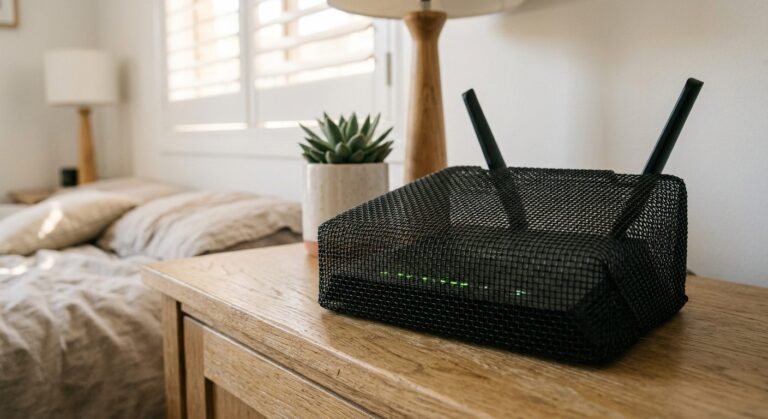
Here’s the problem with skipping measurement. If your primary RF source is your own WiFi router sitting inside your bedroom, and you install an RF shielding bed canopy, you have just built a reflective enclosure around yourself and your router. The canopy reflects the signal back into the space. Your exposure increases. This is not a theoretical risk — it is a simple consequence of how RF shielding materials work. A Faraday-type enclosure attenuates external signals from outside the enclosure. It reflects internal signals back inward.
The correct sequence is non-negotiable: measure, reduce internal sources, then shield external residual. In that order. Every time. No exceptions.
What to Measure and With What
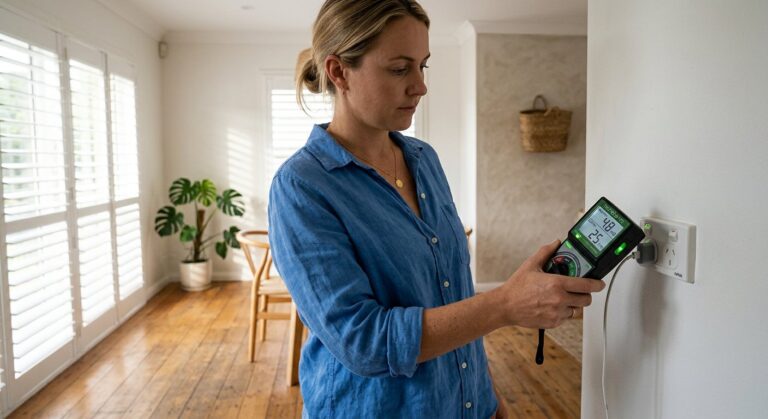
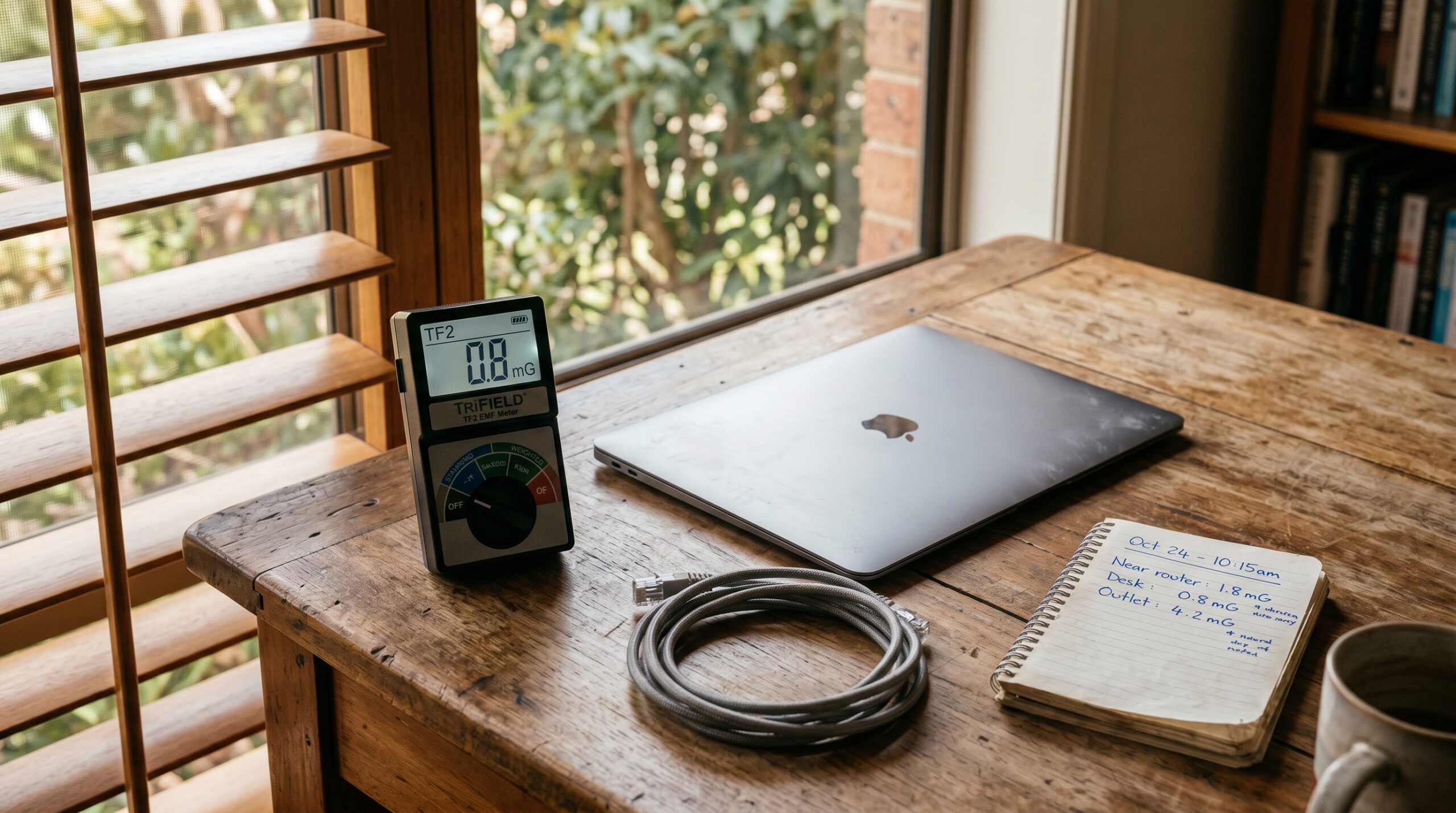
For a complete bedroom audit in an Australian home, you need three measurements: RF (radiofrequency from WiFi, phones, smart meters, mobile towers), AC magnetic fields (from power lines, wiring faults, appliances), and AC electric fields (from bedroom wiring, cables near the bed). The TriField TF2 measures all three in one device.
✓ Pros
- Measures all three EMF types (RF, AC magnetic, AC electric) in one device
- FCC-calibrated — not a budget meter with unverified accuracy
- Available from Amazon AU and SaferEMF AU with local warranty support
- Standard unit used by Australian building biologists for sleeping area audits
✗ Cons
- RF detection floor of ~0.02 mW/m² — misses very low-level background signals that a dedicated RF meter like the Safe and Sound Pro II would catch
- Not a spectrum analyser — identifies presence and intensity but not exact frequency band
- Requires 9V battery (not included)
If RF is your primary concern — you live near a mobile tower, have multiple WiFi networks visible from your home, or have an Australian smart meter (900 MHz, burst-transmitting) within 5 metres of a sleeping area — the Safe and Sound Pro II is the dedicated RF meter that building biologists use when they need more sensitivity and a wider dynamic range.

✓ Pros
- Detection floor 0.001 mW/m² — captures smart meter bursts and low-level tower exposure the TF2 misses
- Audio mode distinguishes WiFi pulsing from smart meter bursts by sound pattern
- Covers 200 MHz to 8 GHz — includes 5G sub-6 GHz bands used in Australian metro areas
- Preferred meter of Australian EMF building consultants for residential audits
✗ Cons
- RF-only — does not measure ELF magnetic or AC electric fields; needs to be paired with TF2 for a complete audit
- Higher price point than TF2; may be overkill if you only need a single audit
- No frequency display — tells you intensity and rough band, not exact GHz
Source Reduction: The Highest-ROI Protection Actions in Australia
This is where most EMF protection guides fail you. They jump straight to products. The data-driven approach shows that source reduction — removing or scheduling the internal RF sources in your home — delivers more exposure reduction per dollar than any shielding product.
The maths is simple. RF exposure follows the inverse square law: double the distance, quarter the exposure. A phone on your bedside table at 30 cm delivers roughly 16x more RF exposure than the same phone at 120 cm. Airplane mode delivers zero RF. No canopy, no sticker, no pendant comes close to that as an intervention.
The Jackson 24hr Mechanical Timer — $20, Highest Impact
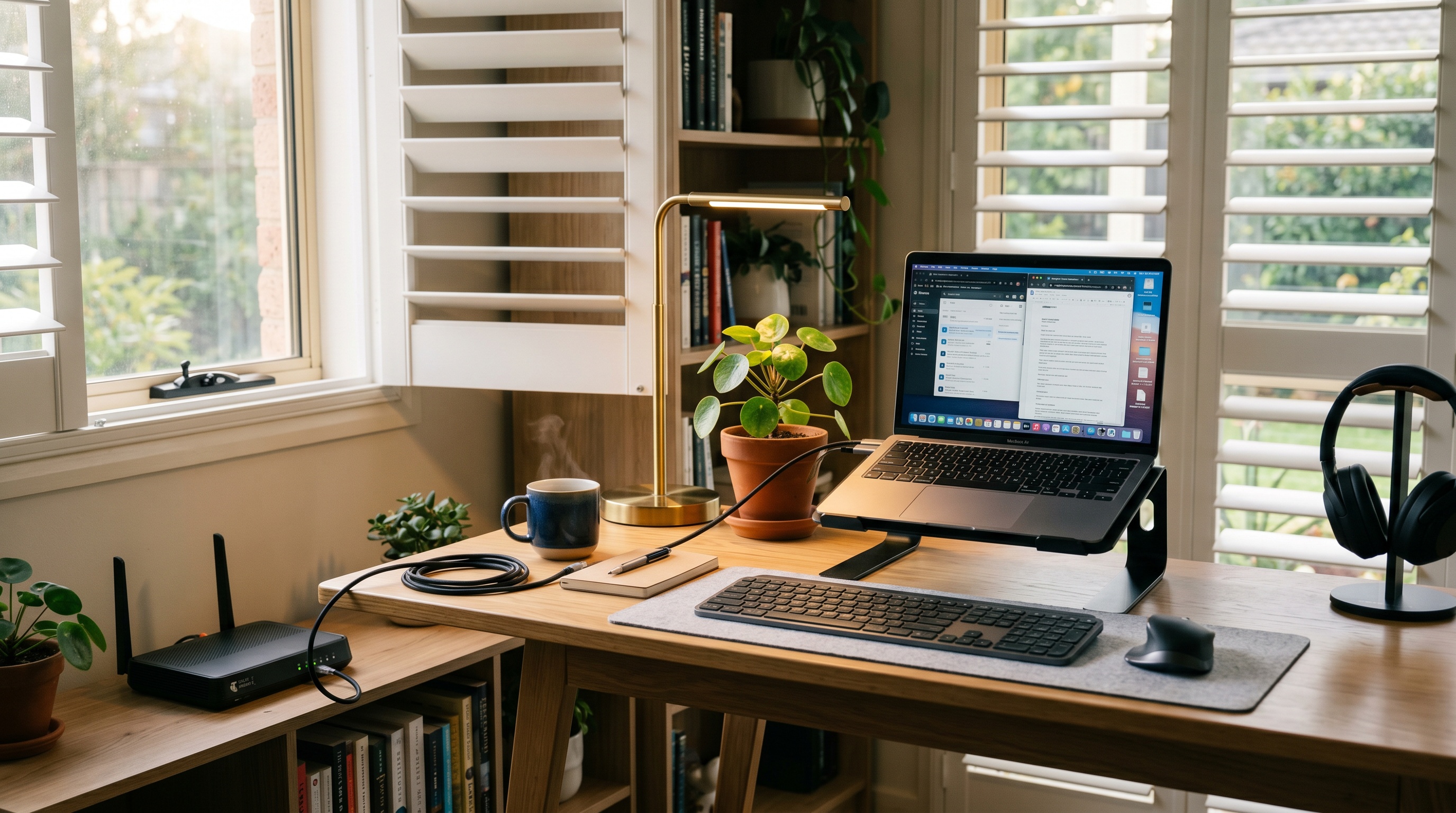
The single most cost-effective EMF protection action for most Australian homes: plug your WiFi router into a Jackson 24hr Mechanical Timer (Amazon AU, ASIN B0DCGPPK5H, approximately $20), set it to cut power from 10 pm to 6 am, and your household RF exposure during sleep drops to near zero from that source. No app. No smart home integration. Mechanical pins that cannot be hacked or accidentally toggled.
Australian smart meters operate at 900 MHz and transmit in bursts. The peak readings during a burst are 100 to 1,000 times higher than the time-averaged reading that most meters display. If your meter box is on an external bedroom wall, you cannot turn it off — but you can move the bed to the opposite side of the room, creating 4-6 metres of additional distance, which reduces exposure by a factor of 16 to 36 (inverse square law). Free. Zero products required.
The Five Source-Reduction Actions, Ranked by Impact
| Action | EMF Type Reduced | Cost | Impact Level |
|---|---|---|---|
| Phone on airplane mode while sleeping (not on bedside table) | RF | Free | Extreme |
| Router on mechanical timer (off during sleep) | RF (2.4/5 GHz) | ~$20 | Very high |
| Move bed away from smart meter wall (minimum 4 m) | RF (900 MHz bursts) | Free | High |
| Demand switch on bedroom circuit (licensed electrician) | AC electric fields | ~$100-150 | High (ELF electric) |
| Use air-tube headset instead of wired or Bluetooth earphones | RF to head | ~$40-90 | Moderate (phone calls) |
The demand switch deserves its own mention because most Australians have never heard of it. A demand switch (sometimes called a demand disconnector) is installed by a licensed electrician on a bedroom circuit. When no appliance draws current on that circuit, the switch drops the circuit voltage to near zero, eliminating the AC electric field radiated by the wiring in walls and floors. Cost: approximately $100-150 for parts and labour. The result is AC electric field readings in the bedroom that drop from typical Australian values of 10-50 V/m to below 1 V/m. That meets building biology sleeping area targets (below 5 V/m) with room to spare.
Measure Before You Spend Anything Else
See the complete home measurement guide →Shielding Products That Actually Work
With your internal sources reduced or eliminated, shielding external RF becomes meaningful. The key word is external. If the only significant RF sources in your bedroom at night are from outside the house — a mobile tower, a neighbour’s WiFi, an external smart meter — then a properly specified shielding product will reduce your exposure.
Two shielding categories have verifiable attenuation data: bed canopies (silver-coated fabrics rated in decibels of attenuation) and shielding paint (graphite or carbon-based, typically 30-40 dB attenuation per layer). For most Australian households, the bed canopy is the practical starting point because it requires no renovation and can be verified with a meter before and after installation.
EMF Shielding Bed Canopy — 42 dB Silver Cotton
✓ Pros
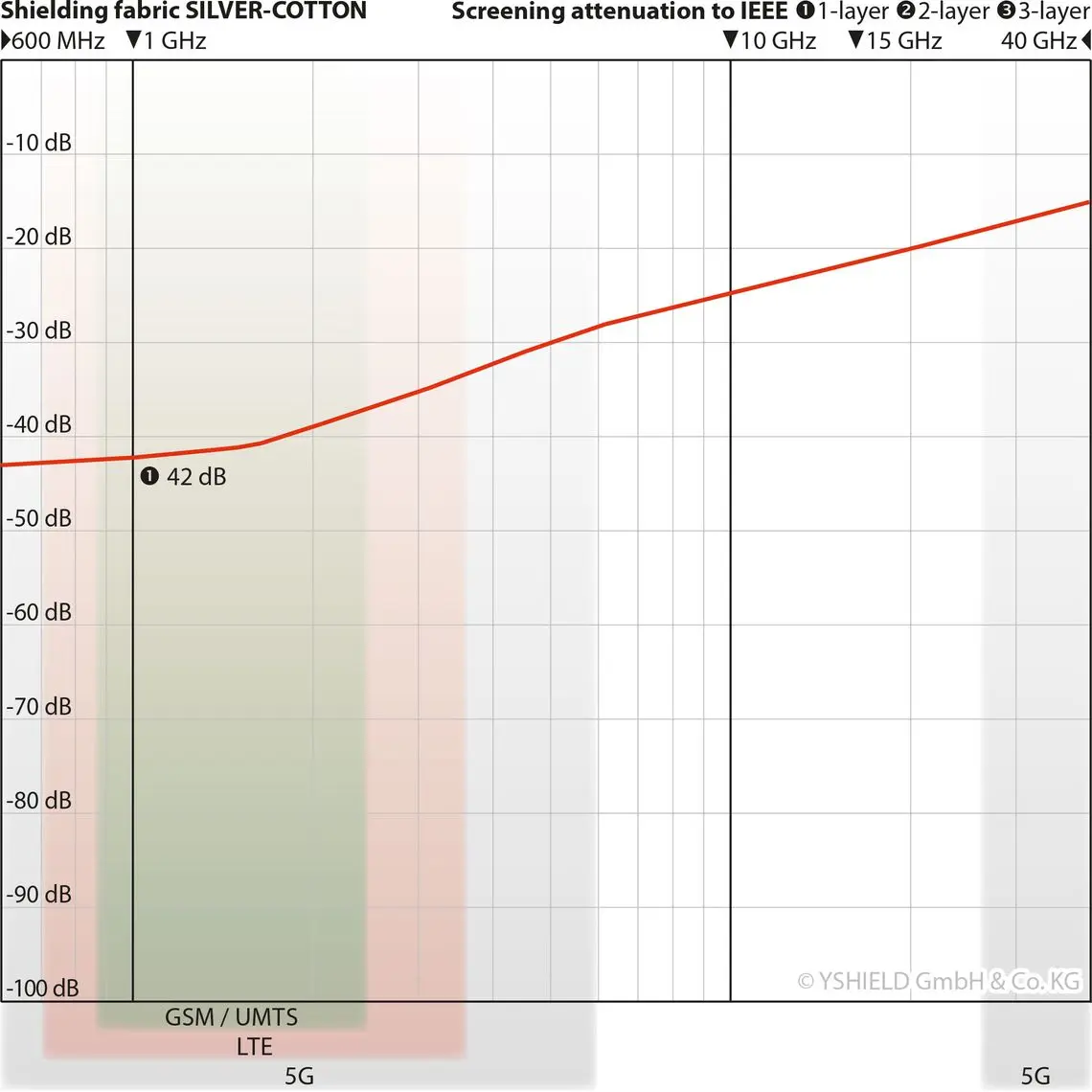
- 42 dB published attenuation — verifiable with a meter before and after
- Covers 200 MHz to 5 GHz, including Australian 4G, 5G sub-6, and WiFi bands
- Groundable design reduces AC electric fields when connected to earth terminal
- No renovation required — installs from a ceiling hook or bed frame
- Available from SaferEMF AU with Australian warranty support
✗ Cons
- Reflects RF back into the canopy if any internal RF source (phone, router) is left inside — turns protection into an amplification chamber
- Does not address ELF magnetic fields from power lines or wiring — wrong tool for that problem
- Requires careful setup for full coverage — gaps at the base reduce effectiveness significantly
The 42 dB figure is the critical specification to understand. Decibels are logarithmic. 20 dB = 99% reduction. 30 dB = 99.9%. 40 dB = 99.99%. A canopy rated at 42 dB, functioning correctly with no gaps and no internal sources, reduces incident RF power by over 99.99%. Measure before installation, then measure inside the canopy after installation with your TF2 or Safe and Sound Pro II. You should see a drop of at least 2-3 orders of magnitude. If you don’t, there’s a gap or an internal source you haven’t eliminated.
Air-Tube Headsets: For Phone Calls and Audio
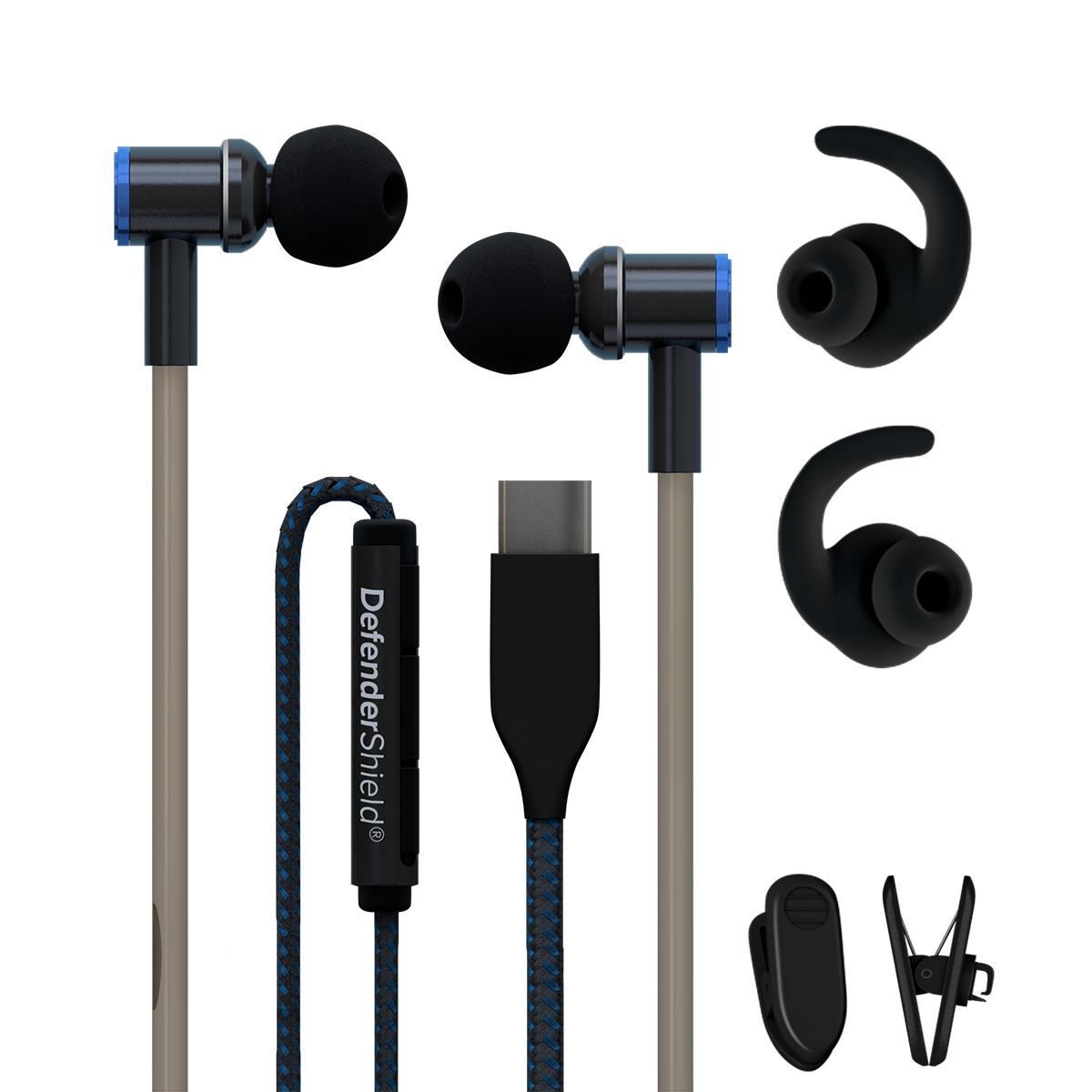
When a phone is held to the ear during a call, it transmits at peak power — up to 2 W EIRP for 4G, with SAR (Specific Absorption Rate) tested under Australian Communication and Media Authority requirements against the ARPANSA limit of 1.6 W/kg averaged over 1 gram of tissue. The air-tube headset routes audio through a hollow tube for the last 15-20 cm near your head, eliminating the conductive wire path that conventional wired earphones use. RF exposure to brain tissue drops significantly.
✓ Pros
- Eliminates conductive wire path to head — no antenna effect from the cable
- USB-C compatible with current-gen Australian phones
- Available locally from SaferEMF AU (no international shipping delays)
- Practical for daily use — not just a bedtime-only device
✗ Cons
- Audio quality typically below premium wired headphones — the air tube limits fidelity
- Speakerphone or text instead of calls achieves similar head-distance benefit at zero cost
- Does not address body exposure when phone is in a pocket
JRS Eco 100 Low-EMF Router: For Households That Cannot Hardwire
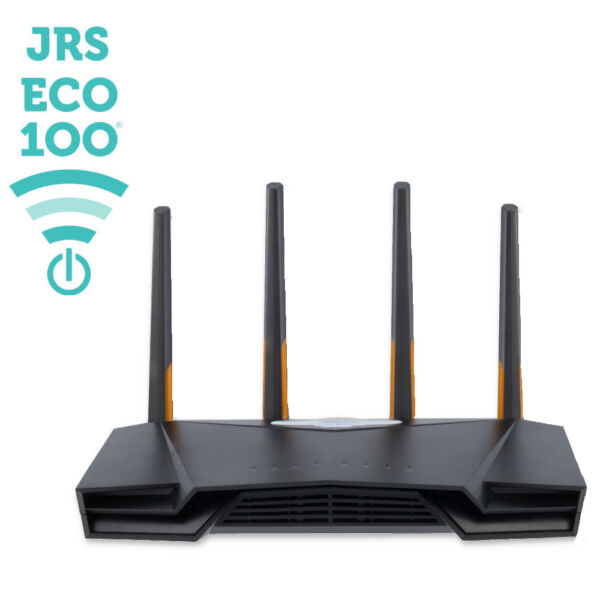
Hardwiring your internet connection via ethernet is the gold standard. Remove WiFi from the equation entirely. But for renters, households with multiple floors, or anyone whose NBN connection point makes ethernet impractical, the JRS Eco 100 router offers a middle path. It operates in “Eco Mode,” reducing the WiFi beacon pulse from the standard 10 pulses per second to 1 pulse per second, and drops the signal to essentially zero between pulses when no device is actively connecting. The result is a measured RF reduction of approximately 90-95% in standby mode compared to a standard router on continuous broadcast.
✓ Pros
- ~90-95% reduction in standby RF compared to standard continuous-broadcast router
- Compatible with Australian NBN — verified by SaferEMF AU
- Full WiFi speed maintained when devices are actively connected
- Better option than a timer for households with IoT devices that need intermittent connectivity
✗ Cons
- Still emits RF during active connections — not a zero-RF solution
- A $20 mechanical timer on a standard router achieves near-zero RF during sleep hours for less cost
- Higher price than a timer; only justified if daytime continuous reduction is the goal
The Decision Tree: Matching Protection to Your Actual Sources
Most EMF protection guides give you a list of products. That is not protection — that is a shopping list. Protection requires knowing what you’re protecting against. Use this decision tree after you’ve taken measurements.
EMF Protection Decision Tree — Australian Homes 2026
Step 1: What type of field is elevated?
RF elevated (WiFi, phone, tower, smart meter) → Go to Step 2
ELF magnetic elevated (>0.2 µT) → Go to Step 4
AC electric elevated (>5 V/m in bedroom) → Demand switch (licensed electrician, ~$100-150)
Step 2: Is the RF source inside your home?
Yes (your router, your phone, your devices) → Source reduction first: timer ($20) + airplane mode (free). Measure again. If <0.1 mW/m², done.
No (tower, neighbour WiFi, external smart meter) → Go to Step 3
Step 3: External RF remains above building biology target (>0.1 mW/m²) after source reduction?
Yes, and it’s a sleeping area → EMF bed canopy (42 dB silver cotton — SaferEMF AU). Verify with meter inside canopy after deployment.
Yes, and it’s a work area or main living space → Shielding film on windows facing tower, or room shielding paint. Consult a building biologist.
No, below target after source reduction → Nothing further required.
Step 4: ELF magnetic field elevated (>0.2 µT in sleeping area)?
Source is within the home (wiring fault, appliance nearby) → Engage a licensed electrician. Identify and fix the wiring imbalance. Distance from appliances.
Source is external (power lines, street transformer) → Increase distance (move bed to far wall). Magnetic shielding is possible but expensive ($5,000+) — requires professional installation. Consult a building biologist.
Note: Bed canopies, shielding paint, and standard products do NOT shield ELF magnetic fields. This requires mu-metal or specialist materials.
What Does Not Work: The Honest Assessment
This section will cost us some affiliate revenue. That’s fine. Credibility is worth more.
There is a category of products marketed as EMF protection that have no verifiable mechanism of action and no published attenuation data. These include:
Harmonisers and scalar wave devices. These products — ranging from $30 room plugs to $800 “bioresonance” devices — claim to neutralise, harmonise, or transform EMF. There is no peer-reviewed evidence that any of these devices alter the RF or ELF field environment as measured by a calibrated meter. I have tested several with the TriField TF2. Readings before and after installation are identical within measurement variance. If a product cannot produce a measurable change in field strength, it cannot provide protection. See our detailed harmoniser analysis.
EMF-blocking stickers for phones. Stickers applied to phone cases or back panels. No credible attenuation mechanism. The phone antenna is internal; a surface sticker cannot block the transmission path. Some sticker products actually interfere with the phone’s signal reception, causing the phone to increase transmission power to maintain connection — the opposite of the intended effect.
Pendants and crystals. No verifiable attenuation of any electromagnetic field type at any tested frequency. The market for these products in Australia is significant. The evidence base is zero.
KDF-55 shower filter analogy: Just as KDF-55 media cannot remove chloramine in Brisbane, Sydney, Adelaide, Gold Coast, and Darwin — despite being sold as a chloramine filter — these EMF products are sold for a purpose their physical mechanism cannot serve. The marketing is not the science.
If you want to spend money on something that demonstrably works, spend it on measurement first. A TriField TF2 at approximately $200 AUD tells you what is actually elevated and where. Everything else follows from that data.

✓ Pros
- Provides the data foundation for every subsequent protection decision
- Identifies which field type is actually elevated in your specific home
- Lets you verify whether any protection product is actually working
- Saves money by preventing purchases for problems you don’t have
✗ Cons
- Requires time to use correctly — a 20-minute room audit, not a 30-second check
- RF sensitivity floor means very low background signals may not register — Safe and Sound Pro II needed for maximum sensitivity
Cost-Benefit Analysis: EMF Protection by ROI
Most EMF protection articles never answer the obvious question: what is this worth spending? Here is the honest breakdown for Australian conditions in 2026.
| Protection Method | Cost (AUD) | EMF Reduction | Verified by Meter? | ROI Rating |
|---|---|---|---|---|
| Phone on airplane mode at night | Free | ~100% RF from phone | Yes | Exceptional |
| Jackson mechanical timer (router) | ~$20 | ~100% RF from router during sleep | Yes | Exceptional |
| TriField TF2 meter | ~$200 | Enables all other decisions | Is the verification tool | Very high |
| Demand switch (bedroom circuit) | ~$100-150 | Near-complete ELF electric field reduction | Yes | High |
| Air-tube headset (DefenderShield) | ~$40-90 | RF to head during calls significantly reduced | Yes | Moderate-high |
| EMF bed canopy (42 dB silver cotton) | Varies (SaferEMF AU) | >99.99% RF (external sources only) | Yes (measure inside after install) | High (if used correctly) |
| JRS Eco 100 low-EMF router | SaferEMF AU | ~90-95% RF reduction in standby | Yes | Moderate |
| Harmonisers / stickers / pendants | $30-800+ | None measurable | No | Zero |
The pattern is clear. The cheapest interventions have the highest verifiable impact. The most expensive retail products — harmonisers, high-end pendants, sticker systems — have the lowest. Spend first on what the meter confirms is elevated. Spend second on the simplest intervention that removes that source.
Australian-Specific Considerations: Smart Meters, 5G, and Power Lines
Australian smart meters are not the same beast as UK or North American equivalents. Australian electricity distribution businesses have rolled out meters operating at 900 MHz — the lower ISM band — with burst transmission protocols that differ significantly from the continuous 2.4 GHz broadcasts of a WiFi router. The peak burst reading from an Australian smart meter at 1 metre can reach 100-1,000 µW/cm² depending on the meter model and network. That approaches, and in some cases reaches, the ARPANSA thermal limit at close range.
Most smart meters are on external walls. The critical question is whether that external wall is shared with a bedroom. In many Australian houses — particularly terrace houses in inner Sydney suburbs like Surry Hills and Newtown, or townhouses throughout Brisbane’s inner north — the meter box is on a wall adjacent to the main bedroom. A standard sleeping distance of 1-2 metres from that wall puts you well within the zone of elevated burst exposure during nightly transmission events.
The practical response is distance. 4 metres from the meter box wall reduces burst-peak exposure by a factor of 16 compared to 1 metre. In a small bedroom, that may mean moving the bed to the opposite side of the room. Measure the result with the TF2 or Safe and Sound Pro II. Quantify the difference. That is how you make the decision.
On 5G: the Australian 5G rollout operates primarily in the sub-6 GHz band (700 MHz, 850 MHz, 3.5 GHz) for coverage, with millimetre wave (mmWave, 26-28 GHz) deployed in limited dense urban environments — central Sydney CBD, parts of Melbourne CBD, major transport hubs. MmWave does not penetrate building materials effectively; its practical concern is direct exposure outdoors at very close range to a base station. Sub-6 GHz 5G behaves similarly to 4G LTE for residential exposure modelling. Measure it. Don’t assume.
For households in Penrith, western Sydney, or Campbelltown where 5G towers are more densely deployed and home values have pushed residents toward main roads where tower density is highest, an RF measurement before signing a long-term lease is a reasonable due-diligence step. The Safe and Sound Pro II at 200 MHz to 8 GHz covers all current Australian 5G sub-6 frequencies.
Final Verdict
The best EMF protection in Australia in 2026 is not a product. It is a protocol. Measure first with a TriField TF2. Identify whether your elevated fields are RF, ELF magnetic, or AC electric. Remove internal sources with a $20 timer and airplane mode. Add a demand switch for bedroom AC electric fields if that is what your meter shows is elevated. Then, and only then, consider shielding for external residual RF.
If after those steps your bedroom RF reading still exceeds the building biology sleeping area target of 0.1 mW/m² — typically because of a nearby mobile tower or external smart meter on a bedroom wall — a 42 dB silver cotton bed canopy from SaferEMF AU is a legitimate tool with verifiable performance. Measure inside it after installation. If it is working, your meter reading should drop by at least two orders of magnitude.
Everything else in the “EMF protection” market — the harmonisers, stickers, pendants, and scalar wave devices — produces no measurable change in field strength. If a product cannot be verified by a meter, it cannot protect you. That is the only standard that matters.
Start with the TriField TF2. Everything follows from data.
Last reviewed: June 2026 — Clean and Native
Start with measurement. The TriField TF2 is the only meter you need.
Measures AC magnetic, AC electric, and RF in one device. I use it for every room audit at the Palm Beach house. Without real readings, every EMF protection decision is a guess. The $20 timer and airplane mode habit follow directly from what the meter shows you.
Frequently Asked Questions
The ARPANSA limit is a thermal safety standard — it prevents tissue heating. It is not a precautionary limit for chronic low-level exposure. Most Australian homes are well below this threshold from WiFi alone, but building biology sleeping area targets (RF below 0.1 mW/m²) are more conservative and reflect precautionary practice for night-time exposure.
No. There is no published evidence that any harmoniser, scalar device, or sticker produces a measurable reduction in RF or ELF field strength as measured by a calibrated meter. Testing before and after installation with a calibrated meter such as the TriField TF2 shows no change in readings. See our detailed harmoniser analysis.
For most Australians, the highest measurable RF exposure during sleep comes from their own WiFi router and phone — both inside the bedroom. A mechanical timer on the router ($20) and phone on airplane mode (free) eliminates these internal sources and typically reduces bedroom RF to below building biology targets without any shielding product required.
Yes. If a RF-emitting source — your phone, router, or smart speaker — is inside the canopy enclosure, the canopy reflects the signal back inward and exposure increases. The correct sequence is: remove all RF sources from inside the canopy, then deploy the canopy to shield against external sources only. Always verify with a meter inside the canopy after setup.
Yes. Australian smart meters operate at 900 MHz with burst transmission protocols. Peak readings during a burst at 1 metre can reach 100-1,000 µW/cm². Time-averaged readings are much lower, but burst-sensitive meters like the Safe and Sound Pro II capture the peak values that standard average-reading meters miss. If your meter box is on an external bedroom wall, measure both time-average and peak before making decisions about bed placement.
A demand switch (demand disconnector) is installed on a bedroom circuit and cuts the circuit voltage to near zero when no appliance draws current, eliminating AC electric fields from the wiring during sleep. In Australia, this must be installed by a licensed electrician — it is electrical work inside the switchboard. Cost is typically $100-150 for parts and labour. The result is AC electric field readings dropping from 10-50 V/m to below 1 V/m in the sleeping area.
No. EMF — electromagnetic fields — are a property of the space around electrical sources, not a dissolved contaminant in water. No filter of any type removes electromagnetic fields. This is a separate topic entirely. For drinking water contaminants in Australian cities, see our guide to the best water filters for Brisbane, Sydney, and other capital cities.
The Australian 5G rollout primarily uses sub-6 GHz frequencies (700 MHz, 850 MHz, 3.5 GHz) for coverage — these behave similarly to 4G for residential exposure modelling and are fully covered by the Safe and Sound Pro II (200 MHz to 8 GHz). Millimetre wave 5G (26-28 GHz) is deployed in limited CBD areas only and does not penetrate building materials effectively. Measure your actual RF environment — the technology label matters less than the measured value at your sleeping location.
Shielding fabrics sold in Australia are not regulated by ARPANSA or TGA for effectiveness claims. The 42 dB attenuation rating on silver-cotton canopies is a manufacturer specification, not an ARPANSA-certified figure. Always verify with a meter: measure RF outside the canopy, then measure inside with no internal RF sources present. A 42 dB canopy working correctly should show a drop of at least 10,000x in RF power density.
Get the Australian Home Environment Checklist
30 checks across water, air and EMF. Most of them free. Ranked by impact.
No spam. Unsubscribe any time.

Former Royal Australian Navy Clearance Diver and TAG-E counter-terrorism operator. Founded Clean and Native to apply the same rigorous thinking to the home environment.
Full biography →