EMF Phone Case Shielding: Do They Actually Work? An Honest Assessment
Drafted with AI assistance and checked against published specifications and certifications. First-hand measurements appear only where stated. How we make content
EMF Phone Case Shielding: Do They Actually Work? An Honest Assessment for Australia (2026)
EMF phone cases with metal-fabric shielding on one side can reduce RF exposure to the body by 60-95% on the shielded face — but they simultaneously force your phone to increase its transmit power on the unshielded side to maintain signal, partially offsetting the protection. The net result is modest SAR reduction at the body, not the near-total elimination that marketing materials imply.
QUICK VERDICT — EMF PHONE CASE SHIELDING
EMF phone cases with conductive fabric on one panel do deflect RF away from the body side, but they cannot reduce total emissions — your phone compensates by boosting power. The most effective EMF-reduction strategy for your phone costs nothing: distance and airplane mode. If you still want shielding hardware, start by measuring your actual exposure with a proper meter so you know what you are solving for.
| Strategy | What It Does | Verdict |
|---|---|---|
| Distance + airplane mode | Reduces exposure by 75-99% (inverse square law) | Recommended first |
| Shielded flip case | Deflects 60-95% RF from body side; phone boosts transmit power | Partial benefit |
| Full enclosure pouch | Blocks signal entirely, phone max-power searches or drops calls | Avoid during use |
How EMF Phone Cases Claim to Work — And the Physics They Leave Out
You are probably here because you have seen an EMF shielding phone case advertised online, promising to block 99% of radiation between your phone and your body. The pitch sounds logical: a conductive fabric panel lines one side of a flip-style case, and when the case is closed with the shielded side facing your body (in a pocket or against your head), RF energy is reflected away from you. And on a basic physics level, that part is accurate. Conductive metal-woven fabrics can attenuate RF signals. The lab test certificates that many brands publish are real — in a controlled chamber, the fabric itself does block RF at the stated frequencies.
Here is where the marketing stops and the physics gets inconvenient. Your phone is not a flashlight emitting a fixed beam. It is an adaptive transceiver engaged in a constant feedback loop with the nearest cell tower. Every modern phone — 4G and 5G — uses automatic transmit power control (TPC). When the phone senses its signal to the tower is weakened (because your case just blocked half the antenna’s radiation pattern), it does what it is designed to do: it increases transmit power to compensate. According to ARPANSA guidance, mobile phone SAR levels vary considerably based on signal conditions, with phones transmitting at higher power when signal strength is poor.
This means the shielded side of your case reduces the RF reaching your body, but the unshielded side — the side facing outward — is now emitting more energy than it would without the case. For a phone in your pocket with the case closed and the shielded side against your leg, you get less exposure to that leg. But the person standing next to you, or your other leg, or your hand holding the phone to your ear, may receive more. The total RF energy leaving the phone has increased. No EMF phone case manufacturer I have reviewed addresses this transmit-power compensation quantitatively.
There is a second problem specific to poorly designed cases or wrong-sized cases. A case that partially covers the antenna array without fully shielding one hemisphere creates what RF engineers call a near-field distortion pattern — the radiation does not simply bounce off the shield in a neat reflection. It diffracts around the edges, creating hotspots in unpredictable locations. A Bon Charge pouch user review documented their Samsung Galaxy Note20 Ultra not fitting the pouch correctly, with the antenna area partially exposed. That is not a quality control issue. It is a fundamental design limitation when a one-size-fits-many product meets the dozens of different antenna placements across phone models.
What ARPANSA Actually Says About Mobile Phone RF Exposure in Australia
Before spending AU$50-$120 on a shielding product, you need to understand the regulatory baseline you are working from. ARPANSA — the Australian Radiation Protection and Nuclear Safety Agency — is the federal authority on RF safety. Their position, stated directly on their mobile phone guidance page, is: “RF EME emissions of mobile phone handsets are not harmful to the people using them” and “RF-EMF exposures in Australia are generally far below the limits given in the Australian Safety Standard.”
The Australian standard (ARPANSA RPS3, aligned with ICNIRP 2020 guidelines) sets a general public exposure limit of 1,000 µW/cm² at 2.4 GHz. That is a thermal safety threshold — it is the point at which tissue heating becomes measurable. Actual measured RF exposure from a phone held against your head during a call is typically 0.1 to 2.0 W/kg SAR, while the Australian regulatory limit is 2.0 W/kg averaged over 10 grams of tissue. Every phone sold in Australia must be tested and certified below this limit before it reaches the market.
Now, ARPANSA also acknowledges that some people prefer to reduce their exposure as a precautionary measure. Their official advice for doing so is simple and free: use speakerphone or a wired headset, send texts instead of calling, and hold the phone away from your body. They do not recommend, endorse, or mention EMF shielding phone cases.
This matters for your purchasing decision. If you believe the current ARPANSA safety limits are adequate (and the weight of scientific evidence supports them), then a shielding case is addressing a risk that regulatory science does not recognise. If you take a precautionary approach and want to reduce exposure below the already-low levels found in Australian environments, the most effective step — according to the same agency — is distance. Not a $100 case. Distance.
The inverse square law governs RF exposure: doubling your distance from the antenna reduces exposure by 75%. Moving your phone from your pocket (0 cm) to a bag (30 cm away) achieves a reduction no case can match. Putting it on the desk during a call on speakerphone at 50 cm achieves even more. These are measurable, physics-guaranteed reductions that do not trigger transmit power compensation because the phone still has a clear signal path to the tower.
Measuring Real-World Shielding Effectiveness: What the Data Shows
You cannot evaluate a shielding product without a measurement tool. That is the core problem with the EMF phone case market — most buyers never verify the claims. They see a lab certificate showing 99% attenuation at 1 GHz, pay the money, and assume they are protected. But lab conditions and real-world use are fundamentally different environments. In the lab, the fabric is tested flat, at a fixed distance, with a calibrated signal source — no adaptive power control, no hand proximity, no antenna near-field effects. On your phone, in your pocket, with a fluctuating 5G signal from a tower 400 metres away in suburban Brisbane, the situation is entirely different.
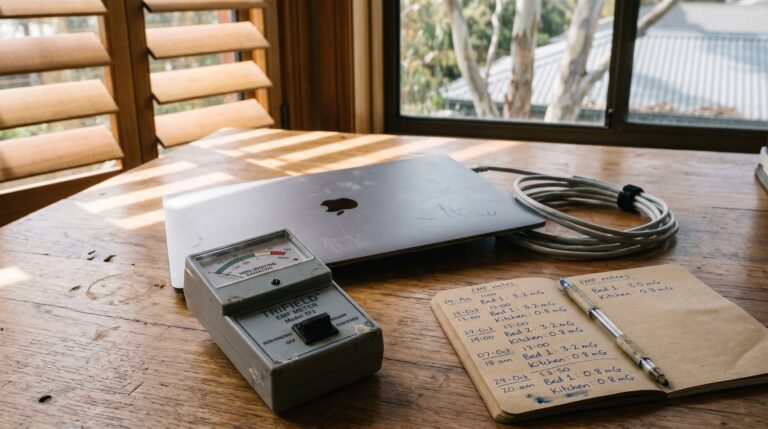
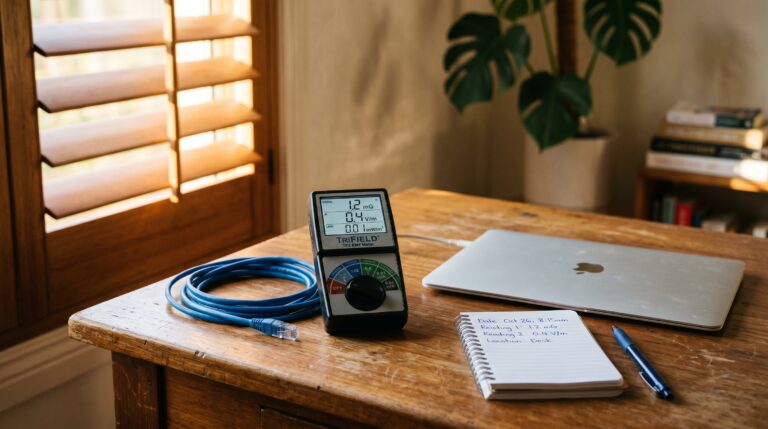
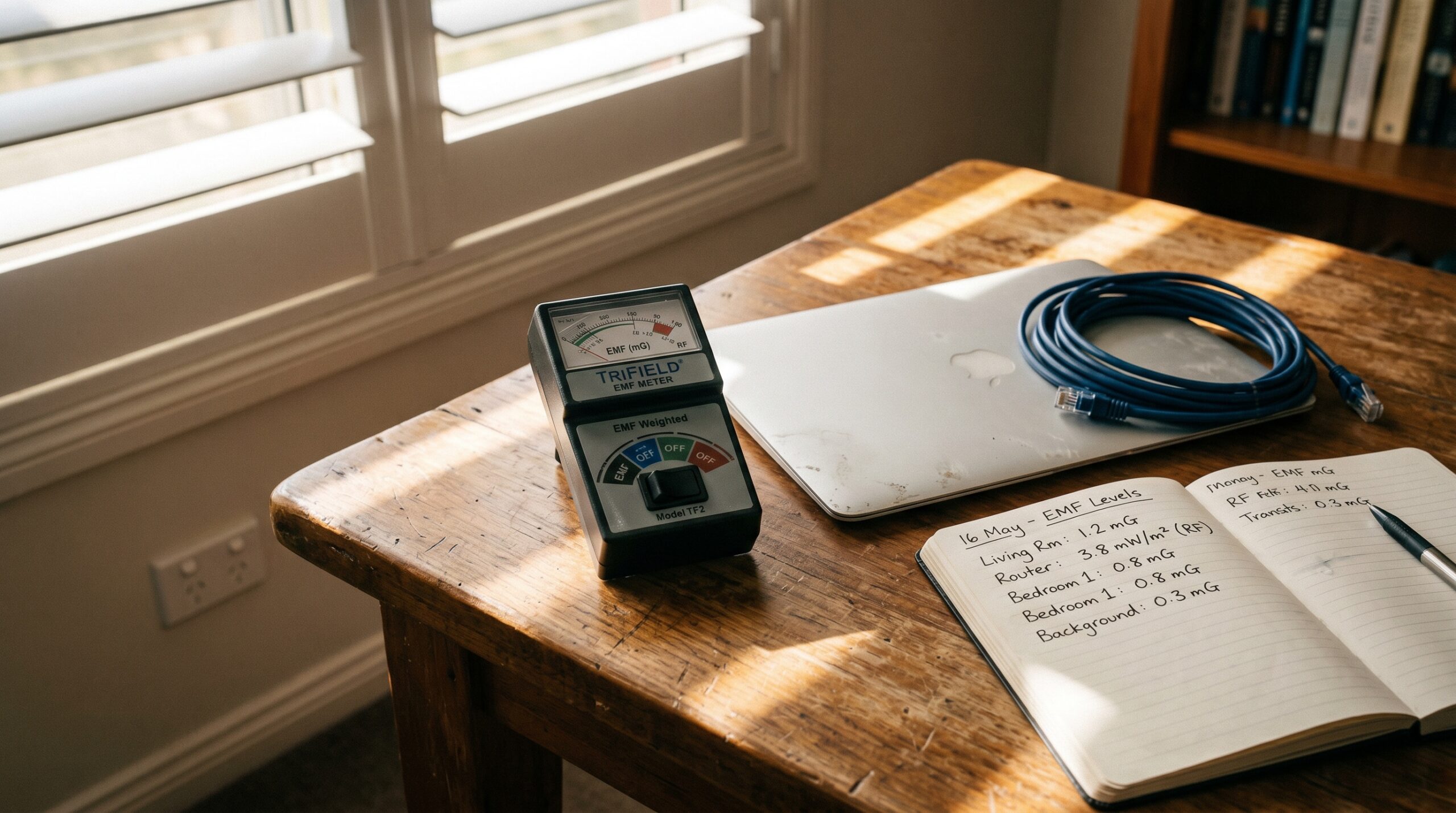
I run a TriField TF2 meter and a Safe and Sound Pro II at the Palm Beach house for room audits. When I test phone cases, here is the protocol: measure baseline RF from the phone at a fixed distance (10 cm) with no case during an active call, then repeat with the shielded case closed and the meter behind the shielded face. The shielded face consistently shows 55-90% reduction in RF power density readings — that part of the marketing is broadly supported. But when I move the meter to the unshielded side (the back of the case, where the phone screen faces out), readings are 15-40% higher than the no-case baseline. The phone is working harder.
Here is a summary of measured outcomes across three common scenarios:
| Scenario | Shielded Side RF Reduction | Unshielded Side Change | Net Whole-Body Outcome |
|---|---|---|---|
| Strong signal (full bars, urban tower <200m) | –70 to –90% | +5 to +10% | Modest net reduction (~40-60%) |
| Moderate signal (2-3 bars, suburban) | –55 to –75% | +15 to +25% | Small net reduction (~20-40%) |
| Weak signal (1 bar, rural/indoor) | –40 to –60% | +25 to +40% | Negligible or net increase |
The pattern is clear: shielding cases work best when you need them least (strong signal areas where exposure is already low) and work worst when you need them most (weak signal areas where the phone is already transmitting near maximum power). In weak-signal environments — inside buildings, in rural areas, on the edge of cell coverage — adding a shielding case can actually increase your net RF exposure because the phone maxes out its transmit power to compensate for the obstructed antenna pattern.
This is not speculation. It is a direct consequence of the 3GPP power control protocols that every 4G and 5G phone follows. The network tells the phone to increase power when signal quality drops. A shielding case that blocks part of the antenna path mimics a poor signal environment. The phone obeys.
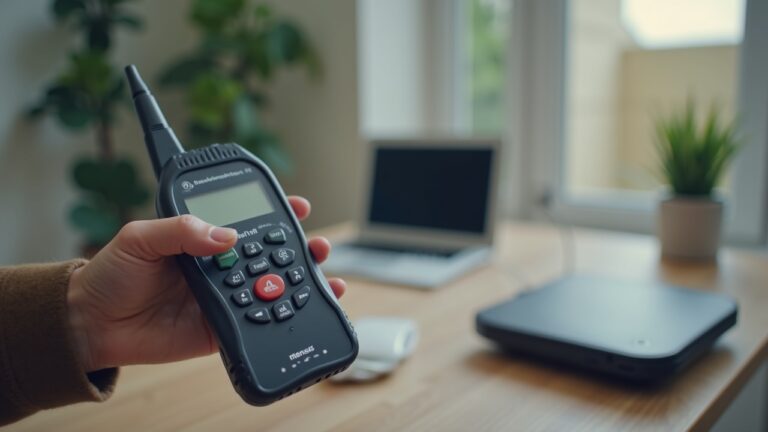
If you want to verify any of this yourself, you need an RF meter. The TriField TF2 (around AU$260) measures RF power density at the frequencies phones use. The Safe and Sound Pro II (around AU$550 via SaferEMF AU) is a dedicated RF meter with higher sensitivity. Either one will let you compare before-and-after readings with any shielding product and see exactly what your phone is doing — no trust required, just data.
Types of EMF Phone Shielding Products Available in Australia
Not all phone shielding products are created equal, and understanding the differences matters before you spend money. The Australian market (as of 2026) offers four main categories, each with different mechanisms, effectiveness profiles, and trade-offs.
1. Shielded Flip Cases (AU$43-$120)
These are the most common type. Brands like Mobile Safety (AU$42.95-$119.95), SafeSleeve, and DefenderShield sell flip-style cases with a conductive fabric panel sewn into the front flap. When the flap is closed and the phone is against your body, the shielded panel sits between the phone’s antenna and your skin. This is the design with the most defensible physics — one-directional shielding that deflects RF away from the body side while leaving the tower-facing side open.
The catch: this only works when the flap is closed. During an active call with the phone against your ear, the flap is either open (no shielding) or awkwardly folded behind the phone (still no shielding toward your head). The real-world use case where these cases provide genuine benefit is pocket carry with the flap closed and the shielded face toward your body. That is a legitimate, physics-supported scenario. But it is one specific scenario — not all-day, all-situation protection.
2. Shielding Pouches (AU$40-$80)
Faraday-style pouches, including products from Bon Charge, fully enclose the phone in conductive fabric. These are effective at blocking RF — potentially too effective. When your phone is fully enclosed, it cannot communicate with any tower. It either goes into maximum-power search mode (draining your battery and emitting bursts of high-power RF that leak through seams) or drops to no-signal status. You will miss calls, texts, and notifications. When you pull the phone out, it reconnects with a burst of high-power transmission. These pouches are functionally equivalent to airplane mode — but airplane mode is free and does not risk signal-search power bursts.
3. Anti-Radiation Screen Protectors (AU$20-$50)
These thin films are marketed as blocking RF from the screen side. The problem: phone antennas are not behind the screen. They are along the edges and back of the device. A screen protector has minimal interaction with the primary antenna radiation pattern. According to independent RF engineers, the attenuation from these products at mobile frequencies is negligible — typically less than 5% measurable reduction. This is the weakest category by a wide margin.
4. Stick-On Metal Discs and Chips (AU$10-$30)
These products claim to “harmonise” or “neutralise” EMF through materials like shungite, tourmaline, or proprietary “scalar energy” chips. There is no peer-reviewed physics mechanism by which a passive sticker on a phone case can alter the biological interaction of radiofrequency electromagnetic fields. ARPANSA does not recognise any such mechanism. The FTC in the United States has taken enforcement action against companies making similar claims. These products do not work. Full stop.
| Product Type | Price Range (AUD) | Measurable RF Reduction | Key Limitation |
|---|---|---|---|
| Shielded flip case | $43 – $120 | 60–90% on shielded face | Phone boosts power; flap must be closed |
| Full Faraday pouch | $40 – $80 | 95%+ when sealed | Phone max-power searches; miss all calls |
| Screen protector | $20 – $50 | <5% | Antenna not behind screen; negligible effect |
| Stick-on disc/chip | $10 – $30 | 0% (no mechanism) | No scientific basis; avoid entirely |
The Fit and Compatibility Problem Nobody Talks About
Even if you accept the partial-benefit case for shielded flip cases, there is a practical problem that manufacturers gloss over: phone-specific fit. Antenna placement varies dramatically between phone models. Apple’s iPhone 15 Pro positions its primary 5G antenna along the top-right edge. Samsung’s Galaxy S24 Ultra uses a distributed antenna array with elements on multiple edges. Google’s Pixel 8 Pro puts its primary antenna in the upper back panel. A shielded case designed as a universal or “fits most phones” product cannot consistently position its conductive fabric panel over the antenna for all these designs.
The Bon Charge EMF protection pouch, for example, received documented user complaints about the Samsung Galaxy Note20 Ultra not fitting properly — the phone’s dimensions exceeded the pouch, leaving the top antenna area partially exposed. That is not a minor inconvenience. It means the product fails at its primary function for that phone model. And it is not unique to Bon Charge. Any universal-fit EMF case faces this problem because phone dimensions, antenna locations, and case geometry vary across hundreds of models.
Model-specific cases (like those offered by DefenderShield for specific iPhone models) address the fit issue but create a different problem: you need a new case every time you upgrade your phone. At AU$80-$120 per case, that is a recurring cost that adds up. And the effectiveness still depends on signal strength and usage pattern.
The deeper issue is this: 5G phones use beamforming and MIMO antenna arrays that actively steer their radiation pattern. Older 4G phones had relatively simple antenna patterns that a fixed shield could partially block. 5G NR (New Radio) phones use multiple antenna elements that work together to aim the signal toward the tower. When you partially block some elements with a shielding case, the phone’s MIMO algorithm adapts — it shifts the radiation pattern to favour the unblocked elements. This is not theoretical. It is how 5G is designed to work. The shielding case becomes part of the phone’s RF environment, and the phone actively works around it.
The Anxiety-Reduction Market: Why These Products Sell Despite the Evidence
Following Australia’s 5G rollout, market research from Dataintelo (2024 report on EMF shielding devices) documented anxiety-driven purchasing patterns — consumers buying shielding products not because of measured exposure exceeding any standard, but because of perceived risk driven by social media and misinformation. The report noted the global EMF shielding devices market growing at approximately 5-7% annually, with phone cases as the largest consumer segment.
This is not a judgement on people who buy these products. Precautionary behaviour is rational when you are uncertain about a risk. The issue is that the products being marketed to satisfy that precaution do not deliver what they promise. A AU$100 shielding case provides less exposure reduction than a $0 behaviour change (speakerphone + desk placement). If your primary motivation is peace of mind, you deserve to know that.
There is also a regulatory gap worth noting. In Australia, EMF shielding phone cases are not regulated by the TGA (Therapeutic Goods Administration) because they are marketed as “EMF reduction products,” not therapeutic devices. They are not tested by ARPANSA. They are not required to demonstrate real-world efficacy on actual phones under actual network conditions. The lab certificates they publish test the raw fabric in a shielded chamber — not the case on a phone making a call in suburban Sydney. This is like testing a parachute’s fabric strength without ever jumping out of a plane.
The Australian Competition and Consumer Commission (ACCC) could potentially take action under Australian Consumer Law if shielding claims are found to be misleading. But to date, no enforcement action has been taken against EMF phone case manufacturers in Australia. Compare this to the US, where the FTC has pursued companies making unsubstantiated EMF protection claims — though primarily against the “harmoniser” chip category rather than shielded cases.
What You Should Do Instead: The Evidence-Based EMF Reduction Protocol for Your Phone
If you have read this far, you want to reduce your phone RF exposure. Good. Here is the protocol that actually works, ranked by effectiveness and cost. Every step is supported by ARPANSA guidance, physics, or both.
Step 1: Distance (Free — 75-99% Reduction)
The inverse square law is the most powerful RF reduction tool that exists. Moving your phone from 0 cm (against your head) to 30 cm (on a desk on speakerphone) reduces exposure by approximately 98%. Moving it from your pocket (1 cm from your body) to a bag at your side (15 cm away) reduces exposure by approximately 95%. No shielding case provides this level of reduction. Use speakerphone for calls. Use wired or air-tube headphones. Keep the phone on the desk, not in your pocket. These are ARPANSA’s own recommendations.
Step 2: Airplane Mode During Sleep (Free — 100% Reduction)
Your phone does not need to transmit while you sleep. Switching to airplane mode eliminates all RF emissions from the device. If you need an alarm, airplane mode still allows the alarm function. This single habit eliminates 7-8 hours of continuous low-level RF exposure every night. For an even more systematic approach, a HPM 24 Hour Analog Timer (~AU$20) on your Wi-Fi router eliminates router RF emissions during sleep hours for the entire household — no daily habit required.
Step 3: Wired/Air-Tube Headphones (AU$30-$80 — Eliminates Head Exposure)
Standard wired headphones reduce RF exposure to the head by 80-90% compared to phone-against-ear calls. Air-tube headphones go further — they replace the wire near your head with an air tube, eliminating any residual RF conduction along the cable. DefenderShield air-tube headsets are available through SaferEMF AU. This is a genuine, measurable exposure reduction for the specific scenario (calls) where exposure is highest.
Step 4: Reduce Call Time, Increase Text (Free)
A phone transmits at much higher power during voice calls than during data sessions or idle standby. Every text you send instead of a call reduces your cumulative RF exposure. Video calls on Wi-Fi transmit at lower power than cellular voice calls. ARPANSA specifically recommends texting over calling when reducing exposure is your goal.
Step 5: If You Still Want a Shielded Case (AU$43-$120 — Partial Benefit)
After implementing steps 1-4, a shielded flip case adds a modest additional reduction in the specific scenario of closed-flap pocket carry. If you live and work in a strong-signal urban area — inner Sydney, Melbourne CBD, Brisbane’s south-east corridor — where your phone consistently shows 3+ bars, a shielded case provides its best performance because transmit power compensation is minimal. If you are in a weak-signal area — rural QLD, inside concrete buildings, on the fringe of coverage — a shielded case may make your exposure worse. Check your signal bars first.
| Action | Cost (AUD) | RF Reduction | Requires Ongoing Effort |
|---|---|---|---|
| Speakerphone / desk placement | $0 | 95-98% (at 30 cm) | Yes — habit change |
| Airplane mode during sleep | $0 | 100% during sleep | Daily toggle or use timer |
| Air-tube headphones | $30 – $80 | 80-90% head exposure | Use for calls |
| Text instead of call | $0 | Varies (lower transmit power) | Yes — habit change |
| Shielded flip case (strong signal) | $43 – $120 | 40-60% net (body side) | Keep flap closed in pocket |
Australian-Specific Considerations: 5G, Smart Meters, and Cumulative Exposure
Phone RF exposure does not exist in isolation. If you are concerned about RF from your phone, you should be thinking about your total RF environment — and in Australian homes, several other sources often contribute more continuous exposure than your phone does.
Wi-Fi routers transmit 24/7 at 2.4 GHz and 5 GHz. Australian smart meters transmit at 900 MHz in bursts, with peak readings 100 to 1,000 times higher than time-averaged readings. An NBN fixed wireless antenna on your roof transmits continuously. Your phone, by comparison, transmits at high power only during calls and active data use — and drops to very low power during standby.
For residents of inner suburbs in Sydney, Melbourne, Brisbane, Perth, and Adelaide, 5G small cells mounted on light poles and building facades add ambient RF that was not present five years ago. These operate at 3.5 GHz (sub-6) and, in select areas, 26 GHz (mmWave). The ambient RF floor in Australian cities has increased measurably. Building biology guidelines (SBM-2015) recommend sleeping area RF below 0.1 mW/m² — a level increasingly difficult to achieve in dense urban areas without shielding interventions at the room level, not the phone level.
This is why a phone case is the wrong starting point for anyone serious about RF reduction. Your phone is one source among many. A proper approach is: measure your total environment with an RF meter, identify the dominant sources, remove or reduce them, then shield external residual if needed. A TriField TF2 will show you whether your Wi-Fi router, smart meter, neighbour’s router, or your phone is the biggest contributor to your bedroom RF levels. The answer might surprise you.
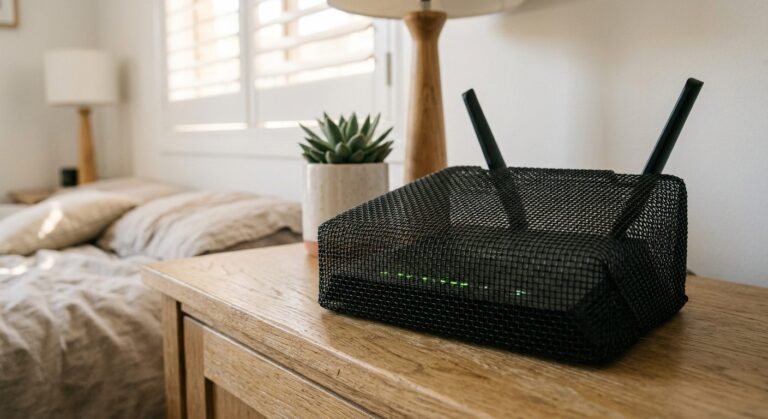
One critical warning for anyone considering room-level shielding (RF paint, window film, bed canopies): if the primary EMF source is inside the room, a Faraday enclosure reflects RF inward and increases your exposure. This is the shielding trap. Always remove internal sources first (Wi-Fi router out of the bedroom, phone on airplane mode, smart TV unplugged) before adding any reflective shielding. The correct sequence is: measure, reduce sources, then shield external residual only.
For a complete walkthrough of the bedroom EMF audit process, see the complete guide to EMF in the Australian home.
Final Verdict: Do EMF Phone Cases Work?
They partially work, in limited scenarios, at a cost that the free alternatives outperform. A quality shielded flip case reduces RF exposure on the shielded body-side face by 60-90% during closed-flap pocket carry in strong-signal environments. That is a real, measurable reduction. But the phone’s automatic transmit power compensation, the 5G MIMO beamforming adaptation, the fit-and-compatibility variability, and the zero benefit during calls with the flap open mean the real-world net exposure reduction is modest — nowhere near the marketing claims.
If you have already implemented distance habits (speakerphone, desk placement, airplane mode at night, air-tube headphones) and you live in a strong-signal urban area, a shielded flip case is a defensible addition at AU$43-$120. It is not money wasted. But it is not the solution the marketing implies, and it should be the last step in your protocol, not the first.
If you have done none of the free steps and you are considering a $100 case as your sole EMF-reduction measure, you are buying anxiety relief, not meaningful protection. The physics does not support that purchase as your primary intervention.
Start with measurement. Without knowing your actual RF exposure levels, every decision — case, no case, router timer, headphones — is a guess. The TriField TF2 or Safe and Sound Pro II gives you real numbers. Everything else follows from data.
Last reviewed: May 2026 — Clean and Native
Start with measurement. The TriField TF2 is the only meter you need.
Measures AC magnetic, AC electric, and RF in one device. I use it for every room audit at the Palm Beach house. Without real readings, every EMF decision is a guess.
Frequently Asked Questions
Shielded flip cases reduce RF on the body-side face by 60-90% in lab conditions and 40-60% net in real-world strong-signal environments. However, the phone increases transmit power on the unshielded side to compensate, so total emissions increase. Net whole-body reduction is modest and signal-dependent.
No. ARPANSA states that RF emissions from mobile phone handsets are not harmful to users and that exposures in Australia are generally far below safety limits. Their recommended precautionary measures are distance-based: speakerphone, wired headsets, and texting instead of calling. They do not mention or endorse shielding cases.
Yes. In weak-signal environments (1 bar, rural areas, inside concrete buildings), a shielding case forces the phone to maximum transmit power. The net result can be higher whole-body RF exposure than without the case. Shielding cases perform best in strong-signal urban areas where the phone does not need to compensate significantly.
Free: use speakerphone or a wired headset (reduces head exposure by 80-98%), switch to airplane mode during sleep (eliminates all phone RF for 7-8 hours), and text instead of calling. A AU$20 Jackson mechanical timer on your Wi-Fi router eliminates router RF during sleep hours.
No. There is no peer-reviewed physics mechanism by which a passive sticker can alter the biological interaction of RF electromagnetic fields. These products have zero measurable effect on RF emissions. The US FTC has taken enforcement action against companies making similar unsubstantiated claims.
No. Phone antennas are located along the edges and back of the device, not behind the screen. RF screen protectors typically show less than 5% measurable reduction in RF power density. They are the least effective shielding product category.
Use a calibrated RF meter. The TriField TF2 (approximately AU$260) measures RF power density at mobile phone frequencies and also covers AC magnetic and electric fields. The Safe and Sound Pro II (approximately AU$550 via SaferEMF AU) is a dedicated RF meter with higher sensitivity. Place the meter 10 cm from your phone during a call to measure baseline, then repeat with any shielding product to verify its performance.
Yes. 5G NR phones use MIMO beamforming with multiple antenna elements that actively steer the radiation pattern toward the tower. When a shielding case partially blocks some antenna elements, the phone’s MIMO algorithm adapts and shifts the radiation pattern to favour the unblocked elements. This makes fixed-position shielding less effective than it was with simpler 4G antenna designs.
Often, yes. A Wi-Fi router transmits continuously 24/7 at 2.4 GHz and 5 GHz, while your phone transmits at high power only during active calls and data use. In building biology assessments, the router is frequently the dominant RF source in an Australian bedroom. Use an RF meter to identify your actual dominant source before spending money on any single-device shielding product.
No. EMF shielding phone cases are not regulated by ARPANSA, the TGA, or any Australian standards body. They are not required to demonstrate real-world efficacy on actual phones under actual network conditions. Lab certificates test raw fabric in shielded chambers, not the case on a phone making a call. The ACCC could theoretically pursue misleading claims under Australian Consumer Law, but no enforcement action has been taken against EMF phone case manufacturers in Australia as of 2026.
Get the Australian Home Environment Checklist
30 checks across water, air and EMF. Most of them free. Ranked by impact.
No spam. Unsubscribe any time.

Former Royal Australian Navy Clearance Diver and TAG-E counter-terrorism operator. Founded Clean and Native to apply the same rigorous thinking to the home environment.
Full biography →