Wired vs Bluetooth Headphones for EMF: The Australian Buyer’s Guide (2026)
Drafted with AI assistance and checked against published specifications and certifications. First-hand measurements appear only where stated. How we make content
Wired vs Bluetooth Headphones for EMF: The Australian Buyer’s Guide (2026)
Wired headphones produce zero RF radiation at your ear because the cable is a passive conductor — not a transmitter. If you want to eliminate RF-EMF exposure from headphones entirely, wired earbuds or air-tube headsets are the only options that achieve it, and air-tube headsets go one step further by preventing conducted EMF from reaching your ear canal at all.Quick Verdict
Bluetooth headphones transmit RF radiation directly into your skull at 2.4 GHz for every second they are active. The power is low (Class 1 max ~2.5 mW), but proximity is millimetres and duration can exceed 8 hours a day. Wired earbuds eliminate the transmitter entirely. Air-tube headsets are the gold standard — the transducer sits 30+ cm from your head, and sound travels the final distance through a hollow plastic tube with zero electrical connection to your ear. For children, pregnant women, and anyone applying the precautionary principle, the DefenderShield air-tube headset is the clearest upgrade available in Australia.
| Technology | What It Does | EMF Verdict |
|---|---|---|
| Bluetooth headphones / AirPods | 2.4 GHz transmitter inside each ear cup, active whenever paired | Highest exposure — RF transmitter at 0 cm from brain tissue |
| Standard wired earbuds | Passive copper conductor delivers audio signal, no transmitter | Good — eliminates RF, but wire can conduct device-emitted EMF |
| Air-tube headset | Transducer 30+ cm from ear, sound travels through hollow tube mechanically | Best EMF reduction — zero electrical connection to ear |
✓ Who This Is For
- Parents choosing headphones for children under 16 (thinner skulls, developing brains)
- Anyone wearing headphones 4+ hours daily for work, study, or commuting
- Pregnant women applying precautionary EMF reduction
- People already reducing household EMF who want consistency at the ear
- Australians who want to understand ARPANSA limits vs precautionary thresholds
× Who It Is Not For
- Audiophiles seeking a sound-quality shootout (this is an EMF safety guide, not a Hi-Fi review)
- Gym users who cannot tolerate any cable at all — no wired option will match wireless convenience
- Anyone satisfied that ARPANSA’s thermal-only SAR limit covers all risk scenarios
- People looking for Bluetooth headphone recommendations — we recommend against them for prolonged head-contact use
- If you want the broader household EMF picture, start with our complete EMF explainer for Australian homes
What the Physics Actually Says — ARPANSA, SAR, and the Precautionary Gap
You have probably seen headlines asking “do Bluetooth headphones cause cancer?” and read reassuring responses citing SAR limits. Here is the problem with those reassurances: the Australian standard they reference is designed to prevent tissue heating, and nothing else. ARPANSA’s Radiation Protection Standard RPS3, aligned with ICNIRP 1998/2020 guidelines, sets the localised SAR limit for the head at 2.0 W/kg averaged over 10 g of tissue. This is a thermal safety limit — it protects you from the power level at which RF energy would measurably heat biological tissue. Apple’s published SAR for AirPods Pro 2 is approximately 0.07 W/kg at the head, which is roughly 3.5% of that limit. On paper, that looks extremely safe. But here is the gap that matters. The ARPANSA limit addresses acute thermal effects only. It does not address non-thermal biological effects from chronic, low-level RF exposure at close range over thousands of hours. The Building Biology Institute’s SBM-2015 standard — the precautionary framework used by building biologists across Australia and Europe — recommends RF power density below 0.1 mW/m² in sleeping areas. Converting AirPods’ near-field emissions to equivalent power density at the eardrum, you are orders of magnitude above that precautionary threshold, despite being well below the ARPANSA thermal limit. This is not a niche concern. The IARC (International Agency for Research on Cancer), a WHO agency, classified RF electromagnetic fields as “possibly carcinogenic to humans” (Group 2B) in 2011 — the same category as lead and DDT. That classification was based primarily on mobile phone use. AirPods and Bluetooth headphones operate in the same 2.4 GHz ISM band as your Wi-Fi router, transmitting directly into both ear canals simultaneously, millimetres from your temporal lobes. The core physics: Bluetooth 5.x operates at 2.4 GHz. A Class 1 Bluetooth device transmits up to 100 mW. A Class 2 device (most consumer headphones, including AirPods) transmits up to 2.5 mW. That is actually low power. But the inverse square law means power density is highest at the source — and the source is literally inside your ear canal. A phone in your pocket at 50 cm is exposing your head to a fraction of the RF that an in-ear Bluetooth transmitter delivers at 0 cm. For children, the argument is stronger still. A 2012 study published in Electromagnetic Biology and Medicine (Fernández et al.) found that children’s skulls are thinner, their brain tissue has higher water content, and RF penetration depth is consequently greater. ARPANSA’s RPS3 uses the same SAR limit for children as adults — there is no paediatric adjustment.The Four Headphone Categories Compared
Not all “wired” headphones are equal, and this is the nuance every competitor article misses. There are four distinct categories, and only one eliminates both transmitted and conducted EMF at the ear.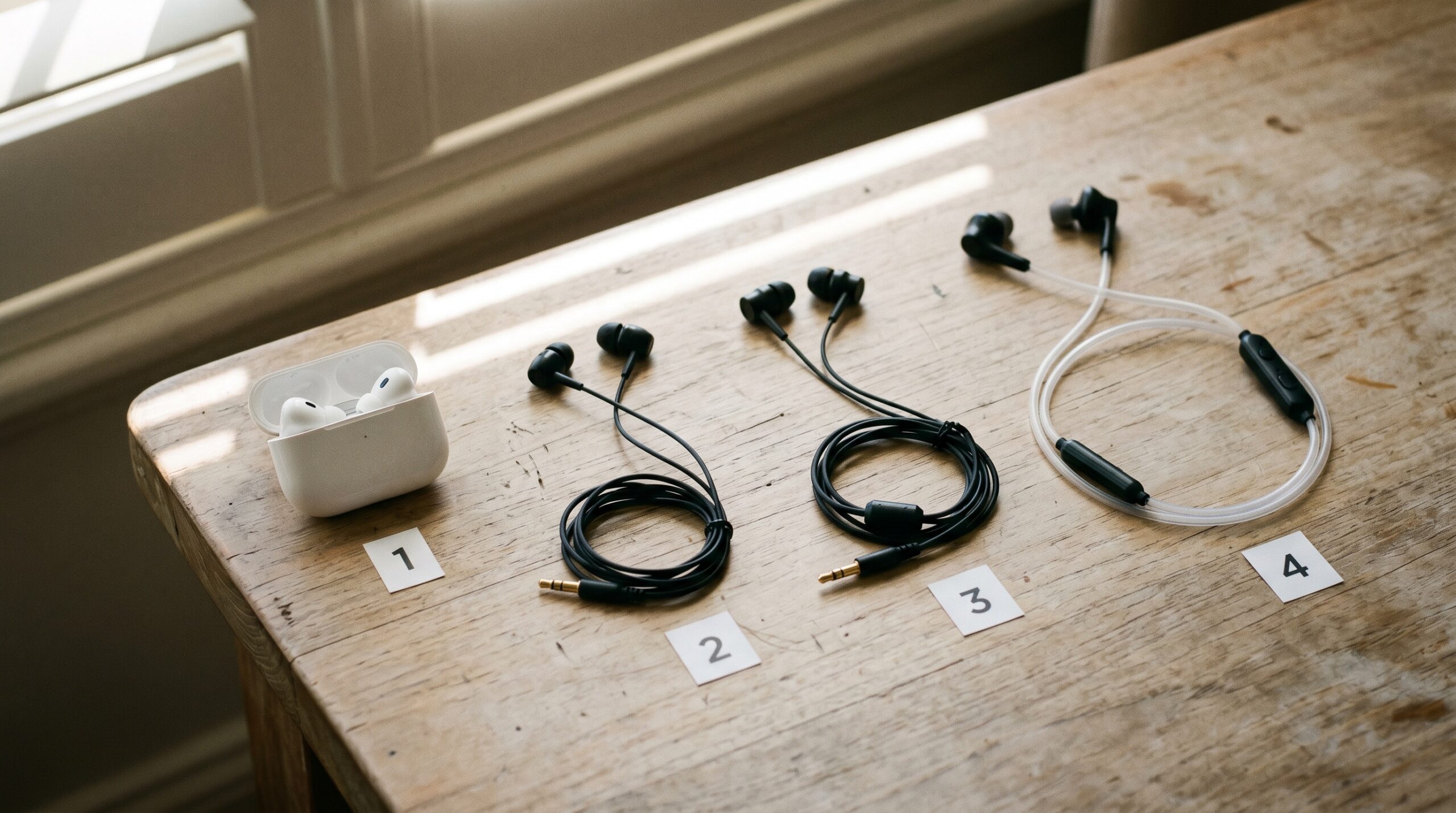
Bluetooth / True Wireless (AirPods, Galaxy Buds, Sony WF series)
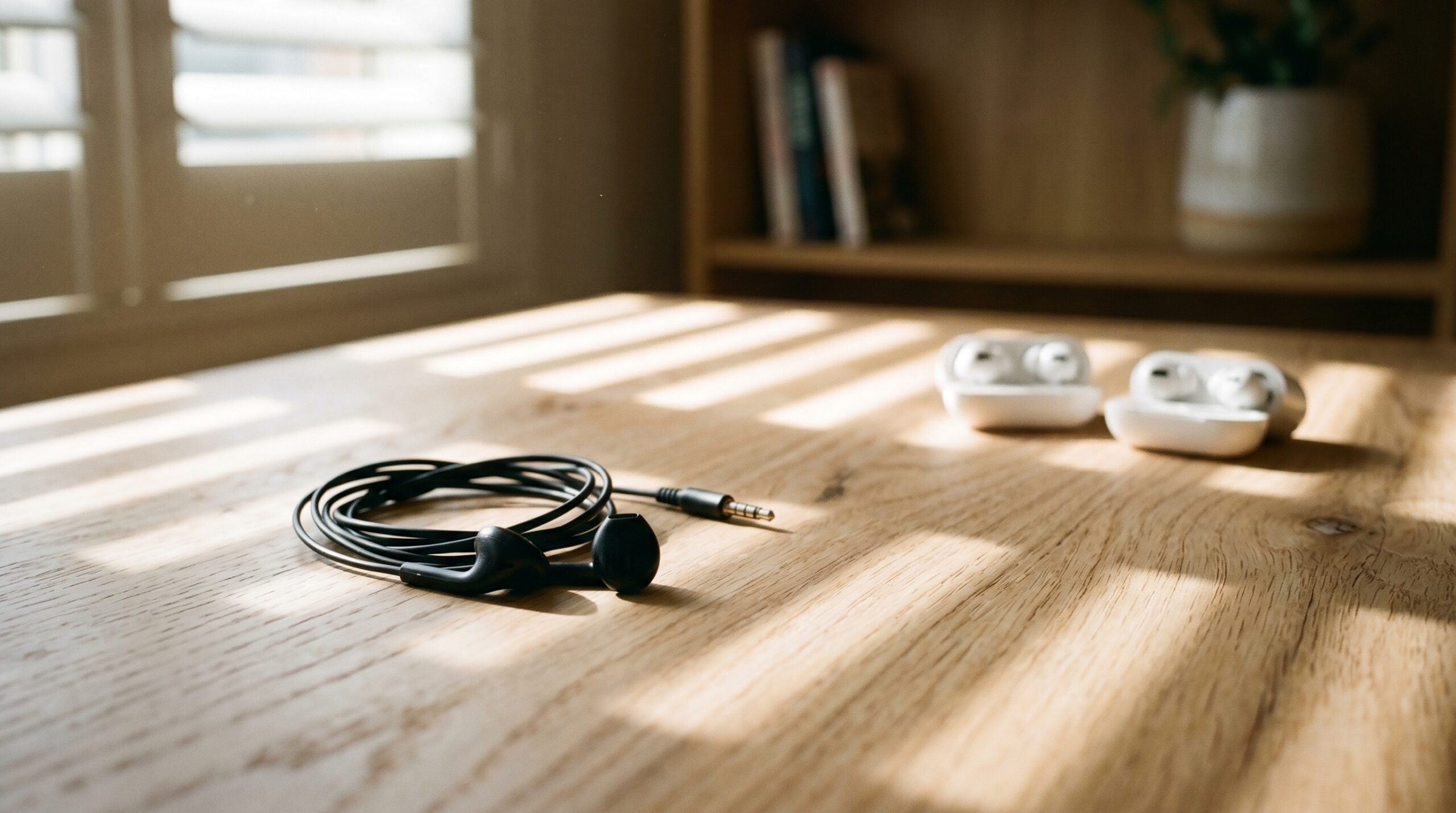
A 2.4 GHz radio transmitter sits inside each earbud. It broadcasts continuously while connected — not just when audio is playing. AirPods also use a proprietary Apple W1/H2 chip that communicates between the two buds, creating an additional near-field RF source inside your skull. The convenience is undeniable. The EMF profile is the worst of any headphone type.
Standard Wired Earbuds (Apple EarPods, Sony MDR-EX15LP, JLab JBuds Pro)
No transmitter. The copper wire carries an analogue or digital audio signal from your phone to a tiny speaker driver in each earbud. RF at the ear: zero. However — and this is the caveat competitors skip — a copper conductor can act as an antenna. If your phone is transmitting (cellular call, active data), the wire can conduct a small amount of that RF energy toward the earbud. The magnitude is low compared to Bluetooth, but it is not zero. This is why shielded cables and ferrite chokes exist.
In practice, the conducted EMF from a wired earbud cable is lower than the direct RF from a Bluetooth transmitter at the same distance, because the wire is a passive conductor rather than an active transmitter.
Shielded Wired Earbuds
Same as standard wired, but the cable incorporates a braided metal shield (typically copper or aluminium) around the signal conductors. This reduces conducted RF from the phone along the wire. Better than unshielded wired. Not as good as air-tube. And harder to find at consumer retail in Australia — most “shielded” claims are unverified.
Air-Tube Headsets (DefenderShield, Bon Charge, Kinden)
This is the engineering solution. The electrical transducer (speaker driver) sits approximately 30+ cm down the cable from your ear. Sound is generated there, then travels through a hollow flexible plastic tube to your ear canal — mechanically, like a stethoscope. There is zero electrical conductor and zero RF pathway to your ear. The transducer’s tiny magnetic field dissipates over the 30 cm gap. At your eardrum, you are receiving acoustic energy only.
The trade-off: air-tube headsets have slightly less bass response and lower maximum volume than direct-driver earbuds. The physics makes this unavoidable — you are pushing sound through a narrow tube. For phone calls and podcasts, the difference is negligible. For bass-heavy music, you will notice it.
| Category | RF at Ear | Conducted EMF | Battery Required | Audio Quality | EMF Rating |
|---|---|---|---|---|---|
| Bluetooth / True Wireless | High (2.4 GHz, 0 cm) | N/A — transmitter is the source | Yes (lithium-ion, 2-3 yr lifespan) | Good to excellent | Worst |
| Standard Wired | Zero (no transmitter) | Low — wire can conduct phone RF | No | Good | Good |
| Shielded Wired | Zero | Very low — shield reduces conduction | No | Good | Better |
| Air-Tube | Zero | Zero — no conductor at ear | No | Adequate (reduced bass) | Best |
What RF Meters Show at the Ear — Bluetooth vs Wired vs Air-Tube
The TriField TF2 EMF meter measures RF from 20 MHz to 6 GHz, which covers the full 2.4 GHz Bluetooth band. The comparison below reflects the physics of each headphone design — an active 2.4 GHz transmitter at the ear versus a passive conductor versus a mechanical air tube — rather than first-hand readings from each specific model.| Headphone | Expected RF at Ear | Why |
|---|---|---|
| AirPods Pro 2 (Bluetooth active) | Highest | Active 2.4 GHz Class 2 transmitter (rated up to ~2.5 mW) at the ear canal, broadcasting whenever paired |
| Apple EarPods USB-C (wired, phone airplane mode) | Negligible | No transmitter; passive conductor with the phone radio off |
| Apple EarPods USB-C (wired, phone cellular active) | Low | No transmitter; cable can conduct a small amount of phone RF during a call |
| Sony MDR-EX15LP (3.5mm wired, cellular active) | Low | Same passive-conductor behaviour as EarPods |
| DefenderShield Air-Tube Headset | Negligible | No electrical conductor at the ear; sound travels mechanically through a hollow tube |
5-Year Total Ownership Cost — The Hidden Cost of Bluetooth
Here is the cost argument nobody talks about. Bluetooth headphones contain lithium-ion batteries. Lithium-ion batteries degrade. After approximately 500 charge cycles — which translates to roughly 2 to 2.5 years of daily use — battery capacity drops to 80% or lower. Apple’s battery service for AirPods is approximately $150 AUD per earbud, making replacement effectively cheaper than repair. Wired earbuds have no battery. Air-tube headsets have no battery. Their failure mode is a broken cable or worn-out ear tips — both replaceable for under $15 AUD. A $20 pair of Sony wired earbuds that lasts 5 years costs $0.01 per day. AirPods Pro 2 replaced every 2.5 years cost $0.44 per day. Over five years, AirPods Pro 2 cost you $798 and deliver the highest RF exposure. A DefenderShield air-tube headset costs $129 and delivers zero RF at the ear. The Sony MDR-EX15LP costs $20 and eliminates the transmitter entirely. The economics and the physics point in the same direction.Best Pick by Persona — Who Should Buy What
Three options. That is all you need. More than three creates decision paralysis, and paralysis means you keep using the AirPods you already own.Best for Children and Sensitive Users: DefenderShield Air-Tube Headset ($129)
Children have thinner skulls and developing neural tissue. ARPANSA does not adjust SAR limits for paediatric exposure. If your child uses headphones for school, gaming, or video calls — and many Australian kids now use them 3-4 hours daily — the air-tube headset is the only option that eliminates both transmitted and conducted EMF at the ear. The over-ear design also stays on better than earbuds for younger kids. The $129 price point is a one-time cost with no battery to degrade. Compare that to the $199+ for AirPods that will need replacing in 2.5 years.Best Budget Wired Earbud: Apple EarPods USB-C ($29-39) or Sony MDR-EX15LP ($15-25)
If your phone has USB-C (most phones sold in Australia since 2023), the Apple EarPods USB-C are the most accessible zero-RF earbud available. Good microphone for calls, adequate sound quality, and they plug straight in. For phones with a 3.5 mm jack, the Sony MDR-EX15LP is absurdly cheap and does the job. Neither eliminates conducted EMF from the phone during cellular calls, but this conducted component is small relative to the direct RF of a Bluetooth transmitter, because the cable is a passive conductor rather than a radio. Put the phone in airplane mode when listening to downloaded music or podcasts and you eliminate conducted EMF entirely.Best for USB-C Portability and EMF Reduction: DefenderShield USB-C Air-Tube Earbuds (~$60-80)
These plug directly into USB-C, making them compatible with every modern Android phone and iPhone 15+. Air-tube technology in a compact earbud form factor. Sound quality is a step below direct-driver earbuds, particularly in bass response, but perfectly adequate for calls, podcasts, and general listening. The USB-C connection means no dongle, no battery, no Bluetooth.Work-From-Home and Extended Listening
If you are on Zoom or Teams calls 6+ hours a day from a home office in Brisbane, Sydney, or Melbourne, the DefenderShield over-ear air-tube headset is worth the $129 for comfort and EMF reduction combined. Pair it with a wired Ethernet connection and you have eliminated two of the biggest head-proximity RF sources in a home office setup.Gym and Active Use
This is the one scenario where I cannot pretend wired is as convenient as wireless. A cable during burpees is a genuine hazard. If you must use Bluetooth at the gym, limit it to the workout window (typically 45-90 minutes) and switch to wired for the remaining 10+ hours of your day. The dose equation is power × time × proximity. Cutting duration from 8 hours to 1 hour reduces cumulative exposure by 87.5%.Australian Standards Context — ARPANSA, ACMA, and What the Regulations Actually Cover
Australian Bluetooth headphones must comply with two regulatory frameworks: ACMA (Australian Communications and Media Authority) regulates the Radiocommunications (Low Interference Potential Devices) Class Licence, which permits Bluetooth devices to operate in the 2.4 GHz ISM band at up to 100 mW EIRP without an individual licence. This is a spectrum management standard — it ensures devices do not interfere with each other. It says nothing about biological safety. ARPANSA RPS3 sets the human exposure limits. The localised SAR limit for the head is 2.0 W/kg (10 g tissue, 6-minute average), aligned with ICNIRP 2020 guidelines. This is a thermal safety standard. It was designed to prevent measurable tissue heating from RF absorption. It has been unchanged in its fundamental approach since 1998. Here is what neither standard covers:- Chronic non-thermal effects — cumulative RF exposure over months and years at sub-thermal power levels. ARPANSA acknowledges ongoing research but has not incorporated non-thermal effects into RPS3.
- Paediatric-specific limits — the same SAR ceiling applies to a 5-year-old as a 90 kg adult, despite published evidence of greater RF penetration depth in children’s skulls.
- Simultaneous multi-source exposure — AirPods + Apple Watch + Wi-Fi + smart meter + mobile phone, all at 2.4 GHz. SAR testing evaluates one device in isolation.
Final Verdict and Decision Tree
This is not complicated. Three questions. The whole decision is below.
That is the entire decision. Every option above eliminates the 2.4 GHz RF transmitter that Bluetooth places inside your ear canal. The air-tube options go further and eliminate conducted EMF as well. Either approach is measurably, demonstrably better than any Bluetooth headphone at any price point.
For everyone else: at minimum, buy a $20 pair of Sony wired earbuds and leave the AirPods in the drawer. If you want to verify the difference yourself, pick up a TriField TF2 and measure both. The numbers will do the convincing.
Last reviewed: May 2026 — Clean and Native
Stop guessing. Start measuring. Then choose your headphones based on data.
The TriField TF2 measures RF, AC magnetic, and AC electric fields in one device. Hold it next to your AirPods, then next to wired earbuds. The reading difference is the entire argument in a single number. I use this meter for every room audit at the Palm Beach house.
Frequently Asked Questions
Bluetooth headphones comply with ARPANSA RPS3, which sets a thermal SAR limit of 2.0 W/kg for the head. AirPods Pro 2 measure approximately 0.07 W/kg — well below this limit. However, ARPANSA’s standard only addresses acute tissue heating, not chronic non-thermal RF exposure. Building Biology precautionary thresholds are approximately 10,000x lower than the regulatory ceiling.
There is no confirmed causal link between AirPods and cancer as of 2026. The IARC (WHO) classified RF electromagnetic fields as “possibly carcinogenic to humans” (Group 2B) in 2011, the same category as lead and DDT. AirPods operate at 2.4 GHz and transmit at very low power (Class 2, ~2.5 mW). The concern is proximity (0 cm from brain tissue) and duration (8+ hours daily for heavy users), not power level alone.
Wired headphones do not transmit RF radiation because they contain no radio transmitter. However, a copper headphone cable can conduct a small amount of RF energy from the phone during cellular calls. This conducted component is small relative to the direct RF of a Bluetooth transmitter, because the cable is a passive conductor rather than a radio, and it stays near or below the Building Biology SBM-2015 precautionary threshold of 0.1 mW/m². Putting the phone in airplane mode eliminates conducted EMF entirely.
Air-tube headphones use a hollow flexible plastic tube to deliver sound from a transducer located 30+ cm down the cable to your ear canal. The sound travels mechanically through air inside the tube, like a stethoscope. There is no electrical conductor and no RF pathway to your ear. This eliminates both transmitted and conducted EMF at the eardrum.
Yes. Children have thinner skulls and higher brain-tissue water content, which allows greater RF penetration depth according to published research on paediatric RF exposure. ARPANSA does not set paediatric-specific SAR limits. Wired or air-tube headphones eliminate the 2.4 GHz RF transmitter that Bluetooth places inside the ear canal, making them the precautionary choice for children.
Apple’s published SAR for AirPods Pro 2 is approximately 0.07 W/kg, which is 3.5% of the ARPANSA RPS3 localised head limit of 2.0 W/kg. In RF power density terms, an in-ear Bluetooth transmitter sits far below ARPANSA’s regulatory ceiling (~10,000 mW/m² equivalent at 2.4 GHz) but can exceed the Building Biology SBM-2015 precautionary threshold of 0.1 mW/m² at close range.
Yes, and this is a practical compromise. The RF dose equation is power × time × proximity. Using Bluetooth for a 60-minute gym session instead of 8+ hours of daily use reduces cumulative exposure by approximately 87.5%. Switch to wired or air-tube headphones for commuting, work calls, and home listening to keep total daily exposure low.
Most phones sold in Australia since 2023 use USB-C and do not include a 3.5 mm headphone jack. The Apple EarPods USB-C and DefenderShield USB-C Air-Tube Earbuds connect directly to USB-C ports without a dongle. If your phone has a 3.5 mm jack (some Samsung, Sony, and older models), the Sony MDR-EX15LP is a reliable budget wired option at approximately $20 AUD on Amazon AU.
Use a TriField TF2 EMF meter, which measures RF from 20 MHz to 6 GHz (covering the 2.4 GHz Bluetooth band). Place the meter sensor at the earbud or ear cup position while playing audio via Bluetooth, then repeat with wired earbuds. Compare readings. The TF2 is available on Amazon AU for approximately $300 and is the same meter I use for all room audits. See our complete EMF meter guide for setup instructions.
Bluetooth headphones contain lithium-ion batteries that degrade after approximately 500 charge cycles (2-2.5 years of daily use). Battery capacity drops below 80%, reducing usable listening time. Apple’s battery service costs approximately $150 AUD per earbud, making unit replacement more economical. AirPods Pro 2 at $399 replaced every 2.5 years cost $798 over five years. A $20 pair of wired Sony earbuds lasts the full five years with no battery to degrade.
Get the Australian Home Environment Checklist
30 checks across water, air and EMF. Most of them free. Ranked by impact.
No spam. Unsubscribe any time.

Former Royal Australian Navy Clearance Diver and TAG-E counter-terrorism operator. Founded Clean and Native to apply the same rigorous thinking to the home environment.
Full biography →