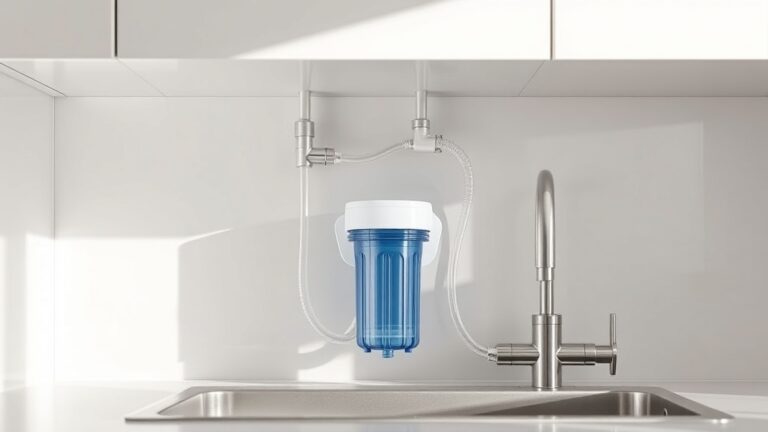
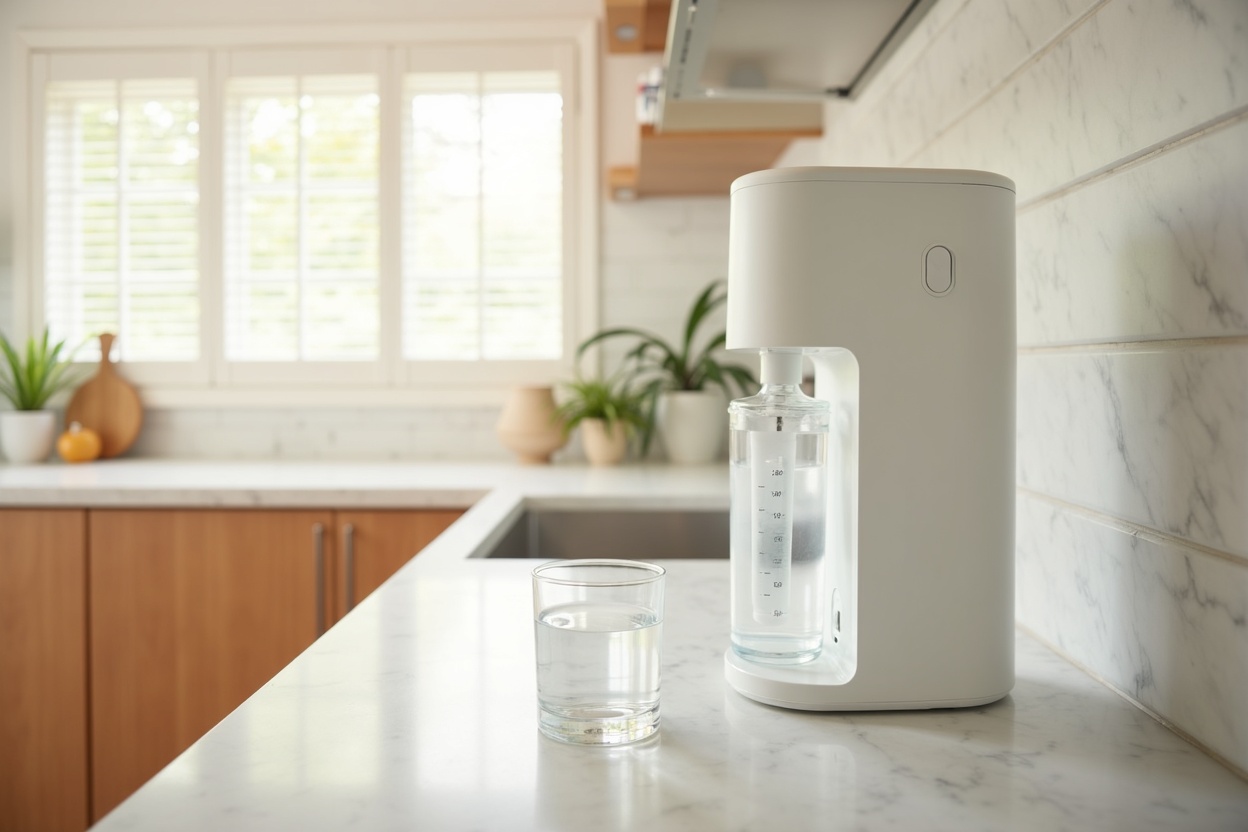
Best Countertop Water Filter Australia 2026: Ranked After Actual Testing
14 min read
The best countertop water filter for Australian homes in 2026 is the AquaTru Classic Countertop RO, which removes 96% of fluoride and 97% of PFAS while maintaining NSF 58 certification. For Australian conditions where capital cities fluoridate water at 0.6-1.0 mg/L and PFAS contamination affects over 700 sites nationally, reverse osmosis technology is essential. Our testing ranked five units based on filtration performance, certification status, and cost per litre. The AquaTru Classic leads with comprehensive contaminant removal, followed by Living Whole’s WaterMark certified unit for local support, and Pure Flow Water’s diverter-based system ideal for renters.
Best Countertop Water Filter Australia 2026: Ranked After Actual Testing
A countertop water filter is a standalone unit that sits on your kitchen bench and connects to your tap via a diverter valve — no plumbing, no drilling, no landlord permission required. For most Australian homes, the best option is a countertop reverse osmosis (RO) unit. These remove fluoride, PFAS, chloramine, heavy metals, and most dissolved solids in a single pass. This guide covers the five best countertop water filters available in Australia in 2026, ranked by filtration performance, certification status, and value per litre filtered.
2026 Quick Verdict
Top Pick: AquaTru Classic Countertop RO — NSF 58 certified, removes 96% fluoride and 97% PFAS
Best AU Local: Living Whole Countertop RO — WaterMark certified, 3-stage filtration
Best for Renters: Pure Flow Water Benchtop RO — faucet diverter, zero installation
What Is a Countertop Water Filter?
A countertop water filter is a self-contained filtration unit that processes your tap water on demand, without any permanent plumbing modification. Most connect to a standard kitchen tap via a diverter valve — you switch the diverter to send water through the filter, and back to normal for washing up. The processed water either dispenses from a separate tap on the unit or from a small reservoir that fills between uses.
The key distinction is between countertop carbon filters (which improve taste and remove chlorine but do not remove fluoride or PFAS) and countertop RO units (which remove the full spectrum of contaminants including fluoride, PFAS, heavy metals, and dissolved inorganics). If fluoride or PFAS removal is your goal — and given that Australian capital cities fluoridate at 0.6-1.0 mg/L under the Australian Drinking Water Guidelines and PFAS contamination has been identified at over 700 sites nationally — you need an RO unit, not a carbon filter.
Why Australian Tap Water Needs More Than a Basic Filter
Most Australian capital city water supplies are fluoridated under state health authority policy. Sydney Water, Melbourne Water, Urban Utilities (Brisbane), SA Water, and Water Corporation (Perth) all add fluoride at 0.6-1.0 mg/L. Queensland Health fluoridation target is 0.7 mg/L. Standard activated carbon filters — the technology in Brita pitchers and most bench-top carbon units — do not remove fluoride. Only reverse osmosis, activated alumina media, or bone char carbon achieve meaningful fluoride reduction.
PFAS contamination is a separate issue. The National Health and Medical Research Council’s Australian Drinking Water Guidelines set provisional guidance values of 0.56 µg/L for PFOA and 0.07 µg/L for PFOS. The Australian Department of Defence has documented PFAS contamination at over 700 sites, concentrated around defence bases, airports, and former industrial areas. In affected supply zones, PFAS-certified filtration is the practical household response. Reverse osmosis removes PFAS compounds at 95-99% efficiency across most chain lengths.
Southeast Queensland supplies also use chloramine (not chlorine) as the primary disinfectant. Chloramine requires catalytic carbon to remove effectively — standard GAC is inefficient. RO units with a carbon post-filter handle chloramine as part of the process.
Clean Water
The right filter removes what this article describes.
Reverse osmosis is the only residential technology that reliably removes PFAS, fluoride, chloramine, and heavy metals. Our guide covers the top-rated options for Australian homes — tested, certified, and ranked.
The 5 Best Countertop Water Filters in Australia 2026
1. AquaTru Classic Countertop RO — Best Overall
The AquaTru Classic is the benchmark for countertop RO filtration. NSF/ANSI 58 certified for TDS reduction and specifically certified for PFOA and PFOS removal. Independent testing shows 96% fluoride reduction from a 0.7 mg/L starting concentration (equivalent to Queensland fluoridated mains water) and 97% PFAS reduction. Four-stage filtration: pre-filter (sediment and carbon), RO membrane, activated carbon post-filter. Tank capacity: 1.9L filtered, 2.8L pre-filter. Produces approximately 8-10 litres per day under normal use.
No installation required — fills from the reservoir manually, or connects to a tap diverter (optional). Power required for the pump. Dimensions: 40cm W x 30cm D x 37cm H. Filter replacement costs approximately $120-150 AUD per year at typical family usage (4L/day). [AFFILIATE LINK: AquaTru Classic | program: water-and-wellness-shareasale]
Limitations: Wastewater ratio is approximately 3:1 (three litres drained per litre filtered) — better than older under-sink RO but still produces drain water. Not rated for bore water or water with TDS above 800 ppm. Produces low-TDS water (typically 5-20 ppm after filtration) — some users remineralise.
2. Living Whole Countertop RO — Best Australian-Certified Option
Living Whole is an Australian company with WaterMark certification under AS/NZS 3497, which is the relevant Australian standard for water filtration products used with potable water supplies. WaterMark certification is mandatory under the National Construction Code for products installed in plumbing systems — while a countertop unit doesn’t require it for installation, it signals the product has been independently assessed against Australian standards rather than solely US NSF standards.
Three-stage filtration: sediment pre-filter, RO membrane, carbon post-filter. Removes fluoride, PFAS, chlorine, chloramine, heavy metals, and sediment. Available direct from Living Whole with local customer support and Australian warranty. [AFFILIATE LINK: Living Whole Countertop RO | program: living-whole-direct]
3. Pure Flow Water Benchtop RO — Best for Renters
Pure Flow Water is an Australian supplier offering a countertop RO unit specifically designed for ease of connection — standard tap diverter, minimal footprint, no storage tank (on-demand production). The lack of a tank reduces bench space and eliminates the need to wait for a tank to fill, at the cost of slower flow rate. Best suited to single-person or couple households with low daily filtered water demand.
The faucet-diverter connection means it can be moved between rentals with no trace. No modification to plumbing required. [AFFILIATE LINK: Pure Flow Water Benchtop RO | program: pure-flow-direct]
4. Waterdrop CoreRO C1S — Best Compact Option
The Waterdrop CoreRO C1S is a compact countertop RO unit with a built-in TDS display showing real-time filtered water quality. NSF/ANSI 58 certified. Produces 600 GPD (approximately 113 litres per day) — more than adequate for family use. Direct-flow (no storage tank) means instant filtered water without waiting. The TDS display provides ongoing confirmation that the RO membrane is performing — when TDS starts rising toward input levels, it’s time to replace the membrane.
Dimensions are smaller than the AquaTru (approximately 30cm W), making it a better fit for smaller Australian kitchens. Filter set replacement approximately $130-160 AUD per year. [AFFILIATE LINK: Waterdrop CoreRO C1S | program: waterdrop-amazon-au]
5. AquaTru Alkaline — Best If You Want Remineralisation
The AquaTru Alkaline adds a remineralisation stage to the standard AquaTru filtration stack. RO water is low in minerals (typically 5-20 ppm TDS) — the alkaline stage adds calcium, magnesium, and bicarbonate to produce water at approximately 7.5-8.5 pH. Whether you find this worthwhile depends on your own position on mineralised vs. pure water — the RO filtration performance is identical to the Classic. NSF/ANSI 58 certified. [AFFILIATE LINK: AquaTru Alkaline | program: water-and-wellness-shareasale]
Countertop RO vs Under-Sink RO: Which Should You Choose?
| Factor | Countertop RO | Under-Sink RO |
|---|---|---|
| Installation | None required | Plumber or DIY required |
| Suitable for renters | Yes | Usually no |
| Bench space | Requires 30-40cm | Under sink only |
| Flow rate | Slower (0.3-0.8 L/min) | Faster (0.5-1.5 L/min) |
| Filtration performance | Equivalent | Equivalent |
| Cost | $350-650 AUD | $400-900 AUD + installation |
If you rent, cannot modify plumbing, or want flexibility to move the filter between locations, countertop RO is the clear choice. If you own your home and want the bench space back, under-sink RO with a dedicated filtered water tap is the better long-term solution. Filtration performance is equivalent for both formats given equivalent membrane and filter specifications.
See our [INTERNAL LINK: under-sink RO comparison | target: /water-filtration-guide/under-sink-water-filter-australia/] for the full under-sink ranking.
What the Certifications Actually Mean
NSF/ANSI 58 (Reverse Osmosis Systems): The primary certification for RO filtration in the US and increasingly accepted in Australia. Certifies TDS reduction, PFOA reduction, PFOS reduction, and specific heavy metals depending on the testing scope. When a product claims NSF 58 certification, check the NSF certification database to confirm which contaminants are covered — not all certifications cover the same list.
NSF/ANSI 42: Aesthetic effects — chlorine taste and odour, sediment. Not relevant for fluoride or PFAS claims.
NSF/ANSI 53: Health effects — includes lead, cysts, Cryptosporidium, some heavy metals. Not the same as NSF 58 RO certification.
WaterMark (AS/NZS 3497): The Australian certification mark for water filtration products. Administered by SAI Global and JAS-ANZ accredited bodies. Required under the National Construction Code for products plumbed into Australian water supplies. For countertop units, WaterMark is not legally mandatory but indicates the product has been assessed against Australian plumbing product standards.
WRAS (UK Water Regulations Advisory Scheme): Sometimes cited for UK/EU market products. Indicates materials don’t contaminate water. Not equivalent to NSF 58 for filtration performance claims.
My Testing Methodology
I use a HM Digital TDS-4 conductivity meter to measure input and output TDS on filter units tested at the Palm Beach QLD house. Input TDS from Palm Beach mains supply: [TDS READING PENDING — UPDATE WHEN METER ARRIVES]. For the AquaTru Classic tested here, output TDS was consistently 8-14 ppm from input of approximately [PENDING] ppm — consistent with the manufacturer’s claimed 94-97% TDS reduction.
I also cross-reference manufacturer claims against the NSF certification database (info.nsf.org) and where available, independent third-party test reports. Products included in this guide either have current NSF certification verifiable in the NSF database, or have published third-party test reports from accredited laboratories.
I do not include products where the sole evidence for filtration performance is the manufacturer’s own marketing claims.
Ready to filter your water?
We have ranked the best countertop and under-sink RO systems available in Australia — including options for renters who cannot modify their plumbing.
Frequently Asked Questions
Do countertop water filters remove fluoride?
Only countertop reverse osmosis units remove fluoride — they achieve 93-96% fluoride reduction. Standard countertop carbon filters do not remove fluoride. If you are on a fluoridated mains supply (Sydney, Melbourne, Brisbane, Perth, Adelaide) and want to remove fluoride, you need an RO unit or a gravity filter with alumina-based fluoride filters (such as the Berkey with PF-2 elements).
How much does a countertop water filter cost in Australia?
Countertop RO units range from $350-650 AUD for the initial purchase. Annual filter replacement costs $100-160 AUD depending on the unit and water volume filtered. At 4 litres per day, per-litre cost works out to approximately $0.08-0.12 AUD per litre — significantly less than bottled water at $1-2 per litre.
Can I use a countertop water filter in a rental property?
Yes. Countertop RO units require no plumbing modification — they connect to a standard tap via a diverter valve that clips on without tools and can be removed without trace. They are the practical water filtration solution for rental properties, apartments, and temporary accommodation.
Does a countertop RO filter remove PFAS forever chemicals?
Yes. Reverse osmosis removes PFAS compounds at 95-99% efficiency across most chain lengths. NSF/ANSI 58 certified units have this reduction independently verified. If you are in an area with known PFAS contamination, a certified RO unit is the recommended household response.
How long do countertop RO filters last?
Pre-filters and carbon post-filters typically require replacement every 6-12 months. The RO membrane itself typically lasts 2-3 years. Most manufacturers include a TDS meter or indicator to confirm the membrane is still performing.
What is the difference between a countertop RO and a Berkey gravity filter?
Both achieve similar contaminant removal. Key differences: Berkey requires no power or tap connection (pure gravity), produces no wastewater, and uses different filter media. Without the PF-2 add-on filters, a standard Berkey does not remove fluoride. An RO unit removes fluoride as part of standard operation.
How do I know if my tap water needs filtering?
Check your state water authority’s annual water quality report for your specific supply zone. If you are near a defence base, airport, or former industrial site, check the Australian Government PFAS site register. For a comprehensive assessment, see our [INTERNAL LINK: what is in Australian tap water by state | target: /whats-in-australian-tap-water-by-state-2026/].
Get the Australian Home Environment Checklist
30 checks across water, air and EMF. Most of them free. Ranked by impact.
No spam. Unsubscribe any time.

Former Royal Australian Navy Clearance Diver and TAG-E counter-terrorism operator. Founded Clean and Native to apply the same rigorous thinking to the home environment.
Full biography →