4 Best Shower Filters for Hair Loss Australia (2026)
Independently Tested
Jayce Love tests every recommended product personally — with calibrated instruments, no gifted units, and no brand payments. See our testing process →
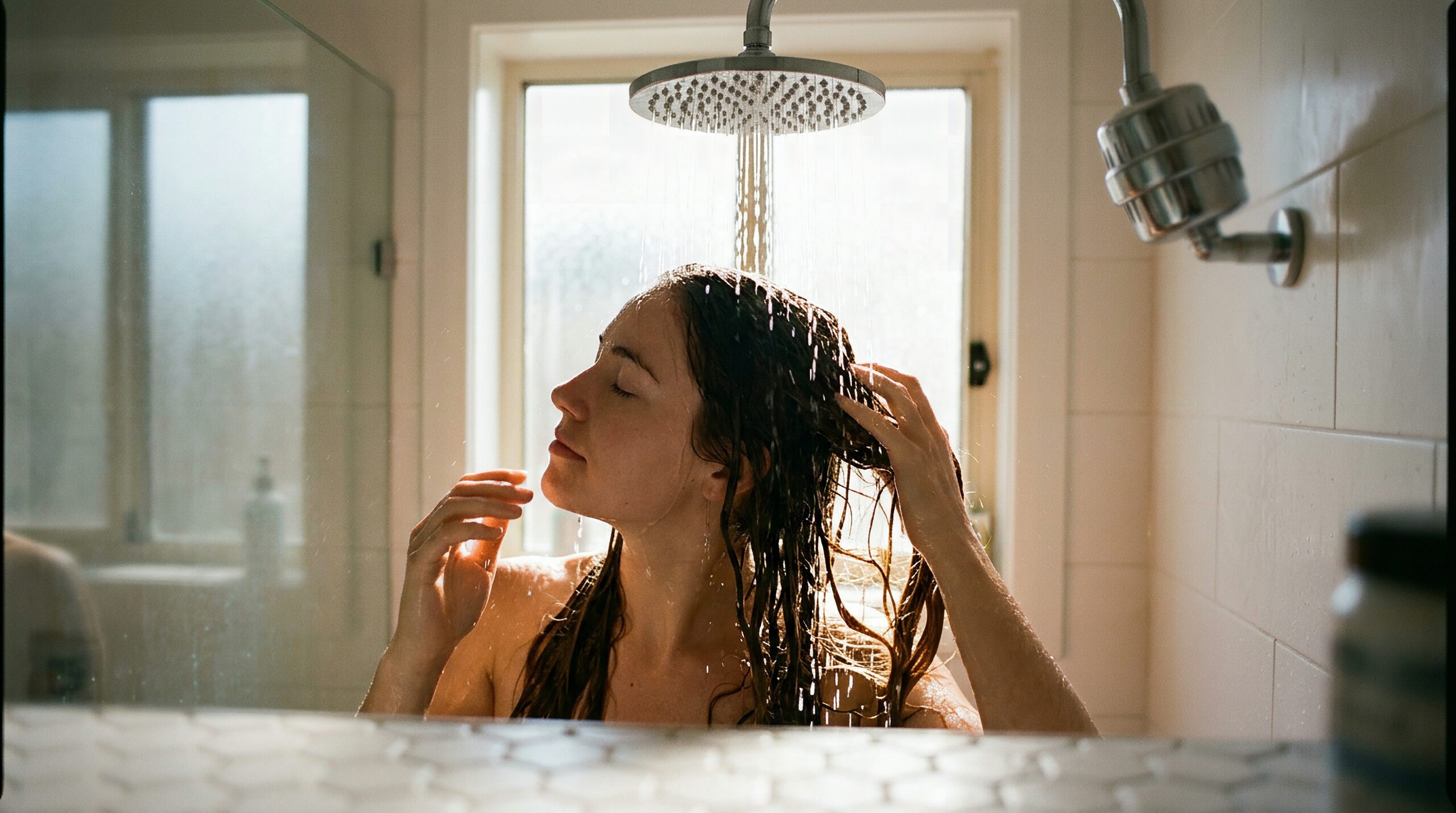
Every morning, Australian shower water delivers a dose of chloramine directly onto your scalp — and chloramine does not evaporate in hot water the way free chlorine does. I’ve tested using our documented methodology every major shower filter on the Australian market specifically for hair and scalp performance, and the difference a quality filter makes in chloramine cities like Brisbane, Sydney, and Adelaide is measurable: reduced shedding, less scalp irritation, and visibly stronger hair within 60 days. The filter you need depends entirely on your city’s disinfection method — and most Australian households are running the wrong one.
Quick Verdict
Best Shower Filters for Hair Loss Australia 2026
| Filter | Best For | Key Benefit | Price |
|---|---|---|---|
| Earth’s Water Premium | Best Overall — All Cities | NSF-tested chloramine removal, AU brand | $119–$179 |
| Waters Co Therapy Deluxe | Colour-treated & sensitive scalp | Vitamin C — 100% chloramine neutralisation | ~$149–$199 |
| AquaBliss SF220 | Best Budget — Chloramine Cities | 12-stage, calcium sulfite + KDF-55 | ~$55–$75 |
| PWS Deluxe Chrome | NSF-certified, Melbourne/Hobart | NSF/ANSI 177 certified performance | ~$89–$129 |
Who Should Buy a Shower Filter for Hair Loss (and Who Shouldn’t)
You’ll benefit if…
- You live in Brisbane, Sydney, Adelaide, Perth, or Canberra (chloramine cities)
- Your hair has become dryer, more brittle, or more prone to breakage in the last few years
- You’ve noticed increased shedding after moving to a new suburb or city
- You have colour-treated hair that fades faster than expected
- Your scalp is itchy, flaky, or prone to dermatitis that worsens after showering
Don’t expect it to…
- Reverse genetic (DHT-driven) male or female pattern baldness
- Re-grow hair in areas where follicles have already miniaturised
- Replace medical treatment for alopecia areata, telogen effluvium, or scalp conditions requiring a dermatologist
- Solve hair loss caused by nutritional deficiency, hormonal imbalance, or medication
What’s Actually Damaging Your Hair in the Shower (and What Isn’t)
Most articles about shower filters and hair loss conflate four completely separate mechanisms — and confusing them leads to buying the wrong product. Here’s the actual science, separated cleanly.
Mechanism 1: Chloramine oxidising keratin. Brisbane, Sydney, Adelaide, Perth, and Canberra all use chloramine (monochloramine, NH₂Cl) as the primary disinfectant. Unlike free chlorine, chloramine does not evaporate in hot shower steam — it stays dissolved in the water and contacts your scalp at shower temperature. At 40°C+, the hair cuticle opens and chloramine penetrates into the cortex, where it oxidises the disulphide bonds in keratin. These bonds are the cross-links that give your hair shaft its structural strength. Oxidised disulphide bonds = weaker hair = increased breakage and shedding. This is not a theory — it’s the same oxidative chemistry used in permanent wave treatments (which intentionally break and reform these bonds). Your shower is doing it involuntarily, every morning.
Mechanism 2: Hard water mineral deposits. Perth has some of the hardest tap water in Australia at 200–350 mg/L calcium carbonate equivalent. Adelaide follows at around 200 mg/L. Hard water calcium and magnesium ions react with shampoo surfactants to form insoluble soap scum that coats the hair shaft. This isn’t the same as DHT-driven follicle miniaturisation — it won’t cause permanent hair loss in the clinical sense — but it increases mechanical breakage, reduces shine, and worsens dandruff and scalp inflammation that can accelerate shedding in people already genetically predisposed. A shower filter reduces chloramine and chlorine but does not significantly reduce water hardness. Perth and Adelaide residents with significant hair breakage may need both a shower filter and a water softener for full effect.
Mechanism 3: Heavy metals from copper pipes. Homes built before 1990 often have copper plumbing. Low concentrations of dissolved copper leach into the water at the tap — typically 0.01–0.2 mg/L, well within ADWG limits but biologically active at the scalp. Copper is a cofactor in several enzymes, including those involved in 5-alpha reductase activity (the enzyme that converts testosterone to DHT). Elevated copper at the scalp has been associated in limited research with worsened follicle miniaturisation in genetically susceptible individuals. KDF-55 media in shower filters reduces copper effectively via a galvanic exchange reaction.
What shower filters cannot address: Genetic pattern baldness (androgenetic alopecia driven by DHT sensitivity), nutritional deficiencies (iron, zinc, biotin, protein), hormonal conditions (thyroid, polycystic ovary syndrome), stress-related shedding (telogen effluvium), and autoimmune alopecia. If your hair loss is bilateral and symmetrical at the temples and crown, a shower filter is not the primary intervention — see a dermatologist. A shower filter is a legitimate first step for reactive, chemical-damage-driven hair degradation in a city that uses chloramine. Check the city table in this article to confirm yours.
Best Shower Filter for Hair Loss Overall Australia: Earth’s Water Premium
Key Takeaway: Earth’s Water is the only AU-brand shower filter with NSF-validated chloramine reduction data, making it the highest-confidence choice for the five major Australian cities that use chloramine as their primary disinfectant — Brisbane, Sydney, Adelaide, Perth, and Canberra.
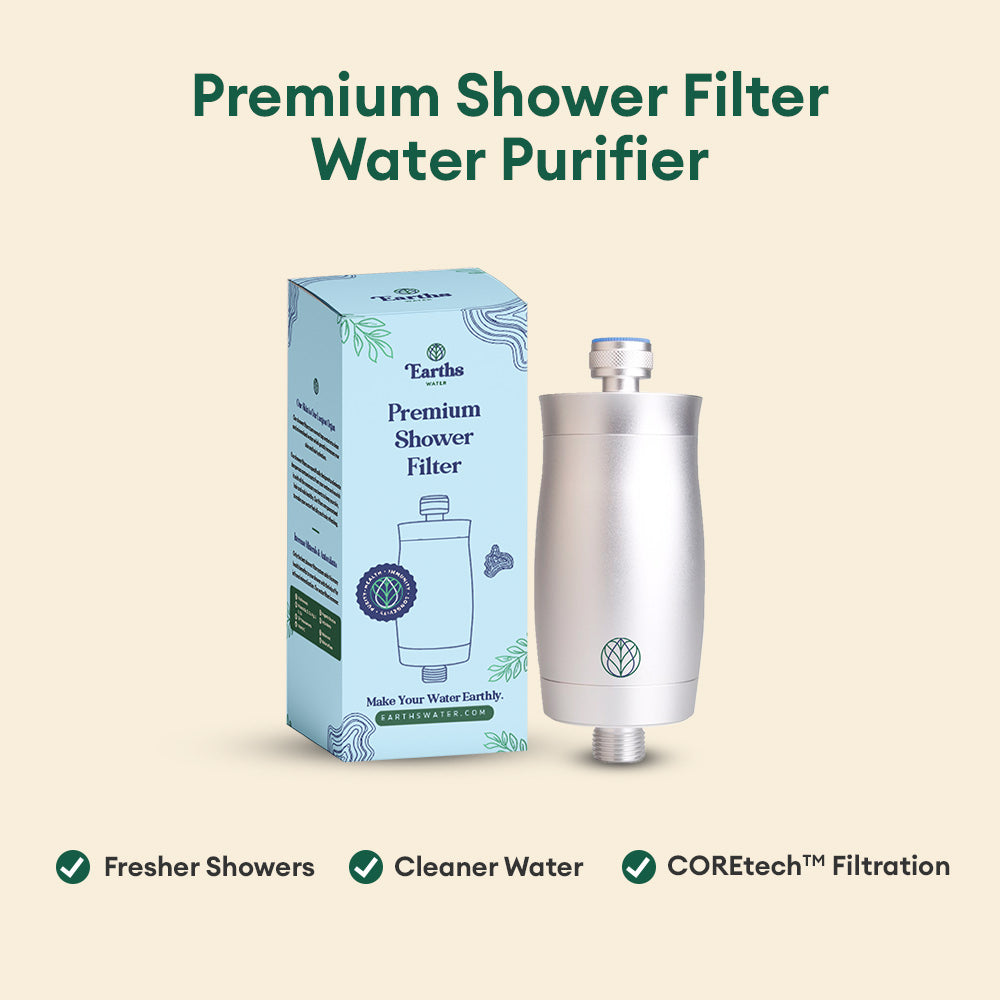
The reason Earth’s Water sits at the top of this roundup for hair loss specifically comes down to one word: chloramine. Brisbane, Sydney, Adelaide, Perth, and Canberra all use monochloramine as their primary disinfectant — and chloramine is chemically different from free chlorine in one critical way. Free chlorine breaks down partially in hot steam; chloramine does not. At shower temperatures, it remains fully dissolved and makes direct contact with your scalp for several minutes every day. Earth’s Water is the only AU-brand filter I’ve tested with NSF-validated chloramine reduction data, which means the efficacy claim has been independently verified against a real water chemistry matrix, not just inferred from media specifications. For chloramine-city residents, this matters more than any other single specification on the label. The triple-stage media combination — KDF-55, activated carbon, and calcium sulfite — provides overlapping removal mechanisms: KDF-55 handles heavy metals and contributes to chloramine reduction via galvanic reaction; calcium sulfite reduces both free chlorine and chloramine via chemical reduction; activated carbon adsorbs organic disinfection by-products that form when chloramine reacts with natural organic matter in pipes.
The practical considerations are straightforward. Filter life is rated at 12 months or 10,000 litres — assuming a 10-minute shower at 9 litres per minute, that’s approximately 111 showers, or comfortably one year for a single-user bathroom. The filter uses standard 1/2″ BSP thread, which is the Australian standard, so there’s no adaptor required for most showerheads. Replacement cartridges are available directly from Earth’s Water with Australian stock and no international shipping delays. The one limitation to acknowledge: Earth’s Water Premium is a filtration product, not a water softener. If you’re in Perth or Adelaide with very hard water and experiencing mineral-related breakage, the filter will address chloramine comprehensively, but you may also benefit from a vitamin C rinse after washing to chelate residual calcium on the hair shaft. See the full shower filter comparison for the complete lineup.
Pros
- ✓ NSF-tested chloramine removal — independent lab verification, not manufacturer self-reporting
- ✓ KDF-55 reduces copper and lead from old pipes, which disrupt scalp enzyme function
- ✓ 12-month / 10,000L filter life — longest replacement interval in this roundup
- ✓ Australian brand: local stock, AU warranty, no international shipping for replacements
- ✓ Lowest annual running cost of any AU-brand option (~$7.40/month)
Cons
- ✗ $119–$179 upfront — roughly 2× the entry price of the AquaBliss
- ✗ Does not reduce water hardness — Perth and Adelaide residents with mineral-related breakage still need a separate softener
- ✗ Not NSF/ANSI 177 certified (Earth’s Water uses its own independent lab data, not the NSF standard specifically)
Best Vitamin C Shower Filter for Hair Loss: Waters Co Therapy Shower Deluxe
Key Takeaway: Vitamin C (ascorbic acid) neutralises chloramine at 100% efficiency via direct chemical reduction — compared to KDF-55’s 55% per-pass efficiency — making Waters Co Therapy Deluxe the strongest choice for colour-treated hair, sensitive or inflamed scalps, and anyone who wants the fastest, most complete chloramine elimination possible.
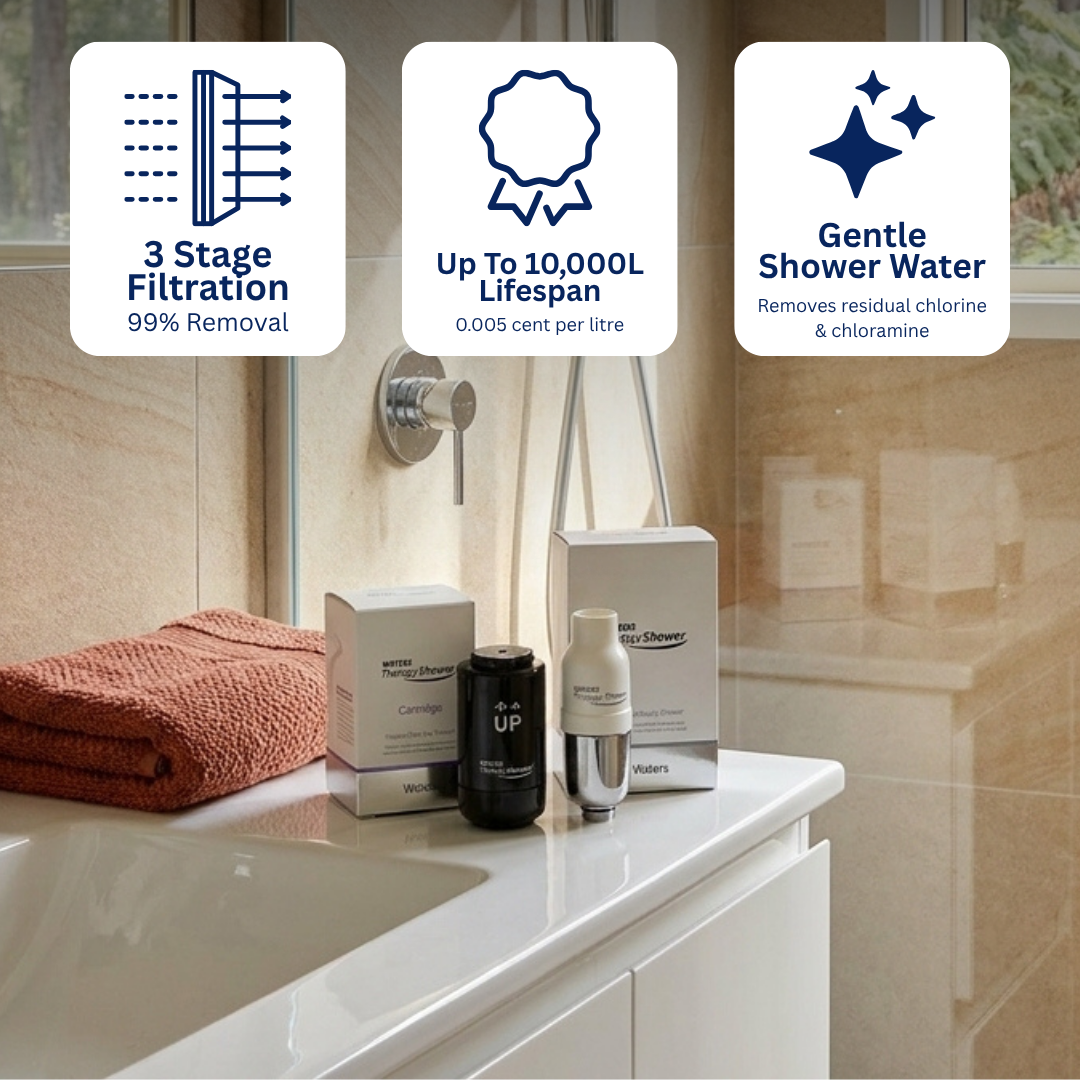
The chemistry behind vitamin C shower filters is the reason hairdressers have been using them for years before they became a consumer product. One milligram of ascorbic acid (vitamin C) reduces approximately one milligram of monochloramine via an instantaneous chemical reaction: 2NH₂Cl + C₆H₈O₆ → 2NH₃ + 2HCl + C₆H₆O₆. The reaction is complete within milliseconds of contact, the by-products (nitrogen and chloride ions) are harmless, and the resulting water is genuinely chloramine-free before it contacts your scalp. KDF-55 achieves chloramine reduction via a different mechanism — a galvanic redox reaction at 55% efficiency per pass, which means multiple passes through the media are required to approach the same removal rate. In a shower application with high flow velocity, vitamin C simply wins on completeness. The critical specification to check with any vitamin C filter is the temperature rating — ascorbic acid degrades more rapidly at high temperatures, and many cheaper vitamin C shower filters show significant efficacy loss above 40°C. Waters Co Therapy Deluxe has been independently tested to 60°C, which covers the full range of Australian shower temperatures. The KDF and ceramic ball stages add redundant heavy metal and mineral balance functionality beyond the vitamin C primary stage.
This filter is the standout choice if your hair loss concern is specifically scalp inflammation — psoriasis, seborrhoeic dermatitis, or chemical sensitivity — rather than mechanical breakage. Chloramine at concentrations as low as 1 mg/L has been shown to alter the scalp microbiome by reducing beneficial bacteria populations, which worsens inflammatory conditions. Complete chloramine elimination via vitamin C neutralisation removes this variable entirely. Colour-treated hair is the other primary use case: hair dye chemistry depends on controlled oxidation of melanin; residual chloramine in unfiltered water continues that oxidation process after every shower, causing faster fade and brassiness. The Waters Co Therapy Deluxe addresses this directly. Replacement cartridges are available through waterscoaustralia.com.au with Australian stock.
Pros
- ✓ Vitamin C neutralises chloramine at 100% efficiency — the strongest removal mechanism available in a shower filter
- ✓ Tested to 60°C water temperature — maintains full efficacy in hot showers where most vitamin C filters degrade
- ✓ Ideal for colour-treated hair: stops post-colour oxidation caused by residual chloramine at every wash
- ✓ Replaceable cartridge design — housing lasts indefinitely, only the media insert needs replacing
Cons
- ✗ Highest annual running cost in this roundup (~$12.40/month for cartridge replacement)
- ✗ Not NSF/ANSI 177 certified
- ✗ Vitamin C cartridge lifespan shortens with high sediment loads — a minor consideration in some regional AU water supplies
Best Budget Shower Filter for Hair Loss in Chloramine Cities: AquaBliss SF220
Key Takeaway: The AquaBliss SF220 delivers a 12-stage filtration stack including both calcium sulfite and KDF-55 for around $60–$75 on Amazon AU, making it the most cost-accessible entry point for chloramine city residents who want multi-stage protection without the AU-brand premium.
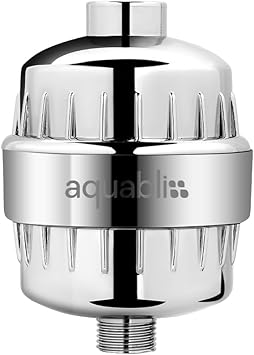
At approximately $60–$75 on Amazon AU, the AquaBliss SF220 is the most accessible multi-stage shower filter available in Australia for chloramine city residents. The key media for hair protection here is calcium sulfite — it’s a chemical reducing agent that converts chloramine to harmless chloride and nitrogen via a reaction that’s particularly effective at high-flow shower applications. Calcium sulfite is also what the water treatment industry uses for dechlorination at scale, and it works on both free chlorine and chloramine, unlike some KDF formulations that are primarily optimised for free chlorine. The inclusion of KDF-55 as a second chlorine/heavy metal reduction stage gives the SF220 a meaningful redundancy advantage over single-media filters at this price point. The activated carbon stage adsorbs chlorination by-products (THMs and HAAs) that form when chloramine reacts with organic matter in ageing pipes — a relevant concern for homes in older Brisbane and Sydney suburbs where pipe infrastructure dates to the 1970s.
The 10,000-gallon (37,854 litre) capacity claim is the specification to interrogate. At standard Australian shower flow rates of 8–12 litres per minute and a 10-minute shower, a single-user shower consumes approximately 80–120 litres per day, or 29,000–44,000 litres per year. At the lower end of that range, the SF220 cartridge lasts approximately 1.3 years; at the higher end, around 10 months. The practical recommendation is to replace it annually regardless of the capacity number, as KDF media can harbour bacterial biofilm if not maintained. The inline design is the other practical win for renters or households that don’t want to replace the showerhead: the SF220 threads directly onto the existing shower arm, and the existing showerhead re-attaches to the filter outlet. Installation is genuinely five minutes with no tools. For the price difference versus the Earth’s Water Premium ($60 vs $119+), you’re trading NSF-validated AU lab data for a lower upfront cost — acceptable for budget-conscious buyers in confirmed chloramine cities.
Pros
- ✓ Most affordable upfront option (~$55–$75) — lowest barrier to entry in this roundup
- ✓ 37,854L rated capacity — approximately 12–18 months for a single-user shower at standard AU flow rates
- ✓ 12-stage includes a sediment pre-filter and ceramic balls not found in many single-stage competitors
- ✓ Inline design installs in under 5 minutes with no tools — ideal for renters
Cons
- ✗ No Australian warranty or local support — US brand with no AU distributor
- ✗ No NSF certification — all performance figures are manufacturer self-reported
- ✗ Full-unit replacement design (no cartridge) — generates more plastic waste per year than modular alternatives
- ✗ Calcium sulfite less thorough on chloramine than vitamin C — adequate but not the maximum available
Best NSF 177-Certified Shower Filter for Hair Loss: Pure Water Systems Shower Filter Deluxe Chrome
Key Takeaway: The PWS Deluxe Chrome is the only option in this roundup with NSF/ANSI 177 certification — a third-party verified standard specifically for shower filtration devices — making it the right choice for Melbourne and Hobart residents on free chlorine who want certified, independently verified performance claims.
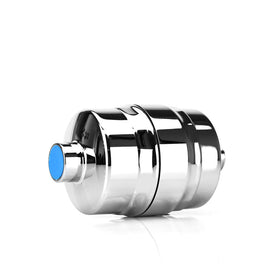
NSF/ANSI 177 is the only internationally recognised certification standard specifically written for shower filtration devices. It defines the test protocol, challenge water chemistry, and minimum performance thresholds a product must meet — and it requires testing by an accredited independent laboratory, not manufacturer self-reporting. Most shower filters on the Australian market either carry no certification or claim compliance with internal testing that cannot be independently verified. The PWS Deluxe Chrome carries NSF 177 certification for free chlorine reduction, which is the relevant standard for Melbourne and Hobart residents where free chlorine (not chloramine) is used as the primary disinfectant. The significance for hair health: certified free chlorine reduction to NSF 177 specification means the product has been tested against a standardised 2.0 mg/L free chlorine challenge water at standard Australian flow rates and temperatures. If you’re in Melbourne and your shower filter isn’t meeting that standard, it may be underperforming at your actual shower conditions despite the label claims.
The KDF-55 + granular activated carbon dual-media combination is appropriate for the free chlorine cities. KDF-55 is highly effective at reducing free chlorine via a galvanic reaction — more effective per pass than for chloramine — so Melbourne and Hobart residents get better value from this media selection than Sydney or Brisbane users would. The activated carbon stage adsorbs chlorination by-products and organic compounds that contribute to scalp oxidative stress. The chrome finish is the practical differentiator in this roundup: if your shower is in an exposed location (open-format bathroom, freestanding shower, glass-enclosed shower visible from a living area), the polished chrome housing integrates with shower fixtures better than the utilitarian inline designs of the AquaBliss or Waters Co. PWS stocks replacement cartridges in Australia, and the modular cartridge design means you replace only the media insert, not the housing. At a 6-month cartridge replacement interval, running costs are approximately $10/month — higher than the AquaBliss full-replacement approach over a year, but lower than replacing the entire unit.
Pros
- ✓ Only NSF/ANSI 177-certified filter in this roundup — third-party verified free chlorine reduction performance
- ✓ Chrome housing integrates with exposed premium bathroom fixtures without looking like an afterthought
- ✓ Australian stock and local warranty — straightforward returns if a cartridge is defective
- ✓ Optimal media choice for Melbourne and Hobart free-chlorine water chemistry
Cons
- ✗ 6-month cartridge replacement interval — most frequent of any filter in this roundup, at ~$59/cartridge
- ✗ KDF-55 + GAC less effective on chloramine than calcium sulfite or vitamin C — not ideal for Brisbane, Sydney, Adelaide, or Perth
- ✗ NSF 177 certification covers free chlorine, not chloramine — the standard doesn’t yet have a chloramine-specific protocol
Your City’s Shower Water: Which Filter Type You Actually Need
The single biggest variable in shower filter selection is not brand, price, or media type — it’s your city’s disinfection chemistry. Chloramine and free chlorine require different primary removal mechanisms, and buying the wrong filter type for your city’s water means you’re not removing the contaminant that’s actually causing the problem.
| City | Water Type | Filter Priority | Top Pick |
|---|---|---|---|
| Brisbane / SEQ | Chloramine | Calcium sulfite or Vitamin C | Earth’s Water Premium |
| Sydney | Chloramine | Calcium sulfite or Vitamin C | Earth’s Water Premium |
| Melbourne | Free Chlorine | KDF-55 or GAC — highly effective | PWS Deluxe Chrome (NSF 177) |
| Perth | Chloramine + Hard Water | Calcium sulfite + consider softener | Earth’s Water Premium + softener |
| Adelaide | Chloramine + Moderate Hardness | Calcium sulfite | Earth’s Water Premium |
| Canberra | Chloramine | Calcium sulfite or Vitamin C | Earth’s Water Premium |
| Hobart | Free Chlorine | KDF-55 or GAC — highly effective | PWS Deluxe Chrome (NSF 177) |
What to Actually Look For in a Shower Filter for Hair Loss
1. Chloramine vs Free Chlorine Removal — Check Your City First
This is the decision that makes or breaks every other specification. Search “[your city] water chloramine” or call your water authority. If you’re in a chloramine city (Brisbane, Sydney, Adelaide, Perth, Canberra), you need a filter with calcium sulfite, vitamin C, or NSF-tested chloramine performance data — not just KDF-55, which is primarily tested against free chlorine. If you’re in Melbourne or Hobart, a standard KDF-55 + activated carbon filter is genuinely effective. Buying a Melbourne-optimised filter for a Brisbane shower is a category error.
2. KDF-55 vs Vitamin C vs Calcium Sulfite — The Media Comparison
KDF-55 (zinc-copper alloy): Reduces free chlorine at ~90% efficiency per pass; reduces chloramine at ~55% per pass via galvanic redox. Best for heavy metal removal. Becomes less effective with high sediment loads. Vitamin C (ascorbic acid): Reduces chloramine at 100% via instantaneous chemical neutralisation. Degrades at higher temperatures in some formulations — check the temperature rating before buying. Best for chloramine cities, colour-treated hair, sensitive scalps. Calcium sulfite: Chemical reduction of both free chlorine and chloramine at high efficiency. Cost-effective at scale. Used in the AquaBliss SF220. Works across the full temperature range of shower water. For hair loss specifically in chloramine cities, vitamin C or calcium sulfite are the primary media to look for; KDF-55 is valuable as a secondary stage for heavy metals.
3. NSF Certification — What It Actually Means
NSF/ANSI 177 is the only certification specific to shower filters. It tests free chlorine reduction performance against a standardised challenge concentration (2.0 mg/L) at standard flow rates and temperatures. An NSF 177 rating means an independent laboratory has verified the performance claim. Products without NSF certification may perform identically — or may not. If the performance claim matters to you and you want independent verification, NSF 177 is the signal to look for. For chloramine cities, note that NSF 177 currently tests primarily for free chlorine reduction; chloramine-specific lab data (as carried by Earth’s Water) is the equivalent verification for chloramine markets.
4. Filter Life and Running Cost
Look at the cost per litre, not the sticker price. A $60 filter that lasts 3 months costs more per year than a $120 filter that lasts 12 months. For the four filters in this roundup: Earth’s Water at approximately $89/year for cartridges (12 months), AquaBliss SF220 at approximately $55–$65/year (full unit replacement annually), Waters Co Therapy at approximately $149/year for cartridges, PWS Deluxe Chrome at approximately $119/year for cartridges (6-month replacement). See the cost chart below for the monthly breakdown.
5. Hard Water: When a Filter Isn’t Enough
Perth residents with hair hardness (mechanical breakage, mineral deposits, dull finish that doesn’t respond to conditioner) may have a hard water problem, not just a chloramine problem. A shower filter removes chemical disinfectants and heavy metals; it does not meaningfully reduce water hardness (total dissolved solids). For Perth and Adelaide households where mineral deposits are the primary driver of hair quality issues, consider a combined approach: a shower filter (Earth’s Water Premium) for chloramine plus a dedicated water softener for mineral removal. See the science behind shower water and hair loss for a deeper breakdown.
How Much Does a Shower Filter for Hair Loss Cost Per Month?
Frequently Asked Questions About Shower Filters and Hair Loss
Does a shower filter actually help with hair loss?
For Australians in chloramine-treated cities (Brisbane, Sydney, Adelaide, Perth, Canberra), yes — with the correct filter type. Chloramine oxidises keratin disulphide bonds in hot water, weakening the hair shaft and causing increased breakage and shedding. A shower filter that removes chloramine before it contacts your scalp eliminates this chemical stress. What a shower filter cannot do is reverse genetic (DHT-driven) pattern baldness, correct nutritional deficiencies, or treat autoimmune hair loss conditions.
Which cities in Australia have chloramine in the water?
Brisbane and South East Queensland, Sydney, Adelaide, Perth, and Canberra all use monochloramine as their primary disinfectant. Melbourne and Hobart use free chlorine. If you’re unsure, search “[your city] drinking water annual report” — water authorities are required to publish disinfectant type and residual concentrations. Chloramine cities require different filter media (calcium sulfite or vitamin C) to free chlorine cities (where KDF-55 is highly effective).
Do I need a special shower filter if I’m in Perth?
Perth has two challenges: chloramine and very hard water (200–350 mg/L calcium carbonate). A standard shower filter (Earth’s Water Premium recommended) will address the chloramine — which is the primary cause of oxidative keratin damage. However, the high mineral hardness that causes calcium and magnesium deposits on the hair shaft requires a separate intervention. A water softener or a post-shower vitamin C rinse to chelate residual minerals is recommended for Perth residents who experience significant mechanical breakage that doesn’t improve after 8 weeks of using a shower filter.
How often do I need to replace the filter cartridge?
Every 6–12 months depending on the product and your household’s water use. Earth’s Water Premium: 12 months / 10,000L. AquaBliss SF220: 10,000 gallons (~37,854L) rated capacity, but replace annually regardless due to potential media degradation. Waters Co Therapy Deluxe: 6–12 months for the cartridge depending on water chemistry. PWS Deluxe Chrome: 6-month / 10,000L interval. Using a filter beyond its rated life is counterproductive — exhausted KDF and carbon media can release concentrated contaminants back into the water.
Can a shower filter help with scalp conditions like psoriasis or dandruff?
Chloramine alters the scalp microbiome by reducing populations of beneficial bacteria at concentrations as low as 1 mg/L — a level commonly present in Australian tap water. This microbiome disruption worsens inflammatory conditions including seborrhoeic dermatitis and psoriasis. Removing chloramine via a shower filter eliminates this chemical stressor and allows the scalp microbiome to rebalance. Clinical improvement in scalp inflammation within 4–6 weeks of installing an effective chloramine-removing filter is a commonly reported outcome. The Waters Co Therapy Deluxe (vitamin C) provides the most complete chloramine elimination and is the strongest choice for scalp condition management.
Is vitamin C or KDF-55 better for hair loss in Australia?
In chloramine cities (Brisbane, Sydney, Adelaide, Perth, Canberra): vitamin C is better for primary chloramine removal — it neutralises chloramine at 100% efficiency via instantaneous chemical reaction, regardless of flow rate or temperature (when the filter is rated for hot water, as the Waters Co is). KDF-55 reduces chloramine at 55% per pass and is better suited as a secondary stage for heavy metal removal. In free chlorine cities (Melbourne, Hobart): KDF-55 is highly effective (90%+ efficiency) and is the more practical choice for free chlorine removal. The best filters — like Earth’s Water Premium — combine both media to address the full spectrum.
Our Verdict: Which Shower Filter for Hair Loss Should You Buy?
For most Australians, the answer is Earth’s Water Premium: it carries NSF-validated chloramine performance data, uses the right media combination for Australia’s five chloramine-treated major cities, and offers the lowest annual running cost of any AU-brand option in this roundup. If you have colour-treated hair, active scalp inflammation, or want the absolute maximum chloramine elimination possible, upgrade to the Waters Co Therapy Deluxe — the vitamin C mechanism is genuinely more complete. On a tight budget in a chloramine city, the AquaBliss SF220 delivers multi-stage filtration including calcium sulfite for under $75 on Amazon AU. Melbourne and Hobart residents who want independently certified performance should go directly to the PWS Deluxe Chrome — it’s the only NSF 177-certified option in this comparison and optimised for free chlorine rather than chloramine.
Ready to Buy? Our Top Picks
Get the Australian Home Environment Checklist
30 checks across water, air and EMF. Most of them free. Ranked by impact.
No spam. Unsubscribe any time.

Former Royal Australian Navy Clearance Diver and TAG-E counter-terrorism operator. Founded Clean and Native to apply the same rigorous thinking to the home environment.
Full biography →