Brisbane Drinking Water Quality 2026: What’s Actually in Your Tap Water
Drafted with AI assistance and checked against published specifications and certifications. First-hand measurements appear only where stated. How we make content
Affiliate disclosure: Clean and Native earns a commission if you purchase through links on this page. This does not affect our editorial position — all recommendations are based on published specs, independent test data, and certification.
Brisbane tap water is safe to drink straight from the tap and meets all Australian Drinking Water Guidelines, but contains chloramine disinfectant (not removed by standard Brita-style filters), PFOA detected at 23–36 ng/L in source water at Mt Crosby (below the June 2025 ADWG limit of 200 ng/L but above the stricter US EPA limit of 4 ng/L), and moderate hardness averaging 80 mg/L. Standard activated carbon filters will improve taste and remove sediment but won’t touch chloramine or PFAS. Reverse osmosis removes both comprehensively, along with fluoride, heavy metals, and microplastics. The catches: RO wastes 2–3 litres per litre produced (though countertop units recirculate), and benchtop carbon filters need quarterly cartridge changes at ~$90/year.
| Household Type | Best Option | Verdict |
|---|---|---|
| Renters / light use | TAPP EcoPro benchtop (0.5µm carbon block, removes chloramine) | Recommended |
| Families / PFAS-conscious | AquaTru Classic countertop RO or EcoHero 5-Stage under-sink RO | Recommended |
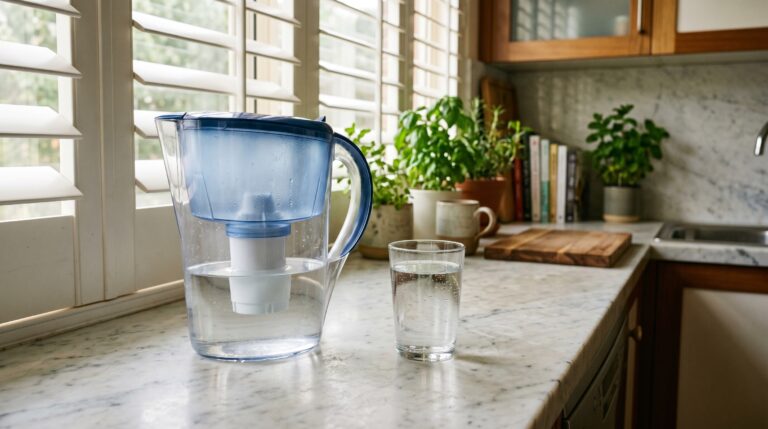
| Pitcher filters (Brita, Zero Water) | Cannot remove chloramine or PFAS from Brisbane supply | Avoid as primary |
Quick answer
The three products we own are measured first-hand by Jayce Love, former Royal Australian Navy Clearance Diver; every other product is assessed on published manufacturer specifications and independent certification using our documented methodology — no gifted units, no brand payments.
Brisbane tap water is safe and meets all Australian Drinking Water Guidelines (ADWG). The main concerns are: (1) chloramine as the primary disinfectant — not removed by standard pitcher filters; (2) PFOA detected in raw source water at Mt Crosby WTP at 23–36 ng/L (well below the June 2025 ADWG limit of 200 ng/L, but above the US EPA limit of 4 ng/L); (3) moderate hardness averaging ~80 mg/L CaCO3. For renters or light filtration: TAPP EcoPro (0.5 micron carbon block) removes chloramine, taste compounds, and microplastics. For whole-family comprehensive filtration including PFAS and fluoride: AquaTru Classic or EcoHero 5-Stage RO.
Where Brisbane’s water comes from
South East Queensland’s drinking water is supplied in bulk by Seqwater, which manages Wivenhoe Dam (71% of SEQ storage at 1,165 GL capacity), Somerset Dam, and North Pine Dam. Urban Utilities distributes treated water across Brisbane, Ipswich, Lockyer Valley, Scenic Rim, and Somerset. The primary treatment facilities are Mount Crosby Eastbank WTP and Mount Crosby Westbank WTP (fed by Wivenhoe/Somerset) and North Pine WTP (fed by North Pine Dam).
Brisbane’s water source is surface water from protected catchment areas — less mineralised than Perth’s groundwater-dominated supply, but more so than Melbourne’s pristine mountain catchments. The treatment process includes coagulation, flocculation, sedimentation, filtration, and disinfection.
Brisbane water quality by the numbers (2023–2024)
| Parameter | Brisbane result | ADWG guideline | Status |
|---|---|---|---|
| Fluoride | 0.6–0.8 mg/L (target range) | <1.5 mg/L | ✓ Within guideline |
| Disinfection | Chloramine (network-wide; residual up to 4.0 mg/L) | Monochloramine <3 mg/L health guideline | ✓ Within guideline |
| Hardness | ~53–115 mg/L as CaCO₃ (avg ~80 mg/L) | No health guideline; aesthetic <200 mg/L | ✓ Moderately hard |
| pH | ~7.8 (Urban Utilities planning to raise to ~8.4 from mid-2026) | 6.5–8.5 | ✓ Within range |
| TDS | ~150 mg/L (estimated; not published in annual reports) | Aesthetic <600 mg/L | ✓ Within range |
| PFAS (PFOA) | Raw water at Mt Crosby Westbank: 23–36 ng/L (2023–2024); treated water <2 ng/L at all sites (March 2026) | PFOA <200 ng/L (ADWG June 2025); US EPA limit is 4 ng/L | ⚠ Compliant with ADWG; above US EPA limit in source water |
Source: Urban Utilities Annual Drinking Water Performance Report 2023–24; Seqwater PFAS monitoring program (March 2026 data). Hardness figures from Urban Utilities suburb-specific data.
The chloramine issue — why Brisbane water smells different
Brisbane uses chloramination (adding both chlorine and ammonia to the water) across the entire distribution network. Chloramine is preferred over free chlorine for large networks because it persists longer in long pipe runs — critical for Brisbane’s extensive distribution system.
The practical difference for households: chloramine produces a distinct disinfectant taste and odour that is more persistent than free chlorine. Unlike free chlorine, which dissipates naturally in a few minutes when water is left in an open jug, chloramine does not off-gas and requires active filtration to remove. Standard pitcher filters using granular activated carbon (most Brita models) are less effective at removing chloramine than at removing free chlorine. Solid carbon block filters (0.5 micron or smaller) are significantly more effective at chloramine removal through the extended contact time the block provides.
For Brisbane households, this means the choice of filter technology matters more than in cities using free chlorine.
PFAS at Mt Crosby — what the data actually shows
This article contains affiliate links. We may earn a commission at no extra cost to you.
Seqwater’s monthly monitoring detected PFOA (perfluorooctanoic acid) in raw source water at Mount Crosby Westbank WTP — 36 ng/L in 2023, reducing to 23 ng/L in 2024. The June 2025 ADWG health guideline for PFOA is 200 ng/ See the EcoHero RO System →L, so Brisbane’s treated water (which is consistently below 2 ng/L — effectively non-detect) meets Australian standards comfortably.
However, context matters: the US EPA’s Maximum Contaminant Level (MCL) for PFOA is 4 ng/L — set after review of cardiovascular, immune, and developmental effects. Australia’s ADWG limit is 50× more permissive. The source water detection does not mean treated tap water is unsafe by Australian standards. It does mean that if you apply the precautionary US standard, reverse osmosis filtration provides a meaningful reduction margin beyond what the ADWG requires.
Hardness and scale — the practical effect
Brisbane’s average hardness of ~80 mg/L as CaCO₃ puts it in the “moderately hard” category. You will see some scale build-up on kettle elements, shower heads, and dishwasher spray arms over time — less than Adelaide or hard Perth suburbs, but more than Sydney or Melbourne. Hardness is not a health concern at these levels, but it does affect appliance longevity and coffee/tea taste.
Which filters work best for Brisbane water
| Filter type | Chloramine removal | PFAS removal | Fluoride removal | Hardness/TDS | Verdict for Brisbane |
|---|---|---|---|---|---|
| Pitcher (Brita, standard GAC) | Partial | No | No | No | Inadequate for Brisbane |
| Carbon block tap filter (TAPP EcoPro) | Yes (0.5 micron block) | Partial (PFAS <0.5 micron) | No | No | Good for renters; covers main taste/chloramine concerns |
| Reverse osmosis (AquaTru / EcoHero) | Yes | Yes (>99%) | Yes (>96%) | Yes (significantly reduces TDS/hardness) | Best comprehensive solution for Brisbane |
Recommended filters for Brisbane households
Renters & light filtration: TAPP EcoPro
Sub-micron carbon block (0.5 micron) with confirmed chloramine removal. No plumbing modification required — installs on any standard tap. NSF 42+53 certified. Specifically effective for Brisbane’s chloramine taste/odour and microplastic removal. Doesn’t address fluoride or PFAS reduction.
TAPP EcoPro — tap-mount, no installation
Comprehensive: AquaTru Classic RO
4-stage countertop RO system. No plumbing required. Removes chloramine, PFAS (>99%), fluoride (>96%), lead, microplastics, and significantly reduces TDS and hardness. NSF 58 + 401 certified. Ideal for Brisbane households wanting full-spectrum filtration including PFAS precautionary reduction. Our Palm Beach testing shows post-RO TDS of 3 ppm from Brisbane-source tap water at 69 ppm.
AquaTru Classic — countertop RO, no plumbing
Who needs what — Brisbane decision guide
| Your situation | Recommendation |
|---|---|
| Renter, mainly want to improve taste and remove chloramine | TAPP EcoPro — installs without modification |
| Homeowner wanting PFAS reduction (precautionary, below ADWG) | AquaTru Classic or EcoHero 5-Stage RO |
| Pregnant, infant formula, or immunocompromised household | RO — addresses all contaminants including PFAS and fluoride |
| Want to remove fluoride specifically | RO only — carbon filters do not remove fluoride |
| Scale on appliances / hard water in northern Brisbane suburbs | RO for drinking water; consider a whole-house softener for appliances |
For a full review of RO options available in Australia, see our best under-sink water filter Australia guide. For countertop options that need no plumbing, see best countertop water filter Australia.
Frequently asked questions
What is the TDS of Brisbane tap water?
Brisbane tap water TDS is typically 70–120 mg/L depending on Wivenhoe Dam inflow conditions. Seqwater publishes annual source water quality data. After RO treatment, TDS drops to under 10 mg/L.
Is Brisbane tap water safe?
Yes — meets all ADWG. PFOA detected in raw source water (23–36 ng/L) but treated water is effectively non-detect.
Does Brisbane use chloramine?
Yes — network-wide. Standard pitchers don’t fully remove it. Use solid carbon block or RO.
Can a Brita remove Brisbane chloramine?
Only partially. Carbon block (TAPP EcoPro) or RO is more effective.
Get the Australian Home Environment Checklist
30 checks across water, air and EMF. Most of them free. Ranked by impact.
No spam. Unsubscribe any time.

Former Royal Australian Navy Clearance Diver and TAG-E counter-terrorism operator. Founded Clean and Native to apply the same rigorous thinking to the home environment.
Full biography →