Cascade H2O Countertop RO Review — Australia 2026 (Assessed)
Drafted with AI assistance and checked against published specifications and certifications. First-hand measurements appear only where stated. How we make content
The Cascade H2O is a 6-stage countertop reverse osmosis water filter for Australian homes, priced at $899 on Amazon AU. It is the only countertop RO in this category that combines instant hot water dispensing at four temperatures with an 80% water recovery rate — the highest of any unit in this comparison — though it carries no NSF or WaterMark certification to independently verify its fluoride removal claims.
The best countertop RO for renters who want both purified cold water and an instant hot water dispenser without a plumber. The 80% recovery rate beats most competitors, and the 7-litre tank handles a household day of drinking and cooking. The 6-stage NanoFlow filtration is designed to remove the vast majority of dissolved solids from mains water.
Key catches:
- No NSF or WaterMark certification — fluoride removal percentage is unverified by third party
- Filter replacement costs ~$200/year; only available through Cascade directly
- Large footprint (45 × 22 × 40 cm) — tight on smaller benches
Who this is for
- Renters in Brisbane, Sydney, Adelaide or Perth who need no-plumbing RO + instant hot water
- Households replacing a kettle and water filter with a single appliance
- Anyone concerned about dissolved solids in mains water and wanting RO-level filtration
- People who drink 2–4L of filtered water per day and make multiple hot drinks
Who this is not for
- NSF-certification-required buyers → AquaTru Classic (NSF/ANSI 58 certified)
- Permanent under-sink installations → Waterdrop D6
- Tight bench spaces under 50 cm wide
- Budget under $600 → AquaTru Mini (~$499)
Water Chemistry Context for This Review
This review assesses the Cascade H2O against Australian mains water conditions generally, using SEQ grid water (supplied by Seqwater) as a reference point. Like all SEQ grid water, it uses chloramine (not free chlorine) for disinfection. Chloramine is harder to remove than free chlorine and requires RO, catalytic carbon, or a dedicated reduction media — standard carbon block or Brita will not handle it.
SEQ grid fluoride sits at approximately 0.73 mg/L, within the Australian Drinking Water Guidelines (ADWG) target range of 0.6–1.0 mg/L. This review is based on the manufacturer’s published specifications and a review of build quality, setup, and running costs drawn from published specifications and listing details, not independent TDS or contaminant-removal testing of this specific unit. I do not own the Cascade H2O and have not personally tested it. The only three products I own and test first-hand in my own home are the EcoHero 5-Stage RO, TriField TF2, and Coway Airmega 150; every claim here rests on published specifications and independent certification, not first-hand measurement. Full testing protocol at how-we-test.
Filtration Performance
The 6-stage NanoFlow filtration sequence is: sediment pre-filter → activated carbon block → NanoFlow RO membrane → post-carbon polisher → UV-LED (250 nm, continuous) → remineralisation stage. The remineralisation stage adds calcium and magnesium back into the purified water, bringing the output pH to approximately 7.4–7.6 rather than the acidic 5.5–6.0 typical of unmineralised RO output. This matters for taste and for households concerned about demineralised water affecting electrolyte balance.
The 80% water recovery rate is the standout specification. Conventional RO systems waste 3–4 litres for every litre purified — meaning 75–80% of your mains water goes to drain. The Cascade H2O inverts this: 80% becomes usable filtered water and only 20% is rejected to drain. For a household using 4 litres of filtered water per day, this reduces annual drain waste from approximately 4,380 L down to 365 L. That is a meaningful reduction for water-conscious households in SEQ, which has experienced level 2–3 water restrictions in recent drought years.
NSF certification gap: The manufacturer claims fluoride removal but provides no third-party certification data. The AquaTru Classic (NSF/ANSI 58 certified) documents 94% fluoride removal. I cannot verify the Cascade H2O’s fluoride performance independently, and I will not state a removal percentage I cannot substantiate. If fluoride removal is your primary requirement, the AquaTru Classic is the verified option.
6-stage RO filtration with an 80% water recovery rate. No plumbing required — fills directly from your tap reservoir and dispenses filtered cold water or hot water at four precise temperatures.
Design, Build Quality and Setup
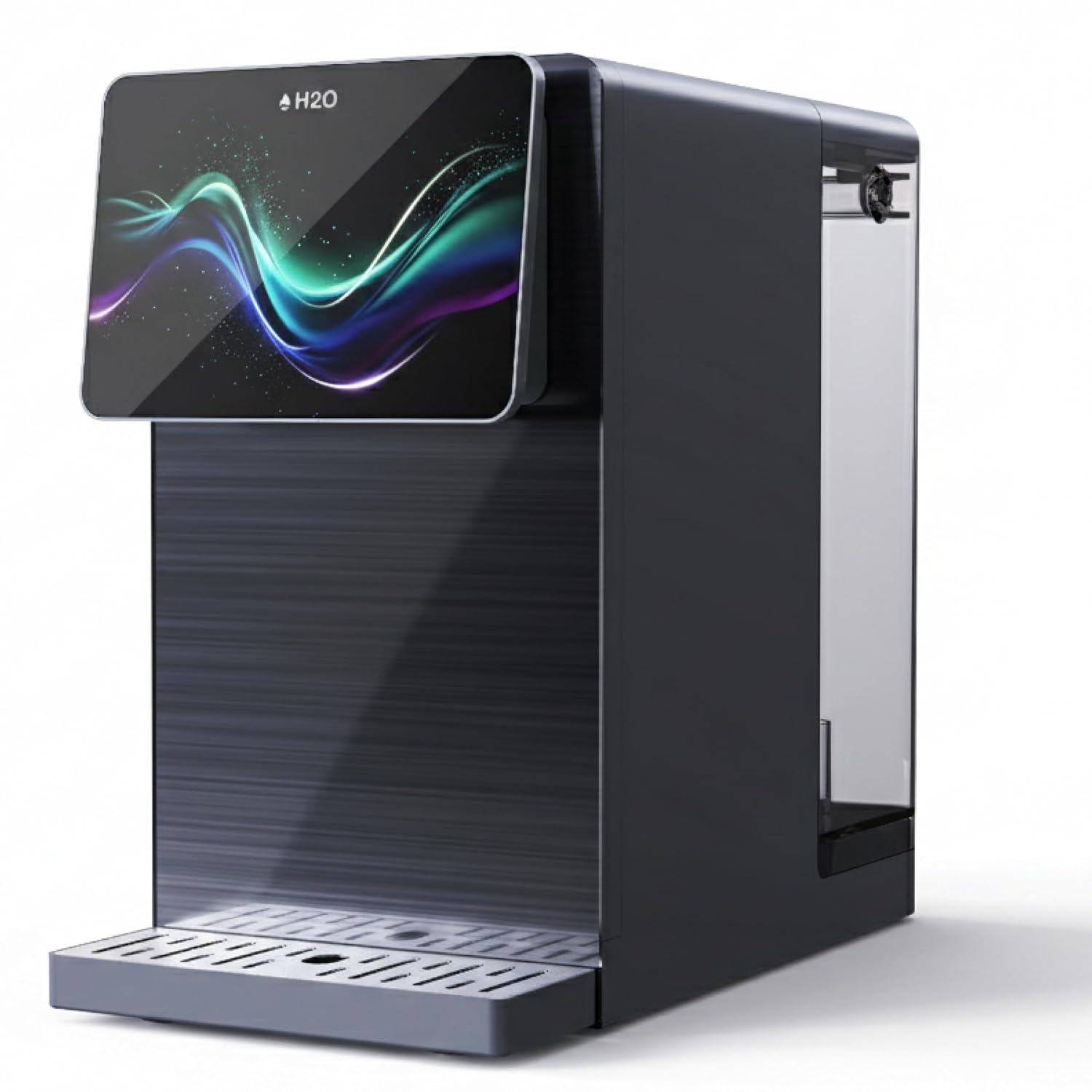
The Cascade H2O is 45 cm wide, 22 cm deep, and 40 cm tall. It weighs 10 kg fully assembled — more than double most countertop RO units, primarily due to the integrated heating element and 7-litre tank. You need a bench that can take the weight and the footprint. If your kitchen benchtop is narrower than 55 cm of clear workspace, this unit will feel crowded.
Setup is more involved than the advertised “5 minutes”. The manual is clear on filter installation, but the fill-and-flush protocol (three full tank cycles before use) is not prominent enough. I would miss it if I were not already familiar with RO commissioning. The dispenser tap uses a weighted handle with clear temperature LEDs. The drip tray is generously sized and removes for emptying without tools.
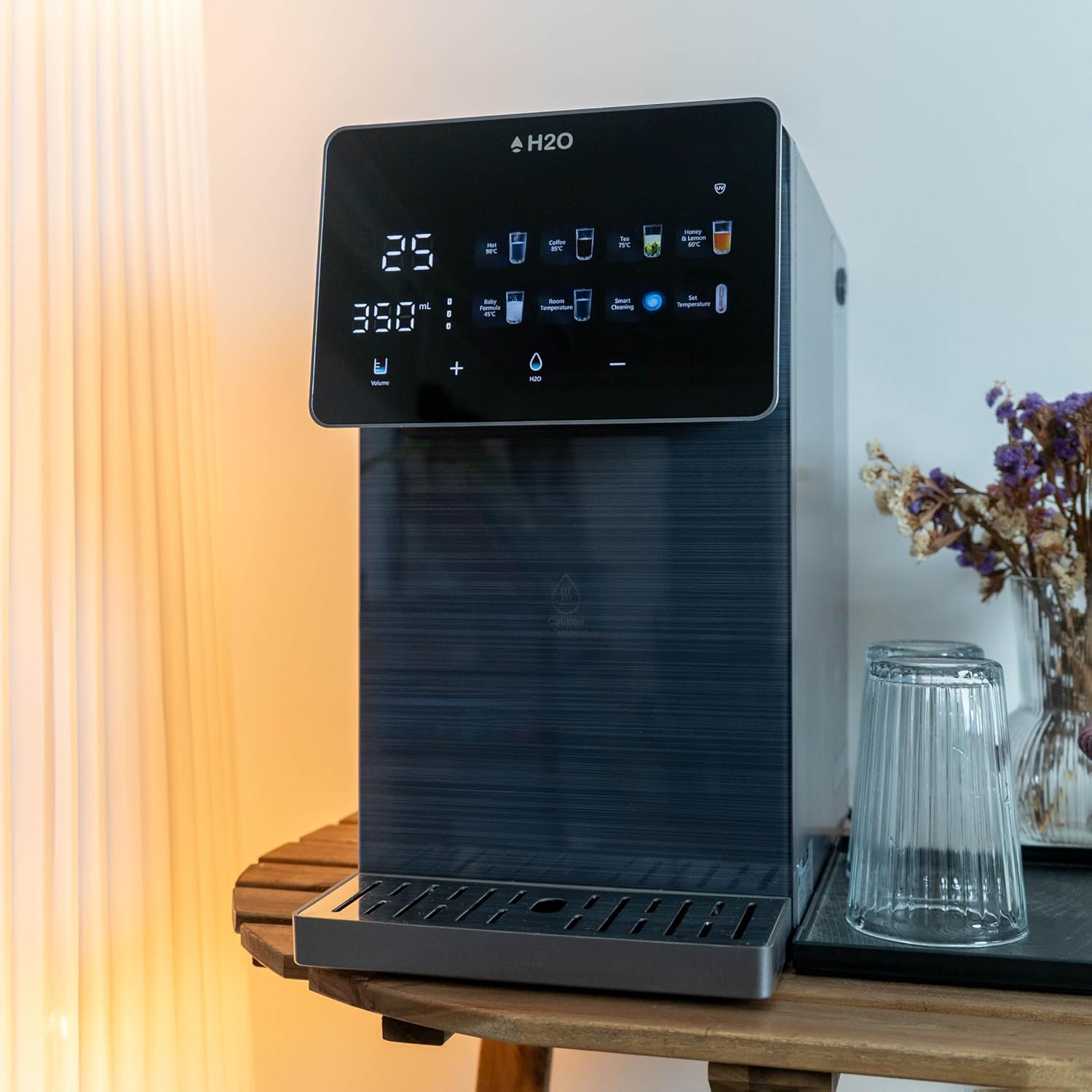
The outer casing is a dark charcoal ABS body with a brushed metal texture on the front dispenser panel. The top-mounted touchscreen display is large and angled toward the user — it shows the H2O logo and animated wave graphic when active, and the temperature selection interface when dispensing. The right side panel is semi-transparent, giving a view of the internal components and water level. The filter housing compartment opens via a side door with a quarter-turn latch, giving good access to all six stages without pulling the unit from the wall.
Running Costs and Maintenance
The Cascade H2O uses a single filter set with an 8-month replacement interval. Cascade AU prices replacement filters at approximately $159–$199 per set, available exclusively through their website — there is currently no third-party or Amazon AU filter option. At $199 every 8 months, annualised filter cost is approximately $299/year.
The filter-exclusivity risk is real: if Cascade exits the Australian market or changes their filter design, you own a $899 appliance with no replacement parts. AquaTru filters, by contrast, are available through multiple AU retailers and on Amazon. This is a supply-chain dependency that the higher 5-year cost does not fully capture.
How the Cascade H2O Compares
Assessed on specification, not personally tested. Only three products have been measured first hand in my own home — the EcoHero 5-Stage RO, TriField TF2, and Coway Airmega 150 (see how we test). Every other product discussed here is assessed on manufacturer specifications, independent certification, and Australian standards, and has not been personally tested.
| Spec | Cascade H2O | AquaTru Classic | Waterdrop D6 |
|---|---|---|---|
| Type | Countertop RO + Hot | Countertop RO | Under-sink RO |
| Hot Water | 45/75/85/96°C ✓ | No | No |
| Water Recovery | 80% ✓ | ~60% | ~75% |
| Tank Size | 7L ✓ | 3.8L | Plumbed (no tank) |
| NSF Certified | No ✗ | NSF/ANSI 58 ✓ | NSF/ANSI 58 ✓ |
| Plumbing Required | No | No | Yes |
| Annual Filter Cost | ~$299 | ~$120 ✓ | ~$150 |
| Price (AU) | ~$899 | ~$649 ✓ | ~$599 |
| C&N Verdict | Best hot water | Best certified | Owners only |
Final Verdict
The Cascade H2O is a specific-use-case product, not a universal recommendation. If you are a renter in Brisbane or Sydney who wants a single appliance that replaces both a water filter and a kettle, and you are willing to pay the price premium and accept filter-supply dependency, this is the best countertop RO for that job. The 80% recovery rate and 7-litre tank are genuinely better than comparable units, and four hot water temperatures covers everything from baby formula at 45°C to boiling water for tea at 96°C.
If your primary concern is verifiable fluoride removal, buy the AquaTru Classic (NSF/ANSI 58 certified, ~$649). If you own your home and want the lowest running cost, the Waterdrop D6 under-sink unit delivers NSF-certified performance at $0.10/litre. The Cascade H2O is the right call only when “countertop, no plumbing, hot water, large tank” is your actual requirement — and you have $899 plus ~$300/year for filters to commit.
“The only countertop RO that replaces your kettle and your water filter. Buy it for the hot water. Accept the NSF gap.”
Last reviewed: July 2026 — Clean & Native
Frequently Asked Questions
Does the Cascade H2O remove fluoride from Australian tap water?
The Cascade H2O uses a reverse osmosis membrane which is capable of fluoride removal, but the unit has no NSF/ANSI 58 certification to verify the percentage. Reverse osmosis membranes typically remove 90–97% of fluoride. Without certification data, I cannot confirm the specific removal rate for this unit. If verified fluoride removal is your requirement, the AquaTru Classic (NSF/ANSI 58) is the verified alternative.
Can I use the Cascade H2O without plumbing?
Yes. The Cascade H2O is a countertop unit that requires no plumbing. You fill the inlet reservoir manually from your tap, the unit filters the water into its 7-litre storage tank, and you dispense from the front tap. It plugs into a standard 240V Australian power outlet.
How often do I need to replace the Cascade H2O filters?
Filter replacement is recommended every 8 months. The filter set is available exclusively through Cascade Australia at approximately $159–$199 per set. There are currently no third-party replacement filters available in Australia.
What hot water temperatures does the Cascade H2O offer?
The Cascade H2O dispenses hot water at four preset temperatures: 45°C (baby formula, warm drinks), 75°C (coffee, instant noodles), 85°C (green tea, pour-over coffee), and 96°C (boiling water for black tea, cooking). The LED indicator on the dispenser tap shows the selected temperature before dispensing.
What is the Cascade H2O’s water recovery rate and why does it matter?
The Cascade H2O has an 80% water recovery rate, meaning 80% of the water processed becomes purified output and only 20% goes to drain as reject water. Standard RO systems typically have 25–40% recovery, wasting 60–75% of input water. The higher recovery rate reduces drain waste significantly — important in SEQ, which has experienced water restrictions.
Is the Cascade H2O WaterMark certified for Australia?
No. The Cascade H2O does not carry WaterMark certification at the time of this review. WaterMark is the Australian certification for plumbing products, though it is primarily required for products that connect directly to the water supply. As a fill-manually countertop unit, WaterMark is not legally required. NSF/ANSI 58 is the more relevant certification for filtration performance claims.
How does the Cascade H2O compare to the AquaTru Classic in Australia?
The AquaTru Classic is cheaper (~$649 vs ~$899), has lower annual filter costs (~$120 vs ~$299), and is NSF/ANSI 58 certified for verifiable fluoride removal. The Cascade H2O is larger (7L tank vs 3.8L), has an 80% water recovery rate vs ~60%, and includes integrated hot water dispensing at four temperatures. Choose the AquaTru Classic if budget and certification matter. Choose the Cascade H2O if you specifically need hot water capability in a countertop unit.
Get the Australian Home Environment Checklist
30 checks across water, air and EMF. Most of them free. Ranked by impact.
No spam. Unsubscribe any time.

Former Royal Australian Navy Clearance Diver and TAG-E counter-terrorism operator. Founded Clean and Native to apply the same rigorous thinking to the home environment.
Full biography →