How to Test Tap Water at Home Australia 2026
Drafted with AI assistance and checked against published specifications and certifications. First-hand measurements appear only where stated. How we make content
A TDS meter tells you total dissolved solids in your tap water — a useful baseline number — but it cannot identify what those solids are, and it will not detect PFAS, fluoride, lead, or chloramine individually. For contaminant-specific results in Australia, you need a NATA-accredited laboratory test, which is the only method recognised by Australian Drinking Water Guidelines (ADWG 2024) for compliance-grade analysis.
I tested my own tap water at Palm Beach, QLD with a calibrated TDS-3 meter: 69 ppm inlet, 3 ppm post-RO through the EcoHero 5-stage under-sink system — a 95.7% reduction. That number confirmed the RO membrane was working. But it told me nothing about whether PFAS or fluoride were present at the inlet. For that, I sent a sample to a NATA lab. Two different tools, two completely different jobs. Here is exactly when you need each one.
A $25 TDS meter is worth owning for two reasons: confirming your RO membrane is still working and establishing a baseline reading for your mains water. But if you want to know whether your water contains PFAS, fluoride above 1.5 mg/L, lead, or arsenic, a NATA-accredited lab test ($150–$400 depending on the panel) is the only path to a real answer. DIY strip kits fall somewhere in between — useful for pH and free chlorine, unreliable for anything else.
Key catches
- TDS meters do NOT detect PFAS, fluoride, lead, or chloramine individually — they measure electrical conductivity and convert to a ppm number
- DIY strip kits are semi-quantitative at best — colour-matching introduces human error of ±30-50%
- NATA accreditation (ISO 17025) is the Australian standard for legally defensible water test results
- Bore water users MUST get lab testing — speciation for arsenic As(III) vs As(V) determines which filter technology works
What a TDS Meter Actually Measures — and Its Hard Limits
A TDS meter does not analyse your water. It measures electrical conductivity — how easily a tiny current passes between two electrodes submerged in your sample — and then applies a conversion factor (typically 0.5 or 0.7, depending on calibration) to estimate the concentration of dissolved solids in parts per million (ppm). That number represents the combined total of everything dissolved: calcium, magnesium, sodium, chloride, silica, bicarbonates, and anything else that conducts electricity. It does not tell you which of those substances are present, or in what ratio.
This matters enormously. Melbourne’s tap water reads around 60 ppm TDS, according to Melbourne Water annual reports. That is very soft, very low mineral content. Brisbane (SEQ Water network) typically reads 80–115 ppm. Adelaide often hits 400 ppm or higher. Perth sits around 170 ppm. All four readings are perfectly safe drinking water that meets ADWG guidelines. The number itself does not indicate danger — it indicates mineral load. A bore water sample at 350 ppm could be harmless calcium bicarbonate, or it could contain arsenic at 0.01 mg/L within that same 350 ppm total. The TDS meter cannot distinguish between those two scenarios.
What a TDS meter is actually useful for is verifying filter performance. When I measured 69 ppm at my Palm Beach inlet and 3 ppm after the EcoHero 5-stage RO system, that 95.7% reduction confirmed the RO membrane was rejecting dissolved solids correctly. If that post-RO reading climbed to 15 or 20 ppm over months, I would know the membrane needed replacing. For this purpose — ongoing RO membrane monitoring — a TDS meter is the single most cost-effective tool you can own. A TDS-3 meter costs roughly $25 on Amazon AU and lasts years on a single battery.
But here is where most Australian water testing guides mislead you: a TDS reading of zero does not mean your water is contaminant-free. Reverse osmosis removes 90–97% of dissolved solids, but some contaminants exist at parts-per-trillion (ppt) concentrations. PFAS compounds, for example, are regulated under the updated ADWG at 0.07 µg/L for PFOS and PFOA combined — that is 0.00007 mg/L. Even a perfect TDS meter cannot resolve concentrations that low. Neither can any consumer-grade instrument. For PFAS, you need mass spectrometry at a NATA-accredited laboratory. No shortcut exists.
DIY Test Strips: Semi-Quantitative Screening at Best
Walk into Bunnings or search Amazon AU for “water test kit” and you will find multi-parameter strip kits that claim to measure pH, hardness, free chlorine, nitrates, nitrites, lead, and sometimes iron. These strips work by colour reaction — you dip a strip into your water sample, wait 30–60 seconds, and compare the colour change against a printed chart. The problem is that colour-matching is subjective and imprecise. Independent assessments of consumer test strips consistently show error margins of ±30–50% compared to laboratory reference methods.
For pH and free chlorine — the two parameters where test strips perform best — you can get a reasonable screening result. If your strip shows free chlorine at 0.5–1.0 mg/L and pH between 6.5 and 8.5, you are within the ADWG aesthetic guideline ranges and you can move on. But here is the critical distinction for Australian cities: if you live in Brisbane, Sydney, Adelaide, or Darwin, your water utility uses chloramine — not free chlorine. Perth uses free chlorine, not chloramine. Most consumer test strips are designed to measure free chlorine only. They will return a misleadingly low reading in chloramine-treated cities because chloramine does not react the same way with DPD reagents unless the strip specifically includes a total chlorine indicator.
For lead, the strips are particularly unreliable. Lead contamination in Australian water typically comes from old brass fittings and lead-soldered copper joints within your home’s plumbing — not from the mains supply. Sydney Water, Melbourne Water, and SEQ Water all test at network level and meet ADWG limits. But a strip test telling you “no lead detected” at home means nothing definitive because the strip’s detection threshold is often 15 ppb (parts per billion) — right at the ADWG health-based guideline value of 0.01 mg/L (10 ppb). You could have 9 ppb lead and the strip reads negative. That is not a clean result. That is a resolution failure.
For PFAS, no consumer test strip exists. Full stop. PFAS analysis requires liquid chromatography-tandem mass spectrometry (LC-MS/MS) performed under controlled laboratory conditions. The NSW Government confirmed in its 2024–2025 testing updates that all public water supplies meet the updated ADWG PFAS limits, but if you are on bore water or a private supply near a known contamination site — Williamtown NSW, Oakey QLD, Katherine NT, or the Kwinana industrial corridor in Perth — a lab test is not optional. It is essential.
When You Need a NATA-Accredited Lab Test — and What It Costs
NATA (National Association of Testing Authorities) accreditation means a laboratory operates under ISO/IEC 17025 — the international standard for testing and calibration laboratory competence. In Australia, NATA accreditation is the benchmark that courts, regulators, and water utilities rely on for legally defensible results. If you want to know whether your water contains a specific contaminant at a specific concentration, a NATA lab is the only path that produces a reliable, defensible answer.
The cost depends on the testing panel. A basic potability screen (heavy metals, pH, turbidity, E. coli, total coliforms) typically runs $150–$200. A comprehensive panel adding PFAS analysis jumps to $300–$400 because LC-MS/MS instrumentation is expensive to operate and calibrate. Some labs offer tiered packages: Envirolab in Sydney, ALS in Brisbane and Melbourne, and SGS in Perth all provide residential water testing panels with online ordering and prepaid sample kits shipped to your door.
Who should get a NATA lab test
Bore water users are the highest-priority group. Unlike reticulated mains water, bore water is not treated or monitored by a utility. Bore water chemistry varies dramatically by aquifer, geology, and depth. If you are in the Perth metro fringe — Rockingham, Mandurah, Serpentine-Jarrahdale — or in regional Queensland — the Darling Downs, Lockyer Valley, or coastal alluvial aquifers — your bore water may contain naturally occurring arsenic, fluoride above 1.5 mg/L, or elevated nitrates from agricultural runoff.
The arsenic speciation issue deserves specific attention. Arsenic exists in two oxidation states in groundwater: arsenite (As(III)) and arsenate (As(V)). This matters because standard activated alumina and iron-based adsorptive media remove As(V) efficiently but perform poorly against As(III). If a NATA lab test returns an arsenic result above the ADWG health-based guideline of 0.01 mg/L, you need to request speciation — the lab identifies which form dominates. Without that information, you could install a filter that targets As(V) while your bore water contains primarily As(III), and achieve minimal removal. Pre-oxidation (typically chlorination or ozone) converts As(III) to As(V) before filtration, but you cannot design that treatment chain without knowing the speciation ratio first.
Households near known PFAS contamination sites should also test. The Australian Government Department of Climate Change, Energy, the Environment and Water (DCCEEW) maintains a national PFAS contamination investigation register listing 700+ confirmed sites across Australia. Defence bases (Williamtown, Oakey, Edinburgh, East Sale), airports, and fire training facilities are the primary source areas. If you live within 5 km of a listed site and draw from a private bore or rainwater tank, a PFAS-specific lab panel is not precautionary — it is necessary.
Rainwater tank users relying on tank water as their primary drinking source should test annually at minimum. Bird and animal faecal contamination introduces E. coli, Campylobacter, and potentially heavy metals from roof materials (zinc, lead from old flashing). The ADWG recommends that all private drinking water supplies be tested at least annually for microbial indicators.
| Contaminant | ADWG Guideline Value | TDS Meter Detects? | DIY Strip Detects? | NATA Lab Required? |
|---|---|---|---|---|
| PFAS (PFOS + PFOA) | 0.07 µg/L combined | No | No | Yes – LC-MS/MS |
| Fluoride | 1.5 mg/L (health) | No | No (strips unreliable) | Yes – ion chromatography |
| Lead | 0.01 mg/L (10 ppb) | No | Unreliable (±50%) | Yes – ICP-MS |
| Arsenic (total) | 0.01 mg/L | No | No | Yes – request As(III)/As(V) speciation |
| Chloramine | 3 mg/L (aesthetic) | No | Only if “total chlorine” strip | Optional – utility reports available |
| E. coli | 0 CFU/100 mL | No | No | Yes – culture or Colilert method |
| Hardness (CaCO₃) | 200 mg/L (aesthetic) | Indirectly (higher TDS = likely harder) | Yes – acceptable accuracy | Optional |
| pH | 6.5–8.5 (aesthetic) | No | Yes – reasonable accuracy | Optional |
Decision Tree: Which Test Do You Actually Need?
Most people reading this article do not need a $400 lab panel. If you are on reticulated mains water in Sydney, Melbourne, Brisbane, Adelaide, or Perth, your utility already tests at multiple network points daily and publishes compliance reports against ADWG standards. Sydney Water, Melbourne Water, and SEQ Water all maintain publicly accessible water quality dashboards updated daily. Your mains water meets guidelines at the treatment plant and distribution network level.
The question is what happens between the street main and your kitchen tap. That is where your internal plumbing, age of your home, and pipe materials come into play. Pre-1980s homes in Sydney (particularly inner-west suburbs like Marrickville, Leichhardt, and Balmain) and Melbourne (Fitzroy, Carlton, Brunswick) may still have lead-soldered copper joints or brass fittings with high lead content. For those homes, a first-draw lead test from a NATA lab — where you collect the very first water from the tap after 8+ hours of stagnation overnight — is the most targeted test you can run. It costs $50–$80 as a single-analyte test.
Use this three-question decision framework:
Water Testing Decision Tree
1. What is your water source?
→ Mains (city/town water): Start with a TDS meter ($25). Check your utility’s online quality report first. Proceed to question 2.
→ Bore water or rainwater tank: Go directly to NATA lab test. You have no utility monitoring your supply. A comprehensive potability panel ($200–$350) is the minimum.
2. What are you trying to find out?
→ Is my RO/filter still working? TDS meter before and after filter. Compare to your baseline. If post-filter TDS rises above 10% of inlet, replace membrane.
→ Do I have lead from old plumbing? NATA lab first-draw lead test ($50–$80).
→ Do I have PFAS? NATA lab PFAS panel ($250–$400). No consumer test can detect PFAS.
3. Which city are you in? (Determines disinfection type for filter selection.)
→ Chloramine cities (Brisbane, Sydney, Adelaide, Darwin): Standard GAC and Brita jugs will NOT remove chloramine effectively. You need catalytic carbon, compressed carbon block, or RO. Perth uses free chlorine — standard carbon filters work.
→ Free chlorine cities (Melbourne, Hobart, Canberra, Townsville, Cairns, Toowoomba): Standard activated carbon works fine for taste and odour improvement.
The decision tree above saves you from over-testing and under-testing simultaneously. If you are on Brisbane mains water and your concern is chloramine taste, you do not need a $400 PFAS panel. You need a catalytic carbon or RO system rated for chloramine. If you are on bore water near Oakey QLD, you need the full panel before you spend a dollar on filtration equipment — because the lab results determine which filtration technology will actually work for your specific contamination profile.
How to Take a TDS Reading — Step by Step
This is simple, but technique matters. A sloppy sample gives a sloppy number. Here is the process I follow at my Palm Beach QLD home, and it takes under two minutes.
Step 1: Flush the tap. Run cold water for 30 seconds to clear standing water from your internal plumbing. Standing water absorbs more minerals from pipe walls and will give you an artificially elevated reading that does not represent your mains supply quality.
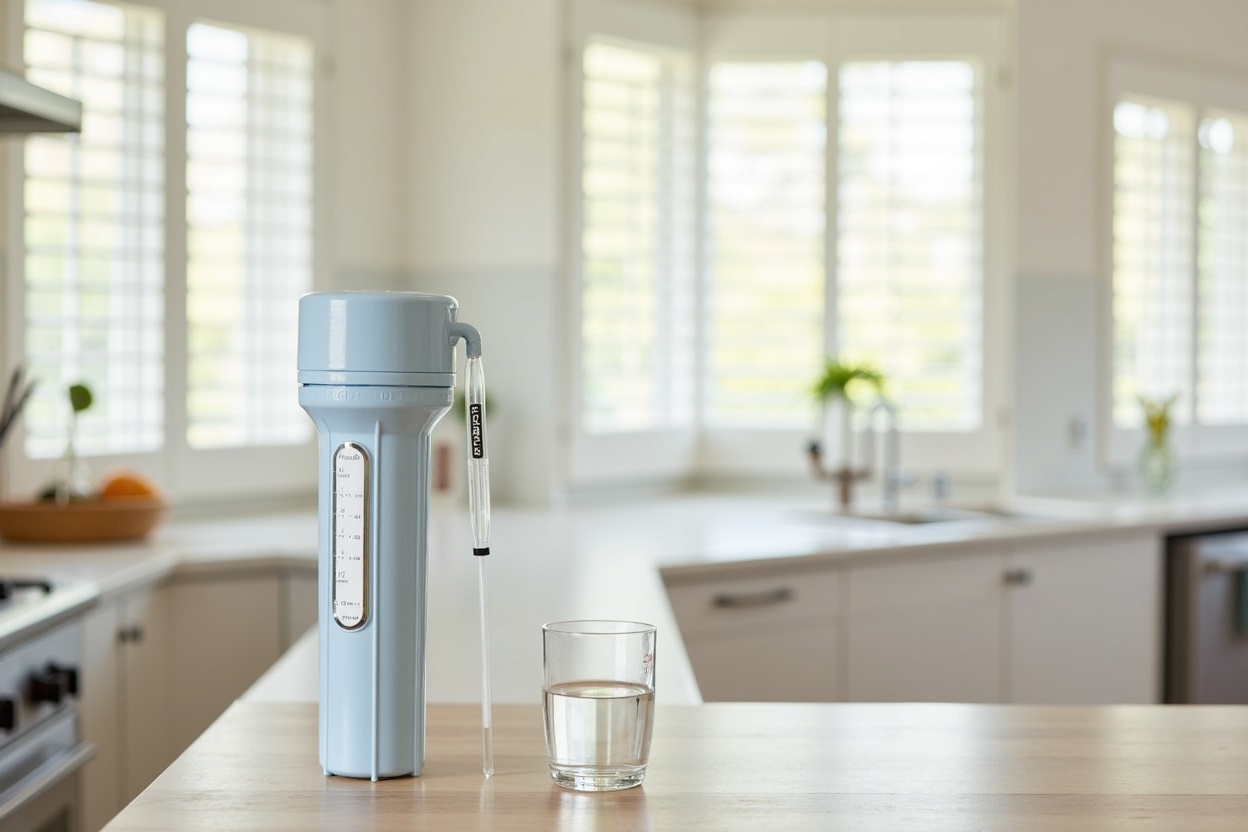
Step 2: Fill a clean glass. Use a glass rinsed with the same tap water — not a glass from the dishwasher (detergent residue will inflate the reading). Fill halfway.
Step 3: Insert the TDS meter probe. Submerge the electrodes (the bottom 3 cm of the meter) into the water. Hold the meter at a slight angle so air bubbles do not trap between the probes. Wait for the reading to stabilise — typically 3–5 seconds on a TDS-3 meter.
Step 4: Record the number. Write it down with the date. This is your baseline. If you are testing before and after a filter, repeat the same process on the filtered water output immediately. Same glass (rinsed with filtered water this time), same technique.
Step 5: Interpret. The ADWG does not set a health-based guideline for TDS specifically. It lists an aesthetic guideline of 600 mg/L (600 ppm). Below that, the water is considered acceptable for taste. For reference: Melbourne typically reads ~60 ppm, Brisbane ~80–115 ppm, Adelaide ~400 ppm, Perth ~170 ppm. All are safe. A high TDS reading does not mean unsafe water. A low TDS reading does not mean pure water.
For RO system owners: Take a reading monthly. A properly functioning RO membrane should reject 90–97% of TDS. My Palm Beach inlet reads 69 ppm consistently. Post-RO reads 3 ppm — a 95.7% rejection rate. If your rejection rate drops below 80%, the membrane is degrading and needs replacement. This single metric — inlet vs outlet TDS — is the most reliable home indicator of RO membrane health, and it is endorsed by membrane manufacturers including Dow FilmTec and Hydranautics.
ADWG Reference Limits Every Australian Should Know
The Australian Drinking Water Guidelines (ADWG) are maintained by the National Health and Medical Research Council (NHMRC) and updated periodically — the most recent significant update included PFAS guideline values finalised in 2024–2025. Unlike the US EPA, which sets legally enforceable Maximum Contaminant Levels, the ADWG provides guideline values that are technically not mandatory for all water suppliers. However, all major urban water utilities voluntarily comply with them, and state health regulations typically reference them as the benchmark.
The guidelines distinguish between health-based guideline values (contaminants that pose a genuine health risk above the stated concentration) and aesthetic guideline values (taste, odour, appearance — not health-related). This distinction is important because many consumer water testing products conflate the two. A TDS reading of 500 ppm exceeds no health guideline. Water that smells of chlorine at 1.5 mg/L exceeds no health guideline either — the aesthetic guideline for chlorine is 0.6 mg/L (taste threshold), but the health-based assessment allows significantly more.
| Parameter | ADWG Health Guideline | ADWG Aesthetic Guideline | What This Means for You |
|---|---|---|---|
| Fluoride | 1.5 mg/L | – | Most cities dose at 0.6–1.0 mg/L. Only RO or activated alumina removes fluoride. Carbon filters cannot. |
| Lead | 0.01 mg/L | – | Usually from internal plumbing, not mains. First-draw lab test is definitive. |
| PFOS + PFOA | 0.07 µg/L combined | – | Updated 2024–2025. Lab test only. NSF/ANSI P473 certified RO removes >95%. |
| Arsenic | 0.01 mg/L | – | Bore water risk. Request As(III)/As(V) speciation if detected. |
| Chlorine (free) | 5 mg/L | 0.6 mg/L (taste) | Melbourne, Hobart, Canberra use free chlorine. Carbon filters remove it effectively. |
| Chloramine | 3 mg/L | – | Brisbane, Sydney, Adelaide, Darwin. Requires catalytic carbon or RO — standard GAC removes at ~1/40th the rate. Perth uses free chlorine (standard carbon effective). |
| TDS | – (no health limit) | 600 mg/L | TDS is NOT a safety indicator. Melbourne ~60 ppm, Brisbane ~80–115 ppm, Adelaide ~400 ppm – all safe. |
| E. coli | 0 CFU/100 mL | – | Zero tolerance. Any detection requires immediate investigation. Bore/tank water risk. |
The most commonly misunderstood guideline is fluoride. Most Australian cities dose fluoride at 0.6–1.0 mg/L, well below the 1.5 mg/L health-based guideline. If you want to reduce fluoride in your drinking water, only reverse osmosis (90–97% removal) or activated alumina (80–95% removal) will work. Carbon filters — including catalytic carbon, carbon block, and granular activated carbon — cannot remove fluoride. This is a non-negotiable chemistry fact. Any filter company telling you otherwise is either misinformed or dishonest. For a breakdown of the best systems that actually remove fluoride, see our best water filter for Australia 2026 guide.
Honest Limitations: What No Home Test Can Tell You
I want to be direct about what even a NATA lab test cannot do — because no testing method is a complete picture frozen in time.
Water quality varies. A single sample taken at 7 am on a Tuesday represents that moment at that tap. Seasonal variation, rainfall events, utility flushing schedules, and temperature changes all affect water chemistry. A comprehensive understanding requires multiple samples over time. For bore water, seasonal water table fluctuations can dramatically change contaminant concentrations — a dry-season bore sample may test clean for arsenic while the same bore during wet season, when the water table rises and contacts different geological strata, may return elevated readings. If your NATA result is borderline for any contaminant, test again in a different season.
Lead is episodic. Lead leaching from plumbing is worst in first-draw water after overnight stagnation and in acidic water (low pH). A sample taken after running the tap for five minutes will show much lower lead than a first-draw sample. Both are “accurate” — they just measure different conditions. If you are testing for lead, always do a first-draw sample AND a flushed sample so the lab can compare.
TDS meters drift. The electrodes on a cheap TDS-3 meter can develop mineral scale over months, causing readings to creep upward. Rinse the probes in distilled water after each use and recalibrate annually using a known 342 ppm NaCl calibration solution (available from aquarium suppliers). A $25 meter is not a precision instrument — it is a screening tool with an accuracy range of ±2%, which is perfectly adequate for filter monitoring but not for regulatory compliance.
No home test replaces your utility’s monitoring. Sydney Water tests at over 200 network points across the Sydney basin. Melbourne Water monitors continuously at treatment plants and service reservoirs across the Yarra Valley, western, and south-eastern networks. SEQ Water publishes daily compliance data for the 12 treatment plants serving Brisbane and the Gold Coast. These utilities employ thousands of analytical tests per year at NATA-accredited laboratories. Your single home test does not override that data — it supplements it by checking what happens inside your specific plumbing.
The honest position is this: Australian mains water, as delivered by major urban utilities, consistently meets ADWG standards. The case for home filtration is not that your mains water is dangerous — it is that ADWG compliance limits represent a population-wide safety standard, and you may choose a stricter personal standard for specific contaminants like chloramine, fluoride, or PFAS. Testing tells you where you stand. Filtration moves you to where you want to be. Neither replaces the other.
Final Verdict: Test First, Filter Second
The sequence matters. Every dollar you spend on filtration equipment before understanding your water chemistry is a dollar that might be solving the wrong problem. A $25 TDS meter establishes your baseline. Your utility’s free online water quality report tells you what is in your mains supply at the network level. A $50–$400 NATA lab test (scaled to your specific concerns) tells you what is arriving at your actual tap.
Once you have data, filter selection becomes a technical matching exercise rather than a guessing game. If your lab test shows fluoride at 0.9 mg/L and you want it lower, you need RO — carbon will not touch it. If your TDS meter shows 400 ppm Adelaide tap water and you want mineral reduction, you need RO. If your concern is chloramine in Brisbane or Sydney, you need catalytic carbon or RO — not the Brita jug in your fridge. For our full under-sink water filter rankings for Australia, or our reverse osmosis filter guide for Australia, we have already done the matching for every major Australian city and water source.
Measure first. Then act on what the measurement tells you. That is the process.
Last reviewed: July 2026 – Clean and Native
Ready to filter based on your test results?
The AquaTru Classic RO is the top-rated countertop reverse osmosis system for Australian homes — no plumbing required. NSF/ANSI 58 certified, removes fluoride, PFAS, lead, and chloramine. Plug in, fill the tank, drink.
Frequently Asked Questions
Does a TDS meter detect PFAS in Australian tap water?
No. PFAS compounds exist at parts-per-trillion concentrations (the ADWG limit is 0.07 µg/L for PFOS and PFOA combined), which is far below any TDS meter’s resolution. Only NATA-accredited laboratory analysis using LC-MS/MS can detect and quantify PFAS in water.
Can a TDS meter tell me if my water filter is working?
Yes — for RO and distillation systems. Measure inlet TDS and post-filter TDS. A properly functioning RO membrane should show 90–97% rejection. If your post-filter reading climbs above 10–15% of inlet, the membrane needs replacing. TDS meters do not verify carbon filter performance because carbon removes contaminants without significantly changing TDS.
How much does a NATA lab water test cost in Australia?
A basic potability screen (metals, pH, turbidity, E. coli) costs $150–$200. A comprehensive panel including PFAS analysis costs $300–$400. Single-analyte tests like lead-only cost $50–$80. Labs like ALS, Envirolab, and SGS offer residential kits shipped to your home.
What is a normal TDS reading for Brisbane tap water?
Brisbane (SEQ Water network) typically reads 80–115 ppm TDS, with hardness around 80–120 mg/L CaCO₃. This is moderate by Australian standards. Melbourne reads ~60 ppm (very soft), Adelaide ~400 ppm (hard), and Perth ~170 ppm. All are within ADWG aesthetic guidelines.
Do I need to test my tap water if I am on mains water in Sydney?
Sydney Water tests at over 200 network points and publishes daily compliance data meeting ADWG standards. For most households, mains water is safe without additional testing. However, if your home was built before 1980 and may have lead-soldered plumbing, a first-draw lead test ($50–$80 via a NATA lab) is worthwhile. Sydney uses chloramine for disinfection, so a standard Brita or GAC jug will not remove it effectively.
What is arsenic speciation and why does it matter for bore water?
Arsenic exists in two forms in groundwater: arsenite (As(III)) and arsenate (As(V)). Standard adsorptive media like activated alumina and iron-based filters remove As(V) effectively but perform poorly against As(III). If your bore water contains arsenic above the ADWG guideline of 0.01 mg/L, you must request speciation from the lab so you know which form dominates and can select the correct treatment technology. Pre-oxidation may be needed to convert As(III) to As(V) before filtration.
Can a carbon filter remove fluoride from Australian tap water?
No. Carbon filters — including granular activated carbon, catalytic carbon, and carbon block — cannot remove fluoride. Only reverse osmosis (90–97% removal) or activated alumina (80–95% removal) will reduce fluoride. Most Australian cities dose fluoride at 0.6–1.0 mg/L, below the ADWG health guideline of 1.5 mg/L.
How often should I test my bore water in Australia?
The ADWG recommends testing private drinking water supplies at least annually for microbial indicators (E. coli, total coliforms). For bore water, test twice per year — once in the dry season and once during or after wet season — because water table fluctuations can change contaminant concentrations significantly. If your initial test shows borderline arsenic, nitrate, or fluoride levels, increase to quarterly testing.
Are DIY water test strips accurate enough for lead detection?
No. Most consumer test strips have a lead detection threshold of around 15 ppb, which is above the ADWG health guideline of 10 ppb (0.01 mg/L). A result showing “no lead detected” on a strip could still mean lead is present at 9 ppb. For lead, a NATA-accredited first-draw lab test is the only reliable method. Collect the sample from the first water out of the tap after 8+ hours of stagnation.
Does Melbourne tap water need testing for chloramine?
No. Melbourne Water uses free chlorine for disinfection, not chloramine. Standard activated carbon filters (including Brita, PUR, and basic GAC systems) remove free chlorine effectively. Chloramine-specific filtration (catalytic carbon or RO) is needed in Brisbane, Sydney, and Adelaide. Perth also uses free chlorine (not chloramine), confirmed by the Water Corporation — standard carbon filters work in Perth for chlorine removal. Darwin uses chloramine.
Get the Australian Home Environment Checklist
30 checks across water, air and EMF. Most of them free. Ranked by impact.
No spam. Unsubscribe any time.

Former Royal Australian Navy Clearance Diver and TAG-E counter-terrorism operator. Founded Clean and Native to apply the same rigorous thinking to the home environment.
Full biography →