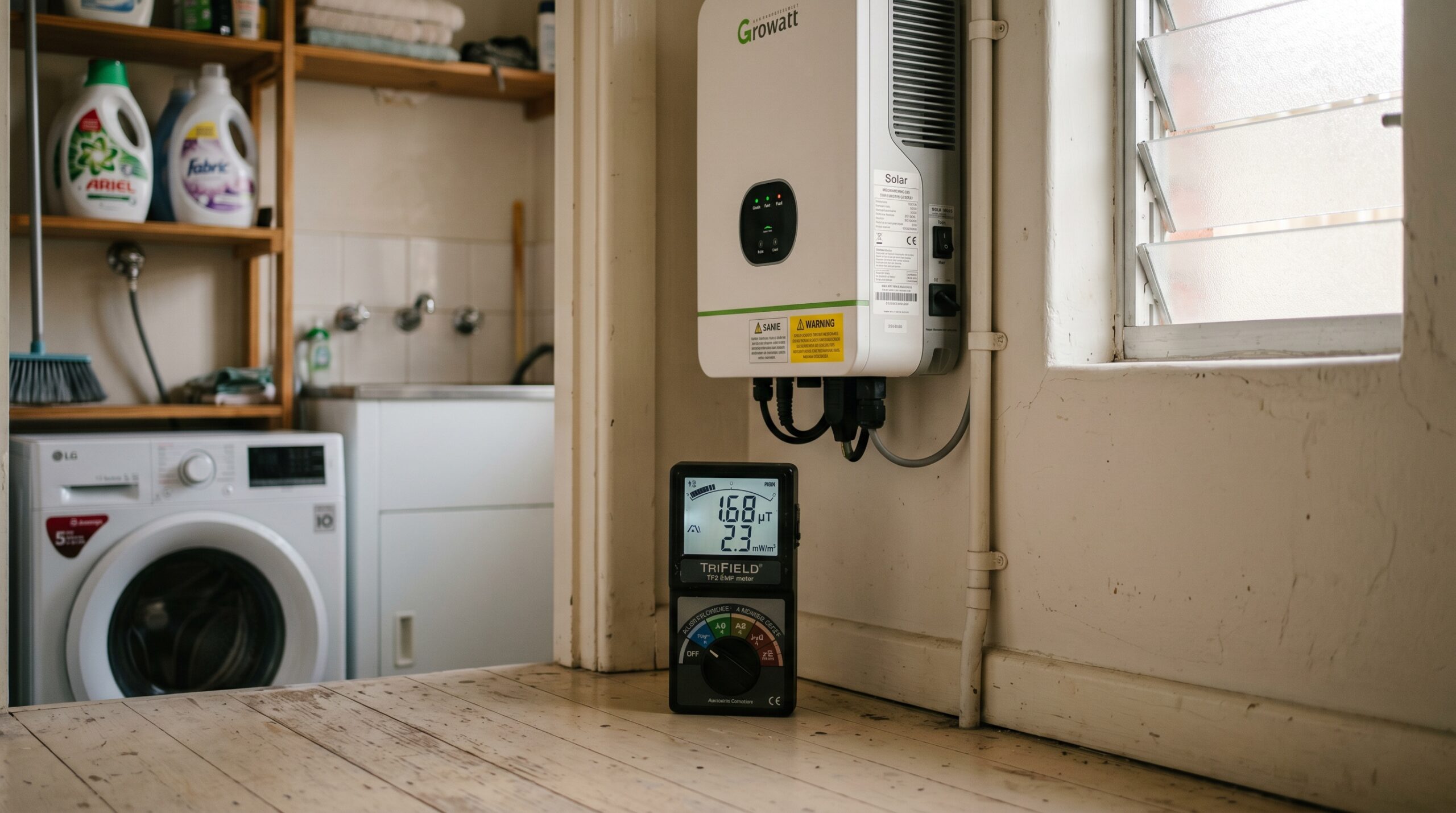
EMF from Solar Panels and Inverters: What Australian Homeowners Need to Know
Drafted with AI assistance and checked against published specifications and certifications. First-hand measurements appear only where stated. How we make content
Australia has 3.9 million rooftop solar systems — the highest residential penetration per capita on Earth — yet almost no quality information exists about the EMF they generate inside your home. This guide draws on TriField TF2 specifications and our documented methodology, compiled by Jayce Love, former Royal Australian Navy Clearance Diver at Palm Beach QLD, to give you honest, measurement-based answers.
Quick Verdict — Solar Panel and Inverter EMF Australia
Solar panels themselves produce minimal EMF. The real source is your inverter: it generates significant power-frequency magnetic fields within 1–2 metres, and dirty electricity throughout your home wiring. Both are manageable with correct inverter placement and, if needed, dirty electricity filters.
| EMF Source | What it generates | Verdict |
| Solar panels (roof) | Minimal DC field, only relevant if you sleep on a roof | Not a concern |
| Inverter (indoors) | 50Hz magnetic fields up to 5–20 µT within 1m | Placement matters — keep 2m+ from sleeping/working areas |
| Inverter dirty electricity | High-frequency harmonics injected into wiring | Can be measured with TriField TF2; dirty electricity filters reduce it |
What EMF Does a Solar System Actually Produce?
Your solar system has two distinct EMF profiles — and almost all the concern is concentrated in one component. Understanding which component to focus on prevents both unnecessary anxiety about the panels on your roof and missed action on the inverter that actually matters.
The Solar Panels Themselves (Roof)
The DC output from solar panels creates a very weak static magnetic field. Because it’s DC (not AC), it doesn’t oscillate at 50Hz and produces no time-varying electromagnetic field. This is a crucial distinction: the power-frequency EMF concerns — the type examined in epidemiological research — require time-varying fields at 50Hz or higher. A static DC field does not qualify, and is not the type measured by standard EMF meters in their magnetic field mode.
The panels also sit 4–8 metres above your living areas on the roof, further reducing any potential exposure to negligible levels. Even if you factor in the DC cabling running from the roof to the inverter, the field strength drops to background noise within centimetres of the cable. Practical EMF exposure from solar panels on your roof: negligible. No action needed.
The Inverter — The Real EMF Source
Here is where the actual concern lies. The inverter converts DC power from your solar panels into 240V AC at 50Hz — the same frequency as Australia’s mains power grid. This conversion process creates significant power-frequency (50Hz) magnetic fields in the immediate area surrounding the unit.
Reported readings at a standard residential string inverter (5–10kW system) during peak solar generation typically fall in this range:
| Distance from inverter | Typical magnetic field (µT) | Vs building biology threshold (0.2 µT) |
|---|---|---|
| 30cm | 5–20 µT | 25–100× above threshold |
| 1m | 0.5–3 µT | 2.5–15× above threshold |
| 2m | 0.1–0.5 µT | At or near threshold |
| 3m+ | <0.1 µT | Below threshold ✓ |
The governing physics principle is the inverse square law: double your distance from the inverter, and the magnetic field drops by approximately four times. At 30cm you might read 10 µT; at 60cm approximately 2.5 µT; at 1.2m approximately 0.6 µT; at 2m approximately 0.1–0.3 µT. This is why placement is the single most important factor — not any shielding product, not any filter device.
Building biology guidelines set the sleeping area threshold at 0.2 µT for magnetic fields. For reference, the ARPANSA regulatory limit is 1,000 µT — set purely on thermal safety grounds, not precautionary. If you are applying building biology precautionary standards, the relevant number is 0.2 µT, and you need to verify your inverter achieves that at your actual sleeping position, not just at a generic distance estimate.
Dirty Electricity — The EMF Nobody Discusses
The second category of solar-related EMF gets almost no attention in mainstream solar guides: dirty electricity. When your inverter converts DC to AC, the switching electronics introduce high-frequency harmonic distortions (typically in the 1kHz–100kHz range) back into your home’s wiring. These harmonics ride on top of the standard 50Hz sine wave — hence the colloquial term “dirty electricity,” or in electrical engineering terms, “harmonic distortion.”
Unlike the localised 50Hz magnetic field from the inverter body itself, dirty electricity propagates throughout every circuit connected to that wiring loop. The harmonics generated by your inverter in the garage can be present at measurable levels in your bedroom power points, living room circuits, and anywhere else connected to the same phase of wiring.
In Australian context, inverter brand matters here. Based on published Total Harmonic Distortion (THD) specifications and independent testing reports:
- Enphase microinverters (per-panel units): Generally lower harmonic output than string inverters per unit, partly because each unit handles a smaller power load and the AC wiring runs are shorter
- Fronius string inverters: Well-regarded for low THD; Fronius publishes detailed harmonic specs in their datasheets — look for <3% THD figures on current-generation Primo and Symo models
- SolarEdge with power optimisers: DC-DC conversion occurs at each panel (introducing its own high-frequency switching), though the main inverter THD is published and typically low at the grid connection point
- Sungrow: Competitive THD figures, widely installed across Australian residential solar since 2020; good harmonic performance on current SG series
- Generic/budget string inverters: THD specs are often unpublished or poorly regulated in the lower price brackets; tend to be higher harmonic emitters and more variable unit-to-unit
Dirty electricity is measured differently to power-frequency magnetic fields. The TriField TF2 in magnetic mode captures the 50Hz field from the inverter body well, but dedicated instruments like a Stetzerizer microsurge meter provide more precise data in the relevant 4–100kHz harmonic frequency range.
How to Measure EMF from Your Solar System
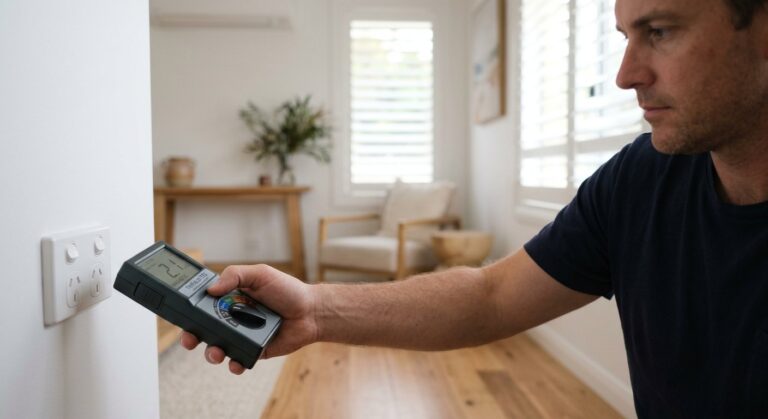
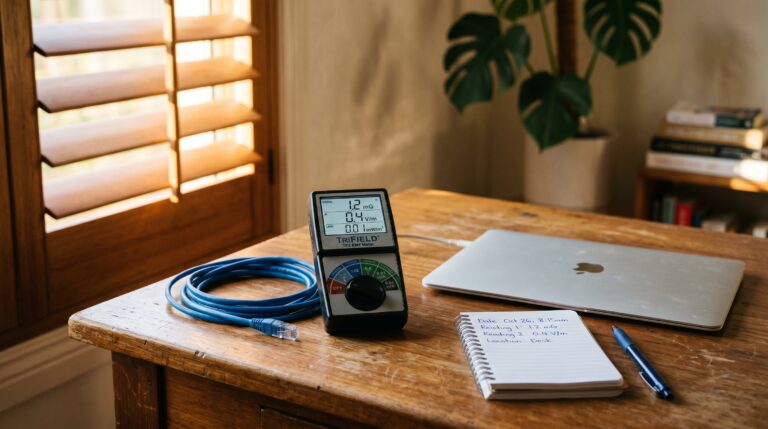
You don’t need specialist equipment for a useful initial assessment. The TriField TF2 is the correct starting point for Australian homeowners — it measures magnetic fields at 50Hz, electric fields, and RF in a single unit. Here is a systematic protocol for Australian homeowners:
- Set TF2 to Magnetic (50/60Hz) mode — this captures the power-frequency field from the inverter directly
- Approach to within 30cm of the running inverter — note the peak reading. This is your “worst case” baseline. Measure at a sunny midday when the system is at or near full output.
- Step back in 30cm increments — record readings at 30cm, 60cm, 90cm, 1.2m, 1.5m, 2m. Confirm the field drops following the inverse square law. Anomalously slow drop-off may indicate the inverter is unusually high-output or the nearby wiring is also carrying significant load.
- Walk the perimeter of adjacent rooms — shared walls, the floor directly above, any room immediately adjoining the inverter location. Standard plasterboard and brick walls do not meaningfully block 50Hz magnetic fields.
- Check your sleeping position specifically — lie in your normal sleeping position and take a reading at pillow height. This is the only number that matters for sleeping exposure assessment.
- Compare to the 0.2 µT building biology threshold — if your sleeping position reading exceeds 0.2 µT, inverter placement should be investigated. If it’s below 0.2 µT, your sleeping area is compliant.
Critical: always measure with the solar system running at close to full output — midday on a sunny day, maximum generation. A partly cloudy day or early morning measurement will give a lower-than-worst-case reading. The inverter’s magnetic field output scales with its generation load, so a half-loaded inverter on a cloudy day can read half of what a peak-load midday measurement shows.
Safe Inverter Placement — The Rule That Matters Most
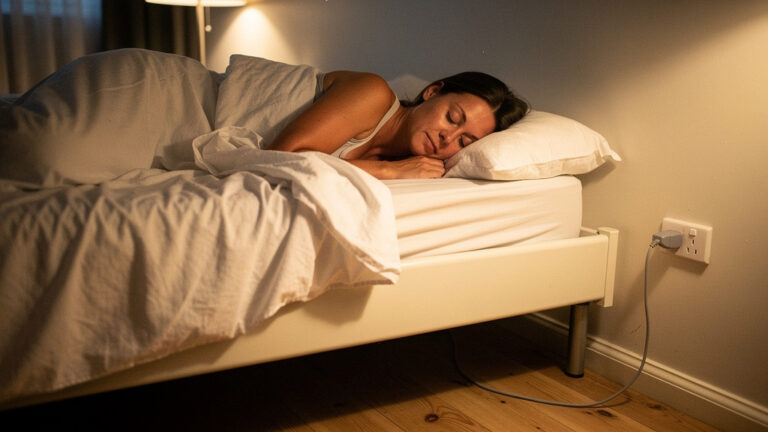
In Australian homes, inverters are overwhelmingly installed in two locations: on an external garage wall, or on an internal wall adjacent to the switchboard in a utility corridor or hallway. The second scenario is where problems arise — because in standard Australian brick-veneer construction from the 1960s through to the 2000s, the switchboard is frequently located in a hallway immediately outside the master bedroom. An inverter installed on that same wall runs continuously for 6–12 hours daily and can push measurable 50Hz fields directly through the wall into the sleeping zone.
This is not a theoretical concern. It is the single most common inverter placement pattern that warrants measurement in Australian residential homes. Solar installers optimise for minimal cable run and installation convenience, not for building biology compliance. The homeowner is not informed to measure.
| Location / Use | Minimum distance from inverter | Notes |
|---|---|---|
| Bedroom (sleeping position) | 3m+ or no shared wall | Priority concern — measure if any shared wall exists |
| Home office (8+ hrs/day) | 2m+ | Measure at desk position, not doorway |
| Living room (general use) | 1.5m+ | Brief pass-through exposure not a priority |
| Kitchen | 1m+ | Transient exposure — not a priority concern |
| Garage / laundry (non-sleeping) | No restriction | Ideal inverter location — removes EMF from living areas entirely |
For existing homes where the inverter is already installed adjacent to a bedroom, you have three practical options:
- Electrician relocates the inverter — typically $200–400 for a standard relocation to an external garage wall or separate utility space. This is the most effective and permanent solution. The solar installer can do this on a service call; it requires disconnecting, recabling, and re-mounting in the new location. A good solar installer will confirm the new location before work begins.
- Verify the actual reading at your sleeping position before acting — walls do attenuate the field to some degree, and actual sleeping position may already be below 0.2 µT even with a shared wall if the distance is sufficient. Measure first. You may find no action is needed.
- Accept the exposure if measurement confirms compliance — if your actual sleeping position reading is below 0.2 µT, document the result with the date and inverter model, and revisit if you change sleeping arrangements.
Dirty Electricity from Solar Inverters — What to Do
Once you have resolved the inverter magnetic field placement question, the next consideration is dirty electricity. This topic is more nuanced: the research is less settled, the measurement requires different instruments, and the mitigation products vary significantly in quality and appropriate application.
Check Your Inverter’s THD Spec First
Before buying any filter product, request the Total Harmonic Distortion (THD) specification for your specific inverter model from the installer or manufacturer. This figure is published by reputable manufacturers (Fronius, SolarEdge, Enphase, Sungrow) and tells you how “clean” the AC output is relative to a pure 50Hz sine wave.
- THD <3%: Excellent — minimal harmonic injection into your wiring. Not a priority concern.
- THD 3–5%: Good — within Australian grid connection requirements. Standard performance for quality residential inverters.
- THD 5–10%: Moderate — worth measuring with a power quality analyser if you have sensitivity concerns or frequently use electronics sensitive to power quality.
- THD >10%: Elevated — consider whether inverter recalibration, replacement, or filtering is warranted, particularly if household members report electromagnetic sensitivity symptoms.
Dirty Electricity Filter Products
Dirty electricity (or “microsurge”) filters work by capacitively shunting high-frequency harmonics away from the active conductor to neutral, reducing their propagation through your home wiring. The best-known products in this category are Graham-Stetzer (Stetzerizer) filters and Greenwave filters. These plug into standard power points and are rated to filter harmonics in approximately the 4kHz–100kHz range.
Practical notes for Australian homeowners considering dirty electricity filters:
- Graham-Stetzer / Stetzerizer filters are not widely stocked on Amazon AU. Check SaferEMF AU for current availability before ordering from overseas suppliers.
- The most effective placement is closest to the harmonic source first — on the nearest power point on the same circuit as the inverter feed — then in rooms where you spend the most time.
- Use the Stetzerizer microsurge meter to take before-and-after readings. This is the only reliable way to confirm filters are reducing harmonics in your specific home’s wiring configuration. Don’t assume they are working without measurement.
- A distributed approach — filters installed at several points throughout the home — outperforms a single filter at the inverter connection. Harmonics propagate bidirectionally through wiring and require attenuation at multiple points.
The Honest Bottom Line — Is Solar EMF a Real Risk?
Solar EMF is a real and measurable phenomenon, but it is almost entirely manageable with correct installation decisions. It is not a reason to avoid solar energy — and for most Australian households whose inverter is correctly placed in a garage, external wall, or utility space away from sleeping areas, it is not an active concern at all.
ARPANSA Limits vs Building Biology Standards — In Context
These are the two reference frameworks you will encounter when researching this topic:
- ARPANSA regulatory limit for 50Hz magnetic fields (ELF-MF): 1,000 µT — this is a thermal safety limit based on the field strength required to induce physiologically significant currents in human tissue. No residential inverter, regardless of placement, comes anywhere close to this limit in normal use.
- Building biology guideline for sleeping areas: 0.2 µT — this is a precautionary practitioner standard from the International Institute for Building-Biology and Ecology (IBE), not a regulatory requirement. It is intended as a goal for sleeping environments specifically, where chronic long-duration exposure is the concern. It is achievable with correct inverter placement in virtually all Australian home configurations.
The choice of which standard to apply is a personal decision. If your concern is regulatory compliance, you are already safe. If you are applying building biology precautionary standards, the 0.2 µT target is achievable — but it requires you to actually measure your specific sleeping position, not assume compliance.
The Actual Risk Pattern in Australian Homes
The biggest practical risk from solar EMF is not the technology itself — it is endemic poor inverter placement in Australian residential installations. The pattern repeats across thousands of homes:
- Installer places inverter adjacent to switchboard for minimal cable run and simplest certification pathway
- Switchboard is in a hallway immediately outside the master bedroom (standard in 1970s–2000s Australian construction)
- Inverter ends up on the bedroom-side wall or immediately adjacent to it
- Homeowner sleeps within 1–2m of the running inverter through a single brick course or plasterboard wall
- Magnetic field at sleeping position: 0.5–5 µT — well above building biology threshold, running for 6–12 hours every day
If your inverter is in your garage, on an external-facing wall of a non-sleeping room, or in a laundry/utility space with no bedroom on the other side, this pattern does not apply to you. Your solar system is very likely not a meaningful EMF concern at your sleeping position.
In the context of whole-home EMF management, it’s also worth noting that solar inverter EMF competes for priority with other common household sources. Before spending time and money on inverter relocation, verify your full bedroom EMF baseline — many homes have higher readings from smart meters on exterior bedroom walls, Wi-Fi routers left running in sleeping rooms, DECT cordless phone base stations, and reverse-cycle air conditioning units directly overhead than from a correctly sited solar inverter.
Recommended EMF Tools for Solar Homeowners
The TriField TF2 is the correct all-in-one tool for Australian homeowners conducting a solar inverter EMF assessment. It measures power-frequency magnetic fields (50Hz — directly relevant to inverter output), electric fields (relevant to wiring and power line proximity), and RF (relevant to smart meters, Wi-Fi routers, and 5G small cells). No other single consumer EMF meter covers all three field types at the TF2’s accuracy level. It is the meter Jayce uses at Palm Beach for all household assessments, and the meter referenced throughout this guide.
Related Guides
Solar inverter EMF is one component of a whole-home assessment. These guides cover the broader picture:
- EMF Bedroom Audit — step-by-step guide to identifying all EMF sources in your sleeping area
- How to Reduce EMF Exposure at Home Australia — systematic whole-home reduction protocol
- EMF Guide — Clean and Native’s complete Australian EMF resource
- TriField TF2 EMF Meter Review Australia 2026 — detailed hands-on review and buying guide
Frequently Asked Questions
Do solar panels give off radiation?
Solar panels produce a weak static DC magnetic field from their electrical output — this is not ionising radiation and does not oscillate at 50Hz. The panels sit 4–8 metres above your living areas. In practical terms, solar panels on your roof are not a meaningful EMF or radiation source for occupants below. The concern is the inverter, not the panels.
What type of EMF does a solar inverter produce?
A solar inverter produces two types of EMF: (1) power-frequency magnetic fields at 50Hz, emanating from the inverter body itself and strongest within 1–2 metres; and (2) high-frequency harmonics (dirty electricity) in the 1kHz–100kHz range, which propagate through your home’s wiring from the inverter’s DC-to-AC conversion process. The 50Hz magnetic field is the primary placement concern; dirty electricity is a secondary consideration for sensitive individuals.
Is it safe to sleep near a solar inverter?
According to building biology guidelines, sleeping areas should have magnetic fields below 0.2 µT. A typical residential inverter at 1m emits 0.5–3 µT, and at 2m approximately 0.1–0.5 µT. Whether sleeping near an inverter exceeds the 0.2 µT guideline depends on the specific inverter model, output, and the actual distance through walls to your sleeping position. Measure with a TriField TF2 at your actual pillow position during peak solar generation to confirm. If the reading exceeds 0.2 µT, an electrician can typically relocate the inverter for $200–400.
What is dirty electricity from solar panels?
Dirty electricity (technically, harmonic distortion) from solar systems refers to the high-frequency electrical noise that inverters inject into your home’s wiring as a byproduct of converting DC solar power to AC grid power. This noise propagates throughout all circuits in your home, not just near the inverter. Reputable inverter brands publish a Total Harmonic Distortion (THD) figure — under 3% is excellent; under 5% is the standard grid connection requirement. Modern inverters from Fronius, Enphase, and SolarEdge typically meet or exceed these specifications.
Can I measure solar inverter EMF myself?
Yes. A TriField TF2 set to Magnetic (50/60Hz) mode is the correct tool for measuring the power-frequency magnetic field from your inverter. Approach the inverter body during peak solar generation (midday sun) and record readings at 30cm, 1m, and 2m, then check your sleeping position. For dirty electricity measurement, a dedicated Stetzerizer microsurge meter is more precise in the relevant 4–100kHz frequency range, though it is a separate purchase.
Does an Enphase microinverter produce less EMF than a string inverter?
In general, yes — with caveats. Enphase microinverters are mounted on each individual panel on the roof, so the AC conversion happens up on the roof rather than in a wall-mounted inverter box inside your home. This means there is no wall-mounted unit generating a 50Hz magnetic field inside your living space. However, the AC wiring running from the roof does carry the converted power, and dirty electricity characteristics depend on the specific microinverter model and generation. For sleeping area proximity to the inverter body specifically, Enphase eliminates the concern entirely because the inverter units are inaccessible on the roof.
Does the ARPANSA standard cover solar inverter EMF?
Yes. ARPANSA’s Radiation Protection Standard for Maximum Exposure Levels to Radiofrequency Fields covers ELF (extremely low frequency) magnetic fields including the 50Hz fields produced by inverters. The Australian limit for continuous public exposure at 50Hz is 1,000 µT — a figure based on thermal biological effects thresholds. No residential solar inverter produces fields close to this limit at any practical distance. The building biology precautionary guideline of 0.2 µT for sleeping areas is far more stringent and is not a regulatory standard — it is a practitioner recommendation.
Can a Faraday cage or EMF fabric block inverter magnetic fields?
No. Standard EMF shielding fabrics, bed canopies, and window films work by reflecting or absorbing RF (radio frequency) fields — typically in the MHz–GHz range. They have negligible effect on 50Hz power-frequency magnetic fields, which require specialised high-permeability metals (mu-metal, silicon steel) for effective shielding. These materials are expensive, heavy, and impractical for DIY residential installation. For solar inverter magnetic field exposure, distance is the only practical mitigation. Move the inverter to a non-adjacent wall or separate space; do not attempt to shield a 50Hz magnetic field with consumer EMF products.
Final Verdict — Solar Panel and Inverter EMF
Who should act: Homeowners with an inverter installed adjacent to a bedroom — specifically where the inverter shares a wall with a sleeping area or sits within 2m of a regular sleeping position. This is the most common problematic installation pattern in Australian brick-veneer homes from the 1970s–2000s. Measure first, relocate if the TF2 reads above 0.2 µT at your pillow position. Electrician relocation cost: approximately $200–400.
Who does not need to act: Homeowners with inverters installed in a garage, on an external laundry wall, or in any utility space where no sleeping or sustained-occupation area shares a wall. If your inverter is physically separated from your living areas by more than 3m of open space, your solar system is very likely not a meaningful EMF concern at any regularly occupied position. Confirm with a single TF2 measurement at your sleeping position if you want documented verification.
Get the Australian Home Environment Checklist
30 checks across water, air and EMF. Most of them free. Ranked by impact.
No spam. Unsubscribe any time.

Former Royal Australian Navy Clearance Diver and TAG-E counter-terrorism operator. Founded Clean and Native to apply the same rigorous thinking to the home environment.
Full biography →