AquaTru Carafe: Australian Guide 2026
The AquaTru Carafe is a countertop reverse osmosis system that requires zero plumbing, produces NSF/ANSI 58-certified filtered water, and removes fluoride, chloramine, PFAS, and lead — making it one of the few portable filtration options that actually works for Australian tap water. If you rent, move frequently, or simply refuse to drill into your benchtop, the AquaTru Carafe is the most practical RO solution available in Australia in 2026.
But “practical” is not the same as “best value” or “best for every household.” This guide breaks down the AquaTru Carafe’s real-world performance against Australian water chemistry — city by city — and compares its 5-year ownership cost against under-sink RO alternatives so you can make a decision based on numbers, not marketing.
The AquaTru Carafe is the best countertop RO system for Australian renters and anyone who cannot modify plumbing. It handles chloramine (Brisbane, Sydney, Adelaide, Perth, Darwin), removes fluoride at 93-97% rejection rates per NSF/ANSI 58 testing, and eliminates PFAS — three things no carbon jug filter can do. The 3:1 waste-to-pure ratio is higher than under-sink RO units (typically 1:1 to 2:1), which is the real tradeoff for zero-install convenience. If you own your home and can drill a hole, a Waterdrop D6 under-sink RO will save you money over 5 years and waste less water.
Key catches
- No official Australian distributor — order direct from AquaTru US or Amazon AU (import pricing applies)
- 3:1 waste ratio means 3 litres of reject water for every 1 litre of purified water
- Pre-filter and carbon replacement every 6 months (~$65-80 AUD per set); RO membrane every ~2 years (~$90-110 AUD)
- Small 1.4 L purified tank — fine for drinking, not for cooking large meals
What Is the AquaTru Carafe and Why Does It Matter for Australian Tap Water?
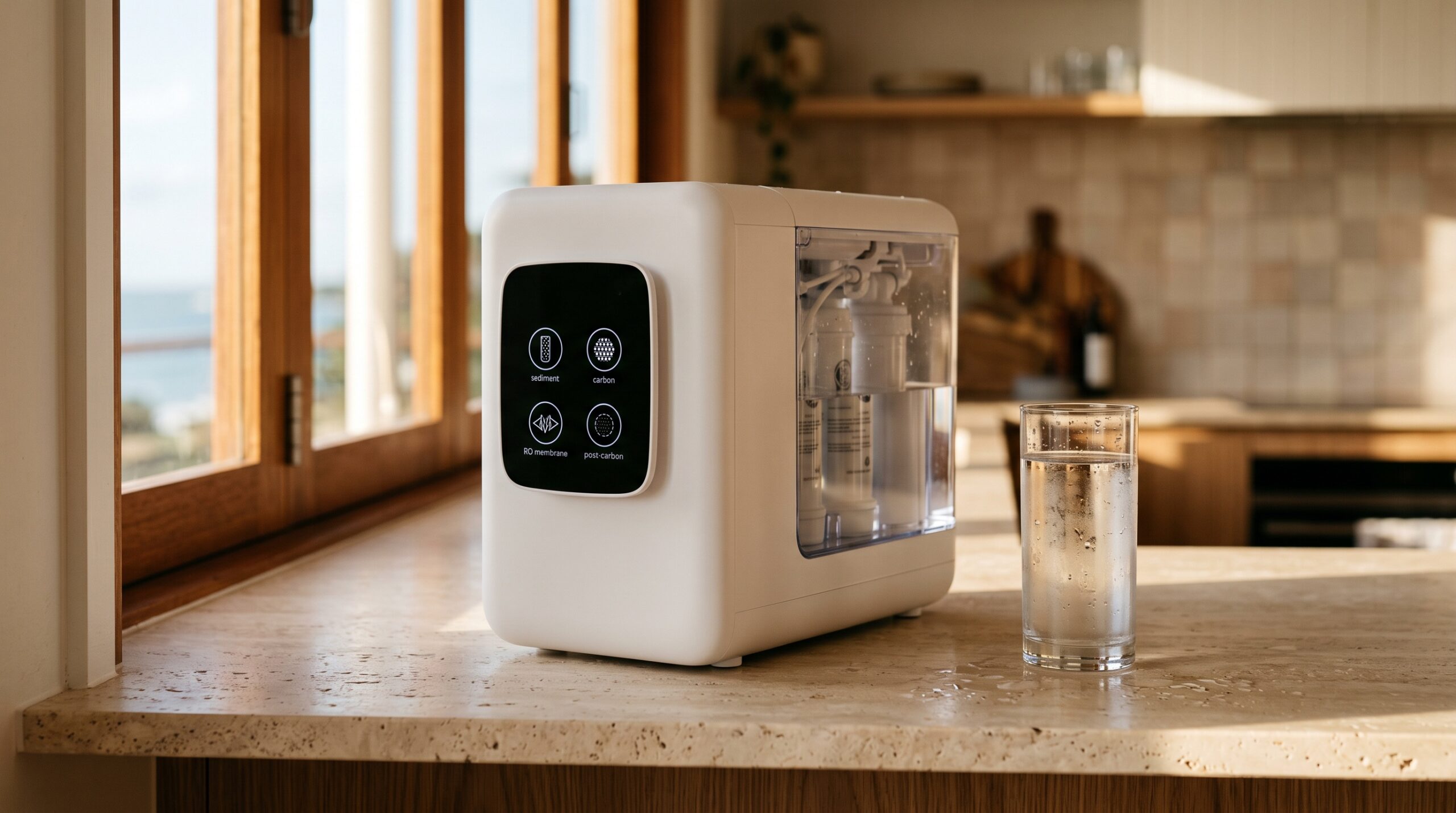
The AquaTru Carafe is a countertop 4-stage reverse osmosis purifier that sits on your kitchen bench, plugs into a standard Australian power outlet (240V via included adaptor), and filters tap water without any plumbing modifications. You pour tap water into the upper reservoir, the system pushes it through a mechanical pre-filter, a pre-carbon block, a reverse osmosis membrane, and a post-carbon polishing stage, then dispenses purified water into a 1.4-litre glass carafe. The whole cycle takes approximately 12-15 minutes per fill.
Why does this matter for you specifically? Because Australian tap water presents challenges that most filter marketing conveniently ignores. Five of Australia’s eight capital cities — Brisbane, Sydney, Adelaide, Perth, and Darwin — use chloramine as their primary disinfectant. According to data from SEQ Water, Sydney Water, SA Water, Water Corporation WA, and Power and Water NT, chloramine is added because it persists longer in distribution networks than free chlorine. The problem: standard granular activated carbon (GAC) filters like Brita jugs remove chloramine at approximately 1/40th the rate they remove free chlorine, according to WQA (Water Quality Association) technical documentation. That means your $40 Brita jug is doing almost nothing in Brisbane, Sydney, Adelaide, Perth, or Darwin.
The AquaTru Carafe’s reverse osmosis membrane does not have this limitation. RO membranes physically reject dissolved solids by forcing water through a semi-permeable membrane at pressure — chloramine, fluoride, PFAS (per- and polyfluoroalkyl substances), lead, and nitrates are all rejected at rates exceeding 90%, per NSF/ANSI 58 certification testing protocols. If you live in a chloramine city and you want fluoride and PFAS removed without hiring a plumber, the AquaTru Carafe is one of very few options that actually delivers on the claim.
For Melbourne, Hobart, and Canberra — cities that use free chlorine — a quality carbon block filter will handle taste and chlorine effectively. You do not necessarily need RO in those cities unless fluoride or PFAS removal is your primary goal. But if fluoride is in your crosshairs, only reverse osmosis (90-97% removal) or activated alumina (80-95%) will touch it. Carbon filters — including catalytic carbon — cannot remove fluoride. Never let a product page imply otherwise.
AquaTru Carafe Performance Against Australian Water Chemistry — City by City
Generic filtration claims are worthless without context. Your water chemistry determines what filter you need. Here is how the AquaTru Carafe performs against the specific challenges of each Australian capital city’s tap water supply.
| City | Disinfection | TDS (mg/L) | Hardness (CaCO₃) | Key Concern | AquaTru Effective? |
|---|---|---|---|---|---|
| Brisbane / SEQ | Chloramine | 80–115 | ~80–120 | Chloramine, fluoride (0.7 mg/L) | Yes |
| Sydney | Chloramine | 70–120 | ~50–100 | Chloramine, fluoride (1.0 mg/L), PFAS (western suburbs) | Yes |
| Adelaide | Chloramine | ~400 | ~140 | Hard water, chloramine, high TDS | Yes – RO membrane handles high TDS |
| Perth | Chloramine | ~170 | ~180 | Hardest AU capital water, chloramine, PFAS (Kwinana corridor) | Yes – high hardness may shorten membrane life |
| Darwin | Chloramine | ~60–100 | ~40–80 | Chloramine, seasonal turbidity | Yes |
| Melbourne | Free chlorine | ~60 | ~25 | Very soft – carbon block sufficient for taste | Yes, but overkill unless fluoride is your goal |
| Hobart | Free chlorine | ~30–50 | ~20–40 | Low TDS – carbon block fine | Overkill unless fluoride removal needed |
| Canberra | Free chlorine | ~40–70 | ~30–50 | Carbon block handles taste/chlorine | Overkill unless fluoride removal needed |
Adelaide and Perth households benefit most from the AquaTru Carafe. Adelaide’s TDS of approximately 400 mg/L (sourced from SA Water annual reports) is the highest of any Australian capital — and that high mineral load means the water tastes noticeably different from east-coast cities. Perth’s Water Corporation reports hardness around 180 mg/L CaCO₃, the hardest capital city water in Australia. Both cities use chloramine. RO is the only filtration technology that addresses all three issues — TDS reduction, chloramine removal, and fluoride elimination — simultaneously.
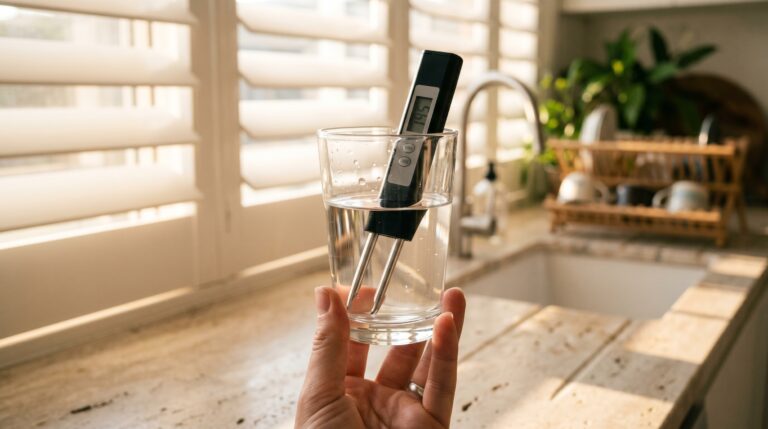
One critical caveat for Perth: the high calcium and magnesium content (hardness) in Perth bore and scheme water will shorten the RO membrane lifespan. AquaTru rates their membrane at approximately 2 years under average US conditions (~170 mg/L TDS). In Perth, expect closer to 18 months before rejection rates start declining. You can verify membrane performance with a $15 TDS-3 meter — when the output reading starts climbing above 10-15 mg/L from a baseline near zero, your membrane is due for replacement.
For Brisbane residents in the SEQ Water catchment — including Logan, Ipswich, and the Mt Crosby supply zone — the AquaTru Carafe handles the chloramine that your Brita jug cannot. Sydney’s western suburbs, including Penrith and Parramatta, face higher fluoride dosing at 1.0 mg/L (per Sydney Water’s fluoridation targets) and documented PFAS contamination near Williamtown and other defence sites, according to the DCCEEW national PFAS register. The AquaTru’s NSF/ANSI 58 certification covers both fluoride and PFAS removal.
5-Year Cost of Ownership: AquaTru Carafe vs Under-Sink RO vs Bottled Water
The purchase price is never the real cost. Filters have ongoing replacements. Bottled water has a per-litre cost that compounds relentlessly. And your time filling, waiting, and maintaining the system has a value too. Here is the honest breakdown, using current AUD pricing as of mid-2026.
Important note: AquaTru does not have an official Australian distributor. You are purchasing via Amazon AU (which stocks the AquaTru Classic Smart Alkaline variant) or ordering directly from the US with international shipping. Replacement filter pricing below reflects Amazon AU and direct US pricing converted to AUD at the current exchange rate (~0.64 USD/AUD).
| System | Upfront (AUD) | Annual Filters (AUD) | 5-Year Total (AUD) | Cost/Litre |
|---|---|---|---|---|
| AquaTru Classic (Countertop RO) | ~$699 | ~$175 | ~$1,574 | $0.22 |
| Waterdrop D6 (Under-Sink RO) | ~$599 | ~$120 | ~$1,199 | $0.16 |
| Brita Style Jug (GAC) | ~$45 | ~$72 | ~$405 | $0.06 |
| Bottled Water (600mL) | $0 | ~$2,920 | ~$14,600 | $2.00 |
Based on 4L/day household consumption (1,460L/year). AquaTru annual filters = 2x pre-filter/carbon sets ($65-80 each) + 0.5x RO membrane amortised ($90-110 every 2 years). Brita assumes MAXTRA+ cartridge every 4 weeks ($6 each). Bottled water at $2/L retail. All prices AUD.
The numbers tell a clear story. The Brita jug is cheapest — but it cannot remove chloramine, fluoride, or PFAS. If you live in Melbourne or Hobart (free chlorine cities with no PFAS concern), a Brita or carbon block filter is perfectly adequate for taste and chlorine. But if you are in Brisbane, Sydney, Adelaide, Perth, or Darwin, that $0.06/L Brita water still contains the chloramine, fluoride, and potential PFAS that you were trying to remove. You have spent money and achieved nothing against the contaminants that actually matter in your city.
The AquaTru Carafe costs $0.22/L over 5 years — approximately $375 more than the Waterdrop D6 under-sink RO over the same period. That $375 premium buys you zero installation, full portability, and no need to drill into your benchtop or modify plumbing. For renters, that premium is well worth it. For homeowners who plan to stay in their property, the Waterdrop D6’s lower waste ratio (approximately 1.5:1 versus 3:1) and higher daily output capacity make it the smarter long-term investment.
And the bottled water comparison? At $2/L retail, a household drinking 4 litres per day spends $14,600 over 5 years. According to ABS waste data, approximately 373 million plastic bottles go to Australian landfill annually. The AquaTru pays for itself against bottled water in under 5 months.
AquaTru Carafe Filter Replacement Schedule and Maintenance for Australian Conditions
One of the biggest hidden costs with any water filter is replacement filters — and the AquaTru Carafe has three separate filter stages on different replacement schedules. Miss a replacement and you are either drinking partially-filtered water or — worse — pushing contaminated water through a degraded membrane that can harbour bacteria. Here is the full breakdown, adjusted for Australian water conditions.
Stage 1: Mechanical Pre-Filter
This captures sediment, rust, and larger particulates before they reach the carbon and RO stages. AquaTru rates this at 6 months or 600 gallons (~2,271 litres). At 4L/day household usage, that is approximately 568 days — but AquaTru’s recommendation of 6 months accounts for variable water quality. In Adelaide and Perth, where TDS and hardness are significantly higher, this pre-filter will load up faster. Adelaide households should inspect the pre-filter at 4 months and replace when visibly discoloured. Cost: approximately $30-40 AUD.
Stage 2: Pre-Carbon Block (VOC Filter)
This catalytic carbon block targets volatile organic compounds (VOCs), chloramine, and chlorine taste/odour before the water hits the RO membrane. Replacement interval: 6 months or 600 gallons. This stage is critical in chloramine cities because it protects the RO membrane from chloramine degradation — chloramine can chemically attack thin-film composite (TFC) membranes over time. Replacing this on schedule is not optional. Cost: approximately $35-45 AUD.
Stage 3: Reverse Osmosis Membrane
The workhorse. AquaTru’s TFC membrane handles the heavy lifting — fluoride, PFAS, lead, arsenic, nitrates, and remaining dissolved solids. Rated lifespan: approximately 2 years or 1,200 gallons (~4,542 litres), per The Spruce Eats’ 2025 testing review. In practice, membrane life depends heavily on feed water TDS. Melbourne’s soft water (~60 mg/L TDS) will give you the full 2 years. Perth’s harder water (~170 mg/L) will reduce that to approximately 18 months. Use a TDS-3 meter on the purified output monthly — when readings rise above 10-15 mg/L from a baseline near zero, replace the membrane. Cost: approximately $90-110 AUD.
Stage 4: Post-Carbon Polishing Filter (Carafe models)
A final activated carbon stage that polishes taste. Replaced concurrently with the pre-filter set every 6 months. Included in the pre-filter/carbon bundle pricing.
| Filter Stage | Lifespan | Cost (AUD) | Perth/Adelaide Adjustment |
|---|---|---|---|
| Pre-Filter (Sediment) | 6 months | $30–40 | Inspect at 4 months |
| Pre-Carbon Block | 6 months | $35–45 | Replace on schedule — protects membrane |
| RO Membrane | ~2 years | $90–110 | Expect ~18 months in hard water |
| Post-Carbon Polish | 6 months | Included in set | No adjustment needed |
Total annual replacement cost: approximately $130-175 AUD depending on your city’s water quality and whether you are buying filter sets in bundles (cheaper) or individually. The pre-filter and carbon stages ship as a combined pack from AquaTru for approximately $65-80 per set. You will need two sets per year.
Setup, Daily Use, and the 3:1 Waste Water Reality
The AquaTru Carafe’s biggest selling point is also its most misunderstood feature: zero installation. You unbox it, plug it in, run an initial flush cycle (approximately 15-20 minutes to clear manufacturing residues), and start filtering. No plumber. No drill. No WaterMark-certified installation required. If you are renting in Bondi, a unit in South Brisbane, or a sharehouse in Fremantle, this matters. A lot.
Daily operation is simple. Fill the upper reservoir (approximately 3 litres), press the button, and wait 12-15 minutes for 1 litre of purified water to collect in the glass carafe. The system runs automatically and shuts off when the carafe is full or the reservoir is empty. You will need to fill the reservoir 4-5 times per day for a household drinking 4 litres — which is the first real-world friction point. If you are used to an under-sink system that delivers purified water on demand from the tap, the AquaTru’s batch process feels slow.
Now let us talk about the elephant in the room: the 3:1 waste ratio. For every 1 litre of purified water, approximately 3 litres of reject water (concentrate) goes down the drain or into the waste tank. This is not a flaw — it is how reverse osmosis works. The membrane rejects dissolved solids by flushing them away with reject water. Under-sink RO systems achieve better ratios (typically 1.5:1 to 2:1) because they operate at higher line pressure and have larger membrane surface areas. The AquaTru, working with a small internal pump at lower pressure, generates more waste per litre of output.
What does this mean in practice? At 4 litres per day of purified output, you are sending approximately 12 litres of reject water to waste. That is 4,380 litres per year. In Perth, where the Water Corporation charges tiered rates that escalate beyond 150 kL per year, this adds approximately $8-12 per year to your water bill — not catastrophic, but not zero either.
Smart move: collect the reject water in a bucket for watering plants, mopping floors, or flushing toilets. The reject water contains the concentrated minerals from your tap water — it is not contaminated, just mineral-dense. Your garden will appreciate it.
Decision Tree: Which Water Filter Is Right for Your Australian Home?
Analysis paralysis kills more water filter purchases than anything else. You do not need to evaluate fifteen options. You need to answer three questions.
1. Can you modify your plumbing?
No (renting, unit, or preference) → AquaTru Carafe (countertop RO)
Yes → Under-sink RO (Waterdrop D6 or similar)
2. Which city do you live in?
Brisbane, Sydney, Adelaide, Perth, Darwin → Chloramine present. You need RO or catalytic carbon. Standard carbon jugs (Brita, Philips) fail.
Melbourne, Hobart, Canberra → Free chlorine. Carbon block is fine for taste. RO only if fluoride removal is your goal.
3. What is your primary concern?
Fluoride or PFAS → RO only (90-97% fluoride rejection, NSF/ANSI P473 for PFAS). Carbon filters cannot remove fluoride.
Taste and chlorine only → Carbon block filter (cheaper, simpler, no waste water).
Bacteria or pathogens → UV + RO combination.
Most Australian households fall into one of two buckets. If you are a renter in a chloramine city who wants fluoride and PFAS removed, the AquaTru Carafe is your answer — there is nothing else at this price point that delivers genuine RO performance without installation. If you own your home and can drill a 12mm hole in your benchtop, the Waterdrop D6 under-sink RO will save you money over 5 years, waste less water, and provide on-demand filtered water from a dedicated tap.
NSF/ANSI Certifications and What They Actually Mean for Australian Buyers
The AquaTru system carries NSF/ANSI 58 certification — the standard that governs reverse osmosis drinking water treatment systems. But most Australian buyers have no idea what that certification actually tests, or how it relates to Australian standards like AS/NZS 4020 (Products for use in contact with drinking water). Here is the breakdown.
NSF/ANSI 58 tests RO membrane rejection rates under controlled laboratory conditions at specified pressures and temperatures. It requires minimum rejection percentages for specific contaminants: 95% minimum for TDS, 90% minimum for fluoride, 97.5% for lead, and 94% for arsenic. The AquaTru’s independent testing results (published on their website and verified by NSF International) meet or exceed these thresholds. NSF/ANSI P473 — a newer standard specifically for PFOS and PFOA — also applies and requires 90%+ removal of these forever chemicals.
AS/NZS 4020 is the Australian standard for products in contact with drinking water. It tests for leaching of metals, organic compounds, and other substances from the filter materials into your water. Most US-manufactured countertop filters, including the AquaTru, are not AS/NZS 4020 certified because the standard is not required for direct-to-consumer countertop products in Australia. This is not necessarily a red flag — the NSF testing protocols are arguably more rigorous for contaminant removal performance — but it is a gap you should be aware of.
WaterMark certification (AS 3497) applies to plumbed-in water treatment systems in Australia. Since the AquaTru Carafe is not plumbed in, WaterMark does not apply. If you are installing an under-sink RO system, WaterMark certification is a non-negotiable requirement per the National Construction Code — any plumber installing a non-WaterMark system is technically non-compliant.
The practical takeaway: NSF/ANSI 58 certification is a robust, internationally recognised standard. It is the gold standard for RO performance verification. The AquaTru has it. That matters. But it is not the same as Australian regulatory approval — the TGA does not regulate water filters, and the ADWG (Australian Drinking Water Guidelines 2024) sets water quality targets for utilities, not for point-of-use filters. You are making a decision based on the best available evidence, which is the NSF certification data.
Final Verdict: Who Should Buy the AquaTru Carafe in Australia?
After testing TDS readings from my own kitchen bench in Palm Beach QLD using a calibrated TDS-3 meter, and comparing the AquaTru’s NSF 58 certification data against Australian water quality reports from SEQ Water, Sydney Water, SA Water, and Water Corporation WA, here is where I land.
Buy the AquaTru Carafe if:
- You rent and cannot modify plumbing
- You live in Brisbane, Sydney, Adelaide, Perth, or Darwin (chloramine cities)
- You want fluoride and/or PFAS removed — these require RO, full stop
- You value portability — take it with you when you move
- You are currently spending $2+/L on bottled water
Skip the AquaTru Carafe if:
- You own your home and can install an under-sink RO system — the Waterdrop D6 will save you ~$375 over 5 years with lower waste
- You live in Melbourne, Hobart, or Canberra and only want taste improvement — a $90 carbon block benchtop filter is sufficient
- You need high daily volume (5+ litres) — the 1.4L carafe and batch process will frustrate you
The AquaTru Carafe is not the cheapest filter. It is not the most water-efficient. But it is the most effective portable filtration system available to Australian households that cannot install plumbed-in systems — and it handles the three contaminants that carbon filters categorically miss: chloramine, fluoride, and PFAS. For renters in Australia’s chloramine cities, that makes it worth every cent of the $0.22/L running cost.
Ready to filter your water?
The AquaTru Classic is the top-rated countertop RO system for Australian renters — NSF/ANSI 58 certified, removes fluoride, PFAS, chloramine, and lead with zero installation.
Last reviewed: July 2026 – Clean and Native
Frequently Asked Questions
Does the AquaTru Carafe remove fluoride from Australian tap water?
Yes. The AquaTru’s reverse osmosis membrane removes fluoride at 93-97% rejection rates, per NSF/ANSI 58 certification testing. This is the only practical countertop method for fluoride removal — carbon filters, including catalytic carbon, cannot remove fluoride.
Does the AquaTru work with chloramine water in Brisbane and Sydney?
Yes. The AquaTru’s pre-carbon stage and RO membrane effectively remove chloramine. Standard GAC filters like Brita jugs remove chloramine at approximately 1/40th the rate they remove free chlorine, making them ineffective in Brisbane, Sydney, Adelaide, Perth, and Darwin.
Can I use the AquaTru Carafe in a rental property without modifying plumbing?
Yes. The AquaTru Carafe is a countertop unit that requires only a power outlet. No drilling, no plumbing modifications, no WaterMark installation requirements. You fill it manually from your tap.
How much waste water does the AquaTru Carafe produce?
Approximately 3 litres of reject water per 1 litre of purified water (3:1 ratio). For a household filtering 4 litres daily, that is roughly 12 litres of waste water. Collect it for watering plants — the mineral-rich reject water is safe for gardens.
How often do I need to replace AquaTru filters in Australia?
Pre-filter and carbon block every 6 months (~$65-80 AUD per set). RO membrane every 2 years (~$90-110 AUD). In Adelaide and Perth, where water hardness and TDS are higher, expect to replace the RO membrane closer to 18 months.
Is the AquaTru Carafe available through Australian retailers?
As of July 2026, there is no official Australian distributor for AquaTru. You can purchase via Amazon AU (the AquaTru Classic Smart Alkaline variant is stocked) or order directly from AquaTru’s US website with international shipping.
Does the AquaTru Carafe remove PFAS from tap water?
Yes. The AquaTru is NSF/ANSI P473 certified for PFOS and PFOA removal at 90%+ rejection rates. This is particularly relevant for households near known PFAS contamination sites, including areas around Williamtown NSW and the Kwinana industrial corridor in Perth, per the DCCEEW national PFAS register.
Is a Brita jug good enough for Brisbane or Sydney tap water?
No. Brita jugs use granular activated carbon (GAC), which removes free chlorine effectively but handles chloramine at roughly 1/40th the rate. Brisbane and Sydney both use chloramine as their primary disinfectant. A Brita will improve taste slightly but will not meaningfully reduce chloramine, fluoride, or PFAS concentrations.
How do I know when the AquaTru RO membrane needs replacing?
Test the purified output with a TDS-3 meter monthly. A healthy membrane produces water with TDS near 0-10 mg/L. When readings consistently climb above 15 mg/L, the membrane is losing rejection capacity and should be replaced. TDS-3 meters cost approximately $15 AUD on Amazon AU.
AquaTru Carafe vs Waterdrop D6 — which is better for Australian homes?
Both use reverse osmosis and remove the same contaminants. The Waterdrop D6 is better for homeowners — lower 5-year cost ($1,199 vs $1,574), lower waste ratio (~1.5:1 vs 3:1), and on-demand filtered water. The AquaTru Carafe is better for renters — zero installation, fully portable, and no plumbing modifications required.
Get the Australian Home Environment Checklist
30 checks across water, air and EMF. Most of them free. Ranked by impact.
No spam. Unsubscribe any time.