How Reverse Osmosis Works: The Science Behind Clean Drinking Water
14 min read
How Reverse Osmosis Works: The Science Behind Clean Drinking Water
Reverse osmosis works by forcing water through a semi-permeable membrane under pressure, blocking contaminants while allowing clean water molecules to pass through. This process removes 95-99% of dissolved solids, heavy metals, and microorganisms from tap water using membrane pore sizes of 0.0001 microns — 4,000 times smaller than bacteria and 1,000 times smaller than most viruses.
Most Australian households drink around 2 litres of tap water per day. Over a year that’s 730 litres. Over a decade, 7,300 litres. Whatever is in that water — fluoride, chloramine, PFAS, trace heavy metals — accumulates. The guidelines say it’s safe. That’s not the same as saying it’s optimal. Reverse osmosis is the only residential technology that removes virtually all of it — not 60%, not most of it, but up to 99% of dissolved contaminants at the ionic level.
Most Australian households drink around 2 litres of tap water per day. Over a year that’s 730 litres. Over a decade, 7,300 litres. Whatever is in that water — fluoride, chloramine, PFAS, trace heavy metals — accumulates. The guidelines say it’s safe. That’s not the same as saying it’s optimal.
Reverse osmosis is the only residential technology that removes virtually all of it — not 60%, not most of it, but up to 99% of dissolved contaminants at the ionic level. This guide explains exactly how it works, what it removes, how it compares to alternatives, and whether it makes sense for your home.
Reverse osmosis works by forcing water through a semi-permeable membrane under pressure, blocking contaminants while allowing clean water molecules to pass through. This process removes 95-99% of dissolved solids, heavy metals, and microorganisms from tap water. The technology relies on membrane pore sizes of 0.0001 microns — 4,000 times smaller than bacteria and 1,000 times smaller than most viruses.
The Physics of Reverse Osmosis: Overcoming Natural Osmosis
Natural osmosis occurs when water moves from areas of low solute concentration to high solute concentration through a semi-permeable membrane. This process continues until equilibrium is reached on both sides of the membrane.
Reverse osmosis reverses this natural process by applying external pressure — typically 60-100 PSI in residential systems. This pressure forces water molecules through the membrane’s microscopic pores while leaving contaminants behind. The Australian/New Zealand Standard AS/NZS 4348:2021 defines reverse osmosis membrane performance requirements, specifying minimum rejection rates of 95% for sodium chloride.
The semi-permeable membrane contains billions of pores measuring approximately 0.0001 microns in diameter. To put this in perspective:
- Water molecules: 0.0003 microns
- Most dissolved salts: 0.001-0.003 microns
- Bacteria: 0.4-2 microns
- Viruses: 0.02-0.4 microns
Only molecules smaller than the membrane pores can pass through, making reverse osmosis highly effective at removing contaminants while producing clean drinking water.
The Multi-Stage Reverse Osmosis Process
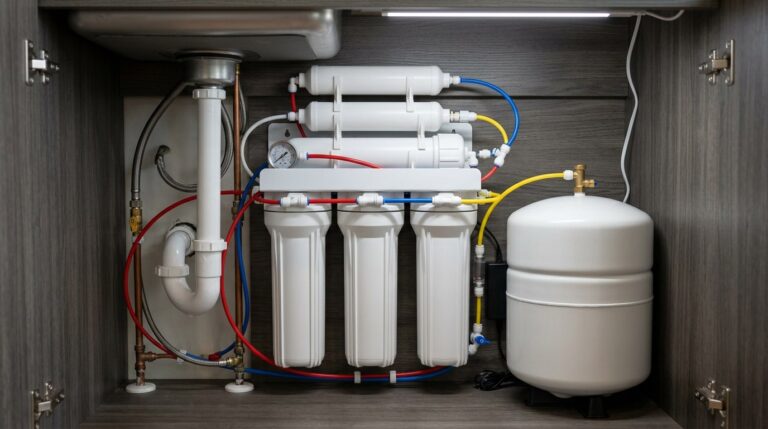
Australian residential RO systems typically operate through five distinct stages, each targeting specific contaminants found in municipal water supplies.
Stage 1: Sediment Pre-Filtration (5-10 Micron)
The first stage removes visible particles including rust, sand, and dirt. This protects downstream filters from clogging and extends their lifespan. The Australian Drinking Water Guidelines (ADWG) recommend pre-filtration for systems treating water with turbidity above 1 NTU.
Stage 2: Activated Carbon Pre-Filtration
Granular activated carbon (GAC) or carbon block filters remove chlorine, which would otherwise damage the RO membrane. Australian water utilities add chlorine at concentrations up to 5 mg/L for disinfection. This stage also reduces taste, odour, and some organic compounds.
Stage 3: Fine Sediment/Carbon Block (1 Micron)
A second carbon stage with smaller pore sizes (typically 1 micron) provides final pre-treatment. This removes remaining chlorine and smaller particles that could foul the RO membrane.
Stage 4: Reverse Osmosis Membrane
The heart of the system — a thin-film composite (TFC) membrane that removes dissolved solids, heavy metals, and microorganisms. Quality membranes achieve 96-99% rejection rates for most contaminants when operating at optimal pressure and temperature.
Stage 5: Post-Carbon Polishing
After the RO membrane, a final activated carbon stage removes any remaining taste or odour compounds. Some systems include remineralisation cartridges that add back beneficial minerals like calcium and magnesium.
The right filter removes what this article describes.
Reverse osmosis is the only residential technology that reliably removes PFAS, fluoride, chloramine, and heavy metals. Our guide covers the top-rated options for Australian homes — tested, certified, and ranked.
What Reverse Osmosis Removes from Australian Tap Water
What RO Actually Removes — Visual Breakdown
NSF/ANSI certified removal rates for a quality RO membrane. These are independently verified figures, not manufacturer claims.
Contaminant Removal Rates — Quality RO Membrane
~100%
99.9%
Up to 99%
Up to 99%
Up to 98%
>95%
>95%
93–96%
Up to 93%
85–95%
Source: NSF/ANSI 58 certified testing data. Actual removal varies by membrane type, water chemistry, and system age.
Australian municipal water supplies contain various contaminants that reverse osmosis effectively removes. The technology’s broad-spectrum removal capabilities make it particularly valuable for addressing multiple water quality concerns simultaneously.
Dissolved Solids and Salts
RO membranes remove 95-99% of total dissolved solids (TDS), including sodium, calcium, magnesium, and sulphates. Australian groundwater often contains elevated TDS levels — particularly in areas like Perth, Adelaide, and parts of Queensland where salinity is a concern.
Heavy Metals
Lead, mercury, cadmium, and other heavy metals are effectively removed. While Australian water utilities monitor these contaminants according to ADWG standards, old plumbing systems and industrial contamination can introduce metals downstream of treatment plants. RO provides point-of-use protection with removal rates exceeding 95% for most heavy metals.
Fluoride
Reverse osmosis removes 85-95% of fluoride, making it one of the few residential technologies effective against this additive. Australian water supplies are fluoridated at 0.6-1.1 mg/L depending on climate zone, as specified in the ADWG.
Chlorine and Chloramine
While pre-carbon stages handle most chlorine, the RO membrane provides additional removal. For chloramine — increasingly used by Australian utilities — the multi-stage process achieves near-complete removal. Sydney Water, for example, switched to chloramine disinfection, which requires more advanced treatment than chlorine alone.
PFAS (Per- and Polyfluoroalkyl Substances)
RO membranes effectively remove PFAS compounds that have contaminated water supplies near industrial sites and military bases across Australia. The technology achieves >95% removal for most PFAS compounds, including PFOA and PFOS.
Microorganisms
Bacteria, viruses, and parasites are physically blocked by the membrane’s microscopic pores. This provides additional protection beyond municipal chlorination, particularly important during boil-water alerts or for immune-compromised individuals.
Membrane Technology and Material Science
Modern RO membranes use thin-film composite (TFC) construction — a three-layer design optimised for both permeability and selectivity. Understanding membrane technology helps explain why reverse osmosis achieves superior contaminant removal compared to other filtration methods.
Membrane Structure
TFC membranes consist of:
- Polyester support fabric (120-150 microns thick)
- Polysulfone intermediate layer (40-50 microns thick)
- Polyamide active layer (0.2-1 micron thick)
The ultra-thin polyamide layer contains the microscopic pores responsible for contaminant rejection. This layer measures less than 1 micron thick but provides the barrier that makes reverse osmosis effective.
Cross-Flow Design
Unlike dead-end filtration where water flows perpendicular to the filter surface, RO systems use cross-flow design. Water flows parallel to the membrane surface, with clean water passing through while concentrate (containing rejected contaminants) flows to drain. This design prevents membrane fouling and maintains consistent performance.
Operating Parameters
Australian RO systems operate within specific parameters for optimal performance:
- Feed pressure: 60-100 PSI (400-700 kPa)
- Water temperature: 4-35°C (optimal 15-25°C)
- pH range: 3-11 (optimal 6.5-8.5)
- Recovery rate: 15-25% (residential systems)
Recovery rate refers to the percentage of feed water that becomes purified product water. Residential systems typically achieve 15-25% recovery, meaning 75-85% goes to drain as concentrate. This ratio ensures adequate flushing to prevent membrane fouling.
System Components and Water Flow Path
Understanding the complete system layout helps explain how reverse osmosis achieves consistent water quality and why proper installation matters for performance.
Storage Tank and Pressure System
RO systems include a pressurised storage tank (typically 3-12 litres capacity) that holds purified water. The tank uses compressed air to maintain delivery pressure when the tap opens. Without adequate storage, flow rates would be limited to the membrane’s slow production rate of 150-400 mL per minute.
Flow Restrictor and Waste Water
A flow restrictor controls the concentrate (waste) flow rate, maintaining optimal pressure across the membrane. This component is precisely sized for each system — too restrictive and the membrane may be damaged by excessive pressure; too open and insufficient pressure reduces contaminant removal.
Check Valves and System Protection
Check valves prevent backflow that could contaminate the storage tank or damage the membrane. Quality systems include multiple check valves at strategic points in the water flow path.
Automatic Shut-Off Valve
When the storage tank reaches capacity, an automatic shut-off valve stops production and closes the drain line. This prevents water waste and maintains system pressure. The valve reopens when the tank pressure drops as purified water is consumed.
Performance Factors and Water Quality Variables
Reverse osmosis performance varies based on feed water characteristics and system operating conditions. Understanding these factors helps predict system performance and maintenance requirements.
Temperature Effects
Membrane permeability increases with temperature — water production roughly doubles for every 10°C temperature increase within the operating range. However, higher temperatures also reduce membrane life and may increase some contaminant passage. Australian systems should account for seasonal temperature variations in water supply lines.
Pressure and Flow Rate Relationships
Higher feed pressure increases both water production and contaminant rejection up to the membrane’s maximum rated pressure. However, excessive pressure can damage membranes and increase waste water flow. Most residential systems operate optimally at 60-80 PSI.
pH and Chemical Compatibility
Extreme pH levels can damage polyamide membranes. Australian bore water sometimes exceeds optimal pH ranges due to mineral content. Water with pH below 3 or above 11 requires pre-treatment to protect the membrane.
TDS and Rejection Rates
Higher total dissolved solids in feed water generally improve rejection rates for most contaminants. However, extremely high TDS levels (above 2,000 mg/L) may reduce membrane life and require more frequent replacement. The ADWG recommends TDS levels below 600 mg/L for aesthetic acceptability.
RO vs Other Filter Types — At a Glance
Most filter decisions come down to one question: what do you actually need to remove? This table cuts through the marketing noise.
| Filter Type | Chlorine/ Chloramine |
Fluoride | PFAS | Heavy Metals |
Bacteria/ Viruses |
Cost (AUD) |
|---|---|---|---|---|---|---|
| Reverse Osmosis ★ | ✓ 95%+ | ✓ 93–96% | ✓ Up to 98% | ✓ Up to 99% | ✓ 99.9% | $400–$1,700 |
| Carbon Filter (pitcher/inline) | ✓ | ✗ | Partial | Partial | ✗ | $50–$300 |
| Berkey Gravity Filter | ✓ | Add-on only | Inconsistent | Partial | ✓ | $350–$700 |
| Hollow Fibre / UF | Partial | ✗ | ✗ | ✗ | ✓ | $100–$400 |
| Water Softener (Ion Exchange) | ✗ | ✗ | ✗ | Partial | ✗ | $800–$3,000 |
Removal rates based on NSF/ANSI certified testing data. RO rates vary by membrane quality and system design.
Frequently Asked Questions
How does reverse osmosis actually work?
Reverse osmosis forces water through a semi-permeable membrane with pore sizes of approximately 0.0001 microns — small enough to allow water molecules through but block dissolved salts, heavy metals, fluoride, PFAS, and virtually all other contaminants. The purified water is stored in a pressurised tank; the concentrated reject stream is flushed to drain.
Does reverse osmosis remove fluoride?
Yes — a quality NSF/ANSI 58 certified RO membrane removes 93–96% of fluoride. This is the only residential filtration technology that reliably removes fluoride. Standard carbon filters, Berkey units (without the add-on PF-2 filters), and pitcher filters do not remove fluoride.
Does RO water taste flat?
Standard RO output can taste flat because minerals like calcium and magnesium have been removed. A remineralisation stage — included in most quality systems like the EcoHero 5-Stage — adds these back in controlled amounts, raising the pH and significantly improving taste. If your RO water tastes flat, the remineraliser cartridge needs replacing or your system doesn’t have one.
How much water does RO waste?
Older RO systems waste 3–4 litres of water for every litre of purified water produced. Modern high-efficiency membranes (like the EcoHero-50) achieve 50% recovery — approximately 1 litre waste per 1 litre produced. At Queensland water prices, the difference across a year of daily use is meaningful on your bill.
Is RO water safe to drink long-term?
Yes. RO water is safe to drink long-term. The concern that mineral-depleted water “leaches minerals from the body” is not supported by the scientific literature — the minerals in drinking water are a negligible fraction of daily intake compared to food. A remineraliser stage addresses the taste issue and adds back beneficial minerals if preferred.
How often do RO filters need replacing?
As a general guide: sediment and carbon pre-filters every 6–12 months, the RO membrane every 2–3 years, and post-carbon and remineraliser cartridges annually. Most quality systems include a cartridge life monitor. Actual replacement intervals vary with your water quality and household usage.
Can renters use a reverse osmosis system?
Under-sink RO systems require a permanent plumbing connection — not practical for most rentals. The best option for renters is a countertop RO system such as the Waterdrop or AquaTru, which connects directly to the tap without drilling or plumbing modifications. These achieve similar fluoride and PFAS removal rates to under-sink systems.
Does reverse osmosis remove PFAS?
Yes — reverse osmosis removes PFAS (per- and polyfluoroalkyl substances) at up to 98% efficiency. The RO membrane physically blocks PFAS molecules regardless of chain length. This makes it one of the most effective residential treatments for PFAS, which is relevant for Australians near the 700+ confirmed contamination sites around defence bases, airports, and industrial zones.
What is the difference between a 3-stage and 6-stage RO system?
A basic 3-stage system includes a sediment filter, carbon filter, and RO membrane — sufficient for core contaminant removal. A 6-stage system adds a second carbon pre-filter, a post-carbon polishing filter, and a remineraliser. The additional stages improve taste, protect the membrane more effectively, and restore beneficial minerals to the output. For daily drinking water, a 5 or 6-stage system is worth the additional cost.
Get the Australian Home Environment Checklist
30 checks across water, air and EMF. Most of them free. Ranked by impact.
No spam. Unsubscribe any time.

Former Royal Australian Navy Clearance Diver and TAG-E counter-terrorism operator. Founded Clean and Native to apply the same rigorous thinking to the home environment.
Full biography →