
Best Water Filter for Pregnancy Australia 2026: Compared & Ranked
Most “safe drinking during pregnancy” advice stops at “avoid alcohol and raw fish.” Water — the thing you drink 2–3 litres of every day — barely gets a mention. That’s a problem. Australian tap water contains PFAS, nitrates, lead from old pipes, chloramines, and microplastics at concentrations that matter when you’re growing a human. Microplastics have been found in human placentas (Ragusa et al., 2021, Environment International). Nitrates above 10 mg/L are linked to methemoglobinemia in infants. PFAS is correlated with lower birth weight and disrupted thyroid function. The solution isn’t expensive — but it requires choosing the right filter for what’s actually in your local water.
Quick Verdict
For most pregnant women, the AquaTru Classic Smart Alkaline is the best water filter available in Australia.
It uses NSF/ANSI 58-certified reverse osmosis to remove PFAS, nitrates, lead, fluoride, chloramines, and microplastics with no plumbing required. The built-in alkaline stage adds magnesium and potassium back — minerals that matter most during pregnancy. For renters who can’t modify plumbing, it’s the complete solution. For fluoride as the primary concern, the Waters Co BIO 500 MAX hits 99% fluoride removal at a lower price.
Best Overall
AquaTru Classic
RO · $649–699
Best Fluoride
Waters Co BIO 500
99% removal · $649
✓ This guide is for you if:
- You’re pregnant or planning to become pregnant and want to reduce chemical exposure
- You’re on Australian mains water and uncertain about PFAS, nitrates, or fluoride levels
- You’re preparing formula for a newborn and want to know which water to use
- You’re renting and cannot install a plumbed-in system
✗ Skip this if:
- You’re on rainwater or tank water — your contamination profile is completely different
- Your local utility has confirmed zero PFAS and nitrates below 3 mg/L — you may not need RO
- You’re looking for a whole-house filter — see our under-sink guide
What Makes Water Unsafe During Pregnancy
Standard Australian tap water is treated to meet the Australian Drinking Water Guidelines (ADWG 2022) — guidelines written for the general adult population, not for foetal development. There are five categories of contaminants that matter specifically during pregnancy:
PFAS (Per- and Polyfluoroalkyl Substances)
PFAS — the “forever chemicals” used in non-stick cookware, firefighting foam, and food packaging — have contaminated groundwater near many Australian military bases and industrial sites. PFAS crosses the placenta and has been detected in cord blood, amniotic fluid, and breast milk. Epidemiological studies consistently associate maternal PFAS exposure with lower birth weight, disrupted thyroid function, and suppressed immune development in the newborn. The ADWG 2022 sets provisional limits, but no level of PFAS exposure has been shown to be harmless during pregnancy. Only reverse osmosis (RO) reliably removes PFAS — activated carbon helps but is inconsistent at the concentrations found in Australian mains water.
Nitrates
Nitrates enter water from agricultural runoff and septic systems. The ADWG limit is 50 mg/L, but the EU limit for infant formula water is 10 mg/L — and research links nitrate exposure above 5 mg/L during pregnancy to intrauterine growth restriction. Nitrates are colourless and odourless; you cannot detect them without testing. Reverse osmosis removes 83–92% of nitrates. Gravity carbon filters do not.
Lead and Heavy Metals
There is no safe level of lead exposure during pregnancy. Lead accumulates in bone and is mobilised during pregnancy to supply calcium to the developing foetus — meaning old body stores become relevant even if current water quality is good. Older Australian homes (pre-1970s) may have lead solder in internal plumbing. RO and high-quality gravity filters both reduce lead effectively. The key variable is the filter’s NSF/ANSI 53 certification for lead reduction — not all filters achieve this.
Chloramines and Disinfection Byproducts
Most Australian capital city utilities now use chloramine (chlorine + ammonia) rather than chlorine alone. Chloramines are more stable and remain active through the distribution network, but they react with organic matter to form disinfection byproducts (DBPs) including trihalomethanes (THMs) and haloacetic acids (HAAs). Both THM and HAA exposure during the first trimester has been associated with increased miscarriage risk and neural tube defects in epidemiological studies. Critically, chloramine exposure during pregnancy is also relevant through the skin and lungs during hot showers — not just through drinking water.
Microplastics
In 2021, Ragusa et al. published the first evidence of microplastics in human placenta, finding plastic particles in all six examined placentas. The Australian water supply contains measurable microplastic concentrations, with NSW waterways showing particle counts consistent with international urban water systems. The ADWG 2022 does not yet set microplastic limits because standardised analytical methods for routine utility monitoring are still being developed. RO membranes, with pore sizes of 0.0001 microns, physically block microplastics.
Which Filter Types Actually Work During Pregnancy
| Filter Type | PFAS | Nitrates | Lead | Microplastics | Fluoride |
|---|---|---|---|---|---|
| Reverse Osmosis (RO) | ✓✓ | ✓✓ | ✓✓ | ✓✓ | ✓✓ |
| Certified Gravity Filter | Partial | ✗ | ✓ | Partial | ✓ |
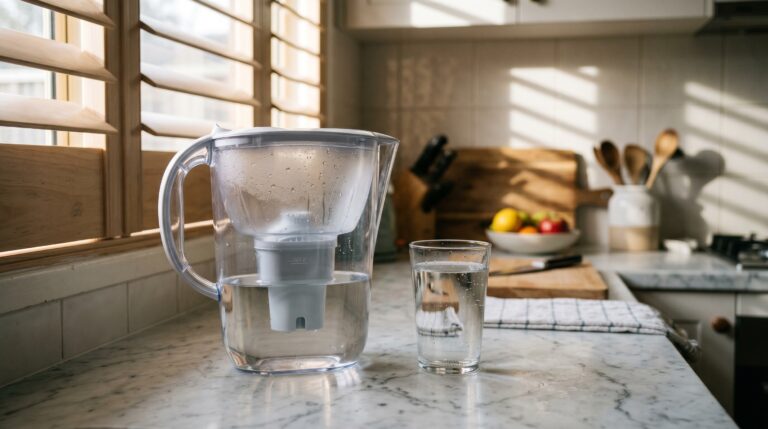
| Standard Carbon Jug | ✗ | ✗ | ✗ | ✗ | ✗ |
| Shower Filter (KDF/Carbon) | ✗ | ✗ | ✗ | ✗ | ✗ |
Shower filters earn a separate row because they address a separate exposure pathway: chloramine absorption through the skin and inhalation of vaporised chloramines during a hot shower. A shower filter doesn’t replace a drinking water filter — it addresses an exposure route that drinking water filters can’t touch.
Quick Comparison: 6 Best Water Filters for Pregnancy in Australia
| Filter | Type | Certification | Price (AUD) | Best For |
|---|---|---|---|---|
| AquaTru Classic Smart Alkaline ★ | Countertop RO | NSF 58 | ~$649–699 | Overall best — PFAS + nitrates + microplastics |
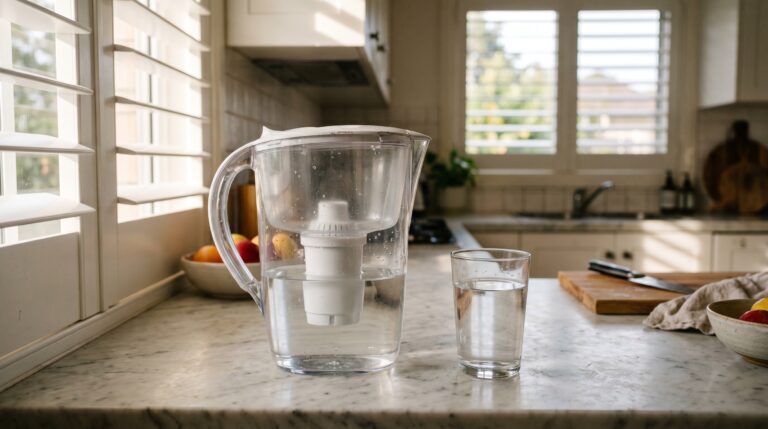
| Waters Co BIO 500 MAX 7L | Gravity | NSF 42/53/401 | $649 | 99% fluoride removal + lifetime warranty |
| HolyH2O Pitcher 2L | Hydrogen | SPE/PEM | $275 | Antioxidant hydrogen water |
| PWS EcoHero 5 Stage RO | Under-Sink RO | WaterMark AS3497 + NSF 42/58 | ~$695 | Permanent install, Australian certified, high-volume |
The 6 Best Water Filters for Pregnancy in Australia (2026)
1. AquaTru Classic Smart Alkaline — Best Overall Water Filter for Pregnancy

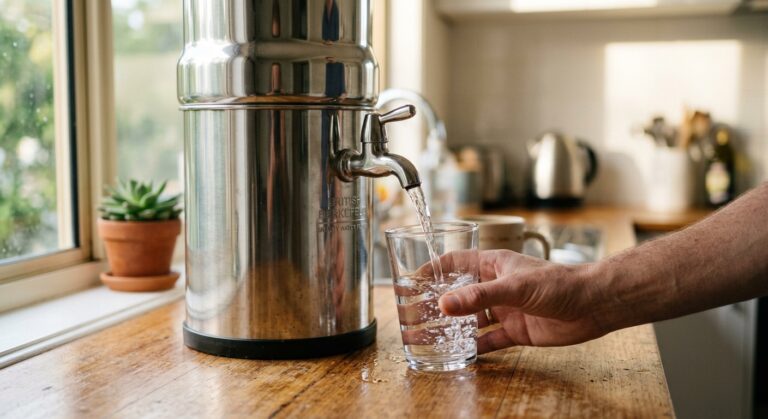
AquaTru Classic Smart Alkaline
NSF/ANSI 58-certified countertop RO with a built-in alkaline stage. No plumbing required — fills from tap, sits on the benchtop. Removes PFAS, nitrates, lead, fluoride, chloramines, and microplastics, then adds magnesium and potassium back into the filtered water.
Check price on Amazon AU →The AquaTru Classic Smart Alkaline earns the top position because it’s the only benchtop filter on this list that combines NSF/ANSI 58-certified reverse osmosis with an alkaline remineralisation stage — two priorities that often pull in opposite directions for pregnant women. RO strips water very thoroughly, including magnesium and calcium. The alkaline stage adds these back in a form the body absorbs readily. For pregnant women concerned about mineral intake (particularly magnesium, which is important for preventing pre-eclampsia), this matters.
Setup requires no plumbing: you fill the top reservoir from the tap, the four-stage RO system processes the water, and filtered water is dispensed from the front spigot. The unit is WiFi-connected for filter monitoring, which removes the guesswork on when to replace media. Filter replacement costs run approximately $120 per year — comparable to a mid-range gravity filter, and significantly less than equivalent bottled water.
The limitation is volume: at the rated output, a family of four on high water consumption may find the benchtop refill cycle inconvenient. For larger households, the PWS EcoHero 5 Stage RO further down this list is a better fit.
✓ Pros
- NSF/ANSI 58 certified — verified PFAS, nitrate, fluoride removal
- Alkaline remineralisation adds magnesium + potassium back
- No plumbing — fits on any benchtop
- WiFi filter monitoring removes guesswork
- Available on Amazon AU with next-day delivery in major cities
✗ Cons
- ~$649–699 upfront — highest unit cost on this list
- Countertop footprint is substantial (~40cm wide)
- Produces some wastewater (RO process, unavoidable)
- Lower volume output than under-sink systems
Buy if: You’re pregnant, on mains water, and want NSF-certified removal of PFAS, nitrates, and microplastics without any plumbing work. Check price on Amazon AU →
3. Waters Co BIO 500 MAX 7L — Best for Fluoride Reduction During Pregnancy

Waters Co BIO 500 MAX 7L
NSF 42/53/401 certified gravity benchtop filter with independently verified 99% fluoride removal. 7-litre capacity, lifetime warranty, and BPA-free construction. Premium filter media certified to NSF 401 — the emerging contaminants standard covering pharmaceuticals and microplastics.
Shop Waters Co BIO 500 MAX →The debate around fluoride during pregnancy reflects a genuine evidence conflict. The NHMRC’s 2017 fluoride review concluded community water fluoridation at 0.6–1.0 mg/L is safe, but a 2020 JAMA Pediatrics study and a 2023 Canadian systematic review found associations between maternal urinary fluoride levels and lower IQ scores in male children. Neither finding is conclusive, and the effect size is small — but for pregnant women wanting to apply the precautionary principle specifically to fluoride, the Waters Co BIO 500 MAX is the only gravity filter on this list with independently certified 99% fluoride removal.
The NSF 401 certification — covering emerging contaminants including pharmaceuticals, microplastics, and BPA — adds a layer of assurance beyond what most gravity filters carry. The lifetime warranty on the housing is a significant commitment from the brand and a mark of confidence in construction quality.
✓ Pros
- 99% fluoride removal — independently verified to NSF standards
- NSF 401 covers emerging contaminants and microplastics
- Lifetime housing warranty
- No electricity or plumbing required
- BPA-free construction throughout
✗ Cons
- Does not remove PFAS or nitrates — gravity filtration limitation
- $649 upfront — same as AquaTru but without PFAS/nitrate removal
Buy if: Fluoride reduction is your primary concern during pregnancy and you want a certified gravity filter with a lifetime warranty. Shop Waters Co BIO 500 MAX →
4. HolyH2O Pitcher 2L — Best Antioxidant Water During Pregnancy
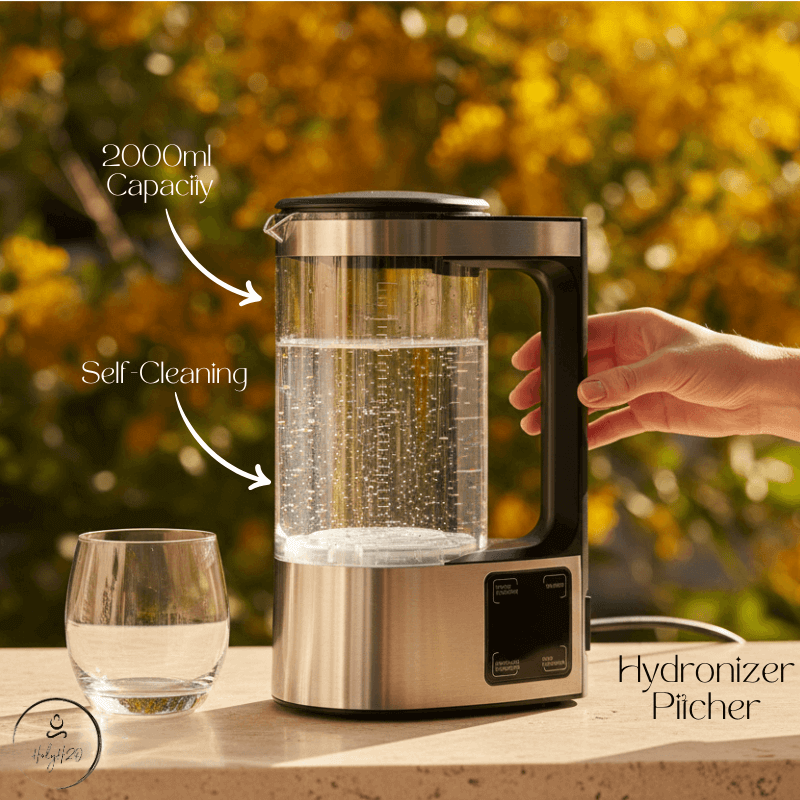
HolyH2O Hydrogen Water Pitcher 2L
2L household hydrogen water pitcher using SPE/PEM electrolysis to generate dissolved molecular hydrogen at 2.4 PPM. Hydrogen-rich water acts as a selective antioxidant, neutralising hydroxyl radicals without disrupting the body’s own oxidative signalling.
Shop HolyH2O Pitcher — $275 (code HOLYJAYCELOVE10 for 15% off) →This is the most specialised pick on the list and requires a clear caveat: the HolyH2O Pitcher is not a contaminant-removal filter. It is an add-on layer for women who want the documented antioxidant benefits of molecular hydrogen water in addition to their primary filter. Use it on pre-filtered water — ideally from the AquaTru above — not directly from the tap.
The pregnancy relevance: oxidative stress increases significantly during pregnancy, particularly in the second trimester, and elevated oxidative stress markers are associated with pre-eclampsia risk. Molecular hydrogen (H₂) at 1.0–2.4 PPM acts as a selective antioxidant, neutralising the most damaging hydroxyl radical without interfering with reactive oxygen species that the body uses for immune signalling. Multiple small trials in pregnant populations (primarily in Japan and South Korea) have shown reductions in blood oxidative markers with regular H₂ water consumption. These are preliminary findings — but the safety profile of H₂ water at the concentrations produced by SPE/PEM devices is well-established, and the risk of use during pregnancy is effectively zero.
✓ Pros
- 2.4 PPM H₂ — above the 1.6 PPM therapeutic research threshold
- SPE/PEM only — no ozone or chlorine byproducts
- 2L capacity suits household daily use
- 15% off with code HOLYJAYCELOVE10 at HolyH2O.com.au
- AU-based shipping and warranty
✗ Cons
- Does not remove any contaminants — must be used on pre-filtered water
- $275 is an add-on cost, not a replacement for your primary filter
- Pregnancy-specific H₂ research is promising but not yet definitive
Buy if: You already have a primary filter and want to add antioxidant hydrogen water — use on pre-filtered water, not directly from the tap. Shop HolyH2O Pitcher →
5. PWS EcoHero 5 Stage Under-Sink RO — Best Australian-Certified Under-Sink for Pregnancy
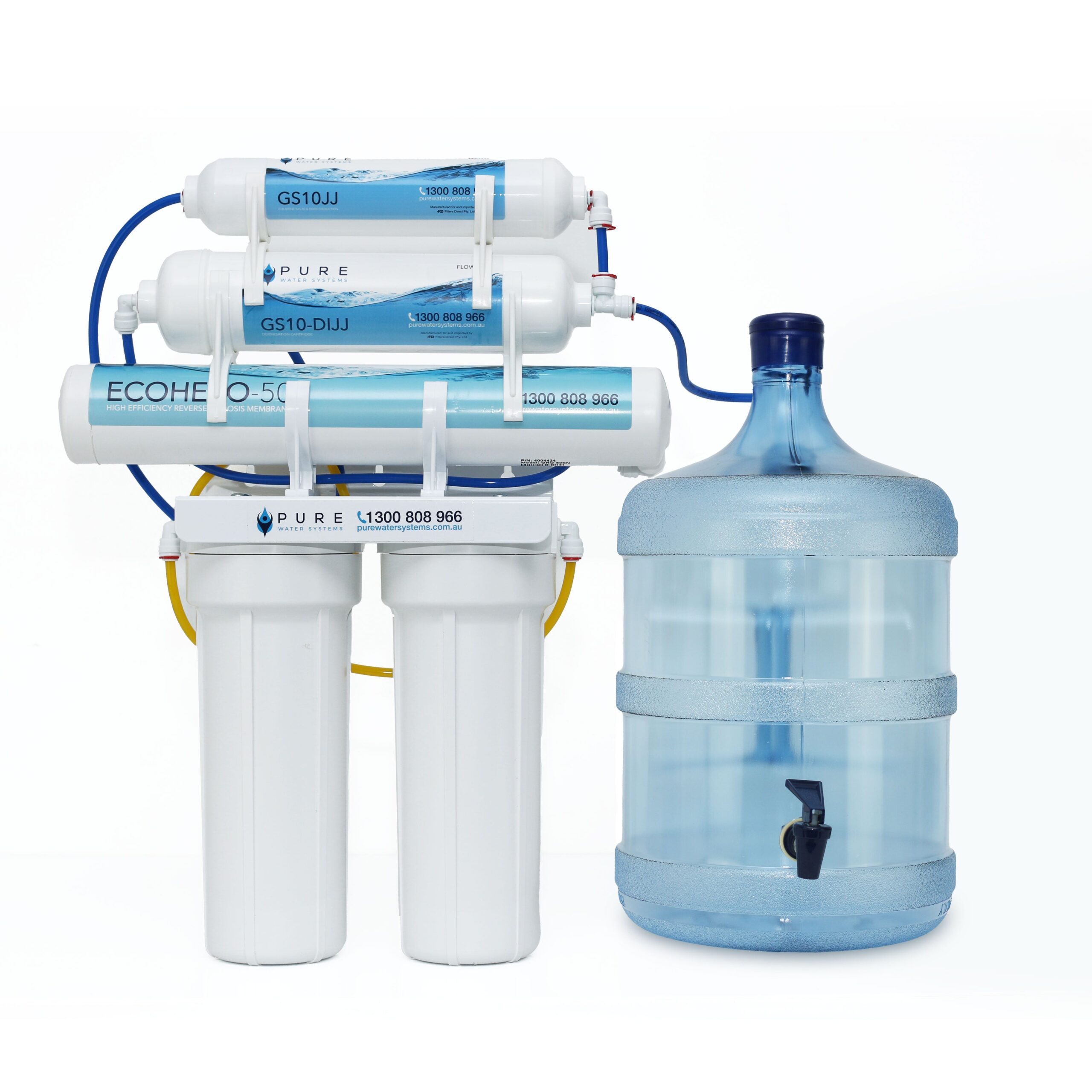
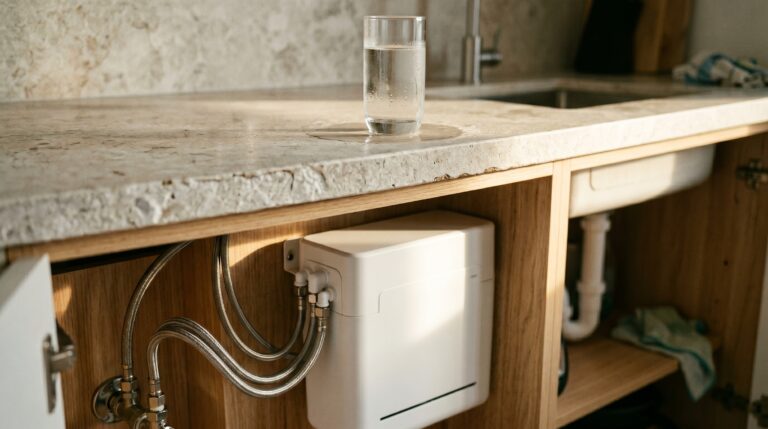
PWS EcoHero 5 Stage Under-Sink RO
5-stage under-sink reverse osmosis with WaterMark AS3497 certification and pH remineralisation. Removes PFAS, nitrates, lead, fluoride, chloramines, and microplastics. Australian brand with local warranty and stocked filters.
See at Pure Water Systems →For homeowners willing to install under-sink plumbing (or pay a plumber ~$200–300 for a licensed install), the PWS EcoHero 5 Stage RO is the standout Australian-certified choice. WaterMark AS3497 is the Australian standard legally required for permanently plumbed filtration — the EcoHero carries this certification in a five-stage configuration that adds a pH remineralisation stage, putting minerals back after RO removes them. This is the same mineral-stripping concern raised with the AquaTru Classic, addressed here natively. Australian customer support and locally stocked filter cartridges mean no international shipping delays during pregnancy or newborn stages when reliability matters most.
The EcoHero includes NSF 42 and NSF 58 component-level certification alongside the WaterMark standard — a stronger certification profile than many imported under-sink units. Five-stage filtration (sediment → carbon pre-filter → RO membrane → deionising → pH remineralisation) pushes TDS reduction to ~95% and brings pH back to a neutral-alkaline range. For pregnancy households in Brisbane, Sydney, Adelaide, or Gold Coast — all on chloramine disinfection — the RO membrane removes chloramine completely, where standard carbon-only filters fail. See our full under-sink RO guide for a broader comparison.
✓ Pros
- WaterMark AS3497 + NSF 42 & 58 component certification
- 5-stage filtration with pH remineralisation — no flat RO taste
- Australian brand, local customer support, domestically stocked filters
- Removes chloramine, fluoride, PFAS, lead, nitrates, and microplastics
- 10% off with code at checkout
✗ Cons
- ~$695 upfront — higher than imported alternatives
- Requires under-sink space and a licensed plumber for Australian compliance
- Add ~$200–300 for professional installation
- Dedicated filter tap requires a bench hole or extra drilling
Buy if: You own your home, have under-sink space, and want the most comprehensively certified Australian-made RO system with local warranty support. See at Pure Water Systems →
What About Water for Infant Formula?
For infant formula preparation, the standard applied in most Australian paediatric nutrition guidelines is to boil water and allow it to cool — but boiling does not remove PFAS, nitrates, fluoride, or microplastics. It only kills pathogens. For households on mains water preparing formula, the precautionary recommendation is RO-filtered water: it removes the full spectrum of chemical contaminants that boiling cannot, while leaving the mineral balance of formula powder intact. The AquaTru or PWS EcoHero 5 Stage RO are appropriate for formula water. Gravity filters are better than nothing, but do not achieve the same level of chemical removal.
Frequently Asked Questions
Is Australian tap water safe to drink during pregnancy?
Australian tap water meets the ADWG 2022 standards, which are set for the general adult population. These guidelines do not specifically address foetal development, transplacental transfer of contaminants, or the precautionary thresholds that apply to nitrates and PFAS during pregnancy. For most metropolitan tap water — Sydney, Melbourne, Brisbane, Adelaide — the chemical risk from drinking unfiltered tap water is low but not zero. PFAS contamination near certain suburbs (RAAF bases, industrial zones) creates localised high-risk pockets. Check your local utility’s annual water quality report; if PFAS is detected above 0.07 µg/L, RO filtration is warranted.
Does a water filter remove PFAS during pregnancy?
Only reverse osmosis reliably removes PFAS — certified systems achieve 94–99% removal. Activated carbon filters (including gravity filters like Waters Co) offer partial PFAS reduction but inconsistently, and particularly not for short-chain PFAS compounds like PFBS and PFBA that have replaced longer-chain PFAS in recent manufacturing. If PFAS is a specific concern in your area, choose an NSF 58-certified RO system — the AquaTru Classic Smart Alkaline (this list) or the PWS EcoHero 5-Stage (our under-sink guide).
Is fluoride in water safe during pregnancy?
The evidence is contested. The NHMRC (2017) found no evidence of harm at fluoride concentrations used in Australian water (0.6–1.0 mg/L). A 2020 JAMA Pediatrics study found an association between higher maternal urinary fluoride and lower IQ in male children; this was replicated in a 2023 Canadian meta-analysis. Neither finding is definitive causation, and effect sizes are small. The mainstream position of Australian dental and obstetric bodies is that fluoride at current levels is safe. For pregnant women who want to apply the precautionary principle, the Waters Co BIO 500 MAX achieves 99% fluoride reduction without RO.
Do I need RO during pregnancy or will a gravity filter work?
It depends on your specific concerns. A certified gravity filter such as Waters Co effectively removes heavy metals, chlorine, chloramines, and fluoride, covering the most common mains water concerns. RO is required if your priorities include PFAS removal, nitrate reduction, or microplastic filtration. If you’re preparing infant formula, using RO-filtered water eliminates more chemical risk than gravity-filtered water. If your utility water report shows no PFAS and nitrates below 5 mg/L, a good gravity filter is a reasonable choice during pregnancy.
Is it safe to shower in chlorinated water during pregnancy?
Regular exposure to hot chlorinated or chloraminated shower water is a real but underappreciated exposure route during pregnancy. The inhalation and dermal absorption of trihalomethanes (THMs) during showering contributes meaningfully to total THM body burden — in some studies, exceeding the contribution from drinking water. The precautionary measure is simple: a shower filter designed for chlorine and chloramine reduction.
What water should I use for baby formula in Australia?
Australian Health guidelines recommend boiling mains tap water before use in formula to kill pathogens. However, boiling does not remove chemical contaminants — it concentrates them. For formula water, we recommend using RO-filtered water (from AquaTru or PWS EcoHero 5 Stage RO), then boiling or using a sterilising kettle to ensure pathogen kill. The mineral content of prepared formula comes predominantly from the powder itself, so using demineralised RO water does not create mineral deficiency in the formula. The NHMRC notes this is safe practice.
Get the Australian Home Environment Checklist
30 checks across water, air and EMF. Most of them free. Ranked by impact.
No spam. Unsubscribe any time.

Former Royal Australian Navy Clearance Diver and TAG-E counter-terrorism operator. Founded Clean and Native to apply the same rigorous thinking to the home environment.
Full biography →