EMF Bedroom Audit Australia: Step-by-Step Measurement Guide
Drafted with AI assistance and checked against published specifications and certifications. First-hand measurements appear only where stated. How we make content
A bedroom EMF audit is a systematic measurement of all three EMF field types in your sleeping environment: AC magnetic fields (wiring and appliances), AC electric fields (power cables), and RF/microwave (wireless devices). It takes 20-30 minutes with the right meter and produces a ranked list of sources by field strength – so you know exactly where to focus reduction effort. The most common outcome: the shielding product someone planned to buy would have had minimal effect on their actual highest source, which turned out to be something free and simple to fix.
A bedroom EMF audit in Australia involves measuring AC magnetic fields from wiring and appliances, AC electric fields from power cables, and RF/microwave radiation from wireless devices using a tri-field meter like the TriField TF2, typically taking 20-30 minutes to identify your highest exposure sources. The most valuable outcome is discovering that free fixes (moving your phone charger to another room, relocating your bed 50cm from a smart meter wall) typically reduce exposure more than expensive shielding products would. Most Australian homes find RF pulses from smart meters through bedroom walls and continuous RF from phones charging within arm’s reach are the dominant sources, not the EMF paint or bed canopy they were about to purchase. The catches: you need a $400-500 meter to measure accurately (phone apps and single-axis meters miss critical data), and the audit only tells you what’s there now — not cumulative exposure from historical sleeping positions or daytime sources.
| EMF Source | Typical AU Finding | Action |
|---|---|---|
| Smart meter (RF) | Pulses through bedroom wall every 30s | Move bed 1m away (free) |
| Phone charger (RF) | Continuous signal 30-50cm from pillow | Charge in another room (free) |
| Unplugged extension cords | E-field from live cable under bed | Unplug or replace with shielded cable |
What this audit will tell you
The three products we own are measured first-hand by Jayce Love, former Royal Australian Navy Clearance Diver; every other product is assessed on published manufacturer specifications and independent certification using our documented methodology — no gifted units, no brand payments.
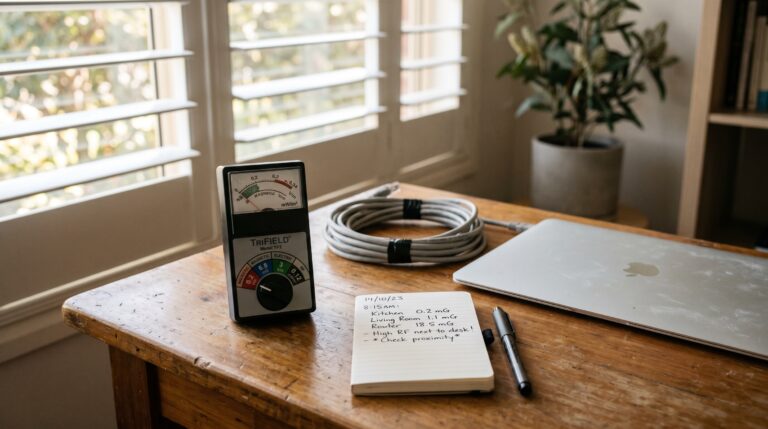
Meter needed: TriField TF2 – measures all three field types, peak hold for smart meter pulses
Time required: 20-30 minutes initial audit + 5-10 minutes re-measure after each change
Most common finding AU homes: Smart meter wall behind bed head (RF pulses), phone charger 30cm from pillow (RF continuous), unplugged extension cord (E-field)
Biggest wins (free): Move phone to charge in another room. Move bed away from smart meter wall.
Palm Beach result: RF 0.032 mW/m², magnetic 0.12 µT, electric 6 V/m at bed head
Why the Bedroom Is the Only Room That Really Matters for EMF Reduction
You spend 7-9 hours in your bedroom every night – more time than any other single location in your life. During that time, your body is doing things it cannot do while awake: consolidating memories, repairing cellular damage, regulating hormones (particularly melatonin and cortisol), and running immune maintenance processes.
Melatonin production is particularly relevant to the EMF discussion. Melatonin is produced by the pineal gland during darkness and is the primary driver of sleep onset and quality. Multiple studies have examined the relationship between electromagnetic fields and melatonin suppression – the evidence is contested but the precautionary logic is straightforward: if there is any biological pathway worth reducing EMF exposure for, sleep is the highest-priority window because it’s both the longest continuous exposure and the time when the body is most engaged in recovery processes.
The practical implication: reducing EMF in your living room, office, or kitchen while leaving your bedroom unchanged misses the point entirely. A bedroom EMF audit is the single most efficient action you can take in the EMF reduction space.
Equipment Required for a Bedroom EMF Audit
Primary Meter: TriField TF2
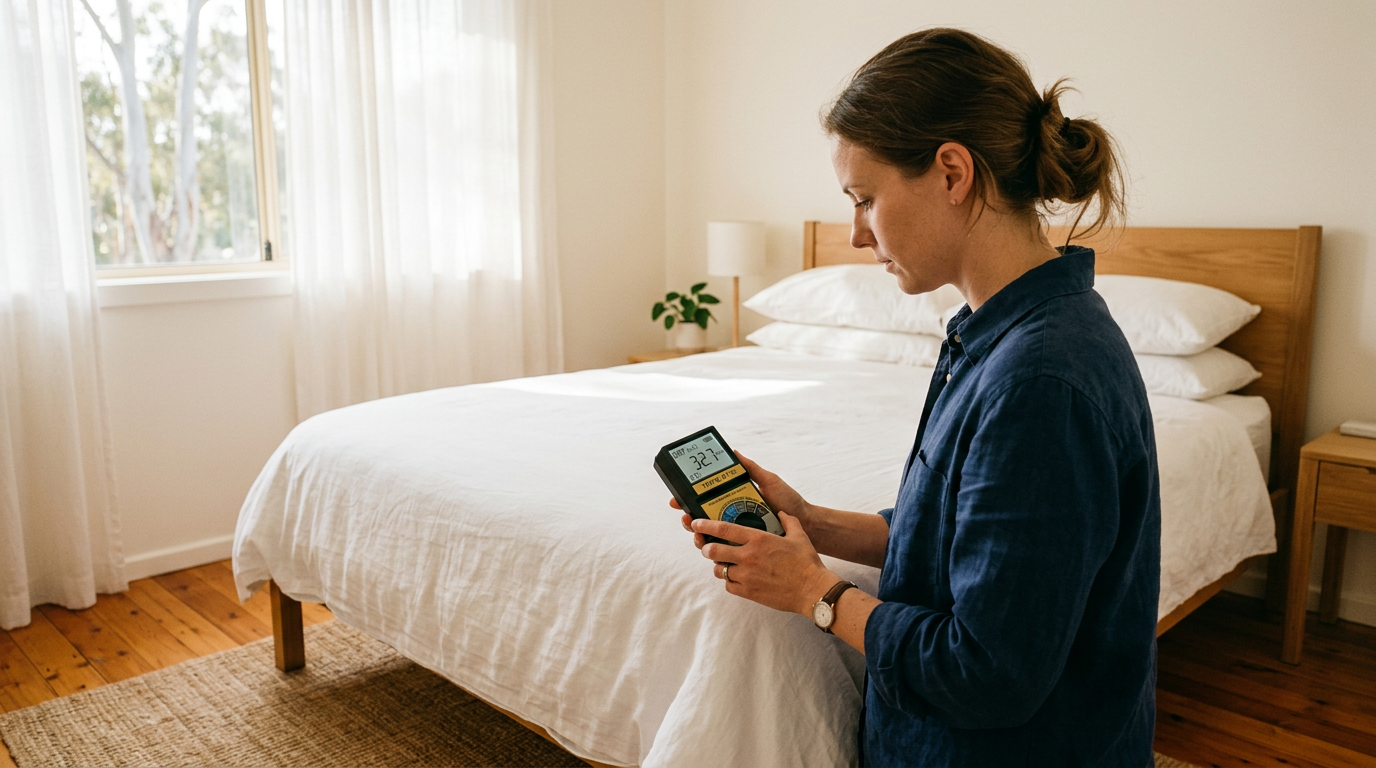
The TriField TF2 is the meter recommended by Australian building biologists and EMF consultants for household audits. It measures all three relevant field types with a single device:
- RF/microwave: 1 MHz – 8 GHz – covers WiFi (2.4GHz, 5GHz), mobile 4G/5G (700MHz-3.5GHz), smart meters (915MHz or 2.4GHz on Ausgrid/Energex networks), DECT phones (1.9GHz), Bluetooth
- AC magnetic: 0.1-100 µT at 50 Hz – covers wiring in walls, transformers, appliances
- AC electric: 1-1,000 V/m at 50 Hz – covers power cables, extension cords, anything plugged in
Key features for bedroom auditing specifically: the TF2 has a peak hold function that captures transient spikes – essential for detecting smart meter pulses which transmit in short bursts every 5-30 minutes. A time-averaging meter will dramatically understate smart meter exposure by averaging the burst over the silent interval between pulses.
The TF2 runs on a 9V battery and is compatible with Australian mains frequency (50 Hz) – no adapter needed.
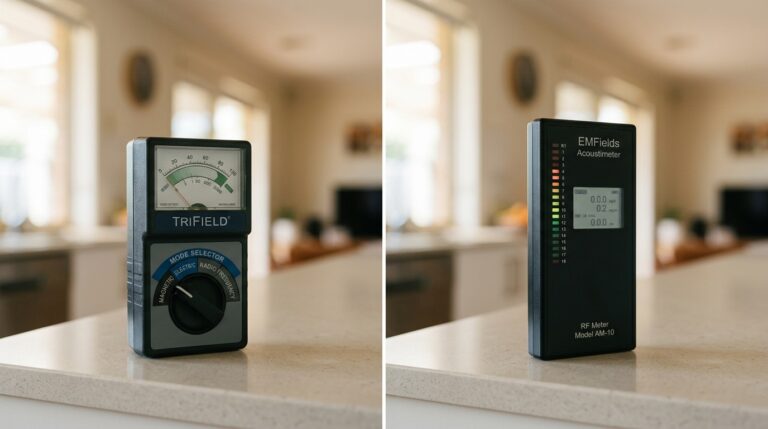
Budget Alternative: Cornet ED88TPlus
At approximately $155 AUD, the Cornet ED88TPlus measures RF (100MHz-8GHz), magnetic fields, and electric fields. Its RF range extends to 8GHz – wider than the TF2’s 3GHz limit, which means it covers 5.8GHz WiFi and more 5G sub-6GHz frequencies. Trade-off: its peak hold for smart meter pulsing is less intuitive than the TF2’s analogue display. For a bedroom-focused audit where smart meter pulsing is a primary concern, the TF2’s display is more useful. For a budget-conscious buyer who also wants future-proofing for 5G frequencies, the Cornet is a reasonable alternative.
What You Do NOT Need
- Smartphone EMF apps: These use the phone’s magnetometer to detect ELF-MF approximately. They cannot measure RF from external sources – the phone itself is transmitting RF continuously, corrupting any RF measurement. Not useful for a bedroom audit.
- Single-field meters under $100: The $35-50 “EMF detectors” on Amazon measure ELF-MF only and typically overread by 2-5x. They miss RF entirely – which is often the dominant source in modern Australian bedrooms.
- Professional laboratory instruments ($1,500+): Unnecessary for household auditing. The TriField TF2 provides meaningful data for all practical bedroom reduction decisions.
Step-by-Step Bedroom EMF Audit Protocol
Document room layout before you start
Sketch or photograph the room noting: bed position relative to all four walls, location of power points, which wall faces the street (likely smart meter side), location of WiFi router (even if in another room, note which direction), any appliances (reverse-cycle aircon, TV, electric blanket). This context is essential for interpreting readings – a magnetic field spike on the north wall means nothing until you know that’s the wall shared with the meter box.
Baseline – room centre, devices off
Stand in the room centre with all devices powered off or in airplane mode. Enable peak hold on the TF2. Record magnetic, electric, and RF readings. This establishes your ambient baseline from external sources: neighbourhood WiFi, mobile towers, power lines passing the property. If your baseline RF already reads above 0.1 mW/m², an external source is penetrating through the walls before you even turn anything on.
Bed head measurement – the critical reading
Place the meter at pillow height with all devices in their normal overnight configuration (phone charging, router on, aircon set, everything as it typically is when you sleep). Record all three field types with peak hold. Leave the meter running for at least 5 minutes at pillow height to capture any smart meter pulse if the smart meter is on a nearby wall. This is the single most important reading of the entire audit – it represents your actual nightly exposure averaged over 7-9 hours.
Perimeter wall sweep
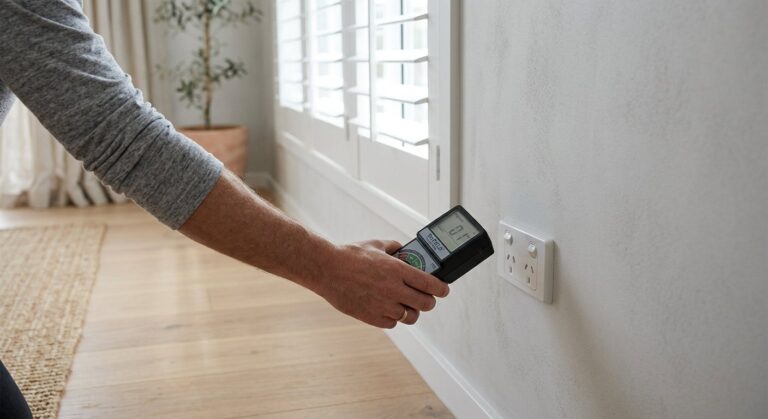
Walk slowly 5-10 cm from each wall in sequence, all three field modes. Note the highest reading on each wall. Common Australian bedroom findings: the wall adjoining the main switchboard reads elevated magnetic fields (transformer and wiring); the exterior wall where the smart meter is mounted reads elevated RF with pulse pattern; the wall shared with a home office reads elevated RF from router proximity. For smart meter walls, leave the meter on peak hold pointing at the wall for 10-15 minutes to capture a full pulse cycle – Ausgrid and Energex meters pulse at intervals of 5-30 minutes depending on network configuration.
Device-by-device testing
Test each bedside item individually: smartphone (normal, then airplane mode – note the difference), bedside lamp (plugged in but off vs. unplugged completely – electric field), extension cord under the bed (electric field mode), digital clock radio, smart speaker, DECT cordless phone base. Turn off or physically unplug one device at a time and observe meter change. Many people find their highest electric field reading comes from an extension cord they didn’t realise was near the bed head – and unplugging it (not just switching off) drops the E-field reading substantially.
Prioritise, act, re-measure
Rank your findings by: reading level multiplied by proximity to where your head rests. A 5 mW/m² reading from a device 50cm from your pillow is more relevant than a 10 mW/m² reading from the meter box on the far wall. Address the highest-impact source closest to the bed head first. Re-measure the bed head reading after each action to verify the change. This before-and-after verification is the step most people skip – and it’s the most important one, because it shows whether your action actually moved the needle.
Australian-Specific EMF Sources in Bedrooms
Most EMF content is written for the US or UK market. Australian bedrooms have specific sources and configurations that differ meaningfully.
Smart Meters: Ausgrid, Energex, CitiPower, SA Power Networks, Western Power
Australia’s national smart meter rollout has placed interval meters on most residential properties. These meters communicate wirelessly using RF – and the way they communicate is what makes them a particular bedroom concern.
Smart meters transmit in short pulses at intervals ranging from every 30 seconds (some mesh network designs) to every 30 minutes. During a pulse, the RF output can be 100-1,000 times the average reading between pulses. This means:
- If you measure smart meter RF with a time-averaging meter and stand there for 5 seconds, you may see 0.02 mW/m² and conclude it’s not significant. Come back with peak hold and leave it running for 20 minutes, and you may capture a pulse at 2.0 mW/m² or higher at 1 metre from the wall.
- Smart meters are typically mounted on the external wall of the property near the meter box – which in many Australian homes is on the bedroom wall, side of the house nearest the street, or on the kitchen/laundry wall which may be adjacent to a bedroom.
- The relevant question is not “is my smart meter on before I go to sleep” – it’s always on, always pulsing. The relevant question is “is my bed head within 1-2 metres of the wall the smart meter is mounted on?”
The fix is simple and free: Move the bed head to the opposite wall. If the smart meter is on the north exterior wall, put the bed head against the south wall. Distance reduces RF by the inverse square law – doubling the distance from 1 metre to 2 metres reduces exposure by 75%.
NBN Connection Equipment
Australia’s National Broadband Network infrastructure involves indoor termination equipment – the NTD (Network Termination Device) for FTTP connections, or a modem/router for FTTN/HFC connections. Most households place the NBN modem/router in the lounge room or study, but some place it in hallways or rooms adjacent to the bedroom. The router transmits WiFi continuously at 2.4GHz and 5GHz. At 1 metre, a standard WiFi router produces 1-10 mW/m². At 5 metres (through a wall), this drops to approximately 0.04-0.4 mW/m².
If your NBN router is in the room directly adjacent to your bedroom wall – particularly the wall near your bed head – moving it to a more central location in the house can meaningfully reduce bedroom RF exposure with no other changes.
Reverse-Cycle Aircon Units
Reverse-cycle split system air conditioners are ubiquitous in Australian bedrooms – far more common than in most other markets. The indoor unit is typically wall-mounted, often on the wall above or near the bed head. These units:
- Produce magnetic fields from their compressor motor – typically 0.1-0.5 µT at 30cm during operation, dropping to negligible at 1 metre
- Some newer “smart” reverse-cycle units include built-in WiFi for app control and connect to the home network continuously
- The electrical cable running to the unit in the wall produces electric fields even when the unit is switched off at the remote (the cable is still energised)
For aircon-specific EMF: check with the magnetic field mode during operation. If the unit is directly above the bed and reads above 0.3 µT at pillow height during operation, this is worth noting. The electric field from the in-wall cable is usually minor (1-5 V/m) but measurable.
5G Street Infrastructure
Telstra, Optus, and TPG/Vodafone have deployed 5G infrastructure including small cells mounted on street furniture (light poles, utility cabinets) in Australian residential streets. These small cells emit RF continuously. If one is mounted within 10-20 metres of a bedroom window, baseline RF readings may be elevated. Check: stand at your bedroom window facing the street and look for small white or grey boxes mounted on poles. Most consumer meters (TriField TF2, Cornet ED88TPlus) measure sub-6GHz 5G frequencies accurately.
Reading Benchmarks: What Your Numbers Mean
| Field Type | ARPANSA Limit | BioInitiative Sleep Guideline | Typical AU Bedroom | Palm Beach Result |
|---|---|---|---|---|
| RF/microwave (2.4GHz) | 10,000 mW/m² | <0.001 mW/m² | 0.005-0.2 mW/m² | 0.032 mW/m² |
| AC magnetic (50Hz) | 1,000 µT | <0.02 µT | 0.05-0.4 µT | 0.12 µT |
| AC electric (50Hz) | Not specified | <1 V/m | 2-30 V/m | 6 V/m |
How to interpret your numbers:
- RF below 0.1 mW/m² at bed head: Within building biology guidelines for sleeping areas. No urgent action required for RF specifically.
- RF 0.1-1.0 mW/m²: Elevated. Identify the source (smart meter pulse? phone charger nearby? router in adjacent room?) and address the highest contributor.
- RF above 1.0 mW/m²: Significantly elevated for a sleeping area. Priority investigation needed. Check for smart meter on bedroom wall, phone charging at bedside, DECT base station in room.
- Magnetic above 0.3 µT: Check for switchboard proximity, transformer, or high-current wiring in adjacent wall. Moving the bed is the most practical response if source is fixed infrastructure.
- Electric above 10 V/m: Unplug all non-essential devices from power points in the bedroom. Use a demand switch on the bedroom circuit if readings remain elevated after unplugging. Electric fields come from cables that are energised (plugged in) even when devices are switched off.
The Priority Reduction Actions: Ranked by Impact and Cost
| Action | Cost | Field type addressed | Typical impact | How to do it |
|---|---|---|---|---|
| Charge phone in another room | Free | RF | High | Phone charging at bedside: 0.5-5 mW/m² at 30cm. In another room: effectively zero. Most impactful single change for most AU bedrooms. |
| Move bed from smart meter wall | Free | RF | High | If smart meter is on one wall, position bed against the opposite wall. Inverse square law: 2m vs 1m = 75% reduction in RF power density. |
| Turn off WiFi router at night | Free / $15 timer | RF | Medium-High | Router off = zero WiFi RF. Use a $15 mechanical outlet timer (Bunnings). Set to power off at 10pm, on at 6am. Does not affect NBN connection itself. |
| Unplug bedside devices at wall | Free | Electric field | Medium | Switching off is not enough – the cable remains energised. Physical unplugging from the wall socket eliminates the E-field from that cable. Bedside lamp, extension cord, clock radio. |
| Phone to airplane mode at bedside | Free | RF | Medium | If charging in the room is unavoidable (alarm use), airplane mode stops RF transmission. Does not reduce E-field from the charging cable itself. |
| Demand switch on bedroom circuit | $150-300 installed | Electric field | High for E-field | Cuts power to the bedroom circuit when no load is present (lights off, nothing drawing current). Eliminates E-fields from in-wall wiring. Requires licensed electrician. Most effective E-field intervention. |
| Relocate WiFi router away from bedroom wall | Free | RF | Medium | If router is in a room sharing a wall with the bedroom, moving it to a more central location increases the signal path distance. Each wall adds attenuation of 5-15 dB depending on material. |
| Wired ethernet for stationary devices | $20-80 | RF | Medium | Desktop, smart TV, streaming device connected by ethernet cable rather than WiFi. Eliminates that device’s WiFi connection. Does not reduce router broadcast – to do that, also disable the router’s WiFi broadcast. |
Electric Fields: The Most Overlooked Category in Bedroom EMF
Most EMF content focuses on RF (WiFi, smart meters, phones) and magnetic fields (power lines, wiring). Electric fields get almost no attention – yet they are often the dominant field type in an Australian bedroom, and they are among the simplest to address.
Electric fields (measured in V/m) are created by any electrical cable that is energised – meaning plugged into an active power point, regardless of whether the device is switched on or off. The cable acts as an antenna radiating an electric field proportional to the mains voltage (240V in Australia) and inversely proportional to distance.
Common bedroom E-field sources:
- Extension cord under or beside the bed: A common finding. Extension cords are flat and run along floors, often directly below where people sleep. In electric field mode, these commonly read 10-50 V/m within 30cm. Unplugging the extension cord (not just switching off the powerboard) drops the reading to near zero.
- Bedside lamp cable: The cable from a plugged-in lamp creates an E-field even when the lamp is off. Unplugging before bed eliminates it.
- In-wall wiring: Wiring in the bedroom walls creates E-fields continuously – this is the baseline you cannot easily eliminate without a demand switch. In most Australian homes this reads 2-10 V/m in the centre of the room and higher near wall outlets.
- Reverse-cycle aircon cable: The supply cable to the aircon unit in the wall is energised continuously. Not removable without a licensed electrician, but the aircon unit’s cable typically runs inside the wall cavity and produces lower E-fields at the bed surface than a cable lying on the floor nearby.
The demand switch solution:
A demand switch (also called a load disconnector or sleeping switch) is wired into the bedroom circuit by a licensed electrician. It monitors the circuit for electrical load. When no load is present – lights off, everything unplugged – it cuts mains power to the circuit, eliminating the E-field from in-wall wiring. When you turn a light on or plug something in, it reconnects automatically.
This is the gold standard for electric field reduction in a sleeping area. It requires a licensed electrician (a legal requirement in Australia for any work involving the switchboard) and costs approximately $150-300 installed. If your audit shows elevated E-fields from in-wall wiring that can’t be addressed by unplugging individual devices, a demand switch is the only practical solution.
RF Reduction: What Actually Works
RF follows the inverse square law: double the distance, quarter the exposure. This physics-based principle makes distance the most reliable and cost-effective RF reduction tool available – more effective than most shielding products at comparable cost.
Practical RF reduction hierarchy for Australian bedrooms:
- Phone away from bed – Charging phone in another room eliminates the dominant RF source for most people. If you use your phone as an alarm, buy a $5 battery alarm clock and leave the phone in the hallway.
- Router off at night – A $15 mechanical outlet timer from Bunnings eliminates all WiFi RF from 10pm-6am. This is the single best value EMF reduction purchase available. Your internet reconnects automatically when the timer switches on in the morning.
- Bed position away from smart meter – Check which exterior wall your smart meter is mounted on. If your bed head is within 1.5 metres of that wall, moving it to the opposite wall is more effective than any shielding product.
- DECT phone base removed from bedroom – DECT base stations transmit continuously at 1.9GHz regardless of whether a call is in progress. They are among the highest RF sources in Australian homes. If a DECT base is in or near the bedroom, move it to the kitchen or lounge.
- Smart speaker off or unplugged – Smart speakers (Google Home, Amazon Echo, Apple HomePod) transmit WiFi and Bluetooth continuously. If one is in the bedroom, either unplug it overnight or assign it to a different room.
Magnetic Fields: When and How to Address Them
Magnetic fields from household wiring (50Hz) are harder to address than RF because they penetrate walls, furniture, and the human body without significant attenuation. The inverse square law still applies but magnetic fields fall off more slowly than RF – the relationship depends on the field source geometry (single conductor vs. balanced pair).
Sources you can address:
- Appliances running near the bed: Hair dryers, electric blankets, and electric heating pads produce significant magnetic fields during operation but at close range only. Electric blankets are particularly relevant – a heated mattress pad or electric blanket below your body produces 0.2-2.0 µT at body-to-mattress distance during heating. Switch off (and ideally unplug) before sleeping rather than sleeping with it active.
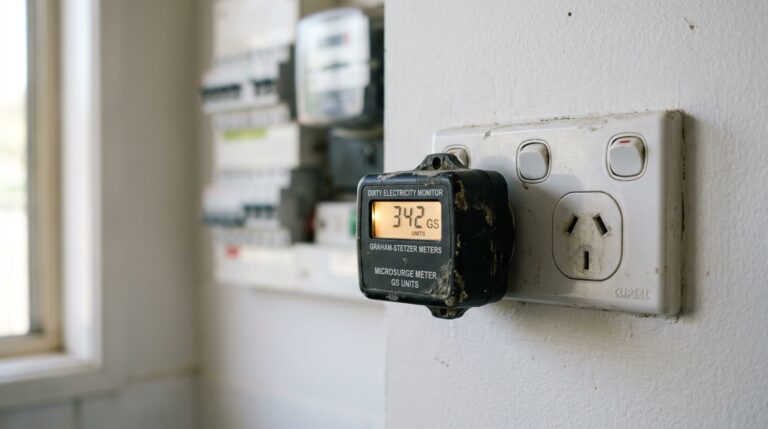
- Bed position relative to switchboard: The main switchboard/meter box produces 0.5-5 µT within 30cm and drops sharply with distance. If your bedroom shares a wall with the meter box, move the bed head to the opposite wall – same principle as the smart meter.
Sources you cannot easily address:
- In-wall wiring (balanced load): Modern Australian home wiring is run as active + neutral pairs, meaning the magnetic fields largely cancel. The residual is typically 0.05-0.2 µT in the room centre – not a priority target.
- External power lines: Distribution lines running along your street or near your property produce ELF-MF. At a typical residential setback of 5-10 metres from street-level distribution wiring, the field is usually below 0.1 µT. High-voltage transmission lines (HV towers) are a different matter and represent a genuine concern for homes within 50-100 metres.
EMF Shielding in Bedrooms: When It Makes Sense and When It Doesn’t
Shielding products – canopy beds, shielding fabric, shielding paint – are the most marketed category in the EMF space and the most misused. Before spending on any shielding product, the audit protocol above must be completed. Here’s why:
The shielding trap: If your highest bedroom RF source is inside the bedroom – phone charger, smart speaker, router in adjacent room through wall – shielding that encloses the sleeping area can create a partial Faraday cage that reflects the internal source back at you, potentially increasing exposure at the sleeping position. Shielding works only when the primary source is external to the shielded zone. Measure first.
Measure First. Act Second.
The TriField TF2 measures AC magnetic, AC electric, and RF fields in one meter. Without real readings, every EMF decision is a guess. Every room audit starts here.
When shielding is appropriate:
- External RF sources cannot be addressed by repositioning (fixed infrastructure: mobile towers, 5G small cells, smart meter on a wall you cannot move the bed away from due to room layout)
- Baseline RF from external sources is elevated (above 0.1 mW/m²) with all internal devices off
- You have addressed all addressable internal sources first (no devices in the room, router off or wired)
Shielding options for Australian bedrooms:
- Canopy bed nets (RF shielding fabric): Swiss Shield, Naturell, and similar silver/copper mesh fabrics provide 20-40dB RF attenuation when properly installed as a complete enclosure. Effectiveness depends on having no gaps (grounding wire, proper overlap at entry point, ensuring the canopy reaches the mattress surface on all sides). Cost: $400-1,200 AUD for a quality canopy. Does not address magnetic fields – only RF.
- Shielding paint: Applied to exterior-facing walls, provides 20-40dB RF attenuation for that wall face. Requires a grounding connection. Effective for a single-direction RF source (fixed tower on one side of the property). Does not help if the source is directly above or below, and will reflect rather than absorb if sources are inside.
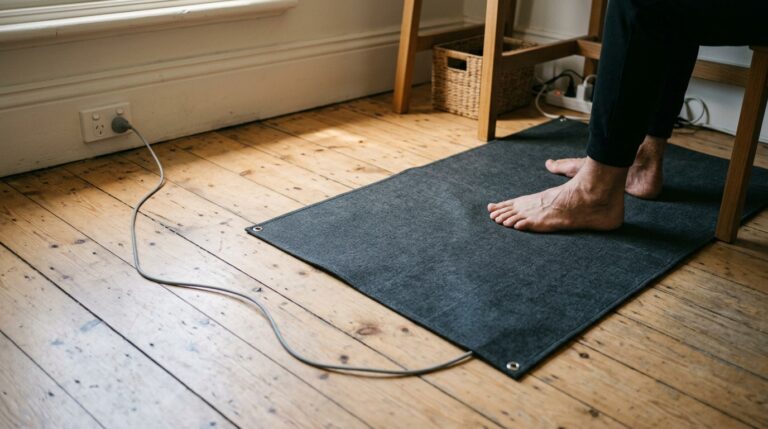
- Grounding mats: Claim to address electric fields at the body surface. The evidence base for benefit beyond basic E-field reduction (achievable by unplugging cables) is limited. An earthed mat provides a path to ground that may reduce the E-field measured at the body – but if the in-wall wiring is still energised, the ambient E-field remains. Not a priority purchase before a demand switch for E-field reduction.
Bedroom EMF Decision Matrix
| Your reading | Likely source | First action | If still elevated after |
|---|---|---|---|
| RF >0.5 mW/m² at bed head | Phone charger, smart meter wall, DECT base, router adjacent | Move phone to another room. Check smart meter wall position. | Turn off router overnight. Remove DECT base. Consider canopy if external source confirmed. |
| RF high in baseline (devices off) | External: mobile tower, smart meter, neighbour WiFi | Locate direction of source. Consider bed repositioning. | Shielding canopy or paint on source-facing wall. Confirm no indoor sources before installing. |
| Magnetic >0.3 µT at bed head | Switchboard wall, in-wall transformer, external power line | Move bed to opposite wall. Test at new position. | If source is external power line: consult building biologist about distance options. |
| Electric >10 V/m at bed head | Extension cord, bedside lamp cable, in-wall wiring | Unplug all non-essential devices from bedroom sockets. | Demand switch installed by licensed electrician. Most cost-effective E-field solution. |
| All fields low, still concerned | Anxiety about EMF rather than a measurement issue | Your bedroom is already well below building biology guidelines. No further action needed. | Read ARPANSA’s position statement. Having the data and seeing it’s low is the most effective resolution. |
Get the meter and start measuring
The TriField TF2 is reviewed in full in our EMF meter guide – covering all seven meters available in Australia, smart meter testing protocol, and ARPANSA vs BioInitiative comparison.
Best EMF Meters Australia → Complete AU Home EMF Guide →Frequently Asked Questions
What EMF meter should I use for a bedroom audit in Australia?
The TriField TF2 (ASIN B078T2R64C on Amazon AU, ~$260) is the recommended meter for Australian household bedroom audits. It measures all three field types (RF/microwave, AC magnetic, AC electric) with a single device, and its peak hold function captures smart meter pulses – critical for Ausgrid, Energex, and other Australian smart meter networks. The Cornet ED88TPlus (~$155) is a capable budget alternative with wider RF coverage (to 8GHz vs 3GHz). Smartphone apps and meters under $100 are inadequate for meaningful bedroom auditing.
How long does a bedroom EMF audit take?
20-30 minutes for the initial systematic measurement: baseline (room centre, devices off), bed head measurement (devices in overnight configuration), perimeter wall sweep, and device-by-device testing. Allow an additional 10-15 minutes if you need to capture smart meter pulses, as these can occur on cycles up to 30 minutes apart on some Australian networks. Re-measurement after each reduction action takes 5-10 minutes.
What are normal bedroom EMF readings in Australian homes?
RF at a bed head with the router in another room and phone absent: typically 0.005-0.05 mW/m² from ambient external sources. With phone charging at bedside: 0.5-5 mW/m². Smart meter on adjacent wall (peak hold): 1-8 mW/m² during pulse. Magnetic fields from household wiring: 0.05-0.3 µT in room centre. Electric fields: 2-15 V/m from in-wall wiring, up to 50 V/m near extension cords and cables directly on the floor. ARPANSA limits are 10,000 mW/m² for RF – residential readings are typically 1,000-100,000 times below this level, with the relevant benchmark for sleeping areas being the more conservative building biology guidelines.
Is it worth buying EMF shielding for my bedroom?
Only after completing the audit and exhausting free options first. If your highest RF source is your phone charger or a DECT base station, buying a $600 shielding canopy would have less effect than moving the phone out of the room – and could make things worse if internal sources reflect off the shielding back toward the sleeping position. Shielding is appropriate when: your baseline RF from external sources is elevated (above 0.1 mW/m² with all internal devices off), you have already removed or addressed all internal sources, and repositioning the bed doesn’t adequately reduce exposure.
How do I deal with a smart meter on my bedroom wall?
The most effective response is to move the bed head to the opposite wall – creating maximum distance between the sleeping position and the meter. Smart meters pulse RF in bursts that can be 100-1,000 times the average reading, so reducing distance is more effective than most shielding approaches. If room layout prevents this, check whether the meter is on the exterior or interior-accessible side of the wall – some Australian properties allow the meter box to be relocated by the network operator, though this typically involves cost. Shielding paint on the interior wall face is a last resort when repositioning is impossible.
Should I turn off my WiFi router at night?
Yes – for most Australian bedrooms it’s the single best-value EMF reduction action available. A $15 mechanical outlet timer (Bunnings) turns the router off at bedtime and on in the morning automatically. WiFi routers transmit continuously and represent one of the two or three highest RF sources in most homes. Turning it off at night doesn’t affect your NBN connection – the modem reconnects when the router powers back on. Your internet will work normally the moment it comes back on in the morning.
Do electric fields from power cables affect sleep?
Electric fields (from powered cables and in-wall wiring, measured in V/m) are the most overlooked EMF category in bedrooms. Some building biologists and researchers consider elevated E-fields in sleeping areas relevant to sleep quality – the mechanism proposed involves the body’s own bioelectric signals being disrupted by ambient electric field gradients. The practical point: E-fields are among the easiest to address. Unplugging cables from wall sockets (not just switching off) eliminates their E-field contribution. A demand switch eliminates in-wall wiring E-fields completely when no load is present. Whether the health case is proven or not, these are low-cost, easily reversible changes.
What’s the difference between RF, magnetic, and electric fields in a bedroom?
RF (radio frequency / microwave, measured in mW/m²): from wireless devices – WiFi, mobile, smart meters, Bluetooth, DECT phones. Intermittent or continuous transmission. Addressed primarily by distance and disabling wireless transmission. Magnetic fields (ELF-MF, measured in µT): from current flowing through wires – appliances, power lines, switchboard. Continuous when load is present. Hard to block; distance is primary intervention. Electric fields (ELF-EF, measured in V/m): from voltage in cables – any plugged-in cord regardless of whether the device is on. Continuous while plugged in. Easiest to address: unplug devices, use a demand switch for in-wall wiring.
Can a DECT cordless phone affect bedroom EMF?
Yes – significantly. DECT base stations transmit continuously at 1.9GHz regardless of whether a call is in progress. This differs from mobile phones which transmit only when connected to a network or during calls. A DECT base station within the bedroom or in an adjacent room is consistently one of the highest RF sources in Australian homes – often exceeding smartphone charger RF levels. If you have a DECT cordless phone, move the base to the kitchen or lounge, away from sleeping areas, or replace with a corded phone.
Get the Australian Home Environment Checklist
30 checks across water, air and EMF. Most of them free. Ranked by impact.
No spam. Unsubscribe any time.

Former Royal Australian Navy Clearance Diver and TAG-E counter-terrorism operator. Founded Clean and Native to apply the same rigorous thinking to the home environment.
Full biography →