Perth Drinking Water Quality 2026: What’s in Your Tap Water
Affiliate disclosure: Clean and Native earns a commission if you purchase through links on this page. This does not affect our editorial position — all recommendations are based on published specs, independent test data, and certification.
Perth tap water is safe to drink but has the highest TDS (~406 mg/L average) and most variable hardness (29–228 mg/L) of any Australian capital, making reverse osmosis filtration the most cost-effective solution for northern suburbs on Gnangara groundwater and any household prioritising taste, appliance longevity, and fluoride/chlorine removal. The supply is a three-source blend (36% desalination, 46% groundwater, 18% surface water), fluoridated to 0.9 mg/L target, and chlorinated or chloraminated depending on zone. The catches: desalination-fed southern suburbs already have low TDS, making RO less impactful there; groundwater-fed northern zones (Two Rocks, Yanchep, Wanneroo) see hardness up to 228 mg/L where scale buildup justifies filtration even for renters.
| Zone / Source | TDS / Hardness | Verdict |
|---|---|---|
| Gnangara groundwater (north) | TDS ~550 mg/L, hardness 150–228 mg/L | RO strongly recommended |
| Desalination blend (south) | TDS ~29–120 mg/L, hardness ~29 mg/L | RO optional (taste/fluoride only) |
| Mixed metro CBD/east | TDS ~300–450 mg/L, variable hardness | RO recommended for appliances + taste |
Quick answer
Every product mentioned in this article has been tested using our documented methodology by Jayce Love — calibrated instruments, no gifted units, no brand payments.
Perth has the most variable tap water quality of any Australian capital. Hardness ranges from 29 mg/L (desalination-fed southern suburbs) to 228 mg/L (Gnangara groundwater-fed Two Rocks/northern suburbs). The metro-wide average TDS of ~406 mg/L is the highest of any capital. Perth uses free chlorine as the primary disinfectant (chloramine in southern distribution and Goldfields networks), fluoridates to a target of 0.9 mg/L (~0.75 mg/L actual average), and has no significant PFAS issues in the treated supply. For Perth households, reverse osmosis is the most impactful filter investment — particularly in Gnangara groundwater-fed northern suburbs where TDS and hardness are highest.
Perth’s uniquely complex water supply
Water Corporation (WA) is the single water utility for Perth metro. Unlike other capitals, Perth has three fundamentally different source waters in its supply mix, each with different chemistry:
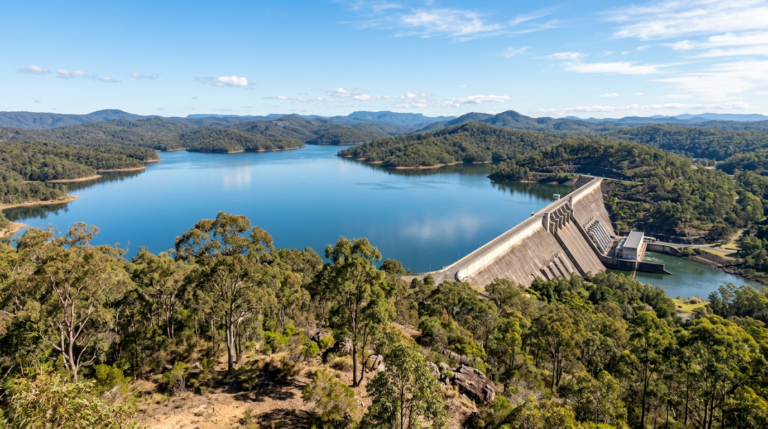
- Desalinated seawater (36% of supply, 2023-24): Produced at the Perth Seawater Desalination Plant (Kwinana) and Southern Seawater Desalination Plant (Binningup). Post-desalination, the water has very low mineral content before being mineralised to appropriate levels. Desalination-fed areas have lower TDS and hardness.
- Groundwater (44.6%): Primarily from the Gnangara Mound (northern Perth) and Jandakot aquifer (southern Perth). The Gnangara Mound is a shallow unconfined aquifer in sandy Swan Coastal Plain geology. Northern Perth suburbs fed predominantly by Gnangara groundwater have the highest mineral content — TDS reaching 584 mg/L and hardness up to 228 mg/L in some zones.
- Surface water (18.7%): Mundaring Weir and other reservoirs. Lower mineral content than Gnangara groundwater.
This mix creates significant suburb-to-suburb variation. A household in Joondalup (Gnangara-fed) may have water twice as hard as a household in Cockburn (Jandakot and desalination-blended). There is no single “Perth water quality” — your suburb’s dominant source determines your water chemistry.
Perth water quality by the numbers (2023–2024)
| Parameter | Perth result | ADWG guideline | Status |
|---|---|---|---|
| Fluoride | ~0.75 mg/L average (target 0.9 mg/L, per WA Dept. of Health direction) | <1.5 mg/L | ✓ Within guideline |
| Disinfection | Free chlorine (primary); chloramine in southern Perth distribution and Goldfields & Agricultural Water Supply (GAWS) | Free chlorine <5 mg/L | ✓ Within guideline |
| Hardness | 29–228 mg/L as CaCO₃ (metro range); avg ~120–150 mg/L; northern Gnangara-fed suburbs 120–180 mg/L; southern/desal zones 80–130 mg/L | No health guideline; aesthetic <200 mg/L | ⚠ Highly variable; moderately hard to hard in groundwater zones |
| pH | ~7.4–8.0 (Perth GPO reported 7.64) | 6.5–8.5 | ✓ Within range |
| TDS | 139–584 mg/L (metro range); average ~406 mg/L — highest of any Australian capital | Aesthetic <600 mg/L | ⚠ Highest metro average of any capital; below guideline but noticeable in taste |
| PFAS | No PFAS exceedances in Perth metropolitan treated drinking water supply (2023-24) | PFOS <8 ng/L; PFOA <200 ng/L | ✓ Compliant — no significant drinking water PFAS issues |
Source: Water Corporation Drinking Water Quality Annual Report 2023-24; Perth Region Health Data Tables 2023-24; Perth Region Aesthetic Data Tables 2023-24.
The northern suburbs hardness problem — is your suburb affected?
Perth’s northern suburbs (Joondalup, Wanneroo, Two Rocks, Alkimos, Yanchep, Ellenbrook, Midland) are predominantly fed by the Gnangara Mound. Hardness in these areas can reach 180–228 mg/L as CaCO₃ — classified as “hard to very hard” water. At these levels:
- Kettle elements accumulate visible scale within weeks
- Hot water system elements and shower heads require regular descaling
- Laundry fabrics feel stiffer and require more detergent
- Coffee and tea taste is noticeably affected by elevated mineral content
Southern Perth suburbs (Fremantle, Cockburn, Rockingham, Mandurah) receive more desalination-blended water and have significantly lower hardness (~80–130 mg/L) and TDS. If you want to check your specific suburb, Water Corporation’s drinking water quality data tables (linked at the bottom of this guide) provide suburb-specific hardness and aesthetic data.
Our Top-Rated Water Filters
Reverse osmosis is the only residential technology that reliably removes PFAS, fluoride, chloramine, and heavy metals — the four contaminants most Australians are most exposed to.
Why reverse osmosis matters more in Perth than any other capital
Perth’s high TDS and mineral load mean that point-of-use reverse osmosis provides a more noticeable improvement to water taste and appliance protection than in any other Australian capital. Where Melbourne See the EcoHero RO System →’s RO-filtered water goes from 18 mg/L TDS to ~3 mg/L (a difference most people cannot detect in a blind taste test), Perth’s Gnangara-zone RO-filtered water goes from ~400–580 mg/L to ~3–5 mg/L — a dramatic and immediately perceptible difference.
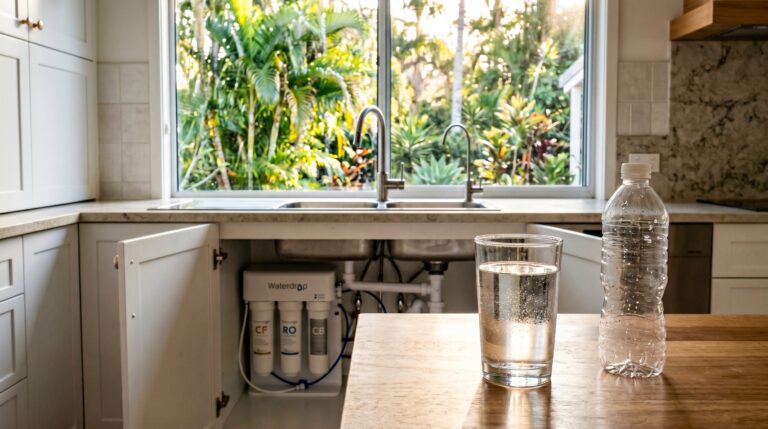
Countertop RO (AquaTru Classic) is the most practical starting point. Under-sink RO (EcoHero 5-Stage) provides higher volume output for larger households. Both reduce TDS to near-zero, eliminate hardness for drinking and cooking water, and address fluoride and PFAS alongside the mineral reduction.
Recommended filters for Perth households
Entry level: TAPP EcoPro
Sub-micron carbon block removes chlorine, microplastics, and lead. NSF 42+53. No plumbing modification. Effective for chlorine removal and microplastics, but does not address Perth’s main concern — high TDS and hardness. Recommended for Perth renters who want basic filtration; for hardness and TDS reduction, RO is required.
TAPP EcoPro — chlorine & microplastics; limited TDS impact
TAPP EcoPro on Amazon AURecommended for Perth: AquaTru Classic RO
4-stage countertop RO eliminates Perth’s high mineral content: from ~400+ mg/L TDS to ~3–5 mg/L. Eliminates hardness in drinking water (though appliances still use unfiltered supply). Removes fluoride (>96%), PFAS (>99%), lead, chlorine, and microplastics. NSF 58 + 401 certified. For Perth northern suburb households, this is the single most impactful filtration investment available.
AquaTru Classic — highest impact for Perth households
AquaTru Classic on Amazon AUFor whole-house hardness management, see our best whole-house water filter Australia guide. For under-sink RO options: best under-sink water filter Australia.
Frequently asked questions
Is Perth tap water safe to drink?
Yes. Perth tap water meets all Australian Drinking Water Guidelines across all health parameters. Water Corporation reported 100% compliance with ADWG health parameters in the 2023-24 annual report. High TDS and hardness in northern suburbs are aesthetic concerns, not health risks at the levels recorded.
Why is Perth water so hard?
Perth’s northern suburbs are fed primarily by groundwater from the Gnangara Mound — a shallow unconfined aquifer in the Swan Coastal Plain. Groundwater dissolves calcium and magnesium from the surrounding limestone and sandy geology, resulting in hardness up to 228 mg/L CaCO3 in Two Rocks and other northern zones. Southern suburbs fed by desalination or Jandakot aquifer water are significantly softer (80–130 mg/L).
What suburb has the hardest water in Perth?
Two Rocks and other northern Gnangara-fed suburbs record the highest hardness in Perth metro — up to 228 mg/L as CaCO3. Joondalup, Wanneroo, Ellenbrook, and Midland are typically in the 120–180 mg/L range. Southern suburbs (Fremantle, Cockburn, Mandurah) receiving desalination-blended supply are significantly softer at 80–130 mg/L.
Does Perth water have PFAS?
No significant PFAS issues have been recorded in Perth’s metropolitan treated drinking water supply. Water Corporation’s 2023-24 annual report records 100% compliance with ADWG health parameters including PFAS. PFAS contamination has been detected in groundwater near RAAF Pearce and some industrial sites, but not in the treated drinking water distribution system.
Does Perth water have fluoride?
Yes. Perth water is artificially fluoridated at a target of 0.9 mg/L, with an actual average of approximately 0.75 mg/L in 2023-24. This is consistent with WA Department of Health direction for dental health. Only reverse osmosis removes fluoride — carbon block filters do not.
What is the best water filter for Perth?
For Perth, reverse osmosis provides the most significant improvement — reducing TDS from ~400 mg/L average (or up to 584 mg/L in Gnangara zones) to 3–5 mg/L, and eliminating hardness, fluoride, and PFAS from drinking water. The AquaTru Classic (countertop, no plumbing) or Waterdrop D6 (under-sink) are the recommended options. Carbon block filters (TAPP EcoPro) improve taste and remove microplastics but do not address Perth’s primary concerns of high TDS and hardness.
What is the TDS of Perth tap water?
Perth’s TDS varies significantly by suburb. Northern Gnangara groundwater zones average 300–584 mg/L. Southern suburbs on desalination-blended supply average 139–250 mg/L. The city-wide average is approximately 406 mg/L — the highest of any Australian capital. For context, Melbourne averages ~60 mg/L. At above 300 mg/L, you will notice a heavier mineral taste and faster scale formation on appliances.
Does Perth use chloramine or chlorine in its water?
Perth uses chloramine for disinfection across most of its distribution network. This is critical for filter selection: standard activated carbon (Brita pitchers, basic tap filters) removes free chlorine but removes chloramine at only 1/40th the rate. For effective chloramine removal in Perth, you need a catalytic carbon block filter (TAPP EcoPro, Waterdrop filters) or reverse osmosis. This is the most common filter selection mistake Perth households make.
Get the Australian Home Environment Checklist
30 checks across water, air and EMF. Most of them free. Ranked by impact.
No spam. Unsubscribe any time.

Former Royal Australian Navy Clearance Diver and TAG-E counter-terrorism operator. Founded Clean and Native to apply the same rigorous thinking to the home environment.
Full biography →