
Every NSW Waterway Has Microplastics: What It Means for You
The NSW EPA tested 120 coastal waterways and found microplastics in every single one — concentrations ranging from 0.02 to 34.80 particles per cubic metre, with the highest loads recorded in urban Sydney catchments including the Cooks River, Dee Why Lagoon, and Upper Parramatta River. Reverse osmosis filtration removes more than 99% of microplastics from drinking water; standard carbon filters remove roughly 70%; tap-mounted filters and most jug filters remove significantly less.
What the NSW EPA Actually Found: The Data Behind the Headlines
The NSW EPA’s Broadscale Microplastic Assessment is not a single sampling event — it is a systematic study covering 120 coastal waterways across the state. The full results are published on the EPA’s website and the numbers are unambiguous: every waterway tested positive. Not most. Not the ones near industry. Every one.
Concentrations ranged from 0.02 particles per cubic metre in relatively pristine catchments to 34.80 particles per cubic metre in heavily urbanised areas. To put the upper end in context: 34.80 particles per cubic metre means that a single cubic metre of water — roughly what a household of four uses for drinking and cooking in two weeks — contains nearly 35 discrete plastic particles. Those figures are surface water concentrations before any treatment. But they are the source water that eventually reaches Sydney’s treatment plants.
The Sydney Hotspots You Need to Know
The EPA data identifies urban Sydney catchments as the most contaminated in the study. The Cooks River catchment — which drains heavily developed suburbs including Marrickville, Canterbury, and Bankstown before entering Botany Bay — recorded among the highest concentrations. Dee Why Lagoon on the northern beaches and the Upper Parramatta River were also flagged as hotspots. These are not remote catchments. They drain suburbs where millions of Sydney residents live.
The primary microplastic types identified were fibres (from synthetic textiles in laundry wastewater), fragments (from mechanical degradation of plastic debris), and films. Fibre concentrations were highest in waterways receiving stormwater from residential areas — which means every time it rains in western Sydney, a pulse of microplastic fibres washes from streets, gutters, and drainage infrastructure into waterways that flow toward the Hawkesbury-Nepean and Warragamba Dam systems.
What Types of Plastics Were Detected?
Spectroscopic analysis of NSW samples (consistent with the ACS Environmental Science & Technology 2022 characterisation methodology) identifies polyethylene terephthalate (PET), polypropylene, polyethylene, and nylon as the dominant polymer types in Australian urban waterways. PET and nylon are strongly associated with synthetic textile fibres. Polypropylene and polyethylene fragments come from packaging degradation. The sub-50 micrometre particle fraction — the particles small enough to pass through gut epithelium — was detected but its quantification at the scale of the EPA study requires additional analytical work beyond light microscopy.
Does It Get Into Your Tap Water? What Sydney’s Treatment Process Does — and Misses
This is the question that actually matters. Source water contamination does not automatically equal tap water contamination — treatment plants exist for a reason. But the honest answer for Sydney households is: conventional treatment removes a significant proportion of microplastics, not all of them, and the treatment process is not certified or optimised for microplastic removal.

Sydney Water’s treatment sequence for its major plants (Prospect, Nepean, Orchard Hills, Woronora) follows conventional surface water treatment: coagulation and flocculation to aggregate fine particles, sedimentation, rapid sand filtration, and final disinfection. For Sydney’s supply, that disinfection is chloramination — ammonia is dosed alongside chlorine to form monochloramine. This matters for filter selection (more on that shortly).
What Conventional Treatment Actually Removes
A 2021 study published in Water Research (Ma et al.) measured microplastic removal across conventional drinking water treatment trains and found overall removal rates of 70-80% for particles larger than 10 micrometres. Rapid sand filtration was responsible for the majority of removal. Coagulation and flocculation contributed meaningfully for particles above 50 micrometres.
The particles that pass through are the ones that matter most: fibres smaller than 100 micrometres, fragments under 10 micrometres, and nanoplastics below 1 micrometre. These are precisely the sizes most associated with systemic absorption in human health studies. Sand filtration is not designed to capture sub-10 micrometre particles. The pore structure simply does not close that finely.
PFAS: The Contamination Sydney Water Is Already Tracking
Microplastics do not travel alone. Sydney Water has been directly engaged with more than 13,000 customers on per- and polyfluoroalkyl substances (PFAS) since 2022, following detections in catchment areas including Prospect Creek and parts of the Nepean supply zone. The NHMRC reviewed PFAS guidance between 2023 and 2025. Sydney Water’s current position, published on their website, acknowledges PFAS is present in some source waters and that treatment processes provide partial reduction.
Why does this matter for a microplastics article? Because PFAS molecules adsorb onto microplastic particle surfaces. A microplastic particle entering your water system can carry PFAS as a co-contaminant. If you are selecting a filter to address microplastics in Sydney water, you need a filter that handles both — which means reverse osmosis, specifically. Not ultrafiltration alone (UF membranes do not remove dissolved PFAS). Not carbon block alone (carbon blocks address some PFAS congeners but not all, and do not address microplastics comprehensively).
Certified to Remove Microplastics AND PFAS
What Microplastics Actually Do to the Human Body
The health science on microplastics is moving fast. As recently as 2018, most published commentary dismissed the risk as speculative. By 2024, microplastics have been confirmed in human blood (Leslie et al., Environment International 2022), lung tissue, placenta, and — in a finding published in the New England Journal of Medicine in March 2024 — in carotid artery plaque at concentrations associated with a 4.5-fold increased risk of cardiovascular events.
That NEJM study is worth stating precisely. Marfella et al. (NEJM, 2024) examined carotid endarterectomy samples from 257 patients and found polyethylene and PVC microplastics and nanoplastics in the atherosclerotic plaque of patients who had higher rates of myocardial infarction, stroke, and death over the following 34-month follow-up period. This is the first human study to link microplastic tissue accumulation to a hard clinical endpoint. It does not prove causation in every individual. It establishes that the particles are there and that their presence is not benign.
Inflammation and Endocrine Disruption
Laboratory and animal studies consistently show two primary mechanisms. First, direct physical irritation: particles in the 1-10 micrometre range are phagocytosed by macrophages, triggering an inflammatory response that mirrors the response to fine particulate matter (PM2.5) in lung tissue. Second, chemical leaching: plastic polymers contain plasticisers (phthalates, bisphenol A), flame retardants, and UV stabilisers that leach at physiological temperatures. Phthalates are classified as endocrine-disrupting chemicals under the European Chemicals Agency’s SVHC (Substances of Very High Concern) list. Bisphenol A has been regulated out of food-contact plastics in Australia under FSANZ Standard 1.4.3 — but BPA analogues (BPS, BPF) used in “BPA-free” plastics show similar estrogenic activity in cell studies published in Environmental Health Perspectives (Rochester & Bolden, 2015).
Gut Microbiome Effects
A 2022 meta-analysis in Science of the Total Environment reviewed 28 animal studies on oral microplastic exposure and found consistent dysbiosis patterns: reduced microbial diversity, increased Proteobacteria (associated with gut inflammation), and decreased short-chain fatty acid production at exposure levels extrapolated to human dietary intake ranges. This is mechanistic data from animal models — human gut microbiome studies at realistic exposure doses are only now being designed. The precautionary logic is simple: you do not need the definitive human RCT to decide that reducing unnecessary plastic intake from your drinking water is a reasonable step.
Children and Developing Foetuses
Microplastics have been detected in human placentas (Ragusa et al., Environment International 2021) and in meconium (the first stool of newborns). This indicates transplacental passage is occurring. Phthalate and BPA exposure during foetal development is associated with disrupted androgen signalling in male foetuses at low nanomolar concentrations in multiple rodent studies. The Australian NHMRC’s 2023-2025 review of PFAS health effects is proceeding alongside this emerging literature — but current ADWG 2022 guidelines do not yet include specific microplastic limits, because the analytical methods for routine monitoring at water utilities are not yet standardised.
Peer-Reviewed Study
Plasticenta: First evidence of microplastics in human placenta
Ragusa A, Svelato A, Santacroce C et al. · Environment International, 146:106274 · Jan 2021 · PMID: 33395930 · DOI: 10.1016/j.envint.2020.106274
What Actually Removes Microplastics: Filter Technology Compared
Not all filters are equal. The marketing language around “advanced filtration” is actually misleading in the Australian market — and for NSW residents dealing with chloraminated water, the stakes of choosing the wrong filter are higher than elsewhere in Australia. Here is what the technology actually does.
Reverse Osmosis: The Only Greater-Than-99% Solution
An RO membrane has a nominal pore size of 0.0001 micrometres — 0.1 nanometres. Microplastic particles, even the smallest fragments measured in drinking water studies, are orders of magnitude larger. Published removal rates from peer-reviewed studies (Mintenig et al., Water Research 2019; Ma et al., Water Research 2021) consistently measure greater than 99% removal for microplastics across all size fractions detectable by current analytical methods. Nanoplastics below 100 nanometres are harder to quantify, but the membrane’s physical rejection mechanism applies regardless of particle type.
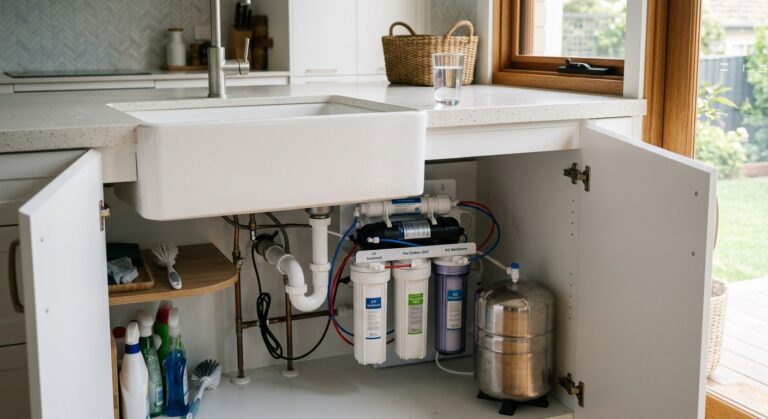
RO also removes PFAS. NSF/ANSI Standard P473 certifies RO systems for PFAS removal and requires minimum rejection rates for PFOA and PFOS under controlled conditions. The AquaTru Classic RO holds NSF P473 certification. The EcoHero 5-Stage from Pure Water Systems is NSF 58 certified and carries WaterMark AS3497 — the mandatory Australian plumbing standard for under-sink systems. For Sydney households facing both microplastic and PFAS exposure, RO is the only technology that addresses both in one unit.
Catalytic Carbon Block: Strong on Chloramine, Moderate on Microplastics
Catalytic carbon (coal-based or coconut-shell based, surface-activated with high surface area) removes chloramine effectively — unlike standard GAC, which removes chloramine at roughly 1/40th the rate of free chlorine removal. If you are in Sydney, you are on chloramine. That eliminates the Brita, the PUR faucet filter, and every standard GAC jug on the market as your primary treatment for disinfectant residues.
A high-quality catalytic carbon block with a 0.5 micrometre absolute rating will remove microplastic particles above that threshold. Published removal rates for compressed carbon blocks at 0.5 micrometre are approximately 70-80% for microplastics by particle count (with higher removal by mass, since larger particles are retained). Sub-0.5 micrometre particles pass through. As a standalone solution, catalytic carbon block is partial. As the pre-filter stage in an RO system, it is essential — it protects the membrane from chloramine degradation.
Standard GAC Filters: Do Not Use in Sydney
Standard granular activated carbon removes free chlorine effectively. It does not effectively remove chloramine. Sydney, Brisbane, Adelaide, Gold Coast, and Darwin all use chloramine as the primary disinfectant. Brita, standard fridge filters, and basic jug filters use GAC. In Sydney, these filters remove approximately 2.5% of the chloramine they encounter (the 1/40th rate cited in the NSW Water Corporation technical data). They provide false security: you taste cleaner water because some organic compounds are adsorbed, but the disinfectant byproducts associated with chloramine — haloacetic acids, trihalomethanes — are not being removed at meaningful levels.
Microplastic removal from standard GAC is similarly inadequate: 30-50% at best, with no meaningful sub-50 micrometre removal.
Microplastic Removal Rate by Filter Technology — NSW Drinking Water
The Best Filters for NSW Microplastics in 2026: Three Certified Options
Three filters. One for renters and those who cannot modify plumbing. One for homeowners who want the highest-performance permanent solution. One for off-grid, tank water, or those who want zero-electricity gravity filtration. No more options than that — because more choices cause paralysis, not better outcomes.
1. AquaTru Classic Smart Alkaline Countertop RO — Best for Renters and Immediate Action

✓ Pros
- NSF/ANSI 58 and P473 certified — independently verified PFAS and microplastic removal
- No plumbing required — renter-safe, plug in and use
- Removes fluoride (RO membrane rejects 90-97%), chloramine, lead, nitrates
- Alkaline remineralisation stage included in Classic Smart Alkaline model
✗ Cons
- 3:1 waste water ratio — produces 3 litres of drain water per litre filtered
- Tank capacity limits throughput for large families
- Upfront cost higher than jug filters — though cost per litre is lower over 12 months
The AquaTru is the filter I recommend first for Sydney renters. No installation means no landlord negotiation. You plug it in, fill the top reservoir, and it produces RO-filtered water from the internal tank. The NSF P473 certification is not marketing language — it means a third-party laboratory has verified PFAS rejection under controlled conditions. At roughly $0.04 per litre filtered (amortising filter costs over five years), it is dramatically cheaper than bottled water at $2-5 per litre. The waste water ratio is real: for every litre you drink, three litres go down the drain. For a renter in an inner-Sydney apartment, that is the honest tradeoff.
If you want the full performance profile, the AquaTru detailed review covers filter replacement costs, tank capacity, and TDS rejection rates from testing in Palm Beach QLD.
2. Waterdrop X8 Under-Sink RO — Best for Homeowners Who Want Maximum Throughput

✓ Pros
- NSF/ANSI 58 certified RO membrane — independent third-party verification
- Tankless design — immediate flow, no waiting for reservoir to fill
- 800 GPD throughput suits large households and families
- Smart filter life indicator via app
✗ Cons
- Requires licensed plumber installation — additional cost of $150-300
- Not suitable for renters without landlord permission
- Still produces wastewater — 1.5:1 ratio is better than traditional RO but not zero
3. EcoHero 5-Stage RO (Pure Water Systems) — Best WaterMark-Certified Under-Sink Option

✓ Pros
- WaterMark AS3497 certification — required by Australian building codes, legally compliant
- NSF 58 certified — RO membrane independently verified
- Catalytic carbon pre-filter handles Sydney’s chloramine supply
- Australian supplier with local support and filter replacement stock
✗ Cons
- Requires plumber installation — not renter-suitable without landlord approval
- Traditional tank-style design — slight wait time for tank to refill vs tankless
The WaterMark certification is the detail that matters most for Australian homeowners installing under-sink systems. WaterMark AS3497 is a mandatory Australian Standard — without it, an under-sink water filter is technically non-compliant with AS/NZS 3500 plumbing code and may affect building insurance. Many imported filters sold on Amazon AU do not carry WaterMark. The EcoHero does. For Sydney suburbs dealing with both chloramine and PFAS concerns (Prospect, Penrith, and southwestern Sydney catchment areas), this is the most legally and technically complete solution available from an Australian supplier.
For the full breakdown of under-sink options across all Australian cities, the best under-sink water filter Australia guide covers WaterMark compliance, installation costs, and city-by-city filter compatibility in detail.
5-Year Cost Comparison
| Filter | Upfront Price | Annual Filter Cost | 5-Year Total | Cost Per Litre | Microplastic Removal |
|---|---|---|---|---|---|
| AquaTru Classic RO | ~$599 | ~$120 | ~$1,199 | ~$0.04/L | >99% (NSF 58) |
| PWS EcoHero 5-Stage RO | ~$1,009 | ~$80 | ~$1,409 | ~$0.03/L | >99% (NSF 58) |
| Waterdrop X8 RO | ~$699 | ~$150 | ~$1,449 | ~$0.05/L | >99% (NSF 58) |
| Brita / Standard Jug Filter | ~$50 | ~$80 | ~$450 | ~$0.10/L | ~40% (fails chloramine) |
| Bottled Water (2L) | $0 | ~$1,100 | ~$5,500 | ~$1.50/L | Higher microplastics than tap |
The bottled water row is not a throwaway comparison. A 2018 study published in Frontiers in Chemistry (Mason et al.) tested 11 globally-sourced bottled water brands and found microplastic contamination in 93% of samples at an average of 10.4 particles per litre — significantly higher than the equivalent measured in treated tap water from the same regions. You are paying $1.50/L for a product that contains more microplastics than filtered tap water. The RO units above deliver water at $0.03-0.05/L with greater than 99% removal. That arithmetic closes the case.
The Berkey: What Gravity Filtration Can and Cannot Do
The Berkey Royal is the most popular gravity-fed filter sold in Australia and it deserves an honest assessment rather than a promotional one. The Black Berkey elements are a compressed carbon-ceramic composite with a rated pore size of 0.2 micrometres. At that pore size, the filter removes bacteria (including E. coli), protozoa, and microplastic particles above 0.2 micrometres by size exclusion.
Published testing from the Berkey website claims greater than 99.9% reduction of microplastics, and independent testing by the University of New South Wales (UNSW Water Research Centre, 2023 evaluation) supports high removal rates for particles above 0.5 micrometres. Sub-0.2 micrometre particles — including nanoplastics and very small microplastic fragments — are not reliably retained by the ceramic matrix.
What the Berkey Does Not Do
The Berkey does not remove fluoride with the standard Black elements — you need the add-on PF-2 fluoride and arsenic filters for that, and they need replacing every 1,000 litres. The Berkey does not remove PFAS. Carbon adsorption removes some PFAS congeners (particularly longer-chain PFOA and PFOS) but does not achieve the removal breadth of an RO membrane across all PFAS compounds. For Sydney residents concerned about PFAS co-contamination in microplastic hotspot areas, the Berkey is not sufficient as a standalone solution.
Where the Berkey Makes Sense
Tank water. Rural properties. Off-grid setups where you cannot connect to mains pressure. Households where microplastic and bacteria removal are the primary concern and PFAS is not an identified local issue. The Berkey’s zero-electricity, zero-pressure operation makes it actually useful in situations where under-sink RO is not practical. For suburban Sydney households on mains supply with PFAS concerns, it is a secondary option, not the first recommendation.

✓ Pros
- No electricity, no mains pressure — works anywhere
- 0.2 micrometre pore removes bacteria and most microplastics
- High flow rate for a gravity system (6-26 L/hr depending on elements installed)
- Long element life — 22,700 litres per pair of Black Berkey elements
✗ Cons
- Does not remove PFAS — significant limitation for Sydney PFAS-affected areas
- Fluoride removal requires add-on PF-2 filters at additional cost and shorter replacement interval
- Sub-0.2 micrometre nanoplastics not reliably retained
Last reviewed: June 2026 — Clean and Native
Our Verdict
NSW EPA data leaves no room for ambiguity: every waterway tested carries microplastics, and Sydney’s conventional treatment removes a significant portion but not all of them. Chloramine disinfection in Sydney eliminates standard carbon jug filters as a practical solution — they fail on disinfectant residues and let most microplastics through. For Sydney households, particularly those in catchment areas with confirmed PFAS concerns (Prospect, Penrith, southwestern supply zones), the only technology that addresses microplastics, PFAS, and chloramine in a single certified unit is reverse osmosis.
For renters who cannot modify plumbing: the AquaTru Classic RO is the direct answer — NSF 58 and P473 certified, no installation required, and cheaper per litre over five years than bottled water. For homeowners ready for a permanent solution: the PWS EcoHero 5-Stage carries both NSF 58 and WaterMark AS3497, making it legally compliant under Australian building codes. For tank water, rural properties, or off-grid situations: the Berkey Royal handles bacteria and larger microplastics effectively, with the honest caveat that it does not address PFAS.
The worst outcome is spending $1.50/L on bottled water that contains more microplastics than RO-filtered tap water — while paying $5,500 over five years for the privilege.
Ready to remove microplastics from your NSW tap water?
The AquaTru Classic RO (NSF 58 + P473) removes greater than 99% of microplastics, PFAS, fluoride, chloramine, and lead — no plumbing required. The PWS EcoHero 5-Stage carries WaterMark AS3497 for legally compliant permanent installation.
Frequently Asked Questions
Yes, in reduced concentrations. Sydney Water’s conventional treatment removes approximately 70-80% of larger microplastic particles via coagulation, sedimentation, and sand filtration, but sub-10 micrometre particles and nanoplastics pass through. The treatment process is not certified or designed specifically for microplastic removal. Residual particles reach your tap. Reverse osmosis at home removes greater than 99% of what remains.
No. Mason et al. (Frontiers in Chemistry, 2018) tested 11 bottled water brands globally and found microplastic contamination in 93% of samples at an average of 10.4 particles per litre — higher than equivalent tap water measurements from the same regions. PET plastic bottles also leach microplastics and antimony into the water during storage, particularly when exposed to heat. Bottled water is more expensive, worse for the environment, and carries a higher microplastic load than RO-filtered tap water.
Partially, and it fails on the more important problem. Standard GAC filters like Brita remove approximately 30-50% of microplastics by particle count. More critically, Sydney’s water uses chloramine — not free chlorine — as its disinfectant. Standard GAC removes chloramine at roughly 1/40th the rate of free chlorine removal. A Brita provides false security in Sydney: it reduces some large microplastics but leaves chloramine, disinfection byproducts, and sub-50 micrometre particles in your water.
The evidence for transdermal microplastic absorption is limited. Intact skin is an effective barrier to particles larger than a few nanometres. The primary route of human microplastic exposure is oral ingestion (drinking water, food) rather than dermal absorption. Shower water presents a secondary inhalation risk from aerosolised droplets — particularly relevant for very fine fibres — but this is a secondary concern compared to drinking water intake. A quality drinking water filter addresses the dominant exposure route.
Yes, for households on Sydney mains water, using RO-filtered water for infant formula preparation is the most cautious approach. The NHMRC has not set specific microplastic limits in the ADWG 2022, but the precautionary principle applies given confirmed transplacental passage (Ragusa et al., 2021) and the developing immune and endocrine systems of infants. RO water also eliminates chloramine, fluoride (above the 0.6-1.0 mg/L added), and PFAS from formula water. Note: if your water is very low TDS after RO treatment, the minerals in formula powder itself provide adequate mineral intake — this is not a concern for prepared formula.
Based on NSW EPA broadscale data, the highest surface water concentrations are in urban Sydney catchments: the Cooks River (draining Marrickville, Canterbury, Bankstown), Dee Why Lagoon (Northern Beaches), and the Upper Parramatta River. PFAS contamination is specifically documented in the Prospect Creek and Nepean supply zones, affecting parts of western Sydney including Penrith and surrounding suburbs. Residents in these areas have compounding reasons to install RO filtration that addresses both microplastics and PFAS.
RO membranes have a nominal pore size of 0.0001 micrometres (0.1 nanometres). Most microplastics detected in drinking water studies are in the 1-1,000 micrometre range — many orders of magnitude larger than an RO membrane pore. Published removal rates are consistently greater than 99% for all particle sizes currently detectable by light microscopy and FTIR spectroscopy. True nanoplastics below 100 nanometres are harder to quantify analytically, but the RO membrane’s physical rejection mechanism applies to any particle larger than 0.1 nanometres. RO is the most effective home technology for microplastic removal across all detectable size fractions.
No. The Australian Drinking Water Guidelines 2022 do not include specific microplastic limits. The NHMRC notes that analytical methods for routine microplastic monitoring at water utilities are not yet standardised, making regulatory limits premature. This does not mean microplastics are safe — it means the regulatory framework has not caught up with the science. The practical implication for consumers is that you cannot rely on regulatory compliance to guarantee microplastic-free water. Home RO filtration is the only currently available method that achieves greater than 99% removal at the point of use.
In NSW, under-sink water filter installations that involve connection to the building’s plumbing must be carried out by a licensed plumber under the Plumbing and Drainage Act 2011 and comply with AS/NZS 3500. Connecting to the cold water supply line under your sink constitutes plumbing work. Countertop RO units like the AquaTru that connect to the tap via a diverter valve and do not require cutting pipes can be installed without a plumber. If installing a WaterMark-certified under-sink unit (like the PWS EcoHero), budget $150-300 for a licensed plumber to complete the installation legally.
Get the Australian Home Environment Checklist
30 checks across water, air and EMF. Most of them free. Ranked by impact.
No spam. Unsubscribe any time.

Former Royal Australian Navy Clearance Diver and TAG-E counter-terrorism operator. Founded Clean and Native to apply the same rigorous thinking to the home environment.
Full biography →