PFAS Contamination in Australian Drinking Water
8 min read
This article contains affiliate links. We may earn a commission at no extra cost to you.
PFAS — per- and polyfluoroalkyl substances — are a group of more than 12,000 man-made chemicals that have been used in industrial and consumer products since the 1940s. They are called “forever chemicals” for a simple reason: the carbon-fluorine bond that makes them so useful industrially is extraordinarily stable. PFAS do not break down naturally in the environment, or in the human body, on any meaningful timescale.
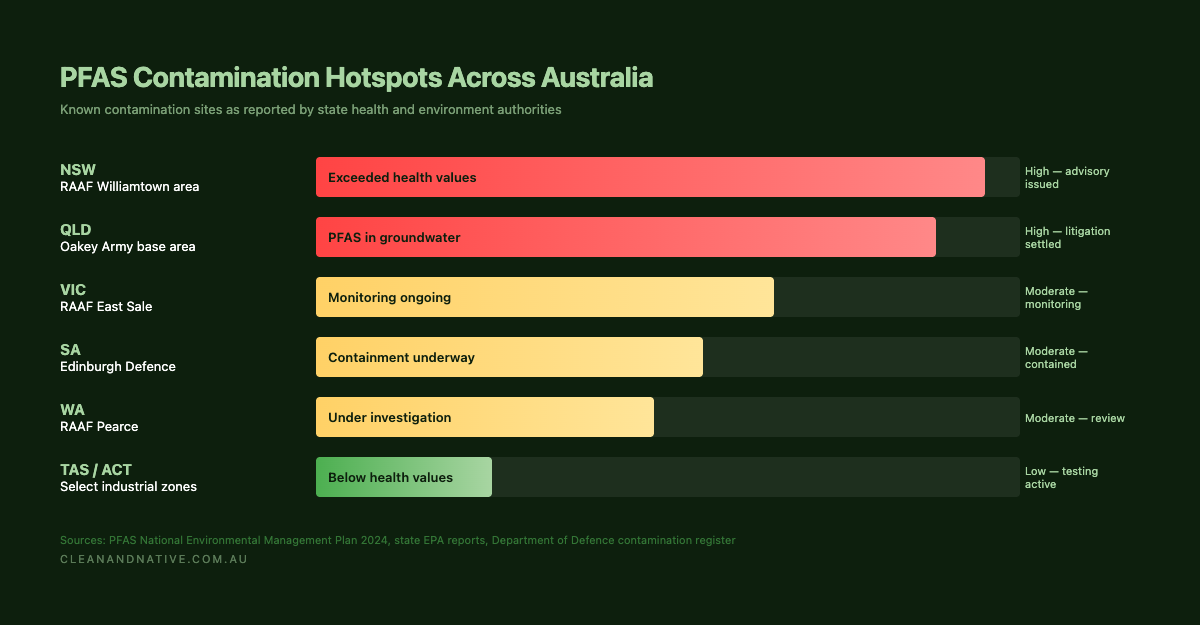
Australia has a significant and under-publicised PFAS contamination problem, concentrated primarily around defence bases and airports where aqueous film-forming foam (AFFF) — a firefighting agent containing PFAS — was used extensively for decades. The contamination extends into groundwater, soil, and in some cases, municipal water supplies serving nearby communities.
Key Takeaways
- PFAS have been found in the blood of virtually all Australians tested — they are ubiquitous in the environment
- The highest-risk communities are near defence bases, airports, and industrial sites where AFFF was used
- Australia’s drinking water guideline for PFOS + PFOA combined is 0.07 µg/L (70 nanograms per litre)
- Standard carbon filters do NOT reliably remove PFAS — you need reverse osmosis or activated carbon specifically rated for PFAS
- The Australian Government has committed to remediation at contaminated defence sites, but progress has been slow
Clean Water
The right filter removes what this article describes.
Reverse osmosis is the only residential technology that reliably removes PFAS, fluoride, chloramine, and heavy metals. Our guide covers the top-rated options for Australian homes — tested, certified, and ranked.
What Are PFAS and Why Are They Dangerous?
PFAS were developed because their unique chemical properties — extreme heat resistance, water resistance, and chemical inertness — made them useful for an astonishing range of applications: non-stick cookware, food packaging, stain-resistant carpets and clothing, firefighting foam, and industrial manufacturing processes.
The same properties that make them industrially useful make them biologically problematic. PFAS accumulate in living tissue (bioaccumulate) and do not metabolise. They have been detected in human blood, breast milk, umbilical cord blood, and organs worldwide. Once PFAS enter your body, they have a half-life in human serum of approximately 3.5 to 8 years depending on the specific compound.
Health Associations
The health effects of PFAS exposure are an active area of research. The most robustly supported associations include:
- Thyroid hormone disruption — PFAS interfere with thyroid hormone binding and metabolism
- Immune system suppression — evidence of reduced vaccine antibody response in children with higher PFAS exposure
- Elevated cholesterol — consistently associated with PFAS serum levels in epidemiological studies
- Kidney and testicular cancer — IARC classifies PFOA as Group 1 (carcinogenic to humans) and PFOS as Group 2B
- Developmental effects — fetal and infant exposure linked to reduced birth weight, altered immune development
- Liver effects — PFAS are hepatotoxic at elevated concentrations
Where PFAS Contamination Is Concentrated in Australia
| State | Key Contamination Sites | Affected Communities (Examples) |
|---|---|---|
| NSW | Williamtown RAAF Base, Holsworthy, Orchard Hills, Bankstown Airport | Williamtown, Salt Ash, Fullerton Cove, Seaham |
| QLD | RAAF Base Amberley, Townsville RAAF, Oakey Army Aviation Centre | Oakey, Gatton area, Northern Townsville suburbs |
| VIC | RAAF Williams (Laverton), RAAF East Sale | Laverton, Sale surrounds |
| WA | RAAF Pearce, RAAF Learmonth | Bullsbrook area, Exmouth (Learmonth surrounds) |
| NT | RAAF Darwin, Katherine RAAF | Darwin northern suburbs, Katherine town |
| ACT | Fairbairn (now Canberra Airport), Duntroon | Queanbeyan area bore water users |
| SA | Edinburgh RAAF, Port Augusta | Northern Adelaide suburbs (limited municipal impact) |
Important: This Is Not a Complete List
PFAS contamination is also found at civilian airports, industrial parks, landfills, and locations where consumer PFAS products have concentrated. The defence-adjacent sites are simply the most extensively documented. For the current list of investigation sites, consult the Australian Government’s Department of Defence PFAS investigation register and your state EPA’s PFAS monitoring data.
Australian Drinking Water Guidelines for PFAS
In 2022, NHMRC updated the Australian Drinking Water Guidelines (ADWG) to include specific health-based guideline values for PFAS in drinking water. The key values are:
- PFOS (perfluorooctane sulfonate): 0.07 µg/L (micrograms per litre)
- PFOA (perfluorooctanoic acid): 0.07 µg/L
- PFHxS (perfluorohexane sulfonic acid): 0.07 µg/L
These values apply to the sum of PFOS + PFOA + PFHxS combined. This is more conservative than previous guidance. For context, the US EPA set emergency health advisories for PFOA and PFOS at 0.004 nanograms per litre (0.000004 µg/L) in 2022 — approximately 17,500 times more stringent than the current Australian combined guideline.
This discrepancy reflects genuine scientific debate about at what level PFAS cause measurable harm, and different regulatory risk tolerance decisions. What is clear is that PFAS at any detectable level represent a chronic cumulative exposure concern, and reducing exposure from all sources — water being a major one — is a reasonable goal.
How to Find Out if Your Water Is Affected
- Check your state EPA’s PFAS investigation area map — all state EPAs publish these
- Check your water utility’s PFAS monitoring data — larger utilities now test routinely; smaller regional utilities may not
- If your home uses a bore or well, and you’re within 5km of a defence base, airport, or industrial site — get your bore water tested by a NATA-accredited laboratory. This is the highest-risk scenario.
- Contact your local council or state health department if you are in a declared investigation area — alternative water may be provided
How to Filter PFAS from Drinking Water
| Filter Type | Removes PFAS? | Notes |
|---|---|---|
| Standard pitcher filter (Brita etc.) | No | Activated carbon in standard pitchers is not fine enough to reliably capture PFAS at relevant concentrations |
| Refrigerator filter | No | Same limitation — standard carbon block |
| Granular activated carbon (GAC) inline | Partial | Can reduce PFAS but effectiveness depends heavily on contact time, flow rate, and filter quality. Not reliable for high-PFAS situations. |
| Activated carbon block (NSF 58 certified) | Partial–Yes | High-quality carbon block filters certified to NSF/ANSI Standard 58 for PFAS reduction are more effective. Verify certification before purchasing. |
| Reverse osmosis (RO) | Yes | The most effective method for PFAS removal — typically achieves 90–99% reduction. Point-of-use under-sink RO systems are practical for Australian households. |
| Nanofiltration | Yes | Similar effectiveness to RO; less commonly available in residential configurations in Australia |
| Ion exchange (PFAS-specific) | Yes | Effective but primarily used in municipal treatment, not typical for residential use |
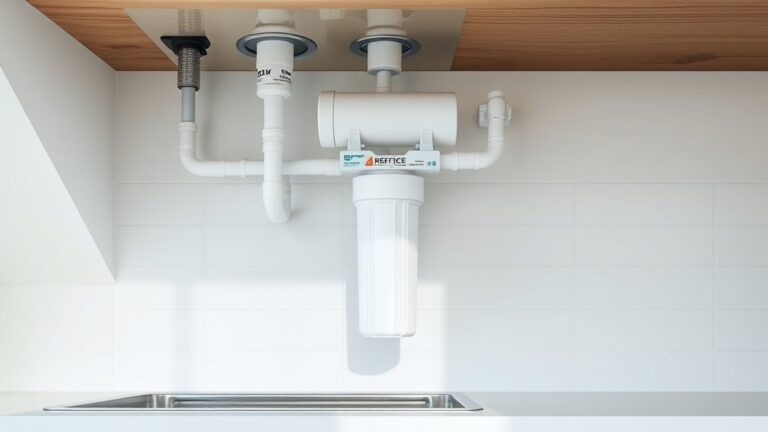
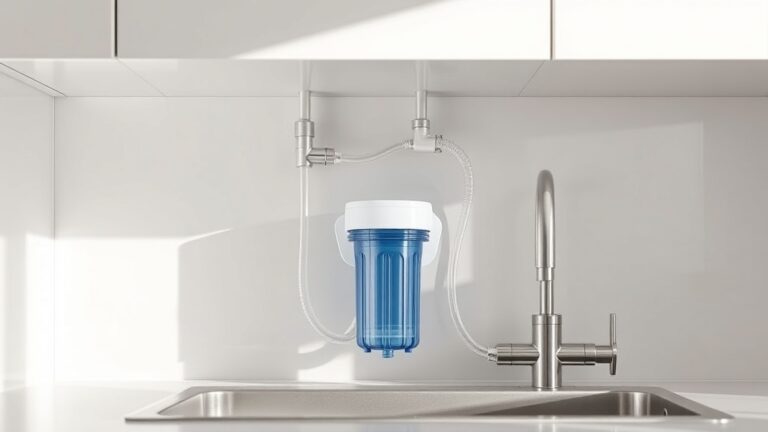
The practical recommendation for households in or near PFAS-affected areas: a point-of-use reverse osmosis system under your kitchen sink for drinking and cooking water. These cost $300–$700 installed, have low operating costs (filter replacement), and are the most reliable method available for residential PFAS reduction.
What to Do
- Search your state EPA website for the PFAS investigation area map — check if your suburb is listed
- Download your water utility’s PFAS monitoring report — most now publish this data
- If you use bore water near a defence base or airport, get it tested by a NATA-accredited laboratory immediately
- If you’re in a confirmed affected area, consider a reverse osmosis filter for drinking and cooking water
- If you’re in a lower-risk area and want additional peace of mind, look for a carbon block filter certified to NSF/ANSI 58 for PFAS reduction
- Contact hello@cleanandnative.com if you’d like guidance specific to your location
Ready to filter your water?
We have ranked the best countertop and under-sink RO systems available in Australia — including options for renters who cannot modify their plumbing.
Frequently Asked Questions
What are PFAS chemicals and why are they in Australian water?
PFAS (per- and polyfluoroalkyl substances) are a class of over 4,000 synthetic chemicals known as “forever chemicals” because they do not break down in the environment or the human body. In Australia, PFAS contamination is primarily linked to aqueous film-forming foam (AFFF) used at defence bases and airports, as well as industrial discharge.
Which areas of Australia have PFAS-contaminated water?
Known PFAS contamination sites include areas surrounding RAAF Base Williamtown (NSW), Oakey Army Aviation Centre (QLD), RAAF East Sale (VIC), Edinburgh Defence Precinct (SA), and RAAF Pearce (WA). The Department of Defence maintains a contamination register. Some drinking water supplies near these bases have had PFAS detected above health guideline values.
Does a standard water filter remove PFAS?
Standard carbon block filters can reduce some PFAS compounds but do not provide comprehensive removal. Reverse osmosis (RO) systems are the most effective at removing PFAS — NSF 58-certified RO systems have been shown to remove over 90% of tested PFAS compounds. Granular activated carbon (GAC) filters used at whole-house scale can also be effective.
How do I know if PFAS is in my tap water?
Contact your local water authority and request their most recent PFAS testing results. In areas known to be affected, state health departments have issued community notices. For independent testing, accredited labs such as ALS Environmental and Eurofins can test your tap water for a panel of PFAS compounds — typically costing $200–$500.
Are Australian PFAS health guidelines safe?
Australia’s PFAS health-based guidance values (set by NHMRC) are periodically reviewed. Notably, the US EPA lowered its PFAS maximum contaminant levels in 2024 to as low as 4 ppt for PFOA and PFOS — far stricter than current Australian guidelines. Some researchers argue Australian limits should be reviewed in light of newer toxicological data.
Get the Australian Home Environment Checklist
30 checks across water, air and EMF. Most of them free. Ranked by impact.
No spam. Unsubscribe any time.
Former Royal Australian Navy Clearance Diver and TAG-E counter-terrorism operator. Founded Clean and Native to apply the same rigorous thinking to the home environment.
Full biography →