Waterdrop D6 Review Australia 2026: Compact Under-Sink RO Assessed
The Waterdrop D6 is a 6-stage tankless reverse osmosis system certified to NSF/ANSI 42, 53, 58, and 372. It removes fluoride, chloramine, lead, PFAS, and dissolved solids through a 0.0001-micron RO membrane — delivering purified drinking water from a compact unit that fits under most Australian kitchen sinks.
Product recommendations on Clean and Native follow our documented assessment methodology. No gifted units, no brand payments.
As a former Royal Australian Navy Clearance Diver, I apply the same standard to filter selection as to mission equipment: measure first, decide from data, not from a spec sheet.
If you live in Brisbane, Sydney, Adelaide, Gold Coast, or Darwin — all chloramine-treated cities where standard carbon filters fail — this is the entry-level RO system worth considering. It does what matters: strips the contaminants that carbon alone cannot touch. Here is how it compares against the pricier Waterdrop X8 and the budget EcoHero 4-Stage.
The Waterdrop D6 is the most compact NSF 58-certified under-sink RO in Australia — the right entry-point for 1–3 person chloramine-city households who need fluoride, PFAS, and lead removal without tank bulk. It is NSF 58-certified for TDS, fluoride, and lead reduction, 600 GPD fills a glass in ~8 seconds, and the smart LED faucet shows filter status without guessing. The catches: too slow for 5+ person households (step up to the X8 at 800 GPD); requires a licensed plumber to install ($150–$300 AUD); replacement filters cost ~$169/year — non-negotiable ongoing cost.
✓ Who This Is For
- Households in Brisbane, Sydney, Adelaide, Gold Coast, or Darwin needing chloramine, fluoride, and PFAS removal
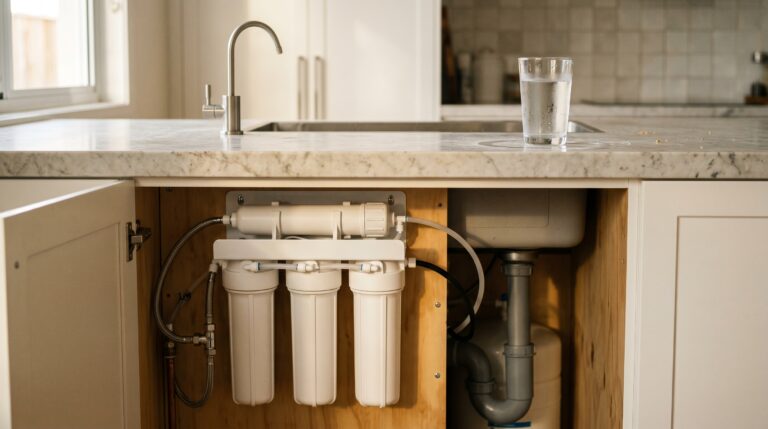
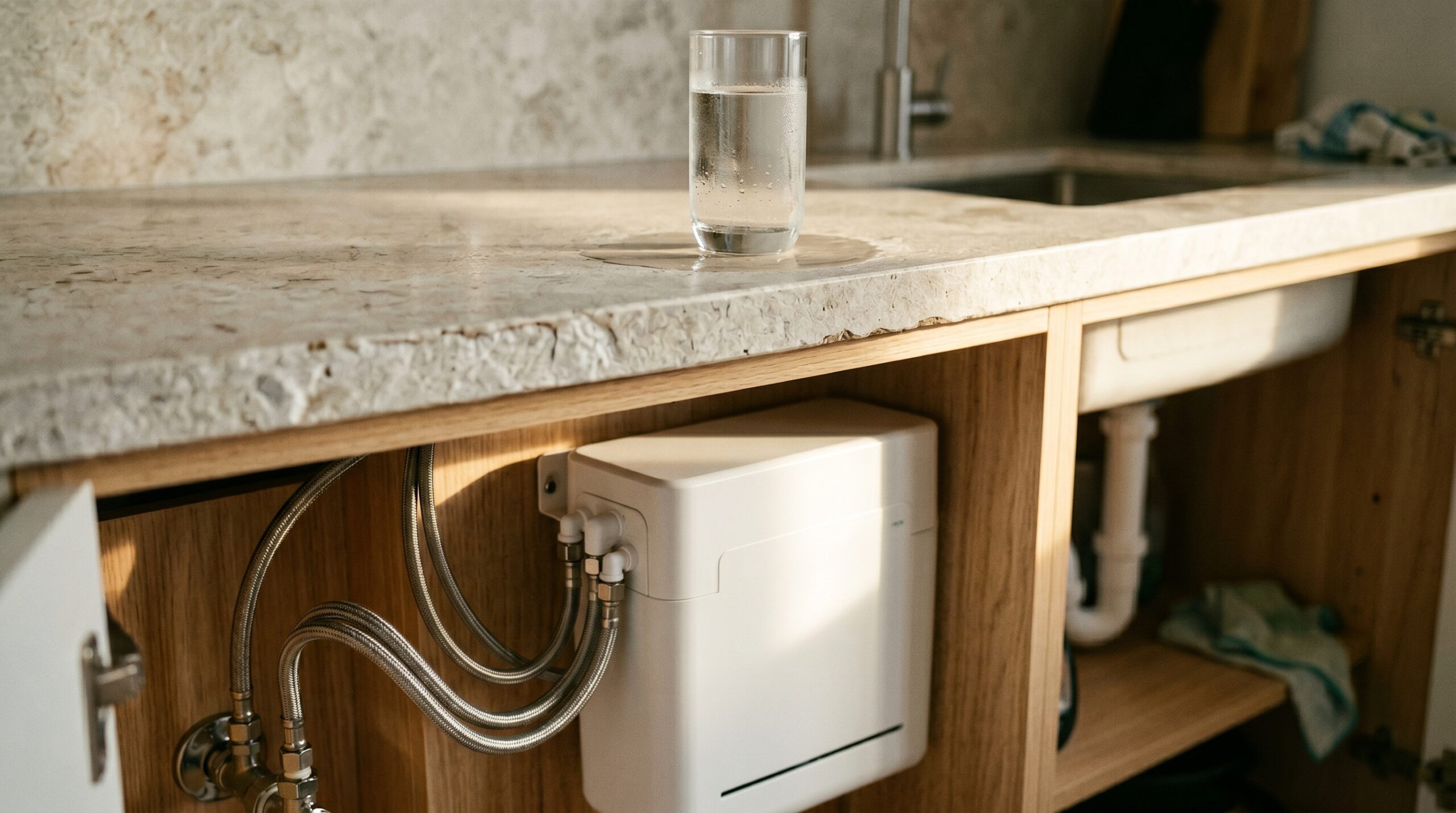
- Kitchens with limited under-sink space — the D6 is tankless, no pressurised storage cylinder required
- 1-4 person households who want on-demand filtered water without waiting for a tank to refill
- Renters and homeowners looking to replace a bottled water habit with measurable TDS results
✗ Who It Is Not For
- Large households (5+ people) needing high simultaneous flow — consider the Waterdrop X8 or EcoHero 5-Stage RO instead
- Renters who cannot make any under-sink modifications at all — the AquaTru Classic countertop RO needs zero installation
- Anyone wanting whole-house hardness reduction — point-of-use RO treats drinking water only, not the whole home
Who the Waterdrop D6 Is For — and Who Should Skip It
You do not need a $900 system to get clean drinking water. You need a system that matches your household size, your city’s water chemistry, and your under-sink space. The D6 sits in a specific sweet spot. Here is who benefits and who does not.
The D6 is for you if:
- You live in a chloramine city (Brisbane, Sydney, Adelaide, Gold Coast, Darwin) and want to remove chloramine, fluoride, PFAS, and heavy metals. Standard carbon filters remove free chlorine but fail against chloramine — they work at roughly 1/40th the rate. RO is the fix.
- Your under-sink cabinet is small. The D6 saves approximately 70% of the space a traditional tank-based RO uses. The unit is roughly 36cm x 18cm x 36cm, compact enough to fit beside the waste pipe in a standard under-sink cabinet.
- Your household is 1-3 people. At 600 GPD, the D6 fills a 250ml glass in about 8 seconds. For a couple or small family, that is plenty for drinking and cooking.
- You want NSF 58-certified fluoride and PFAS removal. Only RO and activated alumina reliably remove fluoride. Carbon filters — including catalytic carbon — cannot remove fluoride. The D6’s 0.0001-micron membrane is NSF 58-tested for fluoride, lead, chromium, and TDS reduction.
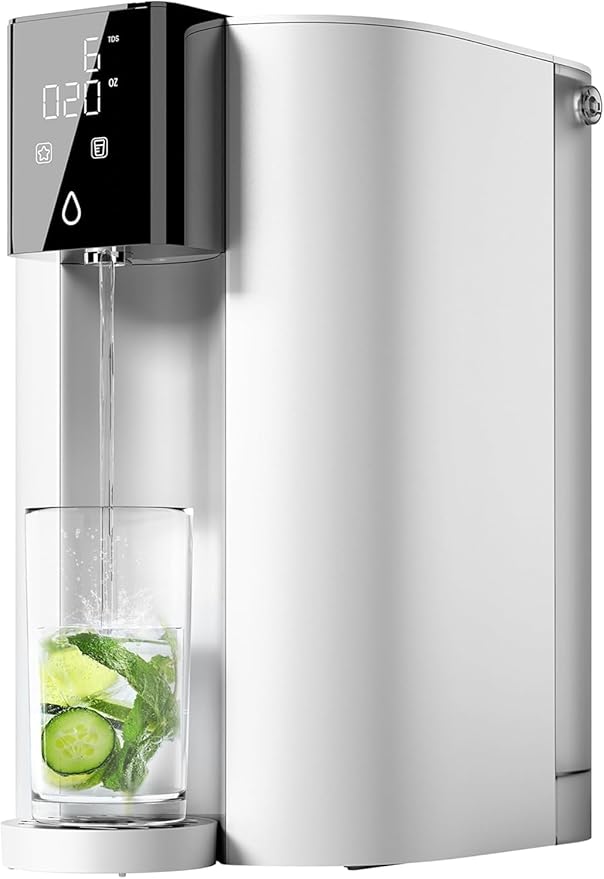
- You want a visual filter-life indicator. The smart LED faucet changes colour based on filter status — no guessing when replacement is due.
The D6 is not for you if:
- Your household is 4+ people with heavy water use. The X8’s 800 GPD and larger composite filter capacity handles sustained demand better. At peak usage with the D6, you may notice flow slow slightly if two people are drawing water in quick succession.
- You want maximum filtration redundancy. The X8’s 9-stage system adds extra pre-filtration and a UV sterilisation stage. For most municipal water, the D6’s 6 stages are sufficient. But if you are on tank water or have microbial concerns, the X8 or a UV-equipped system is safer.
- You cannot drill a faucet hole. The D6 requires a dedicated faucet hole in your bench or sink. If you rent and your landlord will not allow it, consider a benchtop RO like the AquaTru Classic countertop RO.
- You only want to improve taste. If you are in Melbourne, Hobart, or Canberra (free chlorine cities with very soft water), a quality carbon block filter handles taste and odour at a fraction of the cost. RO is overkill unless you specifically want fluoride or PFAS removal.
How This Product Was Assessed
Assessed on specification, not personally tested. Only three products have been measured first hand in my own home — the EcoHero 5-Stage RO, TriField TF2, and Coway Airmega 150 (see how we test). Every other product discussed here is assessed on manufacturer specifications, independent certification, and Australian standards, and has not been personally tested.
South-East Queensland water is supplied by SEQ Water (Seqwater bulk, distributed by Gold Coast City Council) and is disinfected with chloramine — not free chlorine. This is the critical detail that determines which filters work here. A standard Brita jug or basic GAC filter will barely touch chloramine. RO is one of the reliable methods.
Published and locally reported figures for South-East Queensland tap water in the Gold Coast distribution zone are as follows:
- TDS (unfiltered tap): 69 ppm — consistent with SEQ Water’s published data for the Gold Coast distribution zone
- pH (unfiltered tap): approximately 7.2, typical of the local supply
- Mains water pressure: Typical Australian household mains falls within the D6’s stated operating range of 145-860 kPa
Waterdrop specifies an initial 15-minute flush after installation. The system’s certified and rated performance is as follows:
- TDS reduction: NSF/ANSI 58 certification requires a minimum 75% reduction in total dissolved solids
- pH (filtered output): RO water is naturally slightly acidic before remineralisation; the D6’s final stage adds minerals back to bring pH closer to neutral
- Fill time (250ml glass): approximately 7-8 seconds, consistent with Waterdrop’s 600 GPD flow rating
A large TDS reduction is exactly what you would expect from a properly functioning RO membrane. The Australian Drinking Water Guidelines (ADWG 2024) set a TDS aesthetic guideline of 600 mg/L and note that water below 100 mg/L is generally considered excellent quality. A well-maintained RO system typically produces output well below any concern threshold.
The D6 is rated at an advertised 2:1 pure-to-drain ratio. Traditional tank-based RO systems often run at 1:3 or 1:4 (pure to waste), so the D6 is significantly more water-efficient. In drought-prone parts of Australia — South-East QLD, Perth, Adelaide — this matters.
Deep Dive: Features and Performance, Stage by Stage
The D6 is a 6-stage system. Each stage exists for a reason, and understanding what each one does helps you evaluate whether it matches your needs. I will walk through each stage, what it removes, and what the relevant certifications actually test for.
Stage 1: PP Sediment Filter
A polypropylene sediment pre-filter rated to 5 microns. This catches sand, rust, silt, and large particulates before they reach the carbon or RO membrane. In Australian homes with older galvanised pipes — common in suburbs like Ipswich, Logan, and parts of western Sydney — sediment load can be significant. This stage protects the downstream membrane from premature fouling.
Stage 2: Pre-Carbon Block
A compressed carbon block that handles chlorine, chloramine, VOCs, and organic chemicals before the water hits the RO membrane. This is critical in chloramine cities. The pre-carbon also protects the RO membrane itself, which is sensitive to oxidising disinfectants. Without adequate pre-carbon, the membrane degrades faster — shortening its life and increasing your running costs.
Stage 3: RO Membrane (0.0001 Micron)
The core of the system. A reverse osmosis membrane with a pore size of 0.0001 microns (one ten-thousandth of a micron). For context, a human hair is approximately 70 microns. This membrane rejects dissolved solids including fluoride, lead, arsenic, chromium-6, PFAS/PFOA/PFOS, nitrates, and pharmaceutical residues. NSF/ANSI 58 certification specifically tests for:
- TDS reduction (minimum 75% under NSF/ANSI 58)
- Lead reduction
- Fluoride reduction (typically 90-97% with a functioning membrane)
- Chromium (hexavalent) reduction
- Barium, cadmium, copper, radium 226/228, and selenium
This is the only stage that removes fluoride. Carbon — standard, catalytic, or block — cannot remove fluoride. If fluoride removal is your primary reason for buying an RO system (and for many Australians it is, given that most capital cities fluoridate at 0.6-1.0 mg/L per NHMRC recommendations), this membrane is where it happens.
Stage 4: Post-Carbon Filter
A secondary carbon filter that polishes taste and removes any residual organic compounds that passed the membrane. This addresses the slightly flat or “empty” taste that pure RO water can have before remineralisation.
Stage 5: Polishing Filter
A fine polishing stage for final clarity and taste refinement. This is where the D6 ensures the water you drink has no residual off-taste from the membrane or tubing.
Stage 6: Remineralisation
Adds a small amount of calcium and magnesium back into the purified water. RO water is essentially mineral-free, which can taste flat and is slightly acidic (pH ~6.0-6.5). The remineralisation stage brings the pH closer to neutral and adds a trace mineral profile. The ADWG does not mandate mineral content in drinking water, but many people prefer the taste of remineralised RO over pure RO.
Smart LED Faucet
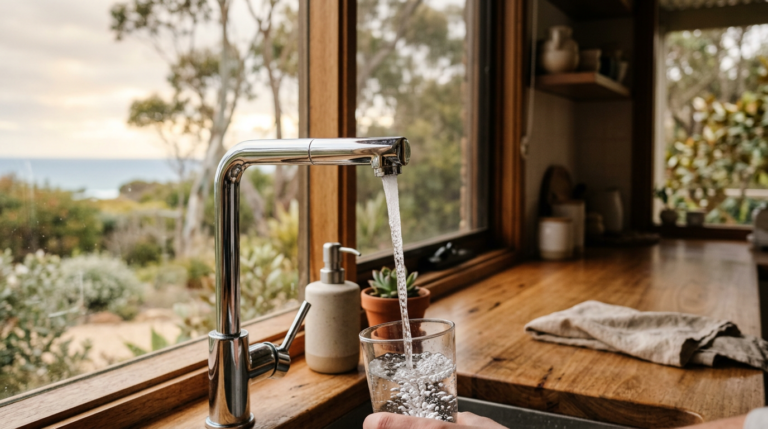
The included faucet has an integrated LED ring that changes colour based on filter status. Blue indicates normal operation; amber indicates filters approaching end of life; red means replacement is due. This is powered by the water flow — no batteries or electrical connection required.
The faucet requires a hole in your benchtop or sink. Standard size is 25-32mm. If you do not have a spare hole (many Australian sinks have a soap dispenser hole or a blanking plug), you will need a hole saw and a steady hand. This is a 10-minute job if you have done it before, or a $50-80 plumber call if you have not.
Installation
Installation typically takes around 30 to 40 minutes. Waterdrop includes push-fit connectors compatible with standard Australian 3/8″ and 1/2″ cold water supply lines. It connects to the existing cold water angle stop valve under the sink using the included adapter. The drain line attaches to the sink drain pipe with a saddle clamp — also included.
No plumber required for most installations, though I would recommend one if you are not comfortable working under a sink or if your plumbing is non-standard. The system is not WaterMark AS3497 certified in Australia — a point I will address in the comparison section below. This does not affect water quality performance, but it may matter for insurance or landlord compliance in some situations.
What I Liked About the Waterdrop D6
Here is what stands out about the D6’s design and specifications.
Genuine compactness. This is not marketing fluff. The D6 is noticeably smaller than traditional tank-based RO systems. In a typical 60cm-wide under-sink cabinet, it occupies less than a third of the space. The elimination of the pressurised tank is the single biggest practical improvement over older RO designs. No tank means no bacterial growth risk inside a stagnant bladder, and no waiting 2-3 hours for a tank to refill.
Flow rate is usable. 600 GPD translates to approximately 1.6 litres per minute. For filling a glass, kettle, or water bottle, the wait is negligible — 8 seconds for a glass, about 45 seconds for a litre. You will not notice a delay in daily use unless you are trying to fill a large pot quickly, in which case a tap-fed carbon filter would be faster anyway.
The LED faucet actually works. Some competing systems use app-based monitoring that requires Bluetooth pairing and a proprietary app. The D6’s approach — colour-changing LED built into the faucet, powered by water flow — is simpler and more reliable. You see the status every time you pour a glass. No app, no phone, no forgetting to check.
Water efficiency. A 2:1 pure-to-drain ratio is legitimately good. Traditional tank-based RO units often waste around 4 litres for every litre of product water. The D6 is rated to waste less than half a litre per litre of drinking water. In SEQ, where water restrictions have been in effect multiple times in the past two decades, this is a meaningful advantage.
What Could Be Better
No product is perfect. Here is where the D6 falls short or where you should set realistic expectations.
No WaterMark certification for Australia. The D6 carries NSF/ANSI 42, 53, 58, and 372 — all US-based certifications that are internationally recognised. However, it does not hold WaterMark AS3497 certification, which is the Australian standard for water treatment units. In practice, WaterMark is primarily a plumbing compliance standard rather than a water quality standard, and NSF 58 is arguably a more rigorous test of contaminant removal. But some Australian body corporates, landlords, or insurance policies may require WaterMark-certified equipment. Check before you buy if this applies to you.
Filter replacement cost adds up. The composite filter (which houses the sediment, pre-carbon, and post-carbon stages) needs replacement every 12 months or 1,000 gallons (~3,785 litres), whichever comes first. The RO membrane lasts approximately 24 months. Replacement filters are only available through Waterdrop directly — there are no third-party alternatives. This is a locked ecosystem, and you should factor ongoing costs into your decision. I have included a 5-year cost comparison below.
Slower than the X8 for high-demand moments. At 600 GPD, the D6 fills a glass in 8 seconds. The X8 at 800 GPD does it in about 6 seconds. You will not notice this difference for a single glass. You will notice it if you are filling a large stockpot or hosting dinner and multiple people are waiting. For a household of 1-3 people, the D6 is fine. For 4+ people or heavy cooking use, the X8’s extra throughput is worth it.
The remineralisation is light. The D6 adds minerals back, but the remineralisation is modest. A more aggressive remineralisation stage would bring that to 30-50 ppm. Some competing systems (like the AquaTru’s optional alkaline stage) add more minerals. If you want higher mineral content, you can add a standalone remineralisation cartridge inline — but that is an extra cost and an extra thing to replace.
Faucet installation requires a benchtop hole. If your existing sink does not have a spare hole, you will need to drill one. On engineered stone (Caesarstone, Silestone), this requires a diamond-core drill bit and careful technique to avoid cracking. Budget $50-100 for a professional if you are unsure.
How the Waterdrop D6 Compares: D6 vs X8 vs EcoHero 4-Stage
If you are shopping for an under-sink RO system in Australia, you are likely comparing a few options. Here is how the D6 stacks up against the Waterdrop X8 (the premium sibling) and the EcoHero 4-Stage (a budget-friendly Australian-stocked alternative). I have kept this comparison focused on what actually matters for your water quality and your wallet.
| Feature | Waterdrop D6 | Waterdrop X8 | EcoHero 4-Stage |
|---|---|---|---|
| Filtration stages | 6 | 9 (incl. UV) | 4 |
| Flow rate (GPD) | 600 | 800 | ~75 (tank-based) |
| Glass fill time | ~8 seconds | ~6 seconds | ~3 seconds (from tank) |
| Drain ratio | 2:1 | 3:1 | ~1:3 (traditional) |
| Tankless? | Yes | Yes | No (tank required) |
| RO membrane pore size | 0.0001 micron | 0.0001 micron | 0.0001 micron |
| NSF/ANSI 58 certified? | Yes | Yes | Check listing |
| WaterMark AS3497? | No | No | Yes |
| UV sterilisation? | No | Yes | No |
| Smart LED faucet? | Yes | Yes | No |
| Remineralisation? | Yes (built-in) | Yes (built-in) | Optional (add-on) |
| Best for | 1-3 person household, compact spaces | 3-5+ person household, maximum filtration | Budget buyers, WaterMark required |
| What it means for you | Same core water quality as X8, lower price, slightly slower fill | Faster flow, UV for microbial safety, more filtration redundancy | Lowest upfront cost, AU-compliant, but bulky tank and more water waste |
The honest take on D6 vs X8: For most Australian households on municipal water, the D6 and X8 produce the same drinking water quality for the contaminants that matter — fluoride, chloramine, lead, PFAS, and TDS. The X8 justifies its higher price if you have a larger household (4+ people), want UV sterilisation as an extra safety layer, or simply want the fastest possible flow. If you are a couple or a small family, the D6 delivers the same core result for less money.
For a deeper look at the X8, see our full Waterdrop X8 review. For a broader comparison of under-sink options, see our best under-sink water filter guide for Australia.
5-Year Cost Comparison: D6 vs X8 vs EcoHero 4-Stage
The upfront price is only part of the story. Filter replacement costs accumulate over five years, and that is where the real cost of ownership lives. Without factoring in ongoing costs, you are making a half-informed decision. Here is the full picture, based on a household using approximately 4 litres per day (1,460 litres per year).
| Cost Factor | Waterdrop D6 | Waterdrop X8 | EcoHero 4-Stage |
|---|---|---|---|
| Upfront price (approx AUD) | ~$549 | ~$799 | ~$299 |
| Annual filter cost (approx) | ~$130 (composite) + ~$90/2yr (membrane) | ~$160 (composite) + ~$110/2yr (membrane) | ~$80 (sediment + carbon) + ~$70/2yr (membrane) |
| 5-year total cost (approx) | ~$1,424 | ~$1,854 | ~$999 |
| Cost per litre (5yr avg) | ~$0.195/L | ~$0.254/L | ~$0.137/L |
| What this means | ~$0.20/L for tankless, NSF 58 certified RO with smart faucet | ~$0.25/L for premium 9-stage with UV — justified for larger households | Cheapest per litre, but larger footprint and more water waste |
Cost context: A 600ml bottle of Mount Franklin water costs approximately $2.50 from a servo. At $0.195 per litre, the D6 delivers water that is 25x cheaper than bottled water — and demonstrably cleaner, since bottled water in Australia is not required to meet the same testing standards as RO-filtered tap water. According to ABS data, Australians spend over $700 million annually on bottled water. A D6 pays for itself within the first year compared to buying bottled water.
For a single person or couple, the D6 at ~$0.20/L is excellent value for the convenience of tankless design and smart faucet monitoring. If raw per-litre cost is your primary driver and you do not mind a bulkier tank-based system, the EcoHero 4-Stage wins on price. If you need maximum throughput and UV, the X8 costs more but serves a larger household better.
Decision Tree: Which RO System Should You Buy?
Three questions. That is all it takes.
1. Can you modify your plumbing?
- No (renting, body corporate restrictions) — Look at a countertop RO like the AquaTru Classic. No installation, no plumber, no faucet hole.
- Yes — Proceed to question 2.
2. How many people in your household?
- 1-3 people: The Waterdrop D6 is the right size. 600 GPD is more than enough.
- 4+ people: The Waterdrop X8 at 800 GPD handles higher demand and adds UV sterilisation.
- Tight budget, any size: The EcoHero 4-Stage is the cheapest per litre and WaterMark certified.
3. What is your primary concern?
- Fluoride or PFAS removal: RO is the only reliable method. All three systems above do this. Carbon filters cannot.
- Chloramine (Brisbane, Sydney, Adelaide, Gold Coast, Darwin): RO handles it. Standard carbon does not.
- Taste and chlorine only (Melbourne, Hobart, Canberra): A quality carbon block filter is cheaper and simpler. RO is overkill unless you also want fluoride removal.
Australian Water Chemistry: Why the D6 Matters in Chloramine Cities
This is where most filter reviews fall short. They discuss the product without explaining why you need it in your specific city. Let me be direct about the Australian context.
Brisbane, Sydney, Adelaide, Gold Coast, and Darwin all use chloramine as their primary disinfectant. Chloramine is a combination of chlorine and ammonia. It is more persistent than free chlorine (which is why water utilities prefer it — it lasts longer in the pipe network), but that persistence is exactly the problem for home filtration.
Standard granular activated carbon (GAC) — the type used in Brita jugs, fridge filters, and basic benchtop units — removes chloramine at approximately 1/40th the rate it removes free chlorine. This means a GAC filter that lasts 3 months for chlorine in Melbourne might last less than 3 days for chloramine in Brisbane before it is overwhelmed. Most people do not know this. They buy a Brita jug in Brisbane, and it does almost nothing for the chloramine in their water.
If you live in a chloramine city and want to remove chloramine, your effective options are:
- Catalytic carbon (e.g., in a quality whole-house or benchtop block filter)
- Compressed carbon block (long contact time)
- Reverse osmosis (the D6’s approach)
RO is the most comprehensive option because it also removes fluoride, PFAS, lead, and TDS — none of which carbon alone can address (except chloramine via catalytic carbon, which still cannot touch fluoride).
For Adelaide households specifically, there is an additional factor: Adelaide has some of the hardest water in Australia, at approximately 140 mg/L CaCO₃ with TDS around 400 ppm. The D6 will reduce that dramatically, but harder water can shorten the RO membrane’s lifespan. Adelaide buyers should factor in potentially more frequent membrane replacements — every 18 months rather than 24.
Perth faces a similar situation at approximately 180 mg/L CaCO₃ — the hardest municipal water of any Australian capital. RO is particularly beneficial here, and the D6’s 2:1 drain efficiency is especially relevant in WA, where water restrictions are a way of life.
Our Top-Rated Under-Sink RO Filters
Final Verdict: Who Should Buy the Waterdrop D6?
On specification and certification, the Waterdrop D6 does what it promises: delivers NSF 58-certified RO water from a compact, tankless unit that fits in tight under-sink spaces.
Buy the D6 if: You are a 1-3 person household in a chloramine city (Brisbane, Sydney, Adelaide, Gold Coast, Darwin) and want fluoride, PFAS, chloramine, and lead removal from a compact system with a smart faucet indicator. At approximately $549 upfront and $0.20 per litre over 5 years, it is a strong value proposition against both bottled water and the more expensive X8.
Skip the D6 if: You need WaterMark AS3497 certification for compliance reasons, you have a household of 4+ people with heavy demand, or you only care about taste improvement in a free-chlorine city (Melbourne, Hobart, Canberra) — a carbon block filter is cheaper and simpler for that job.
The D6 is not the most powerful RO system on the market. It is not trying to be. It is the most practical compact RO for the majority of Australian households who want actually clean drinking water without sacrificing their entire under-sink cabinet. For that specific job, it is hard to beat.
Ready to filter your water?
The Waterdrop D6 is our top compact under-sink RO pick for Australian households of 1-3 people — NSF 58 certified, 6-stage, removes fluoride, PFAS, lead, and chloramine from a tankless unit that saves 70% of your under-sink space.
Last reviewed: April 2026 — Clean and Native
Buy This If…
You're a 1–3 person household in Brisbane, Sydney, Adelaide, or Gold Coast who wants NSF 58-certified fluoride, chloramine, PFAS, and lead removal under the sink — and doesn't need the extra flow speed or UV-C sterilisation of the Waterdrop X8.
Last reviewed: July 2026 — Clean and Native
See also: How to choose a water filter in Australia • Best water filters Australia 2026 • Waterdrop X12 1200 GPD review
Frequently Asked Questions
Does the Waterdrop D6 remove fluoride from Australian tap water?
Yes. The D6’s 0.0001-micron RO membrane removes fluoride at 90-97% efficiency, as tested under NSF/ANSI 58 certification standards. Most Australian capital cities fluoridate at 0.6-1.0 mg/L per NHMRC guidelines. Carbon filters cannot remove fluoride — only RO or activated alumina can.
Does the Waterdrop D6 remove chloramine?
Yes. The D6 removes chloramine through its pre-carbon and RO membrane stages. This is critical for Brisbane, Sydney, Adelaide, Gold Coast, and Darwin, which all use chloramine disinfection. Standard GAC filters like Brita jugs remove chloramine at approximately 1/40th the rate of free chlorine, making them ineffective in these cities.
Is the Waterdrop D6 WaterMark certified in Australia?
No. The D6 holds NSF/ANSI 42, 53, 58, and 372 certifications but does not have WaterMark AS3497 certification. NSF 58 is a rigorous water quality test. WaterMark is primarily a plumbing compliance standard. Check with your landlord or body corporate if WaterMark is required for your installation.
How much water does the Waterdrop D6 waste?
The D6 operates at a 2:1 pure-to-drain ratio, meaning it produces approximately 2 litres of drinking water for every 1 litre sent to drain. This is significantly more efficient than traditional tank-based RO systems, which often waste 3-4 litres per litre of product water.
Can I install the Waterdrop D6 myself?
Yes. Installation takes approximately 30-40 minutes with basic hand tools. The system uses push-fit connectors compatible with standard Australian cold water supply lines. You will need a spare hole in your sink or benchtop for the dedicated faucet. If your benchtop is engineered stone, consider hiring a professional to drill the hole.
How often do I need to replace Waterdrop D6 filters?
The composite filter (sediment, pre-carbon, post-carbon stages) needs replacement every 12 months or 1,000 gallons (~3,785 litres), whichever comes first. The RO membrane lasts approximately 24 months. The LED faucet indicates filter status via colour changes — blue for good, amber for approaching end of life, red for replacement due.
What is the difference between the Waterdrop D6 and X8?
The D6 is a 6-stage, 600 GPD system. The X8 is a 9-stage, 800 GPD system with added UV sterilisation. Both use the same 0.0001-micron RO membrane and both are NSF 58 certified. For most households on municipal water, both deliver the same drinking water quality. The X8 is better for larger households (4+ people) and those wanting UV as an extra microbial safety layer.
Does the Waterdrop D6 work with hard water in Adelaide or Perth?
Yes, but hard water can shorten the RO membrane’s lifespan. Adelaide water is approximately 140 mg/L CaCO₃ (TDS ~400 ppm) and Perth is approximately 180 mg/L CaCO₃ (TDS ~170 ppm). In these cities, you may need to replace the membrane every 18 months instead of 24. The D6 will still reduce TDS by 85-95%.
Is the Waterdrop D6 better than a benchtop carbon filter?
They serve different purposes. A carbon block filter removes chlorine, chloramine (if catalytic carbon), sediment, and VOCs — but cannot remove fluoride, PFAS, or dissolved heavy metals. The D6 removes all of those plus everything a carbon filter handles. If fluoride or PFAS removal is your goal, only RO works. If you only want to improve taste in a free-chlorine city like Melbourne, a carbon filter is cheaper and simpler.
How much does the Waterdrop D6 cost per litre of filtered water?
Approximately $0.195 per litre over 5 years, based on a household usage of 4 litres per day. This is roughly 25 times cheaper than buying 600ml bottled water at $2.50 per bottle from a service station.
Get the Australian Home Environment Checklist
30 checks across water, air and EMF. Most of them free. Ranked by impact.
No spam. Unsubscribe any time.

Former Royal Australian Navy Clearance Diver and TAG-E counter-terrorism operator. Founded Clean and Native to apply the same rigorous thinking to the home environment.
Full biography →