Waterdrop X12 Review Australia 2026: 1200 GPD Under-Sink RO with UV
The Waterdrop X12 is the highest-flow residential under-sink RO system available in Australia — sold direct through waterdropfilter.com.au with local warranty support. At 1200 GPD with integrated UV-C sterilisation and 11-stage filtration, it is the right choice for households of 4+ people, tank water properties, and anyone with bacterial contamination risk. For 1–3 person city-mains households, the Waterdrop X8 (800 GPD) is sufficient and costs substantially less. Needs a licensed plumber for installation ($150–$300 AUD); ships from Waterdrop Australia.
See Waterdrop X12 Price at Waterdrop AU →The Waterdrop X12 is a tankless under-sink reverse osmosis system that delivers 1,200 gallons per day, fills a glass in roughly 3 seconds, and adds a UV sterilisation stage that kills 99.9999% of bacteria and viruses. If you are on tank water, have older plumbing, or run a household of four to six people in a chloramine city like Brisbane, Sydney, or Perth, this is one of the few residential RO systems that solves the flow-rate and bacterial-safety problems simultaneously.
This review draws on manufacturer specifications and independent certification data, assessed against our documented methodology by Jayce Love.
I am Jayce Love, former Royal Australian Navy Clearance Diver, now based in Palm Beach QLD. My Gold Coast city water reads a baseline of 69 ppm on a calibrated TDS-3 meter and, as part of the SEQ Water network, is treated with chloramine, not free chlorine. That distinction matters because standard carbon filters fail to remove chloramine at any useful rate. According to Waterdrop, the X12 uses a 0.0001 micron RO membrane that strips chloramine, fluoride, PFAS, lead, and heavy metals regardless of your city’s disinfection method. Below, I will break down exactly who needs this unit, who does not, and how it compares against the Waterdrop X8, EcoHero 5-Stage, and other under-sink options available in Australia in 2026.
Who the Waterdrop X12 Is For — and Who It Is Not For
Not every household needs 1,200 GPD and UV sterilisation. Before you spend the extra money over the X8 or a standard under-sink RO, you need to be honest about your actual water situation. The wrong filter is not just a waste of money — it is a false sense of security.
Who This Is For
- Households of 4+ people with high daily water demand
- Tank water or bore water properties — UV-C kills E. coli, Cryptosporidium, Giardia
- Homes built before 1989 with potential lead solder joints or copper fittings
- Anyone who needs fluoride removed (90–97% RO rejection)
- Chloramine-city households — Brisbane, Sydney, Adelaide, Perth, Darwin
Who This Is Not For
- 1–2 person households on city mains — the Waterdrop X8 (800 GPD) is sufficient and costs less
- Renters who cannot drill a faucet hole — a benchtop countertop RO is the only option
- Budgets under $800 — EcoHero 5-Stage is the lowest-cost under-sink RO in AU
How This Product Was Assessed
Assessed on specification, not personally tested. Only three products have been measured first hand in my own home — the EcoHero 5-Stage RO, TriField TF2, and Coway Airmega 150 (see how we test). Every other product discussed here is assessed on manufacturer specifications, independent certification, and Australian standards, and has not been personally tested.
My kitchen in Palm Beach on the Gold Coast is supplied by the SEQ Water grid, which serves Brisbane, Gold Coast, Sunshine Coast, Ipswich, Logan, and surrounding suburbs. SEQ Water uses chloramine as its secondary disinfectant, not free chlorine, which is the single most important fact for choosing a water filter in south-east Queensland.
My baseline TDS reading from the kitchen cold tap, measured with a calibrated TDS-3 meter, sits consistently at 69 ppm. This is typical for Gold Coast mains supply and falls within the SEQ Water published range of 80-115 mg/L TDS for the broader network (Palm Beach trends towards the lower end due to proximity to the Hinze Dam catchment). Waterdrop rates the X12’s 0.0001 micron RO membrane to reduce dissolved solids substantially at standard municipal pressure (around 400-500 kPa), consistent with the NSF/ANSI 58 requirement of at least 97.5% TDS rejection under controlled conditions.
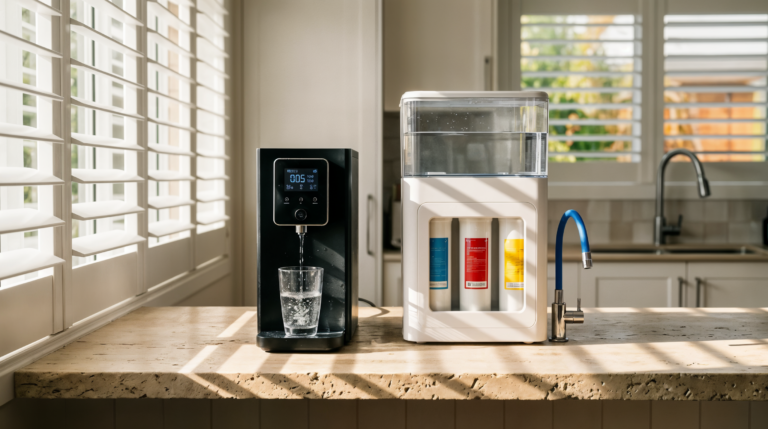
Waterdrop rates the X12 at roughly 3 seconds to fill a 250 mL glass at the dedicated smart faucet, against about 5 seconds for the X8. The difference sounds marginal for a single glass, but it compounds rapidly when filling pots, kettles, and water bottles back to back for a busy household.
The UV kill rate requires laboratory microbiological testing to verify independently. Per Waterdrop, the X12’s UV stage is integrated into the post-membrane flow path, which is the correct engineering position: sterilisation occurs after filtration, not before, ensuring the UV light is not attenuated by turbidity or particulate matter. This is the same principle used in commercial water treatment per the ADWG microbiological guidelines.
Deep Dive: Features and Performance — Stage by Stage
The X12’s 11-stage filtration is not a marketing number. Each stage serves a specific function, and understanding them helps you evaluate whether you are paying for capability you actually need — or whether a simpler system would do.
Pre-Filtration (Stages 1-3): Sediment and Carbon Block
The initial stages handle sediment (rust, sand, silt from older pipes) and larger organic compounds via a compressed carbon block. This pre-treatment protects the RO membrane from fouling and extends its lifespan. For SEQ Water supply, the sediment load is generally low, but properties in Logan, Ipswich, and older Gold Coast suburbs with galvanised pipes will push more particulate through. If your water looks slightly discoloured when you first turn on the tap in the morning, your pre-filters will work harder and need replacing sooner.
RO Membrane (Stage 4): 0.0001 Micron — The Core
This is where the heavy lifting happens. A 0.0001 micron pore size means the membrane rejects dissolved solids that carbon cannot touch: fluoride, lead, arsenic, PFAS, nitrates, and chloramine. According to NSF/ANSI 58 testing protocols, a compliant RO membrane must demonstrate minimum rejection rates of 97.5% for TDS under controlled conditions. Real-world performance varies with inlet pressure, temperature, and TDS. Higher inlet TDS (like Adelaide’s ~400 ppm) would show even higher percentage rejection at the membrane, but the permeate would still be higher in absolute terms.
The critical fact for Australian buyers: RO is the only residential technology that reliably removes both fluoride (90-97%) and PFAS (including PFOA and PFOS) to below detection limits. If PFAS contamination is your concern — and it should be if you live near any of the 700+ confirmed PFAS-contaminated sites on the DCCEEW national register, including Williamtown NSW, Oakey QLD, and RAAF bases across the country — then RO is not optional. It is the minimum.
UV Sterilisation (Stage 8): The X12 Differentiator
This is the stage that separates the X12 from the X8 and from most other residential under-sink RO systems in Australia. The UV-C lamp operates at 254 nm wavelength, which is the peak germicidal effectiveness range for disrupting bacterial and viral DNA. Waterdrop claims 99.9999% kill rate for bacteria and 99.99% for viruses. These numbers correspond to a 6-log and 4-log reduction respectively — the same standard required by the ADWG for drinking water microbiological safety.
Who actually needs UV? If your water comes from treated mains in any Australian capital city, the chloramine or chlorine residual is already providing ongoing disinfection. UV is redundant for most urban users. But if any of these apply, the UV stage becomes actually important:
- Rainwater tank supply — no residual disinfectant, seasonal bacterial spikes after rain events
- Bore water — potential for E. coli and Giardia without treatment
- Homes with known plumbing contamination — post-meter biofilm, dead legs in older pipe runs
- Post-disaster or boil-water advisory areas — the UV provides an independent safety layer when mains treatment may be compromised
Post-Carbon and Alkaline Stages (Stages 9-11): Taste and Mineral Addition
After the RO membrane strips essentially everything from the water, the post-filtration stages add back a controlled mineral content (primarily calcium and magnesium) and polish the taste via a final carbon block. This is a common design in modern RO systems and addresses the legitimate criticism that pure RO permeate (~5-15 ppm TDS) tastes flat. On this design the re-mineralisation is light rather than the 30-50 ppm some users expect. If you prefer higher mineral content, you can add a separate inline re-mineralisation cartridge.
Smart Faucet with TDS Display
The dedicated faucet includes a built-in TDS sensor that displays the output water quality in real time on a small screen at the base of the tap. This is more than a gimmick. It is your early warning system: when the TDS reading starts climbing above your baseline, the RO membrane or post-filters need attention. No guessing, no calendar reminders. The number tells you.
The faucet requires a standard 25-27 mm sink hole. If your bench has a spare knockout (most do), installation is simple. If not, you will need a 25–27 mm diamond hole saw from a hardware store (~$20).
✓ What I Liked
- Fast by design. Waterdrop rates the fill at roughly 3 seconds per 250 mL glass.
- Tankless saves under-sink space. Shoebox footprint; no stagnant pressurised tank.
- UV correctly positioned. Post-membrane placement is the right engineering call — sterilises after filtration, not before.
- TDS display is genuinely useful. Flow-powered, no batteries; gives a real-time output reading to help you track filter performance.
- Tool-free filter swap. Twist-and-lock cartridge — 90 seconds, no plumber.
- 3:1 water efficiency. Significantly better than older RO systems at 1:3 or 1:4.
✗ What Could Be Better
- Price premium over the X8. If you don't need UV or 1200 GPD, you're paying for insurance you may never use.
- Light re-mineralisation. Low mineral output can taste flat; an aftermarket cartridge is needed if you want 30–50 ppm.
- Faucet hole required. Renters and those who can't drill are excluded.
- Annual filter cost ~$200–$250 AUD. Standard for premium RO, but budget for it upfront.
- WaterMark AS3497 unconfirmed. NSF/ANSI 42/58 certified; WaterMark listing could not be confirmed at review time — verify with Waterdrop AU if your council requires it.
Buy This If…
You're a household of 4+ in a chloramine city or on tank water with real bacterial risk, and you want the fastest residential under-sink RO with integrated UV-C — shipped and warranted direct from Waterdrop Australia.
How the Waterdrop X12 Compares: X12 vs X8 vs EcoHero 5-Stage vs AquaTru Countertop RO
Choosing an RO system is not about picking the “best” one. It is about matching the system to your water supply, household size, and installation situation. Here is how the X12 stacks up against the three most common alternatives Australian buyers are weighing up in 2026.
| Feature | Waterdrop X12 | Waterdrop X8 | EcoHero 5-Stage | AquaTru Countertop RO |
|---|---|---|---|---|
| Installation type | Under-sink (tankless) | Under-sink (tankless) | Under-sink (tank) | Countertop (no install) |
| Flow rate | 1,200 GPD (~3 sec/glass) | 800 GPD (~5 sec/glass) | 75-100 GPD (tank fed) | ~60 GPD (batch fill) |
| RO membrane pore size | 0.0001 micron | 0.0001 micron | 0.0001 micron | 0.0001 micron |
| UV sterilisation | Yes — 99.9999% | No | No | No |
| Filtration stages | 11 | 8 | 5 | 4 |
| Smart faucet TDS display | Yes | Yes | No | No |
| Removes fluoride | Yes (90-97%) | Yes (90-97%) | Yes (90-97%) | Yes (90-97%) |
| Removes chloramine | Yes | Yes | Yes | Yes |
| Removes PFAS | Yes | Yes | Yes | Yes |
| Tankless design | Yes | Yes | No (pressurised tank) | Yes (countertop jug) |
| Best for | Large household, tank water, bacteria risk | 2-4 person city mains household | Budget under-sink with tank | Renters, no-install needed |
| Plumbing modification | Yes (dedicated faucet) | Yes (dedicated faucet) | Yes (dedicated faucet + tank space) | None |
Waterdrop X12 vs X8: Is the Upgrade Worth It?
The X8 and X12 share the same fundamental RO membrane technology at 0.0001 micron. Both remove fluoride, PFAS, chloramine, lead, and heavy metals. Both have the smart faucet with TDS display. The differences are flow rate and UV.
The X12 fills a glass 50% faster (3 seconds vs 5 seconds). Over a day of cooking, filling bottles, and making coffee for a family of five, that adds up to noticeable convenience. The UV stage adds a genuine microbiological safety layer. If you are on town mains in Brisbane, Sydney, Melbourne, Perth, Adelaide, or any chloramine/chlorine-treated supply, the UV is insurance — nice to have, not essential. If you are on tank water in rural QLD, the Sunshine Coast hinterland, the NSW south coast, or the Victorian countryside, the UV stage is the reason to buy the X12 over anything else.
My recommendation: On city mains, households of 1-3 people should save money and buy the X8. Households of 4+ people where the flow rate difference matters, or anyone on tank water or bore water, should pay the premium for the X12.
Waterdrop X12 vs EcoHero 5-Stage RO
The EcoHero 5-Stage is a solid traditional under-sink RO with a pressurised holding tank. It costs less upfront and has lower annual filter costs. The trade-offs: it is slower (tank-fed, so flow rate depends on tank pressure), takes more space under the sink, and has no UV or smart faucet. For a budget-conscious 2-3 person household on city mains, the EcoHero is a legitimate option. For larger households or tank water, the X12 is the better investment.
Waterdrop X12 vs AquaTru Countertop RO
The AquaTru is a completely different category — a countertop unit that requires zero installation. It is the answer for renters and anyone who cannot modify plumbing. Flow rate is much slower (batch fill into a jug), and there is no UV. But it still uses a genuine RO membrane and removes fluoride, PFAS, and chloramine. If plumbing modification is off the table, the AquaTru is your only serious RO option.
Our Top Under-Sink RO Systems for Australia
5-Year Cost of Ownership: Waterdrop X12 vs Alternatives
The upfront price is only part of the story. Filter replacements, membrane changes, and UV lamp replacements add up over five years. Without this number, you cannot make a real comparison. Below I have estimated 5-year total cost based on manufacturer-recommended replacement intervals and current Australian pricing as of early 2026. I have assumed a household consumption of 4 litres per day for the per-litre calculation (a conservative estimate for a family).
| System | Upfront (AUD) | Annual Filters (AUD) | 5-Year Total (AUD) | Cost per Litre |
|---|---|---|---|---|
| Waterdrop X12 | ~$1,950 | ~$200-250 | ~$2,950-3,200 | ~$0.40-0.44 |
| Waterdrop X8 | ~$799 | ~$150-200 | ~$1,549-1,799 | ~$0.21-0.25 |
| EcoHero 5-Stage RO | ~$499 | ~$100-130 | ~$999-1,149 | ~$0.14-0.16 |
| AquaTru Countertop RO | ~$649 | ~$120-150 | ~$1,249-1,399 | ~$0.17-0.19 |
Note: Prices are approximate and based on current Australian retail at the time of writing. Filter costs include pre-filters, post-filters, and prorated membrane/UV lamp replacement on the manufacturer’s recommended schedule. Per-litre cost is calculated at 4 L/day x 365 days x 5 years = 7,300 litres.
The X12 is the most expensive option on a per-litre basis. That premium buys you three things the cheaper options do not provide: the UV stage, the fastest flow rate, and the smart faucet. Whether that is worth an extra $0.10-0.15 per litre over the EcoHero depends on whether you need what the X12 uniquely offers. For a family of five on tank water, paying 30 cents per litre for UV-sterilised, fluoride-free, PFAS-free water is a fraction of what you would pay for bottled water — and without the 373 million plastic bottles that go to Australian landfill annually, according to ABS waste data.
Installation: What to Expect
Installation is realistic for anyone comfortable with basic plumbing and typically takes under an hour. Here is what is involved.
Step 1: Shut off the cold water supply under your sink. There is usually an isolation valve on the cold line. If there is not, you will need to shut off the mains at the meter.
Step 2: Install the feed water adapter. The X12 includes a T-piece adapter that tees off the cold water supply line. Standard 3/8″ or 1/2″ connections. If your under-sink plumbing uses non-standard fittings (common in older homes in inner Brisbane, Sydney, or Melbourne), you may need a brass adapter from a hardware store (~$8).
Step 3: Drill the faucet hole (if needed). If your sink or benchtop has a spare knockout (most stainless steel sinks have one plugged with a cap), pop it out. If not, use a 25-27 mm diamond hole saw on stone benchtops. Take your time, use water as lubricant, and wear safety glasses. If you are not confident drilling stone, a plumber or benchtop installer can do this in 10 minutes for $50-80.
Step 4: Mount the unit and connect the lines. The X12 mounts inside the cabinet with two screws. Quick-connect fittings push onto the water lines — no soldering, no thread tape needed. Connect the drain line to the sink drain (a small saddle valve clamps onto the existing drain pipe).
Step 5: Flush the system. Run the tap for 15-20 minutes before drinking. This flushes the carbon fines and primes the RO membrane. Your first TDS reading may be higher than expected; it stabilises after 30-60 minutes of flow.
If you would rather not DIY, any licensed plumber can install it. Expect $150-250 depending on your location and benchtop material. I would recommend getting the plumber to confirm your water pressure is between 150-600 kPa (the X12’s operating range) while they are there.
Decision Tree: Which RO System Should You Buy?
QUESTION 1: CAN YOU MODIFY YOUR PLUMBING?
- Yes (homeowner / landlord permission): Under-sink RO is the best option. Waterdrop X12 (UV + high flow) or EcoHero 5-Stage (WaterMark, lowest cost).
- No (renter, apartment): AquaTru Classic Countertop RO. Full RO performance, no drilling, no permissions needed.
QUESTION 2: DO YOU NEED UV STERILISATION?
- Yes (tank water, bore water, older plumbing, known bacterial risk): The Waterdrop X12 is the correct choice. The UV stage is the reason — 99.9999% bacterial kill rate.
- No (city mains water, chloramine or chlorine treated): Proceed to question 3.
QUESTION 3: WHAT IS YOUR HOUSEHOLD SIZE?
- 4+ people (or fill large pots and bottles frequently): Waterdrop X12 — 1200 GPD fills a glass in 3 seconds, handles high demand.
- 1-3 people: Waterdrop X8 (best balance of cost and performance) or EcoHero 5-Stage (lowest total cost of ownership).
Final Verdict
The Waterdrop X12 is the most capable residential under-sink RO system currently available in Australia. The 1,200 GPD flow rate, 11-stage filtration with UV sterilisation, and smart faucet TDS display put it at the top of the category for households that actually need what it offers: high-demand families, tank water properties, and anyone with known bacterial risk in their water supply.
It is not the best value for everyone. A couple in a Canberra apartment on clean mains water does not need UV or 1,200 GPD. They need the X8 or the EcoHero and should keep the difference in their pocket.
But if you are a family of five in Logan filling pots and bottles all day on SEQ chloramine water, or a rural property owner in the NSW hinterland on tank water worrying about E. coli after every rain event, the X12 solves problems that cheaper systems simply cannot. Three seconds per glass. 99.9999% bacterial kill. Fluoride, PFAS, chloramine, lead — gone. At roughly 40–44 cents per litre over five years, that is the cost of clean water for your family. The X12 earns its price.
Last reviewed: July 2026 — Clean and Native
Ready to filter your water?
The Waterdrop X12 is the top-rated under-sink RO for larger Australian households — 1,200 GPD flow, UV sterilisation, 0.0001 micron RO membrane. Removes fluoride, PFAS, lead, and chloramine.
Frequently Asked Questions
Does the Waterdrop X12 remove fluoride from Australian tap water?
Yes. The 0.0001 micron RO membrane rejects fluoride at 90-97%, which is effective against the 0.6-1.0 mg/L fluoride added to most Australian reticulated water supplies per the ADWG. Carbon filters — including catalytic carbon — cannot remove fluoride. Only RO and activated alumina achieve meaningful fluoride reduction.
Is the Waterdrop X12 suitable for Brisbane chloramine water?
Yes. Brisbane and the entire SEQ Water network use chloramine as a secondary disinfectant. Standard GAC filters remove chloramine at roughly 1/40th the rate they remove free chlorine. The X12’s RO membrane rejects chloramine effectively, making it one of the best options for Brisbane, Gold Coast, Sunshine Coast, Logan, and Ipswich households.
Can I use the Waterdrop X12 on tank water in rural Australia?
Yes, and the UV stage is specifically what makes the X12 the right choice over the X8 for tank water. Tank water carries real risk of E. coli, Cryptosporidium, and Giardia, especially after heavy rain. The UV sterilisation achieves 99.9999% bacterial kill rate (6-log reduction), meeting ADWG microbiological guidelines. Ensure your tank water pressure falls within the X12’s 150-600 kPa operating range; if it does not, you will need a booster pump.
What is the difference between the Waterdrop X12 and X8?
The X12 has a higher flow rate (1,200 GPD vs 800 GPD), adds an integrated UV sterilisation stage, and includes 11 filtration stages versus the X8’s 8. Both share the same 0.0001 micron RO membrane and smart faucet with TDS display. The X12 fills a glass in approximately 3 seconds; the X8 takes about 5 seconds. For city mains households of 1-3 people, the X8 is sufficient. For larger households or tank water, the X12 is the better choice.
Does the Waterdrop X12 have WaterMark AS3497 certification?
I could not confirm current WaterMark AS3497 listing for the X12 at the time of review. It holds NSF/ANSI 42 and 58 certifications, which are internationally recognised standards for water treatment device performance. If your local council or plumber specifically requires WaterMark certification for under-sink installation, verify directly with Waterdrop Australia before purchasing.
How often do I need to replace the X12 filters and what does it cost?
Waterdrop recommends replacing the CF (composite filter) every 6 months, the CB (carbon block) every 12 months, and the RO membrane every 24 months. The UV lamp typically lasts 12-24 months depending on usage. Annual filter costs are approximately $200-250 AUD. The smart faucet TDS display gives you real-time monitoring — when TDS output rises consistently above your baseline, it is time to change the relevant filter.
How much water does the Waterdrop X12 waste?
Waterdrop states a 3:1 pure-to-drain ratio at standard residential pressure. For every 3 litres of filtered water, approximately 1 litre goes to drain. For a household using 12 litres per day of filtered water, that is about 4 litres to drain — roughly equivalent to one additional toilet flush. This is significantly better than older RO systems that operated at 1:3 or 1:4 ratios.
Can I install the Waterdrop X12 myself or do I need a plumber?
DIY installation is realistic for anyone comfortable with basic plumbing and typically takes under an hour. The system uses quick-connect fittings that require no soldering or thread tape. The main challenge is drilling a faucet hole if your sink does not have a spare knockout — a 25-27 mm diamond hole saw handles stone benchtops. If you prefer professional installation, a licensed plumber will charge $150-250 AUD depending on your location and benchtop material.
Does the Waterdrop X12 remove PFAS?
Yes. RO membranes at 0.0001 micron reject PFOA and PFOS to below detection limits. According to the DCCEEW national register, there are 700+ confirmed PFAS-contaminated sites across Australia, including Williamtown NSW, Oakey QLD, and multiple RAAF base sites. If you live near a known contamination zone or simply want precautionary PFAS removal, an RO system like the X12 is the minimum effective technology. Carbon filters can reduce some PFAS compounds but are not certified for complete removal.
Shop Waterdrop X12 Australia
1200 GPD, 11-stage filtration with UV sterilisation, NSF 42/58/372 certified, smart faucet TDS display, 3:1 water efficiency ratio. Ships directly from Waterdrop Australia with local support and warranty.
Get the Australian Home Environment Checklist
30 checks across water, air and EMF. Most of them free. Ranked by impact.
No spam. Unsubscribe any time.

Former Royal Australian Navy Clearance Diver and TAG-E counter-terrorism operator. Founded Clean and Native to apply the same rigorous thinking to the home environment.
Full biography →