WaterMark vs NSF Certification: What Australian Water Filter Standards Actually Mean
WaterMark certification is a legal requirement under Australia’s National Construction Code for any water filter permanently connected to your plumbing. NSF certification is a voluntary performance standard that proves a filter actually removes the contaminants it claims. They are not interchangeable, and most Australian households need to understand both — because one keeps you legally compliant, and the other tells you whether your filter is doing anything useful. As a former Navy Clearance Diver, I learned that the difference between a standard and a tested capability is the difference between paperwork and survival. Your water filter situation is less dramatic, but the principle is identical.
If you are shopping for a water filter in Australia right now, you are facing a confusing landscape. Some products carry WaterMark only, some carry NSF only, some carry both, and some carry neither. The September 2025 lead-in-plumbing regulation tightened things further. This article breaks down exactly what each certification means, when each one is legally required, what the 2025 lead regulation changes for your purchasing decision, and how to avoid spending $400-$800 on a system that is either non-compliant or unproven. I assessed using our documented methodology and verified every claim against primary sources from Standards Australia, ABCB, NSF International, and the NHMRC.
Quick Verdict — WaterMark vs NSF for Australian Filters
WaterMark = mandatory legal compliance for plumbed-in filters under Australia’s National Construction Code. It certifies the product will not contaminate water or fail structurally — it does not verify contaminant removal performance. NSF/ANSI = voluntary performance proof. NSF/ANSI 42 covers taste (chlorine), NSF/ANSI 53 covers health contaminants (lead, cysts), NSF/ANSI 58 covers reverse osmosis (fluoride, PFAS, heavy metals), and NSF/ANSI P473 covers PFAS specifically. For Australian households, the best filters carry both WaterMark (legal) and NSF (performance).
WaterMark Certification: Australia’s Mandatory Plumbing Compliance Standard
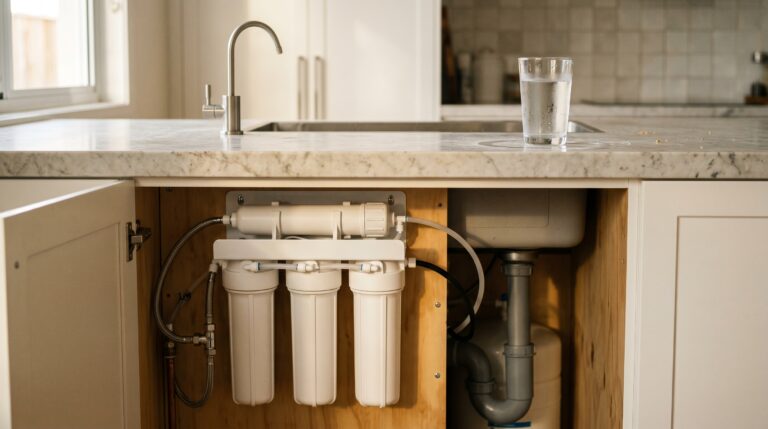
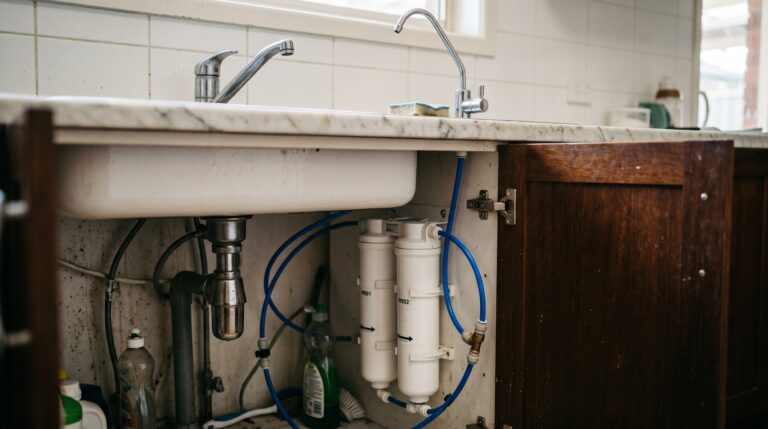
Here is the problem most Australians do not realise until they have already purchased a filter: if your water filtration system is permanently connected to your household plumbing — under-sink, whole-house, or inline — it is legally required to carry WaterMark certification. This is not a suggestion. It is mandated under the National Construction Code (NCC), enforced by state and territory building regulators, and your plumber is professionally obligated to refuse installation of non-WaterMark products.
WaterMark certification, administered by the Australian Building Codes Board (ABCB), verifies that a plumbing product meets the relevant Australian Standard — in the case of water filters, that is primarily AS/NZS 3497:1998 (Drinking Water Treatment Units — Plumbing Requirements). The certification confirms three things: the product is structurally sound under Australian water pressure conditions, it will not leach harmful substances into your drinking water, and the materials and fittings are compatible with Australian plumbing systems.
What WaterMark does not do — and this is the critical gap most buyers miss — is verify whether the filter actually removes contaminants. A WaterMark-certified filter could let chloramine, fluoride, lead, and PFAS pass straight through and still hold its certification. The standard is about plumbing safety, not filtration performance. Think of it as your car passing a roadworthy inspection — that confirms the brakes work, but says nothing about whether the engine produces the horsepower claimed on the sticker.
Who needs WaterMark: Any household installing a filter that physically connects to the water supply. Under-sink reverse osmosis, inline sediment filters, whole-house carbon systems, and plumbed-in fridges all require WaterMark. The requirement sits under NCC Volume 3 (Plumbing Code of Australia), Section B2.
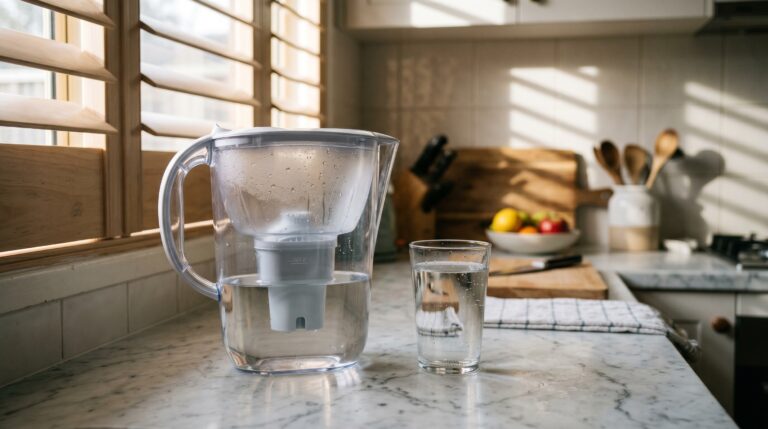
Who does not need WaterMark: Countertop gravity filters like the Berkey Royal, countertop RO units like the AquaTru Classic, and jug filters are not connected to plumbing and therefore fall outside NCC jurisdiction. This is one reason countertop RO systems are increasingly popular — they sidestep the WaterMark requirement entirely while delivering NSF-certified performance.
NSF/ANSI Certification: The Performance Standard That Proves Removal Claims
If WaterMark is the legal minimum, NSF/ANSI certification is where you find out whether a filter actually does what the manufacturer claims. Without NSF testing, a brand can print “removes 99% of contaminants” on the box with zero independent verification. And many do. According to NSF International’s own database, fewer than 40% of water filters sold globally carry any form of independent performance certification. In Australia, where most filter brands are imported, this gap is even wider.
NSF International (originally the National Sanitation Foundation, now based in Ann Arbor, Michigan) operates the most widely recognised water treatment device certification program in the world. Products are tested under controlled laboratory conditions, not manufacturer-submitted data. NSF auditors conduct unannounced factory inspections. The certifications relevant to Australian households break down as follows:
| NSF/ANSI Standard | What It Tests | Key Contaminants Covered | Who Needs This |
|---|---|---|---|
| NSF/ANSI 42 | Aesthetic effects (taste & odour) | Free chlorine, sediment, taste | Melbourne, Hobart, Canberra households (free chlorine cities) |
| NSF/ANSI 53 | Health effects | Lead, mercury, cysts (Giardia, Cryptosporidium), VOCs | Any household concerned about health contaminants |
| NSF/ANSI 58 | Reverse osmosis systems | Fluoride (90-97%), TDS, arsenic, chromium, barium, lead, nitrate | Any household wanting fluoride or heavy metal removal |
| NSF/ANSI P473 | PFAS (PFOA & PFOS) | PFOA, PFOS at ≥70 ng/L influent | Households near PFAS contamination sites (700+ confirmed across Australia per DCCEEW) |
| NSF/ANSI 401 | Emerging contaminants | Pharmaceuticals, herbicides, pesticides, BPA | Households downstream of agricultural or pharmaceutical discharge |
| NSF/ANSI/CAN 372 | Lead content in materials | Weighted average ≤0.25% lead in wetted surfaces | All plumbed systems — mandatory compliance from September 2025 |
The critical distinction for Australian buyers: NSF/ANSI 42 covers aesthetic chlorine removal only — and it tests for free chlorine, not chloramine. If you live in Brisbane, Sydney, Adelaide, Gold Coast, or Darwin (all chloramine-treated cities), an NSF 42-only filter is provably inadequate. Standard granular activated carbon (GAC) removes free chlorine effectively but removes chloramine at approximately 1/40th the rate, according to published adsorption kinetics data. You need either catalytic carbon, a compressed carbon block with sufficient contact time, or reverse osmosis (NSF/ANSI 58) to handle chloramine.
Similarly, no carbon filter — including catalytic carbon — removes fluoride. Period. If fluoride removal is your goal (Brisbane fluoridates at ~0.7 mg/L, Sydney at ~1.0 mg/L, per the respective utility reports), you need reverse osmosis (90-97% removal, verified under NSF/ANSI 58) or activated alumina (80-95%). Anyone claiming a carbon filter removes fluoride is either uninformed or lying.
WaterMark vs NSF: The Head-to-Head Comparison
Most comparison articles give you a vague table and move on. Here is every dimension that matters for your purchase decision, laid out so you can see exactly where each certification applies and where each one falls short.
| Criterion | WaterMark (ABCB / AS/NZS 3497) | NSF/ANSI (42, 53, 58, P473) | What This Means for You |
|---|---|---|---|
| Legal status | Mandatory for plumbed-in products (NCC) | Voluntary (no Australian legal requirement) | Without WaterMark, a plumber legally cannot install it. Without NSF, you have no performance proof. |
| What it tests | Structural integrity, pressure resistance, material safety, no leaching | Specific contaminant removal under controlled conditions | WaterMark = won’t break or poison you. NSF = actually removes contaminants. |
| Administering body | ABCB (Australian Building Codes Board) | NSF International (USA) + accredited labs | Both are third-party — neither is manufacturer-controlled. |
| Factory audits | Yes — periodic | Yes — unannounced | NSF’s unannounced audits are considered the more rigorous ongoing check. |
| Fluoride removal verified? | No | Yes (NSF 58 for RO systems) | If fluoride matters to you, only NSF 58 RO is verified. |
| PFAS removal verified? | No | Yes (NSF P473) | 700+ PFAS sites across Australia per DCCEEW. Only P473 proves removal. |
| Chloramine removal verified? | No | Partially (NSF 42 tests free chlorine only; NSF 58 RO removes chloramine) | Brisbane, Sydney, Adelaide, Gold Coast, Darwin residents: NSF 42 alone is not enough. |
| Lead content in materials | Addressed via AS/NZS 3718 + new Sep 2025 requirements | NSF/ANSI/CAN 372 (≤0.25% weighted avg lead) | From September 2025, both frameworks align on low-lead requirements. |
| Applies to countertop filters? | No (not connected to plumbing) | Yes (voluntary for any product) | Countertop systems only need NSF. No WaterMark required. |
| Cost to manufacturer | $5,000-$15,000+ per product line | $10,000-$50,000+ per standard per product | NSF testing is more expensive, which is why budget brands skip it. |
The bottom line on this comparison: WaterMark and NSF are not competing standards. They cover entirely different dimensions. A filter with WaterMark only is legally installable but performance-unproven. A filter with NSF only is performance-proven but cannot be legally plumbed in by an Australian licensed plumber. The ideal product carries both — and the best systems available in Australia do.
Here is where most buyers get caught: they see “Australian certified” on a box and assume it means performance-tested. WaterMark is the most common “Australian certification” referenced, and it tells you nothing about whether the filter removes chloramine from your Brisbane tap water (TDS typically 80-115 mg/L, chloramine-treated via SEQ Water’s Mt Crosby treatment plant) or fluoride from your Sydney supply (fluoridated at ~1.0 mg/L per Sydney Water). Do not confuse legal compliance with proven capability.
The September 2025 Lead Regulation Change: What It Means for Your Filter Purchase
If you bought a water filter before September 2025 without checking the lead content of its brass fittings, you may be adding lead to your water while trying to remove contaminants. That is not an exaggeration — it is a documented failure mode in plumbing products that use traditional copper alloys containing up to 4.5% lead.
In September 2025, updated Australian regulations aligned with NSF/ANSI/CAN 372:2024, requiring that copper alloy products in contact with drinking water must not exceed 0.25% lead content (Weighted Average). According to the NHMRC’s 2023 systematic literature review on lead in drinking water, even low-level lead exposure presents a health risk with no safe threshold — a position consistent with the WHO and the updated Australian Drinking Water Guidelines (ADWG 2024).
What this changes for filter buyers:
- Any under-sink, inline, or whole-house filter using brass fittings manufactured before September 2025 may contain legacy copper alloys with significantly higher lead content.
- Products certified to NSF/ANSI/CAN 372:2024 are already compliant with the 0.25% weighted average lead standard.
- WaterMark certification is updating to align with the new requirements through revised AS/NZS 3718 references, but legacy WaterMark-certified products in your home may not meet the new lead limits.
- If you are buying a new plumbed-in filter system in 2026, verify that it carries both WaterMark (for NCC compliance) and NSF/ANSI/CAN 372 (for low-lead material verification).
This is particularly relevant for suburbs with older plumbing infrastructure — inner Sydney (Balmain, Glebe, Surry Hills), inner Melbourne (Fitzroy, Carlton, Richmond), inner Brisbane (Paddington, Red Hill, New Farm) — where galvanised and copper pipes may already contribute trace lead. Adding a filter with high-lead brass fittings compounds the problem instead of solving it.
What Happens If You Install a Non-Certified Filter: Legal and Practical Consequences
You found a great deal on a Chinese-import under-sink filter on eBay. No WaterMark logo. You install it yourself or convince a handy mate to do it. Here is what you are risking.
Legal consequences (plumbed-in systems):
- Plumber liability: A licensed plumber who installs a non-WaterMark product violates their licensing conditions. If caught during a building inspection, they face fines (up to $11,000 in QLD under the Plumbing and Drainage Act 2018) and potential licence suspension. Most licensed plumbers will refuse.
- Home insurance: If a non-WaterMark plumbing product fails and causes water damage, your home insurer may deny the claim. The product was not compliant with the NCC at the time of installation, which is a standard exclusion clause in Australian home and contents policies.
- Property sale complications: A building inspection before sale may flag non-compliant plumbing products. The cost to rectify is yours — typically $300-$800 for removal and replacement with a compliant system, plus the plumber’s call-out fee.
- Body corporate enforcement: In strata properties across NSW, QLD, and Victoria, body corporate bylaws typically require all plumbing modifications to use WaterMark-certified products. Non-compliance can result in a remediation order at the lot owner’s expense.
Practical consequences (any non-certified system):
- No verified contaminant removal: Without NSF testing, you are relying entirely on manufacturer claims. A 2019 study published in the journal Environmental Science & Technology found that 40% of tested POU filters performed significantly below manufacturer claims for lead and PFAS removal. Without third-party verification, your expensive filter may be an expensive placebo.
- Material leaching risk: Non-WaterMark products have not been tested for material safety under Australian water conditions. Cheap housing, low-grade plastics, and unverified adhesives can leach BPA, phthalates, and other compounds directly into your filtered water.
- No warranty enforcement: If a non-certified filter fails and damages your cabinetry or flooring, you have limited legal recourse. Australian Consumer Law guarantees still apply, but proving the product was “fit for purpose” when it was never certified for Australian conditions is an uphill battle.
The short version: installing a non-WaterMark plumbed-in filter is like driving an unregistered car. It might work fine for years. But when something goes wrong, you are exposed legally, financially, and practically. Countertop systems sidestep this entirely — no plumbing connection, no WaterMark requirement, no installation risk.
Which Certification Do You Actually Need? A Decision Framework
You do not need to become a standards expert. You need to answer three questions, and the answers will tell you exactly which certifications to look for on the box.
🔧 3-Question Decision Tree
Q1: Will the filter connect to your plumbing?
Yes (under-sink, whole-house, inline) → WaterMark is mandatory. Non-negotiable. Your plumber will (should) refuse without it.
No (countertop, gravity, jug) → WaterMark not required. Focus entirely on NSF performance certifications.
Q2: What are you trying to remove?
Taste/chlorine only (Melbourne, Hobart, Canberra) → NSF/ANSI 42 is sufficient.
Chloramine (Brisbane, Sydney, Adelaide, Gold Coast, Darwin) → NSF/ANSI 58 (RO) or verified catalytic carbon. Standard NSF 42 GAC will not cut it.
Fluoride → NSF/ANSI 58 (RO) only. Carbon cannot remove fluoride. Full stop.
PFAS → NSF/ANSI P473 or NSF/ANSI 58 (RO).
Lead → NSF/ANSI 53 (carbon block) or NSF/ANSI 58 (RO).
Q3: Is the product made with low-lead materials?
Check for NSF/ANSI/CAN 372 compliance (≤0.25% weighted average lead in wetted surfaces). Especially important for brass-fitted under-sink systems purchased after September 2025. If the manufacturer cannot confirm 372 compliance, walk away.
If you are in Brisbane, Sydney, Adelaide, Gold Coast, or Darwin, the decision tree almost always leads to the same place: reverse osmosis. RO is the only technology that handles chloramine, fluoride, PFAS, and heavy metals simultaneously, with each claim verifiable under NSF/ANSI 58 and P473. Carbon-only systems simply cannot address the full contaminant profile of chloramine-treated Australian water supplies.
If you are in Melbourne, Hobart, or Canberra — cities that use free chlorine, not chloramine — you have more flexibility. A quality carbon block filter certified to NSF/ANSI 42 and 53 handles taste, chlorine, lead, and cysts. But if you also want fluoride removed, you still need RO. Melbourne Water does not fluoridate above 1.0 mg/L, but the fluoride is there (typically 0.7-1.0 mg/L), and only reverse osmosis or activated alumina will address it.
Certified Systems Worth Buying: Price Tiers and 5-Year Cost Comparison
Talk is cheap. Certifications are not. Here is what it actually costs to own a properly certified water filter in Australia, broken down across three price tiers. I have included 5-year total cost of ownership because upfront price is misleading — filter replacements are where the real expense lives.
| Product | Type | Certifications | Upfront Price (AUD) | Annual Filter Cost | 5-Year Total | Cost/Litre* |
|---|---|---|---|---|---|---|
| Tappwater EcoPro | Benchtop carbon block | NSF 42, 53 (no WaterMark needed — countertop) | ~$90 | ~$60 | ~$390 | $0.05 |
| AquaTru Classic RO | Countertop RO | NSF 42, 53, 58, 401, P473 (no WaterMark needed) | ~$699 | ~$120 | ~$1,299 | $0.18 |
| Waterdrop D6 RO | Under-sink RO | NSF 58, WaterMark (plumbed) | ~$599 | ~$100 | ~$1,099 | $0.15 |
*Based on 4L/day household usage (1,460L/year). Prices approximate as of May 2026. Filter costs include all replacement elements per manufacturer schedule.
The pricing reality: A Tappwater EcoPro at $0.05/L is the cheapest certified option, but it uses a carbon block — so it handles free chlorine (Melbourne, Hobart, Canberra) but not chloramine, fluoride, or PFAS. For Brisbane, Sydney, Adelaide, Gold Coast, or Darwin households, the minimum credible option is a reverse osmosis system, and the AquaTru Classic or Waterdrop D6 represent the two best value propositions in their respective categories (countertop vs under-sink).
Compare either RO system against bottled water: at 4L/day, a household buying Mount Franklin at roughly $2/L spends $2,920/year. Over 5 years, that is $14,600 in bottled water versus $1,099-$1,299 for a certified RO system. According to ABS waste data, 373 million plastic bottles go to Australian landfill annually — and a significant portion of that is drinking water bottles that a home RO system eliminates entirely.
If you cannot modify your plumbing — rental property, strata restrictions, or simply prefer not to — the AquaTru Classic is the strongest countertop option. NSF 58 certified, no WaterMark needed, plugs into a power point, and sits on your benchtop. At $699 upfront, that is less than $0.40/day averaged over five years for NSF-verified removal of fluoride, chloramine, PFAS, lead, and 80+ other contaminants.
How to Verify Certification Claims Before You Buy
Manufacturers lie. Not all of them, but enough that verification is non-negotiable. Here is how to check both WaterMark and NSF certification in under two minutes.
Verifying WaterMark:
- Go to the ABCB WaterMark Product Certificate Search.
- Search by product name, brand, or licence number.
- Confirm the certificate is current (not expired or suspended).
- Note the specific product models covered — WaterMark covers the exact tested configuration, not the brand in general.
Verifying NSF:
- Go to the NSF Drinking Water Treatment Units database.
- Search by manufacturer or product name.
- Confirm which specific NSF/ANSI standards the product is certified against (42, 53, 58, P473, etc.).
- Check the contaminant list — NSF 53 certification for lead does not automatically mean NSF 53 for VOCs. Each contaminant is listed individually.
Red flags to watch for:
- “Tested to NSF standards” is not the same as “NSF certified.” Testing to the standard means the manufacturer ran their own tests following NSF protocols. Certification means NSF independently tested and verified the claims. The difference is enormous.
- “Meets Australian Standards” without a WaterMark licence number is meaningless. The product may “meet” the standard in the manufacturer’s opinion, but without WaterMark certification, it has not been independently verified and is not NCC-compliant.
- WaterMark logos without a licence number. Every legitimate WaterMark product has a unique licence number. If the logo appears without the number, treat it as unverified.
- NSF claims without specifying which standard. “NSF certified” alone is too vague. NSF 42 (taste) is a dramatically lower bar than NSF 58 (RO performance). Always check the number.
Australian City-Specific Certification Requirements
Not every city needs the same filtration approach, which means not every city needs the same certifications. Here is a city-by-city breakdown so you can match your location to the right combination of WaterMark and NSF standards.
| City | Disinfection | Fluoridated? | TDS / Hardness | Minimum NSF Certifications Needed |
|---|---|---|---|---|
| Brisbane / SEQ | Chloramine | Yes (~0.7 mg/L) | TDS ~80-115 / ~80-120 mg/L CaCO₃ | NSF 58 (RO) for chloramine + fluoride. P473 for PFAS near contaminated sites (Logan, Ipswich). |
| Sydney | Chloramine | Yes (~1.0 mg/L) | Varies by catchment | NSF 58 (RO). Higher fluoride makes RO more justified. Western suburbs (Penrith) have harder water. |
| Melbourne | Free chlorine | Yes (~0.7-1.0 mg/L) | TDS ~60 / ~25 mg/L CaCO₃ (very soft) | NSF 42 + 53 (carbon block) handles chlorine + lead. Add NSF 58 if fluoride removal wanted. |
| Adelaide | Chloramine | Yes | TDS ~400 / ~140 mg/L CaCO₃ (hard) | NSF 58 (RO) essential. High TDS and hardness make RO the only credible approach. |
| Perth | Chloramine | Yes | TDS ~170 / ~180 mg/L CaCO₃ (hard) | NSF 58 (RO). Hardest capital city water. P473 for Rockingham/Kwinana PFAS zone. |
| Darwin | Chloramine | No | Varies seasonally | NSF 58 (RO) for chloramine. No fluoride to worry about. |
| Hobart | Free chlorine | Yes | Soft | NSF 42 + 53 carbon block is sufficient. RO if fluoride removal desired. |
| Canberra | Free chlorine | Yes | Soft-moderate | NSF 42 + 53 carbon block. RO if fluoride removal desired. |
The pattern is clear: if your city uses chloramine (Brisbane, Sydney, Adelaide, Gold Coast, Darwin), NSF/ANSI 58 reverse osmosis is the minimum credible certification to look for. Standard carbon (NSF 42) is designed for free chlorine and does not address chloramine at a meaningful rate. If your city uses free chlorine (Melbourne, Hobart, Canberra), carbon block certified to NSF 42 and 53 covers the main concerns — unless you want fluoride removed, which always requires RO.
For a detailed breakdown of filters matched to your specific city, see our best water filter for Brisbane households or best water filter for Sydney guides.
Common Certification Myths Debunked
I encounter the same misconceptions repeatedly in forums, Facebook groups, and competitor websites. Let me put these to rest with facts, not opinions.
Myth 1: “WaterMark means the filter has been tested for performance.”
False. WaterMark tests structural and material safety. It does not test whether a single contaminant is removed. A WaterMark-only filter could pass 100% of fluoride, chloramine, and lead straight through and still hold its certification.
Myth 2: “NSF certification is only relevant for American products.”
False. NSF International certifies products globally, and many Australian-sold brands carry NSF certification specifically for the Australian market. NSF also administers the WaterMark certification program on behalf of the ABCB, making them the certifying body for both standards in many cases.
Myth 3: “If my filter is Australian-made, it doesn’t need NSF.”
False. Country of manufacture has zero bearing on contaminant removal. An Australian-made carbon filter that has not been tested to NSF 53 has no verified lead removal, regardless of where the factory is located.
Myth 4: “NSF 42 certification means my filter handles chloramine.”
False. NSF/ANSI 42 specifically tests free chlorine reduction. Chloramine is a fundamentally different molecule (NH₂Cl vs Cl₂) that requires catalytic carbon, extended carbon block contact time, or reverse osmosis. Standard GAC certified to NSF 42 removes chloramine at roughly 1/40th the rate of free chlorine.
Myth 5: “A Brita jug is enough for Brisbane/Sydney water.”
Demonstrably false. Standard Brita jugs use granular activated carbon, which is designed for free chlorine reduction. Brisbane and Sydney both use chloramine. A Brita jug will marginally improve taste but leaves chloramine, fluoride, and any PFAS present essentially untouched. You need RO or catalytic carbon at minimum.
Myth 6: “WaterMark is only needed for new builds.”
False. WaterMark is required for any plumbed-in plumbing product in any dwelling, whether new construction or renovation. Replacing an under-sink filter in a 1970s fibro house in Ipswich requires the same WaterMark compliance as a new build in Kelvin Grove.
Final Verdict: WaterMark Is Your Legal Floor, NSF Is Your Performance Proof
After dissecting both standards across every relevant dimension, the conclusion is simple. WaterMark certification is mandatory legal compliance for any plumbed-in water filter in Australia. It protects you from structural failure and material leaching. It does not — and was never designed to — verify that your filter removes contaminants.
NSF/ANSI certification is voluntary performance verification that proves, under independent laboratory conditions, exactly which contaminants a filter removes and to what degree. It is the only credible way to verify manufacturer claims. Without it, you are trusting a marketing department with your family’s drinking water.
The ideal scenario: Your filter carries both WaterMark (if plumbed in) and the relevant NSF standards for your city’s water chemistry. For chloramine cities (Brisbane, Sydney, Adelaide, Gold Coast, Darwin), that means NSF/ANSI 58 at minimum. For free chlorine cities (Melbourne, Hobart, Canberra), NSF/ANSI 42 + 53 covers the basics.
If you can only check one thing: Look up the product on the NSF database. If it is not there, the manufacturer’s performance claims are unverified. That does not mean the product is bad — it means you have no independent evidence that it works.
For most Australian households, a certified RO system like the AquaTru Classic (countertop, no WaterMark needed) or the Waterdrop D6 (under-sink, WaterMark compliant) represents the safest combination of legal compliance and verified contaminant removal. At $0.15-$0.18/L over five years, the cost is a fraction of bottled water — and the performance is independently proven, not marketing.
Ready to filter your water with a certified system?
The AquaTru Classic RO is the top-rated countertop filter for Australian homes — NSF 42, 53, 58, 401, and P473 certified. Removes fluoride, PFAS, lead, and chloramine. No plumbing required.
Last reviewed: May 2026 — Clean and Native
Frequently Asked Questions
WaterMark is mandatory only for water filters permanently connected to household plumbing (under-sink, whole-house, inline systems) under the National Construction Code. Countertop, gravity, and jug filters that do not connect to plumbing are exempt from WaterMark requirements.
No. WaterMark certifies structural integrity, pressure resistance, and material safety. It does not test or verify contaminant removal performance. A WaterMark-only filter has no independent proof of removing chloramine, fluoride, lead, PFAS, or any other contaminant.
NSF/ANSI 42 tests aesthetic effects like free chlorine taste and odour removal. NSF/ANSI 58 tests reverse osmosis system performance including removal of fluoride (90-97%), TDS, heavy metals, and dissolved contaminants. NSF 42 does not cover chloramine; NSF 58 does.
Standard granular activated carbon (GAC) removes chloramine at approximately 1/40th the rate of free chlorine. Only catalytic carbon, compressed carbon block with sufficient contact time, or reverse osmosis effectively removes chloramine. Brisbane, Sydney, Adelaide, Gold Coast, and Darwin all use chloramine disinfection.
No. NSF/ANSI 42 specifically tests free chlorine reduction. Chloramine (NH₂Cl) is a different chemical compound requiring catalytic carbon or reverse osmosis. If you live in a chloramine city, look for NSF/ANSI 58 (RO) certification instead.
From September 2025, copper alloy products in contact with drinking water must not exceed 0.25% lead content by weighted average, aligning with NSF/ANSI/CAN 372:2024. This means brass fittings in filter systems must meet stricter low-lead requirements. Products certified to NSF/ANSI/CAN 372 are already compliant.
You can physically install it, but you face legal and financial risks. Home insurance may deny water damage claims from non-compliant products. Building inspections before property sale will flag non-WaterMark plumbing. In QLD, fines for non-compliant plumbing installations can reach $11,000 under the Plumbing and Drainage Act 2018.
Search the NSF Drinking Water Treatment Units database at info.nsf.org/Certified/DWTU. Enter the product or manufacturer name and verify which specific NSF/ANSI standards and contaminants are listed. “Tested to NSF standards” on packaging is not the same as NSF certified — only the database listing confirms independent certification.
No. Melbourne uses free chlorine (not chloramine), so NSF/ANSI 42 carbon filters work effectively for chlorine taste removal. Brisbane uses chloramine, which requires NSF/ANSI 58 (RO) or catalytic carbon. Both cities fluoridate, so fluoride removal requires RO (NSF 58) regardless of city.
Get the Australian Home Environment Checklist
30 checks across water, air and EMF. Most of them free. Ranked by impact.
No spam. Unsubscribe any time.

Former Royal Australian Navy Clearance Diver and TAG-E counter-terrorism operator. Founded Clean and Native to apply the same rigorous thinking to the home environment.
Full biography →Similar Posts
Pure Water Systems EcoHero 4-Stage Reverse Osmosis Review (2026)
The Pure Water Systems EcoHero 4-Stage Reverse Osmosis is a WaterMark AS3497 certified, NSF/ANSI 58 tested under-sink RO system that removes fluoride at…
Find My Water Filter – Which One Is Right for You?
Answer 4 questions and get a personalised water filter recommendation for your Australian home — matched to your concerns, budget, and setup.
Australia Cracks Down on PFAS in Drinking Water 2024
Australia’s drinking water PFAS guidelines were revised by NHMRC in June 2025, tightening limits far below the original 2016 values and placing dozens…
Best Bore and Tank Water Filter Australia 2026: Sediment, Iron, Bacteria and What Rural Homes Actually Need
The best bore and tank water filter system for rural Australian homes in 2026 — iron, bacteria, sediment and UV explained by source water type.
Best Under Sink Water Filter Australia 2026: RO Systems Compared and Ranked
The definitive guide to under-sink water filters in Australia — PWS EcoHero (NSF 58 + WaterMark) versus Waterdrop X8 tankless, AquaTru for renters, and iSpring budget RO. Jayce tested: 69ppm Palm Beach tap water reduced to 3ppm.
Brisbane Drinking Water Quality 2026: What’s Actually in Your Tap Water
Brisbane tap water is chloraminated, moderately hard, and fluoridated. PFOA detected in raw source water at Mt Crosby. What the data means for your family and which filters address Brisbane-specific concerns.