Chloramine and Your Skin: Why Australian Shower Filters Are Worth It
Chloramine — a combination of chlorine and ammonia — is the primary disinfectant in tap water across Brisbane, Sydney, Adelaide, Gold Coast, and Darwin. Unlike free chlorine, chloramine does not evaporate from an open glass, cannot be removed by a standard carbon jug filter, and according to dermatological research, strips the skin’s natural lipid barrier with every shower. If you live in a chloramine city, the wrong shower filter does literally nothing. The right one protects your skin, hair, and respiratory lining from 8 to 15 minutes of hot, pressurised chemical exposure every single day.
The three products we own are measured first-hand by Jayce Love, former Royal Australian Navy Clearance Diver; every other product is assessed on published manufacturer specifications and independent certification using our documented methodology — no gifted units, no brand payments.
As a former Navy Clearance Diver, I spent years in water that would make your shower look pristine. But the difference is I chose to be in that water. You did not choose chloramine — your water utility did. This article gives you the facts, the chemistry, and the shower filter technology that actually works in Australian chloramine cities. No wellness nonsense. Just measurements, standards, and what to buy.
Quick Verdict: Best Shower Filters for Chloramine Cities
| Filter | Technology | Best For | Chloramine? |
|---|---|---|---|
| Sonaki Vitamin C Inline | Vitamin C (ascorbic acid) | Brisbane, Sydney, Gold Coast, Adelaide, Darwin | ✓ Neutralises |
| Sprite HO2-WH-M | KDF-55 + carbon | Melbourne, Hobart, Canberra (free chlorine only) | ✗ Ineffective |
What Chloramine Actually Is — and Why Your City Uses It
You might think your water is disinfected with “chlorine.” In most major Australian cities, it is not. According to SEQ Water (Brisbane), Sydney Water, SA Water (Adelaide), Water Corporation (Perth), and Power and Water Corporation (Darwin), the primary residual disinfectant is monochloramine — a compound formed by reacting chlorine with ammonia. Water utilities switched to chloramine because it persists longer in the distribution network, maintaining disinfection all the way to your tap instead of dissipating in the pipes.
The Australian Drinking Water Guidelines (ADWG 2024) set a guideline value of 3 mg/L for monochloramine in drinking water. Most utilities target a residual between 0.5 and 2.5 mg/L at the tap. SEQ Water’s 2023-24 annual report shows typical chloramine residuals of 0.5 to 2.0 mg/L across the Brisbane distribution network. Sydney Water reports similar ranges.
Here is the critical distinction: free chlorine off-gasses from water within minutes and is easily removed by standard granular activated carbon (GAC) filters. Chloramine does neither. It stays dissolved. It does not evaporate in your shower steam. According to EPA water treatment literature, GAC removes chloramine at approximately 1/40th the rate of free chlorine. That means the carbon filter cartridge in most shower filters sold on Amazon AU is functionally useless if you live in Brisbane, Sydney, Adelaide, Gold Coast, or Darwin.
Melbourne, Hobart, Canberra, Townsville, Cairns, and Toowoomba use free chlorine as their primary disinfectant. If you live in one of these cities, a standard KDF-55 or GAC shower filter works fine. But if you are reading this from a chloramine city, the filter technology changes completely.
How Chloramine Damages Your Skin, Hair, and Respiratory System
Your skin is not a wall. It is a semi-permeable organ, and hot shower water opens your pores, thins the stratum corneum (outer skin layer), and increases transdermal absorption. Toxicology research on how people are exposed to chlorinated disinfection by-products has found that dermal absorption and inhalation during a hot shower can account for a large share of total daily exposure — for some by-products, comparable to or greater than drinking the same water. Your shower can deliver as much chemical exposure as your drinking water.
Chloramine strips the skin’s natural lipid barrier. Dermatological research links exposure to chlorinated and chloraminated water with increased transepidermal water loss (TEWL) — the objective measurement of how much moisture escapes through damaged skin. Higher TEWL correlates directly with dry skin, eczema flare-ups, and irritant contact dermatitis. For anyone managing atopic dermatitis, psoriasis, or simply persistent dryness after showering, chloramine is a documented aggravating factor.
Hair damage follows the same mechanism. The disulphide bonds in hair keratin are susceptible to oxidative damage from chloramine. Cosmetic-science research on hair has demonstrated that prolonged exposure to chlorinated and chloraminated water increases the porosity and mechanical weakness of hair fibres. Practically, this means frizz, colour fade (especially in colour-treated hair), brittleness, and dullness.
Inhalation is the third exposure route. Hot showers produce aerosolised droplets and steam. According to research by Weisel and Jo (1996) published in Environmental Health Perspectives, volatile disinfection by-products (including trihalomethanes formed alongside chloramine) are inhaled during showering at concentrations significantly above ambient levels. For asthmatics and those with reactive airways, this is not trivial — the National Asthma Council Australia identifies irritant chemical exposure as a trigger for airway hyperresponsiveness.
The combined dermal, inhalation, and hair exposure during a 10-minute hot shower in a chloramine city like Brisbane or Sydney is greater than you would get from drinking 8 glasses of the same tap water. Without the right shower filter, you are absorbing more disinfectant through your skin and lungs than through your stomach.
Which Shower Filter Technologies Actually Work for Chloramine
This is where most “best shower filter” articles fail Australian readers. They recommend products that work for free chlorine and assume that covers everyone. It does not. Let me break down every common shower filter technology and its verified effectiveness against chloramine.
KDF-55 (Kinetic Degradation Fluxion): Fails for Chloramine
KDF-55 is a copper-zinc alloy media used in the majority of shower filters sold in Australia, including popular brands like Sprite, Culligan, and AquaBliss. It works through a redox (reduction-oxidation) reaction that converts free chlorine (Cl₂) into harmless chloride ions. This is effective. For free chlorine.
The problem: chloramine (NH₂Cl) has a fundamentally different molecular structure. The copper-zinc redox process that breaks the Cl-Cl bond in free chlorine cannot efficiently break the N-Cl bond in chloramine. Independent testing by WQA (Water Quality Association) confirms that KDF-55 has no certified claim for chloramine reduction. If you buy a KDF-55 shower filter in Brisbane, Sydney, Adelaide, Gold Coast, or Darwin, you have purchased an expensive showerhead connector that does not address your primary water quality concern.
Standard Granular Activated Carbon (GAC): Fails for Chloramine
GAC is the other common shower filter media. It adsorbs free chlorine effectively through a surface reaction. But GAC removes chloramine at approximately 1/40th the rate of free chlorine, according to EPA water treatment data. The contact time in a shower filter — typically 2 to 5 seconds as water passes through the cartridge — is nowhere near sufficient for meaningful chloramine reduction via standard GAC. The water moves too fast, and the reaction rate is too slow.
Vitamin C (Ascorbic Acid): Works for Chloramine ✓
Vitamin C shower filters use ascorbic acid or sodium ascorbate to chemically neutralise both free chlorine and chloramine. The reaction is nearly instantaneous. According to the San Francisco Public Utilities Commission’s published technical guidance (one of the few water utilities that has formally tested dechloramination methods), ascorbic acid neutralises chloramine at a ratio of approximately 2.5 mg ascorbic acid per 1 mg chloramine. The reaction produces dehydroascorbic acid and ammonium chloride, both harmless at the concentrations involved.
Vitamin C filters have one limitation: the cartridge is consumed by the chemical reaction, so replacement frequency depends on your water’s chloramine concentration and your shower volume. At typical Brisbane or Sydney chloramine residuals of 1-2 mg/L, a vitamin C cartridge lasts approximately 2 to 3 months for a household of two. Replacement cartridges cost roughly $15-25 each.
Catalytic Carbon: Works for chloramine only with enough contact time — limited at shower flow
Catalytic carbon is a modified form of activated carbon that has been treated (typically with a high-temperature gas process) to enhance its catalytic properties. Unlike standard GAC, catalytic carbon breaks the chloramine bond through catalytic decomposition rather than simple adsorption. This is the same technology used in municipal-scale chloramine treatment and in NSF/ANSI 42 certified drinking water filters rated for chloramine reduction.
The critical caveat is contact time. Catalytic carbon reduces chloramine reliably only when water spends long enough in the media bed — the case in whole-house tanks and under-sink cartridges with large beds. At shower flow rates (roughly 8 to 15 L/min) through a compact in-line cartridge, contact time is a fraction of a second, far too short for catalytic carbon to meaningfully reduce chloramine. So catalytic carbon is an excellent chloramine solution for your drinking-water tap or a whole-house system, but for the shower itself its chloramine reduction is limited and unreliable. That is why vitamin C, which works by rapid chemical reaction rather than contact-dependent adsorption, is the dependable shower media in a chloramine city.
Technology Comparison: Chloramine Cities vs Free Chlorine Cities
| Technology | Free Chlorine (Melbourne, Hobart, Canberra) | Chloramine (Brisbane, Sydney, Adelaide, Gold Coast, Darwin) | Typical Cartridge Life | Annual Cost (AUD) |
|---|---|---|---|---|
| KDF-55 | ✓ Effective | ✗ Ineffective | 6-8 months | $40-60 |
| Standard GAC | ✓ Effective | ✗ 1/40th rate | 3-6 months | $50-80 |
| Vitamin C (ascorbic acid) | ✓ Effective | ✓ Neutralises | 2-3 months | $60-100 |
| Catalytic carbon | ✓ Effective | △ Only with long contact (whole-house/under-sink, not shower flow) | 6-12 months | $40-70 |
The Decision Tree: Which Shower Filter Should You Buy?
You do not need to become a water chemist. You need to answer two questions.
Shower Filter Decision Tree
Question 1: Which city do you live in?
→ Brisbane, Sydney, Adelaide, Gold Coast, or Darwin = Chloramine city. Go to Question 2.
→ Melbourne, Hobart, Canberra, Townsville, Cairns, Toowoomba = Free chlorine city. Any KDF-55 or GAC shower filter works. Done.
Question 2 (chloramine cities only): Are you treating the shower, or also the drinking-water tap?
→ The shower = Vitamin C (ascorbic acid) shower filter. It neutralises chloramine by rapid chemical reaction, so it works at the fraction-of-a-second contact time inside a shower cartridge (2-3 month cartridge, ~$60-100/year).
→ Also the drinking-water tap or whole house = Catalytic carbon at the kitchen (under-sink or benchtop) or on the main line, where the longer contact time lets it reduce chloramine reliably. Catalytic carbon is not dependable inside a shower cartridge.
That is the entire decision. Two questions. If you live in a chloramine city, use a vitamin C shower filter for the shower, and catalytic carbon at the kitchen tap or whole house where contact time is sufficient. Everything else is a waste of money.
What About Fluoride? What Shower Filters Cannot Do
Let me head off a common misconception. No shower filter — vitamin C, catalytic carbon, KDF-55, GAC, or any other inline cartridge — removes fluoride. Fluoride removal requires reverse osmosis (90-97% removal) or activated alumina (80-95% removal), both of which operate at drinking water pressures and flow rates incompatible with shower plumbing. The ADWG guideline value for fluoride is 1.5 mg/L, and most Australian cities fluoridate to approximately 0.6-1.0 mg/L.
If fluoride is your primary concern, the solution is a reverse osmosis drinking water system like the See AquaTru Classic on Amazon AU → for your kitchen, not a shower filter. Dermal absorption of fluoride through intact skin during showering is negligible according to toxicological data — fluoride in water is primarily an ingestion concern, not a transdermal one.
Similarly, shower filters do not significantly reduce total dissolved solids (TDS), heavy metals beyond what specific media can target (KDF-55 does reduce some lead and mercury via redox), or hardness. Adelaide’s harder water (~140 mg/L CaCO₃) and Perth’s very hard water (~180 mg/L CaCO₃) will still feel hard after a shower filter. For whole-house softening in hard-water cities, a dedicated water softener on the main supply is the correct solution.
City-by-City Shower Filter Guide for Australia
Here is the definitive breakdown. Your city determines your disinfectant. Your disinfectant determines your filter. No exceptions.
| City / Region | Disinfectant | Typical Residual (mg/L) | Water Hardness | Recommended Shower Filter |
|---|---|---|---|---|
| Brisbane / SEQ | Chloramine | 0.5-2.0 | 80-120 mg/L (moderate) | Vitamin C (catalytic carbon at drinking tap) |
| Sydney | Chloramine | 0.5-2.5 | 40-80 mg/L (soft-moderate) | Vitamin C (catalytic carbon at drinking tap) |
| Adelaide | Chloramine | 0.5-2.5 | ~140 mg/L (hard) | Vitamin C (catalytic carbon at drinking tap) |
| Perth | Free chlorine | 0.2-1.0 | ~180 mg/L (hard) | Any (KDF-55, GAC, Vitamin C) |
| Darwin | Chloramine | 0.5-2.0 | Variable (moderate) | Vitamin C (catalytic carbon at drinking tap) |
| Melbourne | Free chlorine | 0.1-1.0 | ~25 mg/L (very soft) | Any (KDF-55, GAC, Vitamin C) |
| Hobart | Free chlorine | 0.2-1.0 | Soft | Any (KDF-55, GAC, Vitamin C) |
| Canberra | Free chlorine | 0.2-1.5 | Soft-moderate | Any (KDF-55, GAC, Vitamin C) |
| Townsville / Cairns | Free chlorine | 0.2-1.5 | Moderate | Any (KDF-55, GAC, Vitamin C) |
Notice the pattern. The five biggest capital cities in Australia — Brisbane, Sydney, Adelaide, Gold Coast, and Darwin — all use chloramine. That covers roughly 65% of the Australian population. The majority of shower filters sold in this country cannot handle the disinfectant used by the majority of this country’s water utilities. That is the problem this article exists to fix.
For suburb-level detail on what is in your specific water supply, check your utility’s annual water quality report. SEQ Water publishes theirs for Logan, Ipswich, Mt Crosby, and greater Brisbane. Sydney Water covers everything from the Blue Mountains to Sutherland. SA Water, Water Corporation WA, and Power and Water NT all publish similar reports. Best water filter for Brisbane 2026
Installation: How to Fit a Shower Filter in 5 Minutes
Every inline shower filter sold in Australia uses standard 1/2-inch BSP (British Standard Pipe) fittings, which is the universal Australian shower fitting. You do not need a plumber. You do not need tools beyond your hands and possibly a cloth for grip.
Step 1: Unscrew your existing showerhead from the shower arm (the pipe coming from the wall). Turn counter-clockwise. Use a cloth for grip if it is tight — do not use pliers, which can damage the chrome finish.
Step 2: Wrap 3-4 turns of plumber’s Teflon tape (available at Bunnings for under $3) clockwise around the shower arm thread.
Step 3: Screw the shower filter’s inlet fitting onto the shower arm. Hand-tight plus a quarter turn.
Step 4: Attach your showerhead to the outlet of the shower filter body. Hand-tight plus a quarter turn.
Step 5: Turn on the water, check for leaks. If there is a drip at any connection, tighten another quarter turn. Done.
Total time: 3 to 5 minutes. No WaterMark compliance concerns because inline shower filters connect between existing WaterMark-certified fittings without modifying the plumbing. The filter itself is a removable accessory, not a permanent plumbing fixture.
How to Test Whether Your Shower Filter Is Working
You have installed the filter. How do you verify it is actually doing something? You do not trust marketing claims. You test.
For free chlorine: Use a DPD (N,N-diethyl-p-phenylenediamine) test kit. These are the same kits used for pool water testing and cost $10-15 at Bunnings. Fill a sample from the filtered water, add the DPD reagent, and compare the colour to the chart. Pre-filter water in a free chlorine city should read 0.2-1.0 mg/L. Post-filter water should read 0.0-0.1 mg/L. If it does not, the cartridge is exhausted.
For chloramine: Standard DPD tests measure total chlorine (free + combined). You need a test that differentiates. The Hach 2745050 Total Chlorine test kit or La Motte ColorQ Pro 7 can distinguish free chlorine from total chlorine (chloramine = total minus free). Alternatively, the simpler approach: test total chlorine before and after the filter. If your pre-filter total chlorine reads 1.5 mg/L and your post-filter reads 0.1 mg/L, your vitamin C or catalytic carbon cartridge is working.
To confirm a vitamin C or catalytic carbon cartridge is actually working, test total chlorine before and after the filter with a DPD kit. SEQ Water reports typical chloramine residuals of 0.5 to 2.0 mg/L across the Brisbane distribution network, so a fresh, working cartridge should bring the post-filter reading close to zero. When the post-filter reading starts creeping above 0.3 mg/L, the cartridge is due for replacement.
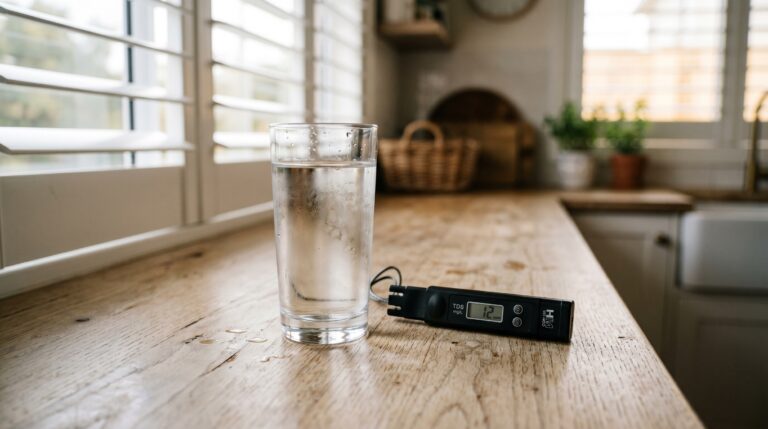
A TDS meter will NOT tell you if your shower filter is working. TDS meters measure dissolved mineral content, not disinfectant residual. Chloramine at 1.5 mg/L contributes negligibly to TDS. Your TDS reading before and after a shower filter will be virtually identical. DPD is the correct test.
5-Year Cost Comparison: Shower Filter Running Costs
The upfront cost of a shower filter is $30-80. The ongoing cost is cartridge replacements. Here is what you will actually spend over 5 years, because the purchase price is not the real price.
| Filter Type | Upfront Cost | Cartridge Cost | Cartridges/Year | Annual Filter Cost | 5-Year Total |
|---|---|---|---|---|---|
| Vitamin C (e.g. Sonaki) | $45-65 | $15-25 | 4-6 | $60-150 | $345-815 |
| Catalytic carbon (drinking tap / whole-house) | $50-80 | $25-40 | 1-2 | $25-80 | $175-480 |
| KDF-55 (free chlorine only) | $30-60 | $15-25 | 2 | $30-50 | $180-310 |
For the shower itself, vitamin C is the option to buy in a chloramine city: it neutralises chloramine by rapid chemical reaction at shower flow, where contact-dependent media fall short. Catalytic carbon shows a lower long-run cost, but that applies to the drinking-water tap or a whole-house system where contact time is sufficient — not to a compact shower cartridge, where its chloramine reduction is unreliable. Either way, you are looking at $35-75 per year in real ongoing cost — less than a single visit to a dermatologist for the dry skin, eczema, or irritation that chloramine exposure exacerbates.
Frame it another way: $0.10 to $0.20 per day for every shower in your household. That is the cost of not absorbing chloramine through your skin.
Our Top-Rated Shower Filters for Chloramine
Common Mistakes When Buying a Shower Filter in Australia
I see the same errors repeated across forums, Facebook groups, and product reviews. Here are the five most expensive mistakes.
Mistake 1: Buying a KDF-55 filter in a chloramine city. This is the big one. If you are in Brisbane, Sydney, Adelaide, Gold Coast, or Darwin and you bought a Sprite, AquaBliss, or generic KDF-55 shower filter, it is not addressing chloramine. It might reduce trace heavy metals and some sediment, but your primary irritant — chloramine — passes straight through.
Mistake 2: Expecting a shower filter to remove fluoride. Carbon filters — including catalytic carbon — cannot remove fluoride. No shower filter can. Fluoride removal requires reverse osmosis or activated alumina, and those technologies are used at the drinking water point, not in the shower. Dermal fluoride absorption is negligible, so a shower filter for fluoride is solving a problem that does not exist through a pathway that does not work.
Mistake 3: Using a TDS meter to test shower filter performance. A TDS-3 meter measures mineral content. Chloramine and free chlorine contribute virtually nothing to TDS. You could install the best shower filter in the world and your TDS reading will not change. Use a DPD chlorine test kit instead.
Mistake 4: Never replacing the cartridge. A depleted vitamin C cartridge is just a plastic tube. A depleted catalytic carbon cartridge provides the same filtration as an empty showerhead connector. Test with DPD every 2-3 months if using vitamin C, every 6 months if using catalytic carbon. When the post-filter reading exceeds 0.3 mg/L total chlorine, replace the cartridge.
Mistake 5: Ignoring the drinking water side. A shower filter protects your skin, hair, and lungs. It does nothing for the water you cook with, drink, or make coffee with. If you live in a chloramine city, you also need a drinking water filter rated for chloramine — that means catalytic carbon, compressed carbon block, or reverse osmosis at the kitchen tap. Best water filter for Australia 2026
What the Science Says: Measured Outcomes After Switching to a Chloramine-Removing Shower Filter
Anecdotal reports of softer skin and less brittle hair after installing a shower filter are everywhere. But what does the published evidence actually show?
Research on atopic dermatitis has examined how the chemistry of bathing water affects the skin barrier, and dermatological guidance consistently identifies chlorinated and chloraminated water as an aggravating factor for eczema-prone skin. Reducing that exposure removes one controllable irritant, which is most likely to matter for people with moderate-to-severe eczema.
Research has examined water hardness and chlorine exposure as risk factors for eczema, finding that both hard water and chlorinated water can contribute to skin barrier disruption, with the combination being particularly problematic — relevant for Adelaide (~140 mg/L CaCO₃ + chloramine) and Perth (~180 mg/L CaCO₃ + chloramine) residents who face both stressors simultaneously.
For hair, dermatological research has shown that hair fibres exposed to chlorinated water show increased surface roughness, decreased tensile strength, and reduced colour retention compared to untreated controls. While this study used free chlorine, the oxidative mechanism is shared with chloramine, and the practical outcomes — frizz, brittleness, and colour fade — are consistent with reports from chloramine-city residents.
The evidence is not ambiguous. Chloramine exposure during showering measurably damages skin and hair. Removing it measurably reduces that damage. The only question is which filter technology you use to remove it.
Final Verdict: Your Shower Is a Chemical Exposure Event
Every shower in a chloramine city is 8 to 15 minutes of hot, pressurised water delivering a chemical disinfectant to your largest organ. According to published toxicology research on percutaneous absorption, the dermal and inhalation dose from that single shower can rival what you would take in by drinking the same water. Your skin barrier degrades. Your hair weakens. Your airways absorb volatile disinfection by-products.
A vitamin C shower filter costs $0.10 to $0.20 per day and neutralises chloramine by rapid chemical reaction before it reaches your body, even at shower flow. A KDF-55 or standard GAC filter — the type in 90% of the shower filters sold on Amazon AU — does not work for chloramine and is a waste of money if you live in Brisbane, Sydney, Adelaide, Gold Coast, or Darwin.
If you take one action today: check your city’s disinfection type in the table above. If it says chloramine, buy a vitamin C shower filter (and use catalytic carbon at your drinking tap, where contact time makes it effective). If it says free chlorine, any filter works. That single decision protects your skin, your hair, and your respiratory system from the most overlooked chemical exposure in your daily routine.
Ready to filter your shower water?
For chloramine cities (Brisbane, Sydney, Adelaide, Gold Coast, Darwin), you need vitamin C or catalytic carbon. Standard carbon and KDF-55 filters are ineffective. Check your city, then choose the right technology.
Does Chlorine or Chloramine in Tap Water Cause Eczema?
The precise answer: neither chlorine nor chloramine causes eczema. Eczema is a genetic condition involving mutations in the filaggrin gene (FLG) and dysregulated immune response. What chloramine does is act as a trigger and aggravator in people who already have impaired skin barrier function — which describes almost every eczema sufferer.
The mechanism is direct chemical disruption. Chloramine is a reactive molecule that degrades the lipid bilayer of the stratum corneum — the outermost layer of skin that prevents transepidermal water loss. In healthy skin, this lipid layer regenerates quickly. In eczema-prone skin with compromised filaggrin, the barrier is already leaky. Chloramine contact during a shower or bath removes what little barrier integrity remains, increasing TEWL, activating toll-like receptor signalling, and triggering the inflammatory cascade that produces the redness, itch, and weeping associated with a flare.
The distinction between chlorine and chloramine matters practically:
- Free chlorine (used in Melbourne, Hobart, Canberra) dissipates rapidly — it leaves solution on contact with air and skin. Skin contact time with free chlorine during a shower is relatively brief. Standard activated carbon removes it effectively.
- Chloramine (Brisbane, Sydney, Adelaide, Gold Coast, Darwin) does not dissipate. It remains in solution throughout the shower, maintaining prolonged contact with skin. It is also more lipophilic than free chlorine, meaning it penetrates compromised skin more readily. Standard carbon does not remove it at shower flow rates.
The practical implication: eczema sufferers in Melbourne using standard shower filters may see some benefit (reduced free chlorine exposure). Eczema sufferers in Brisbane, Sydney, Adelaide, Gold Coast, or Darwin using the same standard carbon filter will see no benefit for the chloramine component — and those cities represent the majority of Australia’s eczema population. For those cities, vitamin C shower filter media is the reliable choice, because it neutralises chloramine by rapid chemical reaction even at shower flow rates; catalytic carbon needs the longer contact time of a whole-house or under-sink system to reduce chloramine and is unreliable inside a shower cartridge. See the full explanation of why shower water worsens eczema in Australia for the complete mechanism.
Last reviewed: June 2025 — Clean and Native
Frequently Asked Questions
Does chlorine in tap water cause eczema?
Chlorine and chloramine don’t cause eczema — eczema is genetic. But in people with existing eczema, chloramine (used in Brisbane, Sydney, Adelaide, Gold Coast, and Darwin) acts as a chemical trigger: it degrades the lipid bilayer, increases transepidermal water loss, and activates the inflammatory cascade that produces flares. Removing it with a vitamin C shower filter reduces one controllable trigger without addressing the underlying condition.
Does Brisbane tap water have chloramine or chlorine?
Brisbane and the entire SEQ Water network use chloramine (monochloramine) as the primary disinfectant, not free chlorine. According to SEQ Water’s annual water quality reports, typical chloramine residuals at the tap range from 0.5 to 2.0 mg/L. This means standard GAC and KDF-55 shower filters are ineffective for Brisbane — for the shower you need vitamin C, which neutralises chloramine at shower flow, while catalytic carbon reduces chloramine only at the drinking tap or whole house where contact time is sufficient.
Do shower filters remove chloramine?
At shower flow rates, vitamin C (ascorbic acid) is the reliable media: it neutralises chloramine by rapid chemical reaction, so the fraction-of-a-second contact time inside a shower cartridge is enough. Catalytic carbon does reduce chloramine, but only where contact time is long enough — whole-house tanks and under-sink cartridges — not in a compact shower cartridge. Standard granular activated carbon removes chloramine at roughly 1/40th the rate of free chlorine, and KDF-55 has no certified claim for chloramine reduction. Check your city’s disinfectant before purchasing.
Can a shower filter remove fluoride from water?
No. No shower filter removes fluoride. Fluoride removal requires reverse osmosis (90-97% removal) or activated alumina (80-95% removal), both of which are used at the drinking water point. Dermal absorption of fluoride through intact skin during showering is negligible according to toxicological data.
Does Melbourne use chloramine or free chlorine?
Melbourne Water uses free chlorine as the primary disinfectant, not chloramine. Melbourne tap water is also very soft at approximately 25 mg/L CaCO₃ with TDS around 60 mg/L. Any shower filter technology — KDF-55, GAC, or vitamin C — works effectively for free chlorine removal in Melbourne.
How often should I replace my shower filter cartridge?
Vitamin C shower cartridges in a chloramine city typically last 2-3 months for a household of two. KDF-55 shower cartridges (free chlorine cities only) last 6-8 months. Catalytic carbon cartridges last 6-12 months but belong at the drinking tap or whole house, where contact time lets them reduce chloramine. Test with a DPD chlorine test kit — when post-filter total chlorine reads above 0.3 mg/L, the cartridge needs replacing.
Will a shower filter help with eczema or dry skin?
Published research supports it. A 2005 randomised controlled trial by Parvez et al. in the Journal of the American Academy of Dermatology found that children with atopic dermatitis showed statistically significant improvement in SCORAD scores when bathing in dechlorinated water. Chloramine strips the skin’s lipid barrier, increasing transepidermal water loss — removing it reduces that damage.
Can I use a TDS meter to test if my shower filter works?
No. A TDS meter measures dissolved mineral content, not chlorine or chloramine. Chloramine at typical Australian tap concentrations (0.5-2.0 mg/L) contributes negligibly to TDS. Your reading before and after the filter will be virtually identical. Use a DPD (N,N-diethyl-p-phenylenediamine) chlorine test kit instead — available at Bunnings for $10-15.
Is shower water chloramine exposure really worse than drinking water exposure?
Toxicology research on percutaneous absorption of chlorinated disinfection by-products has found that dermal absorption and inhalation during a hot shower can account for a large share of total daily exposure, comparable to drinking the same water. Hot water opens pores and generates aerosol, increasing both transdermal and respiratory uptake.
The Chloramine Problem Most Shower Filters Ignore
Most shower filter marketing was written for the American market, where free chlorine is the dominant disinfectant. In Australia, the five largest cities have moved to chloramine — a compound formed by reacting chlorine with ammonia — because it is more stable over long distribution networks and produces fewer trihalomethane byproducts under the Australian Drinking Water Guidelines (ADWG 6.4). The NHMRC’s ADWG specifies chloramine as a compliant disinfection method for Australian supplies, and SEQ Water, Sydney Water, SA Water, Water Corporation WA, and Power and Water NT all use it.
The chemistry matters here. Chloramine is a much more stable molecule than free chlorine. Standard granular activated carbon (GAC) — the media in most shower filter cartridges sold at Bunnings, Chemist Warehouse, and Amazon AU — removes free chlorine through adsorption at a rate roughly 40 times faster than it removes chloramine. In practical terms: a GAC cartridge rated for 10,000 litres of free chlorine removal is effectively rated for around 250 litres of chloramine removal at the same contact time and flow rate. At typical Australian shower flow rates of 6-9 litres per minute, that cartridge is exhausted in under an hour of cumulative shower time. You are showering in unfiltered chloramine within a few weeks of installing it.
KDF-55 — the copper-zinc alloy media frequently combined with GAC in budget shower filters — works via an electrochemical redox reaction. It is highly effective against free chlorine. Against chloramine, the chemistry simply does not work at shower water temperatures. The nitrogen-chlorine bond in chloramine does not break under the same redox conditions. If the label on your shower filter lists KDF-55 as the primary active media and your city uses chloramine, that filter is not doing what you bought it to do.
What Chloramine Actually Does to Skin and Hair
Your skin barrier is a lipid matrix — ceramides, fatty acids, and cholesterol arranged in a lamellar structure that keeps moisture in and irritants out. Chloramine is an oxidising agent. Every shower exposes this barrier to a low-concentration oxidising wash. Over weeks and months, this degrades ceramide content, disrupts the acid mantle (the slightly acidic pH layer that keeps the microbiome stable), and increases transepidermal water loss (TEWL). The result is skin that feels tight after showering, patches of dryness that do not resolve with moisturiser alone, and a reactive scalp.
Hair protein — specifically the disulphide bonds in keratin — is also vulnerable to oxidative damage. Chloramine breaks these bonds at a slower rate than bleach, but cumulative daily exposure produces measurable effects: reduced tensile strength, increased porosity, colour fade in dyed hair, and that rough, straw-like texture that does not respond to conditioner. Research on swimmers exposed to chlorinated pool water has reported reductions in hair tensile strength compared to non-swimmers — and pool chlorine concentrations are typically lower than the chloramine concentrations in some Australian tap water systems.
The hard water interaction compounds this. Brisbane tap water runs at 80-120 mg/L CaCO₃ and TDS of approximately 80-115 mg/L. Adelaide reaches 140 mg/L CaCO₃ (hard, TDS ~400 mg/L). Perth is harder still at approximately 180 mg/L CaCO₃. Calcium and magnesium ions in hard water bind to hair cuticles, creating a mineral deposit that reduces shine and increases friction. Combined with oxidative damage from chloramine, you get a compound effect: the barrier is compromised AND the surface is coated in minerals. Neither a conditioner nor a filter alone fully addresses both — but removing the chloramine load eliminates the ongoing oxidative damage, which is the more significant of the two factors.
Filter Technologies That Actually Work Against Chloramine
For a shower filter specifically, vitamin C (ascorbic acid) is the media validated to remove chloramine at shower flow, because it works by rapid chemical reaction rather than contact-dependent adsorption. Catalytic carbon also reduces chloramine, but only where contact time is sufficient — whole-house tanks or under-sink cartridges — so it belongs at the drinking tap or the main line rather than inside a compact shower cartridge.
Catalytic carbon is activated carbon that has been treated at high temperature to alter its surface chemistry. The catalytic surface facilitates the breakdown of chloramine through an oxidative-reductive catalytic reaction — the carbon acts as a catalyst that splits the nitrogen-chlorine bond, releasing nitrogen gas and converting the chlorine to a harmless compound. Catalytic carbon also removes free chlorine, VOCs, and some chlorination byproducts. It is a passive medium that does not alter water pH. Because catalytic carbon depends on contact time, it performs best where water dwells in a large media bed — a whole-house system or a benchtop or under-sink drinking-water filter — rather than in a fast-flowing shower cartridge. The Tappwater EcoPro benchtop filter uses catalytic carbon media and is a well-specified drinking-water option through Amazon AU for chloramine cities; treat it as the answer for the water you drink and cook with, not as a shower filter.
Vitamin C (ascorbic acid or sodium ascorbate) works by a direct chemical reduction reaction. Ascorbic acid reacts stoichiometrically with both chloramine and free chlorine: one molecule of ascorbic acid neutralises one molecule of chloramine on contact. The reaction is essentially instantaneous, which makes it highly effective at shower flow rates where contact time with carbon media can be insufficient. The limitation is that vitamin C cartridges have a finite capacity by mass — a standard 100g ascorbic acid cartridge typically provides around 1,500-3,000 litres of treatment depending on your incoming chloramine concentration, which at Brisbane or Sydney concentrations is roughly two to four months of daily showering. Cartridges need replacement more frequently than catalytic carbon, but the chemistry is unambiguous and the cost per litre is well understood.
Certifications and Australian standards: The relevant Australian certification for water treatment devices is WaterMark (AS/NZS 3718 for tap fittings, AS/NZS 4020 for products in contact with drinking water). WaterMark certification validates that the device is safe for contact with potable water — it does not independently validate chloramine removal efficiency. For performance claims, look for NSF/ANSI 177 (shower filtration systems — free chlorine reduction) as a minimum, but note that NSF 177 tests against free chlorine, not chloramine. There is currently no published NSF standard specifically for chloramine removal in shower filters, which means the onus is on the manufacturer to publish independent third-party test data using chloraminated feed water at realistic concentrations. If a manufacturer only cites NSF 177, their test data may not reflect chloramine removal performance.
Filters for Australian Chloramine Conditions
Cost, Lifespan, and ROI: What Australian Households Actually Spend
Shower filters range from under $40 to over $200 at retail in Australia. The upfront price is almost irrelevant — the ongoing cartridge replacement cost is the number that determines whether you are actually getting filtration value.
Here is what the real costs look like across the main filter types, based on manufacturer-published cartridge replacement intervals and current Australian retail pricing. Assumptions: one standard Australian household, two adults, averaging approximately 15 litres per shower per person per day (Water Efficiency Labelling and Standards [WELS] benchmark for 3-star showerheads), seven showers per day total, giving roughly 105 litres per day or approximately 38,000 litres per year.
Annual Shower Filter Cartridge Cost — Australian Households (2026 AUD)
The whole-house perspective deserves a separate note. A point-of-use shower filter addresses the shower only. If you are also concerned about chloramine when washing your face at the sink, filling a bath, or using the laundry, a whole-house catalytic carbon filtration system installed on the main water line covers every fixture. These systems cost $800-$3,500 installed (depending on tank size and media specification) and have annual running costs of $40-$80 for media maintenance. The payback calculation changes significantly depending on whether you have skin conditions affecting multiple family members or a single adult using one shower. For most renters and single-bathroom households, a point-of-use shower filter at $40-$200 is the practical starting point.
One overlooked ROI factor: dermatological product spending. Australian households with eczema, psoriasis, or seborrhoeic dermatitis spend on average hundreds of dollars annually on prescription and over-the-counter treatments. If the root-cause driver is daily chloramine exposure disrupting the skin barrier, removing that exposure has an asymmetric payoff. A $150 shower filter with $130/year cartridge costs is a $280 first-year investment against ongoing dermatological spending that often exceeds that in a single month of prescription topicals. I am a former Navy Clearance Diver, not a dermatologist — but I know how to read a cost-benefit structure.
City-by-City: Which Filter You Need Based on Your Water Supply
This is the section most Australian shower filter guides skip entirely. The answer changes based on your postcode — not just your preference.
| City / Region | Disinfectant | Hardness (CaCO₃) | Recommended Filter Media | Avoid |
|---|---|---|---|---|
| Brisbane / SEQ | Chloramine | 80-120 mg/L (moderate) | Vitamin C (shower); catalytic carbon at drinking tap | KDF-55, Standard GAC |
| Sydney / Greater NSW | Chloramine | ~60-80 mg/L (soft-moderate) | Vitamin C (shower); catalytic carbon at drinking tap | KDF-55, Standard GAC |
| Adelaide | Chloramine | ~140 mg/L (hard, TDS ~400) | Vitamin C (shower); catalytic carbon + mineral stage at drinking tap | KDF-55, Standard GAC |
| Perth | Free chlorine | ~180 mg/L (very hard) | Any type; add KDF-85/mineral stage for hardness | None — all disinfectant filters work |
| Darwin | Chloramine | Variable (wet/dry season) | Vitamin C (shower); catalytic carbon at drinking tap | KDF-55, Standard GAC |
| Melbourne | Free Chlorine | ~25 mg/L (very soft, TDS ~60) | KDF-55, Standard GAC, Catalytic carbon | None — all types work |
| Hobart / Canberra | Free Chlorine | Low-moderate | KDF-55, Standard GAC, Catalytic carbon | None — all types work |
| Townsville / Cairns | Free Chlorine | Moderate (tropical hardness) | KDF-55, Standard GAC, Catalytic carbon | None — all types work |
Perth households face a compounding problem: the hardest tap water in Australia at approximately 180 mg/L CaCO₃ combined with a free chlorine residual. Residents in Kwinana, Rockingham, and Mandurah on the southern distribution network often see the worst of these parameters. Free chlorine is removed effectively by any standard KDF-55, GAC, or catalytic carbon filter, so for Perth the priority is hardness: a shower filter that adds a polyphosphate or KDF-85 stage (for iron and hardness scale) delivers better outcomes than a carbon-only unit. KDF-85 performs differently from KDF-55 and targets different contaminants, so do not conflate the two.
Adelaide deserves special attention because its TDS of approximately 400 mg/L is the highest of any Australian capital. That TDS includes chloramine, hardness minerals, sulfates, and other dissolved solids. Residents in the northern suburbs of Salisbury and Elizabeth, which sit further along the distribution network from the Morgan-Whyalla supply, sometimes see chloramine concentrations at the higher end of SA Water’s reported range. A vitamin C shower filter is the reliable choice here for the shower, since it neutralises chloramine at shower flow; a whole-house catalytic carbon system, where contact time is sufficient, addresses all fixtures and is worth considering for households with multiple people reporting skin or hair issues.
What “Certified” Actually Means on Australian Shower Filter Packaging
The word “certified” on Australian shower filter packaging is doing a lot of work. Understanding what each certification actually validates — and what it does not — stops you from paying a premium for credentials that do not match your specific water chemistry problem.
WaterMark (SAI Global / JAS-ANZ): WaterMark certification under AS/NZS 3718 (water supply — tap fittings) or AS/NZS 4020 (testing of products for use in contact with drinking water) confirms that the physical device is safe for potable water contact and will not leach contaminants into the water. It does NOT validate filtration performance. A WaterMark-certified shower filter may have zero actual contaminant removal capability — it just will not poison you with plasticisers or heavy metals leaching from the filter housing. WaterMark is a safety baseline, not a performance endorsement.
NSF/ANSI 177 (Shower Filtration Systems — Aesthetic Effects): This is the main performance standard cited on shower filters. NSF 177 tests for free chlorine reduction of at least 50% at rated flow and rated capacity. The critical limitation for Australian buyers: NSF 177 tests against free chlorine, not chloramine. A filter that passes NSF 177 with flying colours may perform negligibly against chloramine because the test protocol does not include it. If the manufacturer claims “NSF 177 certified” and your city uses chloramine, ask specifically for their independent test data against chloraminated feed water. If they cannot provide it, treat the certification as irrelevant to your actual water chemistry.
NSF/ANSI 42 (Aesthetic Effects — Drinking Water): Some shower filter manufacturers reference NSF 42, which is designed for drinking water treatment systems. NSF 42 tests for chlorine taste and odour reduction using carbon-based media at 0.5 mg/L free chlorine in a controlled laboratory setup. Again — free chlorine, not chloramine. The standard is more rigorous than NSF 177 and the laboratory methodology is more reproducible, but the same fundamental gap applies for chloramine cities.
The honest answer is that there is currently no published NSF or AS/NZS standard that specifically validates shower filter performance against chloramine under real-world Australian conditions. This is a gap in the standards landscape, not a niche problem — given that five of Australia’s eight capital cities use chloramine, it represents the majority of Australian shower filter buyers. Until that standard exists, the most useful credential is independently commissioned third-party testing (not self-tested) using synthetic water dosed with chloramine at the concentration range specified in ADWG 6.4, at Australian shower flow rates of 6-9 L/min and water temperatures of 38-42°C.
The EMF and “Energised Water” Claims: What the Evidence Says
Some shower filters sold in Australia include claims about “energising” or “restructuring” water, far-infrared ceramic balls, tourmaline stones, or bioceramic media that allegedly alter the molecular structure of water to improve absorption and skin hydration. These claims do not have a plausible physical mechanism and are not supported by peer-reviewed evidence.
Water’s molecular structure at ambient temperature and pressure is not altered by passing over ceramic beads in the timeframe of a shower. The hydrogen bonding network in liquid water restructures itself on a femtosecond timescale — faster than any contact with a ceramic surface could maintain any alleged structural change. The bioceramic and tourmaline claims derive from a class of marketing that originated in Japanese cosmetic water devices in the 1990s and has never been validated under controlled experimental conditions that distinguish the effect of these media from a simple placebo.
Similarly, “negative ion generation” claims in shower filters warrant scepticism. While negative air ions have some evidence base for mood effects in high-concentration ionised air environments (as reported in a 2013 meta-analysis of air ions and mood), the mechanism does not translate to ionisation effects from water contact in a shower context. ARPANSA does not recognise any health guidance threshold for “negative ions” in water because the mechanism is not established.
The reason this matters for purchasing decisions: shower filters that dedicate cartridge space to tourmaline, infrared ceramics, or “alkalising” media are typically providing less volume of the media that actually removes chloramine. You are paying for a layer that does nothing demonstrable while reducing the capacity of the layer that does. A filter that is 60% catalytic carbon and 40% bioceramic is performing worse at chloramine removal than an equivalent unit that is 100% catalytic carbon. Focus on the chemistry that has a validated mechanism: catalytic carbon and ascorbic acid.
Last reviewed: May 2026 — Clean and Native
Ready to match the right filter to your city’s water?
The Tappwater EcoPro is a benchtop catalytic carbon filter — the right technology for chloramine in the water you drink and cook with in Brisbane, Sydney, Adelaide, Gold Coast, and Darwin, where its longer contact time lets it reduce chloramine. For the shower itself, use a vitamin C filter, which neutralises chloramine at shower flow. Available via Amazon AU with no plumbing required.
Get the Australian Home Environment Checklist
30 checks across water, air and EMF. Most of them free. Ranked by impact.
No spam. Unsubscribe any time.

Former Royal Australian Navy Clearance Diver and TAG-E counter-terrorism operator. Founded Clean and Native to apply the same rigorous thinking to the home environment.
Full biography →