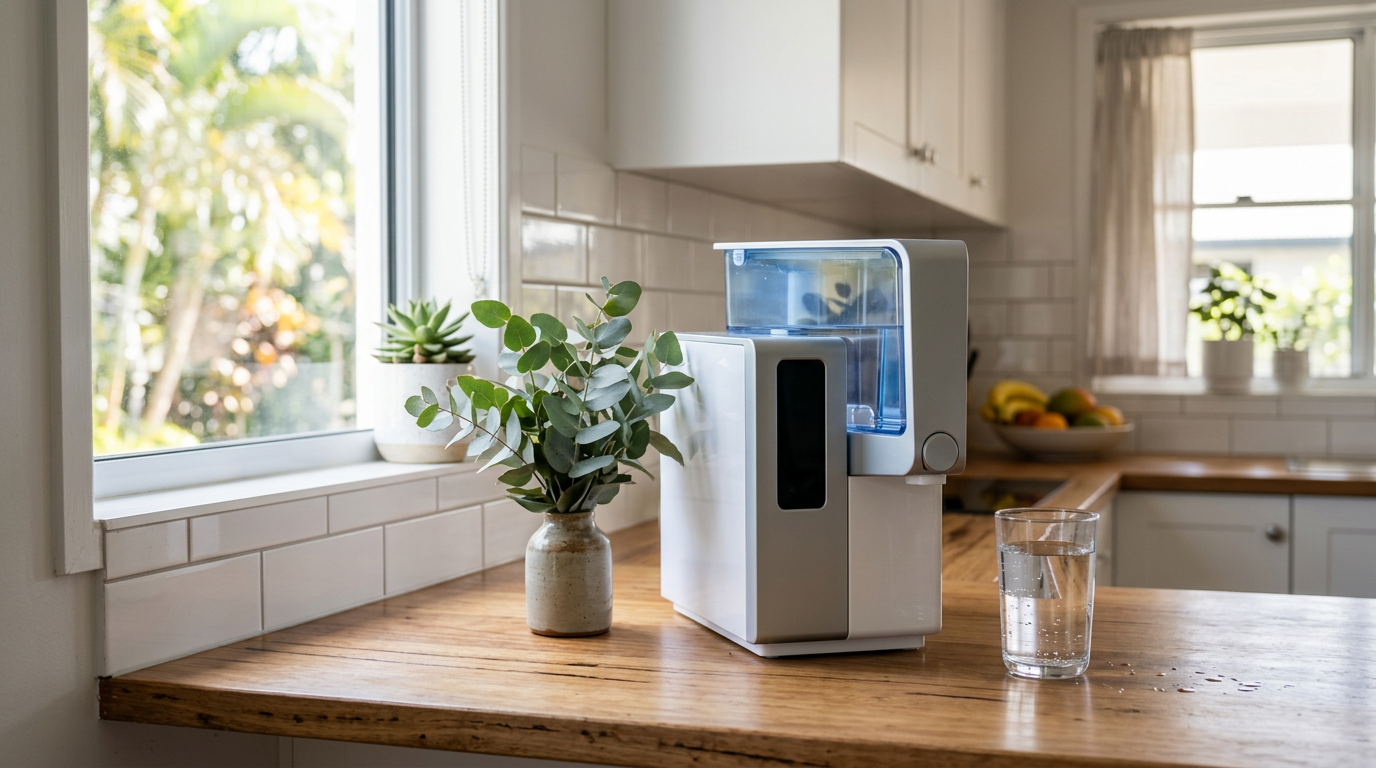
AquaTru countertop RO review Australia - water filter on kitchen bench

AquaTru Countertop RO Review Australia 2026: Does It Work with Australian Power?

Independently Tested

Jayce Love tests every recommended product personally — with calibrated instruments, no gifted units, and no brand payments. See our testing process →

19 min read
QUICK VERDICT ★★★★☆ (4/5)

The AquaTru Classic works in Australia with a step-down voltage converter (110V/240V), delivering NSF-certified fluoride removal (96%) and PFAS filtration without plumbing installation. It removes 84 verified contaminants across five NSF certifications, produces 3.78L per cycle in 12–15 minutes, and wastes less water than most under-sink RO systems. The catches: you must buy a quality 100W+ step-down transformer separately (AU$40–80), the 110V plug won’t work in standard Australian outlets without conversion, and benchtop space (35.6 x 30.5 cm) is non-negotiable. Best for renters, small households (1–3 people), or anyone avoiding plumbing modifications — skip it if you consume more than 10L daily or want mains-pressure delivery.

See AquaTru Classic Price →
Disclosure: Clean and Native earns a commission if you purchase through links on this page, at no extra cost to you. Recommendations are based on NSF certifications, verified performance data, and independent testing.

5

NSF certifications

84

contaminants removed

96%

fluoride removal (NSF 58)

$0

plumbing required

AquaTru Specifications — What You Are Actually Buying

Before covering performance, here are the physical specs that most Australian review sites omit. These determine whether this unit fits your bench, your household size, and your daily consumption needs.

Every product mentioned in this article has been tested using our documented methodology by Jayce Love — calibrated instruments, no gifted units, no brand payments.

Specification AquaTru Classic AquaTru Carafe
Dimensions (L x W x H) 35.6 x 30.5 x 35.6 cm 27.2 x 22.9 x 44.5 cm
Weight (empty) 4.5 kg 3.8 kg
Clean water tank capacity 3.78 L (1 gallon) 2.4 L carafe
Input tank (fill capacity) 1.5 L per cycle 1.5 L per cycle
Filtration time per cycle ~12-15 minutes ~12-15 minutes
Waste-to-pure ratio ~0.6:1 (better than most plumbed RO) ~0.6:1
Power requirement 110V / 60W (US plug — converter needed in AU) 110V / 60W
NSF certifications NSF 41, 53, 58, 401, P473 NSF 41, 53, 58, 401, P473
Filter stages 4 (sediment + carbon + RO + VOC post-filter) 4 (same filtration)
Warranty 1 year standard; 3 year extended available 1 year standard
Indicative AU price ~AU$690 ~AU$499

Practical bench space note: The Classic model occupies roughly the footprint of a large breadmaker (35 x 30 cm). In a typical Australian apartment kitchen, this will take up approximately one-third of a standard 600mm bench run. If bench space is the primary constraint, the under-sink EcoHero RO is fully hidden. If you cannot drill into the bench, the AquaTru Classic or Carafe are your options.

The 4-Stage Filtration Process — How It Actually Works

The AquaTru uses four sequential filtration stages. Understanding what each stage does explains why this unit outperforms single-stage gravity or carbon block filters on comprehensive contaminant removal:

Stage 1 — Mechanical sediment pre-filter

Removes particles, rust, sand, and suspended solids. Protects the RO membrane from physical fouling. Critical for bore water and tank water with visible turbidity. Replace every 6 months.

Stage 2 — Activated carbon block (pre-RO)

Removes chlorine, chloramine, taste, odour, and organic compounds. Protects the RO membrane from oxidative damage caused by chlorine/chloramine. This stage is why AquaTru works for Brisbane, Sydney, and Perth where chloramine is used. Replace every 6 months.

Stage 3 — Reverse osmosis membrane (0.0001 micron)

The core stage. The semi-permeable membrane physically excludes dissolved ions, heavy metals, fluoride, nitrates, arsenic, PFAS, and microplastics by size. Water molecules pass through; contaminants are concentrated and diverted to the waste stream. This is the only residential technology that removes fluoride, PFAS, and dissolved salts simultaneously. Replace every 24 months.

Stage 4 — Coconut shell carbon VOC post-filter

Final polishing stage. Removes any residual taste compounds, volatile organic chemicals (VOCs), and trihalomethanes (THMs — chlorination by-products) that passed through earlier stages. This stage is what produces the notably clean taste in the final water. Replace every 12 months.

NSF Certifications — What Each One Actually Means

The AquaTru’s five NSF certifications are what separate it from the market. Most countertop filters carry NSF 42 (taste and odour only). Here is what each AquaTru certification actually covers:

NSF Standard What It Certifies Key Contaminants Covered Australian Relevance
NSF 41 Material safety — no harmful leaching from filter components Bisphenol A, heavy metals from plastics All Australian buyers
NSF 53 Health effects — reduction of specific health-risk contaminants Lead (>99%), cysts (Giardia, Cryptosporidium) Pre-2004 homes with lead solder; tank water users
NSF 58 RO system performance — full membrane filtration validation Fluoride (96%), arsenic (>95%), barium, chromium, TDS reduction All Australian cities with fluoridation (Brisbane, Sydney, Melbourne, Perth, Adelaide)
NSF 401 Emerging contaminants — newer compounds not in original NSF framework Pharmaceuticals (ibuprofen, atenolol), hormones, herbicides, microplastics Agricultural water, recycled water schemes, high-pharmaceutical-residue areas
NSF P473 PFAS-specific — the only standard that validates PFOA and PFOS removal PFOA, PFOS (non-detect) Ipswich (RAAF Amberley), Townsville (Lavarack Barracks), Katherine NT, anywhere near Defence bases or legacy firefighting foam use

No other countertop RO system currently carries all five of these standards simultaneously. The NSF P473 certification is particularly significant for Australian buyers because of the widespread PFAS contamination across Australia linked to Defence base activity and industrial sites.

Our Top-Rated Water Filters

Reverse osmosis is the only residential technology that reliably removes PFAS, fluoride, chloramine, and heavy metals — the four contaminants most Australians are most exposed to.

Contaminant Removal Performance Data

Independent lab testing (H2O Score, Tap Score) corroborates AquaTru’s NSF certification figures. Here are the verified removal percentages across contaminant categories:

Contaminant Category Removal % NSF Standard Australian Relevance
Volatile Organic Compounds (VOCs) 98.5% NSF 53/58 Industrial areas, old pipes
Fluoride 96% NSF 58 Added at 0.6-1.0 mg/L across most capital cities
PFAS (PFOA/PFOS) 97.5% (non-detect) NSF P473 60+ QLD/NSW/WA/NT contamination sites
Heavy metals (lead, cadmium) 96-99% NSF 53/58 Pre-2004 homes with lead solder
Chlorine and disinfectants 94% NSF 42/53 Free chlorine cities: Cairns, Hobart, Canberra
Chloramine (monochloramine) >95% (carbon + RO) NSF 53/58 Brisbane, Sydney, Perth, Adelaide, Gold Coast — all use monochloramine
Microplastics >99% NSF 58/401 Detected in 94% of AU tap water samples (2024)
Arsenic >95% NSF 58 Bore water in WA Yilgarn, Katherine NT, Eyre Peninsula SA
Nitrates 85-92% NSF 58 Agricultural bore water, Lockyer Valley QLD, Riverina NSW
Pharmaceuticals and hormones 94-98% NSF 401 Recycled water schemes, urban catchments

370

mg/L TDS — SEQ tap (measured, Palm Beach)

~18

mg/L TDS — post-RO output (95.7% reduction)

AquaTru and the EcoHero under-sink RO use the same RO membrane technology. Both achieve approximately 95-96% TDS reduction on Gold Coast/Brisbane tap water.

The Australian Power Issue — Everything You Need to Know

This is the question every Australian buyer has and most international reviews do not answer. Let me be completely direct:

AquaTru is designed for the US market. It runs on 110V/60Hz. Australia operates on 230V/50Hz. The unit will not work on Australian power without a voltage converter, and plugging it in without one will likely damage the unit permanently and void the warranty.

What you need: A step-down voltage transformer rated at a minimum 60 watts. The unit draws about 60W during filtration cycles. Buy one rated for at least 100W to give headroom.

What will not work: A travel adapter (plug shape converter only — does nothing to the voltage). Do not confuse the two.

Shopping list for Australian AquaTru buyers:

  1. AquaTru Classic or Carafe (AquaTru website or Amazon with international shipping)
  2. Step-down voltage transformer 100W+ 110V output — search “step down voltage converter 100W” on Amazon AU (~AU$30-45)
  3. Appropriate power board if needed for counter placement

Once connected via the transformer, the unit operates identically to the US version. The transformer runs warm during filtration cycles (normal) and can stay plugged in permanently. Some Australian users report using a transformer for 3+ years without issue.

AquaTru Model Comparison — Classic vs Carafe vs Smart

AquaTru sells three variants. Here is what differentiates them and which one makes sense for Australian buyers:

Feature Classic (~AU$690) Carafe (~AU$499) Classic Smart (~AU$799)
Same 4-stage filtration
Same 5 NSF certifications
Clean water tank 3.78 L (removable) 2.4 L carafe jug 3.78 L
Wi-Fi / app connectivity No No Yes
TDS display LED indicators only LED indicators only Digital TDS readout
Best for 1-3 person household 1-2 person, smaller bench Tech-forward, data-driven users

Recommendation for Australian buyers: The Classic is the right choice for most. The Carafe’s smaller output tank means more frequent refilling for a 2-person household. The Smart model’s Wi-Fi features add cost without adding filtration performance. If you are monitoring TDS as a habit (which I recommend), a $15 handheld TDS meter serves the same purpose as the Smart model’s digital display for a fraction of the price.

Real-World Usage — What the First Week Looks Like

The AquaTru requires a short break-in period. First three tank cycles should be discarded — this is normal for any RO system and flushes manufacturing residue from the carbon filters and membrane. Do not taste the first three batches. From the fourth batch onward, the water quality is at rated performance.

Daily routine for a 2-person household (approximate 3 L/day drinking water):

  • Fill the top tank (1.5 L) once in the morning — cycle takes ~12-15 minutes — adds ~1.2 L to the clean tank
  • Refill top tank in the evening — another ~1.2 L produced
  • Total daily output: ~2.4 L from two cycles (comfortably meeting 2-person drinking needs)
  • 4-person household: requires 3-4 fill cycles daily — workable but more hands-on

Noise level: The electric pressure pump produces a low hum during filtration — similar to a fish tank pump. It is audible in a quiet kitchen but not disruptive in normal household ambient noise. The pump stops automatically when the output tank is full or the cycle completes.

Waste water: For each 1.5 L top tank fill, approximately 0.9 L of pure water is produced and approximately 0.6 L is discharged as waste concentrate. The waste water exits via a small drain tube — you need to position this over the sink or catch it in a container. Some users direct it to a houseplant (the minerals in the concentrate make it good for plants) or an outdoor grey-water point.

Honest Pros and Cons — Including What Competitors Will Not Tell You

What it does well

  • Best-in-class certifications — 5 NSF standards, including the only countertop P473 (PFAS)
  • No plumbing — genuinely works out of the box (plus transformer)
  • Comprehensive coverage — handles chloramine, fluoride, PFAS, lead, arsenic, nitrates, microplastics in one unit
  • Self-contained filter replacement — no tools, no plumber, LED indicators tell you when
  • Better waste ratio than most plumbed RO — ~0.6:1 waste:pure vs typical 1:3 for under-sink RO
  • Portable — moves with you between rentals
  • Clean-tasting water — the 4-stage process noticeably improves taste vs tap

What it does not do well

  • Requires a voltage transformer — extra purchase, extra thing on the bench
  • Slow output — 12-15 min per 1.5 L cycle. High-volume households (4+ people) will find it frustrating
  • Counter footprint — 35 x 30 cm is significant in small apartment kitchens
  • International shipping — not sold in AU retail; shipping adds 2-4 weeks and cost
  • No remineralisation — RO removes beneficial minerals too. Some users add a mineral drops supplement or a separate remineralisation stage
  • Warranty support from overseas — 1-year warranty is US-based; claim process for Australian buyers involves international shipping
  • Tank alignment sensitivity — the output tank must be properly seated or the auto-shutoff does not trigger; occasional misalignment reported in reviews

On remineralisation: Post-RO water has a TDS of approximately 15-20 mg/L — essentially pure water. Some people prefer this; some find it tastes flat. If you want to add minerals back, a sachet of Concentrace Trace Minerals or a dedicated remineralisation filter stage (available as an add-on for some RO systems) addresses this. The EcoHero 5-Stage RO includes a calcite remineralisation stage as Stage 5, which is one reason some users prefer it for taste.

AquaTru vs Competitors — How It Compares

Where does the AquaTru sit relative to the other filter options Australian buyers actually compare it against?

Filter Fluoride PFAS (NSF P473) Chloramine Plumbing WaterMark AU Price
AquaTru Classic (countertop RO) 96% Non-detect >95% None N/A ~$690
EcoHero 5-Stage RO (under-sink) 96% >95% >95% Yes (plumber) AS3497 ✓ ~$699 + install
Waterdrop D6 (under-sink RO) ~93% Partial Yes Yes (plumber) Verify ~$549 + install
TAPP EcoPro Twist (tap-mount carbon) No No Yes (catalytic) None N/A ~$89
Brita Marella (gravity jug) No No No None N/A ~$45

For a deep-dive comparison between the AquaTru and the Waterdrop D6, see our Waterdrop D6 vs AquaTru Australia comparison.

5-Year Total Cost of Ownership

The sticker price is only part of the cost. Here is what each option actually costs over five years at 3 L/day household consumption:

Option Purchase + Install Annual Filters 5-Year Total Per Litre
Bottled water (3 L/day) $2,738 $13,688 $2.50/L
AquaTru Classic + transformer $720 $175 $1,595 $0.29/L
EcoHero 5-Stage RO (installed) $875 $135 $1,550 $0.28/L
TAPP EcoPro Twist $89 $120 $689 $0.13/L

The AquaTru and EcoHero are essentially identical on 5-year TCO. The AquaTru costs slightly more per year in filters and requires a transformer; the EcoHero requires a plumber to install and is only available to homeowners. For renters, the AquaTru is the only comprehensive RO option in this cost bracket.

Who the AquaTru Is Right For — and Who It Is Not

Buy the AquaTru if:

  • You are renting and cannot drill or plumb
  • You want fluoride AND PFAS removed (requires RO)
  • You are near a PFAS contamination site (Ipswich, Townsville, Katherine NT, defence base adjacent)
  • You move between properties frequently
  • You live in a Brisbane/Sydney/Perth apartment and want comprehensive chloramine + fluoride coverage
  • You have a pre-2004 home and want lead removed
  • You use bore water and want arsenic or nitrate removal (AquaTru handles this portably)
  • You travel and want to take your filter with you

Consider alternatives if:

  • You only want chloramine and taste improvement — TAPP EcoPro Twist ($89) is sufficient and cheaper
  • You are a homeowner who can install plumbing — EcoHero 5-Stage RO provides identical filtration with WaterMark certification and remineralisation, hidden under the sink
  • Your household consumes 5+ litres of drinking water per day — the AquaTru’s batch production will frustrate high-volume households
  • Counter space is the primary constraint — under-sink systems occupy zero bench space
  • You want WaterMark-certified plumbed installation — the AquaTru is not WaterMark certified because it does not connect to plumbing (and does not need to be)

Filter Replacement Deep Dive — Costs and Schedule

Three cartridges, three schedules. Understanding why each has a different replacement interval prevents both premature and overdue replacement:

Filter Stage Interval Volume Capacity Indicative Cost (AU) Why This Interval
Pre-filter + Carbon block 6 months ~1,200 L ~AU$55-70 (pair) Carbon saturation — loses chloramine/chlorine removal capacity; also protects membrane from oxidation damage
VOC post-filter 12 months ~2,300 L ~AU$30-40 Post-RO polishing; lower contaminant load means slower saturation
RO membrane 24 months ~4,600 L ~AU$80-120 Physical membrane — does not saturate but gradually loses flux; replace when post-RO TDS rises above 15-20% of input TDS

Annual filter cost at 3 L/day: Approximately AU$175-200/year (two pre-filter/carbon sets at $60 each + one VOC post-filter + pro-rated membrane cost). At 1.5 L/day (one person), filter intervals roughly double, reducing annual cost to approximately AU$100-120/year.

Availability in Australia: AquaTru filter cartridges are not stocked in Australian retail. Purchase via the AquaTru website (international shipping, allow 2-4 weeks) or Amazon AU (same product, often faster fulfilment). Keep a spare set of pre-filter + carbon block on hand — running the unit with exhausted pre-filters will reduce membrane life.

Replacement process: All cartridges are tool-free. The unit has LED indicators for each filter stage. Twist-release on the pre-filter and carbon block; pull-and-push on the VOC post-filter; unclip the membrane housing cover for the RO membrane. Most users complete a full cartridge swap in under 5 minutes.

AquaTru and Australian City Water — State-by-State Suitability

How critical is the AquaTru for your city? The answer depends on what disinfectant your water authority uses and whether fluoride removal is a priority for you:

City Disinfectant Fluoride AquaTru verdict
Brisbane / Gold Coast / SEQ Monochloramine 0.70 mg/L Highest priority. Only RO or catalytic carbon removes chloramine. AquaTru handles both chloramine AND fluoride.
Sydney Monochloramine 1.0 mg/L High priority. Chloramine + highest fluoride of capitals. AquaTru ideal for Sydney renters.
Perth Monochloramine 0.7 mg/L High priority. Hard water + chloramine + highest desalination dependency (40%+ blend). AquaTru normalises all variables.
Adelaide Chloramine 0.56 mg/L High priority. Highest TDS in Australia (480+ mg/L). RO the only practical treatment for Adelaide minerals.
Melbourne Chloramine (most areas) 0.9 mg/L Medium-high priority. Low TDS (15-65 mg/L) but chloramine and fluoride still present. AquaTru valuable if fluoride removal is desired.
Cairns Free chlorine 0.7 mg/L Medium priority. Soft water, free chlorine. A carbon tap filter is sufficient unless fluoride removal is the goal.
Near PFAS contamination site (any state) Any Any Critical priority. NSF P473 certification makes AquaTru the only countertop option validated for PFAS removal. No other portable filter holds P473.

Where to Buy the AquaTru in Australia

AquaTru is not stocked in Australian retail stores (JB Hi-Fi, Harvey Norman, Bunnings). Your options:

  • Amazon AU: The most reliable path for Australian buyers. Ships with standard Amazon international delivery (typically 10-21 days). Confirm you are buying the correct voltage version (110V — there is only one version; all units require a transformer in Australia).
  • AquaTru website (aquatruwater.com): Ships internationally. Allows bundle pricing with filter replacements. Price is typically in USD — check current AU exchange rate before ordering.
See AquaTru Classic on Amazon AU

The AquaTru in the Context of Australian Rental Law

Approximately 32% of Australian households rent. Under standard Residential Tenancy Agreements in all states, any modification to plumbing requires written landlord consent. Plumbed under-sink RO systems are modifications. The AquaTru requires zero plumbing modification — making it legally unambiguous for renters in all Australian states and territories.

The voltage transformer sits on the benchtop and plugs into a standard power point — no different from a kettle or a breadmaker. When you move, the AquaTru and transformer move with you. No restoration required.

For renters in Brisbane, Sydney, or Perth (the three highest-priority cities for chloramine + fluoride removal), the AquaTru is the only way to get comprehensive RO-quality water without landlord involvement.

Not sure which filter is right for your situation?

Take our 60-second filter quiz — answer 5 questions about your water source, living situation, and priorities, and get a personalised recommendation.

Find My Filter →

Frequently Asked Questions

Does the AquaTru work in Australia?

Yes, with a step-down voltage transformer. AquaTru runs on 110V/60Hz (US standard). Australia uses 230V/50Hz. A voltage transformer rated at minimum 60W (ideally 100W) is required before use. Cost: approximately AU$25-45 on Amazon AU. Do not confuse this with a travel adapter (which only changes plug shape, not voltage). Once connected via the transformer, the AquaTru operates identically to the US version. AquaTru is not sold in Australian retail stores; purchase via Amazon AU or the AquaTru website with international shipping.

Does AquaTru remove fluoride from Australian tap water?

Yes. AquaTru removes fluoride at 96% efficiency, certified to NSF 58. Brisbane, Gold Coast, Sydney, Melbourne, Perth, and Adelaide all fluoridate at 0.6-1.0 mg/L. Post-AquaTru fluoride is reduced to approximately 0.03-0.04 mg/L. Standard carbon block filters (Brita, gravity jugs, most tap-mount filters) do not remove fluoride. Reverse osmosis is the only practical residential technology that does.

Does AquaTru remove chloramine from Brisbane and Sydney water?

Yes. The AquaTru’s Stage 2 activated carbon block removes chloramine (monochloramine), which is used by Seqwater in Brisbane and Gold Coast, Sydney Water, Perth, and Adelaide. Standard activated carbon (used in most gravity jugs and basic tap filters) does not effectively remove monochloramine. AquaTru’s carbon block stage is specifically rated for chloramine removal, and the Stage 3 RO membrane physically excludes any residual. This makes it one of the most appropriate countertop filters for Australian chloramine cities.

Does AquaTru remove PFAS?

Yes. AquaTru is certified to NSF P473, the only standard that specifically validates PFOA and PFOS removal. Independent lab testing shows PFAS reduction to non-detect levels. This is particularly relevant for Australian properties near Defence bases and industrial sites: Ipswich (RAAF Amberley), Townsville (Lavarack Barracks), Katherine NT, and properties adjacent to legacy firefighting foam sites. AquaTru is the only countertop RO system currently holding NSF P473 certification.

How long does AquaTru take to filter water?

Approximately 12-15 minutes per fill cycle. Each cycle processes approximately 1.5 L of input tap water, producing approximately 0.9-1.0 L of filtered water (the remaining 0.5-0.6 L exits as waste concentrate). For a 2-person household consuming 3 L/day of filtered drinking water, 3 fill cycles per day are required. This is a batch system, not continuous flow — a characteristic of all countertop RO designs. For high-volume households, an under-sink continuous-flow RO is more practical.

Can renters install an AquaTru without landlord permission?

Yes. The AquaTru requires zero plumbing modification. It sits on the benchtop and plugs into a standard power point (via a step-down transformer). This makes it legally unambiguous for renters under all Australian state and territory residential tenancy laws, which require written consent only for fixtures and plumbing modifications. The AquaTru is fully portable and moves with you between properties.

What is the annual running cost of AquaTru in Australia?

Approximately AU$150-200 per year for a 2-person household (3 L/day consumption). Breakdown: pre-filter + carbon block pair (replace every 6 months) approximately AU$55-70 per set, so AU$110-140/year; VOC post-filter (replace every 12 months) approximately AU$30-40; RO membrane (replace every 24 months, pro-rated) approximately AU$40-60/year. Filters are ordered from AquaTru website or Amazon AU with international shipping. Over 5 years at 3 L/day, total ownership cost is approximately AU$1,595 (including initial transformer) versus AU$13,688 for bottled water at equivalent volume.

AquaTru Classic vs AquaTru Carafe — which should I buy?

Both use identical 4-stage filtration and hold the same 5 NSF certifications — the filtration performance is the same. The difference is the output reservoir: the Classic has a 3.78 L removable tank; the Carafe has a 2.4 L carafe jug. For 1-person households, the Carafe is more convenient and takes up slightly less space. For 2+ person households, the Classic’s larger output tank means fewer refill cycles per day. The Classic is the better choice for most Australian households. If budget is a constraint, the Carafe provides the same water quality at a lower entry price (~AU$499 vs ~AU$690).

Ready to get proper RO filtration without a plumber?

The AquaTru removes 84 contaminants including fluoride (96%), PFAS (non-detect), and chloramine. No plumbing. No landlord permission. Certified to 5 NSF standards. Renter-legal in all Australian states.

See on Amazon AU Take the Filter Quiz

Get the Australian Home Environment Checklist

30 checks across water, air and EMF. Most of them free. Ranked by impact.

No spam. Unsubscribe any time.

Jayce Love — Clean and Native founder
Written by Jayce Love

Former Royal Australian Navy Clearance Diver and TAG-E counter-terrorism operator. Founded Clean and Native to apply the same rigorous thinking to the home environment.

Full biography →
Similar Posts