Microplastics in Drinking Water Australia 2026
Microplastics and pharmaceutical residues are now confirmed contaminants in Australian tap water, and neither the ADWG nor standard carbon filters address them. The US EPA’s 2026 Contaminant Candidate List 6 (CCL 6) flags both contaminant classes for regulatory action — reverse osmosis is currently the only proven household filtration method that removes microplastics to sub-micron level and rejects pharmaceutical compounds at 90%+ rates.
What the US EPA’s CCL 6 Means for Australian Drinking Water
In April 2026, the United States Environmental Protection Agency added microplastics and pharmaceutical compounds to its Contaminant Candidate List 6 (CCL 6). If you have never heard of the CCL, here is what matters: it is the formal regulatory pipeline that precedes enforceable drinking water limits in the US. Every contaminant that eventually receives a Maximum Contaminant Level (MCL) — the legally binding standard US water utilities must meet — starts life on a CCL. PFAS went through this exact pathway before receiving its 4 parts-per-trillion MCL in 2024.
This is not an Australian regulation. But it matters to you for three reasons. First, Australian Drinking Water Guidelines (ADWG), maintained by the NHMRC, have historically followed the trajectory of US and WHO regulatory action — often with a 5–10 year lag. Second, the ADWG currently has no guideline value, no health-based target, and no monitoring requirement for microplastics or pharmaceutical residues. Third, Australian researchers have already confirmed these contaminants are present in our water supply chain.
The CCL 6 listing does not mean the US EPA has set a safe limit for microplastics or pharmaceuticals yet. It means they have gathered enough evidence to warrant formal evaluation. For Australian consumers, this is the early warning signal. The contaminants are in your water now. The regulatory response has not arrived yet. That gap is yours to fill.
Microplastics in Australian Tap Water: What the Data Shows
You are not dealing with a theoretical risk. According to NSW EPA broadscale microplastic assessment data, microplastics were detected in all 120 waterways sampled across New South Wales, at concentrations ranging from 0.02 to 34.80 particles per cubic metre. The highest concentrations were found in urban catchments — the Cooks River and Parramatta River — which feed directly into water supply chains serving millions of Sydneysiders. If you live in western Sydney suburbs like Penrith, Parramatta, or Liverpool, your source water travels through some of the most microplastic-contaminated urban waterways in the state.
CSIRO research published in the journal Science of the Total Environment has confirmed microplastic contamination in Australian drinking water sources, including surface reservoirs and treated water supplies. The particles range from visible fragments (5 mm) down to sub-micron fibres invisible to the naked eye. The most common types detected are polyethylene (PE) from packaging, polypropylene (PP) from food containers, and polyester fibres shed from synthetic clothing during washing.
Here is the problem most people miss: conventional water treatment does not target microplastics. Municipal treatment plants in Brisbane, Sydney, Melbourne, Adelaide, and Perth use coagulation, flocculation, sedimentation, and disinfection (chloramine in Brisbane, Sydney, Adelaide, Gold Coast, and Darwin; free chlorine in Melbourne, Hobart, and Canberra). These processes were designed for turbidity, pathogens, and dissolved organics. They catch some larger particles incidentally, but peer-reviewed research consistently shows microplastics smaller than 10 micrometres pass through conventional treatment. A 2019 study published in Water Research found that even advanced treatment facilities released an average of 0.7 microplastic particles per litre in treated effluent.
When SEQ Water treats your Brisbane tap water or Sydney Water treats supply for greater Sydney, neither utility is required to measure, report, or remove microplastics. The ADWG does not list them. Your water bill funds treatment for what is regulated — not what is emerging.
Pharmaceuticals in Water: The Invisible Co-Contaminant
Microplastics get the headlines. But the EPA’s CCL 6 listing also flags pharmaceutical residues — and this is the contaminant class most Australians have never considered. Every time you take a paracetamol, an antibiotic, a contraceptive pill, or an antidepressant, your body excretes a portion of the active compound. That compound enters the sewage system. Australian sewage treatment plants are not designed to fully degrade pharmaceutical molecules, and treated effluent re-enters the water cycle — either discharged into rivers and oceans or, in some regions, recycled into indirect potable reuse schemes.
Research published by the University of Queensland detected 17 pharmaceutical compounds in south-east Queensland waterways, including ibuprofen, naproxen, carbamazepine (an anticonvulsant), and sulfamethoxazole (an antibiotic). Concentrations were in the low nanograms-per-litre range — parts per trillion. That sounds tiny. But endocrine-disrupting compounds like synthetic oestrogen (ethinylestradiol, the active ingredient in most oral contraceptives) have been shown to cause biological effects in aquatic organisms at concentrations as low as 1 ng/L, according to research published in Environmental Toxicology and Chemistry.
The concern for human health is not acute toxicity from a single glass of water. It is chronic low-dose exposure over decades. You drink roughly 2–3 litres of water per day. Over 30 years, that is approximately 30,000 litres — each litre carrying a cocktail of pharmaceutical traces that your water utility is not required to test for, let alone remove. The ADWG provides no guideline value for any pharmaceutical compound in drinking water. The WHO has published a technical brief acknowledging pharmaceuticals in drinking water but has not set guideline limits either.
What makes this worse is the interaction with microplastics. Microplastic particles act as vectors for other contaminants, including pharmaceuticals, heavy metals, and persistent organic pollutants. The hydrophobic surface of microplastic particles attracts and concentrates these compounds — a process documented in peer-reviewed research from multiple Australian universities. You are not dealing with two separate problems. You are dealing with a delivery system: microplastics carry pharmaceuticals deeper into the water supply chain and potentially deeper into your body.
Why Your Carbon Filter Will Not Solve This
This is where most Australians get caught. You bought a Brita jug or a benchtop carbon filter. You feel like you have done the right thing. But standard activated carbon — whether granular activated carbon (GAC) in a jug or a basic carbon block on a benchtop unit — was not designed to remove microplastics below 10 micrometres or pharmaceutical molecules.
The physics are simple. GAC filters have effective pore sizes in the range of 1 to 50 micrometres, depending on the media grade. A standard Brita-style jug uses loose GAC with an effective filtration threshold around 20–50 µm. Microplastics smaller than that pass straight through. Pharmaceutical molecules are vastly smaller still — measured in nanometres (0.001 µm), not micrometres. A carbon filter trying to catch a pharmaceutical molecule is like a chain-link fence trying to stop fog.
There is a secondary problem specific to Australian chloramine cities. If you live in Brisbane, Sydney, Adelaide, Gold Coast, or Darwin, your water is disinfected with chloramine, not free chlorine. Standard GAC removes chloramine at approximately 1/40th the rate it removes free chlorine. This means your jug filter is not even doing the basic taste and odour job effectively, let alone addressing emerging contaminants. Catalytic carbon or reverse osmosis is required for chloramine removal — and only RO addresses microplastics and pharmaceuticals.
If you live in Melbourne, Hobart, or Canberra (free chlorine cities), a quality carbon block filter handles taste and chlorine well. But it still cannot touch microplastics below its pore rating or pharmaceutical residues at the molecular level. Carbon is a tool. It is just the wrong tool for this particular job.
| Filter Type | Effective Pore Size | Microplastics (<10 µm) | Pharmaceuticals | Chloramine |
|---|---|---|---|---|
| Standard GAC Jug (Brita-style) | 20–50 µm | ✘ No | ✘ No | ✘ Ineffective |
| Carbon Block (benchtop) | 0.5–10 µm | ◐ Partial (larger particles only) | ✘ No | ◐ Only if catalytic |
| Ultrafiltration (UF) | 0.01–0.1 µm | ✔ Yes | ✘ No | ✘ No |
| Reverse Osmosis (RO) | 0.0001 µm | ✔ Yes (>99%) | ✔ Yes (90–99%) | ✔ Yes |
How Reverse Osmosis Removes Microplastics and Pharmaceuticals
Reverse osmosis works by forcing water through a semi-permeable membrane with a pore size of approximately 0.0001 micrometres (0.1 nanometres). To put that in perspective: the smallest microplastic particles detected in drinking water studies are around 1 micrometre. An RO membrane pore is 10,000 times smaller than that particle. Nothing plastic gets through.
For pharmaceutical compounds, the rejection mechanism is both physical (size exclusion) and chemical (charge repulsion). Most pharmaceutical molecules fall in the 200–800 Dalton molecular weight range. RO membranes certified to NSF/ANSI 58 consistently reject compounds in this range at 90–99%, depending on the specific molecule and membrane condition. A 2020 study published in Journal of Membrane Science found RO rejection rates of 95%+ for ibuprofen, carbamazepine, and sulfamethoxazole — the same compounds detected in Queensland waterways.
The best RO systems for Australian households use multi-stage filtration: a sediment pre-filter catches particles above 5 µm, an activated carbon pre-filter handles chlorine or chloramine (protecting the membrane), the RO membrane itself does the heavy lifting, and a post-carbon polishing filter improves taste. This layered approach means you are not relying on a single barrier. Each stage handles specific contaminant classes, and the membrane sits protected in the centre of the sequence.
Two systems stand out for Australian households dealing with microplastics and pharmaceuticals right now, before the ADWG catches up.
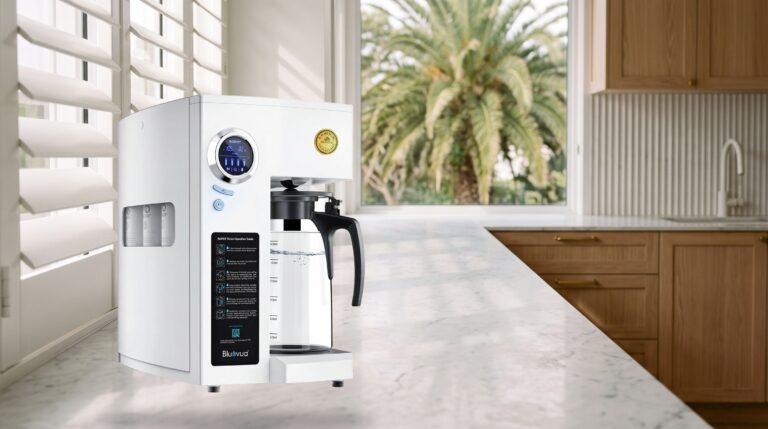
AquaTru Classic Smart Alkaline — Best Countertop RO
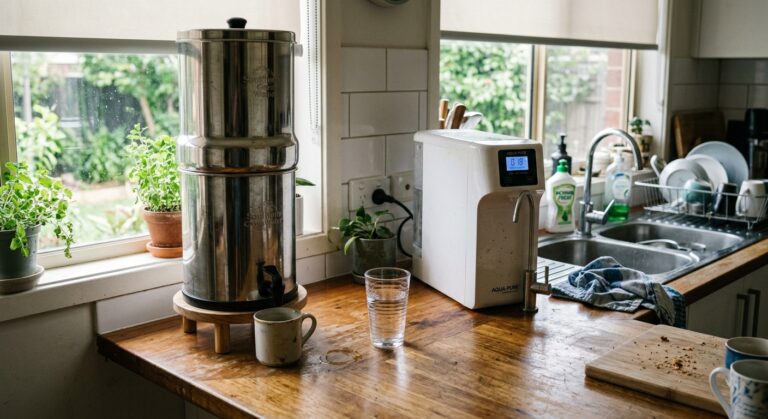
The AquaTru Classic Smart Alkaline is a countertop reverse osmosis unit that requires zero plumbing modification. You fill the tank, plug it in, and it produces filtered water through a 4-stage process: mechanical sediment pre-filter, carbon block pre-filter (VOC and chloramine reduction), RO membrane (NSF/ANSI 58 certified), and alkaline remineralisation post-filter. It removes up to 99.9% of microplastics by size exclusion and is independently tested for pharmaceutical compound rejection.
If you are renting in Brisbane, Sydney, or any other chloramine city and cannot modify plumbing, this is the practical solution. No landlord approval required. It sits on your kitchen bench, draws from a top-fill reservoir, and delivers filtered water from an integrated dispenser. The unit costs approximately $699 AUD. Over 5 years at 4 litres per day household usage, the total cost including replacement filters sits around $1,200 — or roughly $0.16 per litre. Compare that to $2–5 per litre for bottled water, which itself contains microplastics according to a 2024 study published in the Proceedings of the National Academy of Sciences that found an average of 240,000 nanoplastic particles per litre of bottled water.
Read the full analysis: AquaTru countertop RO review
Waterdrop D6 — Best Under-Sink RO
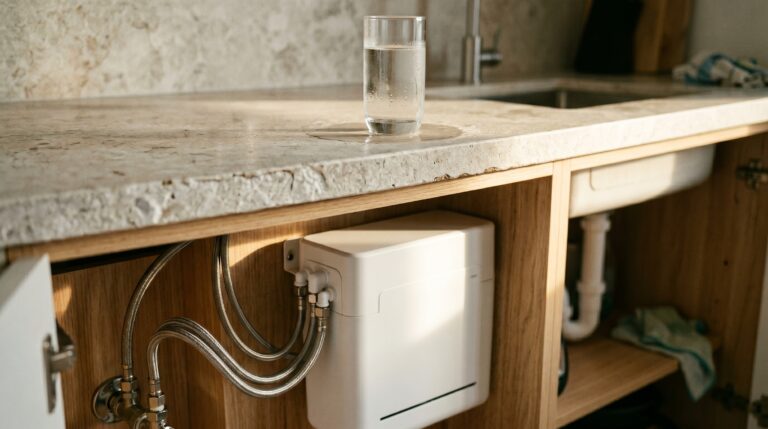
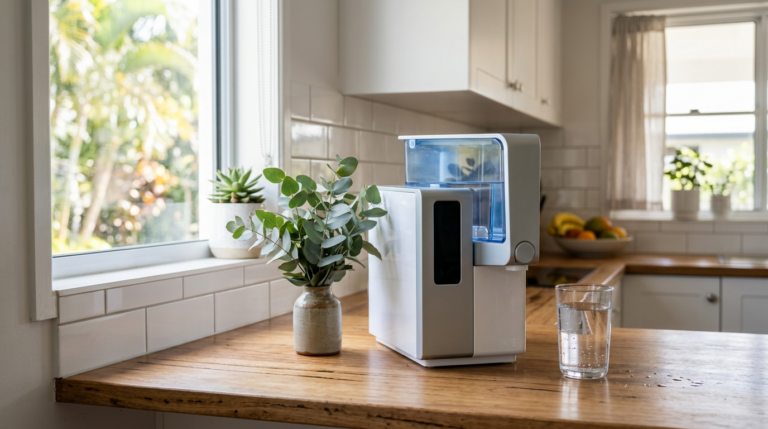
If you own your home or have landlord permission for a simple under-sink installation, the Waterdrop D6 under-sink RO system offers higher daily throughput and a cleaner benchtop (the unit hides under the sink). It uses a multi-stage RO process with an integrated pump, producing filtered water on demand through a dedicated faucet. NSF/ANSI 58 certified. The D6 handles chloramine, fluoride, PFAS, heavy metals, microplastics, and pharmaceutical residues.
Under-sink installation typically takes 30–60 minutes with basic tools. The system connects to your cold water supply line and drains waste water into your existing drain pipe. For Perth households dealing with hard water (~180 mg/L CaCO₃) and chloramine simultaneously, or Adelaide households facing the hardest municipal water in Australia (~140 mg/L CaCO₃, TDS ~400), the D6’s higher flow rate and permanent installation make more practical sense than a countertop unit you need to refill manually.
Remove Microplastics & Pharmaceuticals From Your Water
5-Year Cost Comparison: RO vs Bottled Water vs Doing Nothing
The cost objection is the most common reason people delay a water filtration decision. So here is the maths. A household drinking 4 litres per day (two adults, conservative estimate) consumes 1,460 litres per year, or 7,300 litres over five years.
| Option | Upfront Cost | Annual Filter / Ongoing Cost | 5-Year Total | Cost per Litre |
|---|---|---|---|---|
| AquaTru Classic RO | ~$699 | ~$100–120 | ~$1,199–$1,299 | $0.16–$0.18 |
| Waterdrop D6 Under-Sink | ~$599 | ~$80–100 | ~$999–$1,099 | $0.14–$0.15 |
| Bottled Water (Woolworths 600mL) | $0 | ~$2,920 ($2/L avg) | ~$14,600 | $2.00 |
| Unfiltered Tap Water | $0 | ~$6 (water bill portion) | ~$30 | $0.004 |
| Brita Jug (GAC) | ~$45 | ~$80 (6 cartridges) | ~$445 | $0.06 |
The Brita looks cheap on paper. But go back to the filtration table above — it does not remove the contaminants this article is about. You are paying $445 over five years for chlorine taste reduction (and not even that effectively if you are in a chloramine city). Bottled water costs 12–14x more than countertop RO over the same period — and that 2024 PNAS study found bottled water contains 100x more nanoplastics per litre than tap water. You are paying a premium to drink more plastic.
The RO units cost $0.14–$0.18 per litre. That is less than $1 per day for a household of two. Frame it this way: $0.50 per person per day to remove microplastics, pharmaceuticals, chloramine, fluoride, PFAS, and heavy metals. The worst outcome is you buy it, test your water before and after with a TDS meter, and decide you want to return it. The more likely outcome is you stop spending $40–50 a month on bottled water and never go back.
Decision Tree: Which Filter Do You Need?
Three questions. That is all it takes to make the right decision.
1. Can you modify your plumbing?
No (renting, apartment, strata restrictions) → AquaTru Classic Smart Alkaline countertop RO. Zero plumbing. Sits on bench. Plug-in operation.
Yes (homeowner, landlord approval) → Waterdrop D6 under-sink RO. Higher throughput, cleaner benchtop, permanent install.
2. Which city are you in?
Brisbane, Sydney, Adelaide, Gold Coast, Darwin = chloramine disinfection. Your RO system’s carbon pre-filter must handle chloramine to protect the membrane. Both the AquaTru and Waterdrop D6 include appropriate pre-filtration for chloramine cities.
Melbourne, Canberra, Hobart = free chlorine. Any RO pre-filter handles this easily. You also have the option of a quality carbon block filter if your only concern is taste and chlorine — but if microplastics and pharmaceuticals are your concern, you still need RO.
3. What is your primary concern?
Microplastics + pharmaceuticals + fluoride + PFAS = RO is the only technology that addresses all four. Carbon cannot remove fluoride. Carbon cannot remove microplastics below its pore size. Carbon cannot remove pharmaceutical molecules.
Taste and chlorine only = A quality carbon block filter (catalytic carbon in chloramine cities) is sufficient and cheaper. But you are reading this article because you are concerned about more than taste.
For the complete filtration breakdown, see our full guide: best water filter for Australian homes
What Comes Next: ADWG, Regulation, and Your Window to Act
The NHMRC reviews and updates the Australian Drinking Water Guidelines periodically, but the process is slow. The current ADWG framework focuses on established contaminants: microbial pathogens, disinfection byproducts, heavy metals, nitrates, fluoride (as an additive, not a contaminant to remove), and a limited set of pesticides and industrial chemicals. Microplastics and pharmaceutical residues are not on the current agenda.
Based on the regulatory trajectory of PFAS — which took approximately 8 years from initial scientific concern to enforceable US limits and is still only addressed as a “guideline” (not mandatory) in Australia — microplastics regulation in Australian drinking water is likely 5–10 years away. That is 5–10 years of unregulated exposure. Every glass of unfiltered tap water in that window carries microplastic particles and pharmaceutical traces that no utility is required to address.
The US EPA’s CCL 6 listing accelerates the global research timeline. It unlocks federal funding for occurrence studies, health effects research, and treatment technology evaluation. Australia will benefit from that research — eventually. But the ADWG update cycle, followed by state-level implementation, followed by utility compliance timelines, means your tap water will be the last thing to change.
You do not need to wait for regulation to catch up. A countertop or under-sink RO system gives you the same level of protection today that regulations might mandate in 2032 or later. For less than $1 per day, you close the regulatory gap yourself.
Final Verdict
Microplastics and pharmaceutical residues are confirmed present in Australian drinking water sources. The ADWG sets no limits. Your water utility is not required to test for them. Standard carbon filters and jug filters do not remove them. The US EPA’s CCL 6 listing in April 2026 signals that regulatory action is coming globally — but for Australia, that timeline is measured in years, not months.
The practical solution available right now is reverse osmosis. As a former Navy Clearance Diver, I approach water quality the same way I approached dive equipment: the gear has to work under pressure, and you verify it yourself. I test my filtered water with a calibrated TDS-3 meter at my home in Palm Beach, QLD. The numbers do not lie.
For renters or anyone who cannot modify plumbing: the AquaTru Classic Smart Alkaline countertop RO removes microplastics, pharmaceuticals, chloramine, fluoride, and PFAS without touching a single pipe.
For homeowners ready for permanent installation: the Waterdrop D6 under-sink RO delivers higher throughput at a lower per-litre cost over 5 years.
Both are NSF/ANSI 58 certified. Both handle chloramine pre-filtration for Brisbane, Sydney, Adelaide, Gold Coast, and Darwin. Stop paying for a jug filter that gives you false confidence. The contaminants in your water are real, measured, and published. The solution costs less than your morning coffee.
Ready to remove microplastics from your drinking water?
The AquaTru Classic Smart Alkaline is the top-rated countertop RO for Australian homes — NSF 58 certified, removes microplastics, pharmaceuticals, fluoride, PFAS, chloramine, and heavy metals. No plumbing required.
Last reviewed: June 2026 — Clean and Native
Frequently Asked Questions
Yes. CSIRO research confirms microplastics in Australian drinking water sources, and the NSW EPA detected microplastic contamination in all 120 waterways sampled across New South Wales. Municipal treatment plants are not designed to remove sub-10 µm microplastic particles.
No. The Australian Drinking Water Guidelines, maintained by the NHMRC, currently have no guideline value, health-based target, or monitoring requirement for microplastics or pharmaceutical residues in drinking water.
Not reliably. Standard Brita jug filters use loose granular activated carbon (GAC) with effective pore sizes of 20–50 µm. Microplastics smaller than that pass through. Pharmaceutical molecules, measured in nanometres, are far too small for GAC to intercept.
Reverse osmosis is the most effective household technology for microplastic removal. RO membranes have pore sizes of approximately 0.0001 µm — 10,000 times smaller than a 1 µm microplastic particle. RO also rejects pharmaceutical compounds at 90–99% according to published membrane science research.
University of Queensland research detected 17 pharmaceutical compounds in south-east Queensland waterways, including ibuprofen, carbamazepine, and sulfamethoxazole. Australian sewage treatment plants are not designed to fully degrade pharmaceutical molecules, and the ADWG sets no limits for pharmaceutical residues.
The CCL 6 is the US EPA’s formal regulatory pipeline listing contaminants identified for potential future drinking water regulation. In April 2026, the EPA added microplastics and pharmaceutical compounds to the CCL 6, triggering a regulatory evaluation pathway similar to the one that led to enforceable PFAS limits.
Yes. A 2024 study published in the Proceedings of the National Academy of Sciences found an average of 240,000 nanoplastic particles per litre of bottled water — approximately 100 times more than tap water. Bottled water is not a solution to microplastic exposure.
Yes. Reverse osmosis removes fluoride at 90–97% rejection rates. Carbon filters — including catalytic carbon — cannot remove fluoride. Activated alumina is the only other household technology effective for fluoride, at 80–95% removal. For combined microplastic, pharmaceutical, and fluoride removal, RO is the only single technology that addresses all three.
Based on PFAS regulatory precedent — approximately 8 years from initial concern to enforceable US limits, and still only guideline-level in Australia — microplastic drinking water regulation in Australia is estimated at 5–10 years away. The US EPA CCL 6 listing accelerates global research timelines but does not directly trigger Australian regulatory action.
Brisbane and south-east Queensland tap water is disinfected with chloramine, not free chlorine. Standard GAC filters remove chloramine at approximately 1/40th the rate of free chlorine removal. Catalytic carbon or reverse osmosis is required for effective chloramine reduction in Brisbane, Sydney, Adelaide, Gold Coast, and Darwin.
Get the Australian Home Environment Checklist
30 checks across water, air and EMF. Most of them free. Ranked by impact.
No spam. Unsubscribe any time.

Former Royal Australian Navy Clearance Diver and TAG-E counter-terrorism operator. Founded Clean and Native to apply the same rigorous thinking to the home environment.
Full biography →