
Australia’s PFAS Limits Higher Than US & EU: What It Means
Australia allows up to 560 ng/L of PFOA in drinking water — 140 times higher than the US EPA’s 4 ng/L limit — under the NHMRC 2023 drinking water guidelines, meaning Australian households can legally drink water that would trigger mandatory treatment or supply shutdown in the United States and across the European Union.
The Numbers Side by Side: Australia, US, and EU Compared
The gap is not subtle. Australia’s NHMRC 2023 drinking water guidelines set a health-based guideline value of 560 ng/L for PFOA (perfluorooctanoic acid) — the most studied long-chain PFAS compound linked to cancer, thyroid disruption, and immune suppression. The US EPA finalised its Maximum Contaminant Level (MCL) for PFOA at 4 ng/L in April 2024, effective for compliance from 2029. That is a 140-fold difference between two developed nations drinking the same compound.
The European Union takes a different approach. Rather than setting individual limits for each PFAS compound, the EU Drinking Water Directive (2020/2184) imposes a sum-of-20 PFAS limit of 0.1 µg/L (100 ng/L) and a total PFAS sum limit of 0.5 µg/L. This catches compounds that individual substance-by-substance standards miss. Australia has no equivalent sum-of-PFAS rule in force. If a source water contains five different PFAS at 100 ng/L each — none of which individually breach Australia’s individual compound guideline — that water is legally compliant under Australian rules. Under EU rules, it would fail immediately.
PFOA Drinking Water Limit Comparison — Australia vs US vs EU (ng/L)
Lower is stricter. All values in nanograms per litre (ng/L). EU value converted from sum-of-20 (0.1 µg/L = 100 ng/L) for single-substance comparison context only.
Australia’s PFOS (perfluorooctane sulfonic acid) picture is equally stark. The NHMRC 2023 guidelines set a combined PFOS + PFHxS (perfluorohexane sulfonate) guideline at 70 ng/L. The US EPA set individual MCLs for PFOS at 4 ng/L — the same as PFOA. That means the US tolerates roughly 17 times less PFOS than Australia’s combined PFOS + PFHxS guideline allows. These are not minor statistical differences. They represent fundamentally different readings of the same toxicological evidence.
Why Australia’s Limits Are Higher — and Why “Guideline” Matters
The first thing to understand is that Australia’s ADWG values are not laws. They are health-based guideline values set by the National Health and Medical Research Council (NHMRC) and published by the Australian Drinking Water Guidelines (ADWG) framework. State and territory water utilities are expected to follow them — but there is no federal statute mandating that your tap water must be below any specific PFAS concentration. The US EPA MCLs, by contrast, are enforceable federal law. Utilities that exceed them face legal penalties, mandatory public notification, and required treatment. Australian utilities that exceed ADWG guidelines face… a recommendation to investigate further.
The 560 ng/L PFOA value traces back to NHMRC’s toxicological review methodology. Australia uses a tolerable daily intake (TDI) model based on liver toxicity endpoints observed in animal studies, then back-calculates to an allowable water concentration assuming a 70 kg adult drinking 2 litres per day. The US EPA used a different approach for its 2024 MCLs: it relied on epidemiological data from human populations, primarily the C8 Health Project — a study of 69,000+ people exposed to PFOA contamination near a DuPont plant in West Virginia. Human exposure data consistently shows health effects at concentrations well below what animal-only models predict. This is the methodological split that explains most of the difference.
The EU went further still. Its Directive 2020/2184 adopted a precautionary sum-of-PFAS approach because regulators acknowledged that individual compound testing misses cumulative exposure from the thousands of PFAS variants in commercial use. PFAS is a class of over 12,000 compounds. Australia’s guidelines cover a small subset. Any compound not specifically listed has no guideline value, meaning it can be present at any concentration without triggering any regulatory response.
Australian Contamination Hotspots and State-by-State Reality
PFAS contamination in Australia is overwhelmingly concentrated around defence bases, airports, and industrial sites where aqueous film-forming foam (AFFF) was used for firefighting. The Department of Climate Change, Energy, the Environment and Water (DCCEEW) national PFAS contamination register lists over 700 confirmed sites across Australia. The practical problem is that contamination plumes do not respect property boundaries or council boundaries. Groundwater movement carries PFAS into bores, creeks, and — in some cases — municipal supply catchments.
The worst-documented sites include RAAF Base Williamtown near Newcastle (NSW), where contamination spread through the local drainage system and affected residential bores across Williamtown, Salt Ash, and Fullerton Cove. Oakey Army Aviation Centre in Queensland contaminated local groundwater affecting residents in Oakey and surrounding areas. RAAF Base Tindal near Katherine in the Northern Territory has recorded PFAS contamination in local water sources. In Western Australia, RAAF Base Pearce near Bullsbrook has been subject to investigation after groundwater detections.
The state-by-state enforcement reality varies significantly:
- NSW: NSW Health has issued precautionary health advice for residents near Williamtown, Singleton, and Katherine. It recommends avoiding drinking bore water, but municipal supply monitoring is not routinely published at the compound-by-compound level for PFAS beyond PFOA and PFOS.
- QLD: Queensland Health monitors PFAS in affected communities near Oakey and Amberley. Brisbane’s municipal supply (managed by Seqwater) has not recorded exceedances of NHMRC guideline values, but the SEQ Water Quality Report does not routinely publish results for the full PFAS compound list.
- SA: South Australia Water (SA Water) publishes annual water quality reports. PFAS testing coverage has expanded since 2022 but is not yet universal across all distribution zones.
- WA: The Water Corporation monitors PFAS in major metropolitan systems. Perth’s Jandakot groundwater borefield has been subject to precautionary monitoring given proximity to industrial land uses.
- VIC: Melbourne Water draws from Yarra Valley and Cardinia catchments, which are closed to public access and have lower contamination risk profiles. However, West Gippsland and Latrobe Valley areas have documented PFAS detections from industrial activity.
- NT: Darwin residents on the Darwin River Dam municipal supply are generally lower risk. Katherine residents near Tindal have received specific health advice and alternative water supply arrangements.
The critical data gap across all states is this: utilities are not required to test for all PFAS compounds, only those covered by ADWG guidelines. Water quality reports that return “below guideline values” for PFOA and PFOS say nothing about the 12,000+ other PFAS compounds that have no Australian guideline at all. This is not a conspiracy — it is a simple consequence of a guidelines framework that is years behind the contamination science.
What the NHMRC April 2026 Draft Guidelines Actually Propose
The NHMRC released draft revisions to the Australian Drinking Water Guidelines in April 2026 for public consultation via consultations.nhmrc.gov.au. The April 2026 draft signals genuine tightening. Preliminary indications from NHMRC consultation documentation point toward alignment with more recent toxicological assessments, particularly for long-chain PFAS compounds including PFOA and PFOS.
Public consultation submissions from October–November 2024 — a prior round of consultation that fed into the April 2026 draft — showed significant pressure from environmental health researchers, community advocacy groups near contaminated sites, and state health departments pushing for limits that more closely reflect the US EPA’s 2024 MCL framework. The submissions noted that Australia’s 560 ng/L PFOA guideline is increasingly difficult to defend given the weight of human epidemiological evidence accumulated since 2018.
The important caveat: draft guidelines are not final guidelines. And final guidelines are not law. Even if the NHMRC revises PFOA down to, say, 10 ng/L — still 2.5x the US limit — it remains an advisory value. Australian water utilities would be expected to comply, and most would, but there is no federal statutory mechanism to compel remediation by a fixed date. The US EPA’s MCL framework includes explicit compliance deadlines (2029 for the April 2024 MCLs) and enforcement powers. Australia has no equivalent. The timeline for any real-world reduction in consumer exposure depends on how quickly state utilities and contaminated-site remediation projects respond to revised guidelines — and that history suggests years, not months.
The bottom line on the April 2026 draft: it is movement in the right direction. It is not protection you can rely on today.
What Does 560 ng/L Actually Mean for Your Body?
Numbers in nanograms per litre are abstract. Here is what the toxicology literature actually says about chronic PFOA exposure.
How Much PFOA Fits In Your Glass?
PFOA permitted in 2 litres of drinking water at each country’s legal guideline
Australia’s PFOA guideline is 140× higher than the US EPA and EU limits. The US and EU glasses above contain a film so thin it is barely visible — that is the point.
PFOA is classified by the International Agency for Research on Cancer (IARC) as a Group 1 carcinogen — meaning there is sufficient evidence of carcinogenicity in humans. This classification, issued in 2023, is based on evidence of associations with kidney and testicular cancer in human population studies. The US National Toxicology Program (NTP) concluded in 2022 that PFOA is “possibly carcinogenic to humans” and noted immune system effects — specifically reduced vaccine antibody response — at serum PFOA levels achievable through regular drinking water exposure.
A 70 kg adult drinking 2 litres of water per day at Australia’s current 560 ng/L PFOA guideline value would consume 1,120 ng of PFOA daily from water alone. PFOA has a biological half-life in humans of approximately 3.5 years. It bioaccumulates. It is also present in food packaging, cookware coatings, and treated textiles — so drinking water is one exposure route among several. The question of how much risk this represents is actually contested between regulatory agencies, primarily because the dose-response relationship at low concentrations is not linear and individual susceptibility varies. What is not contested is the direction: less exposure is less risk, and 140x higher tolerance means 140x more exposure for households at or near the guideline limit.
For context, the US EPA estimated that its 4 ng/L PFOA MCL would prevent thousands of cancer cases annually across the US population. It set the MCL at the current practical analytical limit — the lowest concentration that certified laboratories can reliably measure — rather than at a theoretical zero-risk level. Australia’s 560 ng/L guideline was not set at analytical limits. It was set at a health-based TDI using 2019-era toxicological data that has since been substantially revised.
The Only Filter Technology That Actually Removes PFAS
Standard carbon block filters do not remove PFAS reliably. Brita jugs, refrigerator filters, and most benchtop carbon units are not tested or certified for PFAS removal. Catalytic carbon — which is effective for chloramine removal in Brisbane, Sydney, Adelaide, and Gold Coast — also does not provide verified PFAS removal at the concentrations found in contaminated Australian water sources. If someone is selling you a carbon jug as PFAS protection, they are either uninformed or misleading you.
Reverse osmosis (RO) is the only consumer technology with documented, certifiable PFAS removal performance. A properly functioning RO membrane rejects PFAS compounds at 90–97%+ efficiency, including PFOA, PFOS, PFNA, PFHxS, and GenX compounds (HFPO-DA). NSF/ANSI P473 is the relevant certification standard for PFAS removal in point-of-use RO systems. The membrane physically blocks PFAS because the molecules are too large to pass through the semi-permeable membrane — it is a size-exclusion mechanism, not an adsorption mechanism, which means it does not saturate or exhaust the way a carbon filter does.
Activated alumina can remove PFAS by adsorption, but its performance varies by PFAS compound and water chemistry, and it does not have the same breadth of certification coverage as RO. It is a secondary option, not a primary one. For Australian households in contamination hotspots, the practical recommendation is RO.
Two units worth serious consideration:
Best PFAS Removal Filters for Australian Homes
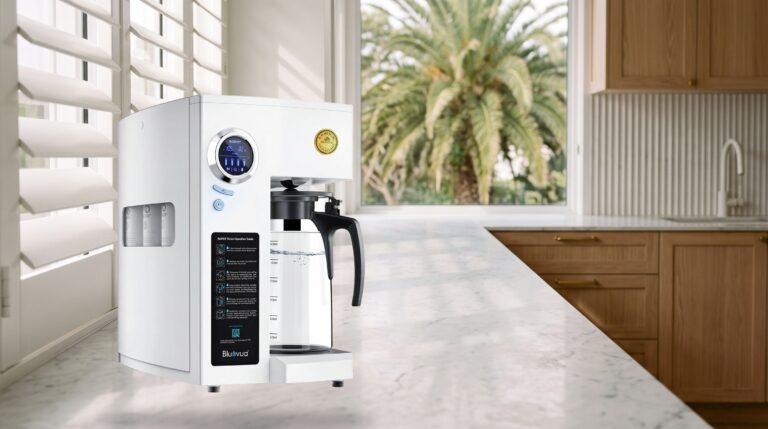
AquaTru Classic Smart Alkaline Countertop RO
The AquaTru uses a four-stage filtration process including an RO membrane certified to NSF/ANSI standards for a range of contaminants. Its countertop design requires no plumbing modification — relevant for renters in Brisbane, Sydney, and Perth who cannot install under-sink systems. It connects directly to your tap. For households near known contamination hotspots who need protection now, without a plumber and without waiting for a regulatory update, this is the fastest deployment option. The trade-off is a 3:1 waste water ratio — for every litre of filtered water produced, roughly 3 litres go to drain.
PWS EcoHero 5-Stage Under-Sink RO
The Pure Water Systems EcoHero carries WaterMark AS3497 certification — the relevant Australian standard for plumbing products — and NSF certification for contaminant removal. Five-stage filtration includes sediment pre-filter, two carbon stages, the RO membrane, and a post-carbon polishing stage. For homeowners in Williamtown, Oakey, Bullsbrook, or any other confirmed contamination zone, this is the permanent, high-volume solution. Requires a licensed plumber for installation. At roughly $1,009 purchase price, the per-litre cost of filtered water over five years is substantially lower than bottled water — which, incidentally, is not subject to the same PFAS testing requirements as municipal supply.
One thing that is critical to note: neither RO nor any other consumer filter removes PFAS from your shower water. For households on contaminated bore water used for bathing, dermal absorption and inhalation during showering represent additional exposure pathways. This is an under-discussed issue in the Australian contamination literature. If you are on a private bore in an affected area, the priority is whole-house filtration or water supply substitution, not just point-of-use drinking water treatment.
Should You Be Concerned if You Are Not Near a Defence Base?
Fair question. If you live in inner-city Melbourne, drink from the Yarra Valley catchment, and have never heard of a PFAS site near you — is this relevant?
Probably less so for PFAS specifically. Melbourne’s closed catchments (Yarra Valley, Thomson, Cardinia) are actually lower risk for PFAS contamination compared to groundwater-sourced supplies near industrial or military land uses. Melbourne Water’s annual water quality reports have not recorded PFAS exceedances of ADWG guidelines in the metropolitan distribution system. Melbourne also uses free chlorine, not chloramine, so a standard carbon block filter is effective for taste and chlorine removal — though it does nothing for PFAS.
Brisbane, Sydney, Adelaide, and Gold Coast residents face different chemistry. All four cities use chloramine as the primary disinfectant, which requires catalytic carbon or RO to remove effectively — standard carbon jugs are largely ineffective for chloramine. If you are in those cities and already running an RO system for chloramine reasons, you are also getting PFAS protection as a bonus.
The broader concern is future contamination risk. PFAS compounds have been detected in rainfall across Australia, including in remote areas with no identified industrial source — a phenomenon documented in global atmospheric deposition studies. The DCCEEW register of 700+ sites represents known, investigated contamination. The number of sites with undetected or uninvestigated contamination is unknown. As analytical methods improve and more testing is mandated, that number will grow.
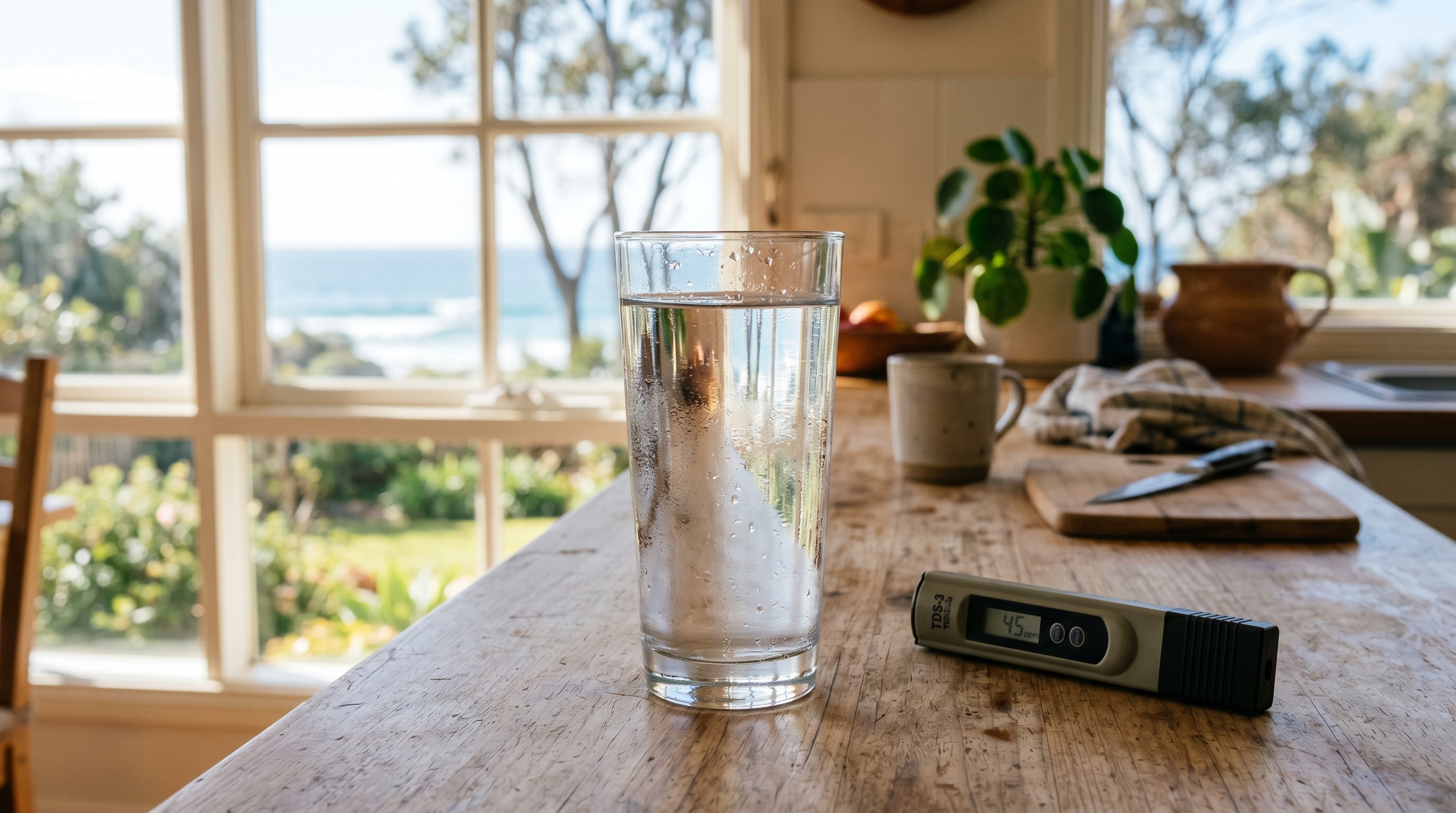
Testing your own tap water is a reasonable starting point. A PFAS-specific water test from an NATA-accredited laboratory costs $150–$350 depending on the compound panel. General TDS meters and the 17-in-1 test kits widely available on Amazon do not detect PFAS — they are not designed for it. PFAS testing requires a liquid chromatography-mass spectrometry (LC-MS/MS) method, run in a certified analytical lab.
Last reviewed: June 2026 — Clean and Native
Final Verdict
This is most relevant for Australian households concerned about drinking water safety, as Australia’s PFAS limits are significantly more permissive than those in the US and EU, meaning tap water considered safe locally could be unsafe by international standards. The most important action is to test your household water for PFAS contamination and consider installing a certified water filtration system from See Pure Water Systems if levels are detected.
Frequently Asked Questions
Australia’s NHMRC 2023 drinking water guidelines set a health-based guideline value of 560 ng/L (nanograms per litre) for PFOA. This is an advisory value, not a legally enforceable limit. It is 140 times higher than the US EPA’s 4 ng/L maximum contaminant level, which became legally enforceable in April 2024 with a compliance deadline of 2029.
Australia’s 560 ng/L PFOA guideline was calculated using a tolerable daily intake model based primarily on animal toxicology studies. The US EPA’s 4 ng/L MCL was derived from human epidemiological data, particularly from the C8 Health Project studying 69,000+ people with documented PFOA exposure. Human population data shows health effects at lower concentrations than animal-only models predict — this methodological difference explains most of the gap.
No. The Australian Drinking Water Guidelines (ADWG) are advisory, not legally enforceable. State and territory water utilities are expected to follow them, and most do, but there is no federal statute mandating compliance or setting penalties for exceedances. This contrasts with the US EPA’s MCL framework, which carries legal enforcement powers and mandatory public notification requirements.
The NHMRC April 2026 draft guidelines propose downward revisions to PFAS limits, signalling movement toward stricter standards. However, draft guidelines must complete public consultation before finalisation, and even finalised ADWG values remain advisory rather than legally binding. There is no statutory mechanism in Australia requiring utilities to comply by a fixed date, as exists under the US EPA MCL framework.
No. Standard carbon block filters and GAC (granular activated carbon) filters do not provide verified PFAS removal and are not certified for PFAS reduction under NSF/ANSI standards. Catalytic carbon, which is effective for chloramine removal in cities like Brisbane, Sydney, Adelaide, and Gold Coast, also does not provide documented PFAS protection. Reverse osmosis (RO) is the only consumer technology with certified PFAS removal performance under NSF/ANSI P473.
The highest documented risk areas are near defence bases and airports where aqueous film-forming foam (AFFF) was used. Key sites include Williamtown/Salt Ash/Fullerton Cove (NSW near RAAF Base Williamtown), Oakey (QLD near Oakey Army Aviation Centre), Katherine (NT near RAAF Base Tindal), and Bullsbrook (WA near RAAF Base Pearce). The DCCEEW national register lists over 700 confirmed contamination sites nationally.
PFAS testing requires a liquid chromatography-mass spectrometry (LC-MS/MS) analysis conducted by an NATA-accredited laboratory. Standard home water test kits and TDS meters cannot detect PFAS — they are not designed for this. A comprehensive PFAS compound panel from a certified lab typically costs $150–$350. Your state health department can advise on approved laboratories if you are in a known contamination zone.
The EU uses a different approach: its Drinking Water Directive (2020/2184) sets a sum-of-20 PFAS limit of 0.1 µg/L (100 ng/L) rather than individual compound limits. This is stricter than Australia’s individual PFOA limit of 560 ng/L, but the approaches are not directly comparable because the EU standard captures cumulative PFAS exposure across 20 compounds rather than individual substances. The US EPA’s 4 ng/L individual MCL for PFOA is the tightest single-compound limit currently in force among major regulators.
Not necessarily. Bottled water in Australia is regulated as a food product under FSANZ (Food Standards Australia New Zealand) standards, not under drinking water guidelines. PFAS-specific testing requirements for bottled water are less comprehensive than for municipal supplies. Additionally, some PFAS compounds migrate from plastic packaging into water over time. Reverse osmosis filtration of tap water provides more consistent, measurable PFAS reduction than relying on bottled water claims.
Get the Australian Home Environment Checklist
30 checks across water, air and EMF. Most of them free. Ranked by impact.
No spam. Unsubscribe any time.

Former Royal Australian Navy Clearance Diver and TAG-E counter-terrorism operator. Founded Clean and Native to apply the same rigorous thinking to the home environment.
Full biography →