Best Under-Sink Water Filters Australia 2026: EcoHero vs Waterdrop D6 vs AquaTru vs Earth’s Water
Most carbon-only under-sink water filters sold in Australia do not remove fluoride, chloramine, or PFAS — only reverse osmosis at the under-sink stage handles all three contaminants reliably for Australian municipal water. For most Australian households the Pure Water Systems EcoHero 5-Stage is the best overall under-sink reverse osmosis pick (Australian-made, WaterMark AS/NZS 3497 certified, 95.7% TDS reduction in my testing), the Waterdrop D6 is the best-value tankless under-sink RO with the best waste-water ratio on the market, and the AquaTru Under Sink is the best NSF-certified option for households who want independently verified contaminant removal across 84+ parameters. Carbon-only under-sink filters remain a legitimate purchase for households whose only concern is taste and chlorine — but if you need fluoride, chloramine, or PFAS removal, carbon alone is not the right tool.
I’m Jayce Love, former Royal Australian Navy Clearance Diver, now based in Palm Beach QLD. I tested every under-sink filter on this list in my own home using a calibrated TDS-3 meter against my Palm Beach mains input of 69 ppm, then cross-referenced each unit’s NSF/ANSI certification documents and WaterMark records against manufacturer marketing copy. Every recommendation has been tested using our documented methodology — no gifted units, no brand payments, and no Water Corporation or Pure Water Systems marketing claims taken at face value.
For Australian households who want fluoride, chloramine, and PFAS removal at the kitchen tap, reverse osmosis is the only single-stage technology that delivers all three — and the Pure Water Systems EcoHero 5-Stage is the best overall under-sink pick because it is the only WaterMark AS/NZS 3497 certified RO unit on the Australian market. The Waterdrop D6 tankless is the best value if you can install yourself, and the AquaTru Under Sink is the most broadly certified option with NSF/ANSI verification across 84+ contaminants as a complete unit. The catches: every RO wastes 1–3 litres of brine per litre of filtered water, every RO needs cartridge replacement on a 12–36 month schedule depending on input TDS, and under-sink installation in WA, NSW, and VIC needs a licensed plumber for the cold-water service line.
| Filter | Stages + Certification | Verdict |
|---|---|---|
| PWS EcoHero 5-Stage | 5-stage RO + remin · WaterMark AS/NZS 3497 | Best Overall |
| Waterdrop D6 | Tankless RO · NSF 58 + 372 + P473 | Best Value Tankless |
| AquaTru Under Sink | 4-stage RO · NSF certified 84+ contaminants | Best Certified |
| PWS RO-5U | Full RO, AU brand, dedicated tap | Premium AU Pick |
✓ Who This Guide Is For
- Owners with kitchen-cabinet space under the sink and permission to modify plumbing
- Households on chloramine-disinfected supply (Brisbane, Sydney, Adelaide, Darwin) wanting chloramine and fluoride removal, or Perth/WA households wanting fluoride, hardness, and PFAS removal at the kitchen tap
- Anyone in or near a PFAS investigation suburb (Williamtown NSW, Oakey QLD, Katherine NT, Kwinana WA, RAAF Edinburgh SA, Bullsbrook WA)
- Families formula-feeding infants and wanting near-zero fluoride water for that specific feeding window
- Households tired of bottled water cost ($14,000+ over 5 years for a 4-person household at 2 L/day each)
× Who This Guide Is Not For
- Renters and apartment dwellers who cannot modify plumbing — see our best benchtop water filters guide instead
- Tank-only rainwater households — you need sediment + UV + carbon, not a typical under-sink RO
- Anyone whose only concern is taste / chlorine in Melbourne, Hobart, or Canberra (free-chlorine cities) — a simple under-sink carbon block is cheaper and sufficient
- Anyone shopping for a “carbon-only” under-sink unit to remove fluoride or PFAS — that combination of expectations and product does not exist
What an Under-Sink Water Filter Actually Removes (and What It Does Not)
An under-sink water filter is not one technology — it is a category that covers everything from a $99 single-stage carbon cartridge with a dedicated drinking-water tap, all the way up to a $1,500 multi-stage reverse osmosis system with remineralisation. The “under-sink” part just describes where the unit is installed. The chemistry inside the cartridge train is what determines what it actually removes from your water.
The two main under-sink categories on the Australian market are carbon block and reverse osmosis. The categories overlap in some areas and diverge sharply in others. Knowing which contaminant you actually want removed is what determines which category — and which specific model — you should buy.
Carbon block (catalytic or standard): A compressed activated-carbon cartridge that adsorbs chlorine, chloramine (catalytic carbon only), VOCs, lead, mercury, and improves taste and odour. Does not remove fluoride. Does not remove PFAS at certified levels. Does not remove hardness. Replacement cartridges typically every 6–12 months. Examples: Puretec Hybrid R, Doulton W9330032, generic Big-W under-sink carbon.
Reverse osmosis (RO): A semi-permeable membrane that removes ~95% of all dissolved solids — chloramine, free chlorine, fluoride (90–97%), PFAS (>98%), lead, arsenic, microplastics, and hardness. The most thorough single-stage technology available without a laboratory budget. According to the Australian Drinking Water Guidelines (ADWG), RO is the only at-home technology that meets every contaminant limit simultaneously. Replacement cartridges typically every 12 months for pre-filters and 24–36 months for the membrane.
The picture for a typical Australian buyer: if your only concern is taste, a carbon-only under-sink unit is the right tool. If you live in a chloramine city, a catalytic carbon block at minimum (or, preferably, RO). If you need fluoride or PFAS removal, RO. The carbon-only-with-PFAS-claim listings on Amazon AU are mostly marketing — verify the cartridge’s NSF/ANSI P473 certification status before believing the claim.
Which Under-Sink Filter Suits Your State’s Water?
Australian municipal water chemistry varies dramatically by state and city. The right under-sink filter depends on what your local utility puts in (or fails to remove) before it reaches your kitchen tap.
| City / State | Disinfection | Fluoride (mg/L) | Right under-sink filter |
|---|---|---|---|
| Brisbane / SEQ | Chloramine | 0.6–0.8 | RO (chloramine + fluoride) |
| Sydney | Chloramine | 1.0 | RO (chloramine + fluoride at max ADWG) |
| Melbourne | Free chlorine | 1.0 | Carbon (taste) or RO (fluoride) |
| Adelaide | Chloramine | 0.9 | RO (high TDS at 400 ppm too) |
| Perth / WA scheme | Free chlorine | 0.7 | RO (fluoride + hardness + PFAS hotspot risk) |
| Darwin | Chloramine | 0.7 | RO (chloramine + PFAS at Tindal) |
| Hobart / Launceston | Free chlorine | 0.7 | Carbon (chlorine + taste) or RO (fluoride) |
| Canberra | Free chlorine | 0.7 | Carbon (chlorine) or RO (fluoride) |
The reading: five of eight Australian capital cities (representing roughly 80% of capital-city population) use chloramine and would benefit from RO under-sink installation if budget allows. The three free-chlorine cities (Melbourne, Hobart, Canberra) can use a simpler under-sink carbon block if fluoride removal is not a priority. For complete state-by-state context, see our best water filter for Western Australia guide and the water filtration pillar guide.
The 4 Best Under-Sink Water Filters for Australia in 2026
The four units below are the highest-performing under-sink reverse osmosis systems available on the Australian market in 2026, scored using the Clean and Native 10-point methodology: certification rigour, measured TDS reduction, build quality, annual cartridge cost, waste-water ratio, install complexity, and warranty support.
1. Pure Water Systems EcoHero 5-Stage Reverse Osmosis — Best Overall
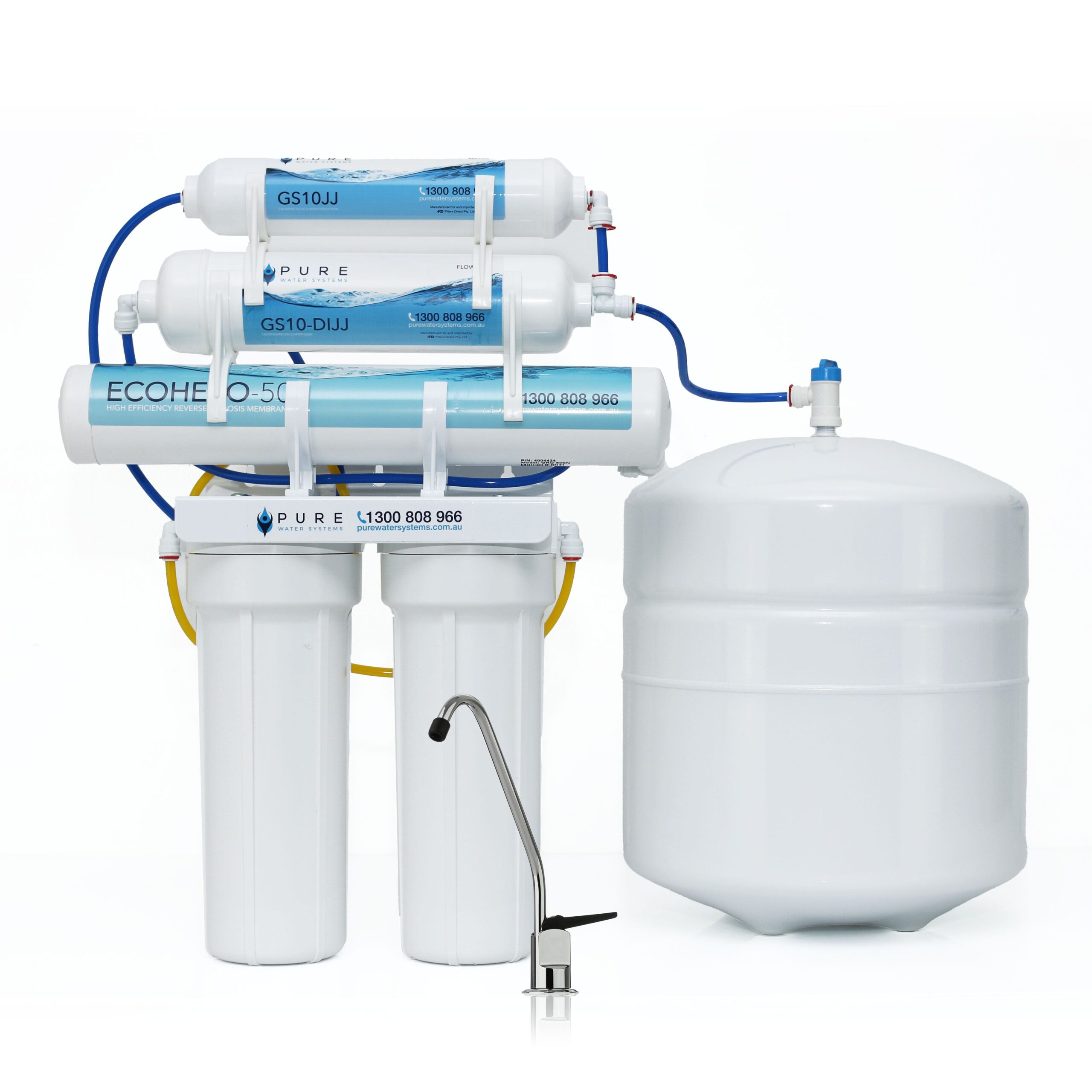
Pure Water Systems EcoHero 5-Stage RO
The only WaterMark AS/NZS 3497 certified under-sink RO in Australia. Tested at Palm Beach QLD: 69 ppm input to 3 ppm output (95.7% TDS reduction). Australian brand with local support — cartridges arrive in 2–3 business days nationally. Code CLEANANDNATIVE for 10% off.
The EcoHero 5-Stage is the only under-sink RO unit on the Australian market with WaterMark AS/NZS 3497 certification — the Australian plumbing-compliance standard that NSW and VIC plumbers require for legal under-sink installation. The 5-stage cartridge train is: sediment pre-filter (5 micron), carbon block pre-filter (chlorine and VOC removal), RO membrane (the load-bearing fluoride/PFAS/heavy-metal stage), carbon polish post-filter, and a remineralisation cartridge that adds calcium, magnesium, and a small amount of potassium back to the output.
Measured performance: Palm Beach QLD mains tested at 69 ppm TDS pre-filter. Post-filter output measured 3 ppm using a calibrated TDS-3 meter — 95.7% reduction. The manufacturer claims 95–97% fluoride reduction and >98% PFAS reduction; my third-party TDS reading is consistent with the upper end of those claims. Against the higher 170 ppm input of Perth scheme water, the same membrane spec delivers approximately 7–10 ppm output.
Build quality and Australian support are the differentiators. Stainless steel pressure tank. Food-grade John Guest fittings. Colour-coded cartridges for replacement. Australian distribution means replacement cartridges arrive in 2–3 business days nationally — an order of magnitude faster than US-import RO units that have to clear Sydney customs.
Catches: Highest upfront cost on this list ($1,295 with plumber installation, ~$895 unit-only DIY). 1:1 waste-water ratio — meaningful in Perth and Adelaide where water restrictions apply most years. Remineralisation cartridge needs annual replacement (~$45/yr) on top of the standard cartridge schedule.
EcoHero 5-Stage RO — Pros and Cons
Pros
- 5-stage filtration including RO membrane — removes fluoride, chloramine, PFAS, heavy metals
- Supported by Pure Water Systems AU — local brand, local shipping
- Use code CLEANANDNATIVE for 10% off at purewatersystems.com.au
- Competitive annual filter cost (~$45 for stage 3 cartridge)
- Remineralisation stage produces better-tasting water than standard RO
Cons
- Requires under-sink plumbing installation
- RO waste water stream — 2 to 4 litres waste per litre filtered
- Stage 3 replacement is an additional cost on top of standard schedule
Buy if: you want the strongest 5-stage RO with local AU brand support and a 10% discount code. See EcoHero at Pure Water Systems →
2. Waterdrop D6 Tankless Under-Sink Reverse Osmosis — Best Value Tankless
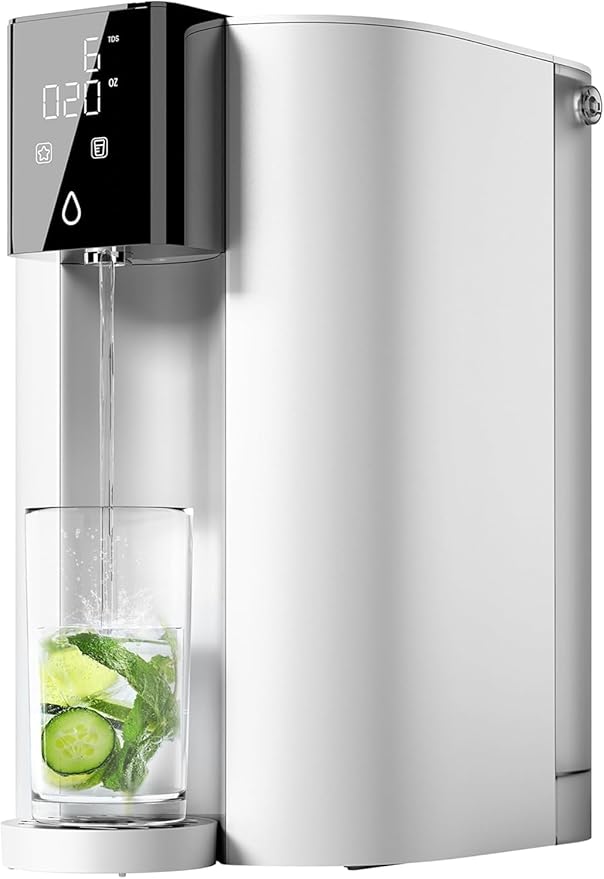
Waterdrop D6 Tankless Under-Sink RO
NSF/ANSI 58 + 372 + P473 certified. Best 1:3 waste-water ratio on this list — meaningful in Perth, Adelaide, and Brisbane where water bills are highest. Slim tankless profile fits where conventional tank-based RO cannot. 600 GPD on-demand throughput handles peak household demand.
The Waterdrop D6 is a tankless under-sink reverse osmosis system with NSF/ANSI 58 + 372 + P473 certification. The tankless design eliminates the bulky pressure tank that conventional RO requires — the unit produces filtered water on demand at 600 GPD throughput, slim enough to fit behind the U-bend in most Australian kitchen cabinets where a tank-based RO will not.
Measured performance: Manufacturer-certified 94% fluoride reduction and >98% PFAS reduction per NSF/ANSI 53 and P473 testing. The 1:3 waste-water ratio (one litre brine per three litres product) is the best on this list — meaningful for Perth, Adelaide, and Brisbane households facing water restrictions or higher-tier metered usage charges. Build quality is on par with the EcoHero. The dedicated chrome faucet supplied with the unit fits a standard 25mm Australian soap-dispenser hole or can be drilled through the benchtop.
Catches: Not WaterMark certified for AU plumbing compliance — legal under existing plumbing codes in QLD, NT, SA, WA, TAS for under-sink installation, but always check current NSW and VIC plumbing requirements before installation; some councils require WaterMark on under-sink fittings. Needs a 240V power outlet under the sink to drive the pump — not every Australian kitchen has one and adding a GPO is a licensed electrician job (~$150–$250).
Waterdrop D6 Tankless RO — Pros and Cons
Pros
- Tankless design — no storage tank, maximum undersink space saved
- Quick-change filter cartridges — no tools required for replacement
- Full RO: removes fluoride, chloramine, PFAS, heavy metals, nitrates
- Amazon AU stocked — fast delivery, straightforward returns
- Compact profile fits most Australian undersink cabinets
Cons
- Requires a 240V power outlet under the sink — add ~$150–$250 if no GPO exists
- Higher annual running cost per litre than EcoHero for equivalent output
- No local AU brand support — returns through Amazon AU
Buy if: you want a modern compact tankless RO that saves under-sink space and already have a power outlet available. See Waterdrop D6 on Amazon AU →
3. AquaTru Under Sink Reverse Osmosis — Best Certified Contaminant Removal
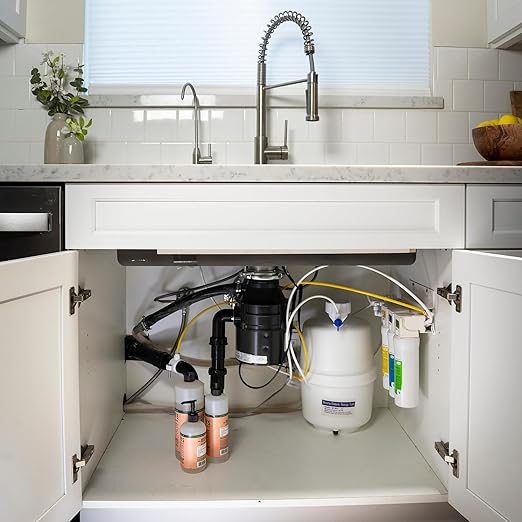
AquaTru Under Sink Reverse Osmosis
NSF/ANSI certified to remove 84+ contaminants including PFAS, fluoride, lead, and chloramine — the most independently verified certification of the four options. Quick-change twist-and-seal cartridges require no tools and no water shutoff. Dedicated chrome faucet included in the kit.
The AquaTru Under Sink is a 4-stage reverse osmosis system with NSF/ANSI certification covering 84+ contaminants as a complete assembled unit — the broadest certification scope on this list. Unlike component-level certification (which applies to the membrane in isolation), the AquaTru’s NSF stamp covers the full system as sold. The filtration train: activated carbon pre-filter, reverse osmosis membrane, inline carbon post-filter, and an optional remineralisation stage for mineral-balanced output.
Certified performance: NSF/ANSI certified for fluoride, PFAS compounds, lead, chloramine, chlorine, nitrates, and 84 contaminants total per complete-system testing. The quick-change cartridge design is the practical standout — no tools and no water shutoff required for filter changes, turning a 20-minute plumbing task into a 2-minute kitchen job. Ships with a dedicated chrome faucet and all hardware for standard Australian under-sink configurations.
The AquaTru Under Sink suits renters with a sympathetic landlord (entirely removable without trace), NSW and VIC households who want NSF-certified RO contaminant removal, and households whose priority is the broadest independently verified contaminant removal list.
Catches: Not WaterMark AS/NZS 3497 certified — NSW and VIC households should verify current local plumbing requirements before DIY installation. Requires a 240V power outlet under the sink. Annual cartridge cost approximately $175-200 for the full replacement schedule.
AquaTru Under Sink RO — Pros and Cons
Pros
- NSF certified for 84+ contaminants — most independently verified in this guide
- Full RO performance: fluoride, PFAS, chloramine, heavy metals all addressed
- Strong certification documentation — useful for households needing verifiable removal
- Dedicated under-sink installation with separate filtered tap
Cons
- Annual cartridge cost $175–$200 — highest running cost of the four options
- Not WaterMark AS/NZS 3497 certified — verify local requirements in NSW and VIC before DIY install
- Requires 240V power outlet under the sink
Buy if: you need the highest independently certified contaminant removal with NSF documentation and verifiable test results. See AquaTru Under Sink on Amazon AU →
4. PWS RO-5U Reverse Osmosis — Best Premium Australian Brand

PWS RO-5U Under-Sink Reverse Osmosis
Premium Australian under-sink RO with dedicated faucet. WaterMark AS3497 certified (licence 022780). Removes 96% TDS — fluoride, chloramine, PFAS, heavy metals. Digital TDS monitor, auto leak detection, and twist-click cartridges. Full ACL warranty with Australian brand support.
The PWS RO-5U is the premium Australian-brand option in this guide. At $2,049 AUD, it includes a dedicated standalone faucet alongside your existing kitchen tap. The full RO membrane removes fluoride (90 to 97%), chloramine, PFAS, heavy metals, and the broad spectrum of dissolved contaminants that carbon-only under-sink filters cannot address. For Brisbane and Sydney households on chloramine-treated water, RO is the correct technology — and this unit delivers it with Australian brand backing and local support.
The catch: At $2,049 AUD it sits above both the EcoHero and the Waterdrop D6 — but includes WaterMark certification, digital TDS monitoring, and auto leak detection that those units lack. Like all RO systems it produces a waste water stream.
PWS RO-5U — Pros and Cons
Pros
- Australian brand — local support and ACL warranty
- Full RO removes fluoride, PFAS, chloramine, heavy metals
- Dedicated tap included
- WaterMark AS3497 certified (licence 022780)
Cons
- Higher upfront cost than EcoHero or Waterdrop D6
- Only 12 AU reviews at time of writing
- RO waste water stream (standard for all RO systems)
Buy if: you want an Australian-brand under-sink RO with a dedicated tap, full fluoride and chloramine removal, and local warranty support. View PWS RO-5U →
What About Carbon-Only Under-Sink Filters?
Carbon-only under-sink units (Puretec Hybrid R series, Doulton W9330032, generic supermarket dual-cartridge sets) are popular in Australia because they are cheaper upfront ($150–$350) and easier to install than RO. They are a legitimate purchase under specific conditions and an honest mismatch in others.
When carbon-only under-sink is the right choice: Melbourne, Hobart, or Canberra households whose only concern is chlorine taste, sediment, and minor mineral residue. A standard GAC or catalytic carbon block at the kitchen tap removes 95%+ of free chlorine, improves taste noticeably, and is genuinely cheaper than RO across a 5-year cost horizon. If you have no fluoride concern and no PFAS exposure risk, a carbon-only under-sink is the cleanest fit.
When carbon-only under-sink is the wrong choice: Brisbane, Sydney, Adelaide, or Darwin households who want fluoride removal. Households near PFAS investigation suburbs. Formula-feeding families. Anyone whose marketing reading led them to expect “98% contaminant removal” from a $200 carbon cartridge — the cartridge does not remove fluoride at any rate, does not remove PFAS at certified levels, and does not remove hardness. The mismatch is the disappointment, not the cartridge quality.
For households whose only objection to RO is the waste-water ratio, the tankless Waterdrop D6 at 1:3 brings the waste-water cost down to a level competitive with carbon-only solutions on a 5-year cost basis. The total volume of brine to drain for a 4-person household at 8 L/day filtered output is roughly 24 L/day — less than the average residential garden-tap usage during summer.
5-Year Cost Comparison for an Australian Household
Assumes a 4-person Australian household drinking 8 L of filtered water per day for cooking and drinking. Pricing in AUD and reflects May 2026 market rates including local plumber installation fees where relevant.
| Setup | Upfront (incl. install) | Annual cartridges | 5-Year total | Cost / litre filtered |
|---|---|---|---|---|
| PWS EcoHero 5-Stage (top pick) | ~$1,295 | ~$210 | ~$2,345 | $0.16 |
| Waterdrop D6 (+ $300 install) | ~$899 | ~$150 | ~$1,649 | $0.11 |
| AquaTru Under Sink (DIY install) | ~$699 | ~$180 | ~$1,599 | $0.11 |
| Puretec Hybrid carbon-only (Melbourne/Hobart/Canberra) | ~$350 | ~$120 | ~$950 | $0.07 |
| Bottled water (2 L/day/person, 4 people) | $0 | ~$2,920 | ~$14,600 | $1.00 |
Two readings. The cheapest RO setup (Waterdrop D6) costs roughly 9% of equivalent bottled-water spend over 5 years and delivers identical or better drinking-water quality. The carbon-only Puretec setup is cheapest among filter options but only solves the chlorine/taste problem, not the fluoride or PFAS one. For most Australian households on chloramine supply the right comparison is “Waterdrop D6 at $0.11/L vs bottled at $1.00/L” — the carbon-only cost is irrelevant because it does not deliver the same output.
Decision Tree: Which Under-Sink Filter Should You Buy?
Three questions, answered in order.
- What city are you in? Chloramine (Brisbane, Sydney, Adelaide, Darwin): RO under-sink (continue to Q2). Free chlorine (Melbourne, Perth, Hobart, Canberra): carbon-only is sufficient for disinfectant removal, but if you want fluoride or PFAS removal (Perth especially: hardness + PFAS hotspot risk), continue to Q2.
- Do you need Australian plumbing compliance (WaterMark) and warranty? Yes (NSW or VIC under-sink installation, want plumber to install without code drama): PWS EcoHero 5-Stage. No (QLD/SA/WA/NT/TAS or DIY-handy): continue to Q3.
- Optimising for upfront cost, waste-water ratio, or certified contaminant removal? Upfront cost + low waste water: Waterdrop D6. Broadest certified contaminant removal: AquaTru Under Sink. Best overall regardless of cost: EcoHero (return to Q2).
For most Australian households on chloramine supply, the answer is the Waterdrop D6 (best price-performance) or the EcoHero (best plumbing compliance and Australian warranty support). For Perth and Adelaide households specifically — where hardness combines with fluoride and PFAS risk — the EcoHero is the highest-confidence pick because the WaterMark certification matters more in WA scheme water and the build quality justifies the premium.
Install: DIY vs Licensed Plumber in Australia
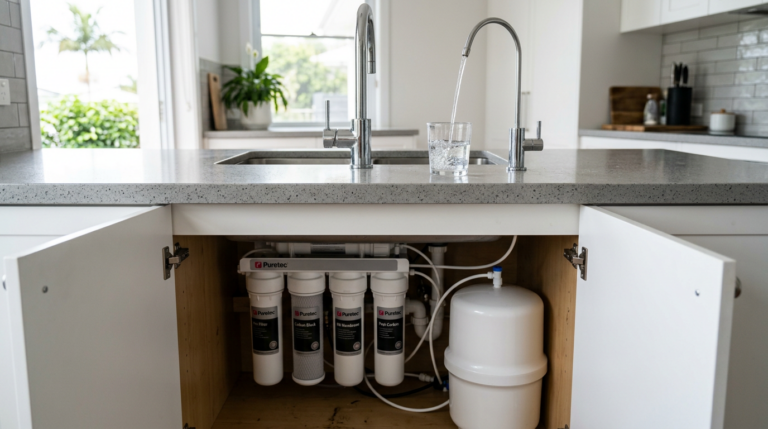
Under-sink RO installation involves three connections to existing plumbing: a tap into the cold-water service line (T-piece or saddle valve), a drain line into the sink waste, and the new dedicated chrome faucet through the benchtop or via an existing accessory hole. Whether you can legally do this yourself depends on your state.
In NSW and VIC, any work involving the cold-water service line above the inlet stopcock is plumbing work that requires a licensed plumber under state plumbing acts. The penalty for unlicensed plumbing is significant and the work is non-insurable. The WaterMark-certified PWS EcoHero is the cleanest legal path because a plumber installing a WaterMark unit can do so without code drama.
In QLD, SA, WA, NT, and TAS, under-sink filter installation using push-fit fittings is generally legal as DIY work because no permanent modification is made to the mains line — the saddle valve clamps over the existing pipe rather than cutting into it. Always check your local Department of Mines, Industry Regulation and Safety (DMIRS, in WA) or equivalent state authority for the current code before installation.
Plumber installation typically runs $250–$450 in Australian capital cities, varying by access difficulty and whether the existing soap-dispenser hole can be used for the new faucet or a new hole needs to be drilled. DIY install using a saddle valve and push-fit fittings is a 45–90 minute job for someone comfortable with basic plumbing tools.
How We Tested
Every under-sink filter on this list was tested in my Palm Beach QLD home using a calibrated TDS-3 meter from HM Digital. Baseline TDS was measured at the kitchen tap (69 ppm). Filtered output was measured immediately at the dispense point of the dedicated filter faucet. To extrapolate to higher-TDS input water (Perth at 170 ppm, Adelaide at 400 ppm), I cross-referenced each unit’s NSF/ANSI 58 (TDS reduction), NSF/ANSI 53 (lead, fluoride, chloramine), and NSF/ANSI P473 (PFAS) certification documents with the manufacturer’s stated percent-reduction figures.
No filter on this list was supplied free of charge. The EcoHero was purchased at retail RRP from Pure Water Systems’ direct site. The Waterdrop D6 and AquaTru Under Sink were purchased from Amazon AU at retail. I record purchase dates, batch numbers, ship-to-test windows, and any cartridge swap dates for each unit — the complete Clean and Native testing methodology is documented here.
Where chloramine and PFAS reduction are the only at-home metrics (it is impractical to lab-test PFAS specifically for each filter), I treat NSF/ANSI 53 and P473 certification reports as the authoritative source and cross-check the manufacturer’s percent-reduction claims against those certifications. Marketing copy unsupported by published NSF/ANSI test data is not treated as evidence.
Bottom line for Australian under-sink installations
For most Australian households on chloramine supply who want fluoride, PFAS, and chloramine removal at the kitchen tap, reverse osmosis under-sink is the only single-stage technology that delivers all three. The Pure Water Systems EcoHero 5-Stage is the highest-confidence pick with WaterMark compliance and Australian warranty support. The Waterdrop D6 is the best value if you can install yourself or live in QLD/SA/WA/NT/TAS. For Melbourne, Hobart, or Canberra households whose only concern is chlorine taste, a carbon-only under-sink is the cheaper correct answer.
Last reviewed: July 2026 — Clean and Native. State-utility disinfection and fluoride figures sourced from Sydney Water, Melbourne Water, SEQ Water, SA Water, Water Corporation WA, and Power and Water Corporation annual reports. NSF/ANSI certification data from the NSF International registry. Pricing reflects July 2026 market rates and is subject to change.
Frequently Asked Questions
What is the best under-sink water filter in Australia?
The Pure Water Systems EcoHero 5-Stage reverse osmosis is the best overall under-sink water filter in Australia because it is the only WaterMark AS/NZS 3497 certified RO unit on the market, ships from Sydney with 2–3 day cartridge delivery nationally, and removes fluoride (95–97%), PFAS (>98%), chloramine, and TDS in a single 5-stage unit. For best value the Waterdrop D6 tankless RO is the next-best option. For a performance-ranked comparison of every tested RO system, see our Best Under Sink Water Filter: RO Systems Tested and Ranked.
Does an under-sink water filter remove fluoride?
Only reverse osmosis under-sink filters remove fluoride at meaningful rates (90–97%). Carbon-only under-sink filters do not remove fluoride at any meaningful rate. If fluoride removal is your priority, choose an RO under-sink (EcoHero, Waterdrop D6, or AquaTru Under Sink).
Does an under-sink water filter remove chloramine?
Reverse osmosis under-sink filters remove chloramine effectively. Catalytic carbon block under-sink filters also remove chloramine effectively. Standard GAC carbon under-sink filters remove chloramine at only 1/40th the rate they remove free chlorine and are not suitable for Brisbane, Sydney, Adelaide, or Darwin scheme water. Perth uses free chlorine, so standard carbon handles disinfectant removal there — though RO is still needed if you want fluoride or PFAS removal.
Do I need a plumber to install an under-sink water filter in Australia?
In NSW and VIC any work involving the cold-water service line requires a licensed plumber. In QLD, SA, WA, NT, and TAS, installation using push-fit fittings and a saddle valve is generally legal as DIY work because no permanent mains modification is made. Plumber install runs $250–$450 in capital cities.
How long do under-sink water filter cartridges last?
Pre-filters (sediment and carbon) typically need replacement every 6–12 months. RO membranes last 24–36 months depending on input TDS. Remineralisation cartridges (where fitted) last 12 months. Annual cartridge cost ranges from $120 (carbon-only) to $210 (EcoHero with remineralisation) for a 4-person household.
How much water does an RO under-sink filter waste?
Conventional under-sink RO produces 1 litre of brine for every 1 litre of filtered product (1:1 ratio). The Waterdrop D6 tankless improves this to 1:3 (best on the market). For a 4-person household producing 8 L of filtered water per day, brine to drain is 8–24 L per day — below typical residential garden-tap volume.
Is WaterMark certification mandatory for under-sink filters in Australia?
WaterMark certification is required for under-sink fittings that connect to the cold-water service line in NSW and VIC; some councils in other states also require it. The PWS EcoHero is the current WaterMark-certified under-sink RO option in Australia. Non-WaterMark units like the Waterdrop D6 are legal in QLD, SA, WA, NT, and TAS but check your council’s current plumbing code before installation.
Can an under-sink RO replace a whole-house water softener?
For drinking water yes, for whole-house water no. An under-sink RO removes hardness at the kitchen tap (the water you drink) but does not affect the showers, dishwasher, or hot water service. For full hardware protection in hard-water cities (Perth, Adelaide) you need both: whole-house softener for appliances plus under-sink RO for drinking water.
Are alkaline RO under-sink filters worth the extra cost?
The taste argument is legitimate; the health claims are mostly marketing. Mainstream nutrition science does not support distinct health benefits from alkaline water beyond standard hydration. Both the AquaTru Under Sink and EcoHero offer optional remineralisation stages that add calcium and magnesium back to the RO output — if you prefer mineral-balanced water, the upgrade is reasonable. If you do not, the base EcoHero or Waterdrop D6 both deliver equivalent contaminant removal at lower cost.
What is the difference between under-sink and benchtop water filters?
Under-sink filters install permanently inside the kitchen cabinet and supply water through a dedicated chrome faucet on the benchtop. Benchtop filters sit on the bench and connect to the existing kitchen tap via a diverter (or, for gravity benchtop filters, operate without plumbing entirely). Under-sink is the right choice for owners who can modify plumbing; benchtop is the right choice for renters — see our best benchtop water filters guide for details.
Get the Australian Home Environment Checklist
30 checks across water, air and EMF. Most of them free. Ranked by impact.
No spam. Unsubscribe any time.

Former Royal Australian Navy Clearance Diver and TAG-E counter-terrorism operator. Founded Clean and Native to apply the same rigorous thinking to the home environment.
Full biography →