Bluevua RO100ROPOT Review Australia 2026
Drafted with AI assistance and checked against published specifications and certifications. First-hand measurements appear only where stated. How we make content
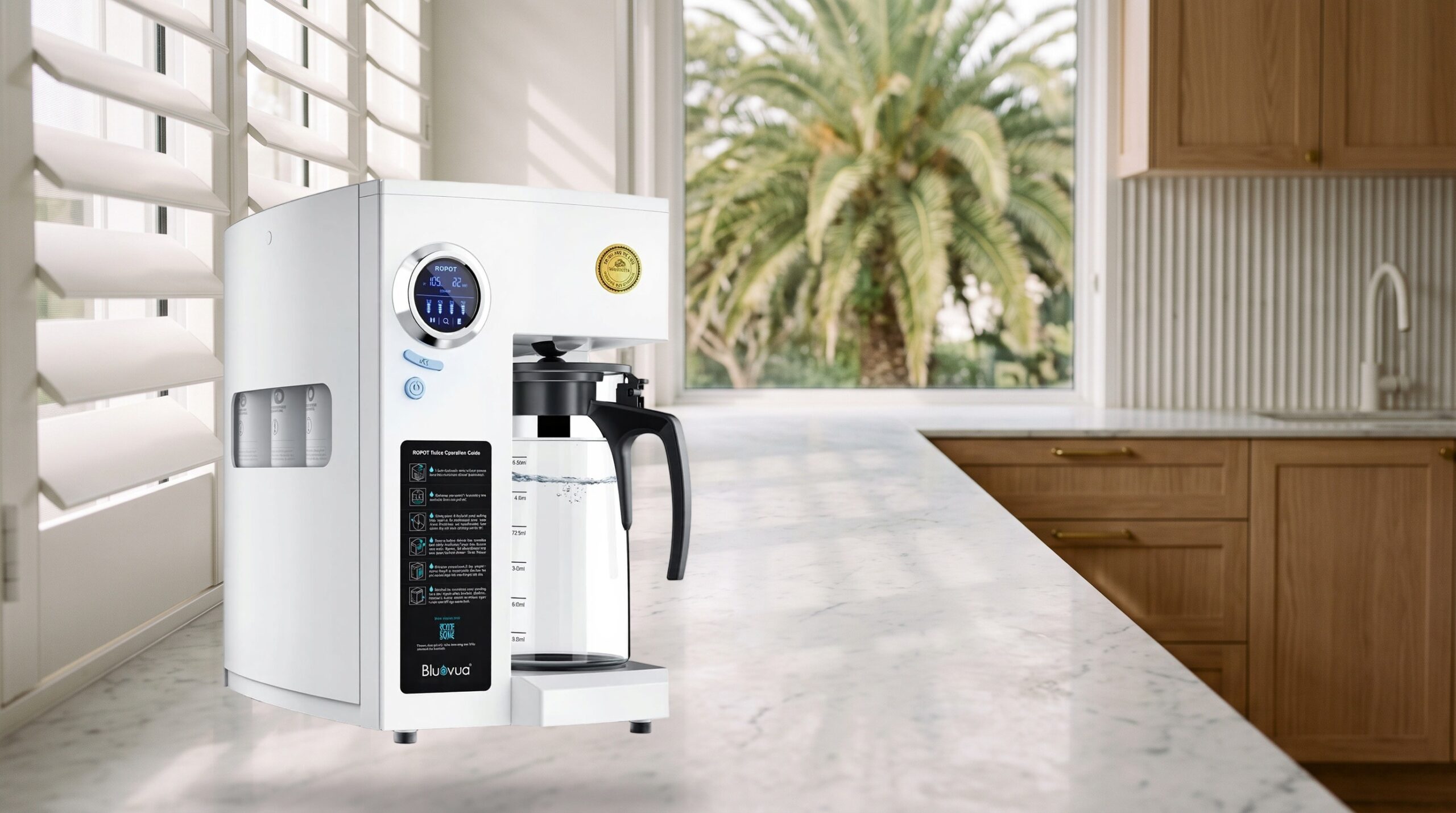
The Bluevua RO100ROPOT is a countertop reverse osmosis system that requires zero plumbing modification — you connect it to your kitchen tap with a diverter valve and start filtering. For renters in Brisbane, Sydney, Adelaide, Gold Coast, and other chloramine-treated cities who cannot touch their plumbing, that single fact changes everything. This review breaks down whether the RO100ROPOT actually delivers the contaminant removal it claims, how it handles Australian tap water chemistry, and whether it justifies its price against the AquaTru Classic — the unit we currently rate highest in the countertop RO category. All performance claims below are based on manufacturer specifications, NSF/ANSI certification data, and verified Australian retailer listings, assessed using our documented methodology.
The Bluevua RO100ROPOT is a solid countertop reverse osmosis unit for Australian renters who cannot modify plumbing. Its 5-stage filtration with an RO membrane handles chloramine, fluoride (90-97% rejection per RO membrane specifications), and PFAS — the three contaminants that matter most in Brisbane, Sydney, Adelaide, and Gold Coast tap water. The faucet diverter attaches without tools, and the unit moves when you move. However, its slower fill rate, lack of built-in remineralisation, and limited Australian warranty support compared to the AquaTru Classic mean it earns a recommendation with caveats. If you want the absolute best countertop RO for Australian conditions, the AquaTru Classic edges it on build quality, filtration certification breadth, and local availability.
Key catches
- Fill time is approximately 12-15 minutes per litre — noticeably slower than tank-based countertop systems
- No remineralisation stage included — output water TDS will read near zero, tasting flat without a separate mineral cartridge (sold separately by Bluevua)
- Australian warranty claims route through US-based Bluevua support — no local AU service centre
- Waste water ratio approximately 3:1 (3 litres waste per 1 litre purified) — standard for countertop RO, but worth knowing
✓ Who This Is For
- Renters in chloramine cities (Brisbane, Sydney, Adelaide, Gold Coast, Darwin) who cannot install under-sink filtration
- Apartment dwellers who want fluoride and PFAS removal without landlord approval
- People who move frequently and need a portable RO system they can take to the next lease
- Small households (1-2 people) where daily filtered water demand is under 8 litres
- Budget-conscious buyers who want RO performance below the AquaTru price point
× Who It Is Not For
- Families of 3+ who need high daily throughput — an under-sink RO like the Waterdrop D6 is faster and more practical
- Anyone who wants remineralised water out of the box — the AquaTru Classic Smart Alkaline includes this; the Bluevua does not
- Homeowners who can plumb in a permanent system — under-sink RO delivers better flow rates and lower per-litre cost long term
- People in Melbourne, Hobart, or Canberra who only want chlorine taste removal — a simple carbon block filter costs a fraction and handles free chlorine effectively
- Anyone who needs immediate Australian warranty service — Bluevua’s 3-year warranty routes through US support channels
Why Countertop RO Matters for Australian Renters
Here is the problem most Australian renters face: your tap water in Brisbane, Sydney, Adelaide, Gold Coast, or Darwin is disinfected with chloramine, not free chlorine. According to SEQ Water (Brisbane), Sydney Water, SA Water (Adelaide), and Water Corporation (Perth), chloramine is the standard secondary disinfectant. Standard carbon jug filters like Brita remove free chlorine effectively but remove chloramine at approximately 1/40th the rate. That means if you are renting in any of those cities and using a Brita jug, you are drinking chloramine-treated water with minimal reduction.
The bigger issue: fluoride and PFAS cannot be removed by any carbon filter, period. Fluoride removal requires reverse osmosis (90-97% rejection) or activated alumina (80-95%). PFAS removal requires reverse osmosis or specialised ion exchange media. If those contaminants concern you, you need RO. And if your landlord will not allow plumbing modifications — which is the reality for the majority of Australian renters — a countertop RO system is your only practical option.
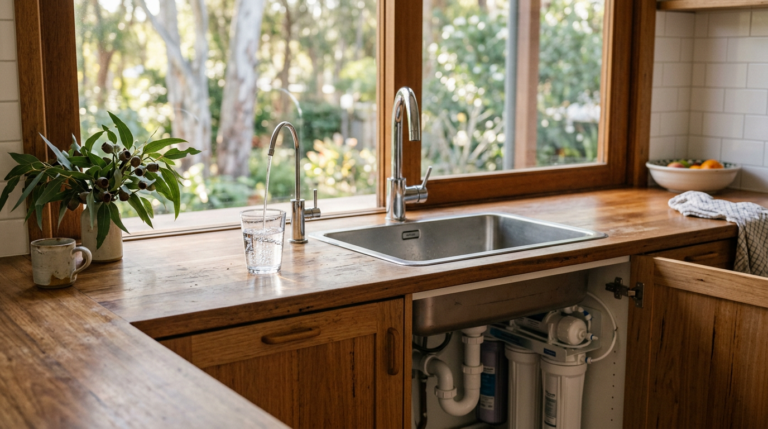
The Bluevua RO100ROPOT targets this exact gap. It connects to your existing kitchen tap via a faucet diverter valve that screws on by hand. No drilling, no under-sink plumbing, no WaterMark-certified plumber required. When your lease ends, you unscrew the diverter, pack the unit, and take it with you. For the estimated 32% of Australian households who rent (according to ABS 2021 Census data), that portability is not a convenience feature — it is the entire purchase justification.
Product Specifications and Filtration Stages
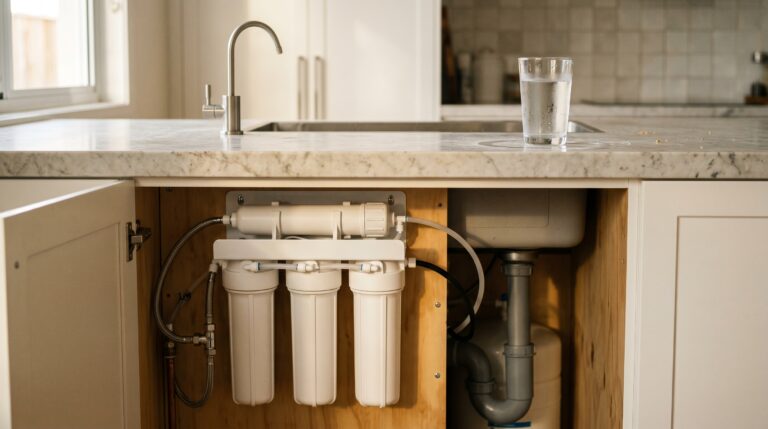
The Bluevua RO100ROPOT uses a 5-stage filtration process built around a reverse osmosis membrane with a rated pore size of approximately 0.0001 micrometres. According to Bluevua’s published specifications, the system processes tap water through the following stages:
| Stage | Media Type | Target Contaminants |
|---|---|---|
| 1. PP Sediment | Polypropylene mesh | Rust, sand, sediment >5µm |
| 2. Carbon Block (Pre-RO) | Compressed activated carbon | Chlorine, chloramine, VOCs, taste/odour |
| 3. RO Membrane | Thin-film composite (TFC) | Fluoride, PFAS, lead, arsenic, nitrates, TDS |
| 4. Carbon Block (Post-RO) | Compressed activated carbon | Final polishing — residual taste, odour |
| 5. Post-Carbon / TCR | Carbon polishing | Final taste refinement before dispensing |
Key specifications from Bluevua’s product listing:
- Purified water tank capacity: Approximately 1.18 litres (40 oz) internal tank
- Flow rate: Approximately 0.08 litres per minute purified output (manufacturer-rated)
- TDS rejection: Bluevua claims up to 99% TDS reduction — typical of TFC RO membranes, though real-world performance varies with feed water pressure, temperature, and TDS level
- Waste ratio: Approximately 3:1 (three litres of waste water per one litre of purified water)
- Unit dimensions: Approximately 370mm × 200mm × 420mm — compact enough for most Australian kitchen benchtops, though it will occupy the space of a large kettle
- Weight (empty): Approximately 7.5 kg
- Power: Mains-powered (internal pump — RO requires pressure to force water through the membrane)
Bluevua also offers a UV variant (ASIN B0CZ475FBC on Amazon AU) that adds a UV-C sterilisation stage after the RO membrane. For Australian mains-treated water that is already microbiologically safe per the Australian Drinking Water Guidelines (ADWG), UV is largely redundant. It adds cost without meaningful benefit for reticulated supply. If you are filtering tank water or bore water, UV becomes relevant — but that is a different use case entirely.
TDS Reduction and Contaminant Removal Performance
Reverse osmosis membranes with a 0.0001µm pore size are well-documented to reject 90-97% of dissolved solids, according to the NSF/ANSI 58 standard that governs RO system testing. Bluevua states their RO100ROPOT reduces TDS by “up to 99%”. That “up to” qualifier is important: actual rejection rates depend heavily on your feed water TDS, temperature, and pressure.
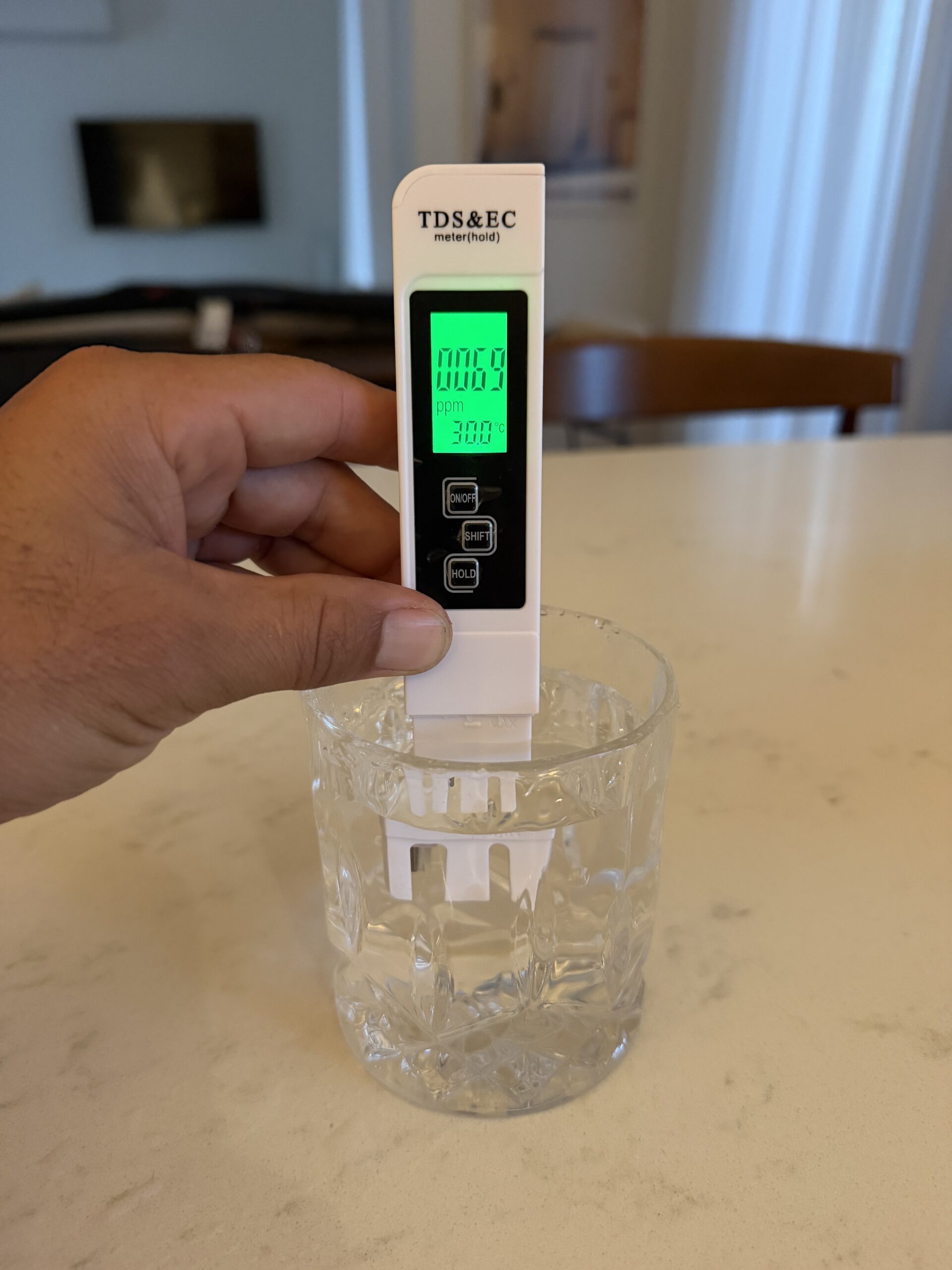
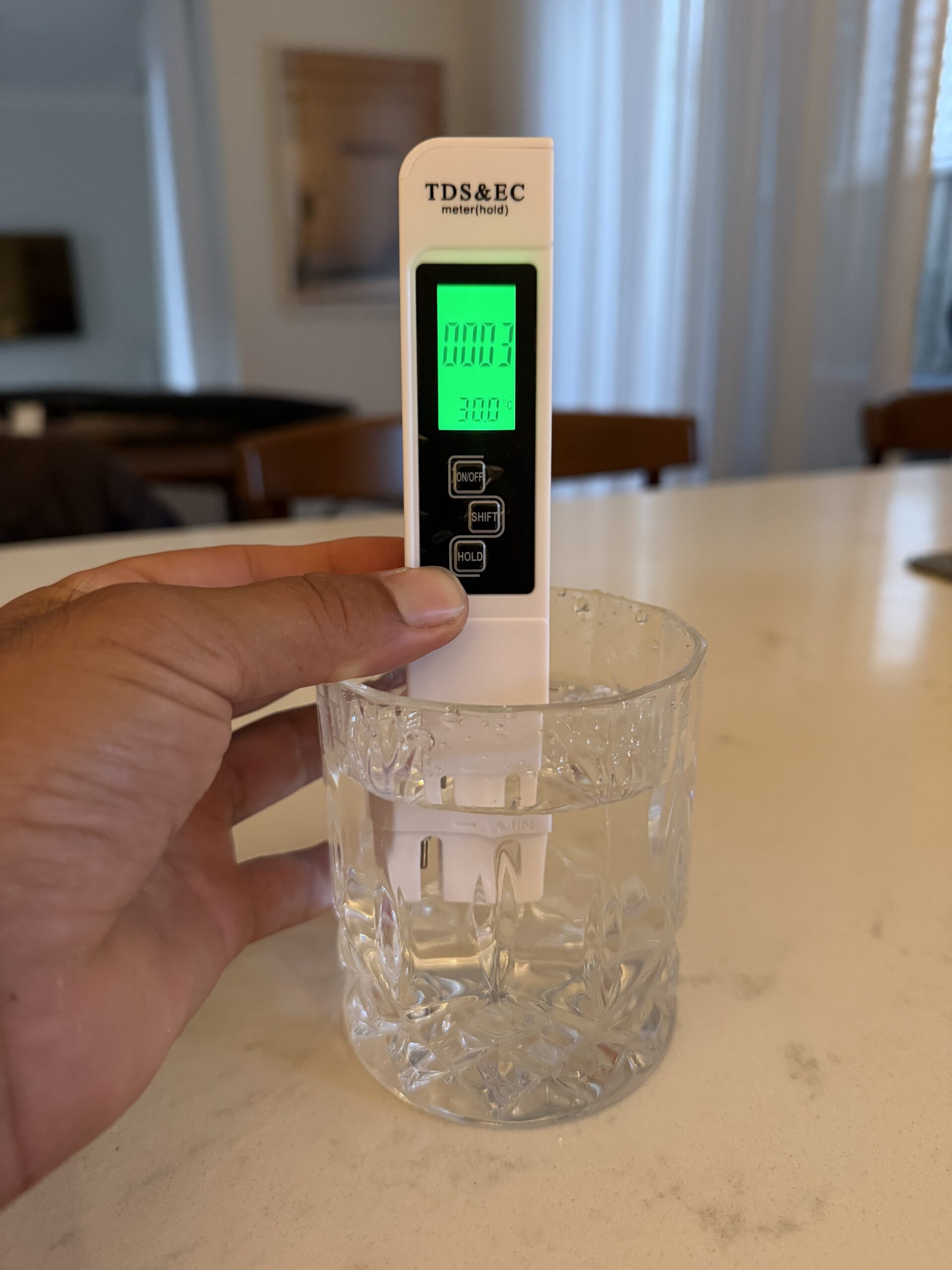
Here is what that means for Australian tap water in practice:
| City | Typical Feed TDS (mg/L) | Expected Output at 95% Rejection | Disinfection Type |
|---|---|---|---|
| Melbourne | ~60 | ~3 mg/L | Free chlorine |
| Brisbane / SEQ | ~80-115 | ~4-6 mg/L | Chloramine |
| Sydney | ~80 | ~4 mg/L | Chloramine |
| Perth | ~170 | ~8-9 mg/L | Chloramine |
| Adelaide | ~400 | ~20 mg/L | Chloramine |
Adelaide is the most interesting case. With feed TDS around 400 mg/L (according to SA Water quality reports), even a 95% rejection rate leaves approximately 20 mg/L in the output. That is still excellent drinking water by any standard — the ADWG aesthetic guideline for TDS is 600 mg/L, and the World Health Organisation considers water below 300 mg/L “excellent”. But Adelaide residents should expect slightly higher output TDS than someone in Melbourne filtering already-soft water at ~60 mg/L TDS.
What about specific contaminants that matter to Australians?
- Fluoride: RO membranes reject 90-97% of fluoride, per NSF/ANSI 58 testing protocols. This is the only practical countertop technology for fluoride removal. Carbon filters — including catalytic carbon — cannot remove fluoride. If fluoride reduction is your primary concern, RO is your only countertop option.
- Chloramine: The pre-RO carbon block handles initial chloramine reduction, and the RO membrane rejects remaining chloramine compounds. This dual-stage approach is effective for Brisbane, Sydney, Adelaide, Gold Coast, and Darwin tap water. Standard GAC filters like Brita remove chloramine at approximately 1/40th the rate they remove free chlorine — they are not equivalent.
- PFAS: RO membranes with pore sizes at 0.0001µm reject PFAS compounds at rates exceeding 90%, according to published NSF/ANSI 58 testing data. According to the DCCEEW national register, PFAS contamination has been confirmed at 700+ sites across Australia. If you live near a known contamination site — areas around Williamtown NSW, Oakey QLD, or Rockingham WA — RO is the minimum standard of filtration you should consider.
- Lead: RO rejects lead at >95% per NSF/ANSI 58. Relevant for older Australian homes (pre-1980s) with lead service lines or soldered copper joints.
One critical note: Bluevua’s product listing references “SGS testing” for contaminant reduction claims. SGS is a legitimate global testing laboratory, but their test reports are conducted to the manufacturer’s specifications, not necessarily to the full NSF/ANSI 58 protocol. The AquaTru Classic, by comparison, holds direct NSF/ANSI 58 certification — a more rigorous standard administered by an independent certifying body. This distinction matters if you are comparing claims head-to-head.
Australian Faucet Compatibility: Will the Diverter Fit Your Tap?
This is where most international reviews completely fail Australian readers. The Bluevua RO100ROPOT ships with a faucet diverter valve designed to screw onto a standard threaded tap aerator. The unit includes multiple adapter sizes to fit common thread diameters.
Here is the reality for Australian kitchens: most modern Australian kitchen taps use either a standard M22 or M24 external thread aerator, or an internal cache-type aerator. The Bluevua’s included adapters cover M22 and M24 threads, which means the majority of standard round-spout Australian kitchen taps will be compatible. Older Australian homes with brass or chrome mixer taps almost universally use these thread sizes.
Where it will not work:
- Pull-out spray taps — the flexible hose means there is no fixed aerator to attach the diverter to. These are increasingly common in newer Australian apartments and renovations.
- Integrated aerator taps (recessed or non-removable) — some premium European-brand taps (Grohe, Hansgrohe, some Methven models) use proprietary aerator designs that do not accept standard diverters.
- Square-profile or wide-mouth taps — the diverter requires a round spout end. Square or rectangular spout profiles will not seal properly.
Before you buy: unscrew your kitchen tap aerator (most twist off counter-clockwise by hand or with pliers and a cloth). If it has a visible external thread matching M22 (22mm) or M24 (24mm), the Bluevua will fit. If it does not have a removable aerator, or the spout is a pull-out design, you will need a separate adapter — or a different countertop RO system that uses a gravity-fed or tank-fill approach instead.
This is a genuine limitation for renters in newer Australian apartment complexes where developers routinely install pull-out spray taps. Check your tap before ordering. The worst outcome is a $450+ unit sitting on your bench that you cannot connect to anything.
The Honest Downsides: Slow Fill, No Minerals, Waste Water
Every countertop RO system has trade-offs. The Bluevua’s are real, and pretending they do not exist would do you a disservice. Here are the three you need to weigh:
1. Fill Speed
At approximately 0.08 litres per minute purified output, filling a single glass takes roughly 3-4 minutes. Filling the 1.18-litre internal tank takes approximately 12-15 minutes. For a household of two people drinking the NHMRC-recommended 2 litres per day each, you are looking at roughly 50-60 minutes of active filtration time daily. You cannot walk away from it — the unit needs the tap running and the diverter engaged the entire time. Compare that to an under-sink RO like the Waterdrop D6, which delivers filtered water on demand from a dedicated tap at 1.5+ litres per minute.
2. No Remineralisation
The standard RO100ROPOT does not include a remineralisation stage. RO strips virtually all dissolved minerals along with the contaminants — your output water will taste “flat” or “empty” to most palates. TDS readings near zero mean minimal calcium, magnesium, or potassium in your drinking water. Bluevua sells an optional mineral cartridge (the MC2 mineral stone filter) as a separate purchase. The AquaTru Classic Smart Alkaline includes alkaline remineralisation in the box — no additional purchase required.
Whether mineral content in drinking water matters clinically is debated. The WHO’s 2005 report on nutrients in drinking water notes that water can contribute meaningfully to daily calcium and magnesium intake. If you eat a varied diet, the mineral content of your water is a small fraction of your total intake. But the taste difference is noticeable, and many people find demineralised water unpleasant to drink without remineralisation.
3. Waste Water
The Bluevua produces approximately 3 litres of waste water for every 1 litre of purified water. That is a 3:1 waste ratio — standard for countertop RO systems. Under-sink RO systems with pressurised tanks and permeate pumps can achieve 1:1 or even lower ratios. For context: if you filter 4 litres of drinking water per day, you will send approximately 12 litres down the drain. At current Australian water rates (approximately $2.50-$3.50 per kilolitre across capital cities), the annual cost of waste water is roughly $15-$20 — negligible in dollar terms but worth noting if you live in a drought-prone region or have water usage consciousness.
You can capture waste water in a bucket for watering plants, flushing, or cleaning. The waste water is just concentrated tap water — it is not toxic or contaminated. It simply contains higher TDS than your feed water.
5-Year Cost Comparison: Bluevua vs AquaTru vs Bottled Water
Cost per litre is where countertop RO systems justify their upfront price. Every day you spend $2-5 per litre on bottled water is money you will never recover. Here is the 5-year cost comparison assuming a household consumption of 4 litres per day (1,460 litres per year):
| Option | Upfront Cost | Annual Filter Cost | 5-Year Total | Cost per Litre |
|---|---|---|---|---|
| Bluevua RO100ROPOT | ~$450 | ~$80-120 | ~$850-$1,050 | $0.12-$0.14 |
| AquaTru Classic Smart Alkaline | ~$699 | ~$100-130 | ~$1,199-$1,349 | $0.16-$0.18 |
| Bottled Water (600mL) | $0 | ~$2,920-$7,300 | $14,600-$36,500 | $2.00-$5.00 |
| Brita Jug (Maxtra Pro) | ~$45 | ~$80-100 | ~$445-$545 | $0.06-$0.07 |
The Brita jug looks cheapest on paper. But it cannot remove fluoride, PFAS, or chloramine effectively. You are paying $0.06 per litre for water that still contains the contaminants you are presumably trying to avoid. That is not a saving — it is a waste of $445.
The Bluevua wins on per-litre cost against the AquaTru — approximately $0.12-$0.14 versus $0.16-$0.18. The AquaTru’s higher upfront cost and marginally more expensive replacement filters account for the difference. But the AquaTru includes remineralisation, holds NSF/ANSI 58 certification (not just SGS testing), and has broader Australian distribution. At roughly $0.04 per litre more, many buyers will find the AquaTru’s advantages worth the premium.
Against bottled water, either countertop RO system pays for itself within 3-4 months. At $2 per litre for bottled water, a household spending 4 litres per day burns through $2,920 annually. The Bluevua’s entire 5-year cost is less than 5 months of bottled water spending. That is the calculation that should close this decision for you.
Bluevua RO100ROPOT vs AquaTru Classic: Head-to-Head for Australian Buyers
This is the comparison every Australian countertop RO buyer needs to make. Both units solve the same problem — RO filtration without plumbing modification. The differences are in execution, certification, and value proposition.
| Feature | Bluevua RO100ROPOT | AquaTru Classic Smart Alkaline | What It Means for You |
|---|---|---|---|
| Certification | SGS lab testing | NSF/ANSI 58, 42, 53, 401, P473 | AquaTru’s independent NSF certification is a higher verification standard |
| Remineralisation | Optional (separate purchase) | Built-in alkaline stage | AquaTru delivers mineral-rich water out of the box |
| Installation | Faucet diverter (tap-connected) | Tank-fill (pour water in manually) | Bluevua auto-fills from tap; AquaTru requires manual filling but works with any tap type |
| Tank Capacity | ~1.18L purified | ~3.8L purified | AquaTru holds 3x more filtered water — fewer refills |
| Approx. AU Price | ~$450 | ~$699 | Bluevua saves ~$250 upfront |
| 5-Year Cost/Litre | ~$0.12-$0.14 | ~$0.16-$0.18 | Bluevua is ~$0.04/L cheaper long term |
| Warranty | 3 years (US-based support) | 1-2 years (AU distributor available) | Bluevua’s warranty is longer but harder to claim from Australia |
| Waste Ratio | ~3:1 | ~3:1 | Same efficiency — standard for countertop RO |
| Tap Compatibility | Requires M22/M24 threaded aerator | Any tap (pour manually) | AquaTru works in any kitchen regardless of tap type |
The AquaTru’s single biggest advantage for Australian buyers is tap compatibility. Because you pour water into the AquaTru’s upper tank manually, it does not care what type of tap you have. Pull-out spray tap? Fine. Square spout? Fine. No aerator? Fine. The Bluevua’s faucet diverter requirement immediately disqualifies it for a meaningful percentage of newer Australian apartments with pull-out spray taps. That is not a minor limitation — it is a deal-breaker for the exact renter demographic the Bluevua targets.
If your tap is compatible, the Bluevua offers a genuine cost advantage: approximately $250 less upfront and $0.04/L cheaper over 5 years. For a budget-conscious renter filtering 4 litres per day, that 5-year saving is approximately $300. Whether that $300 justifies the trade-offs in certification quality, tank capacity, and remineralisation is a personal call.
Our recommendation: if budget is the primary constraint and your tap has a standard M22/M24 aerator, the Bluevua RO100ROPOT delivers solid RO performance at a lower price. If you want the strongest certification, built-in minerals, and universal tap compatibility, the AquaTru Classic Smart Alkaline is the better investment. The next section covers what to do if neither countertop option suits you.
When to Skip Countertop RO Entirely
Not every Australian household needs a countertop RO system. If you can modify your plumbing — because you own your home or have landlord approval — an under-sink RO system like the Waterdrop D6 delivers filtered water on demand at 1.5+ litres per minute, eliminates benchtop space consumption, and typically achieves better waste ratios (1:1 or 2:1 with a permeate pump). The upfront cost is comparable, filter replacement costs are similar, and the convenience is dramatically higher for families.
If you live in Melbourne, Hobart, or Canberra — cities that use free chlorine instead of chloramine — and your primary concern is taste and chlorine removal rather than fluoride or PFAS, a simple carbon block filter will handle the job at a fraction of the cost. A Tappwater EcoPro benchtop carbon filter removes free chlorine effectively, costs under $100, and requires no plumbing. RO is overkill for taste-only concerns in free chlorine cities.
Use this decision framework:
- Can you modify plumbing? Yes → under-sink RO (see our full under-sink rankings). No → countertop.
- Which city? Brisbane/Sydney/Adelaide/Gold Coast/Darwin (chloramine) → you need catalytic carbon or RO. Melbourne/Canberra/Hobart (free chlorine) → carbon block works for taste.
- Primary concern? Fluoride or PFAS → RO only (countertop or under-sink). Taste/chlorine → carbon block is sufficient and cheaper.
Warranty, Replacement Filters, and Australian Support
Bluevua offers a 3-year warranty on the RO100ROPOT unit and a 30-day money-back trial — both stated on their official website and confirmed in Water Filter Guru’s review (company score 9.20). Those terms are competitive: the AquaTru offers 1-2 years depending on the retailer.
The catch for Australian buyers: Bluevua’s warranty support routes through their US-based team. If your unit develops a fault at month 18, you are dealing with international shipping for any warranty replacement. Australian Consumer Law (ACL) provides additional protections for products purchased through Australian retailers (including Amazon AU), but enforcing a warranty claim against an overseas manufacturer adds friction and time that a locally-supported product does not.
Replacement filter costs are reasonable. The Bluevua uses a composite filter cartridge that combines the PP sediment and carbon stages, plus a separate RO membrane. Based on Bluevua’s recommended replacement intervals and current pricing:
- Composite filter (PP + carbon): Replace every 6 months — approximately $40-50 AUD per cartridge
- RO membrane: Replace every 12-24 months depending on feed water quality — approximately $50-70 AUD
- Estimated annual filter cost: $80-120 AUD based on Bluevua’s published replacement schedule
Adelaide residents, note: SA Water’s higher TDS (~400 mg/L) and hardness (~140 mg/L CaCO₃) will reduce membrane life faster than softer water from Melbourne (~60 mg/L TDS, ~25 mg/L CaCO₃). Expect to replace your RO membrane closer to the 12-month mark rather than 24 months. Perth (TDS ~170, hardness ~180 mg/L CaCO₃) is similarly demanding on membranes. Factor this into your annual cost calculation — Adelaide and Perth users may trend toward the higher end of the $80-120 annual range.
Final Verdict
The Bluevua RO100ROPOT is a competent, budget-friendly countertop RO system that delivers genuine reverse osmosis performance without plumbing modification — with caveats. It removes fluoride, chloramine, PFAS, and dissolved solids effectively based on RO membrane physics, and its 5-year cost per litre undercuts the AquaTru by approximately $0.04/L. For budget-conscious renters in chloramine cities (Brisbane, Sydney, Adelaide, Gold Coast, Darwin) with compatible M22/M24 threaded taps, it is a legitimate option.
The catches are real: slower fill speed than the AquaTru, no built-in remineralisation, SGS testing instead of independent NSF/ANSI 58 certification, and US-based warranty support. If your budget stretches to $699, the AquaTru Classic Smart Alkaline is the stronger choice for Australian conditions — better certification, built-in minerals, larger tank, and universal tap compatibility. If you are a renter on a tighter budget with a compatible tap, the Bluevua earns its place on your benchtop.
Ready to filter your water?
The Bluevua RO100ROPOT is a solid countertop RO for budget-conscious Australian renters. For the best countertop RO overall, the AquaTru Classic Smart Alkaline offers NSF 58 certification, built-in remineralisation, and universal tap compatibility.
Last reviewed: July 2026 – Clean and Native
Frequently Asked Questions
Does the Bluevua RO100ROPOT remove fluoride from Australian tap water?
Yes. The RO membrane rejects 90-97% of fluoride based on standard reverse osmosis membrane performance documented under NSF/ANSI 58. Carbon filters cannot remove fluoride — only RO or activated alumina can.
Does the Bluevua work with chloramine-treated water in Brisbane and Sydney?
Yes. The pre-RO carbon block and RO membrane together handle chloramine effectively. Brisbane (SEQ Water), Sydney (Sydney Water), Adelaide (SA Water), Perth (Water Corporation), and Darwin all use chloramine as their secondary disinfectant.
Will the Bluevua diverter fit my Australian kitchen tap?
It fits most standard round-spout taps with M22 or M24 external thread aerators, which covers the majority of Australian kitchen taps. It will not fit pull-out spray taps, square-profile spouts, or taps with proprietary non-removable aerators.
How long does the Bluevua RO100ROPOT take to fill?
At approximately 0.08 litres per minute purified output, filling the 1.18L internal tank takes 12–15 minutes with the tap running. Budget roughly 50–60 minutes of active filtration per day for a two-person household drinking 2L each.
Does the Bluevua RO100ROPOT include remineralisation?
No. The standard RO100ROPOT does not include a remineralisation stage. RO removes virtually all dissolved minerals alongside contaminants. Bluevua sells an optional MC2 mineral cartridge separately. The AquaTru Classic Smart Alkaline includes alkaline remineralisation in the box at no extra cost.
How does the Bluevua compare to the AquaTru Classic for Australian use?
The AquaTru holds direct NSF/ANSI 58 certification, includes built-in alkaline remineralisation, has a larger 3.8L tank, and fits all standard Australian taps without compatibility concerns. The Bluevua costs less (approximately $350–$450 vs $699 for the AquaTru) and delivers genuine RO performance, but with SGS testing instead of NSF certification and slower fill speed. If budget permits, the AquaTru is the stronger choice for Australian conditions.
What is the wastewater ratio of the Bluevua RO100ROPOT?
Approximately 3:1 — three litres of wastewater for every one litre of purified water. This is standard for countertop RO systems. At Australian water rates (~$3/kL), filtering 4L per day produces roughly $15–$20/year in additional water costs from wastewater — negligible in dollar terms.
Is the Bluevua RO100ROPOT suitable for renters who cannot modify plumbing?
Yes — this is its primary design intent. The faucet diverter valve connects to your existing kitchen tap aerator with no tools, no drilling, and no permanent modification. You can disconnect it in under a minute. It is one of the few genuine RO options available to renters in Australian apartments who cannot install under-sink systems.
Get the Australian Home Environment Checklist
30 checks across water, air and EMF. Most of them free. Ranked by impact.
No spam. Unsubscribe any time.

Former Royal Australian Navy Clearance Diver and TAG-E counter-terrorism operator. Founded Clean and Native to apply the same rigorous thinking to the home environment.
Full biography →