Adelaide Tap Water Quality 2026: What’s Actually In It?
Adelaide Water Quality: Quick Verdict
| TDS | ~300–500 mg/L — saltiest Australian capital city |
| Hardness | ~100–160 mg/L CaCO₃ — moderately hard |
| Fluoride | ~0.9–1.0 mg/L — near top of NHMRC guideline |
| pH | 7.4–7.9 |
| Disinfection | Chloramine — standard carbon (Brita) does NOT remove it |
| Primary source | Murray River (50–90%) + Hills Face Zone catchments |
| Bottom line | Australia’s most mineral-laden capital water. High TDS + chloramine + high fluoride = RO is the most defensible choice for anyone who cares about water quality. Carbon filtration alone is insufficient. |
Jayce Love, a Royal Australian Navy Clearance Diver, researched and tested the products in this guide. Adelaide has the highest total dissolved solids (TDS) of any Australian capital city, drawing the majority of its water supply from the Murray River — Australia’s longest river, shared by four states and carrying dissolved minerals accumulated across its 2,500 km journey through semi-arid country. Understanding Adelaide tap water means understanding the Murray’s chemistry, the role of the Hills Face Zone catchments, and why the right filter makes a more significant difference in Adelaide than almost anywhere else in Australia.
The three products we own are measured first-hand by Jayce Love, former Royal Australian Navy Clearance Diver; every other product is assessed on published manufacturer specifications and independent certification using our documented methodology — no gifted units, no brand payments.
Two facts define Adelaide water quality above all others. First, TDS of 300–500 mg/L — against Melbourne’s ~60 and Brisbane’s ~100 — which contributes to the distinctive salty, slightly flat taste many Adelaide residents describe. Second, Adelaide uses chloramine as its disinfectant, not free chlorine. Standard activated carbon filters (Brita pitchers, generic fridge filters, most cheap under-sink cartridges) do not effectively remove chloramine. Adelaide’s water quality case for filtration is, measurably, the strongest of any Australian capital.
Adelaide’s Water Supply: Murray River and the Hills Face Zone
SA Water manages Adelaide’s supply from two very different source types that are blended before reaching taps:
- Murray River: The dominant source — providing 50–90% of Adelaide’s water depending on rainfall and drought conditions. The Murray picks up dissolved salts, minerals, and agricultural runoff over its vast catchment. River Murray water is treated at Mannum-Adelaide Pipeline and Murray Bridge-Onkaparinga Pipeline facilities. When Murray water dominates, Adelaide TDS climbs toward 400–500 mg/L.
- Hills Face Zone catchments: Protected reservoirs including Happy Valley, Mount Bold, Myponga, Barossa, and Millbrook in the Adelaide Hills. Catchment water is significantly cleaner and lower in TDS than Murray water (~100–150 mg/L). When catchment water availability is high (wet years), blending brings Adelaide’s overall TDS down. In drought years, the Murray dominates and TDS rises noticeably.
- Morgan-Whyalla pipeline: Serves regional SA, also drawing from the Murray.
The seasonal and year-to-year variability means Adelaide water quality is not fixed. A TDS meter test during a wet year might read 250 mg/L; the same tap during a drought year could read 480 mg/L. SA Water publishes water quality reports by zone, and individual suburb supply source can be checked on their website.
Adelaide Water Quality Data 2026
| Parameter | Adelaide Level | ADWG Guideline | What It Means |
|---|---|---|---|
| TDS | ~300–500 mg/L (Murray-dependent) | <600 mg/L | Highest of any AU capital — salty, mineral-laden |
| Hardness (CaCO₃) | ~100–160 mg/L | No guideline | Moderate-hard — noticeable scale on appliances |
| Fluoride | ~0.9–1.0 mg/L | 0.6–1.1 mg/L | Near top of guideline; added by SA Water |
| pH | 7.4–7.9 | 6.5–8.5 | Normal range |
| Disinfection | Chloramine (monochloramine) | <3 mg/L | NOT free chlorine — standard carbon inadequate |
| Sodium | ~80–200 mg/L | <180 mg/L | Can exceed aesthetic guideline in drought years |
| Chloride | ~100–250 mg/L | <250 mg/L | Contributes to salty taste — at or near guideline in drought |
| E. coli | 0 / 100 mL | 0 / 100 mL | Compliant — microbiologically safe |
Sources: SA Water Annual Drinking Water Quality Report 2024–25; ADWG 2011 (updated 2022); Murray-Darling Basin Authority water quality data.
The Murray River Factor: Why Adelaide Water Tastes Different
The Murray River flows from the Australian Alps through Victoria and along the NSW/VIC border before crossing into SA and reaching the sea at Lake Alexandrina. Along 2,500+ km it collects mineral runoff from agricultural land, dryland salinity areas, and limestone bedrock — arriving in SA with a naturally high ionic load. The primary ions contributing to Adelaide’s elevated TDS are sodium, chloride, sulphate, and magnesium, which give the water a slightly salty and flat character distinctive to Adelaide tap water.
The taste difference between a high-Murray year and a high-catchment year is noticeable. During extended droughts — the Millennium Drought (1997–2009) hit Adelaide water quality particularly hard — Murray water dominance pushed Adelaide TDS to the higher end of the range. Residents who have moved from Melbourne or Sydney often notice Adelaide’s water quality immediately.
Chloramine: Adelaide’s Invisible Filter Problem
Adelaide uses chloramine (monochloramine) as its primary disinfectant, as does Brisbane, Perth, Sydney, and Darwin. Melbourne and Hobart use free chlorine. This distinction is critical for filter selection.
Standard granular activated carbon (GAC) — the media in Brita pitchers, most fridge filters, and many cheap under-sink cartridges — removes free chlorine through a rapid, effective catalytic reaction. The same GAC removes chloramine at approximately 1/40th to 1/50th the rate. A standard carbon filter in Adelaide will have negligible effect on chloramine. Given that Adelaide’s water also has high TDS, chloramine, and high fluoride simultaneously, a single-stage carbon filter addresses only peripheral concerns.
For Adelaide residents: if you’re using a Brita pitcher believing it’s meaningfully improving your water quality, you’re mostly wrong. It may reduce some volatile organic compounds, but it’s not touching chloramine (your disinfectant), TDS (your primary taste problem), or fluoride. A catalytic carbon block does address chloramine; only RO addresses the full picture.
Adelaide Fluoride: Near the Top of the Guideline
SA Water adds fluoride to Adelaide’s supply at approximately 0.9–1.0 mg/L — near the upper end of the NHMRC recommended range of 0.6–1.1 mg/L. This is higher than Perth (~0.7 mg/L), Brisbane (~0.7 mg/L), and Melbourne (~1.0 mg/L), and approaches the technical upper limit.
Standard carbon filters cannot remove fluoride. This is one of the most common filter misconceptions in Australia. Only two technologies remove fluoride from drinking water:
- Reverse osmosis (RO): 90–97% removal, depending on membrane quality and water pressure. The definitive solution for fluoride reduction.
- Activated alumina: 80–95% removal when properly maintained. Less common in residential applications. Requires periodic regeneration or replacement.
For Adelaide residents concerned about fluoride combined with the high TDS, RO is the logical single solution — it addresses both simultaneously.
Adelaide vs Other Australian Capitals: Water Quality Comparison
| City | TDS | Hardness | Disinfection | Primary Source | Filter Need |
|---|---|---|---|---|---|
| Adelaide | ~300–500 | Moderate-hard | Chloramine | Murray River | Highest |
| Perth | ~170 | Hard | Chloramine | IWSS (desal + groundwater) | High |
| Brisbane/SEQ | ~100 | Moderate | Chloramine | Wivenhoe + SEQ grid | Moderate-high |
| Sydney | ~80 | Soft | Chloramine | Warragamba Dam | Moderate |
| Melbourne | ~60 | Very soft | Free chlorine | Protected catchments | Low |
| Hobart | ~15–25 | Very soft | Free chlorine | Derwent River catchment | Very low |
Best Water Filters for Adelaide: By Concern
High TDS / taste / overall minerals: Reverse osmosis
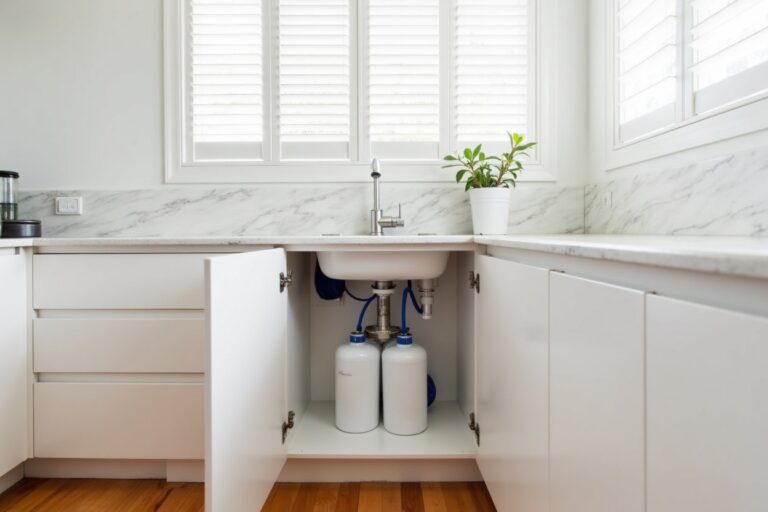
For Adelaide’s defining water quality characteristic — high dissolved solids from the Murray — only reverse osmosis provides comprehensive reduction. RO removes 90–97% of TDS, eliminating the salty, flat taste. It simultaneously removes chloramine (via catalytic pre-carbon stage in most RO systems), fluoride (90–97% via membrane), and any trace PFAS or heavy metals. The EcoHero 5-stage under-sink RO (~$490 installed by a plumber) is a well-regarded Australian option. The AquaTru benchtop RO is appropriate for renters who cannot modify under-sink plumbing.
Chloramine taste and odour (without TDS reduction): Catalytic carbon block
If your primary concern is chloramine taste and odour rather than overall TDS, a catalytic carbon block under-sink filter is more economical than RO ($200–400 installed vs $500+). Puretec’s PureMix Z series and TAPP EcoPro clip-on filter both use catalytic carbon rated for chloramine. The TAPP EcoPro is particularly useful for Adelaide renters who cannot modify under-sink plumbing. Be clear on the limitation: catalytic carbon addresses chloramine but not TDS, sodium, or fluoride.
Shower filter: Vitamin C or catalytic carbon (NOT KDF-55)
Adelaide uses chloramine, making KDF-55 shower filters (the most commonly sold type at hardware stores) largely ineffective. Vitamin C (ascorbic acid) inline shower filters neutralise both free chlorine and chloramine instantly and completely. Catalytic carbon shower filters also work. Budget $40–120 for a quality vitamin C inline shower filter; replace cartridges every 3–6 months.
Should Adelaide Residents Drink Tap Water?
Adelaide tap water is safe. SA Water consistently meets Australian Drinking Water Guideline requirements for microbiological safety, and while TDS approaches guideline limits in drought years, it remains within the acceptable range. The ADWG aesthetic guideline for TDS is 500 mg/L — Adelaide’s water can approach this threshold during drought. “Aesthetic” means taste and appearance, not health risk.
The case for filtering in Adelaide is not that tap water is unsafe. It’s that the water quality differential between unfiltered and RO-filtered is much more noticeable in Adelaide than in Melbourne or Hobart. An RO system in Adelaide transforms tap water from noticeably salty and mineral-laden to clean and almost flavourless. The sensory improvement is significant — more so than in most other Australian cities.
Frequently Asked Questions
Why does Adelaide water taste salty?
Adelaide draws 50–90% of its water supply from the Murray River, which accumulates dissolved sodium, chloride, sulphate, and other minerals over its 2,500+ km journey through semi-arid Australia. The resulting TDS of 300–500 mg/L (compared to Melbourne’s ~60 or Sydney’s ~80) is responsible for the characteristic flat, slightly salty taste. During droughts, when Murray River reliance increases, the taste intensifies. Hills Face Zone catchment water blending reduces it during wet years.
Does Adelaide water have chloramine?
Yes. SA Water uses chloramine (monochloramine) as Adelaide’s primary disinfectant. Standard activated carbon filters including Brita pitchers do not effectively remove chloramine — they remove it at approximately 1/40th the rate of free chlorine. Adelaide residents need catalytic carbon block or reverse osmosis to address chloramine.
What is the TDS of Adelaide tap water?
Between approximately 300 and 500 mg/L depending on the Murray River vs. catchment blend at the time of testing. This is the highest TDS of any Australian capital city and is primarily responsible for Adelaide’s taste reputation. A $15 TDS meter from Amazon lets you test your specific tap water. During wet years with high catchment availability, TDS will be at the lower end; during droughts, it may approach 500 mg/L.
Will a Brita filter fix Adelaide water?
No, not meaningfully. A Brita pitcher uses standard GAC which cannot remove chloramine (Adelaide’s disinfectant) at any practical flow rate, cannot remove TDS or dissolved salts (the primary taste problem), and cannot remove fluoride. A Brita may marginally improve taste through partial organic compound adsorption, but it does not address Adelaide’s core water quality issues. An RO system is the appropriate choice.
Can I remove fluoride from Adelaide water?
Yes, with reverse osmosis (90–97% removal) or activated alumina (80–95%). Standard carbon filters, including Brita and most under-sink carbon filters, cannot remove fluoride. Adelaide adds fluoride at approximately 0.9–1.0 mg/L — near the top of the NHMRC recommended range.
Is Adelaide water safe to drink without a filter?
Yes. Adelaide tap water is microbiologically safe and complies with the Australian Drinking Water Guidelines. The concerns about TDS, chloramine, and fluoride are quality-of-life and precautionary issues, not safety emergencies. Many Adelaide residents drink unfiltered tap water without any health consequences. Filtration (particularly RO) significantly improves taste and reduces dissolved minerals.
What is the best water filter for Adelaide?
For comprehensive improvement, a reverse osmosis system. RO addresses Adelaide’s three main water quality characteristics simultaneously: high TDS/salinity (90–97% reduction), chloramine (catalytic pre-carbon stage), and fluoride (90–97% via membrane). Under-sink RO (~$490 installed) is the permanent solution; AquaTru benchtop RO (~$400–500) suits renters. If budget is the constraint, a TAPP EcoPro or Puretec catalytic carbon filter ($50–200) addresses chloramine but not TDS or fluoride.
How does Adelaide water compare to Melbourne?
Very differently. Melbourne uses free chlorine (Brita actually works), has very soft water (~25 mg/L CaCO₃), and TDS of ~60 mg/L — effectively mountain-clean water. Adelaide uses chloramine (Brita largely fails), has moderate-hard water (~130 mg/L CaCO₃), and TDS 5–8x higher from Murray River salinity. The sensory difference between Adelaide and Melbourne tap water is among the most pronounced of any two Australian capitals.
Does Adelaide’s water quality vary between suburbs?
Yes, because the Murray vs. catchment blend varies by treatment plant and distribution zone. Southern Adelaide and Hills suburbs often receive more catchment water (lower TDS). Northern and western suburbs may receive more Murray-sourced water (higher TDS). SA Water publishes supply zone information, and a TDS meter will accurately reflect your specific supply quality in real time.
Our Top Picks
For most Australian homes, the TAPP EcoPro handles chloramine and heavy metals at the tap. If you need fluoride removal, the iSpring RCC7 RO system is the only realistic option.
Get the Australian Home Environment Checklist
30 checks across water, air and EMF. Most of them free. Ranked by impact.
No spam. Unsubscribe any time.

Former Royal Australian Navy Clearance Diver and TAG-E counter-terrorism operator. Founded Clean and Native to apply the same rigorous thinking to the home environment.
Full biography →