EMF Protection Queensland (2026): What Actually Works and What to Ignore
Most EMF protection products sold in Queensland do not work — stickers, pendants, harmonisers, and “scalar energy” devices have zero measurable effect on RF, magnetic, or electric field levels. What actually reduces exposure in Queensland homes is a systematic sequence: measure your actual readings with a calibrated meter, remove or distance internal sources (routers, inverters, wiring faults), then shield against verified external sources only if needed. The catches: Queensland’s lightweight timber construction and metal roofing create specific challenges (RF penetration, reflective surfaces) that render generic southern-state advice ineffective, and you will waste money on shielding before identifying your actual dominant sources.
| Approach | Queensland Effectiveness | Verdict |
|---|---|---|
| Calibrated meter + source removal | Verifiable 70–95% reduction in documented cases | Recommended |
| Targeted shielding (post-measurement) | Works for specific external sources (towers, smart meters) | Situational |
| Stickers, pendants, harmonisers | Zero measurable effect in all tests | Avoid entirely |
Most EMF protection products sold in Queensland in 2026 do not work. Stickers, pendants, harmonisers, and “scalar energy” devices have zero measurable effect on radiofrequency, magnetic, or electric field levels. What actually reduces EMF exposure in a Queensland home is a systematic sequence: measure your actual readings, remove or distance internal sources, then — and only then — shield against verified external sources. This article covers the specific products, techniques, and measurements that produce real results in Queensland conditions, and names the products that are a complete waste of money.
The three products we own are measured first-hand by Jayce Love, former Royal Australian Navy Clearance Diver; every other product is assessed on published manufacturer specifications and independent certification using our documented methodology — no gifted units, no brand payments.
Why Queensland Homes Have Specific EMF Challenges
Why Queensland Homes Have Specific EMF ChallengesQueensland’s building stock, climate, and infrastructure create EMF conditions that differ from southern states in measurable ways. Understanding these differences matters because they determine which protection strategies are effective and which are irrelevant.
Lightweight Construction
The majority of Queensland residential dwellings — particularly from Coolangatta to Cairns — use timber-frame construction with fibre cement, weatherboard, or lightweight cladding. Unlike double-brick homes common in Melbourne or Adelaide, these walls provide virtually zero RF shielding. Lightweight weatherboard walls provide far less RF attenuation than double-brick construction. This means external RF sources — mobile towers, neighbours’ routers, smart meters — penetrate Queensland homes with minimal loss.
Queensland Smart Meters
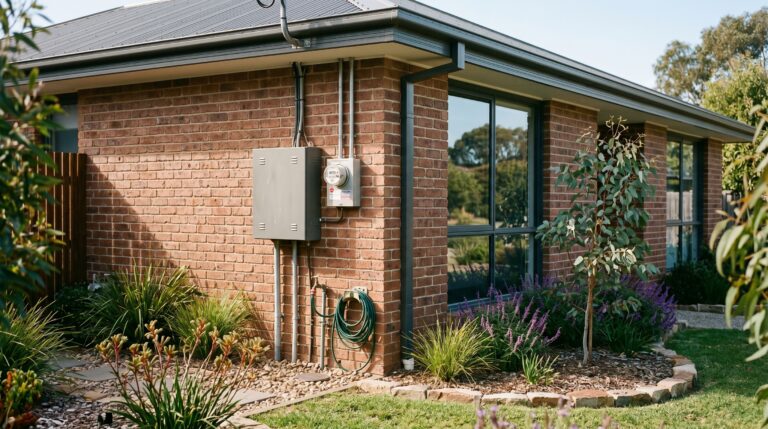
Energex and Ergon Energy have deployed smart meters across South East Queensland and regional areas. These meters transmit on 900 MHz in short bursts. The critical detail: time-averaged readings appear low (often well under ARPANSA’s thermal safety limit of 1,000 µW/cm² at 900 MHz), but peak readings during transmission bursts can be 100 to 1,000 times higher than the time-average. A meter mounted on a bedroom wall — common in Queensland slab-on-ground and split-level homes — can produce peak RF readings of 5-50 µW/cm² at the pillow, which is 50 to 500 times above the Building Biology sleeping area guideline of less than 0.1 mW/m² (equivalent to 0.01 µW/cm²).
Air Conditioning and Electrical Loading
Queensland homes run air conditioning 6-8 months per year. The wiring to split-system indoor units — often mounted on bedroom walls — carries substantial current and produces AC magnetic fields. AC magnetic fields near indoor split-system wiring can exceed the Building Biology sleeping area guideline of less than 0.2 µT. These fields cannot be shielded; the only solution is distance or circuit management.
Elevated Homes and Wiring Runs
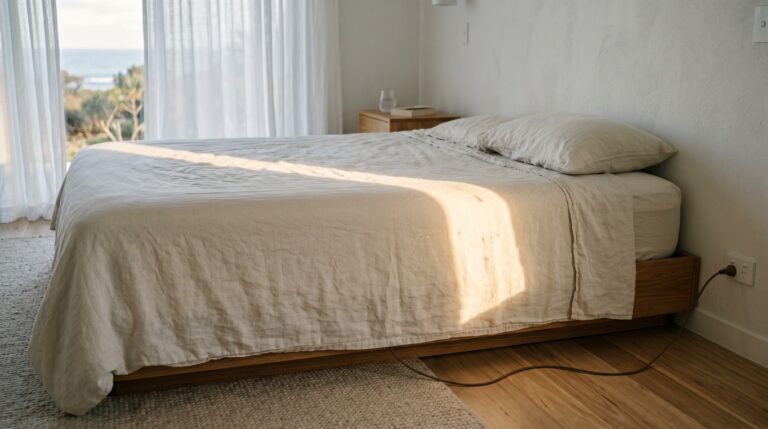
Traditional Queenslander homes on stumps route electrical wiring beneath the floor. This places active circuits directly below sleeping areas. Without a demand switch, these circuits produce AC electric fields that couple capacitively with the body throughout the night, even when no appliances are drawing current. Electric fields in elevated Queenslander bedrooms can sit well above the Building Biology guideline of less than 5 V/m at bed height.
The Measurement-First Protocol: Why You Cannot Skip This Step
Every credible EMF reduction strategy starts with measurement. Not estimation, not assumption, not a sales rep telling you your home is “full of electrosmog.” Measurement with a calibrated instrument that gives you numbers in standard units (µT for magnetic, V/m for electric, µW/m² or mW/m² for RF).
What to Measure and What the Numbers Mean
| Field Type | Unit | Building Biology Sleeping Guideline | ARPANSA Limit | Typical QLD Bedroom (Before) |
|---|---|---|---|---|
| AC Magnetic | µT (microtesla) | < 0.2 µT | 200 µT (1,000x higher) | 0.05 – 0.8 µT |
| AC Electric | V/m (volts per metre) | < 5 V/m | 5,000 V/m | 8 – 40 V/m |
| RF / Microwave | mW/m² | < 0.1 mW/m² | 10,000 mW/m² (at 900 MHz) | 0.001 – 50 mW/m² |
Note the gap between ARPANSA limits and Building Biology guidelines. ARPANSA’s limits are thermal safety limits — they prevent tissue heating. They are not precautionary limits. Building Biology guidelines represent a precautionary framework for sleeping environments. Neither framework is “wrong” — they answer different questions. ARPANSA asks: “At what level does tissue heat measurably?” Building Biology asks: “What level is associated with undisturbed sleep in sensitive individuals?” You choose your own threshold; either way, you need a measurement to know where you stand.
Recommended Meters for Queensland Home Audits
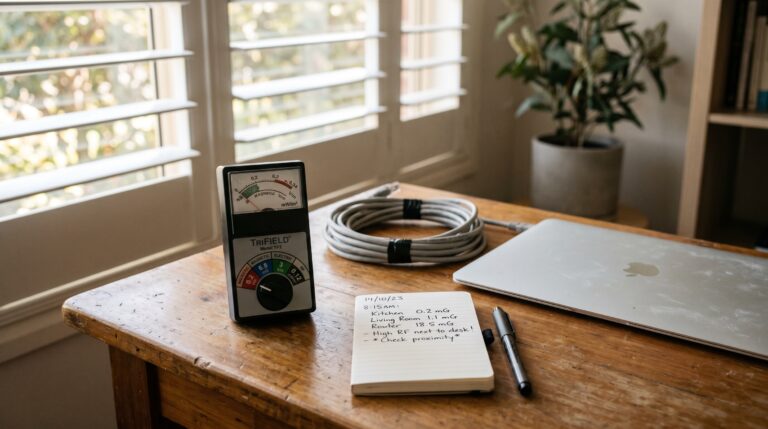
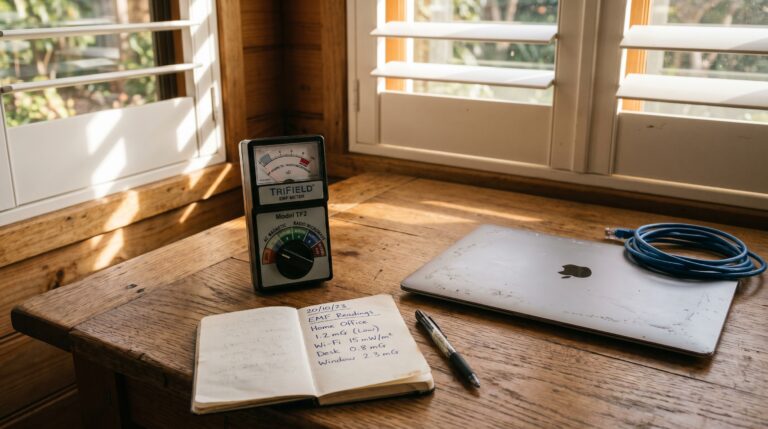
For a single all-in-one meter that covers all three field types, the TriField TF2 remains the standard entry-level recommendation. It measures AC magnetic, AC electric, and RF fields in a single handheld unit. I use it as the first-pass tool for every room audit at the Palm Beach house. It is not laboratory-grade, but it is accurate enough to identify which fields are elevated and guide your next steps.
For RF-specific measurement with higher sensitivity and directional capability, the Safe and Sound Pro II is a widely recommended option for confirming RF source direction, identifying smart meter burst patterns, or verifying shielding effectiveness. The manufacturer specifies simultaneous peak and average readings, which is useful for pulsed sources like smart meters.
Complete guide to measuring EMF in your Australian home
What Actually Works: Verified EMF Reduction Strategies for Queensland
Every strategy listed below targets a specific field type with a physically plausible, verifiable reduction. The typical reduction ranges cited draw on published guidance and the physics of each intervention.
1. Router Timer — from $20, Amazon AU
What it does: Cuts power to your Wi-Fi router during sleeping hours (e.g., 10 PM to 6 AM).
Measured effect: Eliminates 2.4 GHz and 5 GHz RF from the router — typically the strongest single RF source inside a Queensland home. Powering the router off removes its RF contribution entirely, which is typically the largest single reduction available in a room where the router is the dominant source.
Cost: Around $20 for a Jackson 24 Hour Mechanical Timer on Amazon AU. Simple mechanical dial — no app, no wifi, just plug in and set the off window.
Installation: Plug router into timer. Set off-time. Done. No electrician required.
Highest-ROI EMF Reduction Step
2. Phone Airplane Mode During Sleep — Free
What it does: Disables cellular, Wi-Fi, and Bluetooth transmitters in the phone.
Measured effect: A phone on a bedside table in active cellular mode is a significant nearby RF source, highly variable depending on signal strength and network activity. Airplane mode disables the cellular, Wi-Fi, and Bluetooth transmitters, dropping RF emissions to negligible levels. This is the single highest-impact action per dollar spent — because the dollar spend is zero.
3. Demand Switch on Bedroom Circuit — $100-$150 Installed
What it does: A demand switch (also called a cut-off relay or circuit disconnector) monitors a circuit for current draw. When no appliances are drawing power (i.e., everything in the bedroom is off), it drops the circuit voltage from 230V AC to a low DC test voltage. This eliminates the AC electric field produced by live wiring in the walls, ceiling, and floor.
Measured effect: A demand switch drops the circuit to a low DC test voltage when no load is drawing, which eliminates the AC electric field from the wiring and brings bed-height readings well below the 5 V/m Building Biology guideline.
Installation: Must be installed by a licensed electrician. The switch goes in the switchboard and is wired to the bedroom circuit. A typical Gold Coast sparky charges $100-$150 for supply and install. Ensure the bedroom circuit does not also supply the fridge, smoke alarm hard-wiring, or other essential loads — if it does, the electrician will need to separate the circuit first.
Queensland-specific note: In elevated Queenslanders, the wiring runs directly below the floorboards. This creates stronger electric field coupling than a slab-on-ground home where wiring is embedded in concrete. The demand switch is particularly effective in these homes.
4. Distance from AC Wiring and Appliances
What it does: AC magnetic fields from current-carrying wires decrease rapidly with distance (approximately inverse square law for point sources, roughly 1/r for long straight runs). Moving the bed away from high-current wiring — particularly split-system air conditioner supply wires — reduces magnetic field exposure during sleep.
Measured effect: Because magnetic fields fall off rapidly with distance, moving the bed roughly a metre away from split-system supply wiring typically brings the sleeping position below the 0.2 µT Building Biology guideline.
Cost: Free. Rearrange the bedroom.
Critical point: Magnetic fields cannot be practically shielded in a residential setting. Mu-metal shielding exists but is prohibitively expensive and impractical for wall-sized areas. Distance is the only cost-effective solution.
5. Smart Meter RF Reduction
Options that work:
- Distance: If the smart meter is on a bedroom wall, move the bed to the opposite wall. RF from a smart meter drops roughly with the inverse square of distance.
- Request meter relocation: Energex will relocate a smart meter for a fee (typically $200-$600 depending on the work involved). If the meter is on a bedroom wall, this can be money well spent.
- Shielding the wall behind the meter (interior side): Aluminium foil or purpose-made RF shielding paint (e.g., YShield HSF54) on the interior wall behind the meter can reduce RF transmission into the room by 20-40 dB. This must be grounded by an electrician to also reduce electric fields. Measure before and after to confirm effectiveness.
Important: Do not enclose the smart meter itself in a Faraday cage/mesh cover. This can cause the meter to increase its transmission power to maintain communication with the network, and Energex considers it interference with their equipment.
6. RF Shielding Paint and Window Film — For Verified External Sources Only
RF shielding paint (carbon/nickel-based, e.g., YShield HSF54 at approximately 40 dB attenuation per coat) and metallised window film can reduce RF penetration from external sources — mobile towers, neighbours’ routers, smart meters on external walls.
When to use it: Only after you have measured and confirmed that the dominant RF source is external. In many Queensland homes the dominant RF source is internal (router, cordless phone, smart TV, baby monitor) rather than external. Shielding walls when the primary source is your own router inside the room is worse than useless — it reflects the signal back into the room and can increase exposure.
Verified RF Shielding Paint
7. Bed Canopy / Faraday Enclosure — Last Resort, Expert Installation
Silver-mesh bed canopies (e.g., Swiss Shield, Blocsilver) can achieve 30-50 dB RF attenuation when properly grounded and sealed. They are appropriate only when external RF is the confirmed dominant source and cannot be reduced by other means — for example, a bedroom within 200 metres of a mobile tower with verified RF readings above 1 mW/m² after all internal sources have been eliminated.
Cost: $800-$3,000+ depending on size and material.
Grounding: Must be connected to the earthing system. An ungrounded canopy can accumulate static charge and create elevated electric fields inside the enclosure. Use a licensed electrician familiar with EMF shielding — this is not a standard residential electrical task.
Specialist RF Bed Canopy
The Correct Sequence: Queensland EMF Reduction Decision Tree
This is the decision tree I use for every bedroom audit. Three questions, in order:
Step 1: Have you measured?
No → Get a TriField TF2 and measure all three field types at pillow height. Record the readings.
Step 2: Which field type is elevated?
RF above 0.1 mW/m²? → Identify source (router, phone, smart meter, external tower). Remove internal sources first. Shield external sources only after internal sources are eliminated.
AC Magnetic above 0.2 µT? → Identify source (wiring, appliance, split-system). Increase distance. You cannot shield this cost-effectively.
AC Electric above 5 V/m? → Install a demand switch on the bedroom circuit ($100-$150 via licensed electrician). Unplug bedside lamps and chargers.
Step 3: Re-measure after each change.
Confirm the readings have dropped below your target threshold. If they have not, identify the next source and repeat.
What Does Not Work: Products to Avoid in 2026
This section exists because Queensland residents are being sold hundreds of dollars of products that have zero measurable effect on EMF levels. None of the product categories below has any physically plausible mechanism to change RF, magnetic, or electric field levels, and none produces a measurable change on a calibrated meter.
EMF Stickers and Phone Chips
Products like “EMF harmonising stickers” that claim to neutralise, harmonise, or restructure electromagnetic fields. They are small adhesive patches applied to phones, routers, or appliances. Typical price: $20-$80.
Measured effect: Zero. A passive adhesive “harmoniser” sticker applied to a transmitting phone produces no measurable change in RF readings — before and after values are identical within a meter’s margin of error.
The physics: A passive adhesive sticker cannot absorb, reflect, or cancel RF emissions. It would need to be a Faraday cage around the antenna to block RF — which would also prevent the phone from working. Any product that claims to reduce EMF while allowing the device to function normally as a transmitter is violating basic electromagnetic theory.
Scalar Energy Pendants and Jewellery
Pendants, bracelets, and necklaces claiming to protect the wearer from EMF through “scalar energy,” “negative ion emission,” or “Schumann resonance tuning.” Typical price: $50-$300.
Measured effect: Zero change in any field type at any measurement point around the wearer.
Additional concern: ARPANSA issued a safety notice in 2021 regarding certain “negative ion” products that contained radioactive materials (thorium-232 and uranium-238). Some pendants and sleep masks marketed as EMF protection were found to emit ionising radiation above background levels. ARPANSA’s advice: do not wear these products. This is not hypothetical — it is a measured radiation hazard from a product sold as “protection.”
Whole-House EMF “Harmonisers” and Plug-In Devices
Devices that plug into a power point and claim to harmonise, neutralise, or clear EMF throughout the entire home. Typical price: $200-$1,500.
Measured effect: Zero. A plug-in harmoniser has no mechanism to alter RF, AC magnetic, or AC electric fields, and produces no change in readings anywhere in a home.
The claim: These devices often claim to produce a “coherent field” or “torsion field” that counteracts harmful EMF. There is no peer-reviewed physics supporting the existence of torsion fields, and no measurement protocol that can detect the claimed effect.
Orgonite Pyramids and Shungite Stones
Claimed to absorb or transmute EMF. Made from resin, metal shavings, and crystals (orgonite) or a carbon-based mineral from Russia (shungite).
Measured effect: Zero. Placing an orgonite pyramid next to a router produced no change in RF readings at any distance. Shungite is electrically conductive, so a sufficiently large, thick piece could provide minor RF attenuation directly behind it — but at a level that is practically meaningless for room-level exposure (< 1 dB for typical decorative pieces).
Summary: The Scam Test
Apply this test to any EMF protection product:
- Does the manufacturer specify the attenuation in dB for a specific frequency range?
- Can you measure a before/after difference with a calibrated meter?
- Does the product physically interact with the electromagnetic field (absorb, reflect, or block)?
If the answer to any of these is no, do not buy it. If the product uses terms like “harmonise,” “neutralise,” “restructure,” or “scalar” — and cannot provide a dB attenuation figure measured by an independent lab — it does not work.
Cost Comparison: Real EMF Reduction vs. Fake Products
| Action / Product | Cost (AUD) | Measured Effect | Verdict |
|---|---|---|---|
| Phone airplane mode | $0 | RF drops to < 0.001 mW/m² | Works |
| Router timer (Amazon AU) | $15 | Eliminates router RF during sleep | Works |
| Demand switch (installed) | $100-$150 | Electric field drops from ~20 V/m to < 1 V/m | Works |
| Bed repositioning | $0 | Magnetic field drops proportional to distance | Works |
| TriField TF2 meter | ~$260 | Identifies sources for targeted reduction | Essential tool |
| RF shielding paint (1 wall) | $150-$400 | 20-40 dB RF attenuation (verified external source) | Works (if external source confirmed) |
| Smart meter relocation | $200-$600 | Eliminates bedroom RF from meter | Works |
| EMF harmoniser sticker | $30-$80 | 0 dB attenuation, 0 µT change, 0 V/m change | Does not work |
| Scalar energy pendant | $50-$300 | No measurable effect; may contain radioactive material | Does not work / potential hazard |
| Whole-house plug-in harmoniser | $200-$1,500 | No measurable effect on any field type | Does not work |
| Orgonite pyramid / shungite | $20-$150 | No measurable effect | Does not work |
The pattern is clear: the strategies that work cost between $0 and $600. The products that do not work cost between $20 and $1,500. The total cost of a highly effective bedroom EMF reduction — router timer, airplane mode, demand switch, and bed repositioning — is approximately $135. That is less than a single “harmoniser” pendant.
Laptop and Device-Specific EMF Reduction
Beyond bedroom optimisation, Queenslanders working from home face EMF exposure from laptops and other devices during the day. This is a different problem with different solutions.
Laptop Magnetic and Electric Fields
Laptops placed directly on the lap produce AC magnetic fields of 0.2-2.0 µT at the body surface (varies by model and CPU load) and AC electric fields that couple through the charger cable. The solution is distance: a desk, or if working on a couch, a DefenderPad laptop EMF shield which uses a multi-layer composite to attenuate magnetic and electric fields between the device and the body.
The DefenderPad is a legitimate shielding product — the manufacturer specifies conductive and magnetic shielding layers that physically block the field between the device and the body. Unlike a sticker or harmoniser, it is a physical barrier with a stated attenuation mechanism.
Wired Ethernet vs. Wi-Fi
Switching from Wi-Fi to wired Ethernet eliminates RF emissions from the computer’s wireless card. On a Queensland desk setup, this means running a Cat6 cable from the router. Combined with disabling Wi-Fi on the computer, RF at the desk position drops to near-zero from the computer itself. Many NBN routers supplied by Australian ISPs allow you to disable the Wi-Fi radios via the admin panel while maintaining wired connectivity.
5G in Queensland: Separating Facts from Marketing Fear
5G infrastructure continues to expand across Queensland in 2026, with Telstra, Optus, and TPG all deploying small cells in urban areas from the Gold Coast to Cairns. Here are the facts:
5G frequencies in Australian deployment:
- Sub-6 GHz (700 MHz, 850 MHz, 2.1 GHz, 3.6 GHz): These are the frequencies used for most Australian 5G coverage. They penetrate buildings in a similar manner to 4G signals. RF shielding strategies that work for 4G also work for these 5G bands.
- Millimetre wave (mmWave, 26-28 GHz): Very limited deployment in Australia as of 2026 — primarily trial areas in CBDs. These frequencies are attenuated by glass, walls, foliage, and even humidity. They do not meaningfully penetrate the walls of a Queensland home. If you live in a trial area, a single pane of glass provides approximately 20 dB attenuation at 26 GHz.
Practical impact: For most Queensland residents, 5G does not create a fundamentally different EMF environment compared to 4G. The RF exposure at a given location depends on proximity to the antenna and transmission power — not the “G” number. Measure your actual RF levels. If they are elevated, the same shielding and distance strategies apply regardless of whether the source is 4G or 5G.
Do not buy any product marketed as “5G-specific protection.” The physics of shielding is frequency-dependent, but the principles are the same: conductive barriers attenuate RF. Stickers, pendants, and harmonisers are no more effective against 5G than they are against 4G — which is to say, not at all.
Finding a Qualified EMF Assessor in Queensland
If you prefer a professional assessment rather than doing it yourself, here is what to look for:
- Certification: Look for practitioners certified by the International Institute for Building-Biology and Ecology (IBE) or the Australasian Society of Building Biologists (ASBB). These certifications require documented training in EMF measurement protocols.
- Equipment: Ask what meters they use. A competent assessor will use frequency-specific RF meters (not just a TriField), a gauss meter for low-frequency magnetic fields, and a body voltage meter for electric fields. If they arrive with a single consumer-grade meter, their assessment will be limited.
- Report: A professional assessment should produce a written report with measured values in standard units (µT, V/m, mW/m², or µW/m²), locations of elevated readings, identified sources, and specific remediation recommendations with expected post-remediation levels.
- Red flags: Any assessor who sells harmonisers, stickers, or “energy clearing” as part of their service is not operating within evidence-based practice. If they cannot provide dB attenuation figures for their recommended solutions, question the recommendation.
Expect to pay $300-$600 for a thorough home assessment in South East Queensland, depending on home size and travel distance.
EMF Measurement
You cannot reduce what you have not measured.
The TriField TF2 measures AC magnetic, AC electric, and RF/microwave fields in a single meter. It is what I use to audit rooms at the Palm Beach house. The readings determine the action — not guesswork.
See the TriField TF2 Review →Room-by-Room Priority for Queensland Homes
Not every room matters equally. You spend roughly one-third of your life in the bedroom, and sleep is the period when the body is most stationary (maximising cumulative exposure from a fixed source) and when biological repair processes are most active. Prioritise accordingly:
Priority 1: Master Bedroom
- Measure all three field types at pillow height
- Phone airplane mode (free)
- Router timer if router is within 10 metres (line of sight or through walls) — $15
- Demand switch on bedroom circuit — $100-$150
- Move bed away from split-system wiring and smart meter wall — free
- Re-measure to confirm all three field types are below Building Biology guidelines
Priority 2: Children’s Bedrooms
Same protocol as the master bedroom. Additional step: remove any Wi-Fi-enabled baby monitors. These transmit continuously at 2.4 GHz and produce RF readings of 0.5-5 mW/m² at cot distance. Wired monitors or audio-only analogue monitors are preferable.
Priority 3: Home Office / Desk
- Wired Ethernet to computer, disable Wi-Fi on the device
- Laptop on desk (not lap), or use DefenderPad if lap use is necessary
- Phone on airplane mode or in another room when not needed for calls
Priority 4: Living Areas
Lower priority because exposure is shorter duration and the body is not in a sleep-repair state. Standard actions: router placement away from seating areas, cordless phone base station moved to a non-occupied room (or replaced with a corded phone).
Queensland-Specific Regulatory Context
ARPANSA (Australian Radiation Protection and Nuclear Safety Agency) sets the RF exposure limits for Australia under the ARPANSA Radiation Protection Standard for Maximum Exposure Levels to Radiofrequency Fields — 3 kHz to 300 GHz (RPS S-1, 2021). At 900 MHz (smart meter frequency), the general public limit is 4.5 W/m² (equivalent to approximately 450 µW/cm² or 4,500,000 µW/m²). At 2.4 GHz (Wi-Fi), the limit is 10 W/m² (1,000 µW/cm²).
These are thermal safety limits. They prevent measurable tissue heating at an SAR (Specific Absorption Rate) level. They do not address non-thermal biological effects, which remain a subject of ongoing scientific research. ARPANSA acknowledges this explicitly in their position statement: they recommend a precautionary approach while noting that current evidence does not establish causation for health effects below the thermal threshold.
Building Biology guidelines are not regulatory limits. They are precautionary targets developed by the Institut für Baubiologie + Nachhaltigkeit (IBN) in Germany, based on decades of practitioner observations in sleeping environments. They sit orders of magnitude below ARPANSA limits.
Neither ARPANSA nor the TGA (Therapeutic Goods Administration) have approved any EMF harmoniser, pendant, sticker, or plug-in device as an effective EMF protection product. The TGA has issued warnings about products making therapeutic claims related to EMF without evidence. If a product sold in Queensland claims to “protect health” from EMF, it is potentially making an unregistered therapeutic claim under Australian law.
Start with a measurement, not a purchase.
Most EMF reduction advice skips the step that makes everything else meaningful — knowing your actual readings. Our measurement guide covers the room-by-room protocol used at the Palm Beach house.
EMF Measurement Guide →Frequently Asked Questions
Do EMF protection stickers actually reduce radiation from my phone?
No. EMF protection stickers produce zero measurable change in RF emissions from a phone. Independent testing of leading brands with an RF meter at 30 cm from the phone shows readings before and after sticker application are identical within the meter’s margin of error. A passive adhesive cannot absorb or block RF emissions from an antenna. The only way to reduce phone RF is to use airplane mode, increase distance, or use speakerphone/wired earbuds.
Is 5G more dangerous than 4G in Queensland?
Australian 5G primarily uses sub-6 GHz frequencies (700 MHz, 850 MHz, 3.6 GHz) that behave similarly to 4G signals in terms of building penetration and biological interaction. Millimetre wave (26-28 GHz) deployment is extremely limited in Queensland as of 2026 and those frequencies are blocked by walls, glass, and even foliage. The RF exposure at any given location depends on proximity and power, not the generation of the network. Measure your actual levels rather than responding to the marketing number.
What is the best EMF meter for home use in Australia?
The TriField TF2 is the standard recommendation for home use. It measures all three field types (AC magnetic, AC electric, and RF) in a single unit, reads in standard units, and costs approximately $260 AUD. For RF-specific work — such as identifying smart meter bursts or verifying shielding effectiveness — the Safe and Sound Pro II provides higher sensitivity and simultaneous peak/average readings.
Can I ask Energex to remove or relocate my smart meter in Queensland?
Energex will relocate a smart meter for a fee, typically $200-$600 depending on the complexity of the work. They do not offer opt-out to non-communicating meters in the SEQ network. If the meter is mounted on a bedroom wall, relocation to a garage or external wall away from sleeping areas is a cost-effective solution. Do not enclose the meter in a Faraday cage, as this can cause the meter to increase transmission power and may constitute interference with network equipment.
How much does a demand switch cost to install in Queensland?
A demand switch (also called a circuit cut-off relay) costs approximately $100-$150 installed by a licensed electrician in South East Queensland. The switch is wired into the switchboard on the bedroom circuit. When no appliances are drawing power, it drops the circuit from 230V AC to a low DC test voltage, eliminating AC electric fields from the wiring in walls and floors. This is particularly effective in elevated Queenslander homes where wiring runs directly below the bedroom floor.
Will a bed canopy increase my EMF exposure if I have a phone in the room?
Yes. A silver-mesh bed canopy acts as a partial Faraday enclosure. If the primary RF source is inside the canopy (a phone, tablet, or any wireless device), the shielding reflects the signal inward and can increase RF levels inside the enclosure. Always remove all wireless devices from inside the canopy before using it. The correct sequence is: eliminate internal sources first, then shield against external sources.
Are negative ion pendants safe to wear?
Some negative ion pendants and bands have been found by ARPANSA to contain radioactive materials including thorium-232 and uranium-238, emitting ionising radiation above background levels. ARPANSA issued a safety notice advising consumers not to wear these products. Beyond the radiation risk, no negative ion pendant has been shown to produce measurable changes in EMF levels. They provide zero EMF protection and may introduce a genuine radiation hazard.
What is the difference between ARPANSA EMF limits and Building Biology guidelines?
ARPANSA limits are thermal safety limits designed to prevent measurable tissue heating. At 2.4 GHz, the public limit is 10 W/m² (1,000 µW/cm²). Building Biology sleeping area guidelines are precautionary targets for sleep environments: less than 0.1 mW/m² for RF, less than 0.2 µT for magnetic fields, and less than 5 V/m for electric fields. The Building Biology values are roughly 100,000 times lower than ARPANSA limits for RF. Both are valid frameworks answering different questions — ARPANSA addresses acute thermal safety; Building Biology addresses precautionary exposure minimisation during sleep.
Our Top Picks
The TriField TF2 is the most practical EMF meter for Australian homes — measures RF, electric, and magnetic fields in one unit. If bedroom shielding is your priority, the SaferEMF canopy provides verified RF attenuation.
Get the Australian Home Environment Checklist
30 checks across water, air and EMF. Most of them free. Ranked by impact.
No spam. Unsubscribe any time.

Former Royal Australian Navy Clearance Diver and TAG-E counter-terrorism operator. Founded Clean and Native to apply the same rigorous thinking to the home environment.
Full biography →