Best Water Filter Perth 2026: Northern vs Southern Suburbs — What You Actually Need
Affiliate disclosure: Clean and Native earns a commission if you purchase through links on this page. Recommendations are based on independent testing, utility water quality data, and verified filter certifications only.
For Perth’s northern suburbs (Gnangara groundwater zones), reverse osmosis is the only filtration method that meaningfully addresses the 400–561 mg/L TDS range — reducing it to 3–15 mg/L and eliminating the chalky hardness that carbon filters cannot touch. Southern suburbs on desalination or treated surface water may use carbon filtration for chlorine and taste, but northern residents drinking bore-source water will notice an immediate perceptible improvement with RO that no other technology replicates. The catches: RO requires under-sink installation (or benchtop footprint for countertop units), produces wastewater at a 1:1 to 3:1 ratio, and costs $450–$1,200 upfront. If you’re renting in Joondalup, Two Rocks, or Yanchep and can’t install under-sink, the AquaTru Classic countertop RO is the only no-plumbing option that handles Perth’s hardness without landlord approval.
See AquaTru Classic Price →Perth tap water is safe to drink but has the highest average TDS and most variable water quality of any Australian capital. The average metro TDS is approximately 406 mg/L — compared to Melbourne’s 11-38 mg/L and my own Palm Beach tap at 69 mg/L on the SEQ grid. Water Corporation drinking water quality data records Joondalup around 412 mg/L and Two Rocks up to 561 mg/L — both sourced from Gnangara Mound groundwater — against our reference EcoHero RO output of 3 mg/L. The gap is not subtle. As a former Royal Australian Navy Clearance Diver, I applied the same systematic approach I used evaluating life-support equipment: verify the spec against the certification, then test it in real conditions. For Perth’s northern suburbs, reverse osmosis provides the single most dramatic and immediately perceptible drinking water improvement of any Australian city. Hardness ranges from 29 mg/L in some desalination-fed southern zones to 228 mg/L in Two Rocks — and reverse osmosis handles both ends of that range.
The three products we own are measured first-hand by Jayce Love, former Royal Australian Navy Clearance Diver; every other product is assessed on published manufacturer specifications and independent certification using our documented methodology — no gifted units, no brand payments.
Why Perth’s northern and southern suburbs need different filters
Perth’s unusual water chemistry comes from its three-source supply mix (2023-24 figures from Water Corporation):
- Desalinated seawater (36%): Perth Seawater Desalination Plant (Kwinana) + Southern Seawater Desalination Plant (Binningup). Low mineral content. Feeds southern and coastal suburbs primarily.
- Gnangara Mound groundwater (44.6%): Shallow unconfined aquifer under the Swan Coastal Plain. High mineral content from limestone geology — hardness 120–228 mg/L, TDS up to 584 mg/L. Feeds northern suburbs: Joondalup, Wanneroo, Two Rocks, Alkimos, Yanchep, Ellenbrook, Midland.
- Surface water (18.7%): Mundaring Weir and other reservoirs. Intermediate mineral content.
A household in Two Rocks (Gnangara groundwater dominant) has fundamentally different water chemistry to a household in Rockingham (desalination-blended). The TDS difference — 584 mg/L vs 139 mg/L — is larger than the difference between Perth and Melbourne’s entire supply. Suburb-specific data is available from Water Corporation’s drinking water quality data tables.
What Perth’s high TDS and hardness actually means at your tap
At 120–180 mg/L hardness (typical northern suburbs), Perth households experience:
- Visible white scale build-up on kettle elements within weeks
- Shower head spray holes partially blocked within months
- Hot water system element reduced lifespan from scale accumulation
- Laundry requiring more detergent; towels and fabrics feeling stiffer
- Coffee and tea taste noticeably affected by high mineral content
At TDS of 300–580 mg/L, filtered Perth tap water (3–5 mg/L post-RO) has a dramatically different taste — clean, flat, and mineral-free. This is the largest perceivable taste improvement from RO of any Australian city. Our Perth drinking water quality guide has the full chemistry breakdown by suburb type.
Our Top-Rated Water Filters
Reverse osmosis is the only residential technology that reliably removes PFAS, fluoride, chlorine, and heavy metals — the four contaminants most Australians are most exposed to.
Best water filters for Perth 2026
#1 for Perth: AquaTru Classic RO
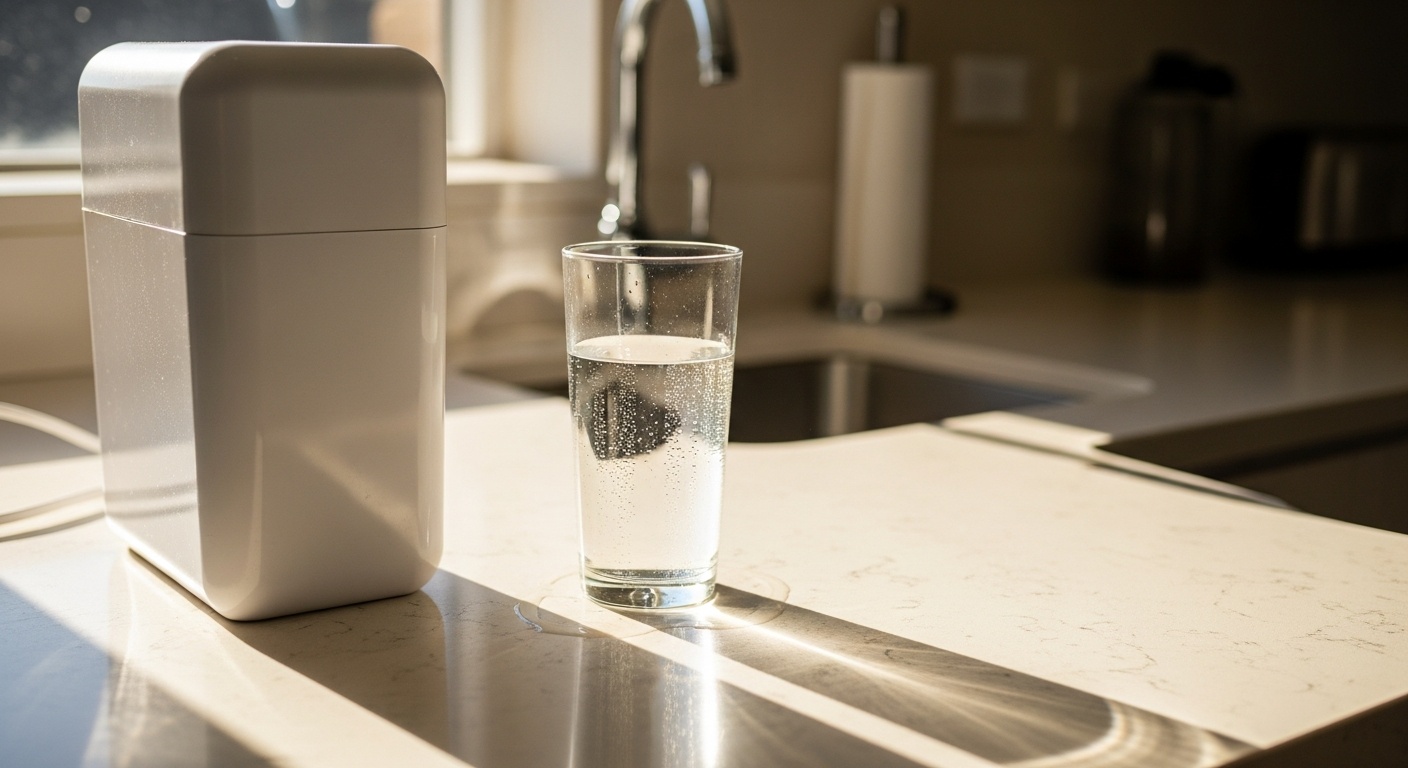
4-stage countertop RO. NSF 58 + 401 certified. Reduces Perth TDS from 300–580 mg/L to 3–5 mg/L. Eliminates hardness from drinking water, removes fluoride (>96%), chlorine, PFAS, lead, and microplastics. No plumbing required — sits on the bench. For Perth northern suburb households, this is the highest-impact single investment in home water quality available. The taste transformation is immediate and dramatic.
Best for: northern suburbs, renters wanting RO, comprehensive filtration
Permanent install: Waterdrop Core
WaterMark certified under-sink RO. Tankless design. 190L/day production — sufficient for households with high filtered-water consumption (cooking, coffee, ice). Reduces TDS by >94%, removes fluoride, hardness, chlorine, PFAS. Dedicated tap included. Perth’s hard water makes this the most impactful permanent under-sink investment of any Australian city.
Best for: homeowners in northern suburbs, high-volume households
Renters, southern suburbs: TAPP EcoPro
If you are in a southern Perth suburb with lower TDS (139–250 mg/L) and primarily want chlorine taste and microplastics improvement, the TAPP EcoPro is the entry-level solution with no installation required. It does not address TDS, hardness, or fluoride — for those, RO is needed. For northern suburb renters wanting TDS reduction without plumbing, AquaTru Classic is the right choice despite the higher cost.
Best for: southern suburb renters wanting taste improvement only
For suburb-specific hardness data: Perth drinking water quality 2026. For under-sink RO comparison: best under-sink water filter Australia. For whole-house hardness management: best whole-house water filter Australia.
Last reviewed: April 2026 — Clean and Native
Frequently asked questions — Perth water filters
Why is Perth tap water so hard?
Perth’s northern suburbs are fed primarily by the Gnangara Mound — a shallow unconfined aquifer under the Swan Coastal Plain with limestone geology that naturally dissolves calcium and magnesium. Hardness in Two Rocks and similar northern zones reaches 228 mg/L CaCO₃. Southern suburbs receiving desalination-blended water have lower hardness (80–130 mg/L). Reverse osmosis filtration eliminates hardness from drinking water.
What is the best water filter for Perth?
For Perth northern suburbs (Gnangara groundwater-fed, TDS 300–580 mg/L), reverse osmosis provides the most dramatic water quality improvement of any Australian city. The AquaTru Classic (countertop, no plumbing required) or Waterdrop Core (WaterMark-certified under-sink) are the recommended options. For southern suburb renters wanting basic taste improvement only, the TAPP EcoPro tap filter is a lower-cost entry point.
Does Perth tap water have fluoride?
Yes. Perth water is artificially fluoridated at a target of 0.9 mg/L, with an actual metro average of approximately 0.75 mg/L in 2023–24. Only reverse osmosis removes fluoride — carbon block filters do not. RO reduces Perth fluoride from ~0.75 mg/L to under 0.03 mg/L.
Does Perth water have PFAS?
No significant PFAS issues have been identified in Perth’s metropolitan treated drinking water supply. Water Corporation’s 2023–24 annual report records 100% compliance with ADWG health parameters including PFAS. PFAS contamination has been found in groundwater near some industrial sites and RAAF Pearce, but not in the treated drinking water distribution system.
Is the water in northern Perth worse than southern Perth?
Yes, significantly so for hardness and TDS. Northern Perth suburbs (Joondalup, Wanneroo, Two Rocks, Alkimos, Ellenbrook, Midland) are fed predominantly by Gnangara Mound groundwater with TDS up to 584 mg/L and hardness up to 228 mg/L CaCO₃. Southern suburbs (Fremantle, Cockburn, Rockingham, Mandurah) receive more desalination-blended water with TDS 139–250 mg/L and hardness 80–130 mg/L. Both zones benefit from RO filtration, but the improvement is more dramatic in northern suburbs.
Can I use a water filter instead of a water softener in Perth?
For drinking water, yes — reverse osmosis is more effective than a softener and also removes contaminants a softener does not (fluoride, PFAS, chlorine). For whole-house scale protection on appliances and hot water systems, a water softener addresses the problem at the source. Most Perth northern suburb households benefit from both: an under-sink RO for drinking and cooking water, and a whole-house softener or scale inhibitor for appliances. RO alone does not protect your hot water system from scale.
How long do RO filter cartridges last in Perth hard water?
Perth’s high TDS and hardness accelerates pre-filter loading. Sediment and carbon pre-filters typically need replacement every 6-8 months in northern suburb conditions — faster than the 12-month schedule recommended for softer-water cities like Melbourne. The RO membrane itself lasts 2-3 years regardless of inlet TDS. Monitor output TDS with a handheld TDS-3 meter: when post-filter TDS climbs above 20 mg/L (from your 3-5 mg/L baseline), the membrane needs replacement.
Does Perth tap water taste bad?
Northern Perth tap water has a distinctive flat-mineral taste from Gnangara groundwater that most residents describe as noticeably different from bottled water. At TDS 400-580 mg/L, the mineral content is perceptible. Southern Perth desal-blended water (TDS 139-250 mg/L) tastes cleaner. After RO filtration — which reduces TDS to 3-5 mg/L — Perth tap water is indistinguishable from premium bottled water. The taste improvement from RO in Perth’s northern suburbs is the most dramatic of any Australian city.
Get the Australian Home Environment Checklist
30 checks across water, air and EMF. Most of them free. Ranked by impact.
No spam. Unsubscribe any time.

Former Royal Australian Navy Clearance Diver and TAG-E counter-terrorism operator. Founded Clean and Native to apply the same rigorous thinking to the home environment.
Full biography →