Best Shower Filter for Hard Water Australia 2026: Protect Hair & Skin
If your hair feels brittle, your skin itches after showering, or your shower screen is constantly coated in white scale, your water is almost certainly the cause – not your products. Research published in the International Journal of Trichology confirms hard water above 200 mg/L measurably increases hair fibre breakage and scalp dryness. But there is a second problem most Australian shower filter guides miss: chloramine. Brisbane, Sydney, Adelaide, Gold Coast, and Darwin all use chloramine for water disinfection – and chloramine is far more damaging to skin and hair than chlorine. Most shower filters sold in Australia don’t remove it.
The best shower filter for hard water in Australia must remove both calcium carbonate scale (above 200 mg/L threshold) and chloramine used in Brisbane, Sydney, Adelaide, Gold Coast, and Darwin—most filters sold locally do neither effectively. Perth, Adelaide, and parts of Queensland have the hardest water (150-300 mg/L), causing measurable hair breakage and scalp dryness per peer-reviewed dermatology research. The catches: KDF-55 media (the only filtration stage proven to reduce both hardness minerals and chloramine) requires replacement every 6-8 months in very hard water areas, and no shower filter eliminates hardness completely—only reduces it to below the 200 mg/L damage threshold. Households on town supply in soft-water regions (Hobart, Melbourne metro) don’t need one; those in Perth, Adelaide, or rural Queensland with bore water absolutely do.
See Whole-Home Filtration Options →Hard Water in Australia: Which Cities Have It
Water hardness is measured in mg/L as calcium carbonate (CaCO3). Below 60 mg/L is soft; 60-120 mg/L is moderate; 120-180 mg/L is hard; above 180 mg/L is very hard. The damage threshold for hair and skin research is around 200 mg/L.
The three products we own are measured first-hand by Jayce Love, former Royal Australian Navy Clearance Diver; every other product is assessed on published manufacturer specifications and independent certification using our documented methodology — no gifted units, no brand payments.
| City / Region | Hardness (mg/L) | Classification | Disinfection | Hair/skin impact |
|---|---|---|---|---|
| Perth (WA) | 150-300 | Hard – Very Hard | Chloramine | High. Scale, brittle hair, dry skin. |
| Adelaide (SA) | 200-280 | Very Hard | Chloramine | Highest risk. Murray River minerals + chloramine combination. |
| Brisbane / SEQ (QLD) | 80-130 | Moderate | Chloramine | Moderate. Chloramine is the bigger concern than hardness. |
| Sydney (NSW) | 40-60 | Soft | Chloramine | Low hardness but chloramine is still a concern for skin. |
| Melbourne (VIC) | 15-65 | Very Soft | Free Chlorine | Low. Standard KDF/carbon sufficient. |
| Inland towns (QLD/NSW/SA/WA) | 300-600+ | Extreme | Varies | Severe. Whole-house water softener more appropriate than shower filter. |
| Canberra / Hobart | 40-60 | Soft | Free Chlorine | Minimal. Standard carbon shower filter optional. |
Why Chloramine Is the Bigger Problem Than Hardness in Most Australian Cities
Hard water’s damage mechanism is mineral precipitation – calcium and magnesium ions bond to hair protein, roughen the cuticle, and reduce lather efficiency. This is real and documented. But chloramine causes a different category of damage that most shower filter marketing ignores.
Monochloramine (NH2Cl) – used in Brisbane, Sydney, Adelaide, Gold Coast, and Darwin – is a skin irritant at shower concentrations. Multiple dermatology studies link chloramine exposure to:
- Increased transepidermal water loss (TEWL) – your skin loses moisture faster after chloramine-treated water exposure than after chlorine-treated water
- Aggravation of atopic dermatitis and eczema, particularly in children (Danby et al., Journal of Investigative Dermatology, 2017)
- Scalp irritation and disruption of the acid mantle (the slightly acidic film that protects skin from pathogens)
The critical buyer information: KDF-55 media (zinc-copper alloy) does not remove chloramine. KDF works via redox reaction against free chlorine. Chloramine has a different chemistry. If you buy a KDF-only shower filter in Brisbane, Sydney, Adelaide, or Gold Coast, you are paying for a filter that does not address your water’s primary chemical concern.
What removes chloramine from shower water:
- Catalytic activated carbon – the only reliably effective media. Requires contact time, so flow rate matters. The Aquasana AQ-4100 uses this.
- Ascorbic acid (vitamin C) – chemically neutralises chloramine at shower temperatures through reduction. Works but vitamin C shower blocks deplete faster than catalytic carbon and require monitoring. Suitable as a secondary layer but not a primary filter.
How Hard Water Damages Hair and Skin Over Time
At concentrations above 200 mg/L, calcium ions bind to the protein structures of your hair shaft, raising the cuticle and making strands rough, porous, and prone to snapping under normal mechanical stress – brushing, towel drying, tying back. Simultaneously, mineral deposits interfere with soap and shampoo lathering, meaning you rinse with more product residue still present.
On skin, hard water disrupts the acid mantle – the slightly acidic film (pH 4.5-5.5) that acts as your first barrier against pathogens and moisture loss. A compromised acid mantle correlates with increased transepidermal water loss (TEWL), worsening conditions including eczema, psoriasis, and keratosis pilaris.
The damage compounds over time. A single wash in hard water won’t destroy your hair, but daily exposure over months shifts hair tensile strength measurably. The compounding effect of hard water minerals plus chloramine is worse than either alone – the minerals roughen the cuticle while chloramine strips the lipid layer from the hair shaft.
Our Top-Rated Water Filters
Reverse osmosis is the only residential technology that reliably removes PFAS, fluoride, chloramine, and heavy metals — the four contaminants most Australians are most exposed to.
Best Shower Filters for Australian Hard Water: Full Comparison
| Product | Media | Removes Chloramine? | Filter Life | NSF Cert | Best For |
|---|---|---|---|---|---|
| Aquasana AQ-4100 | Catalytic carbon + KDF | Yes | ~45,000L (~6 months) | Yes (NSF 177) | Chloramine cities. Best overall. |
| Pelican PSF-1 | KDF-55 + carbon | Partial | ~40,000L | Yes | Older homes, heavy metals. Free chlorine cities. |
| AquaBliss SF100 | KDF-55 + calcium sulfite + carbon | No | ~10,000L (~3 months) | NSF listed | Melbourne, Canberra, Hobart. Budget option. |
| Berkey Shower Filter | KDF-55 | No | ~75,000L (~12 months) | Unverified AU | Free chlorine cities only. Long filter life. |
| Sprite HO2 (High Output) | Chlorgon (calcium sulfite) | Partial* | ~50,000L | NSF 177 | High-flow showers. Better for chloramine than KDF. |
*Calcium sulfite (Chlorgon) has partial effectiveness against chloramine vs its strong performance against free chlorine. Not equivalent to catalytic carbon for chloramine removal.
The Top Pick: Aquasana AQ-4100 (Full Review)
The Aquasana AQ-4100 is the most appropriate shower filter for the majority of Australians because it addresses the most common problem: chloramine. Its two-stage design uses catalytic activated carbon as the primary media, supported by a copper-zinc KDF stage for heavy metal reduction.
- Chloramine removal: NSF 177 certified for chlorine reduction up to 91%. The catalytic carbon is effective against monochloramine through surface-catalysed oxidation reactions that standard carbon cannot perform.
- Flow rate: 9.5 litres/minute – consistent with Australian standard shower heads (7-12 L/min). No pressure drop issues reported in Australian homes.
- Australian compatibility: Ships with G1/2 BSP thread adapters compatible with all Australian shower arms.
- Filter life: ~45,000 litres – approximately 6 months for a two-person household at daily use.
- Heavy metals: The KDF stage addresses lead, mercury, and scale-causing iron. Relevant for pre-1970 homes with older plumbing.
Who should not buy the AQ-4100: If your primary concern is extreme water hardness (300+ mg/L), no shower filter replaces a whole-house water softener. The AQ-4100 will improve the chemical profile of your shower water significantly but will not precipitate dissolved calcium and magnesium minerals.
Installation: Australian Shower Fittings
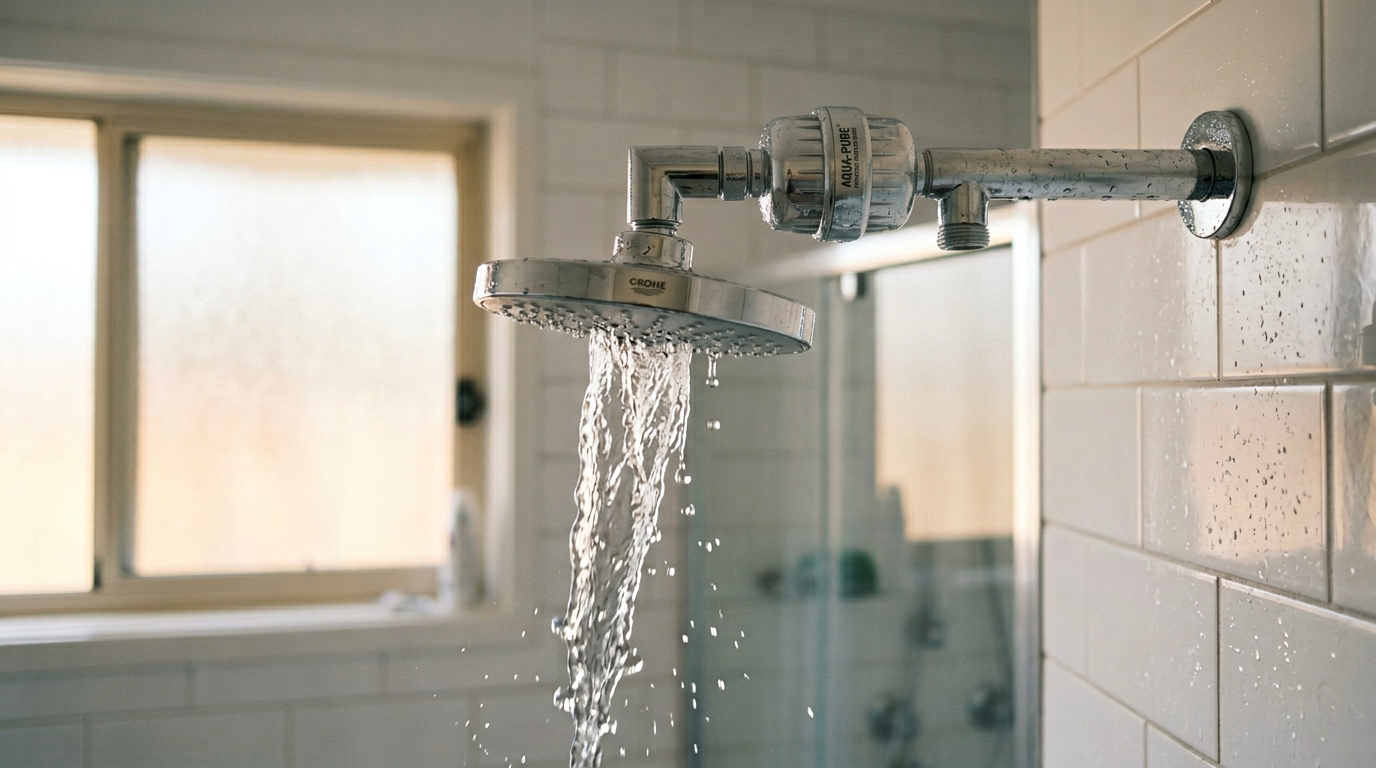
All Australian shower arms use G1/2 inch BSP (British Standard Pipe) thread – consistent across all states and territories. Installation takes under 15 minutes:
- Turn off the shower tap fully (no need to isolate the main).
- Unscrew the existing shower head anticlockwise from the wall arm.
- Clean the wall arm thread and apply 3-4 wraps of PTFE tape clockwise.
- Hand-thread the shower filter inlet onto the wall arm, then tighten one additional quarter-turn with adjustable pliers. Do not overtighten.
- Attach your shower head to the filter outlet, again using fresh PTFE tape.
- Turn water on slowly and check both connection points for leaks.
If your shower head is on a ceiling rose or integrated rail system, you may need a G1/2 BSP extension nipple (Bunnings, under $8). Some pre-1980 Victorian and Queensland Queenslander homes have imperial 1/2 inch BSF threads – these are functionally interchangeable with BSP in most cases but check for smooth engagement before applying tape.
Set a reminder to replace the filter cartridge every 6 months or at the rated litre threshold, whichever comes first. A depleted cartridge provides no protection and can backflush captured contaminants.
Hard Water Shower Filters and Eczema: What the Research Shows
The connection between hard water and eczema is well-documented. The relevant studies:
- Danby et al. (2017) in the Journal of Investigative Dermatology showed that hard water (320 mg/L) increased the severity of sodium lauryl sulfate (SLS)-induced skin irritation vs soft water, with measurable increases in TEWL. The authors proposed that calcium in hard water binds to SLS, forming calcium laureate deposits in the stratum corneum that impair the skin barrier.
- A 2021 study in JAMA Dermatology (the SWET trial) found that installing domestic water softeners in the homes of children with eczema did not significantly improve eczema severity compared to controls – suggesting that total body exposure (bathing, drinking) contributes differently to eczema pathology than contact-time-limited shower exposure alone.
- The chloramine data is less studied in controlled trials for eczema specifically, but dermatology literature consistently identifies chloramine as a more potent skin irritant than free chlorine at equivalent concentrations due to its different mechanism of skin penetration.
Practical takeaway: For eczema sufferers in chloramine-treated cities (Brisbane, Sydney, Adelaide, Gold Coast), a shower filter targeting chloramine removal (catalytic carbon) is more evidence-supported as an intervention than one targeting hardness. Hardness reduction through a whole-house softener has the stronger intervention for eczema in areas with genuinely hard water.
Also treating your drinking water? Your shower filter handles the topical exposure pathway. For drinking water in chloramine cities, you need a catalytic carbon under-sink filter or RO system – a shower filter does nothing to address ingested chloramine from your tap water.
When a Shower Filter Isn’t Enough: Whole-House Solutions
If your hardness consistently exceeds 300 mg/L (most of Perth’s groundwater zones and inland SA, QLD, NSW), a shower filter is addressing symptoms, not the cause. The appropriate solutions in order of increasing cost and effectiveness:
- Point-of-use shower filter ($80-200): Removes chloramine and chemicals. Does not reduce hardness. Appropriate for moderate hardness with chloramine concerns.
- Whole-house carbon block filter ($400-800 installed): Treats all water entering the home. Removes chloramine from all taps and showers. Does not reduce hardness.
- Ion exchange water softener ($1,500-4,000 installed): Replaces calcium and magnesium with sodium (or potassium for salt-free). True hardness removal. Requires a licensed plumber for installation. WaterMark AS3497 certification required for permanently plumbed units.
- Whole-house RO ($3,000-8,000 installed): Removes hardness, TDS, chloramine, fluoride, PFAS. Highest cost, requires ongoing membrane replacement and remineralisation for drinking water quality.
For renters who cannot install permanent plumbing: a shower filter (no plumber required) is the only realistic intervention. Purchase one with a BSP thread adapter set and it moves with you between properties.
Also treating your whole house?
Our whole house filter guide covers WaterMark-certified systems for Australian hardness and chloramine conditions.
Whole House Filter Guide -> Under-Sink vs Countertop RO ->Frequently Asked Questions
Does a shower filter actually reduce water hardness?
Not significantly. True water softening requires ion exchange – swapping calcium and magnesium ions for sodium or potassium. Shower filters target chemical contaminants (chlorine, chloramine, heavy metals), not dissolved minerals. Where they help with hard water symptoms is by removing chemical irritants that compound mineral damage on hair and skin. If your hardness exceeds 300 mg/L, a whole-house softener produces more meaningful results.
How do I know my water hardness level in Australia?
Your local water authority publishes annual water quality reports: Sydney Water, Melbourne Water, SA Water, Unitywater (QLD), and Water Corporation (WA) all include hardness data. Test strips from Bunnings or online (~$15 for 100 strips) give a real-time reading. If you are on bore or tank water, independent testing is essential as hardness varies significantly by geology.
Can I use a vitamin C shower filter for chloramine in Brisbane or Sydney?
Ascorbic acid (vitamin C) does chemically neutralise chloramine through a reduction reaction – this is well established. However, vitamin C shower blocks deplete faster than catalytic carbon cartridges and provide less consistent contact time at typical shower flow rates. Catalytic carbon is the more reliable primary solution. Vitamin C cartridges are useful as a secondary stage but should not be your only defence against chloramine if you are in Brisbane, Sydney, Adelaide, Gold Coast, or Darwin.
Are shower filters certified to Australian standards?
There is no standalone Australian standard specific to shower filtration. NSF/ANSI 177 (the US standard for shower filtration, specifically chlorine reduction) is the internationally accepted benchmark. The Aquasana AQ-4100 and Sprite HO2 carry NSF 177 certification. For permanently plumbed shower installations (inline filtration), WaterMark AS3497 certification applies and a licensed plumber is required.
Will a shower filter help with eczema?
Evidence is mixed. Chloramine removal via catalytic carbon has more support as an eczema intervention in chloramine-treated cities (Brisbane, Sydney, Adelaide, Gold Coast) than hardness reduction via shower filters alone. The SWET trial (2021, JAMA Dermatology) found that whole-house water softeners did not significantly improve eczema severity in children versus controls. For eczema, combining a catalytic carbon shower filter with short (5-minute) showers in lukewarm (not hot) water and immediate moisturisation post-shower has the most evidence basis.
How often do I need to replace a shower filter cartridge?
Most shower filter cartridges are rated for 3-6 months (approximately 10,000-50,000 litres depending on the product). The Aquasana AQ-4100 is rated at ~45,000L, roughly 6 months for a two-person household at typical daily use. Running a depleted cartridge is worse than no filter – it can backflush captured contaminants. Set a calendar reminder.
Do I need a plumber to install a shower filter in Australia?
No – for inline shower filters that connect between the wall arm and shower head, installation is a DIY task with no plumbing licence required. Australian shower arms use G1/2 BSP thread. You need adjustable pliers and PTFE tape. For permanently plumbed inline systems that connect to supply plumbing rather than the shower arm, a licensed plumber and WaterMark-certified fittings are required under Australian plumbing regulations.
KDF vs catalytic carbon – which is better for Australian water?
Depends entirely on your city’s disinfection method. KDF-55 (zinc-copper alloy) removes free chlorine, heavy metals, hydrogen sulfide, and scale through redox reaction. It does not remove chloramine. Catalytic carbon removes both free chlorine and chloramine, plus organic compounds and DBPs. For Melbourne, Canberra, and Hobart (free chlorine): KDF or standard carbon both work. For Brisbane, Sydney, Adelaide, Gold Coast, and Darwin (chloramine): catalytic carbon is essential. KDF alone is insufficient.
Get the Australian Home Environment Checklist
30 checks across water, air and EMF. Most of them free. Ranked by impact.
No spam. Unsubscribe any time.

Former Royal Australian Navy Clearance Diver and TAG-E counter-terrorism operator. Founded Clean and Native to apply the same rigorous thinking to the home environment.
Full biography →