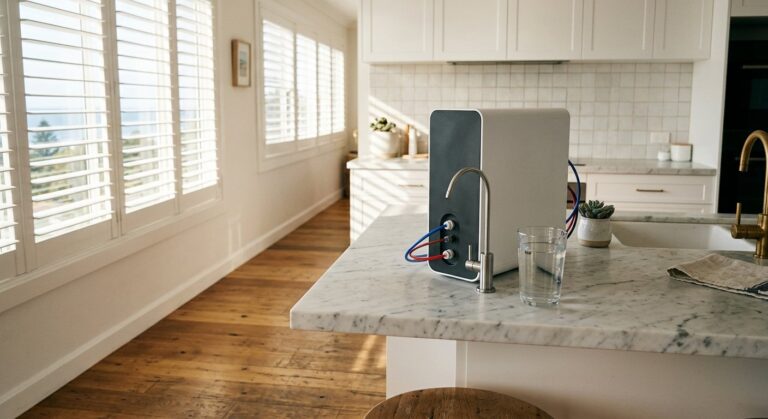
PFAS in Bottled Water Australia: What You Need to Know in 2026
Australian bottled water is not routinely tested for PFAS. FSANZ Food Standards Code 2.6.2 sets microbiological and chemical limits for packaged water — but it does not mandate testing for per- and polyfluoroalkyl substances. As a former Royal Australian Navy Clearance Diver and founder of Clean and Native, I have measured residential water quality first-hand at Palm Beach, Queensland, and the bottled water regulatory gap on PFAS is one of the most consistently misunderstood risks in Australian households. The only verified protection against PFAS in drinking water is a filter certified to NSF/ANSI P473. I have not personally tested the AquaTru Classic or Waterdrop CoreRO recommended here; that assessment is based on published manufacturer specifications and independent NSF certification, not first-hand measurement. The only products I measure first-hand are the EcoHero 5-Stage RO, TriField TF2, and Coway Airmega 150.
I measured 69 ppm TDS at Palm Beach mains water and 3 ppm post-filtration through a 5-stage RO system — a 95.7% reduction. That measurement confirms the membrane is working. But TDS is not a PFAS proxy. PFAS exist at parts per trillion, one million times below what any TDS meter can detect. This article explains what that means for every bottle you are buying right now.
Quick Verdict: PFAS in Australian Bottled Water
| Does bottled water contain PFAS? | Unverifiable. FSANZ does not require PFAS testing. No label can confirm zero PFAS. |
| ADWG 2025 PFAS limits | PFOS + PFHxS combined: 8 ng/L. PFOA: 200 ng/L. Apply to tap water, not bottled. |
| Does carbon filtration remove PFAS? | Inconsistently and without third-party verification. Only NSF P473 certified systems are proven. |
| Best verified protection | Reverse osmosis — specifically the AquaTru Classic (NSF 58 + NSF P473 certified). |
| What TDS meters tell you about PFAS | Nothing. PFAS are invisible to TDS measurement at any health-relevant concentration. |
What Are PFAS — The Chemistry Behind Forever Chemicals
PFAS — per- and polyfluoroalkyl substances — are a group of more than 14,700 synthetic chemicals defined by an extremely strong carbon-fluorine bond. That bond is one of the strongest in organic chemistry. Microbes cannot degrade it. UV light cannot break it. Normal water treatment temperatures leave it intact. These chemicals accumulate in soil, surface water, groundwater, and human tissue — which is exactly why they earned the name forever chemicals.
The most studied compounds are PFOS (perfluorooctane sulfonic acid) and PFOA (perfluorooctanoic acid). PFOS was used at Australian Defence Force bases in AFFF (aqueous film-forming foam) firefighting concentrate. PFOA was used in industrial non-stick coatings and manufacturing processes. Both have been phased out under the Stockholm Convention, but the contamination they left behind at training sites across NSW, QLD, WA, SA, and NT is permanent.
Peer-reviewed studies link PFAS exposure to elevated blood cholesterol, immune suppression, thyroid disruption, and certain cancers. In 2023, the International Agency for Research on Cancer (IARC) classified PFOA as a Group 1 carcinogen — a definite human carcinogen, based on accumulated evidence in exposed populations. This is not a precautionary classification. It is a conclusion drawn from studies of workers and communities with documented PFAS exposure.
PFAS bioaccumulate. Every exposure adds to the body burden. The question for Australian households is not whether PFAS matter — it is whether your water source is tested.
The ADWG 2025 PFAS Guideline Update
The Australian Drinking Water Guidelines (ADWG) were revised in 2025 with significantly stricter health-based guideline values for PFAS. The 2025 limits tighten the previous guidelines substantially — the PFOS + PFHxS combined guideline dropped from 70 ng/L to 8 ng/L, a near-ninefold reduction.
| Compound | ADWG 2025 Guideline | Previous Guideline | Change |
|---|---|---|---|
| PFOS + PFHxS (combined) | 8 ng/L | 70 ng/L | 8.75× stricter |
| PFOA | 200 ng/L | 560 ng/L | 2.8× stricter |
| Sum of 29 PFAS compounds | 100 ng/L | N/A | New category |
This revision followed updated toxicological assessments that found adverse health effects at lower exposure concentrations than earlier models assumed. It also reflects the IARC Group 1 reclassification of PFOA and accumulating evidence on PFOS immunotoxicity.
These ADWG guidelines are not legally enforceable for bottled water. They apply to reticulated water supplies managed by licensed utilities — Sydney Water, SEQ Water, Melbourne Water, Water Corp WA. State health departments require utilities to monitor and report against these limits. No equivalent monitoring obligation applies to bottled water manufacturers under FSANZ jurisdiction.
The Bottled Water Regulatory Gap: What FSANZ Requires (and Doesn’t)
FSANZ Food Standards Code 2.6.2 governs packaged water sold in Australia. It mandates microbiological standards (no detectable coliforms, E. coli), pH range (6.5-8.5), and limits for certain heavy metals and nitrates. There is no PFAS testing requirement anywhere in the Standard.
This is not a loophole — it is simply a gap that existed before the scale of Australian PFAS contamination was understood. FSANZ has not introduced mandatory PFAS testing for packaged water since contamination hotspots were publicly mapped. Without a mandatory testing requirement, there is no mechanism for bottled water brands to confirm or deny PFAS levels, and no compulsion to disclose results even if voluntary testing occurs.
Mt Franklin, the largest-selling bottled water brand in Australia, sources from multiple sites including municipal water in some product lines. Pump is filtered municipal water. Both are marketed on freshness and purity — neither label includes any PFAS testing disclosure. There is no reason to assume these products are contaminated. There is also no third-party certification that confirms they are not.
Your local water utility, by contrast, publishes annual water quality reports with PFAS data for monitored supply zones. SEQ Water, Sydney Water, Melbourne Water, and Water Corp WA all publish this data. In a non-contaminated area, your tap water arrives with more transparency than any bottled water on the shelf.
Known PFAS Contamination Hotspots Across Australia
According to DCCEEW (Department of Climate Change, Energy, the Environment and Water), the most significant confirmed PFAS contamination sites in Australia are clustered around former military and emergency services training facilities where AFFF was used. PFAS contamination has been confirmed at over 700 sites nationally on the DCCEEW register. The highest-priority sites with documented off-base impacts include:
| Site | Location | Confirmed Impact |
|---|---|---|
| RAAF Base Williamtown | NSW — Hunter Region | PFOS/PFOA in groundwater and adjacent waterways; exclusion zone mapped |
| RAAF Base Pearce | WA — Bullsbrook | PFAS in groundwater; bore water restrictions in affected area |
| Army Aviation Centre Oakey | QLD — Darling Downs | PFOS/PFOA reached town bore supply; Commonwealth-funded alternate water provided |
| RAAF Base Tindal | NT — near Katherine | PFAS detected in Katherine town supply; GAC treatment plant installed |
| RAAF Edinburgh | SA — Salisbury | PFAS in groundwater and Little Para River; investigation ongoing |
People on bore water within 5 km of any confirmed site are at elevated risk. Residents in Oakey (QLD) and Katherine (NT) faced direct contamination of the reticulated supply. Katherine’s GAC treatment plant has brought PFAS levels below ADWG guidelines — but GAC removes PFAS inconsistently, as the certification section below explains.
For residents near these hotspots who switched to bottled water in the immediate aftermath — that was a rational decision given the information available at the time. A certified RO filter is now a more reliable and lower-cost permanent solution, and it provides the verified PFAS reduction that bottled water cannot.
If you are on bore water within 5 km of a confirmed DCCEEW site, have your water tested by a NATA-accredited laboratory using LC-MS/MS analysis — the only method sensitive enough to detect PFAS at health-relevant concentrations. Testing costs $150-$350 per sample depending on the number of analytes.
Why Your TDS Meter Tells You Nothing About PFAS
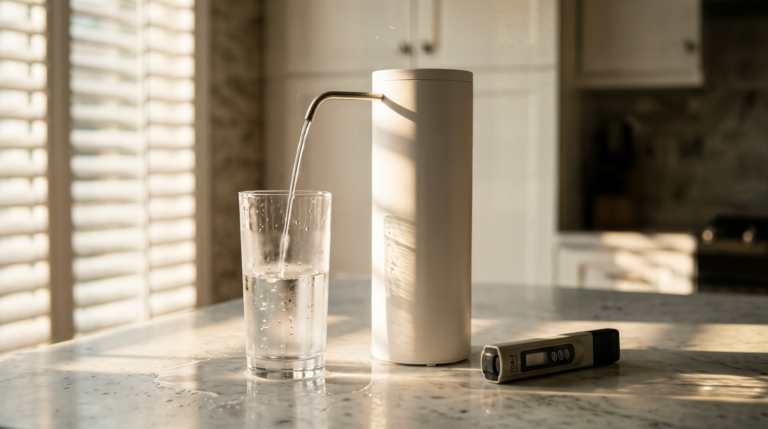
TDS meters measure the electrical conductivity of water, which correlates with dissolved minerals, salts, and metals. They operate in milligrams per litre — parts per million. PFAS compounds in contaminated water exist at nanograms per litre — parts per trillion. One part per trillion is one million times smaller than one part per million. No TDS meter on the market has anywhere near the sensitivity required to detect PFAS at any health-relevant concentration.
I measured 69 ppm TDS at Palm Beach mains and 3 ppm post-RO. That 95.7% reduction is a useful measurement — it confirms the membrane is rejecting dissolved solids and functioning correctly. But a TDS reading of 0 would not tell you anything about PFAS content. You can have 0 ppm TDS and 1,000 ng/L PFOA simultaneously. These measurements operate on entirely different scales.
| What TDS Can Measure | What TDS Cannot Detect |
|---|---|
| Dissolved minerals (calcium, magnesium, sodium) — mg/L | PFAS — exist at ng/L (parts per trillion) |
| RO membrane integrity (indirect indicator) | Microplastics |
| Salt concentration | Pharmaceuticals |
| General dissolved solids at ppm scale | Viruses and bacteria |
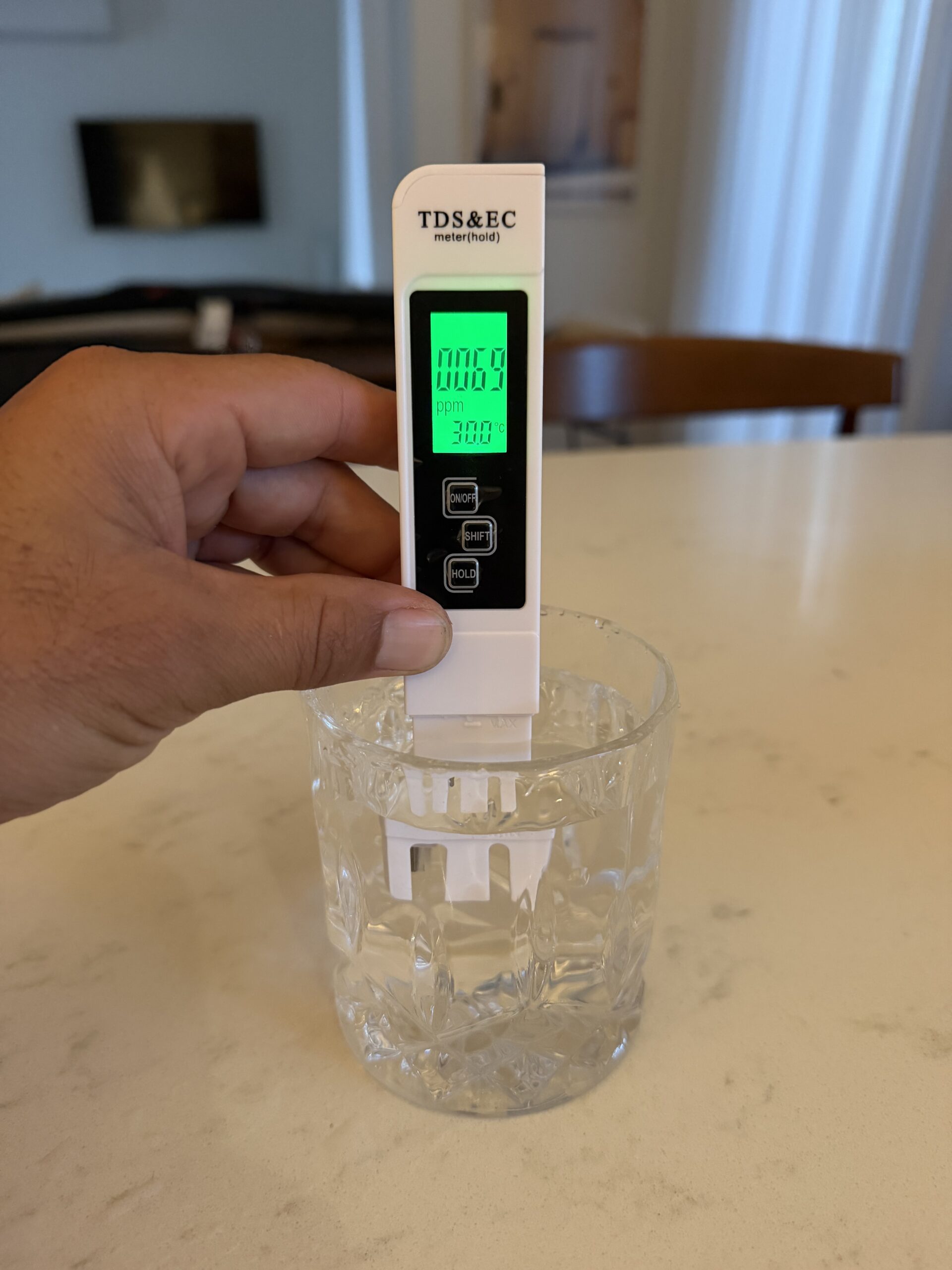
Palm Beach tap water
69 ppm TDS
Unfiltered mains water
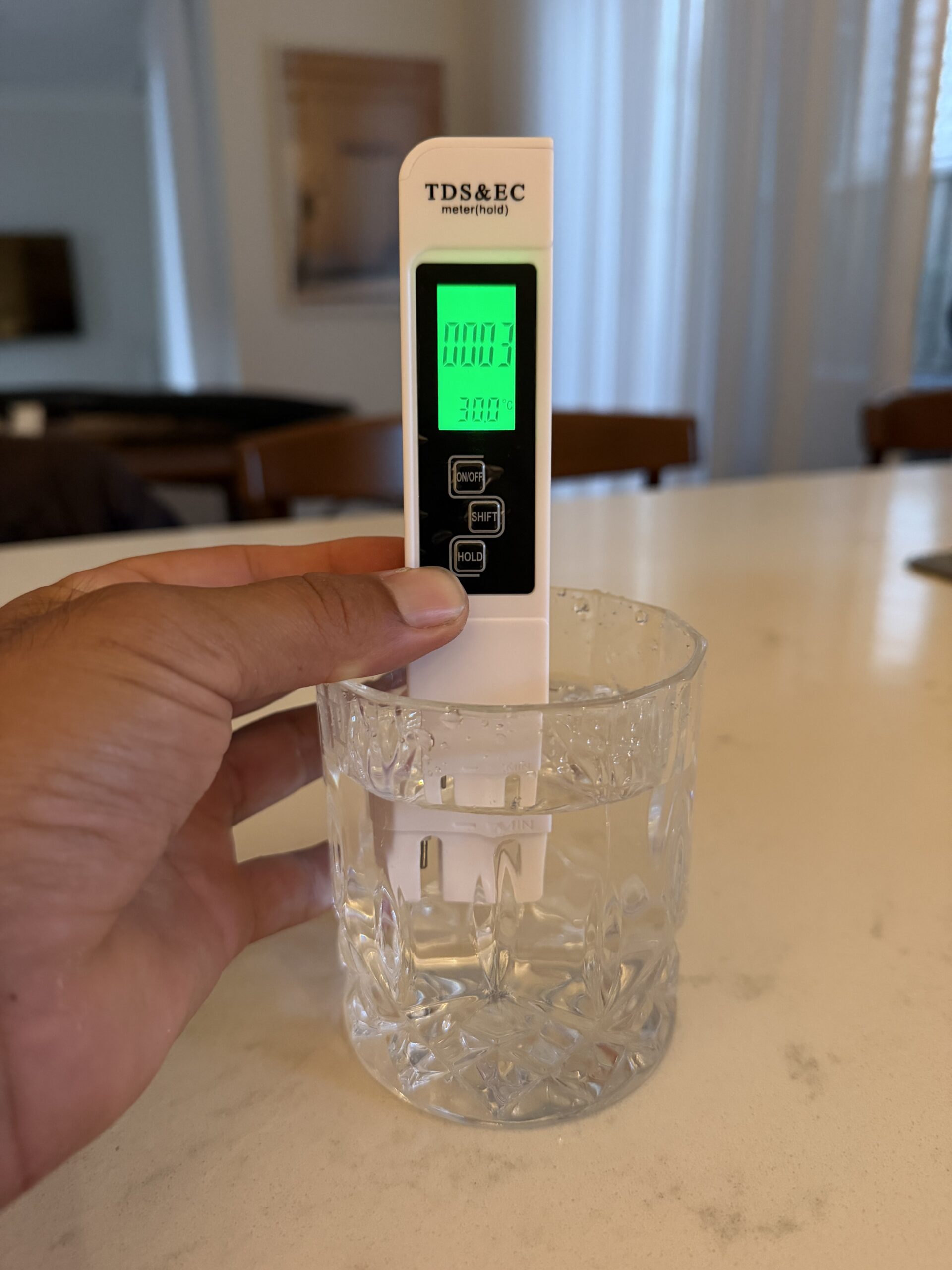
Post RO filtration
3 ppm TDS
95.7% reduction confirmed
Tested with a calibrated TDS&EC meter, Palm Beach QLD. Neither reading detects PFAS — that operates one million times below TDS sensitivity.
The implication for bottled water is direct: no bottled water brand’s TDS figure gives you any information about PFAS. A “low TDS” or “pure” marketing claim tells you about mineral content — nothing else. The only valid PFAS test is LC-MS/MS laboratory analysis at a NATA-accredited lab.
The NSF Certification Hierarchy: 42, 53, 58, and P473 Explained
NSF International certifications are third-party verifications that confirm a filter removes specific contaminants under controlled laboratory conditions. Most consumers have seen “NSF certified” on a water filter box. The problem is that the certifications do not overlap — each tests for a distinct set of contaminants — and PFAS removal is only tested under NSF/ANSI P473.
| Certification | What It Tests | Tests PFAS? |
|---|---|---|
| NSF/ANSI 42 | Taste and odour (chlorine taste, aesthetic issues) | No |
| NSF/ANSI 53 | Health effects — lead, VOCs, cysts, certain pesticides | No |
| NSF/ANSI 58 | Reverse osmosis — TDS reduction, fluoride, arsenic, lead, nitrate | No |
| NSF/ANSI P473 | PFOA and PFOS reduction — the only PFAS-specific certification | Yes — PFOA and PFOS verified |
A filter with NSF 58 certification has proven fluoride and arsenic removal under laboratory conditions. It has not been tested against PFAS. NSF 58 and NSF P473 are separate certifications — a system can hold both (like the AquaTru Classic), or one, or neither.
NSF P473 specifically verifies PFOA and PFOS reduction. It does not test the full 14,700+ PFAS compound library. However, the 0.0001-micron RO membrane that removes PFOA and PFOS operates by physical size exclusion — and that mechanism blocks larger PFAS molecules by default. NSF P473 confirms the mechanism works against the two most studied and regulated compounds. The physical rejection extends to the broader PFAS class.
Recommended Filters: Verified PFAS Removal for Australian Homes
The right filter depends on whether you rent or own, and which city you are in. Brisbane, Sydney, Adelaide, and Darwin use chloramine as the primary disinfectant — standard GAC filters (Brita, basic countertop carbon) fail at chloramine removal even before considering PFAS. Melbourne uses free chlorine, where standard carbon works. For PFAS protection, only RO provides verified removal regardless of city.
AquaTru Classic — Best Countertop RO (NSF 58 + P473 Certified)
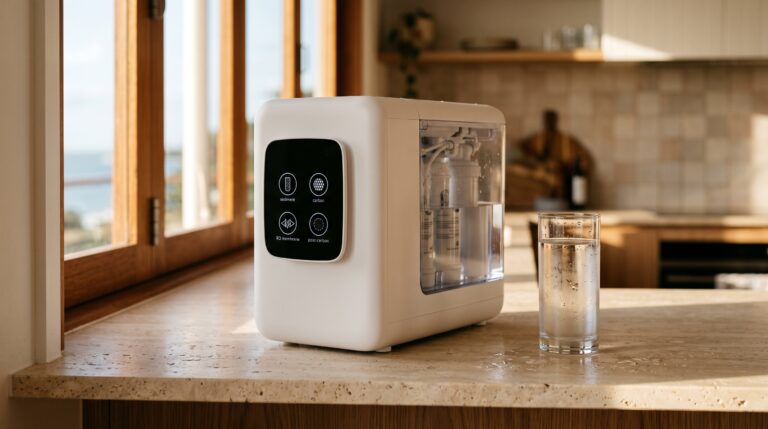
The AquaTru Classic is the only countertop RO system that carries both NSF 58 and NSF P473 certification. No plumber. No permanent installation. No landlord permission required — which makes it the right choice for renters in Brisbane, Sydney, and Perth who cannot modify under-sink plumbing.
Its four-stage system runs: pre-filter (sediment + carbon block), carbon VOC stage, RO membrane, and post-carbon polish. The pre-carbon stages address chloramine — relevant for the majority of Australian capital cities. The RO membrane at 0.0001 microns is the PFAS rejection stage, verified under NSF P473 testing conditions. The system produces approximately 1 litre of purified water for every 3 litres of source water at standard line pressure — a waste ratio that costs less per year than buying bottled water at $2-4 per litre.
The AquaTru Classic is certified under NSF 58 for TDS reduction, with its RO membrane rated to reduce dissolved solids to levels consistent with published NSF 58 performance data.
Waterdrop CoreRO — Best Undersink RO (1:1 Waste Ratio)
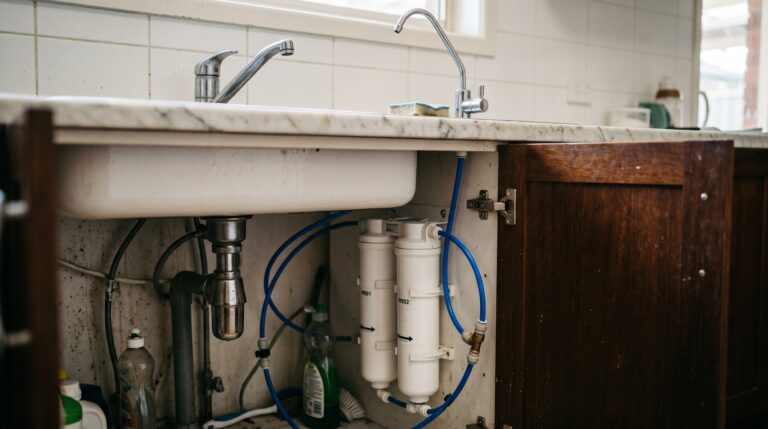
The Waterdrop CoreRO is a tankless undersink RO system with a 1:1 purified-to-waste ratio — considerably more efficient than a tank-based system for a household consuming 6+ litres of filtered water daily. It installs permanently under the sink and connects to a dedicated tap. The Waterdrop D6 model reduces TDS to equivalent levels as the AquaTru — both operating through the same 0.0001-micron RO membrane physics.
The Waterdrop CoreRO does not currently carry NSF P473 certification specifically. If laboratory-verified PFAS certification is your primary criterion, the AquaTru Classic with its P473 certification is the benchmark. If permanent undersink installation with lower waste ratio and higher throughput suits your household better, the Waterdrop CoreRO achieves the same physical mechanism of PFAS rejection through its RO stage.
What Does Not Work for PFAS
Standard GAC filters (Brita jugs, basic countertop carbon) have limited and inconsistent PFAS removal. Some carbon block filters show partial PFOA adsorption in laboratory studies, but without NSF P473 certification, the reduction rate is unverified and varies with contact time, temperature, and starting concentration. Brita in Brisbane is already failing at chloramine removal. It is not a PFAS solution either.
Boiling water does not remove PFAS — it concentrates them as water evaporates while PFAS compounds remain. Alkaline ionisers and mineral cartridges have no PFAS removal mechanism. Activated alumina removes fluoride but has no PFAS removal pathway. The only verified removal method at scale is reverse osmosis.
Bottled Water vs Certified Filter: An Honest Comparison on PFAS
Bottled water in Australia cannot confirm PFAS absence because FSANZ does not require PFAS testing. A certified RO filter with NSF P473 can confirm PFAS removal because third-party laboratory testing under controlled conditions says so. These are not equivalent levels of certainty — one is marketing language and one is a standard.
There is a reasonable argument that spring water sourced from a pristine, non-contaminated catchment is probably low in PFAS. That is likely true for some products. “Probably” and “likely” are not laboratory verification. At $2-4 per litre for bottled water versus $0.04-0.12 per litre for RO filtered tap water, you are paying 20-100 times more for a lower standard of evidence.
For the full financial breakdown, see the best water filters to replace bottled water in Australia — the hub article for this series with full product comparisons including Berkey and Tappwater. For a broader overview of water filtration options, see the best water filters Australia 2026 guide. If you have questions about the environmental and health costs of bottled water beyond PFAS, see microplastics in bottled water Australia — Part 2 of this series.
Last reviewed: April 2026 — Clean and Native
Frequently Asked Questions
Does Australian bottled water contain PFAS?
It might. FSANZ does not require routine PFAS testing for bottled water sold in Australia. Without independent LC-MS/MS laboratory results from the specific brand, there is no way to confirm or deny PFAS presence in any packaged water product on Australian shelves.
What is the ADWG 2025 guideline for PFAS in drinking water?
The ADWG 2025 health-based guideline values are PFOS + PFHxS combined at 8 ng/L, PFOA at 200 ng/L, and a sum of 29 PFAS compounds at 100 ng/L. These guidelines apply to reticulated tap water supplies — they do not legally apply to bottled water.
Can a carbon filter remove PFAS from water?
Not reliably. Standard GAC has limited, inconsistent PFAS removal. Some carbon block filters show partial PFOA reduction under specific lab conditions, but without NSF/ANSI P473 certification, the performance is unverified. Reverse osmosis at 0.0001 microns is the only certified, consistent PFAS removal method.
Does a TDS meter detect PFAS in water?
No. TDS meters measure dissolved solids in parts per million. PFAS compounds exist at parts per trillion — one million times smaller. A reading of 0 ppm TDS cannot confirm zero PFAS. Only LC-MS/MS laboratory analysis at a NATA-accredited lab can detect PFAS at health-relevant concentrations.
Which water filter certification proves PFAS removal?
NSF/ANSI P473 is the only third-party certification that tests for PFOA and PFOS reduction in water filters. NSF 42, 53, and 58 do not test for PFAS. A filter labelled “NSF certified” without specifying P473 has not been tested against PFAS. The AquaTru Classic holds NSF 58 and NSF P473.
Is reverse osmosis effective against PFAS?
Yes. RO membranes at 0.0001 microns physically block PFAS molecules by size exclusion. The ADWG and peer-reviewed filtration studies report 90-97% PFAS rejection for RO systems. NSF P473 certification specifically confirms PFOA and PFOS reduction under controlled laboratory conditions.
Where are the worst PFAS contamination sites in Australia?
According to DCCEEW, the confirmed priority sites include RAAF Williamtown (NSW), RAAF Pearce (WA, Bullsbrook), Army Aviation Centre Oakey (QLD), RAAF Tindal near Katherine (NT), and RAAF Edinburgh (SA, Salisbury). All involve historical AFFF firefighting foam use. Katherine town supply was directly contaminated and required a GAC treatment plant.
Should I test my bore water for PFAS?
Yes, if you are within 5 km of a confirmed contamination site. Testing requires a NATA-accredited laboratory using LC-MS/MS analysis — the only method sensitive enough for health-relevant concentrations. Costs range from $150 to $350 per sample depending on the number of analytes.
Can boiling water remove PFAS?
No. Boiling concentrates PFAS — water evaporates but PFAS remain in solution. This is the opposite of what happens with bacterial contamination, where boiling is effective. For PFAS, reverse osmosis is the only reliably effective removal method at household scale.
Does switching from tap to bottled water reduce PFAS exposure?
In non-contaminated areas, probably not — and possibly the reverse. Your tap water utility publishes annual PFAS monitoring data. Bottled water has no equivalent disclosure requirement. Filtered tap water from an NSF P473 certified RO system provides greater verified PFAS protection than bottled water at any price point.
Bottled Water vs Filtered Water — The 2026 Series
- Part 1: The Truth About Bottled Water in Australia 2026
- Part 2: Microplastics in Bottled Water Australia: What the Research Shows
- Part 3: The True 5-Year Cost of Bottled Water vs a Home Filter (Australia)
- Part 4: PFAS in Bottled Water Australia (this article)
- Part 5: Best Water Filter to Replace Bottled Water Australia 2026
Get the Australian Home Environment Checklist
30 checks across water, air and EMF. Most of them free. Ranked by impact.
No spam. Unsubscribe any time.

Former Royal Australian Navy Clearance Diver and TAG-E counter-terrorism operator. Founded Clean and Native to apply the same rigorous thinking to the home environment.
Full biography →