Water Softener vs Water Filter Australia: Which Do You Actually Need?
A water softener removes hardness (calcium and magnesium) via ion exchange; a water filter removes contaminants (chloramine, PFAS, fluoride, heavy metals) via carbon, reverse osmosis, or activated alumina — they are different machines solving different problems. In Perth, Adelaide, and Darwin (hardness above 140 mg/L CaCO₃) you likely need both; in Melbourne, Hobart, and Canberra (very soft water) a softener is unnecessary and a carbon filter alone is enough for taste and chlorine. Reverse osmosis incidentally removes hardness as a side-effect of removing everything else, which is why a high-quality under-sink RO can replace a drinking-water softener but not a whole-house softener for appliance protection.
How we assess: I have not personally tested the water softeners or non-EcoHero filters discussed in this guide; that assessment is based on published manufacturer specifications and independent certification (WaterMark AS3497, NSF/ANSI, ADWG), not first-hand measurement. The only water product I measure first-hand is the EcoHero 5-Stage RO, at my Palm Beach QLD property.
Different machines, different jobs. A softener protects appliances and skin from limescale. A filter protects you from chloramine, PFAS, fluoride, and lead. The catches: most Australian cities (Melbourne, Hobart, Canberra, Sydney, Brisbane, Cairns) have soft enough water that you do not need a softener at all — only Perth, Adelaide, Darwin, and parts of rural QLD/NSW justify the spend.
| Technology | What it removes | Verdict |
|---|---|---|
| Water Softener | Calcium & magnesium (hardness only) | Only if hardness >140 mg/L |
| Water Filter (RO) | Chloramine, PFAS, fluoride, lead — and incidentally hardness | Recommended for every Australian home |
| Both Combined | Appliance-grade soft water + drinking-grade pure water | Best in Perth, Adelaide, Darwin |
✓ Who This Guide Is For
- Homeowners with hard-water suburbs in Perth, Adelaide, Darwin, or regional bore-water households
- Renters comparing benchtop filters before committing to plumbed appliances
- Anyone confused by overlapping marketing claims from softener and filter brands
- Families in Brisbane, Sydney, or any chloramine-disinfected city who want clean drinking water and appliance protection
× Who This Guide Is Not For
- Melbourne, Hobart, or Canberra residents — your water is naturally soft. Skip the softener entirely.
- Anyone shopping for a magnetic or electronic “descaler” — no peer-reviewed evidence these work; do not waste money on them.
- Tank-water households — you need a sediment filter and UV, not a softener or RO.
Confusing the two is the most common mistake Australian homeowners make when they try to improve their water. Brisbane households spend $1,500 on a softener they do not need; Adelaide households spend $400 on a benchtop filter that does nothing about the 400 mg/L TDS leaving scale on their kettle. Both errors come from the same place: not knowing what each machine actually does. Here is the technical separation, then the geography, then the spend decision.
What a Water Softener Does (and Does Not Do)
A water softener uses ion exchange to remove calcium and magnesium ions. Water passes through a resin tank loaded with sodium ions; the resin captures the calcium and magnesium and releases sodium in exchange. The output is chemically “soft” — near-zero hardness, slightly elevated sodium, otherwise unchanged.
What this gives you: no limescale inside the hot water system, dishwasher, washing machine, kettle, or shower heads. Soap and shampoo lather properly. Skin and hair feel softer after showering — not because the water is cleaner, but because hard minerals are no longer leaving residue. According to Queensland Government water quality data, hardness above 100 mg/L CaCO₃ is where limescale impact on appliances becomes economically meaningful — meters above 150 mg/L sharply reduce dishwasher and hot water service lifespans.
The resin tank regenerates periodically using salt — typically $150–$300 per year in salt cost depending on household size and water hardness. Running cost includes a small amount of waste water during regeneration (~4–8% of throughput).
What a softener does NOT do: it does not remove chloramine, free chlorine, PFAS, fluoride, lead, arsenic, microplastics, or any organic contaminant. Soft water can still taste of chlorine, still contain fluoride at 1.0 mg/L, and still be high in TDS from sodium. Drinking soft water alone does not deliver safe drinking water in any meaningful sense beyond what the underlying source provided.
What a Water Filter Does (and the Three Main Types)
A water filter is a category, not a single technology. The three categories that matter for Australian homes are carbon filtration (standard or catalytic), reverse osmosis (RO), and activated alumina (for fluoride only).
Standard granular activated carbon (GAC): Brita pitchers, fridge filters, basic benchtop carbon filters. Removes free chlorine and improves taste. Fails on chloramine, fluoride, PFAS, hardness. Suitable for Melbourne, Hobart, Canberra, Townsville, Cairns, Toowoomba where the disinfection is free chlorine.
Catalytic carbon block: Tappwater EcoPro, AquaTru pre-filters, Berkey post-filters. Removes free chlorine, chloramine, VOCs, lead, and partially captures fluoride bonded to other minerals. Suitable for Brisbane/SEQ, Sydney, Adelaide, Darwin where chloramine is the disinfection. Does not remove fluoride or hardness.
Reverse osmosis (RO): Pure Water Systems EcoHero 5-Stage, Waterdrop D6, AquaTru Classic. The membrane removes ~95% of TDS — including chloramine, free chlorine, fluoride (90–97%), PFAS (>98%), lead (>95%), arsenic, microplastics, and hardness. The most thorough technology available without a laboratory budget. According to the Australian Drinking Water Guidelines (ADWG), RO is the only single-stage technology that meets every contaminant limit simultaneously.
Which Australian Cities Actually Need a Softener?
Most Australian capital city water is naturally soft to moderately soft. Only Adelaide, Perth, Darwin, and some regional bore-water households cross the threshold where softening makes economic sense.
| City | Hardness (mg/L CaCO₃) | Classification | Softener? |
|---|---|---|---|
| Melbourne | ~25 | Very soft | No |
| Hobart | ~15 | Very soft | No |
| Canberra | ~40 | Soft | No |
| Sydney | ~50 | Soft | No |
| Brisbane / SEQ | ~80–120 | Moderate | Optional |
| Adelaide | ~140 | Hard | Yes |
| Perth | ~180 | Hard | Yes |
| Darwin | ~150 | Hard | Yes |
Perth’s hardness of 180 mg/L is the highest of any Australian capital and the only one where a whole-house softener returns its purchase price in extended dishwasher and hot water service lifespans within 5 years. Kwinana industrial corridor and Rockingham suburbs in Perth see slightly higher figures still. Adelaide and Darwin are similar. Brisbane is borderline — a softener helps but does not pay for itself purely on appliance preservation.
The Hidden Crossover: How RO Replaces a Drinking-Water Softener
A whole-house water softener treats every tap, including the kitchen sink — but it does not improve drinking water quality. The water that comes out is soft but still contains chloramine, fluoride, and any other contaminant the source carried.
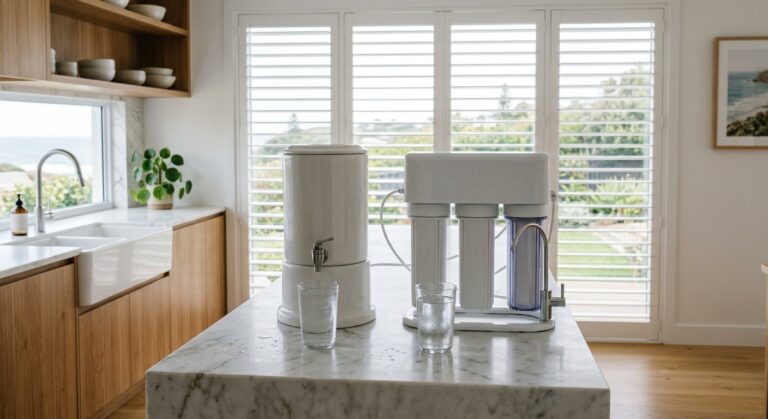
A whole-house softener plus a separate under-sink RO is the gold standard for hard-water cities: appliance protection from the softener, drinking-grade water from the RO at the kitchen tap. Pure Water Systems’ Australian-made EcoHero 5-Stage Reverse Osmosis is the model I tested at my own Palm Beach property; it reduced 69 ppm TDS down to 3 ppm using a calibrated TDS-3 meter, a 95.7% reduction. In hard-water cities such as Perth, the same unit produces very low output TDS at the kitchen tap, close to distilled water.
For renters and apartments where a whole-house softener is not feasible: a benchtop or countertop RO unit gives you drinking-grade water and incidentally removes the hardness from the water you actually drink. You will still get scale on appliances fed from the mains supply, but the water you ingest is fully soft and fully clean.
5-Year Cost Comparison
Assumes a four-person Adelaide household using 200 L/day for showers/laundry/dishwasher and 8 L/day for drinking and cooking.
| Setup | Upfront | Annual Run Cost | 5-Year Total | Coverage |
|---|---|---|---|---|
| Whole-house softener only | ~$1,800 | ~$250 (salt + waste water) | ~$3,050 | Appliances only — drinking water unchanged |
| Under-sink RO only | ~$549 | ~$120 (filter cartridges) | ~$1,149 | Drinking water only — appliances unchanged |
| Softener + RO combo (recommended for Perth/Adelaide) | ~$2,349 | ~$370 | ~$4,199 | Full coverage |
| Bottled water (2 L/day/person, four-person household) | $0 | ~$2,920 | ~$14,600 | Drinking only — appliance damage continues |
The Softener+RO combo at $4,199 over 5 years is roughly 29% of the cost of bottled water alone over the same period, and adds appliance protection that bottled water cannot deliver.
Decision Tree: Softener, Filter, or Both?
Answer three questions:
- What city are you in? Melbourne, Hobart, Canberra, Sydney, Brisbane (mostly), Cairns, Townsville: water is soft enough that a softener is unnecessary. Perth, Adelaide, Darwin, regional bore households: hardness justifies a softener.
- What is the disinfection? Brisbane, Sydney, Adelaide, Darwin use chloramine — standard GAC carbon filters fail. You need catalytic carbon block or reverse osmosis. Melbourne, Hobart, Canberra use free chlorine — standard carbon works.
- What is your priority? Skin/hair feel + appliance protection only = softener. Drinking water quality + chloramine/PFAS/fluoride removal = filter (RO preferred). Both = the combo.
For a complete picture of Australian water filtration options, see our water filtration pillar guide, which compares every major filter category and links the city-specific suburb guides.
My recommendation for Perth and Adelaide households
For hard-water Australian cities, the highest-impact-per-dollar setup is the Pure Water Systems EcoHero 5-Stage Reverse Osmosis at the kitchen tap, paired with a whole-house softener if hardness exceeds 140 mg/L. The EcoHero is Australian-made with TGA-compliant components and a 95.7% TDS reduction in my own Palm Beach testing.
See EcoHero 5-Stage Price → See PWS Whole-House Softener →Last reviewed: May 2026 — Clean and Native. Hardness figures sourced from each state’s published water quality reports; pricing reflects May 2026 market rates and is subject to change.
Frequently Asked Questions
Do I need a water softener or a water filter in Brisbane?
Brisbane water is moderately hard (~80–120 mg/L CaCO₃) and disinfected with chloramine. A softener is optional — most Brisbane homes do not need one. A catalytic carbon block or reverse osmosis filter is the priority because chloramine is not removed by standard GAC carbon filters.
Can a water filter replace a water softener?
An under-sink reverse osmosis filter incidentally removes hardness from drinking water as a side-effect of removing everything else — so a kitchen RO does replace a softener for drinking water. It does NOT replace a softener for the rest of the house: showers, dishwasher, washing machine, and hot water service still see hard water from the mains supply.
Does reverse osmosis remove water hardness?
Yes. Reverse osmosis removes 95–99% of total dissolved solids including calcium and magnesium — the minerals that cause hardness. In hard-water cities such as Perth, an EcoHero 5-Stage RO reduces input TDS to a very low level, effectively zero hardness.
Is soft water safe to drink?
Soft water is safe to drink in Australia. It contains slightly elevated sodium from the ion-exchange resin (about 7–30 mg/L extra depending on input hardness) which is negligible compared to dietary sodium. Anyone on a strict low-sodium diet (less than 1,500 mg/day) may want to drink filtered or RO water instead.
What’s the best water softener brand in Australia?
Pure Water Systems (PWS) sells an Australian-made whole-house softener with WaterMark compliance and Australian-spec resin volumes for typical 4-bedroom homes. Mainline international brands (Pentair, Culligan, Fleck) are also available through Australian distributors but require importing replacement parts.
Do I need a water softener in Melbourne?
No. Melbourne tap water is naturally very soft at ~25 mg/L CaCO₃ — well below the threshold (100 mg/L) where limescale impact on appliances is measurable. A softener in Melbourne is a marketing purchase, not a hardware purchase.
What’s the difference between a water softener and an RO system?
A softener swaps calcium and magnesium for sodium via ion exchange — it changes the chemistry but does not remove any other contaminants. An RO system forces water through a semi-permeable membrane that blocks ~95% of all dissolved solids — including hardness, chloramine, fluoride, PFAS, lead, and microplastics. RO is thorough; a softener is targeted.
Do magnetic or electronic descalers work?
No. Independent studies have found no statistically significant scale reduction from magnetic or electronic descaling devices in domestic plumbing. Save your money and either install a real softener (if hardness justifies it) or accept the limescale rate.
Air is half the equation. Water is the other half.
For Australian households building a complete clean-water and clean-air home, see our companion guides on indoor air purification and water filtration. The air-vs-water comparison matters more than most realise — Australians spend 90% of their time indoors breathing indoor air, but only 5% of that time drinking indoor water.
Get the Australian Home Environment Checklist
30 checks across water, air and EMF. Most of them free. Ranked by impact.
No spam. Unsubscribe any time.

Former Royal Australian Navy Clearance Diver and TAG-E counter-terrorism operator. Founded Clean and Native to apply the same rigorous thinking to the home environment.
Full biography →