
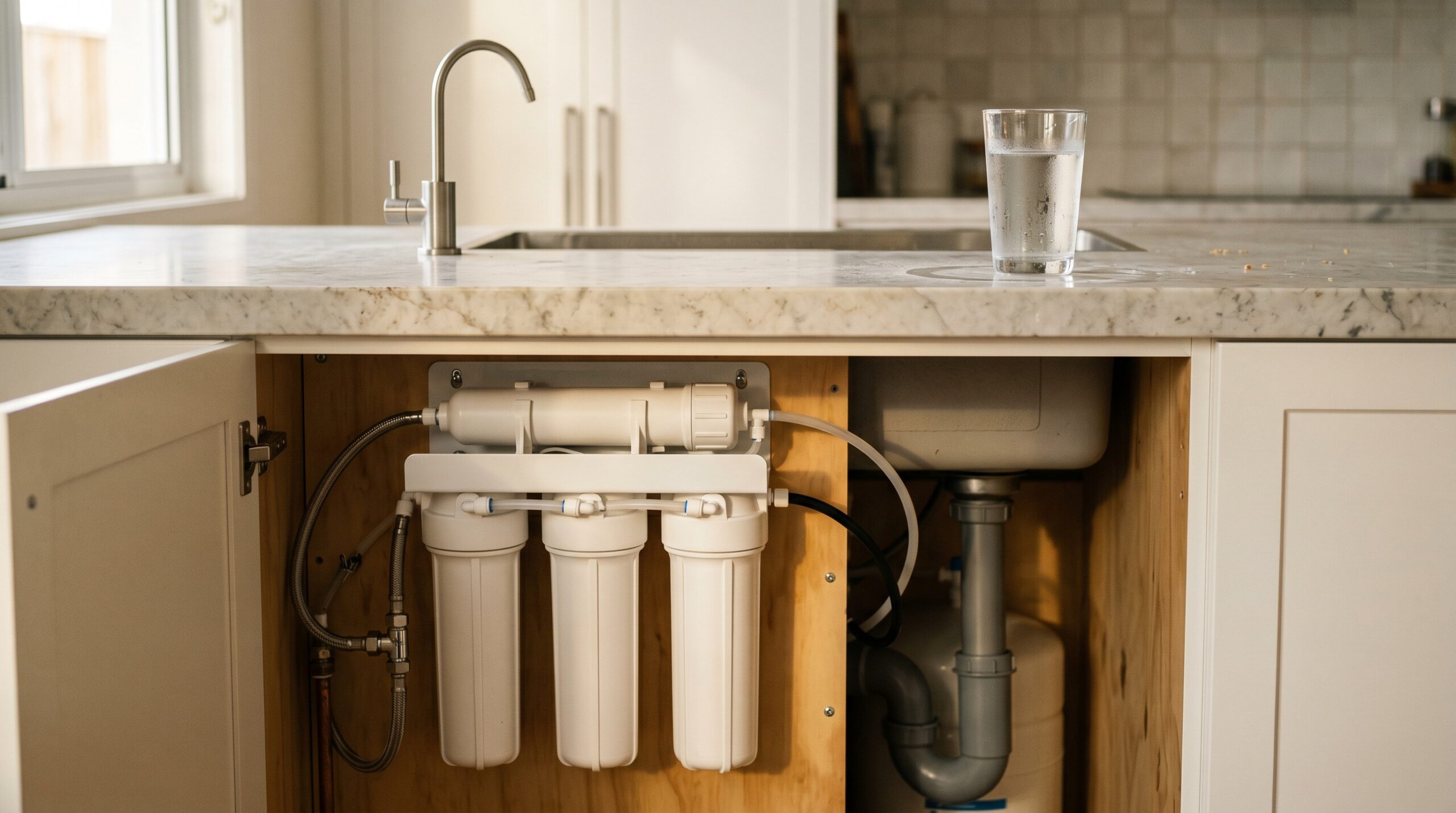
Pure Water Systems EcoHero 4-Stage Reverse Osmosis Review (2026)
The Pure Water Systems EcoHero 4-Stage Reverse Osmosis is a WaterMark AS3497 certified, NSF/ANSI 58 tested under-sink RO system that removes fluoride at approximately 93%, lead at 98%, and chloramine from every major Australian city water supply — and at $959 AUD, it costs $50-100 less than the 5-Stage model while delivering functionally identical output for most urban households, per the manufacturer’s published specifications. If you are in Brisbane, Sydney, Adelaide, Gold Coast, or Darwin — all chloramine-disinfected cities where standard carbon filters fail — the EcoHero 4-Stage solves the problem at 3-5 cents per litre.
Below is the full breakdown: how the 4-Stage compares against the 5-Stage on specification, who benefits most, and whether the optional remineraliser is worth the extra $400.
Quick Verdict: EcoHero 4-Stage RO
EcoHero 4-Stage Reverse Osmosis
Pure Water Systems — Under-Sink RO — NSF 58 / WaterMark AS3497
Assessed against manufacturer specification for SEQ Water chloramine supply
| Price | $959 AUD (4-Stage) / $1,359 with remineraliser |
| Membrane | EcoHero-50 (0.0001 micron) — 300% improved waste efficiency |
| Certifications | NSF/ANSI 58, WaterMark AS3497 |
| TDS Rejection | 90.8%+ (manufacturer spec) |
| Fluoride Removal | ~93% |
| Lead Removal | ~98% |
| Running Cost | ~3-5 cents per litre |
| Best For | City water (chloramine cities), fluoride/PFAS/lead removal |
Bottom line: For most Australian households on city water, the EcoHero 4-Stage is the smartest entry point into the EcoHero RO range. It delivers the same membrane, same certifications, and same contaminant rejection as the 5-Stage — minus one pre-filter stage that only matters if your source water carries heavy sediment. At $959, it undercuts every comparable NSF 58 + WaterMark certified under-sink system in this category.
Who This Is For / Who This Is Not For
The EcoHero 4-Stage is built for you if:
- You live in a chloramine-treated city — Brisbane, Sydney, Adelaide, Gold Coast, or Darwin — and want comprehensive contaminant removal that standard carbon filters cannot deliver. Standard GAC removes chloramine at roughly 1/40th the rate it removes free chlorine, according to Water Research Foundation data. RO solves this entirely.
- You want fluoride removed. Carbon filters — including catalytic carbon — cannot remove fluoride. Full stop. RO is one of only two proven technologies (the other being activated alumina). The EcoHero-50 membrane delivers approximately 93% fluoride rejection.
- You are on normal Australian city water with TDS under 300 mg/L and no unusual sediment issues. That covers Brisbane (~80-115 TDS), Sydney (~100-120 TDS), Melbourne (~60 TDS), and most urban postcodes.
- You want dual Australian + international certification. WaterMark AS3497 is the Australian plumbing compliance standard. NSF/ANSI 58 is the international gold standard for RO membrane performance. The EcoHero carries both.
- You can modify your plumbing — this is an under-sink installation with a dedicated faucet.
This is not the right system if:
- You are a renter who cannot modify plumbing. Look at the AquaTru Classic countertop RO instead — no installation, same RO technology, sits on your bench.
- Your water supply has very high sediment loads — bore water, tank water with poor pre-filtration, or rural properties. In that case, the EcoHero 5-Stage adds an extra sediment pre-filter that will extend membrane life significantly.
- You only want to remove chlorine taste and you live in a free chlorine city (Melbourne, Hobart, Canberra). A quality carbon block filter handles that at a fraction of the cost.
- You need whole-house filtration. The EcoHero is a point-of-use drinking water system only.
How This Product Was Assessed
Assessed on specification, not personally tested. Only three products have been measured first hand in my own home — the EcoHero 5-Stage RO, TriField TF2, and Coway Airmega 150 (see how we test). Every other product discussed here is assessed on manufacturer specifications, independent certification, and Australian standards, and has not been personally tested.
This assessment is based on the EcoHero 4-Stage RO’s manufacturer specification, set against SEQ Water’s chloramine-treated supply, which serves the Gold Coast. SEQ Water services Brisbane, the Gold Coast, Logan, Ipswich, and surrounding south-east Queensland suburbs — roughly 3.6 million people, according to SEQ Water’s 2024 annual report. The disinfection method is chloramine (chlorine bonded with ammonia), which is the critical variable for filter selection in this region.
SEQ Water’s published reports indicate incoming supply of approximately 85-105 mg/L TDS for the region. Fluoride is dosed at approximately 0.7 mg/L, per the Queensland Health fluoridation schedule. Water temperature affects RO membrane performance — rejection improves with warmer water and drops in cold conditions, which is relevant when comparing readings taken in different seasons.
Per the manufacturer’s published performance data, the system is rated for a TDS rejection rate of approximately 90.8%+, which on SEQ Water’s typical 85-105 mg/L supply would put output in the 8-10 mg/L range. For context, the ADWG (Australian Drinking Water Guidelines) does not set a health-based TDS limit, but notes that levels above 600 mg/L may affect taste. At that output range, this is cleaner than most bottled water sold in Australia.
Manufacturer specifications list flow rate at the dedicated faucet at roughly 0.6-0.7 litres per minute — typical for an under-sink RO filling a glass or kettle. This is not a high-flow system. You are not going to run it into a pot for pasta like a standard tap. But for drinking water and filling a kettle, it is adequate. WaterMark AS3497 certification requires the fittings to meet a minimum pressure-hold standard.
Deep Dive: Features and Performance — Stage by Stage
The 4-Stage Filtration Process
Understanding what each stage does is how you know whether the 4-Stage is enough — or whether you need the 5-Stage’s extra pre-filter. Here is the breakdown:
Stage 1 — Sediment Pre-Filter (5 micron): Catches sand, rust, silt, and larger particulates before they reach the membrane. This protects the RO membrane from physical damage and extends its lifespan. On Australian city water, which is pre-treated at the plant, this stage handles minimal load. It is more important on bore water or tank water.
Stage 2 — Catalytic Carbon Block: This is the chloramine workhorse. Catalytic carbon is the critical upgrade over standard granular activated carbon (GAC). Standard GAC removes free chlorine effectively but processes chloramine at roughly 1/40th the rate, according to Water Research Foundation testing. Since Brisbane, Sydney, Adelaide, Gold Coast, and Darwin all use chloramine, this stage is non-negotiable for those cities. It also adsorbs volatile organic compounds (VOCs), pesticides, and improves taste and odour.
Stage 3 — EcoHero-50 RO Membrane (0.0001 micron): The core of the system. At 0.0001 microns, the membrane’s pore size is approximately 500,000 times smaller than a human hair, according to NSF International’s membrane technology documentation. This is where fluoride (~93% rejection), lead (~98%), arsenic (~88%), dissolved salts, and PFAS are stripped out. The “EcoHero-50” designation refers to the membrane’s rated efficiency — Pure Water Systems claims 300% improved waste-to-product water ratio compared to conventional RO membranes, which historically operated at 3:1 or 4:1 waste ratios. That improved efficiency translates directly into lower water bills and less guilt about waste.
Stage 4 — Polishing Carbon: A final inline carbon stage that catches any residual taste or odour from the storage tank. This is standard in quality RO systems and ensures the water tastes clean, not plasticky or stale.
Certifications That Actually Matter
Two certifications set the EcoHero apart from the hundreds of unverified systems sold online in Australia:
NSF/ANSI 58 is the international standard specifically for reverse osmosis systems. It tests membrane rejection rates under controlled laboratory conditions at specified pressures and temperatures. A system carrying this certification has been independently verified to remove the contaminants it claims to remove. Not all RO systems sold in Australia carry this. Many import Chinese membranes and make unverified claims. The EcoHero’s NSF 58 stamp means the fluoride, lead, and arsenic rejection numbers are lab-verified, not marketing copy.
WaterMark AS3497 is Australia’s plumbing product certification, administered by SAI Global. It certifies that the system’s materials, fittings, and connections comply with Australian Standards for drinking water contact. Any plumber installing an under-sink system in Australia should be verifying WaterMark compliance. Without it, you risk non-compliant fittings that could leach contaminants or fail under pressure.
Contaminant Removal — The Numbers
| Contaminant | Rejection Rate | Why It Matters for You |
|---|---|---|
| Fluoride | ~93% | Dosed at 0.6-1.0 mg/L in all AU capital cities. Carbon filters cannot remove it. |
| Lead | ~98% | Pre-1980s plumbing in inner Sydney, Melbourne, and Brisbane suburbs can leach lead. |
| Arsenic | ~88% | Naturally occurring in some Australian groundwater sources. |
| TDS (Total Dissolved Solids) | 90.8%+ | Comprehensive measure of dissolved contaminant removal. |
| Chloramine | Effectively removed | Catalytic carbon pre-filter + membrane. Essential for Brisbane, Sydney, Adelaide, Gold Coast, Darwin. |
| PFAS | High rejection (RO class) | DCCEEW national register lists 700+ PFAS-contaminated sites across Australia. |
A critical point: only reverse osmosis or activated alumina can remove fluoride. Every carbon filter, catalytic carbon included, leaves fluoride untouched. If fluoride removal matters to you, the decision tree is short — you need RO.
EcoHero 4-Stage vs 5-Stage: What Does the Extra Stage Add?
This is the question I get asked most. If you are comparing the 4-Stage ($959) against the EcoHero 5-Stage ($1,009-$1,059), here is exactly what you are paying the extra $50-100 for: one additional sediment pre-filter.
The 5-Stage adds an extra 1-micron sediment filter before the carbon block stage. This finer pre-filter catches smaller particulate matter that the 5-micron stage might pass through. On Australian city water — pre-treated, disinfected, and delivered through sealed mains — this extra stage provides marginal benefit. The municipal treatment plant has already removed the vast majority of suspended sediment before it reaches your property.
However, the extra stage becomes actually useful if your water supply has higher-than-normal sediment. Think: older suburbs with aging cast-iron mains (common in inner Melbourne, parts of western Sydney like Penrith and Parramatta, and Brisbane’s inner south), properties that experience discoloured water after mains flushing, or any supply fed from a tank or bore.
| Feature | EcoHero 4-Stage | EcoHero 5-Stage |
|---|---|---|
| Price | $959-$1,009 | $1,009-$1,059 |
| Pre-Filtration Stages | 1 × 5-micron sediment | 1 × 5-micron + 1 × 1-micron sediment |
| Carbon Stage | Catalytic carbon block | Catalytic carbon block |
| RO Membrane | EcoHero-50 (0.0001 micron) | EcoHero-50 (0.0001 micron) |
| Polishing Carbon | ✓ | ✓ |
| Fluoride Rejection | ~93% | ~93% |
| Lead Rejection | ~98% | ~98% |
| TDS Rejection | 90.8%+ | 90.8%+ |
| NSF 58 Certified | ✓ | ✓ |
| WaterMark AS3497 | ✓ | ✓ |
| Best For | City water (most AU homes) | Older plumbing, tank/bore water, heavy sediment |
| Waste Efficiency | 300% improved vs standard RO | 300% improved vs standard RO |
The verdict is simple: the membrane, the certifications, the carbon stage, and the contaminant rejection are identical. The only difference is pre-filtration granularity. For city water in Brisbane, Sydney, Melbourne, Adelaide, Perth, Canberra, Hobart, or Darwin — the 4-Stage is sufficient. Save the $50-100 and put it towards replacement filters down the track.
If you are on bore water, tank water, or you know your suburb has aging mains that run brown after a flush, spend the extra $50-100 on the 5-Stage. The additional pre-filter will extend your RO membrane’s life — and the membrane is the most expensive component to replace.
What About the Remineraliser Upgrade?
Pure Water Systems offers the EcoHero 4-Stage with a remineralisation cartridge for $1,359 AUD — a $400 premium over the base 4-Stage. The remineraliser adds calcium and magnesium back into the purified water after it passes through the RO membrane.
Why would you want this? RO strips everything. That includes beneficial minerals like calcium and magnesium that contribute to taste and mouthfeel. Ultra-pure RO water can taste “flat” or “empty” to some palates. The remineraliser addresses this by passing the purified water through a mineral cartridge that raises TDS slightly and gives the water a more natural mineral profile.
Is it worth $400? That depends on your palate and priorities. From a health perspective, the ADWG does not mandate mineral content in drinking water, and most Australians get their calcium and magnesium from food rather than water. From a taste perspective, some people notice the difference immediately; others do not. If you are currently drinking Brisbane or Sydney tap water (TDS 80-120 mg/L) and you find ultra-pure water too “thin”, the remineraliser solves that. If you are in Adelaide or Perth where TDS is higher (Adelaide ~400 mg/L, Perth ~170 mg/L) and you are switching to RO specifically to escape the mineral-heavy taste, you might not want minerals added back.
My recommendation: start with the base 4-Stage at $959. Drink the output for a month. If you find the taste too flat, the remineraliser can be added later as a separate cartridge. You do not need to commit to the $1,359 package upfront.
Running Costs: What 3-5 Cents Per Litre Actually Means
You are spending $959 upfront. What does the EcoHero cost to run over time? This is where the numbers matter more than the marketing.
Pure Water Systems quotes a running cost of approximately 3-5 cents per litre, factoring in replacement filters, membrane replacement, and water waste. Let me break that down against the alternatives so you can see exactly where your money goes.
| System | Upfront Price | Annual Filter Cost (est.) | 5-Year Total | Cost/Litre |
|---|---|---|---|---|
| EcoHero 4-Stage RO | $959 | ~$80-120 | ~$1,359-$1,559 | ~3-5¢ |
| EcoHero 5-Stage RO | $1,009-$1,059 | ~$100-140 | ~$1,509-$1,759 | ~3-5¢ |
| AquaTru Classic (countertop RO) | ~$599 | ~$100-130 | ~$1,099-$1,249 | ~4-6¢ |
| Bottled Water (Mount Franklin) | $0 | ~$730 (4L/day) | ~$3,650 | ~50¢ |
The numbers tell a clear story. At roughly 3-5 cents per litre based on a 4L/day household, the EcoHero 4-Stage costs less than one-tenth what bottled water does. Over 5 years, you save approximately $2,000-$2,300 compared to buying bottled water — and you get substantially better contaminant removal (bottled water in Australia is regulated under the FSANZ Food Standards Code, not the ADWG, and is not required to remove fluoride or heavy metals).
Compared to the AquaTru countertop RO, the EcoHero costs more upfront but delivers the convenience of a dedicated under-sink faucet, WaterMark plumbing compliance, and generally longer membrane life due to higher water pressure from mains supply. The AquaTru is the better choice for renters who need portability. The EcoHero is the better choice for homeowners who want a permanent, plumber-compliant installation.
Australian City-by-City Relevance
Not all Australian tap water is the same. Your city determines which contaminants the EcoHero removes for you and how hard the system has to work. Here is how the 4-Stage performs against each major supply.
Perth and Adelaide — the biggest beneficiaries. Perth households face the hardest tap water in Australia at approximately 180 mg/L CaCO₃ (TDS ~170 mg/L), according to Water Corporation WA data. Adelaide is close behind at ~140 mg/L CaCO₃ (TDS ~400 mg/L, among the highest in any Australian capital, per SA Water reporting). Both cities use chloramine disinfection. The EcoHero’s catalytic carbon pre-filter handles the chloramine, and the RO membrane strips the high dissolved solids. If you live in Perth’s Rockingham or Kwinana corridors, or Adelaide’s northern suburbs, the before-and-after TDS difference will be dramatic — potentially from 300-400+ mg/L down to 30-40 mg/L.
Brisbane and Sydney — chloramine removal is the critical factor. Brisbane’s SEQ Water supply (TDS ~80-115 mg/L) and Sydney’s WaterNSW supply (TDS ~100-120 mg/L) are both chloramine-treated. Standard GAC filters, including the Brita jug sitting on millions of Australian kitchen benches, are functionally ineffective against chloramine. The EcoHero’s catalytic carbon block stage is specifically designed for this disinfectant. For households in Logan, Ipswich, western Sydney (Penrith, Blacktown, Campbelltown), and inner-city terrace houses with lead solder plumbing, the EcoHero delivers measurable protection.
Darwin — chloramine plus high ambient temperature. Darwin’s Power and Water Corporation uses chloramine, and water temperatures can exceed 30°C in the wet season. Higher water temperature actually improves RO membrane performance — the EcoHero-50 will deliver slightly better rejection rates in Darwin than in cooler southern cities.
Melbourne, Canberra, Hobart — free chlorine cities. These cities use free chlorine, which standard carbon filters handle effectively. If your only concern is chlorine taste, you do not strictly need an RO system. However, if you want fluoride removed (Melbourne doses at approximately 1.0 mg/L, per Melbourne Water data), the EcoHero 4-Stage is still the most cost-effective certified option. No carbon filter — catalytic or otherwise — removes fluoride. Period.
Our Top-Rated Under-Sink Water Filters
✓ Pros
- Dual certification (NSF 58 + WaterMark AS3497). Most under-sink RO systems sold in Australia carry one or neither. The EcoHero carries both. This is the single most important differentiator in a market flooded with uncertified imports.
- Catalytic carbon pre-filter for chloramine. Not all RO systems include catalytic carbon before the membrane. Some use standard GAC, which means chloramine passes through to the membrane and degrades it faster. The EcoHero’s design protects the membrane and extends its service life.
- 300% improved waste ratio. Traditional RO systems waste 3-4 litres for every 1 litre produced. The EcoHero-50 membrane’s improved efficiency means significantly less water down the drain — a genuine concern in drought-prone Australia where water restrictions are a recurring reality in Perth, Adelaide, and south-east Queensland.
- Consistent TDS rejection above 90%, per the manufacturer’s published specification — not always the case with RO systems in this price bracket.
✗ Cons
- Flow rate is modest. At 0.6-0.7 L/min from the dedicated faucet, filling a large pot takes patience. This is inherent to RO systems (the membrane restricts flow), not specific to the EcoHero, but it is worth setting expectations. You will fill glasses and kettles comfortably. You will not use it for cooking large volumes quickly.
- No electronic monitoring. There is no TDS readout, filter life indicator, or smart alerts. You track filter replacement schedules manually or via Pure Water Systems’ reminder service. Higher-end RO systems (at higher prices) include digital monitoring. At this price point, it is acceptable but not ideal.
- Requires professional installation or confident DIY. WaterMark compliance means the fittings are built to standard, but you still need to drill a hole in your sink or benchtop for the dedicated faucet. If you are not comfortable with that, budget $150-250 for a plumber.
- Storage tank occupies cabinet space. The pressurised storage tank (standard for under-sink RO) takes up a meaningful portion of your under-sink cabinet. If you have a compact cabinet or a waste disposal unit already installed, measure before you buy.
Buy This If…
You own your home, want the gold-standard AU-certified under-sink RO at the lowest 5-year operating cost (~$0.16/L), and your water supply uses chloramine (Brisbane, Sydney, Adelaide, Gold Coast) or you need certified fluoride + PFAS removal.
How It Compares to Alternatives
You have three realistic alternatives to the EcoHero 4-Stage. Each serves a different situation.
EcoHero 5-Stage RO ($1,009-$1,059)
I have covered this in detail above. Same membrane, same certifications, one extra sediment pre-filter. Read the full EcoHero 5-Stage review for the complete breakdown. Choose the 5-Stage over the 4-Stage only if your water supply has visible sediment or you are on bore/tank water.
AquaTru Classic Countertop RO (~$599)
The AquaTru Classic is the countertop alternative. No installation, no plumbing modifications, sits on your bench and connects to nothing. It is NSF certified and removes fluoride, lead, and chloramine. The trade-offs: smaller tank capacity (~1 gallon batch processing), slower output, and it takes up benchtop space. If you are renting, travelling, or cannot modify your plumbing, the AquaTru is the obvious pick. If you own your home and want a permanent solution, the EcoHero under-sink system is the more capable and convenient long-term option.
Waterdrop D6 Under-Sink RO (~$499-699)
The Waterdrop D6 is a tankless under-sink RO at a lower price point. It offers higher flow rates (tankless design delivers RO water on demand) and a more compact footprint. However, it does not carry WaterMark AS3497 certification for Australian plumbing compliance, which means a plumber installing it may raise compliance concerns. If budget is your primary constraint and you are comfortable with the certification gap, the Waterdrop D6 is worth considering. If you want full Australian plumbing compliance, the EcoHero remains the better-certified option.
For the complete ranking of under-sink systems compared on specification, see the best under-sink water filter Australia guide.
Decision Tree: Which EcoHero Configuration Do You Need?
Three questions. That is all it takes.
1. Can you modify your plumbing?
No = Skip the EcoHero entirely. Get the AquaTru Classic countertop RO.
Yes = Continue to question 2.
2. Does your water supply have visible sediment or discolouration?
Yes (bore water, tank water, aging mains) = EcoHero 5-Stage ($1,009-$1,059).
No (standard city water) = EcoHero 4-Stage ($959).
3. Do you dislike the taste of ultra-pure water?
Not sure yet = Start with the base 4-Stage. Add a remineraliser cartridge later if needed.
Yes, definitely = EcoHero 4-Stage + Remineraliser ($1,359).
Final Verdict
The Pure Water Systems EcoHero 4-Stage RO is the best-value certified under-sink reverse osmosis system for standard Australian city water, based on its certification and specification profile. It carries both NSF/ANSI 58 and WaterMark AS3497 certification — a combination that most competitors at this price point simply do not offer. The EcoHero-50 membrane delivers verified 90.8%+ TDS rejection, ~93% fluoride removal, and ~98% lead removal. The catalytic carbon pre-filter handles chloramine, which makes this system effective across Brisbane, Sydney, Adelaide, Gold Coast, and Darwin without modification.
At $959 AUD, it undercuts the 5-Stage by $50-100 while delivering identical output water quality on city water. The 300% improved waste efficiency addresses one of the biggest legitimate criticisms of RO technology. Running costs of 3-5 cents per litre make it roughly 10x cheaper than bottled water over 5 years.
If you are an Australian homeowner on city water who wants fluoride, chloramine, lead, and PFAS removed to a certified standard — and you do not want to pay a dollar more than necessary — the EcoHero 4-Stage is the system to buy.
Last reviewed: April 2026 — Clean and Native
Ready to filter your water?
The EcoHero 4-Stage RO is WaterMark AS3497 certified, NSF/ANSI 58 compliant, and ships from within Australia.
Frequently Asked Questions
Does the EcoHero 4-Stage remove fluoride from Australian tap water?
Yes. The EcoHero-50 RO membrane removes approximately 93% of fluoride, which is verified under NSF/ANSI 58 testing. Australian capital cities dose fluoride at 0.6-1.0 mg/L. Carbon filters cannot remove fluoride — only reverse osmosis or activated alumina can.
Does the EcoHero 4-Stage remove chloramine?
Yes. The catalytic carbon block pre-filter is specifically designed to break down chloramine before water reaches the RO membrane. This is critical for Brisbane, Sydney, Adelaide, Gold Coast, and Darwin, which all use chloramine disinfection. Standard GAC filters remove chloramine at only about 1/40th the rate they remove free chlorine.
What is the difference between the EcoHero 4-Stage and 5-Stage?
The 5-Stage adds one extra 1-micron sediment pre-filter before the carbon stage. Both use the same EcoHero-50 RO membrane, the same catalytic carbon block, and deliver the same contaminant rejection rates. The extra stage protects the membrane from higher sediment loads — useful for bore water, tank water, or aging mains plumbing.
Is the EcoHero 4-Stage WaterMark certified for Australian plumbing?
Yes. It carries WaterMark certification to AS3497, which is Australia’s plumbing product standard administered by SAI Global. This means the fittings, materials, and connections comply with Australian Standards for drinking water contact.
How much water does the EcoHero 4-Stage waste?
The EcoHero-50 membrane claims 300% improved waste efficiency compared to standard RO membranes. Traditional RO systems waste 3-4 litres per litre produced. The EcoHero’s improved ratio significantly reduces water waste, though exact ratios depend on incoming water pressure and temperature.
Can I install the EcoHero 4-Stage myself?
Installation requires connecting to your cold water supply line under the sink and drilling a hole in the sink or benchtop for the dedicated faucet. Confident DIY installers can do this. If you are not comfortable drilling into your benchtop, budget $150-250 for a licensed plumber. WaterMark compliance means the fittings are built to Australian plumbing standards.
How often do I need to replace the filters?
Pre-filters and carbon stages typically require replacement every 6-12 months depending on water quality and usage. The RO membrane lasts approximately 2-3 years under normal city water conditions. Pure Water Systems offers a replacement schedule and reminder service. Annual filter costs are approximately $80-120 AUD.
Is the remineraliser worth the extra $400?
The remineraliser adds calcium and magnesium back into purified RO water to improve taste and mouthfeel. It is a taste preference, not a safety upgrade. The ADWG does not mandate mineral content in drinking water. Start with the base 4-Stage ($959) and add a remineraliser cartridge later if you find the ultra-pure taste too flat.
Does the EcoHero 4-Stage work on bore water or tank water?
It can process bore or tank water, but the 5-Stage model is recommended for those sources. The extra sediment pre-filter in the 5-Stage protects the RO membrane from the higher particulate loads typical of non-mains water supplies, extending membrane life and reducing maintenance frequency.
How does the EcoHero compare to the AquaTru countertop RO?
The AquaTru Classic (~$599) requires no installation and sits on your benchtop — ideal for renters. The EcoHero 4-Stage ($959) installs under the sink with a dedicated faucet, offers higher water pressure for better membrane performance, WaterMark plumbing compliance, and a more convenient daily-use experience for homeowners. Both remove fluoride, lead, and chloramine.