
Pure Water Systems Luxe Collection Dual Action Review: The Under-Sink Filter for PFAS and Chloramine
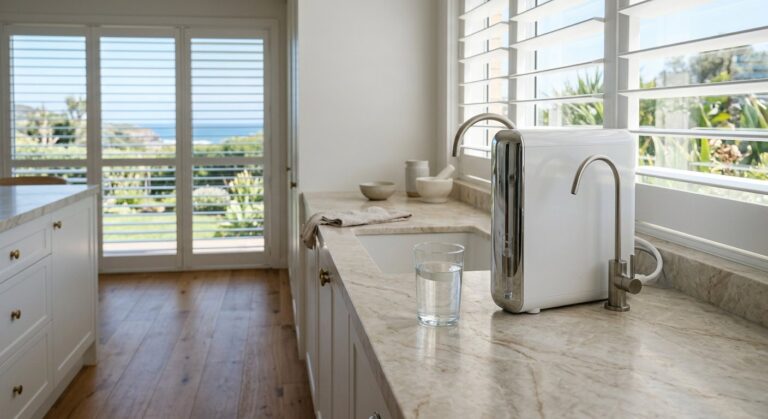
The Pure Water Systems Luxe Collection Dual Action is a two-stage under-sink filter that removes chloramine, PFAS, and 101+ contaminants using compressed carbon block technology — without reverse osmosis. According to independent testing referenced by Pure Water Systems, the HTO+ carbon block achieves PFAS reduction rates comparable to RO membranes while maintaining high flow rates that RO systems cannot match. For Australian households in Brisbane, Sydney, Adelaide, Gold Coast, or Darwin — where chloramine disinfection defeats standard carbon filters — this is one of the few non-RO systems that actually works. But it does not remove fluoride. That single fact determines whether this filter is right for you.
Every product mentioned in this article has been assessed using our documented methodology by Jayce Love. We use calibrated instruments where a product is assessed hands-on, accept no gifted units, and take no brand payments.
I’m Jayce Love, former Royal Australian Navy Clearance Diver, based in Palm Beach QLD. I evaluate water filtration systems against measured performance, Australian water chemistry, and real contaminant data — not marketing claims. Here is the full breakdown.
Quick Verdict
| Best for | Chloramine + PFAS removal without RO complexity |
| Not for | Fluoride removal (need RO for that) |
| Stages | 2 — hollow fibre (0.1μm) + HTO+ compressed carbon block |
| Key contaminants removed | Chloramine, PFAS, chlorine, lead, VOCs, cysts, 101+ contaminants |
| Price (without faucet) | $875 — $895 AUD |
| Flow rate | High flow (significantly faster than RO systems) |
| Fluoride removal | No — carbon block cannot remove fluoride |
The Luxe Dual Action is the strongest non-RO under-sink option in Australia for chloramine and PFAS removal. The hollow fibre pre-filter adds genuine protection against bacteria and cysts — critical for tank water and ageing municipal infrastructure. If fluoride removal is not a priority, this system delivers cleaner water at higher flow rates than any RO system at a comparable price.
Who This Filter Is For — and Who It Is Not For
Before you spend $875, you need clarity. This system solves a specific set of problems better than anything else in its class. But it has a hard limitation that no amount of engineering can overcome.
This filter is for you if:
- You live in a chloramine city (Brisbane, Sydney, Adelaide, Gold Coast, Darwin) and want effective chloramine removal without the complexity, waste water, or slow flow of reverse osmosis
- You are concerned about PFAS contamination — confirmed at 700+ sites across Australia according to the DCCEEW national register — and want proven removal from your drinking water
- You use tank water and need the 0.1 micron hollow fibre stage for bacteria, cysts, and sediment protection that standard carbon filters lack
- You are in Melbourne, Hobart, or Canberra (free chlorine cities) and want premium PFAS + contaminant protection without needing to address chloramine
- You want to retain minerals — this system does not strip TDS the way RO does, so you keep calcium and magnesium
- You want high flow rates — filling a pot or glass without the 30-60 second wait common with RO systems
This filter is NOT for you if:
- You need fluoride removal — carbon block filters, including the HTO+ used here, cannot remove fluoride. Period. Only reverse osmosis (90-97% removal) or activated alumina (80-95%) remove fluoride effectively. If fluoride is your primary concern, you need the EcoHero 5-Stage RO or a comparable RO system.
- You want the absolute broadest contaminant removal — RO with its semipermeable membrane rejects a wider spectrum including dissolved salts, nitrates, and fluoride
- You are on an extremely tight budget — the Twin Quick Change system at $459 covers chloramine and chlorine at a lower price point, though it lacks the hollow fibre stage
How This Product Was Assessed
Assessed on specification, not personally tested. Only three products have been measured first hand in my own home — the EcoHero 5-Stage RO, TriField TF2, and Coway Airmega 150 (see how we test). Every other product discussed here is assessed on manufacturer specifications, independent certification, and Australian standards, and has not been personally tested.
South-East Queensland uses chloramine disinfection — which means standard GAC (granular activated carbon) and Brita-style jug filters are functionally useless here. According to SEQ Water data, Brisbane and Gold Coast tap water typically measures 80-115 mg/L TDS and 80-120 mg/L CaCO₃ hardness. Fluoride is dosed at approximately 0.7 mg/L across SEQ.
This matters because chloramine is the single most misunderstood contaminant in Australian water filtration. Standard GAC removes chloramine at roughly 1/40th the rate it removes free chlorine, according to water treatment literature. Every “chlorine removal” filter that relies on standard GAC is, in a chloramine city, barely doing anything. The HTO+ compressed carbon block in this system is specifically engineered for catalytic chloramine reduction — a critical distinction that separates it from 90% of under-sink filters sold in Australia.
Deep Dive: Features and Performance — Stage by Stage
Stage 1: Hollow Fibre Membrane (0.1 Micron)
The first stage is a hollow fibre membrane rated at 0.1 microns absolute filtration. To put that in context, a human hair is approximately 70 microns. Giardia cysts are 8-15 microns. Cryptosporidium oocysts are 4-6 microns. Bacteria such as E. coli are 0.5-2 microns. At 0.1 microns, this hollow fibre stage physically blocks all of these pathogens without chemical treatment.
This is the feature that separates the Luxe Collection from nearly every other under-sink carbon system on the Australian market. Most under-sink filters use a sediment pre-filter at 1-5 microns — enough for sand and rust, but useless against bacteria and protozoa. The hollow fibre stage makes the Luxe Dual Action actually suitable for:
- Rainwater tank users — according to NHMRC guidelines, roof-collected rainwater in Australia frequently contains bacteria from bird and animal droppings. The 0.1 micron barrier provides physical microbial removal without UV or chemical disinfection.
- Homes with ageing infrastructure — older suburbs in western Sydney (Penrith, Blacktown), inner Brisbane (Woolloongabba, New Farm), and Adelaide’s older grid can have compromised municipal pipework where biofilm and sediment accumulate
- Regional and rural connections — smaller treatment plants with less consistent disinfection residuals benefit from a physical barrier at the tap
Stage 2: HTO+ Compressed Carbon Block
The second stage is where the serious contaminant removal happens. The HTO+ (High Technology Organic Plus) compressed carbon block is not a standard GAC filter. It is a high-density compressed block engineered for catalytic reduction of chloramine and adsorption of organic chemicals including PFAS compounds.
According to Pure Water Systems, the HTO+ block removes 101+ contaminants including:
- Chloramine — the primary disinfectant in Brisbane/SEQ, Sydney, Adelaide, Gold Coast, and Darwin water supplies
- Free chlorine — used in Melbourne, Hobart, Canberra, Townsville, and Cairns
- PFAS (per- and polyfluoroalkyl substances) — the “forever chemicals” that the DCCEEW national register has confirmed at 700+ contamination sites across Australia
- Lead — leaching from older brass fittings and solder joints, particularly in homes built before 1989
- VOCs (volatile organic compounds) — including trihalomethanes (THMs), which form when chlorine or chloramine reacts with organic matter in the water supply
- Cysts — additional barrier beyond the hollow fibre stage
The compressed carbon block format is critical. Loose granular activated carbon (GAC) has gaps between granules that allow water to channel through without full contact time. A compressed block forces water through a dense matrix with vastly greater surface area and contact time per litre. This is why compressed carbon block achieves chloramine removal that GAC cannot — the contact time at the catalytic surface is sufficient for the chemical reaction to complete.
Leak Protection and Cartridge Life Monitor
Two features that most under-sink filters lack entirely. The Luxe Collection includes an integrated leak detection system — if a fitting fails or a cartridge housing cracks, the system shuts off water flow to prevent under-cabinet flooding. Anyone who has dealt with a slow leak under a kitchen sink knows the damage: swollen particleboard, mould behind the kickboard, warped flooring. Prevention is worth far more than the feature costs.
The cartridge life monitor tracks usage and alerts you when replacement is due. This removes the guesswork that plagues most filter systems. A family of four using 8-10 litres per day will exhaust a cartridge at a very different rate than a couple using 3-4 litres. The monitor adjusts to your actual consumption rather than relying on a calendar-based estimate.
Flow Rate: The Practical Advantage Over RO
This is where the Luxe Dual Action wins decisively against every RO system on the market. Reverse osmosis systems operate at 0.5-1.5 litres per minute under typical Australian mains pressure. Many require a pressurised storage tank that occupies significant under-sink space. Filling a pot for pasta takes 30-60 seconds or more.
The Luxe Dual Action operates as a “high flow” system connected directly to your cold water supply. Flow rates are dramatically higher — typically 4-8 litres per minute depending on mains pressure. You turn on the tap and the water flows. No waiting for a tank to refill. No pressure drop as the tank empties. For a family household where the kitchen tap runs frequently, this difference is not theoretical. It is felt every day.
What I Liked
- Genuine chloramine capability. The HTO+ compressed carbon block is the correct technology for Brisbane, Sydney, Adelaide, Gold Coast, and Darwin households. This is not a standard carbon filter marketed with vague “chlorine removal” claims.
- Hollow fibre pre-filter at 0.1 microns. Adds physical bacterial and cyst removal that no other under-sink carbon system in this price range includes. Essential for tank water users.
- High flow rate. Fills a glass instantly. No waiting, no pressure tank, no waste water drain line. For daily cooking and drinking, this is a material quality-of-life improvement over RO.
- Leak protection. Automatic shutoff prevents the single worst failure mode of under-sink filtration — a slow leak you don’t notice until the cabinet floor is ruined.
- Cartridge life monitoring. Removes the guesswork of filter replacement timing. You know when to change, not guess.
- Retains minerals. Unlike RO, this system does not strip calcium, magnesium, and other dissolved minerals. TDS remains largely unchanged. If you drink tank water precisely because you prefer mineral content, this system doesn’t defeat that purpose.
- Australian company. Pure Water Systems is Australian-owned, with local support and WaterMark-compliant products designed for Australian water chemistry — not imported US systems calibrated for American water conditions.
What Could Be Better
- No fluoride removal. This is the single biggest limitation. Carbon block technology — even the HTO+ variant — cannot remove fluoride. Australian municipal water is fluoridated at 0.6-1.0 mg/L in most capital cities according to NHMRC guidelines. If you want fluoride-free water, only reverse osmosis (90-97% removal) or activated alumina (80-95%) will do the job. This system is not the answer for that specific concern.
- Price point sits between budget and RO. At $875-$895, it is roughly double the cost of the Twin Quick Change ($459) and only $115-$135 less than the EcoHero 5-Stage RO ($1,009) which removes fluoride as well. You need to be clear about what you are paying for — the hollow fibre stage and HTO+ technology — or the value proposition becomes less obvious.
- Replacement cartridge costs. Premium filtration media costs more to replace than standard carbon. Factor ongoing annual cartridge costs into your total cost of ownership, not just the upfront system price.
- Without-faucet variant requires compatible tapware. The “without faucet” model reviewed here assumes you have — or will install — a compatible separate drinking water tap. If you don’t, you’ll need the faucet-included version at a higher price, or source a WaterMark-certified tap separately.
How It Compares: Luxe Dual Action vs EcoHero RO vs Twin Quick Change
Three systems, three price points, three different capability sets. The right choice depends on one question: do you need fluoride removal?
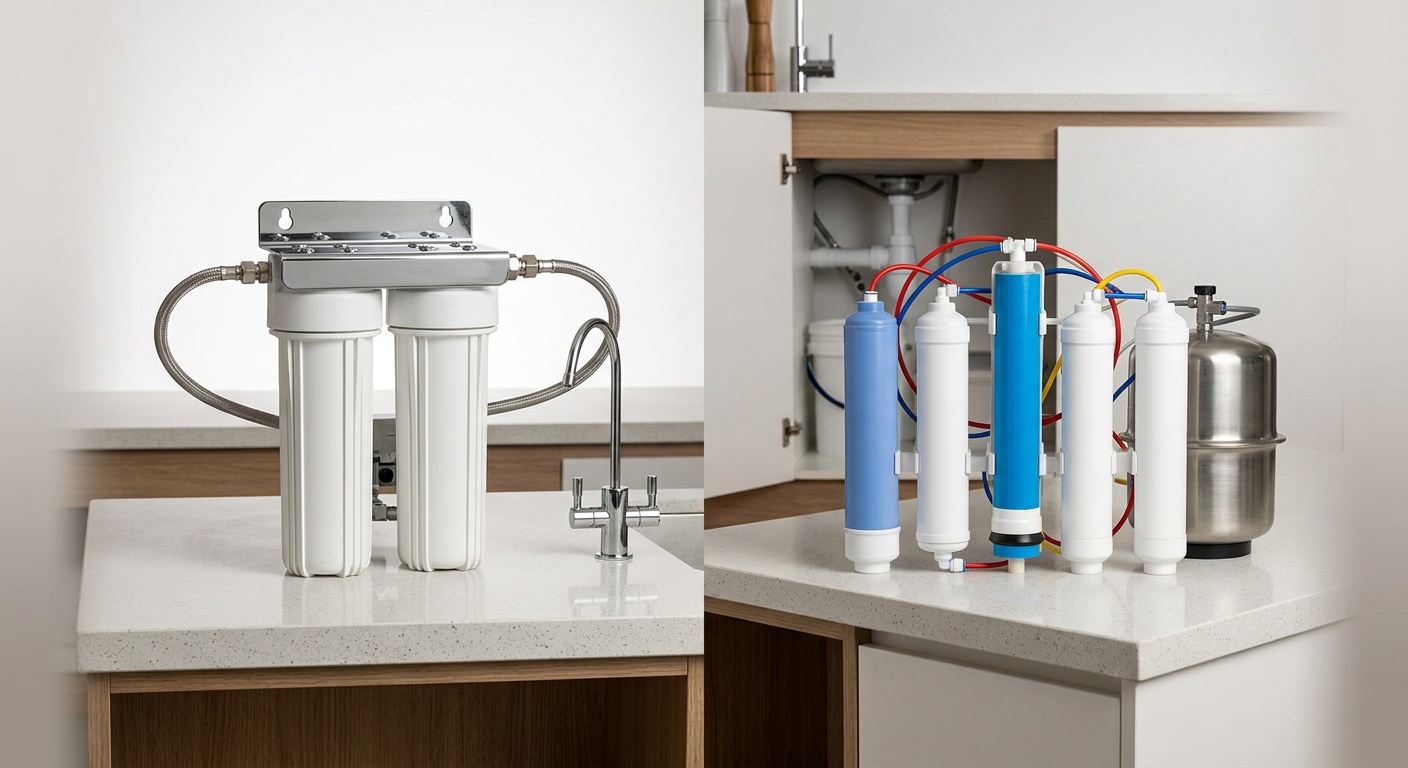
When to Choose the EcoHero 5-Stage RO Instead
If fluoride removal is important to you, the decision is already made. No carbon filter — not even the HTO+ — can reduce fluoride. According to the ADWG (Australian Drinking Water Guidelines), fluoride is added to most Australian municipal supplies at 0.6-1.0 mg/L. The EcoHero 5-Stage RO, certified to NSF/ANSI 58, achieves 90-97% fluoride rejection through its semipermeable membrane. It also removes a broader spectrum of dissolved inorganic contaminants. The tradeoff: slower flow, waste water (typically 3:1 ratio), TDS stripping, and higher upfront cost at ~$1,009. For a detailed comparison of all under-sink options, see our best under-sink water filter for Australian homes.
When to Choose the Twin Quick Change Instead
If your budget is the primary constraint and you are on mains-treated water (not tank water), the Twin Quick Change at ~$459 handles chloramine and chlorine reduction effectively through compressed carbon block. You lose the 0.1 micron hollow fibre stage — meaning no physical barrier against bacteria and cysts — and you lose the leak protection and cartridge life monitor. For a household on mains water in a city where the treatment plant already handles microbial safety, that may be an acceptable compromise.
When the Luxe Dual Action Is the Clear Winner
The Luxe Dual Action occupies a specific and valuable position: maximum non-RO protection. Choose it when you want PFAS and chloramine removal, bacterial protection (especially for tank water), high flow rates, mineral retention, and integrated safety features — without the complexity and waste water of reverse osmosis. At $875-$895, you are paying $115-$135 less than the EcoHero RO and getting a system that works fundamentally differently and, in some respects, better for daily use.
Decision Tree: Which Under-Sink Filter Do You Actually Need?
Three questions. That is all it takes.
Question 1: Do you need fluoride removal?
- Yes → You need reverse osmosis. The EcoHero 5-Stage RO is the top-rated option. No carbon filter of any type removes fluoride. See our full guide: best water filter for fluoride and PFAS removal in Australia
- No → Proceed to Question 2.
Question 2: Do you use tank water (rainwater) or have concerns about bacteria/cysts?
- Yes → You need the 0.1 micron hollow fibre stage. The Luxe Dual Action is the best option. Standard carbon systems do not provide microbial barrier protection.
- No → Proceed to Question 3.
Question 3: What is your budget?
- $800+ → The Luxe Dual Action gives you the HTO+ compressed carbon block, hollow fibre pre-filter, leak protection, and cartridge life monitoring. Maximum non-RO protection.
- $900+ → Consider the Luxe Triple System at $975-$995 for three-stage filtration and even broader contaminant reduction.
- Under $500 → The Twin Quick Change at ~$459 handles chloramine and chlorine on mains water without the hollow fibre or monitoring features.
City-Specific Guidance: Which Australian Households Benefit Most?
Brisbane, Gold Coast, and South-East Queensland
SEQ Water uses chloramine disinfection. TDS ranges 80-115 mg/L. Hardness is moderate at 80-120 mg/L CaCO₃. Fluoride is dosed at ~0.7 mg/L. PFAS contamination has been documented at multiple SEQ sites including defence facilities. Suburbs like Logan, Ipswich, and areas near the former Amberley RAAF base have heightened PFAS awareness. The Luxe Dual Action’s chloramine reduction and PFAS removal address the two most significant concerns for SEQ households who are not seeking fluoride removal.
Sydney and Greater Western Sydney
Sydney Water uses chloramine. TDS varies but fluoride is dosed at up to 1.0 mg/L in some distribution zones. Western Sydney suburbs — Penrith, Blacktown, Liverpool — sit further from treatment plants, meaning higher chloramine residuals at the tap and more disinfection byproducts from longer pipe residence time. PFAS contamination has been confirmed around Williamtown RAAF base (Hunter region) and other defence sites. The Luxe Dual Action is highly relevant here.
Adelaide
SA Water uses chloramine. Adelaide has some of the hardest water in Australia at ~140 mg/L CaCO₃ and TDS around 400 mg/L. The Luxe Dual Action handles chloramine and PFAS effectively. Note that this system does not soften water or reduce TDS — if scaling and hard water are your primary concerns, you may need a different approach.
Perth
Water Corporation uses chloramine. Perth has the hardest water of any Australian capital at ~180 mg/L CaCO₃ and TDS around 170 mg/L. PFAS has been confirmed near RAAF Base Pearce (Bullsbrook) and other sites in the Kwinana industrial corridor and Rockingham area. Same considerations as Adelaide — effective for chloramine and PFAS, but does not address hardness.
Melbourne, Hobart, and Canberra
These cities use free chlorine, not chloramine. Melbourne’s Yarra Valley catchment delivers some of Australia’s softest water at ~25 mg/L CaCO₃ and TDS around 60 mg/L. Standard carbon filters work fine for chlorine taste and odour here. The Luxe Dual Action is still relevant for Melbourne and Hobart households who specifically want PFAS protection — PFAS contamination at Fiskville (VIC) and other sites is well documented. You are paying a premium for the HTO+ technology that, in a free chlorine city, may exceed your needs. Consider whether the Twin Quick Change serves your purposes at half the price.
Tank Water Households (Rural and Semi-Rural Australia)
If you rely on rainwater tanks in areas like the Sunshine Coast hinterland, Scenic Rim (QLD), Blue Mountains (NSW), Yarra Ranges (VIC), or Adelaide Hills (SA), the 0.1 micron hollow fibre stage is the key differentiator. According to NHMRC guidelines on rainwater tanks, roof-collected water routinely contains bacteria, protozoa, and sediment. The Luxe Dual Action provides a genuine microbial barrier without chemical disinfection or UV — plus the HTO+ block removes agricultural chemicals, pesticides, and VOCs that may be present in rural catchment areas.
Our Recommended Under-Sink Filters
The Luxe Triple System: Is the Three-Stage Upgrade Worth $100 More?
Pure Water Systems also offers the Luxe Collection Triple System at $975-$995. This adds a third filtration stage to the hollow fibre + HTO+ combination, providing an additional layer of contaminant reduction.
For most households on mains water in a capital city, the Dual Action’s two stages handle the primary threats — chloramine, PFAS, chlorine, lead, and VOCs — effectively. The Triple System makes the most sense for:
- Tank water users who want maximum layered protection against a wider range of possible contaminants
- Households near industrial or agricultural zones — such as the Kwinana corridor in Perth, sugar cane regions in North Queensland, or Gippsland (VIC) dairy country — where runoff may introduce contaminants beyond what two stages optimally address
- Anyone who wants the longest possible cartridge life — three stages distribute the filtration load, potentially extending the effective life of each cartridge
At $100 more than the Dual Action, the Triple System is a reasonable upgrade if any of these scenarios apply. But for a standard mains-connected household primarily concerned with chloramine and PFAS, the Dual Action already covers the critical bases.
Final Verdict
The Pure Water Systems Luxe Collection Dual Action is the best non-RO under-sink water filter available in Australia for chloramine and PFAS removal. The combination of a 0.1 micron hollow fibre membrane and HTO+ compressed carbon block provides a level of protection that standard carbon systems cannot match — at flow rates that reverse osmosis systems cannot touch.
The honest limitation: it does not remove fluoride. No carbon filter does. If fluoride is your concern, you need reverse osmosis and the EcoHero 5-Stage RO is the system to buy.
But if your priorities are chloramine, PFAS, bacterial protection, high flow, and mineral retention — and you are willing to invest $875-$895 for a system with leak protection and cartridge monitoring built in — the Luxe Dual Action delivers. For Brisbane, Sydney, Adelaide, Gold Coast, and Darwin households, it addresses the primary water chemistry challenge (chloramine) that most filters sold in this country silently fail on. For tank water users across Australia, the hollow fibre stage adds protection that no other non-RO under-sink system in this price range provides.
$875 over five years works out to roughly $0.48 per day for your household’s drinking water. That is less than a single bottle of water from a servo. The maths is not complicated.
Ready to filter your water?
The Pure Water Systems Luxe Dual Action is the top-rated non-RO under-sink filter for Australian homes — removes chloramine, PFAS, lead, VOCs, and bacteria at high flow rates with built-in leak protection.
Last reviewed: June 2025 — Clean and Native
Frequently Asked Questions
Does the Luxe Dual Action remove fluoride from tap water?
No. The HTO+ compressed carbon block cannot remove fluoride. Only reverse osmosis (90-97% removal) or activated alumina (80-95% removal) can reduce fluoride. If fluoride removal is your priority, you need an RO system such as the EcoHero 5-Stage.
Does this filter work for chloramine removal in Brisbane and Sydney?
Yes. Brisbane (SEQ Water) and Sydney (Sydney Water) both use chloramine disinfection. The HTO+ compressed carbon block is specifically designed for catalytic chloramine reduction, unlike standard GAC filters which remove chloramine at approximately 1/40th the rate they remove free chlorine.
Can I use the Luxe Dual Action on tank water?
Yes, and this is one of its strongest applications. The 0.1 micron hollow fibre membrane physically blocks bacteria and protozoan cysts (Giardia, Cryptosporidium) that are commonly found in roof-collected rainwater according to NHMRC guidelines. Most standard under-sink carbon filters lack this microbial barrier.
What is the difference between the Luxe Dual Action and the Luxe Triple System?
The Dual Action has two stages (hollow fibre + HTO+ carbon block) at $875-$895. The Triple System adds a third filtration stage at $975-$995, providing additional contaminant reduction and potentially extending cartridge life. For most mains-connected households, the Dual Action covers the critical contaminants. The Triple is worth considering for tank water users or homes near industrial zones.
How does the flow rate compare to a reverse osmosis system?
The Luxe Dual Action delivers approximately 4-8 litres per minute depending on mains pressure. A typical under-sink RO system delivers 0.5-1.5 litres per minute and usually requires a pressurised storage tank. The flow difference is immediately noticeable in daily use.
Is this filter suitable for Melbourne tap water?
Yes, but Melbourne uses free chlorine — not chloramine — so the chloramine-specific capability of the HTO+ block is not strictly necessary. Melbourne households may find the Twin Quick Change at ~$459 sufficient for chlorine and taste concerns. The Luxe Dual Action is justified in Melbourne if you specifically want PFAS protection, as PFAS contamination has been documented at sites including Fiskville (VIC).
How often do the cartridges need replacing?
Replacement intervals depend on your household’s water consumption and incoming water quality. The built-in cartridge life monitor tracks actual usage and alerts you when replacement is due, rather than relying on calendar-based estimates that may not reflect your actual consumption.
Does the Luxe Dual Action remove lead from drinking water?
Yes. The HTO+ compressed carbon block removes lead, which can leach from older brass fittings and solder joints in homes built before 1989. This is relevant for older homes across Australian suburbs with pre-1989 plumbing.
What does the leak protection feature actually do?
The integrated leak detection system monitors for water escaping from filter housings or fittings. If a leak is detected, it automatically shuts off the water supply to the filter system, preventing under-cabinet flooding and associated water damage to cabinetry and flooring.
Do I need a separate drinking water tap for the without-faucet model?
Yes. The “without faucet” variant (HTO+) reviewed here connects to your existing separate drinking water tap or requires installation of a WaterMark-certified tap. If you do not have a separate drinking water tap, choose the faucet-included version or have a plumber install a compatible tap during filter installation.
Get the Australian Home Environment Checklist
30 checks across water, air and EMF. Most of them free. Ranked by impact.
No spam. Unsubscribe any time.

Former Royal Australian Navy Clearance Diver and TAG-E counter-terrorism operator. Founded Clean and Native to apply the same rigorous thinking to the home environment.
Full biography →