What Is TDS in Water? Meaning, Safe Levels and How to Test It in Australia
Drafted with AI assistance and checked against published specifications and certifications. First-hand measurements appear only where stated. How we make content
How this assessment was made. I test my own water. The readings on this page are mine: Gold Coast mains water at my kitchen tap in Palm Beach, QLD, and the output of the two reverse osmosis systems I own, a Pure Water Systems EcoHero 5-stage under the sink and a Waterdrop C1S on the bench, all taken with the same handheld TDS and EC meter. It is a consumer meter and not calibrated, so I treat its numbers as a before-and-after comparison, not a lab result. Guideline values come from the NHMRC Australian Drinking Water Guidelines (ADWG), the World Health Organization and SA Health; the Gold Coast laboratory figures are from Seqwater’s September 2026 zone report. Prices were checked on 8 Nov 2026. Drafted with AI assistance and checked against my notes and the sources: how we make content.
TDS (total dissolved solids) is the total amount of minerals, salts and other matter dissolved in water, measured in milligrams per litre (mg/L), which for drinking water is the same as parts per million (ppm). In Australia it is a taste measure, not a safety one: the drinking water guidelines set no health limit, and say water tastes good up to 600 mg/L.
That is the short answer. The useful part is knowing what a TDS number can and cannot tell you, because a cheap pen meter is one of the most misread instruments in a kitchen. In the Navy we learned to trust an instrument only as far as we understood what it actually measures. A TDS meter measures one thing, electrical conductivity, and turns it into an estimate. Here is what that means at my sink: Gold Coast tap water reads 69 ppm, my under-sink RO reads 3 ppm, and my countertop RO reads 7 ppm.
TDS tells you how much is dissolved in your water, not whether it is safe. Use it to gauge overall mineral content, and so roughly taste, and above all to check that a reverse osmosis or ion exchange filter is still working. It cannot see PFAS, lead, fluoride or bacteria: test for those separately.
| Option | Best for | Price |
|---|---|---|
| TDS meter (pen, with ATC) | Checking an RO or ZeroWater filter | Inexpensive |
| Waterdrop C1S (countertop RO) | Lower TDS with no plumbing; built-in readout | See Amazon AU |
| EcoHero 5-stage (under-sink RO) | The system I use: 69 to 3 ppm | from $949 |
TDS in plain terms
Pour a litre of tap water into a pot and boil it dry. The white film left behind is the dissolved solids: mostly calcium, magnesium, sodium, bicarbonate, chloride and sulfate. Weigh it in milligrams and you have the TDS in mg/L. Laboratories do it either by evaporating a filtered sample and weighing the residue, or by analysing each ion and adding them up.
Rain is close to zero because it has not yet picked anything up. River and dam water gather minerals from rock and soil. Groundwater, which sits in rock for years, usually gathers more. Seawater is about 35,000 mg/L. So TDS mostly tells you where your water has been and how long it spent there.
| Unit | What it means | For drinking water |
|---|---|---|
| mg/L | Milligrams of dissolved matter per litre | The unit in Australian guidelines and lab reports |
| ppm | Parts per million by mass | Effectively the same number as mg/L |
| µS/cm | Electrical conductivity (EC), microsiemens per centimetre | What a meter actually measures; it is not TDS |
What makes up TDS
The Australian Drinking Water Guidelines list the main components as sodium, potassium, calcium, magnesium, chloride, sulfate, bicarbonate, carbonate, silica, organic matter, fluoride, iron, manganese, nitrate, nitrite and phosphates. In practice, a handful of those make up nearly all of it.
| Component | Where it comes from | What you notice |
|---|---|---|
| Calcium and magnesium | Limestone and other rock | Hardness: scale in kettles, soap that will not lather |
| Bicarbonate and carbonate | Dissolved rock | Alkalinity; part of the white scale |
| Sodium and chloride | Rock, sea spray, seawater intrusion, treatment | A salty taste at high levels |
| Sulfate | Minerals in rock | A bitter or medicinal taste at high levels |
| Silica | Sand and rock | Often the hard-to-shift spots on glass |
| Small amounts of the rest | Fluoride (where added), iron, manganese, nitrate, organic matter | Too small to move the TDS number much |
Notice what is missing: chlorine. Your tap water’s disinfectant is present at a few milligrams per litre or less, so it barely moves a TDS reading. Removing chlorine is a carbon filter’s main job, which is why carbon filters can transform the taste of water while leaving the TDS reading almost unchanged.
How a TDS meter works (and why it is an estimate)
A handheld meter does not weigh anything. It measures electrical conductivity. As the US Geological Survey explains, pure water is a poor conductor, but dissolved salts split into charged ions that carry a current, so the more ions there are, the better the water conducts. The meter’s two electrodes measure that conductivity, then multiply it by a conversion factor to display an estimated TDS.
Three things follow from that, and they explain most of the confusion in online forums.
1. The factor is a guess about your water. The ADWG says TDS can be roughly estimated as conductivity times 0.64, and that factors from 0.50 to 0.64 are used across Australia. SA Health uses 0.55 for River Murray water and gives a range of 0.5 to 0.7. Many pen meters are set near 0.5. Two meters with different factors give different numbers for the same glass.
2. Temperature matters. Ions move faster in warm water, so conductivity rises with temperature. Good meters have automatic temperature compensation (ATC) that corrects the reading to a 25°C reference. My C1S test was at 26.2°C, close to the 25°C reference, so temperature makes little difference to the comparison.
3. Not everything dissolved conducts. Some silica and dissolved organic matter carry little or no charge, so a conductivity meter partly misses them. A lab figure, which weighs the residue, catches them.
What is a good TDS level for drinking water?
There is no health-based guideline for TDS in Australia, and the World Health Organization proposes none either, because TDS at the levels found in drinking water is not a health concern in itself. The limit that exists is about taste. The ADWG says that for good palatability, TDS in drinking water should not exceed 600 mg/L, and uses these bands, which come from the WHO:
| TDS (mg/L) | Taste rating (ADWG) | What it is like |
|---|---|---|
| 0 to 600 | Good | Most Australian city water sits here |
| 600 to 900 | Fair | Taste becomes noticeable to some people |
| 900 to 1,200 | Poor | Salty or mineral taste for many |
| Over 1,200 | Unacceptable | Most people will not drink it by choice |
SA Health’s salinity page quotes an older guideline value of 500 mg/L alongside the current bands, and notes that water up to 1,000 mg/L is acceptable to many people. The practical reading is the same: under about 500 to 600 mg/L taste is rarely an issue, and above about 1,000 mg/L most people find it unpalatable.
TDS in Australian tap water
Australian supplies vary enormously because the sources do. The ADWG says TDS in the major cities ranges from below 100 mg/L to more than 750 mg/L, that regional supplies can reach 1,000 mg/L, and that some rural and remote communities exceed 1,000 mg/L, mainly because they rely on groundwater. SA Health gives these typical figures:
| Source | Typical TDS (SA Health) |
|---|---|
| Rainwater | Under 100 mg/L |
| Metropolitan mains supplies | 150 to 400 mg/L |
| Bore water | Can exceed 1,000 mg/L |
Adelaide is the classic high-TDS capital because it draws on the River Murray, which SA Health says provides around 40% of the city’s water in a normal year and up to 90% in drought. South-east Queensland is the opposite: the Gold Coast’s supply is soft. Seqwater’s laboratory measured it between 58 and 280 mg/L over the 12 months to September 2026, averaging 108.6 mg/L, with hardness averaging 38 mg/L against the guideline’s 200 mg/L aesthetic limit, which is set to limit scale. For a state-by-state breakdown of what else is in the water, see what’s in Australian tap water by state.
To find your own supply’s figure, look up your water utility’s quality report: search your suburb or zone name with “water quality report”. Most list TDS, conductivity, hardness and sodium. If you are on tank or bore water, there is no report, which is exactly when a lab test is worth paying for; see how to test your tap water at home.
My readings: tap, under-sink RO and countertop RO
Here is what the same handheld meter showed on the same Gold Coast supply. The tap and EcoHero photos are from July 2026; the C1S readings are from my November 2026 review. The C1S percentage uses my July tap reading, so treat it as approximate.
| Sample | My meter | Drop vs tap | Notes |
|---|---|---|---|
| Kitchen tap, Palm Beach QLD | 69 ppm | baseline | Soft Gold Coast mains water |
| EcoHero 5-stage under-sink RO | 3 ppm | 95.7% | RO membrane plus a deioniser post-filter |
| Waterdrop C1S countertop RO | 7 ppm | 89.9% | Measured at 26.2°C in the glass |
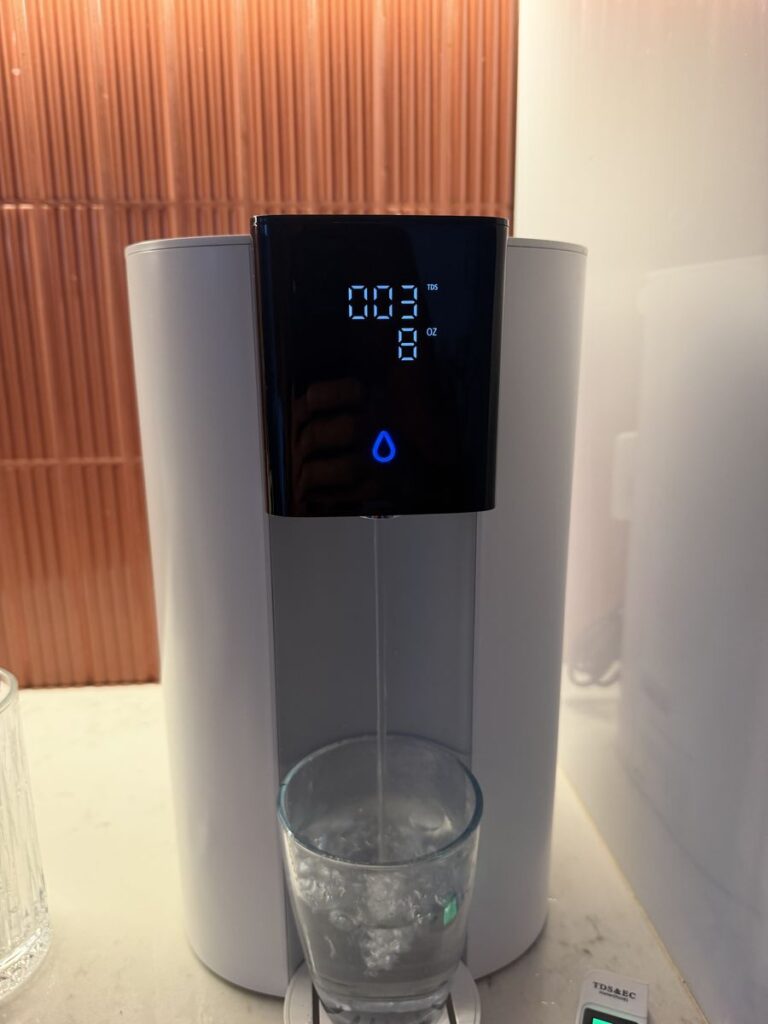
| Waterdrop C1S, its own display | 3 ppm | (different instrument) | Inline sensor reading, not my meter |
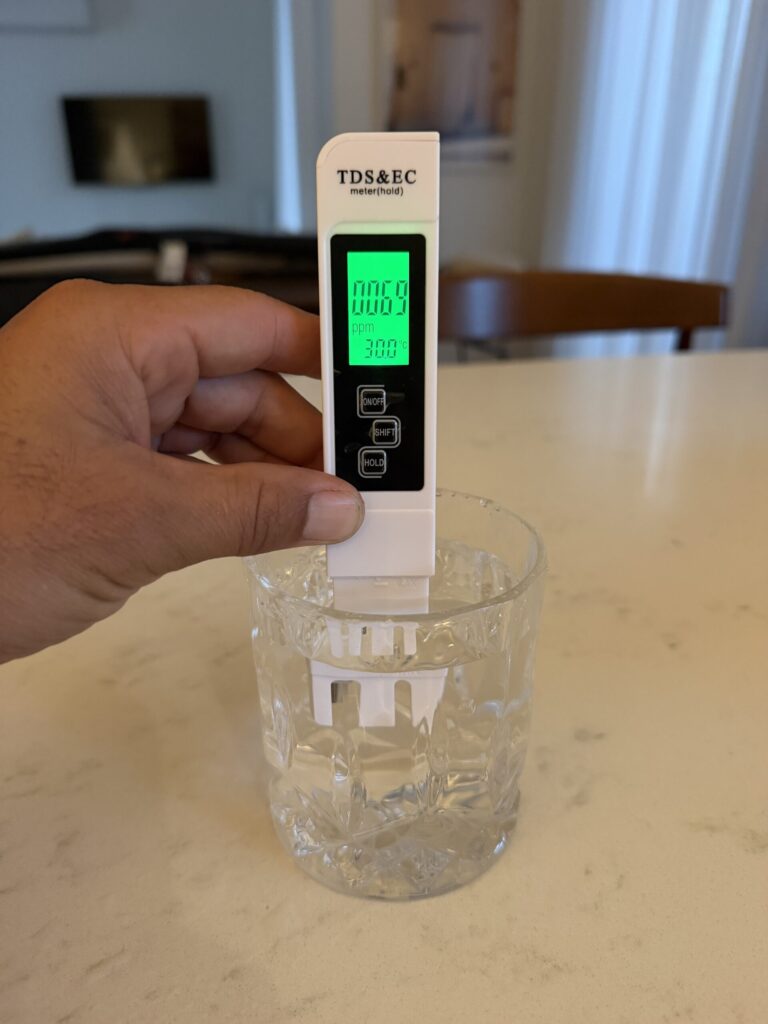
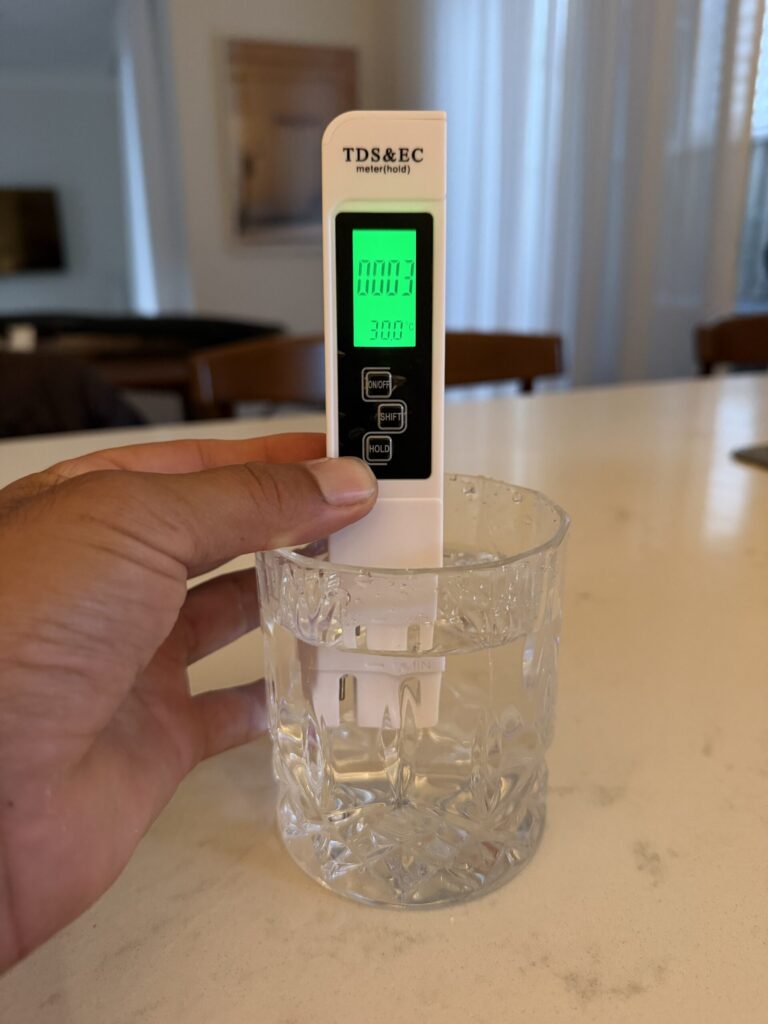
Two things are worth pointing out. First, the C1S’s built-in display said 3 ppm while my pen meter said 7 ppm in the glass. Neither is wrong as such: they are different sensors with different factors and calibration, measuring at different points. The lesson is to compare readings from the same instrument. Second, both RO systems did what RO is supposed to do: they removed about nine-tenths or more of everything dissolved. For more on how, see what a reverse osmosis filter is and how it works.
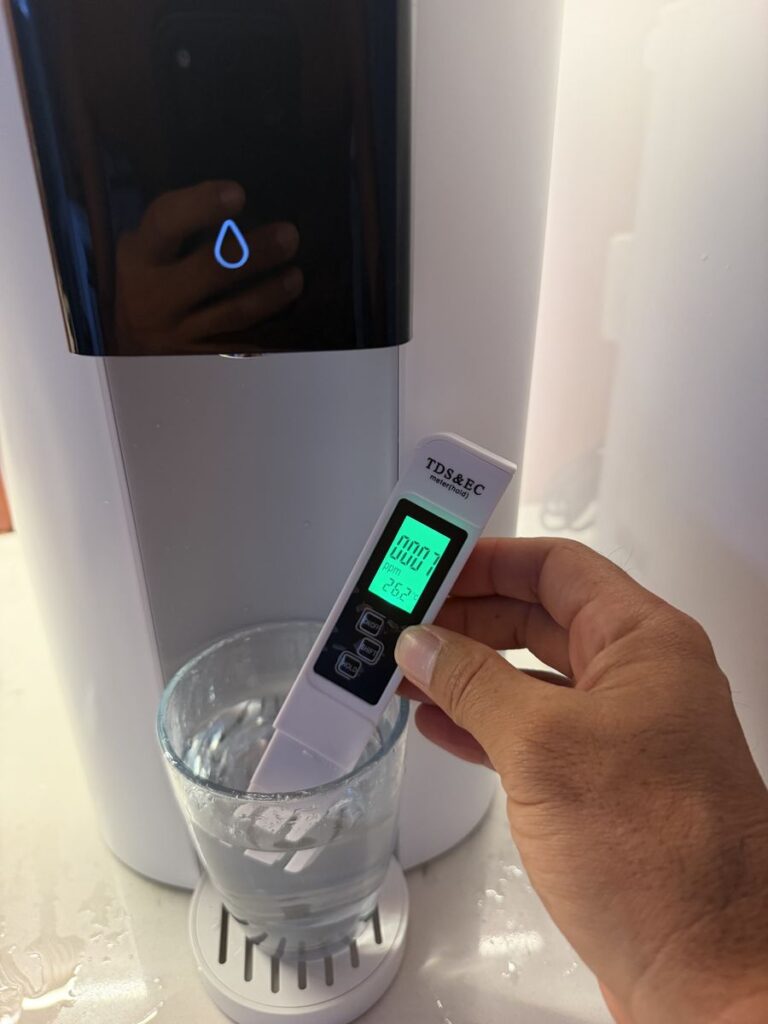
 My reading69 → 7ppm on my meter
Built-in TDS readout (it showed 3 ppm; my meter said 7) | 3:1 pure to drain (Waterdrop) | NSF/ANSI 372 (materials) | Price on Amazon AU
Check the C1S price on Amazon →Amazon AU price: $379.22 · as of 22 Nov 2026, 2:43 am AEST DetailsThe full C1S test, with setup time, flow rate and running costs, is in my Waterdrop C1S review.
What TDS cannot tell you
This is the most important section on the page. A low TDS reading does not mean water is safe, and a high one does not mean it is dangerous. The contaminants most people actually worry about are either too small in amount to register, or are not dissolved ions at all.
| Contaminant | Australian guideline | Can a TDS meter see it? |
|---|---|---|
| Lead | 0.005 mg/L (ADWG, 2025) | No. That is 200 times smaller than a meter’s 1 ppm step |
| PFOS (a PFAS chemical) | 8 nanograms per litre (ADWG, 2025) | No. That is 0.000008 mg/L |
| Fluoride | 1.5 mg/L (ADWG) | No. It is counted, but cannot be told apart from calcium or sodium |
| Bacteria and viruses | None should be detected (E. coli) | No. They are not dissolved ions |
| Chlorine | 5 mg/L health limit (ADWG) | Barely. Too little to move the reading much |
| Pesticides and many organics | Various | Mostly no: low amounts, often non-conductive |
So a TDS meter is a check on your filter, not on your water’s safety. When the reading at an RO tap stays low, the system is still removing dissolved ions, which is a reasonable sign the membrane is working, and a working RO membrane also reduces lead, fluoride and PFAS. One caveat: systems with a deioniser post-filter, like my EcoHero, can hold the reading low for a while as the membrane wears, so follow the maker’s membrane interval as well. That inference only holds for RO. It does not hold for any other kind of filter, and it is never a replacement for a lab test if you have a specific worry, such as old plumbing, a bore, or a PFAS-affected area. The US cooperative extension guidance makes the same point: a TDS test is a general indicator and does not identify individual contaminants.
Check all seven rooms, not just this one
38 checks, 29 free, ranked by impact. Sent as a 32-page PDF.
We'll email you the audit and a short series of practical guides. Unsubscribe in one click, any time. Privacy.
Sent. Taking you to your download...
Which filters lower TDS, and which do not
If you have bought a filter and your TDS meter shows little change, the filter is not necessarily faulty. Most filters are not designed to lower TDS.
| Filter type | Effect on TDS | Why |
|---|---|---|
| Reverse osmosis | Large drop; my uncalibrated TDS-3 readings dropped 90% and 96% | The membrane separates water from dissolved ions |
| Distillation | Near zero | Water is boiled off and condensed; solids stay behind |
| Ion exchange or deionisation (e.g. ZeroWater) | Near zero when new | Resins swap dissolved ions for hydrogen and hydroxide, which form water |
| Activated carbon (jugs, benchtop, under-sink) | Little change | Targets chlorine, taste, odour and some chemicals, not minerals |
| Ceramic and gravity (e.g. Berkey) | Little change | Built for particles, chlorine and some chemicals |
| Water softener | About the same, or slightly higher | Swaps calcium and magnesium for sodium |
| Remineralising cartridge or drops | Goes up | Adds calcium and magnesium back |
| Boiling | Goes up slightly | Water evaporates; solids stay and concentrate |
Remineralisers are worth a word, because people are surprised when a filter raises the reading. That is the cartridge doing its job. If you run RO and prefer more mineral taste, see how to remineralise RO water. If you want the lowest numbers possible, compare water distillers with RO.
 Comes withTDS meterin the box
Ion exchange filter designed to read 000 when new; replace at 006 (ZeroWater) | IAPMO certified to NSF/ANSI 53 for lead, fluoride and total PFAS | Imported by Amazon US | Price on Amazon AU
Check the ZeroWater price on Amazon →Amazon AU price: $55.19 · as of 21 Nov 2026, 11:43 pm AEST DetailsZeroWater is the cheapest way to see a near-zero reading, and it ships with a TDS meter for exactly that reason. The trade-off is cartridge life: ZeroWater’s own guide says to replace the filter when the meter reads 006, and that a cartridge lasts 40 gallons (about 150 litres) or more on water under 50 ppm but 8 gallons (about 30 litres) or less above 400 ppm. On soft water like mine that is workable; on hard water it gets expensive.
Interpret your own TDS readings
Enter your tap and filtered readings to see the reduction and what it suggests. The second tab converts a conductivity reading into TDS with each of the factors used in Australia, so you can see how much the factor alone changes the answer. It is pre-filled with my numbers and Seqwater’s Gold Coast average.
How to test TDS at home
This article contains affiliate links. We may earn a commission at no extra cost to you.
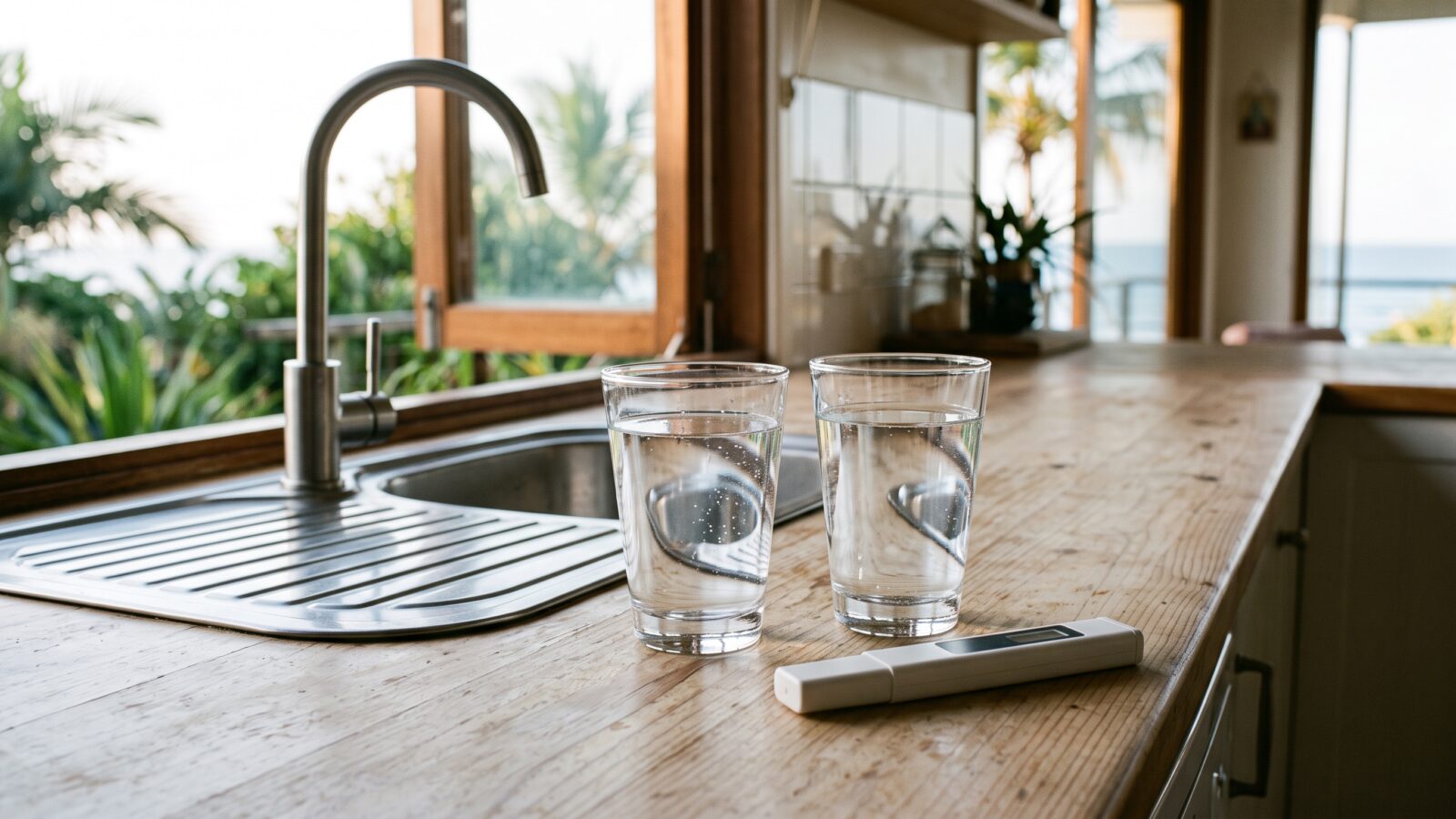
A pen-style meter is inexpensive. I have not compared brands, so I will not recommend one by name; what matters is automatic temperature compensation (ATC), a 1 ppm resolution, and a cap you can rinse. Basic TDS meters on Amazon AU all work the same way. Here is the method I use, which is about consistency more than precision:
- Use clean glasses. Rinse each glass with the water you are about to test, so leftover residue does not add to the reading.
- Run the tap for about 30 seconds. Water that has sat in pipes overnight can read differently from fresh mains water.
- Let the water reach room temperature. Even with ATC, very hot or cold samples are less reliable.
- Dip to the marked line and stir gently. Knock off air bubbles, then wait for the number to stop moving before you read it.
- Rinse the probe between samples. Test the low-TDS water first if you can, so you do not carry minerals across.
- Write it down with the date and temperature. One reading is a snapshot; a logbook is a trend.
If your meter can be calibrated, a calibration solution brings it closer to the truth. Mine is not calibrated, which is why every number on this site is framed as a comparison on the same meter.
Using TDS to know when to change filters
This is where a TDS meter earns its keep, and it only works for filters that lower TDS in the first place: RO, deionisers and ion exchange jugs. The method is simple. Record the tap and filtered readings when the system or cartridge is new. That is your baseline. Recheck every month or two.
For RO, compare the percentage drop rather than the raw number, because your tap water’s TDS moves with the seasons and with the source your utility is drawing on. On my EcoHero, 69 to 3 ppm is a 95.7% drop. If that slid steadily towards 80%, the membrane or post-filter would be due, whatever the calendar said. A sudden jump, on the other hand, usually means something simpler: water that has sat in the system, or a probe that needs a rinse. Waterdrop’s own C1S notes card makes the same point about readings fluctuating after a pause.
For ZeroWater, the maker gives the rule: replace at 006. For carbon filters, TDS is no guide at all; follow the maker’s interval, and watch for chlorine taste coming back.
Is low TDS water bad for you?
RO, distilled and deionised water all read very low, and this is the most common worry I see. The WHO says TDS is not of health concern at the levels found in drinking water, and its drinking water guidelines note that water with extremely low TDS may be unacceptable to consumers because of its flat, insipid taste, and is often corrosive to water supply systems. The corrosion point mainly concerns pipes and fittings, which is why utilities do not deliver near-zero water. For a home RO tap, use the fittings supplied or specified by the maker, installed by a licensed plumber.
The mineral question is mostly about diet. For most people, most dietary calcium and magnesium comes from food rather than water, though very hard water can contribute a share. If you want minerals back for taste, a remineralising cartridge or mineral drops does that; see does reverse osmosis remove minerals. If you have a medical condition that affects what you should drink, ask your doctor rather than a water filter website.
What to do about high TDS
If your water reads over about 500 ppm and tastes salty or bitter, or leaves heavy scale, start by finding out why. On mains water, check your utility’s report: if it agrees with your meter, the water is within the TDS guideline unless it exceeds 600 mg/L, and even then the issue is taste, not safety. On tank or bore water, get a proper lab test, because high TDS there can come with things that do matter, such as nitrate or naturally occurring metals.
For drinking and cooking, reverse osmosis is the practical fix, with distillation as the alternative. RO also works harder on high-TDS water, so expect shorter membrane life. Softeners deal with scale on the whole house but do not lower TDS. Compare under-sink and countertop options in the best reverse osmosis systems in Australia, or the budget options in affordable reverse osmosis filters.
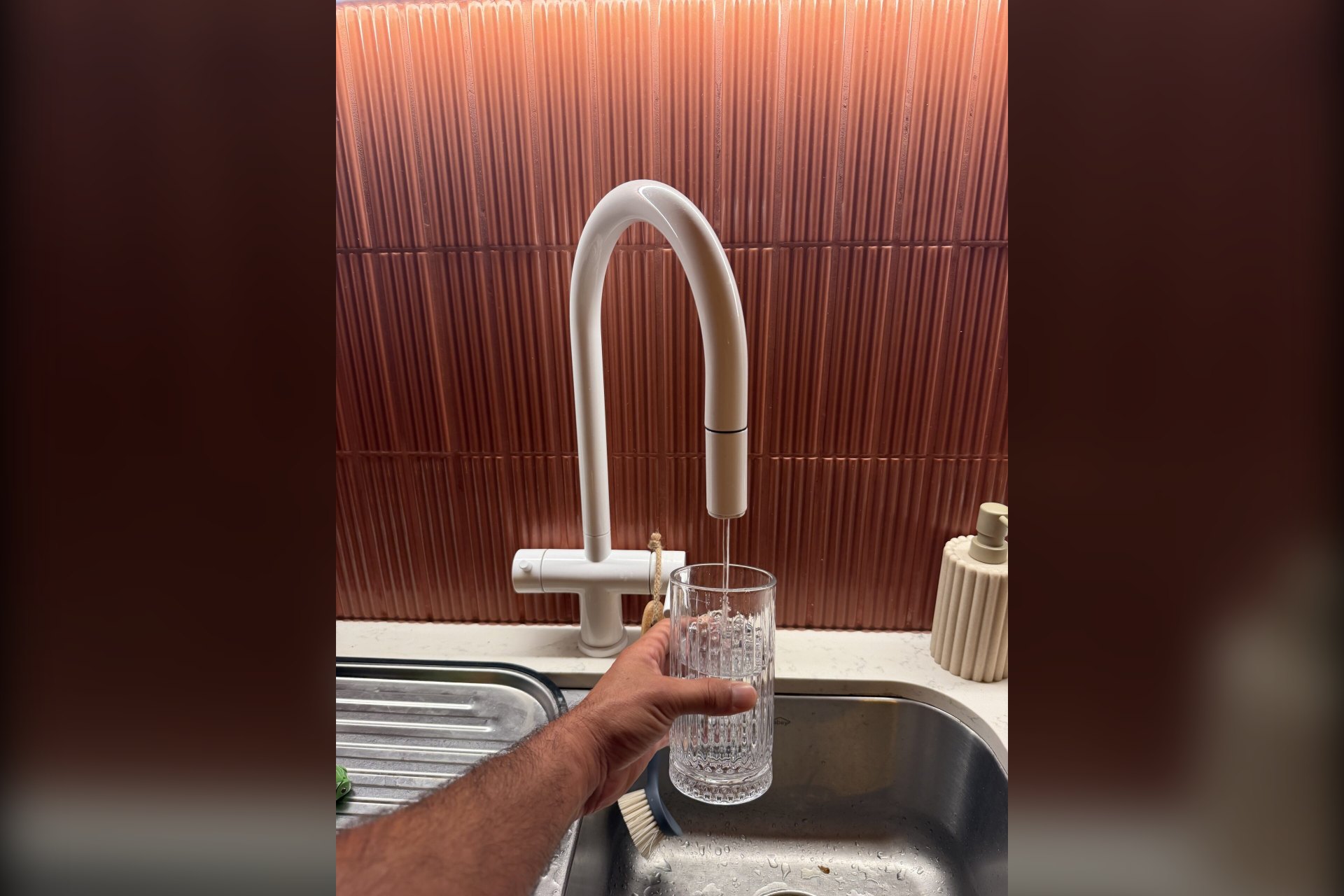 My reading69 → 3ppm on my meter
5 stages incl. RO membrane and deioniser | Listed to AS/NZS 3497 on the national product register | Needs a licensed plumber | from $949 (Pure Water Systems, 8 Nov 2026)
Black Friday alternative: Waterdrop X8 on Amazon AU →Amazon AU price: $611.29 · as of 22 Nov 2026, 2:43 am AEST DetailsFinal verdict
TDS is the total of everything dissolved in your water, mostly harmless minerals, measured in mg/L or ppm. In Australia it is a taste guideline, good up to 600 mg/L, with no health limit. A handheld meter estimates it from electrical conductivity, so treat its number as a comparison tool: excellent for checking that an RO, deioniser or ZeroWater filter is working, useless for detecting lead, PFAS, fluoride or germs.
At my sink, Gold Coast water reads 69 ppm, my under-sink RO 3 ppm, and the Waterdrop C1S 7 ppm. Those numbers tell me both RO systems are doing their job. They tell me nothing about whether my tap water was safe to begin with; Seqwater’s reports do that. If you are choosing a filter, start with what you want removed, then see the best water filters in Australia.
Prices change. Check Amazon AU before buying.
Frequently asked questions
What is TDS in water?
TDS stands for total dissolved solids: the total amount of minerals, salts and other matter dissolved in water, measured in mg/L or ppm. It is mostly calcium, magnesium, sodium, bicarbonate, chloride and sulfate.
What is a good TDS level for drinking water in Australia?
The Australian Drinking Water Guidelines say TDS should not exceed 600 mg/L for good taste. They rate 0 to 600 mg/L as good, 600 to 900 fair, 900 to 1,200 poor and over 1,200 unacceptable. There is no health-based limit.
Is high TDS water dangerous?
Not in itself. TDS is a taste measure, and the WHO does not consider it a health concern at the levels found in drinking water. But a TDS number cannot rule out specific contaminants, so test bore or tank water with a lab if you have concerns.
Does low TDS mean my water is safe?
No. A TDS meter cannot detect lead at its 0.005 mg/L guideline, PFAS at nanogram levels, or bacteria. On a reverse osmosis system, a low reading is good evidence the system is removing dissolved ions, and an RO membrane in good condition also reduces lead, fluoride and PFAS. It does not make water microbiologically safe.
Are TDS meters accurate?
They are consistent, not exact. A meter measures electrical conductivity and multiplies it by a factor, usually between 0.5 and 0.7, so two meters can disagree on the same water. Use one meter to compare before and after.
Is ppm the same as mg/L?
For drinking water, yes: 1 ppm is effectively 1 mg/L.
Do water filters reduce TDS?
Only some. Reverse osmosis, distillation and ion exchange or deionising filters lower it a lot. Carbon, ceramic and most gravity filters barely change it, because they target chlorine, taste and chemicals rather than dissolved minerals.
Is zero TDS water good for you?
For most people it is fine to drink as part of a normal diet, because most dietary calcium and magnesium comes from food. It may taste flat. If you prefer some mineral taste, a remineralising cartridge or drops adds it back. If you have a medical condition, ask your doctor.
- NHMRC ADWG: Total dissolved solids
- NHMRC ADWG: Lead fact sheet (0.005 mg/L, 2025)
- NHMRC: PFAS guideline values (updated 25 June 2025)
- NHMRC ADWG: Fluoride fact sheet
- NHMRC ADWG: Summary of guideline values (chlorine, monochloramine, hardness)
- Seqwater: Gold Coast zone water quality report, September 2026
- Cooperative Extension: what a TDS test does and does not tell you
- World Health Organization: chemical fact sheet, total dissolved solids
- World Health Organization: Guidelines for drinking-water quality, 4th edition incorporating the 1st and 2nd addenda (2022)
- SA Health: salinity and drinking water
- US Geological Survey: conductivity (electrical conductance) and water
- ZeroWater: when to change your ZeroWater filters (006 rule and filter life by TDS)

Former Royal Australian Navy Clearance Diver and TAG-E counter-terrorism operator. Founded Clean and Native to apply the same rigorous thinking to the home environment.
Full biography →The 7-Room Home Audit
Your tap water is one room. The audit covers all seven: 38 checks across water, air and EMF, 29 of them free, ranked by impact against Australian guidelines.
- Morning tap flush: the free lead fix most homes skip
- How to read your utility's water quality report
- Renting or owning: the two reverse osmosis filters I use at home
We'll email you the audit and a short series of practical guides. Unsubscribe in one click, any time. Privacy.
Sent. Taking you to your download...