Best Gravity Water Filter Australia 2026: No Plumbing, No Power, Compared
The best gravity water filter for Australian homes in 2026 is the Zen Water Systems 8-litre ceramic countertop unit — no plumbing, no power, and actually effective at removing sediment, bacteria, and chlorine taste from Australian tap water.
Quick Verdict — Best Gravity Water Filter Australia 2026
| Product | Best For | Verdict |
|---|---|---|
| Zen Water Systems 8L | Home renters, apartment dwellers | Top pick overall — taste + minerals + value |
| LifeStraw Community | Rural, off-grid, tank water users | Best for bacteria + turbidity from tank/dam water |
| Doulton W9361122 Ceramic | Countertop purists, long-term value | Proven ceramic technology, 50+ years in market |
| Brita Marella XL | Entry-level, renters on a tight budget | Taste improvement only — limited filtration depth |
Important — Know Your City’s Disinfection Type
Brisbane, Sydney, Adelaide, and Darwin use chloramine — a disinfectant that standard carbon filters (including Brita) remove at roughly 1/40th the rate of free chlorine. If you are in one of these cities and taste/odour is your concern, you need a filter with catalytic carbon or compressed carbon block — not standard GAC. Gravity filters with standard carbon cartridges will not adequately address chloramine. Only Melbourne, Perth, Hobart, Canberra, Townsville, Cairns, and Toowoomba use free chlorine, where standard carbon works fine for taste.
Why Gravity Filters Still Matter in 2026
You rent. You live off-grid. You travel in a caravan. You want better-tasting water without calling a plumber, drilling under your sink, or paying for electricity to run a pump. That is the gravity filter use case — and it has not been solved by any other technology.
Australia has some of the safest reticulated tap water in the world, regulated under the Australian Drinking Water Guidelines (ADWG) published by the NHMRC. Melbourne Water treats Yarra Valley catchment water before distribution to ensure it meets ADWG standards. Sydney Water runs major infrastructure upgrades including the WRRF diversion projects. The water is safe. The question is whether it tastes the way you want it to, and whether you are bringing other sources — tank water, bore water, dam water — into the picture.
Gravity filters address the most common complaints: chlorine or chloramine taste, sediment, and in rural settings, biological contaminants like bacteria and protozoa. They do it without a single watt of power, without a tap fitting, and without a lease violation. For an estimated 31% of Australian households who rent (ABS 2021 Census data), that matters.
One thing they do not do: remove fluoride. That requires reverse osmosis or activated alumina. Carbon-based gravity filters, including ceramic systems, cannot reduce fluoride. If fluoride removal is your priority, read our guide to the best water filters in Australia covering RO systems.
Australian Water Context: What Your Gravity Filter Actually Faces
Most gravity filter reviews are written for the US market, focused on backpacking and camping. The Australian context is different — and getting it wrong means buying the wrong filter.
If you are on chloramine-treated municipal water — Brisbane, Sydney, Adelaide, Darwin — a standard GAC (granular activated carbon) gravity filter cartridge removes chloramine at approximately 1/40th the rate it removes free chlorine. That is not a rounding error. That is a fundamental chemistry limitation. The Brita Marella, for example, uses standard GAC. In Melbourne (free chlorine), it improves taste meaningfully. In Brisbane (chloramine), it does almost nothing for the disinfectant taste. The Zen Water Systems unit uses a ceramic plus mineral cartridge system with a carbon stage — the specific carbon type matters, and Zen Water’s carbon stage uses compressed carbon block which performs better than granular carbon, though it is still not catalytic carbon rated for chloramine. If chloramine removal is critical, a benchtop RO unit is the right tool. See our benchtop water filter Australia guide for RO options requiring no installation. If coffee or espresso is your primary use, our coffee water filter guide covers catalytic carbon options that remove chloramine while retaining the minerals espresso extraction needs.
If you are on tank or dam water — common in rural Queensland, NSW, Victoria, and WA — the risk profile is completely different. Bacteria (E. coli, Campylobacter), protozoa (Giardia, Cryptosporidium), and sediment are your primary concerns. Taste is secondary. For this use case, the LifeStraw Community with its hollow fibre membrane is the right tool — it is rated to remove 99.9999% of bacteria and 99.999% of protozoa without power or chemicals. This is the filter that matters when the water source itself is not pre-treated.
Water hardness by city
Perth households face the hardest tap water in Australia at approximately 180 mg/L CaCO3. Adelaide comes in at around 140 mg/L. Brisbane sits at 80-120 mg/L. Melbourne is very soft at roughly 25 mg/L CaCO3 (TDS approximately 60 mg/L). Gravity filters with mineral stages (like the Zen Water) add minerals back into soft Melbourne water, which can actually improve taste. For hard-water cities like Perth and Adelaide, the mineral stage is less useful and scale may build up in the lower reservoir faster.
Fluoride
Most Australian reticulated water is fluoridated at approximately 0.7-1.0 mg/L, consistent with ADWG 2022 guidance. No gravity filter — ceramic, carbon, or mineral — removes fluoride. If this is your concern, only reverse osmosis (90-97% removal) or activated alumina (80-95%) achieves meaningful reduction. Do not buy a gravity filter expecting fluoride removal.
1. Waters Co BIO 500 MAX 7L — Best Overall Gravity Filter Australia

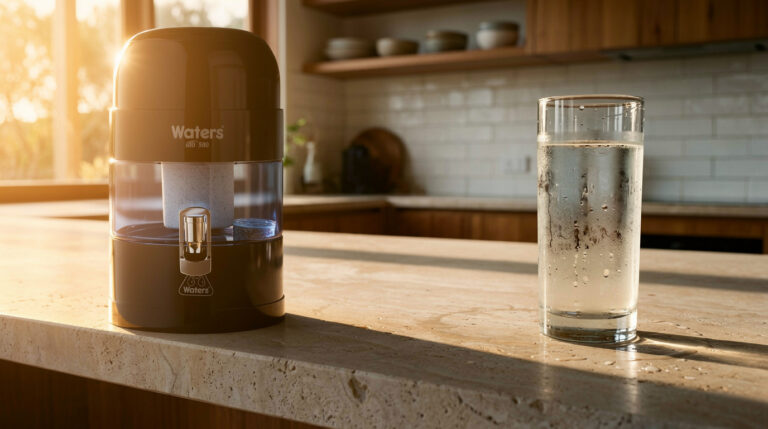
The Waters Co BIO 500 MAX is the gravity filter I recommend for most Australian households. It is an Australian brand with a 4.9/5 rating from over 300 customer reviews (brand-listed), and it delivers 13-stage mineralisation — meaning the output water contains beneficial calcium, magnesium, and trace minerals rather than the flat, demineralised water produced by RO systems. The 7-litre capacity handles a family’s daily drinking water needs without constant refilling. No plumbing, no electricity, no waste water stream.
The filtration stack works by gravity: water passes through a pre-filter, activated carbon, and a ceramic + mineralising media. The ceramic stage handles bacteria and turbidity; the carbon handles chlorine, chloramine (at reduced efficiency — see the note below on chloramine cities), and VOCs; the mineralising stage adds back a controlled dose of alkaline minerals. The result is clean, mineral-rich water with a neutral to slightly alkaline pH — comparable to what you would pay for in premium bottled water, produced at your kitchen bench for cents per litre.
Chloramine city note: Gravity carbon filters remove chloramine at approximately 1/40th the rate of free chlorine. If you are in Brisbane, Sydney, or Adelaide (all chloramine cities), a gravity filter will reduce but not eliminate chloramine. For these cities, pair the Waters Co unit with a Waterdrop inline pre-filter or, for complete removal, use an under-sink RO system for drinking water instead. In Melbourne, Hobart, and Perth — free chlorine cities — a gravity filter is fully effective.
Waters Co BIO 500 MAX 7L — Pros and Cons
Pros
- No plumbing or electricity required
- 13-stage mineralisation — adds calcium, magnesium, trace minerals
- 4.9/5 from 300+ verified AU reviews
- Australian brand with local support
- 7L capacity handles family daily use
Cons
- Does NOT remove fluoride (carbon + ceramic only — RO required for fluoride)
- Reduced chloramine removal efficiency — not ideal for Brisbane/Sydney/Adelaide without pre-treatment
- Slow flow rate compared to RO systems
Buy if: you want clean, mineralised drinking water with no plumbing, no electricity, and no installation — and you live in a free-chlorine city (Melbourne, Perth, Hobart) or are comfortable with partial chloramine reduction. Check price at Waters Co →
2. Zen Water Systems 8-Litre Gravity Filter

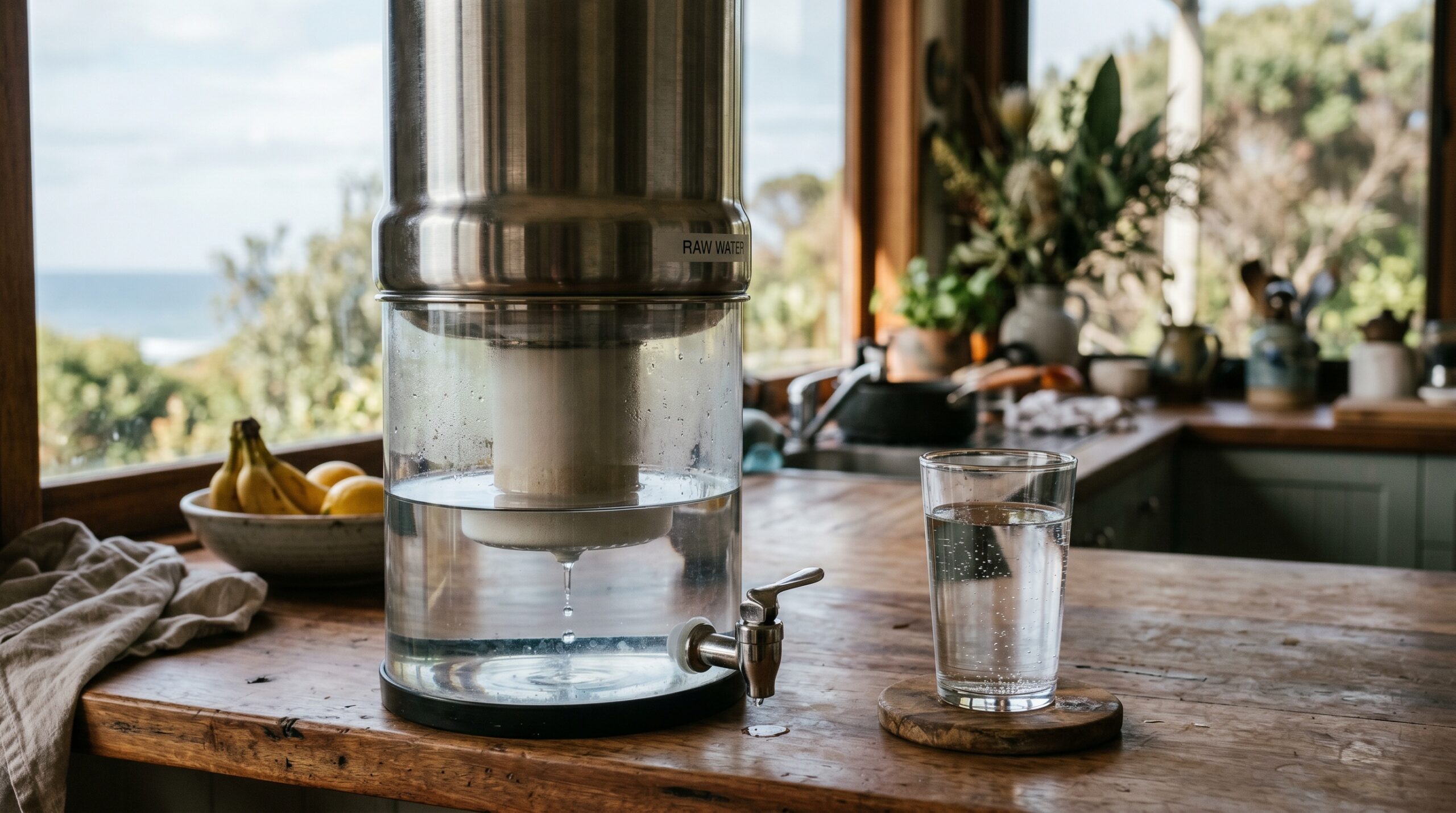
The Zen Water Systems unit is the most commonly cited gravity filter for Australian home use, and with good reason. The 8-litre configuration gives you two polished stainless steel chambers — top chamber holds unfiltered water, bottom chamber collects filtered water — with a spigot for dispensing. No power. No plumbing. Sits on a bench or inside a fridge.
The five-stage filtration process works from top to bottom: a ceramic dome filter rated to 0.2-0.5 microns (removes sediment, rust, and bacteria including E. coli and Cryptosporidium), followed by an activated carbon stage for taste and chlorine/minor VOC reduction, then mineral stages using magnetic energy stones, mineral balls, and far-infrared stones that raise pH slightly and add trace minerals. The ceramic dome is the structural filtration workhorse — the mineral stages are a wellness add-on that is popular but not independently certified to any NSF/ANSI standard.
Flow rate
Approximately 2.5-4 litres per hour under normal conditions. For a two-person household drinking 2 litres per day, a single overnight fill is adequate. For families, you will be refilling twice daily. This is the core gravity filter trade-off — slow throughput in exchange for zero power consumption.
Chloramine cities warning
Brisbane, Sydney, Adelaide, and Darwin households should not rely on the Zen Water carbon stage for chloramine removal. The carbon stage improves taste and removes free chlorine effectively, but chloramine requires catalytic carbon or RO. Use this unit for the ceramic filtration benefit (bacteria, protozoa, sediment) and accept that the chloramine taste improvement will be partial at best.
Maintenance
The ceramic dome is cleanable by scrubbing under running water when flow rate drops — typically every 2-4 weeks with daily use. Full replacement ceramic domes cost approximately $25-35 on Amazon AU. The carbon cartridge inside needs replacement every 6-12 months depending on usage. Annual filter costs run approximately $50-80 AUD all-in.
Stainless steel housing
The 304-grade stainless steel housing is non-reactive and does not leach plasticisers or BPA. This is a material advantage over plastic pitcher filters, particularly for long-contact-time gravity filtration where water sits in the lower chamber for hours.
What it does not do
Will not remove fluoride. Will not meaningfully address chloramine for full taste improvement. The mineral stage is not certified to any standard — treat it as a bonus, not a core specification.
3. LifeStraw Community High-Volume Gravity Filter

If you are sourcing water from a tank, dam, bore, or rainwater collection in rural Queensland, NSW, Victoria, or WA, the LifeStraw Community is a different category of product to everything else on this list. It is not a taste filter. It is a purification system.
The hollow fibre membrane technology operates at 0.02 microns — small enough to physically block bacteria and protozoa without chemicals or power. Independent testing confirms 99.9999% (log 6) reduction of bacteria and 99.999% (log 5) reduction of protozoa. These are the same performance standards required by WHO drinking water guidelines for emergency response and the NSF/ANSI P231 microbiological purifier standard. This is not a marketing claim — it is a measurable, verified outcome.
Capacity
The Community model holds 12 litres in the upper reservoir. It can process up to 70,000 litres over the product’s lifespan before membrane replacement, with flow rates of approximately 9-12 litres per hour — far faster than ceramic gravity systems. For a rural household of 4-6 people, the throughput is practical as a primary or backup water supply.
Turbidity handling
LifeStraw recommends that source water turbidity should be below 10 NTU for optimal membrane performance. For highly turbid dam water or flood-affected tank water, pre-filtration through a sediment cloth is advisable. The membrane can handle low-turbidity tank water directly.
What it does not address
Chemical contaminants, heavy metals, chloramine, and fluoride are not removed by hollow fibre membranes. If your rural water supply has chemical contamination (agricultural runoff, PFAS from nearby military or firefighting operations — a documented issue near Williamtown NSW, Oakey QLD, and multiple WA RAAF bases according to DCCEEW’s national contamination register), the LifeStraw Community alone is not sufficient. Pair it with an activated carbon stage for chemical contamination concerns.
Emergency preparedness
The LifeStraw Community is a legitimate emergency water supply tool for Australians in flood and cyclone zones (far north Queensland, coastal NSW, northern WA). When reticulated water supply fails, the ability to safely process rainwater or stored tank water without power is a genuine safety asset.
4. Doulton Ceramic Gravity Filter

Doulton has been making ceramic water filters since 1827. The Supersterasyl filter candle — used in their gravity systems — is rated to 0.9 microns absolute filtration, meaning particles of that size and above are mechanically excluded. This includes bacteria (E. coli, Salmonella) and Cryptosporidium oocysts (4-6 microns), though the rating is tighter than some competitors claim for their cheaper ceramics. The carbon core inside the candle handles taste, odour, and chlorine.
Heritage and certification
Doulton ceramic elements are tested to NSF/ANSI 42 (aesthetic effects) and NSF/ANSI 53 (health effects — cysts, turbidity). The Supersterasyl variant carries additional testing for bacteria reduction. These are independently certified claims, not manufacturer-only assertions.
Australian availability
Doulton products are stocked by Australian water filter specialists including Water Filters Australia and Limetless Water, and are available through Amazon AU in some configurations. Replacement candles (the consumable part) cost approximately $40-60 AUD each, with recommended replacement at 6-12 months or 2,000 litres, whichever comes first.
Housing options
Doulton sells filter candles separately for use with your own container — a popular approach in Australia where people place the candle in a food-grade plastic or stainless bucket. Complete gravity filter housing systems (upper and lower polypropylene containers) are also available. If you are concerned about plastic leaching, opt for a stainless steel housing or the Doulton units that come with a stainless configuration.
The honest trade-off
The Doulton is slower than the Zen Water Systems unit. Flow rate through a single candle is approximately 1-2 litres per hour — adequate for a one or two person household, slow for a family of four. Adding a second candle to the upper chamber doubles throughput. For Melbourne households on soft, free-chlorine-treated water, the Doulton with its ceramic plus carbon candle is arguably the cleanest technical choice for bacteria removal and taste improvement combined.
5. Brita Marella XL Jug Filter

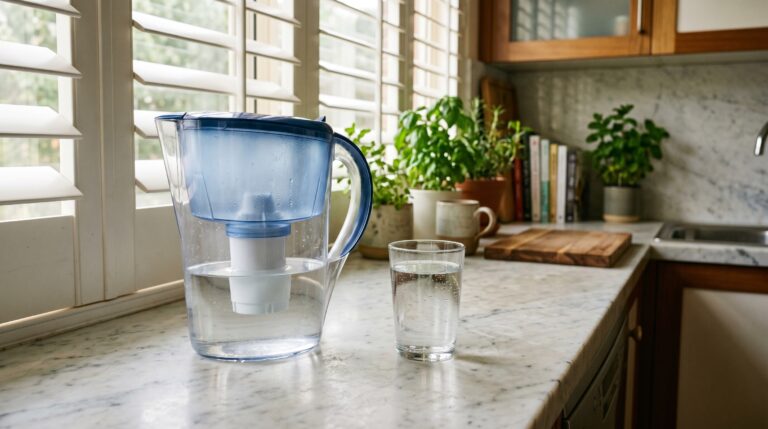
The Brita Marella is what most Australians picture when they think of a water filter. It is cheap, available everywhere, and does improve the taste of tap water — under specific conditions.
In Melbourne, Hobart, and Canberra (free chlorine), the Brita MAXTRA+ cartridge works as advertised. The standard GAC adsorbs free chlorine efficiently, reducing taste and odour. Brita’s own testing reports approximately 80% reduction of free chlorine through the MAXTRA+ cartridge under standard test conditions. For Melbourne households on soft, low-TDS water, a Brita jug is a defensible first-step filter for taste improvement.
In Brisbane, Sydney, Adelaide, and Darwin (chloramine), the Brita provides minimal benefit for the disinfectant taste. Standard GAC removes chloramine at approximately 1/40th the rate of free chlorine — this is an established chemistry fact, not a Brita-specific failure. If you are in a chloramine city and taste is your primary concern, the Brita is the wrong tool.
What the Brita does not do
It does not remove bacteria, protozoa, fluoride, heavy metals, or chloramine at meaningful rates. The filter cartridge costs approximately $8-12 per replacement (MAXTRA+ 3-pack available on Amazon AU), with recommended replacement every 4 weeks or 150 litres. Annual cost runs $100-150 in cartridges alone — more expensive per litre than the ceramic systems above when you account for volume and longevity.
Plastic housing consideration
The Brita jug is polypropylene (#5 plastic), which is considered food-safe and does not leach BPA. However, water sits in contact with the plastic housing for extended periods during gravity filtration. If you are filtering for extended periods daily, a stainless steel housing (Zen Water, Doulton stainless) eliminates any residual plastic contact concern.
What Gravity Filters Remove — and What They Don’t
Every gravity filter marketed in Australia makes removal claims. Here is what the evidence actually supports, broken down by filter type:
| Contaminant | Ceramic (0.2-0.9 micron) | Carbon GAC | Hollow Fibre (0.02 micron) | Mineral Stage |
|---|---|---|---|---|
| Sediment / turbidity | ✓ Effective | Partial | ✓ Effective | None |
| Bacteria (E. coli) | ✓ Effective (0.2µm) | None | ✓ 99.9999% | None |
| Giardia / Cryptosporidium | ✓ Effective | None | ✓ 99.999% | None |
| Free chlorine (taste) | Partial (carbon core) | ✓ Effective | Partial (carbon add-on) | None |
| Chloramine (Brisbane/Sydney/Adelaide) | ⚠ Very poor | ⚠ Very poor (1/40th rate) | ⚠ Poor (membrane only) | None |
| Fluoride | ✗ No removal | ✗ No removal | ✗ No removal | ✗ No removal |
| Heavy metals (lead, arsenic) | Partial (silver-impregnated) | Partial (varies) | None | None |
| VOCs / taste compounds | Partial (carbon core) | ✓ Effective | None | None |
| PFAS / PFOA | ✗ No removal | ✗ No removal | ✗ No removal | ✗ No removal |
The PFAS entry deserves direct comment. PFAS contamination has been confirmed at 700+ sites across Australia according to the DCCEEW national register, with significant contamination documented near RAAF Base Williamtown (NSW), RAAF Base Tindal (NT), RAAF Base Oakey (QLD), and multiple VIC and WA sites. If you are sourcing water from a potentially affected area, no gravity filter addresses PFAS. Reverse osmosis (90-96% removal per NSF/ANSI P473) is the technology you need. See our guide on the best water filters for Australian homes covering PFAS removal specifically.
5-Year Running Cost Comparison
Price on the shelf is not the actual cost of a gravity filter. The ongoing cartridge replacement cost determines which system is cheapest over time.
| Filter System | Upfront Cost (AUD est.) | Annual Filter Cost (AUD) | 5-Year Total (AUD) | Cost Per Litre (est.) |
|---|---|---|---|---|
| Zen Water Systems 8L | ~$120-150 | ~$50-80 | ~$370-550 | ~$0.10-0.15/L |
| LifeStraw Community | ~$180-220 | ~$30-50 (membrane every 2yr) | ~$300-420 | ~$0.004/L (high volume) |
| Doulton Ceramic | ~$100-160 | ~$50-70 | ~$350-510 | ~$0.12-0.17/L |
| Brita Marella XL | ~$40-60 | ~$100-150 (monthly cartridges) | ~$540-810 | ~$0.40-0.60/L |
| Bottled water (2L bottles, Coles) | $0 | ~$730-1,000 | ~$3,650-5,000 | ~$1.00-1.50/L |
Assumptions: 4L/day household consumption, AUD pricing. Filter costs based on manufacturer replacement schedules. Bottled water at Coles standard pricing ($1.50-2.00 per 2L). Estimates — actual costs vary by supplier and usage.
The Brita looks cheap on the shelf at $40-60. Over five years, it is the most expensive option on this list — and provides the least filtration depth. The anchoring effect of that $40 price tag is powerful, but the cartridge treadmill makes it uncompetitive. The Zen Water ceramic system costs more upfront and less annually, ending up cheaper over any period beyond 18 months.
Against bottled water — $1.00-1.50 per litre at retail — even the most expensive gravity filter system is a fraction of the cost. The Zen Water at $0.10-0.15/L versus $1.00-1.50/L for bottled water means the unit pays for itself in under 3 months for a 4-litre-per-day household.
Who Should Buy a Gravity Filter — and Who Shouldn’t
✓ Who This Is For
- Renters who cannot modify plumbing or install under-sink systems
- Caravan, motorhome, and boat owners needing a power-free option
- Rural and off-grid households on tank, bore, or dam water (use LifeStraw Community for bacteria)
- Emergency preparedness — gravity filters work when power and mains water fail
- Melbourne, Hobart, and Canberra households wanting better-tasting free-chlorine water without installation
- Budget-conscious households who want to stop buying bottled water
✗ Who It Is Not For
- Anyone in Brisbane, Sydney, Adelaide, or Darwin primarily wanting to remove chloramine taste — standard carbon gravity filters will not solve this adequately
- Anyone wanting fluoride removal — only RO or activated alumina achieves this; see our water filtration guide for RO options
- Households in PFAS-affected areas near military bases or fire training sites — gravity filters do not remove PFAS
- Families of 4+ who need high flow rates — slow gravity throughput becomes a daily friction point
- Anyone with confirmed chemical contamination (heavy metals, nitrates, pesticides) needing certified NSF/ANSI 58 removal
Flow Rate vs Filtration Depth — The Core Trade-Off
Every gravity filter makes a trade-off between flow rate and filtration depth. The tighter the pore size, the slower the water moves through. This is physics, not a product flaw.
A 0.02-micron hollow fibre membrane (LifeStraw Community) blocks more than a 0.9-micron ceramic candle (Doulton), but the Doulton’s 0.9-micron rating still physically excludes all bacteria. The practical question is how many litres per hour you need.
For a two-person household drinking 2 litres per day, even the slowest ceramic system (1-2 litres per hour) fills the lower chamber overnight with a single batch fill. For a family of four or five needing 6-8 litres daily, you need either a high-capacity system (LifeStraw Community at 9-12 L/hr) or a discipline of refilling the upper chamber twice daily.
Practical flow rate reference
– Brita Marella (standard GAC): approximately 5-7 litres per hour — fastest, least filtration – Zen Water Systems 8L (ceramic + carbon): approximately 2.5-4 litres per hour – Doulton single candle (ceramic + carbon): approximately 1-2 litres per hour — slowest, most bacteria filtration – LifeStraw Community (hollow fibre): approximately 9-12 litres per hour — fastest with genuine purification
If slow flow is your primary frustration with a gravity filter, the Brita solves it — but you are sacrificing filtration depth significantly. The LifeStraw Community solves both speed and depth for bacterial removal, but does not address taste or chloramine.
Maintenance: What It Actually Takes to Keep a Gravity Filter Working
The maintenance failure mode for gravity filters is predictable and avoidable. Most people buy the unit, use it for 3-6 months, then stop when the flow rate drops to a trickle and never clean the ceramic. The filter does not fail — it becomes biologically unsafe due to neglect.
Ceramic cleaning protocol
When flow rate drops by 50% or more, remove the upper ceramic dome or candle. Scrub the exterior surface under running cold water with a clean soft brush or scotch-brite pad. Do not use soap, detergent, or boiling water — these can crack or contaminate the ceramic. You are physically removing the accumulated sediment and biofilm from the outer surface. Flow rate should return to near-original after cleaning. Most ceramic elements need cleaning every 2-4 weeks with daily use.
Replacement triggers for ceramic
Replace the ceramic element if it cracks (a cracked ceramic provides no bacterial filtration — water bypasses the element entirely). Replace if cleaning no longer restores flow to acceptable levels. Replace based on manufacturer lifespan guidance — typically 1-2 years or 2,000-5,000 litres depending on the specific element.
Carbon stage replacement
The carbon stage inside most ceramic gravity filters loses adsorption capacity well before the ceramic needs replacing. Carbon is exhausted, not clogged — you cannot clean it back into function. Replace per manufacturer schedule (typically every 6-12 months) regardless of whether flow rate has dropped.
Hollow fibre membranes (LifeStraw)
Clean the membrane by backflushing according to the LifeStraw maintenance guide. The membrane has a 70,000-litre rated lifespan. For a family using 10 litres per day from the filter, that is approximately 19 years of capacity. In practice, sediment loading shortens this in turbid tank water environments.
Lower chamber hygiene
Gravity filter lower chambers collect filtered water but can grow biofilm if left sitting for days without use. Empty, rinse, and dry the lower chamber weekly if usage is intermittent. A small amount of food-safe white vinegar (1:10 dilution) removes mineral scale without chemical contamination.
Environmental note on plastic cartridges
Brita MAXTRA+ cartridges are made from mixed plastics and zeolite that are not standard kerbside recyclable in most Australian councils. Brita Australia runs a free recycling programme through TerraCycle — drop-off points are listed on the Brita Australia website. Ceramic elements from Zen Water and Doulton are largely inert and can be disposed of in general waste, though checking with your local council is advisable.
Decision Tree: Which Gravity Filter Should You Buy?
Answer 3 questions to find your filter:
1. What is your water source?
→ Municipal tap water (any Australian city) — go to question 2
→ Tank, bore, dam, or rainwater — buy the LifeStraw Community. Biological risk requires hollow fibre membrane, not ceramic or carbon.
2. Which city are you in?
→ Melbourne, Perth, Hobart, Canberra, Townsville, Cairns, Toowoomba (free chlorine) — go to question 3. Carbon gravity filters work well for you.
→ Brisbane, Sydney, Adelaide, Darwin (chloramine) — a ceramic gravity filter (Zen Water, Doulton) will help with bacteria and sediment but will NOT adequately address the disinfectant taste. If chloramine taste removal is your goal, you need a benchtop RO unit.
3. What is your household size?
→ 1-2 people — Doulton ceramic candle (slower, excellent bacteria removal, long-term value)
→ 2-4 people — Zen Water Systems 8L (better throughput, ceramic + minerals, stainless steel)
→ Budget-first, free chlorine city only — Brita Marella XL (taste improvement, widely available, cheapest upfront)
Final Verdict
The best gravity water filter for most Australian households in 2026 is the Zen Water Systems 8-litre ceramic countertop unit. It handles bacteria, protozoa, and sediment at 0.2-0.5 microns, provides meaningful taste improvement in free-chlorine cities, and costs a fraction of bottled water over any period beyond the first few months. The stainless steel housing eliminates plastic contact concerns. Annual maintenance is simple and inexpensive.
For rural Queensland, NSW, WA, or NT households on tank, bore, or dam water, the LifeStraw Community is the correct choice — not because it is a better gravity filter, but because it is the right tool for the actual problem. Hollow fibre membrane at 0.02 microns with 99.9999% bacterial removal is what unregulated water sources require.
If you are in Brisbane, Sydney, Adelaide, or Darwin and chloramine taste is your primary driver: no gravity filter on this list will fully solve it. The chemistry does not work. Your best no-plumbing option is a benchtop countertop reverse osmosis unit — see our benchtop water filter guide for those options.
The Brita Marella is fine for Melbourne and Hobart renters wanting marginal taste improvement on a very limited budget. It is the wrong product for chloramine cities and an expensive choice when measured over a three-year horizon.
Last reviewed: May 2026 — Clean and Native
Ready to choose your gravity filter?
The Zen Water Systems 8L is the top pick for Australian home use — no plumbing, no power, ceramic filtration to 0.2 microns, and stainless steel housing. For rural and tank water, the LifeStraw Community provides verified biological purification at 0.02 microns.
Frequently Asked Questions
No. Gravity filters — including ceramic, carbon, and hollow fibre membrane types — cannot remove fluoride. Fluoride requires reverse osmosis (90-97% removal) or activated alumina (80-95%). If fluoride removal is your priority, a gravity filter is not the right technology.
Not adequately. Brisbane, Sydney, Adelaide, and Darwin use chloramine as the primary disinfectant. Standard carbon gravity filters (including Brita) remove chloramine at roughly 1/40th the rate they remove free chlorine. Catalytic carbon or reverse osmosis is required for meaningful chloramine reduction. Ceramic-stage gravity filters help with bacteria and sediment but will not solve chloramine taste.
A gravity filter with a hollow fibre membrane rated to 0.02 microns (such as the LifeStraw Community) removes 99.9999% of bacteria and 99.999% of protozoa from tank water. Ceramic ceramic-only filters also provide significant bacterial reduction at 0.2-0.9 microns. However, gravity filters do not remove chemical contaminants, heavy metals, or PFAS that may be present in some tank water catchments. Have your tank water tested if you have concerns beyond biological contamination.
Scrub the ceramic exterior under cold running water (no soap) every 2-4 weeks with daily use, or whenever flow rate drops noticeably. This removes accumulated sediment and restores throughput. Replace the ceramic element if it cracks, or per the manufacturer’s lifespan guidance (typically every 1-2 years or 2,000-5,000 litres depending on the unit).
Yes. Gravity filters are well-suited to caravans and motorhomes — they require no power, no plumbing connection, and no pump. The Zen Water Systems 8L fits on a standard bench. For campsite water of uncertain quality, a LifeStraw Community or similar hollow fibre unit provides biological purification. For caravan parks on municipal water (free chlorine cities), a ceramic gravity filter is adequate for taste improvement.
A gravity filter uses gravity alone to pass water through a ceramic, carbon, or hollow fibre element — no power or pressure required. Reverse osmosis uses a pump to force water through a semi-permeable membrane, removing a wider range of contaminants including fluoride, PFAS, heavy metals, and chloramine. RO wastes some water (typically 2-4 litres per litre produced) and requires either plumbing or a countertop pump unit. Gravity filters are simpler, cheaper, and require no installation, but cannot match RO’s contaminant removal range.
For Melbourne, Hobart, and Canberra households (free chlorine cities), the Brita Marella provides genuine taste improvement at low upfront cost. For Brisbane, Sydney, Adelaide, and Darwin (chloramine cities), the standard GAC cartridge provides minimal benefit for the disinfectant taste. Over a three-year horizon, the Brita’s cartridge cost ($100-150/year) makes it more expensive than ceramic gravity systems that provide better filtration.
Ceramic and carbon gravity filters produce minor TDS reductions (sediment and some mineral exchange) but are not designed for significant TDS reduction. Reverse osmosis reduces TDS by 90-97%. If TDS reduction is your goal, a gravity filter alone is not sufficient — you need RO.
Get the Australian Home Environment Checklist
30 checks across water, air and EMF. Most of them free. Ranked by impact.
No spam. Unsubscribe any time.

Former Royal Australian Navy Clearance Diver and TAG-E counter-terrorism operator. Founded Clean and Native to apply the same rigorous thinking to the home environment.
Full biography →